Travel Thru History

Historical and cultural travel experiences

  • Home
  • Airfare Deals
  • Get Travel Insurance
  • Writers Guidelines

May Days in Moscow

victory day moscow

by Angela Lapham

I predict May might be a good time to visit Moscow. Not too touristy, not too cold and…

1 May is May Day. International Workers’ Day was a big deal in Soviet Russia. Would it be in today’s Russia?

&

9 May is Victory Day, the day Germany surrendered to the Allies in WWII. Moscow holds a huge military parade in commemoration.

May Day

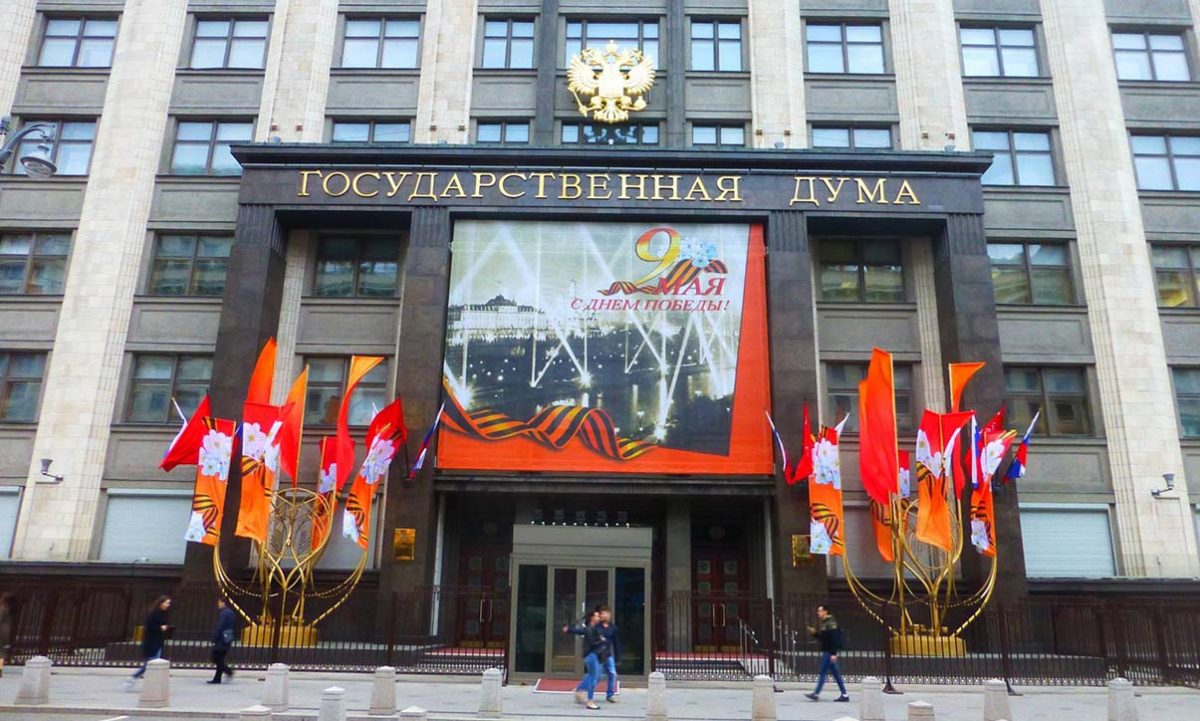
As soon as we arrive, we see Victory Day decorations all over the city. Whether anything is planned for May Day, however, remains a mystery. We knew there were big parades in Communist times, but all we can find about the upcoming May Day is an online reference to the parade that took place two years prior. This mentions a midday start. What could we do but head for Red Square and hope for the best?

Oh no! Loads of people are walking away from the city waving Russian flags. Have we missed it?

No one appears to be dismantling the fence barrier though. In fact, people, including police, are standing alongside it. Is more planned?

The crowd keeps growing.

An hour later we’re glad we stuck around.

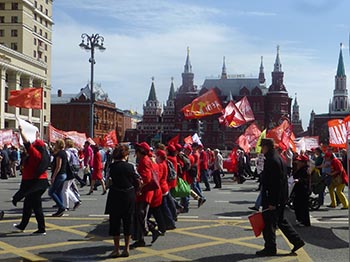
 The parade isn’t inside Red Square but in front of it. Nevertheless, just like the Soviet-era, it’s big, red, and full of Lenin and hammer & sickle flags. Marchers are all ages, though predominantly older – presumably carrying the tradition on from their youth.

Moscow Mayday ParadeWhat’s new is that they also clutch banners calling for revolution and an end to government corruption. Some get so passionate they come right up to the fence we’re standing behind to vocalize their demands. I’m comforted to see the police tolerating it all.

The parade concludes with marchers and onlookers gathering in front of a temporary stage, fittingly parked beside Karl Marx’s statue – now a platform for roaring speeches and the Communist anthem ‘The Internationale.’ There’s even an operatically-trained choir to lead.

Moscow parade crowdOn the ground lie blankets from which the more enterprising communists hawk antique Soviet-era brooches, illustrated children’s books on Lenin, and other reasonably priced, authentic souvenirs. Curious to see how the day had been covered on the news, that night we watch ‘Russia Today,’ the Russian international news channel. We discover that the crowd we’d seen leaving the city that morning had also been at a May Day parade: a pro-government, nationalist celebration of workers’ rights at Red Square. Notably, the first May Day parade held at Red Square since 1992 took place in 2014 – the year Russia took over Crimea. Likewise, it wasn’t until 1996 that the Victory Day parade came to be held annually, and 2008 that it included military vehicles. Before then, Victory Day parades only occurred in 1965, 1985 and 1990.

Victory Day
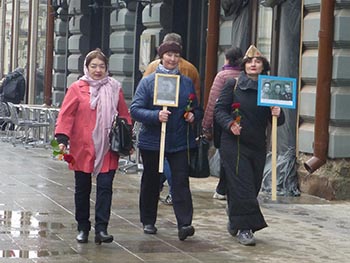
Moscow parade goersIf Putin’s aim was to bring people together under what was arguably Russia’s greatest achievement – the winning of WWII for the allies – it worked! Millions are out. Many are wearing military fashions and the orange and black striped St Georges ribbon, which in 1769 became the highest military decoration of Imperial Russia. They carry red carnations to give out to veterans and lay at memorials, as well as these great professionally made signs displaying photos and short bios of family members that served. Much more informative than our practice of simply wearing their medals! Children dress in khaki uniform; toddlers pedal around in toy tanks.

Throughout the city, concerts entertain and projectors show war footage. Many pay their respects at the war memorial at Park Pobedy (pobedy meaning victory) and the co-located Museum of the Great Patriotic War, which offers free entry today. In the museum, people are keenly engaging with the exhibits, school choirs are busy warming hearts, and men are having their photos taken with Stalin’s statue.

As for the Victory Day parade itself…

We didn’t secure a position early enough to see it on the day. Not that we minded – it was still great to be amongst it. Plus, we’d already seen it. Twice! Attending full-scale rehearsals on the 3rd and 6th. While these also attract crowds, they’re not so well attended as to obscure your view.
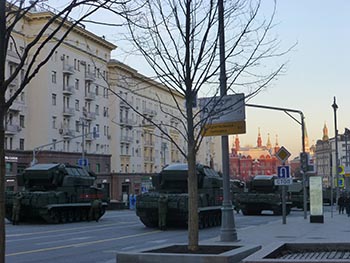
Army tanks MoscowEach rehearsal requires the city center to be completely blocked off. Tanks, missile systems, armored and combat vehicles are all lined up ready to go, remaining stationary for 1-2 hours during which time you can take photos. Surreal. Wait until you see them powering down the street! The strong scent of kerosene in the air…the thunder of engines…

The grand finale is the jets overhead: red, white and blue smoke trailing behind them resembling the stripes of the Russian flag. That gets the previously austere, silent crowd clapping and cheering!

Whether or not you’re against killing machines forming the centerpiece of a parade, if you enjoy travelling as a sort of journalism, you’ll be eternally grateful for that first week and a half in May.

27 April to 9 May also sees the staging of the annual A Cappella Festival. Walking through the city, we’re treated to many free performances, both traditional and modern.

 If You Go:

Moscow is awash with free/extraordinarily cheap activities, all of which provide fascinating insights into Russian culture, history and society.
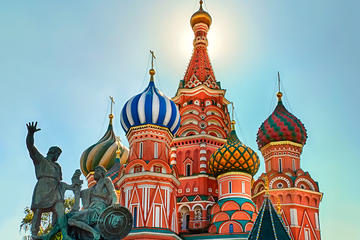

City Bus or Car Tour to Incredible Moscow

Lenin

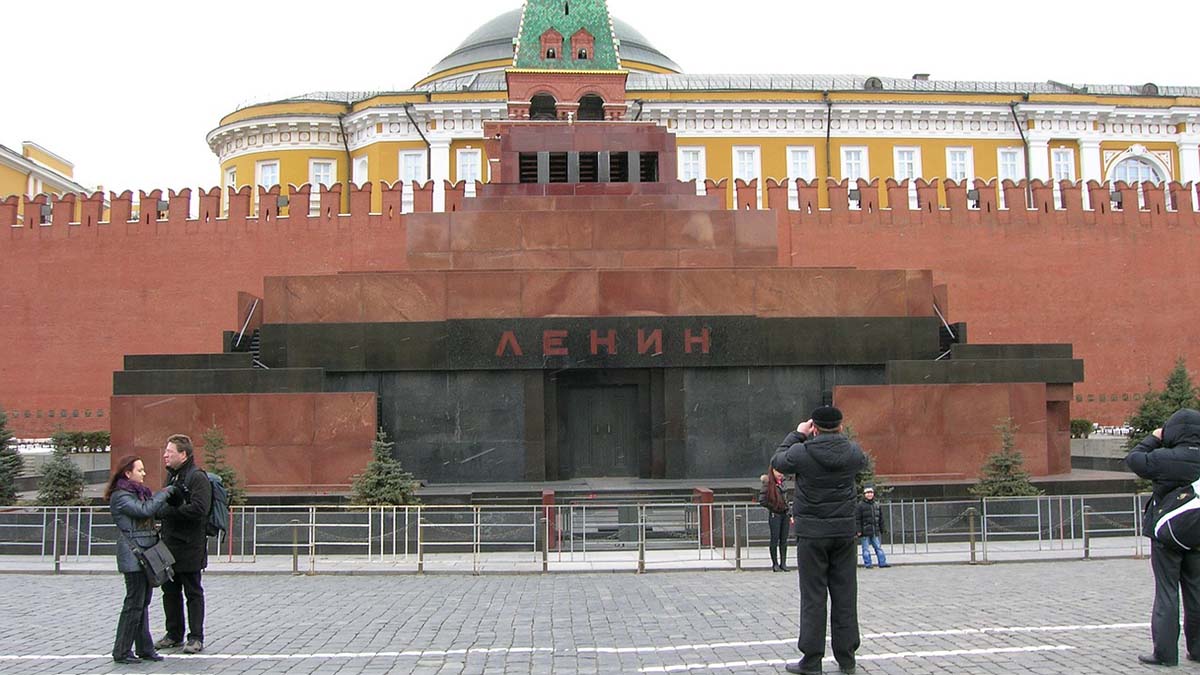
See the embalmed leader of the Bolshevik Revolution and first leader of the USSR. (NOTE: the mausoleum closes late April and doesn’t reopen until just after mid-May. Usual opening hours are 10am-1pm Tue, Wed, Thu, Sat, Sun).

Metro

Spend hours admiring the world’s most beautiful metro stations, for less than $1:

Though not as extravagant as the Soviet-era stations, new stations, i.e. Dostoevskaya, continue to be works of art.

Get a good overview of Moscow by riding the entire circle of the new Central Circle line linking all its outer suburbs. This Western European-style train will cost you less than $1 (including a metro transfer!).

Parks

Hang out in some of Moscow’s ninety six stunning parks where you’ll enjoy free concerts from purpose-built stages, fountains choreographed to classical music, statues of famous Russians, and art exhibition spaces. Gorky Park is a must.

Russian State Library (one of the five great libraries of the world).

Enjoy statues of Russian writers and Soviet citizens, and a front door sign that still reads ‘CCCP Lenin Library.’

Wander through old-fashioned reading rooms, each with their own specialized collection and typically a painting of Lenin on the wall (Open Mon to Sat 9am to 8pm EXCEPT the last Monday of the month).

Perhaps because Russians are the second biggest readers in the world (after China), Moscow also has an unusually high number of large and lively bookshops. At the very least, go for the atmosphere!
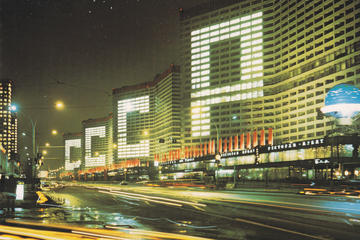

Private Moscow Walking Tour: Life in the Soviet Times

Panoramic view

Look out over Moscow from the observation deck of the 7th Floor of the Central Children’s Store (Lubyanka Square, near Red Square). Historic buildings within view are described in English. Enter through the excellent free museum showcasing toys sold in the Soviet-era.

The world’s largest mechanical clock also resides here, as does a ‘Lego store’ filled with Lego constructions of the Kremlin, Bolshoi Theatre, and Russian countryside.

Museums

State Central Museum of Contemporary Russian History

GULAG History Museum

Art Deco Museum

Tsarist-era luxury Shopping

GUM (Red Square). Built in the 19th century, this elegant arcade of shops was a department store during Soviet times.

Yeliseyevsky Gastronom (Tverskaya Street). Architecturally beautiful gourmet supermarket.


Gastronomic tour in Moscow

Soviet Exhibition grounds & Cosmonaut Memorial

Take the metro to Station VDNKh (acronym for ‘Exhibition of Achievements of National Economy’). In Soviet times, the 130m squared grounds hosted more than 300 national and international exhibitions a year. Now largely a recreation space, on weekends its people-watching heaven.

The colossal size of the grounds, numerous tall Corinthian-columned pavilions – several of which carry the names of countries of the former USSR, and glistening gold Friendship of Nations fountain fill me with the kind of excitement I imagine a child gets when they see Disneyland for the first time. Pavillions ‘Belarus’ and ‘Armenia’ continue to sell their nation’s produce, and Armenia has a fancy but inexpensive restaurant. The giant statue of ‘Worker and Kolkhoz Woman’, sculpted for the 1937 International Trade Show in Paris can be seen over 1 km away.

Next door you can marvel at the similarly extraordinary 107m high ‘Lenin and the workers’ cosmonaut memorial. The cosmonaut museum underneath is also worth visiting (Open 10-7pm every day EXCEPT Mon. Thurs until 9pm).
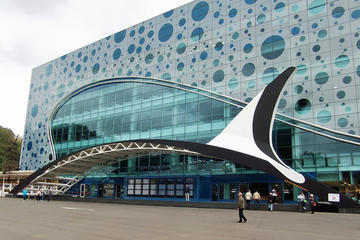

Amazing Tour to Mosquarium Space Museum of Cosmonautics and VDKH in Moscow Russia

About the author:

Angela is a Melbourne-based librarian and history graduate fascinated with Eastern Europe and different cultures and histories in general. Every few years it’s time to take off to Europe for another lengthy adventure.

Photos by Angela Lapham
Tagged With: moscow attractions, moscow tours, Russia travel Filed Under: Europe Travel

From Ancient Spotted Horses to the American Appaloosa

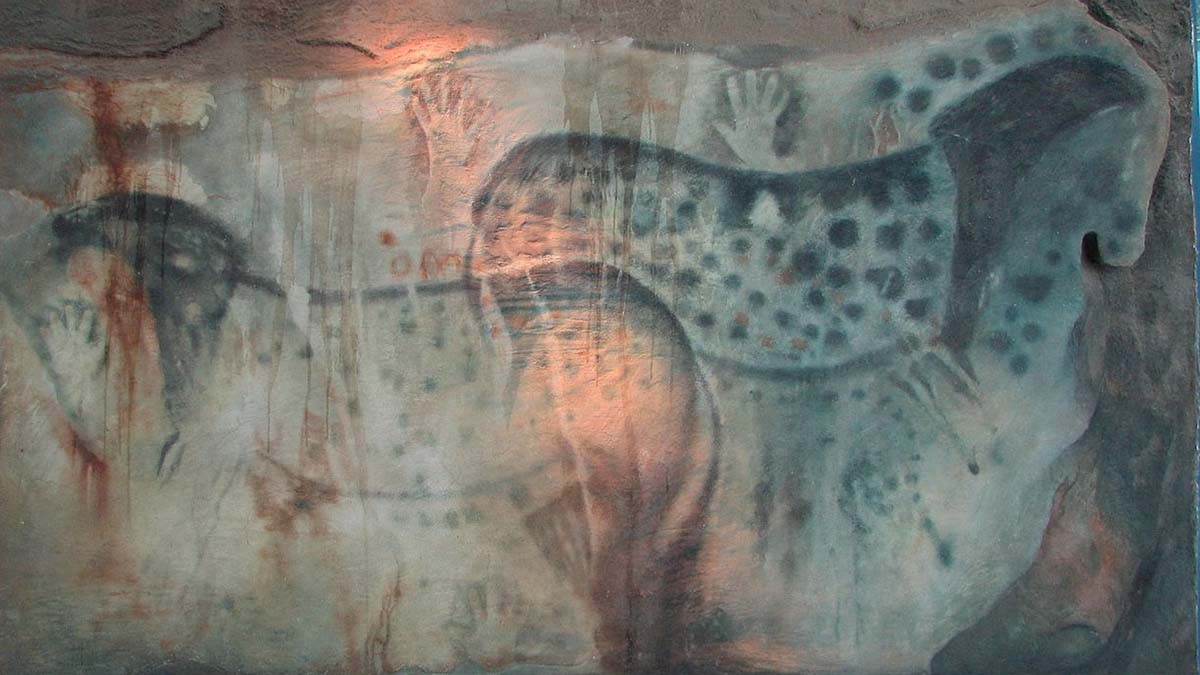
spotted horses in cave painting

A Journey from the Caves Of France to The Hills and Prairies Of Palouse

by Karin Leperi

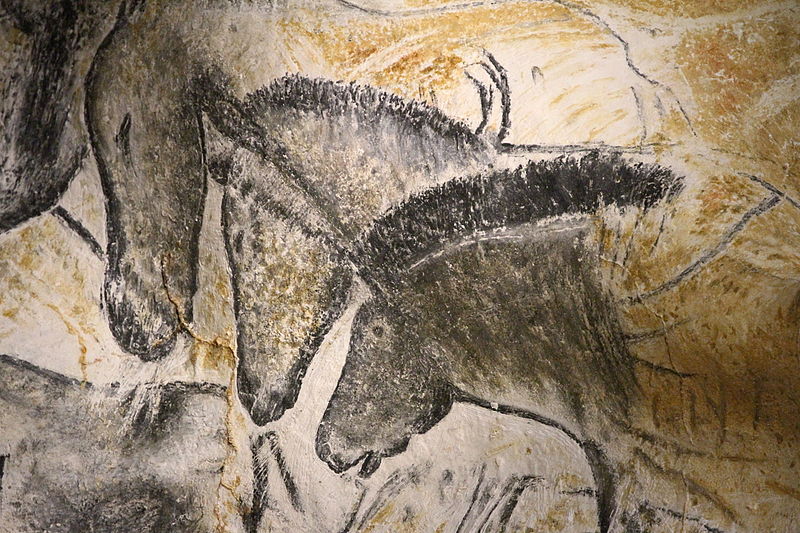
Over 25,000 years ago, somewhere in the Pyrenees region of France, cave-dwelling men and women artistically painted graceful murals of spotted horses on cavern walls. Using materials such as wooden sticks and pigment from charcoal and iron oxide, they drew and colored flowing pictures of a variety of mammals, some of which are now extinct.

Now known as the Pech Merle cave, it is one of a handful of cave painting sites in France that are still open to the general public. Other cave paintings of spotted horses have been found in Lascaux, France and Altamira, Spain as well as many other places throughout Europe.

Mystery of the Pech Merle Spotted Horse

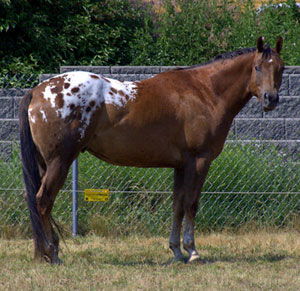
painting of horses in Chauvet caveThe prehistoric spotted horses of Pech Merle – white horses with dark spots – are sometimes referred to as “dappled horses” because of the spots or patches of color on the horses: They are very similar to the leopard pattern seen in Appaloosas today. It is characterized by a few white spotting patterns on the rump to horses that are almost completely white with pigmented oval spots known as ‘leopard spots.’ At first blush, the connection between early spotted horses and modern-day Appaloosas appears uncanny.

However, up until about a year ago, archaeologists and scientists were divided about what the spotted horse sketches actually represented and whether these spotted horses were related to the Appaloosa. Did the dappled horses represent mystical creatures conjured up during lucid dreaming? Were the cave paintings symbolic images with some religious significance or purpose for these ancient cave dwellers? Or were the spotted equine simply realistic drawings of man’s prehistoric environment?

Some researchers were adamant that a spotted coat phenotype from the Paleolithic period could not have existed; rather it could only have evolved through mutation over the centuries. After all, previous ancient DNA studies only supported the existence of bay and black horses. Why then the cave paintings of spotted horses?

A team of researchers from the UK, Germany, USA, Spain, Russia and Mexico set out to find the answer. By genotyping and analyzing coat color from ancient bone and teeth samples of 31 pre-domestic horses from Siberia, the Iberian Peninsula, and Eastern and Western Europe, they found that there was a shared gene present associated with leopard spotting. The conclusion: Spotted horses existed in Europe over 35,000 years ago.

Professor Michael Hofreiter, an evolutionary biologist from the University of York in England, noted: “While previous DNA studies have produced evidence for bay and black horses, our study has demonstrated that the leopard complex spotting phenotype was also already present in ancient horses and was accurately depicted by their human contemporaries nearly 25,000 years ago.”

Spotted Horse Through the Ages

Artwork also documents the fact that domesticated horses with leopard spotting patterns existed as far back as Ancient Greece, Persia, and the Han Dynasty in China to early modern period. By the 11th century, spotted horses were depicted in French art and in England they appeared in artwork by the 12th century. French paintings from the 16th and 17th centuries depict riding horses with spotted coats and spotted coach horses that were used by the French court of Louis XIV.

By the mid-18th century in Europe, European royalty and nobility clamored for “spotted horse” gene stock – that is, until it became common. Once that happened, the no-longer-fashionable spotted horses were readily surplused and shipped to the New World. Spanish conquistador and explorer Hernando Cortez was also known to bring a lone spotted horse with snowflake patterning to the New World. Others would follow.

The Nez Perce and the Appaloosa

appaloosa horseBy 1680, the year of the Pueblo Revolt in New Mexico, horses spread rapidly through the plains and prairies of North America, probably reaching the Northwest around 1700. And the Nez Perce tribe, long known for their dog-breeding skills, quickly adapted to the horse, harnessing it as an invaluable aide in hunting buffalo. Because of the horse’s speed, they were able to cover more territory in less time and thus extend the expanse of their hunting grounds. Life was good and meat became more plentiful as a result.
Soon they captured escaped spotted horses and cross-bred them with wild mustangs, producing a stunning white horse with leopard spots. Since the Nez Perce lived near the Palouse River, these horses were first known as the “A Palouse” which later became the Appaloosa. They continued to selectively breed the horse for speed, strength, stamina, agility and docility. Because of these traits along with the horse’s innate intelligence and beauty, the Appaloosa became highly prized throughout the high plateau country, creating great wealth for the Nez Perce. (It is estimated that about one in ten Nez Perce horses were spotted.)

Nez Perce War

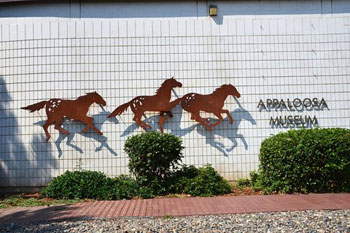
Appaloosa Museum signageOver the following years, Chief Joseph of the Nez Perce found that his tribal homelands were increasingly encroached upon by white settlers, despite signed treaty promises to the contrary. Rather than continue to fight against overwhelming odds, he mustered a band of his people consisting of several warriors, elders, and many women and children, embarking on a 3-month, 1,170 mile journey to sanctuary in Canada.
The hardy and spry Appaloosa horse helped his weary band evade the U.S. 7th Cavalry, but the toll was heavy in terms of human casualties. With many of his warriors dead and the rest of tribe cold and starving, Chief Joseph had no choice but to surrender to overwhelming force when he was only 40 miles from the Canadian border. The year was 1877. His famous words still resonate: “From where the sun now stands, I will fight no more forever.”

When Chief Joseph and his haggard followers gave up the fight, the cavalry rounded up more than 1,000 of the tribe’s horses, selling what they could and shooting the remainder. Some animals escaped and some were abandoned, with a significant population of horses having been left behind in the Wallowa Valley due to a hasty retreat. Perhaps fearing the indomitable qualities of the Appaloosa, a federal law remained on the books until 1935 that prohibited the breeding of Appaloosa to Appaloosa.

After the infamous slaughter of the Appaloosa, they unfortunately became a forgotten breed. That is, until 1937. Concerned about losing the genetic stock of the American Appaloosa forever, the Western Horseman ran an article on the Appaloosa, appealing to the public to preserve and improve the Appaloosa breed. By 1938, the Appaloosa Horse Club was chartered.

The Appaloosa Today

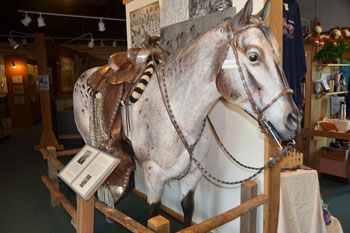
Horse in museum exhibitNowadays, the Appaloosa horse breed is enjoying a resurgence in popularity and can often be seen exhibited at county fairs along with their young mounts. Besides being popular with young horse riders, Appaloosas are also used as working ranch horses and trail horses. The Appaloosa Horse Club, an international breed registry, has records of more than 635,000 Appaloosas and 33,000 members. The horses excel in many competitive events, including racing, jumping, dressage, reining roping gaming, pleasure and endurance.

By 1975, the Appaloosa was named the official state horse of Idaho in recognition of its integral part of Idaho history. In Florida, an Appaloosa serves as a mascot for the Florida State Seminoles. Finally, the Appaloosa bloodlines have influenced other breeds including the Pony of the Americas, the Nez Perce Horse, and several gaited breeds.

If You Go:

The Appaloosa Museum & Heritage Center in Moscow, Idaho is located on Highway 8, just over the border from Pullman, Washington. Established in 1975 in the heart of Palouse prairie lands and rolling hills, the Appaloosa Museum pays tribute to what was once the home of the Nez Perce Appaloosa.

Today, the non-profit museum is dedicated to collecting, preserving, studying, and exhibiting artifacts and data about the history of the Appaloosa horse and its region of origin.

It is also home to the Appaloosa Horse Club (ApHC), an organization that serves as the international breed registry for the Appaloosa “by recording and preserving the horses’ heritage and history.” The ApHC is dedicated to promoting, enhancing and improving the bloodline characteristics of the Appaloosa by focusing on preferred characteristics that include the coat pattern. The club actively supports competitive and non-competitive events. If visiting during the summer, be sure to see the outdoor Appaloosa exhibit that runs from mid-May to mid-October. Here you will find shade trees and picnic tables along with benches, perfect for admiring the two stately Appaloosas grazing nearby behind a fenced corral.

Hours are 11 a.m. – 4 p.m. Monday through Thursday and 10 a.m. – 4 p.m. on Fridays and Saturdays.) Admission is free though voluntary contributions are happily accepted. Suggested donation is $2.00 per person.

For more information, be sure to visit:
Appaloosa Museum
2720 W. Pullman Road
Moscow, Idaho 83843
Phone: 208-882-5578

Photo credits:
Pech Merle cave leopard spotting by HTO, User:Kersti Nebelsiek / Public domain
PanneauDesChevaux(Détail) by Claude Valette / CC BY-SA
Photos 3-5 by Karin Leperi

About the author:
Karin Leperi is an award winning writer and photographer with bylines in over 75 publications that include print, broadcast, and internet media. A gypsy at heart who particularly enjoys bucket-list experiences, she has traveled to 80 countries and is still counting. Specialties include travel, culture, cuisine, nature, adventure and lifestyle. Her photo website is: www.travelprism.com.

Tagged With: Idaho travel, moscow attractions Filed Under: North America Travel

Paying Respect to Vladimir Lenin, Father of Russian Communism

Lenin's tome Moscow
Moscow, Russia

by Adam Bennett

As I stared into the thick bulletproof glass separating me from the legendary dogmatic Russian leader I was surprised to see he was still looking his best. During the first few weeks after his death in 1924 Lenin was embalmed and set on display in Red Square. This enabled over ¾ million Russian citizens to pay their respects to the man who liberated them from the former socially destructive Tsar dynasty in the early 20th century.

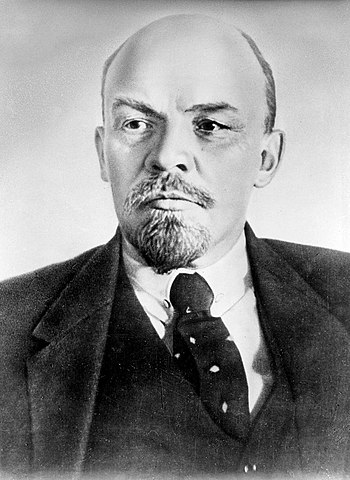
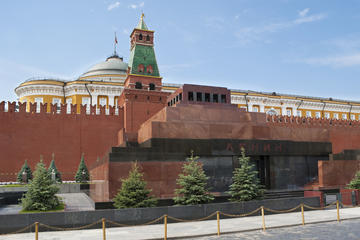
Vladimir LeninBorn Vladimir Ilich Ulyanov, he became known as Lenin whilst in exile in Siberia during the early years of his political career. Some say he took his name from a nearby lake or from his middle name Ilich. Resting in a grand red granite mausoleum, Lenin’s cyrillic name is set atop the entrance echoing a turbulent Soviet and Russian past.

I arrived in Red Square on a blisteringly cold January morning and was instantly taken aback at the incredible sight of St. Basil’s cathedral, the Kremlin and Lenin’s Mausoleum. Red Square’s infamous red brick and cobbled stone have seen witness to public executions, Soviet parades and rock concerts. Even though at the time I only had a hazy knowledge of Russian history, Red Square is a truly spectacular sight and a historical attraction I had always wanted to visit.

As I joined a long queue of weary tourists I struck up a conversation with a fellow Englishman who was visiting Lenin for the second time. He explained to me that during his first visit he queued for well over two hours before arriving at the airport style security checks only to be turned away because he still had a mobile phone in his pocket. Thankfully, entrance to the mausoleum is free, however visitors should be mindful to store any cameras, mobile phones or bags at the cloakroom nearby to the mausoleum.

Luckily, I only queued for half an hour before reaching the security barriers. The sullen faces of the soldiers manning security gave the impression that this was one of the more menial tasks given to a Russian soldier and it lead me to conclude that they did not want to be there.

To keep the mausoleum from getting overcrowded the soldiers let groups of around 12 visitors through the security barriers at 10-minute intervals. As I was going through the security checks one soldier stared point blank at me before saying something in frustrated Russian and scanning me with a flashing handheld device. He gestured for me to continue through the security barrier and I joined a small group of visitors being herded down a granite path. As we reached the entrance it became apparent that the mausoleum was much larger than it had first appeared.

Lenin's monumentThe atmosphere was tense and by this time all visitors had taken their hats off apart from me. This was much to the annoyance of one soldier who angrily motioned for me to remove my hat immediately. Now accompanied by two armed guards, we descended down three dark flights of stairs until we reached the crypt.

The crypt was dimly lit and five heavily armed guards stationed in different corners of the room watched us intently as we entered. Lenin, complete in his replica 1920’s style suit (the original was replaced in 2003) and trademark white spotted tie he almost looked peacefully asleep behind the glass. His head rests on a velvet pillow with his arms by his side and the embalmed communist leader could have been mistaken for a wax model at Madame Tussauds. I learnt afterwards that both the temperature and lighting within the tomb are meticulously monitored to ensure that Lenin’s body will continue to be seen by millions of people in the years to come.

As we came out of the mausoleum into the cold Russian air we were guided along a series of gravestones and busts of some of Russia’s most famous figures including Josef Stalin, Felix Dzerzhinsky and Mikhail Kalinin. There is also a plaque dedicated to Yuri Gagarin, the first man in space.

For any traveler visiting Moscow and Red Square Lenin’s mausoleum is a definite must see especially for those who have an interest in Russian history. An experience that you won’t forget in a hurry. Vladimir ‘Lenin’ Ulyanov revolutionised Russia and is one of the most charismatic figures of the early 20th century.


Tour to The Lenin Mausoleum in Moscow Russia

If You Go:

♦ Leave cameras at home! Whilst there is a cloakroom facility next to the mausoleum, it is expensive and you definitely won’t be allowed inside with any digital technology.
♦ Arrive early! There will always be a queue to visit Lenin. On weekends and peak times queues can last up to four hours. Just because you’re in the queue it doesn’t mean you’re guaranteed entry either. It’s all up to the guard’s digression.
♦ Check the opening times! Lenin’s mausoleum is never open on a Monday but is open from 10am – 1pm Tuesdays, Wednesdays, Thursdays and Saturdays.


Photo credits:
Lenin’s Tomb by Rosie Hayes from Pixabay
Portrait of Lenin by Wwamirhosseinww / CC BY-SA
Lenin monument by Ferran Cornellà / CC BY-SA

About the author:
Fuelled by his love of travelling and being on the road, Adam Bennett has written some unique and compelling articles from his experiences across the globe. From visiting dogmatic political figures in Red Square to recounting stories of touring and busking throughout Europe. Adam Bennett gives a delectable insight into the world of nomadic travelling.

Tagged With: moscow attractions, Russia travel Filed Under: Europe Travel

Moscow, Russia: Where History Starts

Christ the Savior Cathedral, Moscow

by Maria Kozyreva

When I was a little girl my parents took me to Moscow to visit the circus or dolphinarium. I remember crowds of people and the noisy metro. I even remember how afraid I was to be lost in one of the metro stations. As I grew up and finished secondary school I arrived in Moscow to enter one of its Universities. Exams have passed and I became “a real Moscow student” because I had a chance to live in a student residence, to meet lots of new people and to have a fresh look at Moscow.

For me (and for the majority of tourists) Moscow is a big Russian city with lots of business centers and sightseeing among which were the Red Square, St. Basil’s Cathedral, Kremlin and other famous places. But frankly speaking, if you want to get to know the capital of Russia it is not enough to visit only these “standard sightseeing” places. One should know at least a little bit about its history and culture, and try to understand Moscovites and their lifestyle.

I remember how my friends and I began our first tours with simple strolls along Moscow streets with a history book in hands. I was surprised for the first time when I got to know that the structure of the Russian capital consists of rings. Yes, it is! If you look at Moscow city map you will be surprised by its similarity to annual rings.

street performers, MoscowThe first one is the Kremlin where the residence of the President of the Russian Federation is situated. Kremlin is a wonder and you will read everything about it in any tourist guide. I would like to attract your attention to the streets that start from the heart of Moscow. For example, Tverskaya. In the 18th and 19th centuries it was the main street in the city. The best Moscow mansions, hotels and shops were built here. Today in Tverskaya you may also see the residence of the Mayor of Moscow and the English Club. At night it’s a pleasure to walk along this street with its sparkling lights and billboards but don’t forget that it is considered to be one of the most expensive trade streets not only in Moscow and in Russia but also in the whole world.

As you wander about city center don’t forget to look at Stoleshnikov Lane that runs from Bolshaya Dmitrovka. This small street is not so famous, its history is neither so captivating. Nowadays the street is stuffed with expensive boutiques and stores but still Stoleshnikov Lane remains one of the most favorite streets for Moscovites. The secret of this small street lies in its special atmosphere. If you arrive in Moscow in winter, please don’t forget to visit it. Some restaurants like to switch on classic music so that it is heard outdoors. Snowflakes fall slowly, shop windows and New Year garlands are glowing and it seems to you that you are on the pages of a wonderful fairytale.

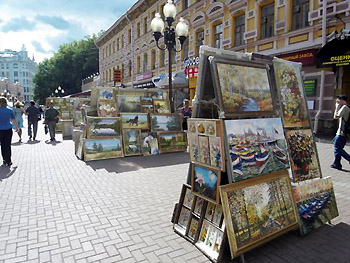
art for sale on Moscow streetIf you decide to go further, you will continue your way following any main street of the city center and sooner or later find yourself in the middle of the next Moscow ring that is called the Boulevard Ring. It is the city’s centermost road that begins in the west, passing through major Moscow squares (such as Pushkin and Arbat Square) and ends in the east. So if you follow the Boulevard ring you may see the majority of the city’s sightseeing.

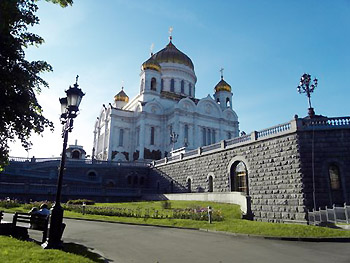
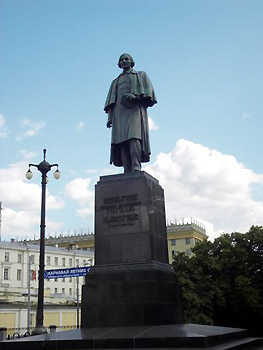
If you are in Moscow for the first time it may seem to you that each square in Boulevard ring is almost the same. Yes, they are all similar, they are green and have almost the same appearance. Almost. In reality, each square on this street has its own features. Take, for example, the Gogolev Boulevard (the very beginning of the Boulevard ring) that starts near the Cathedral of Christ the Saviour. (Top photo) I never tire of visiting this Cathedral. Look at its golden domes, at its magnificent white walls. It is considered to be the central Russian Orthodox Church. However some Russians think that it is too magnificent, and in the last few years it has become a museum. But it is still a functional cathedral and one should respect feelings of Orthodox adherents when visiting it, especially during the Divine Services.

Moscow statue of Nikolai Vasilievitch GogolI adore Gogolev Boulevard. I love walking along its small park that ends with the statue of the great Russian writer Nikolai Vasilievitch Gogol. One of my friends whispered to me that she liked to make wishes to Gogol monument. The writer always hears her and makes her wishes come true. Me too, I made a wish. Let’s wait and see if she has told me the truth!

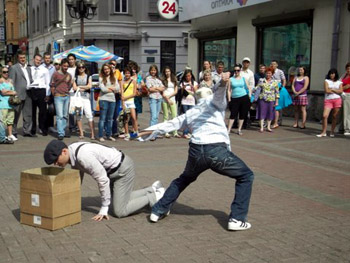
Once you reach the monument of Gogol, his boulevard comes to an end and you find yourself in the Arbat Square. For Moscovites, Arbat is not simply a street. It’s a “Moscow in Moscow” with its history, traditions and originality. From the XI century Arbat was densely populated. There were lots of wooden houses and churches. Unfortunately during the Revolution, Arbat suffered a lot. It became grey and desolate. In Soviet times the New Arbat appeared and swallowed up many churches, monuments and statues. Moscow didn’t like this new street that destroyed the original Arbat. People rudely called the New Arbat “a set of false teeth” as they considered it as an artificial and ugly element that intruded in one of their favourite streets. Fortunately a part of Arbat was preserved and now you can look at it when walking along the Old Arbat street. Do please visit the Old street! There is a lot to see. Would you like to have your own portrait painted? Choose an artist. Any souvenirs? What about Russian folklore? If you are lucky enough you will meet musicians, dancers and even clowns here. Don’t forget to take your camera.

What is so important about Moscow’s city center? It is that the city center is the center of Moscow’s history. If one wants to understand its traditions and culture, he/she should take a curious look at its past.

Copyright © 2009 by Kozyreva Maria.


Moscow Private Tour: Izmailovo Kremlin and Vodka Museum

If You Go:

Moscow is an economic and political center of the Russian Federation and is one of the biggest cities in the world. As it is also a business center of the country, the traffic here is rather intense especially in rush hours, so sometimes its more convenient to use metro (news.metro.ru) For Moscow hotels/restaurants: Travel Guide www.moscowcity.com. www.geographia.com/moscow

About the author:
Maria Kozyreva is a freelance writer and interpreter working and living in Russia. She is fond of learning foreign languages as she believes that they open the door to the world. She also enjoys traveling and painting. Contact: fleurlaska@hotmail.com.

All photographs are by Maria Kozyreva.

Tagged With: moscow attractions, Russia travel Filed Under: Europe Travel

Moscow Sculptor Zurab Tsereteli

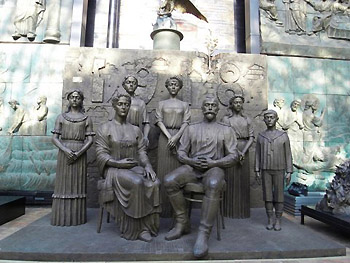
Tsereteli sculpture of family group

Changing the Artistic Face of Russia

by Maria Kozyreva

Once you are in Moscow, as you walk down its streets, go sightseeing, visit the most popular tourists’ attractions, almost everywhere you find sculptures, mosaic or decorations of Moscow’s own sculptor.

“Moscow has its own sculptor?” you ask.

Actually, yes. It has its own chief sculptor who has changed the architectural layout of the Russian capital. His name is Zurab Tsereteli. He was born in 1934 in Tbilisi (Georgia) where he graduated from the Academy of Arts. In 1964 he studied in France where he got to know famous artists Picasso and Chagal. In 2003 Tsereteli obtained Russian citizenship status for outstanding service for Russian Federation and even nowadays he continues creating. Whether or not he has made Moscow more beautiful or only spoiled it are heated debates that will last forever. Let me provide you with the facts, some background information and pictures so that you can make your own conclusion and maybe, put an end to this endless argument.

Tsereteli sculpture representing the Fox and Geese fairy taleLet’s go to the Red Square, the heart of Moscow. In the Manezhnaya square, right in the Alexander Garden you will find sculptures that depict famous Russian fairytales. Look at the sculpture “The Old Man and the Goldfish.” According to the fairy tale this Fish can carry out three wishes of anyone who catches it. The Old man was lucky. He was very poor but had a kind and honest heart, so he just let the Fish free. But his greedy wife wanted to become the Sea queen so the Fish obeyed her. In the end the Goldfish punished the old woman for her greediness and envy.

Now let’s stroll along the Mokhovaya street, then turn to Volkhonka and in fifteen minutes we are standing in front of the Cathedral of Christ the Saviour. It’s the major Russian Orthodox cathedral, built to commemorate the sacrifices of the Russian people and their victory in the war with Napoleon. In 1953 it was blown up and completely destroyed. Only after more than 40 years did the reconstruction began. Although the construction was supported by many social groups, it was the center of many disputes, protests and allegations of authorities in corruption. Moreover a part of the society was so irritated that the author of the project was replaced by Zurab Tsereteli, under whose direction the original layout of the cathedral was changed. Thus he introduced several controversial innovations, such as modern bronze reliefs that you can see on the walls of the cathedral that are unusual for Orthodox architecture. Moreover wall paintings were done by artists recommended by Tsereteli, which cultural values are also disputable.

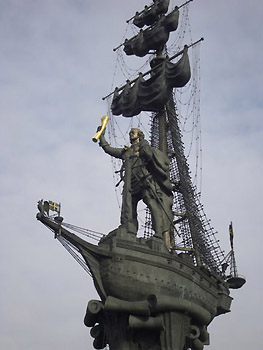
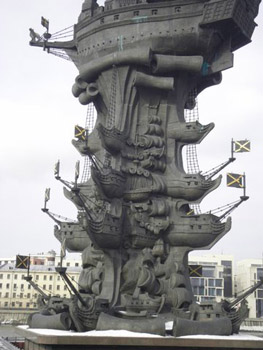
Peter the Great sculpture by TsereteliNow that you are familiar with some Tsereteli’s masterpieces I think that you are ready to look at one of the most scandalous sculptures in Moscow, the Peter I monument, standing on Moskva river. (Pictured left) Some Moscovites hate it, others laugh at the irony; there are those who like and adore it but nobody is indifferent. Peter the Great is the Russian tsar who had drastically changed its history. In a few words his policy was Europe-oriented. Historians say that he “had hacked through a window to Europe”. He used to send nobles to foreign educational institutions. He imposed on Russians European culture, reformed social structure, extended Russian territory in Baltic region and finally was titled the first Russian emperor. In fact it’s hard to underestimate his policy but still the majority of Moscovites don’t appreciate this sculpture. Why? Here’s three reasons that evoke lots of discussions and disputes around this monument. The first one is that fact this sculpture stands in Moscow because Peter I not only hated Moscow but he had been afraid of it since his early childhood. He clearly remembered rebellions, revolts and plots that endangered his life. This was one of the main reasons why he did his best to transfer the capital of Russia from Moscow to Saint-Petersburg. Secondly, Moscovites think that this monument is huge and ugly and doesn’t fit Moscow’s layout. If you look at the statue from the quay you will see nothing but Peter the Great. Far away you will notice a tiny church – the Cathedral of Christ the Saviour that seems so unimportant in comparison with the tsar.

 Christopher Columbus statue by TsereteliThe third and the most scandalous reason is that Peter I monument in reality is the statue of Christopher Columbus! Initially Tsereteli created the statue of Columbus that was supposed to be placed in the USA. The mayor of Moscow and he made a gift to the North America but Americans politely refused to accept it. Tsereteli didn’t get upset, and made a brilliant decision: he replaced Columbus head with the Peter’s and placed the new monument by the Moskva river. This caused a huge stir.

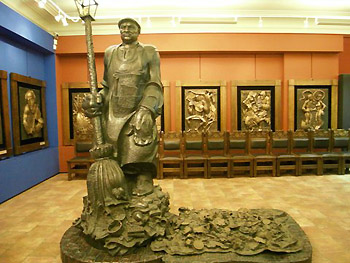
Now let’s go to the museum. Right in the central administrative district of Moscow, ten minutes by foot from the Cathedral of Christ the Saviour, on Prechistenka, you will find the Gallery of Arts of Zurab Tsereteli. Few artists or sculptures can boast their own museum, but Tsereteli can. One of the most beautiful Moscow private residences of the Classical era holds the collection of his masterpieces. This permanent exposition represents all facets of his art: painting, graphic works, sculptures, enamel plastic art. There are also photos that illustrate his monuments which are placed in different parts of the world.

inside Tsereteli museumTsereteli’s art, supported by the Russian government (especially Moscow), is often criticized by artistic critics and society. He is also reproached for “monopolization” of Moscow monumental projects, for violation of Moscow style, for gigantomania and lack of taste. Nevertheless his sculptures have become the inherent part of the architectural layout of Moscow, and we can’t deny his original style. Tsereteli is an experimentor who managed to combine almost all techniques of figurative art. The uniqueness of his art is multinational, he wants to show how the majority of cultural traditions and religions of different people coexist on the Earth. The fact that his masterpieces leave no one unfazed means that his works deserve special consideration and respect. Is a genius who has made Moscow more beautiful and unique? Or is he an untalented sculptor constantly imposing his sculptures? You must come to Moscow and see for yourself!

Copyright © 2009 by Kozyreva Maria.


Moscow Private Tour: Izmailovo Kremlin and Vodka Museum

If You Go:

Although it is said that Russia is a country of permafrost, it isn’t always true. In summer it’s quite warm (25 C above zero), although there is always room for exceptions. In winter it can be rather cold so if you want to visit Moscow, it’s better to see a weather forecast (www.worldweather.org).

Moscow is an economic and political center of the Russian Federation and is one of the biggest cities in the world. As it is also a business center of the country, the traffic here is rather intense especially in rush hours, so sometimes its more convenient to use metro (news.metro.ru)

There are lots of places in Moscow where you can see Tsereteli’s masterpieces. I would advise you to visit the most popular:
The Cathedral of Christ the Saviour (Kropotkinskaya metro station)
Tsereteli Art Gallery (en.rah.ru)
The Alexander Garden (Okhotny Ryad metro)
Poklonnaya Gora (a bow-down hill)

If you want to learn more about the sculptor you can visit his official site: zurabtsereteli.com

About the author:
Maria Kozyreva is a freelance writer and interpreter working and living in Russia. She is fond of learning foreign languages as she believes that they open the door to the world. She also enjoys traveling and painting. Contact: fleurlaska@hotmail.com

All photos are by Maria Kozyreva.

Tagged With: moscow attractions, Russia travel Filed Under: Europe Travel

MORE TRAVEL STORIES:

Explore the hidden gems of Malaysia – Start your journey here

Secrets of Cave Hill Revealed

Poland: Auschwitz-Birkenau

Breathtaking Adventure Tours in Kona You Must Try

A Visit to the Site of the First Christmas

The Potter’s Village: Mata Ortiz, Chihuaua, Mexico

Remembered Moments at Jim Corbett National Park

Pastel Sunshine Thoughts In Stockholm


SEARCH

DESTINATIONS

  • Africa Travel
  • Antarctica travel
  • Asia Travel
  • Australia travel
  • Caribbean Travel
  • Central America Travel
  • Europe Travel
  • Middle East Travel
  • North America Travel
  • Oceania Travel
  • South America Travel
  • Travel History
  • Travel News
  • UK Travel
  • Uncategorized
  • World Travel
facebook
Best Travel Blogs - OnToplist.com

Copyright © 2026 Cedar Cottage Marketing | About Us | Contact | Privacy Policy | Terms & Conditions | Copyright Notice | Log in