Travel Thru History

Historical and cultural travel experiences

  • Home
  • Airfare Deals
  • Get Travel Insurance
  • Writers Guidelines

Philae, Pearl of the Nile

Philae Temple Egypt

The Temples of Philae: Aswan, Egypt

by Aaron Robertson

We were tired after arriving in Aswan early in the morning on the overnight train from Cairo. However, it was a beautiful day, and we didn’t want to waste it so we headed off to see the Temples of Philae, which lie just south of the city on an island in the river Nile. With our guide, Mohammed, we arrived at the small jetty where boats leave for the island.

The Isis Temple of Philae at AswanThe completion of the Aswan Low Dam in 1902 meant that several archaeological sites on this part of the river, including the temple complex on the island of Philae, were consequently submerged for most of the year. The construction of the Aswan high dam further downstream, between 1960-70, threatened to leave these sites permanently underwater. Thankfully, UNESCO decided to remove the endangered temples from Philae block by block, and reconstruct them about 500 meters away, on the nearby island of Agilkia, which would remain above water after the high dam was finished. This ambitious project lasted from 1972-80.

As we approached the island, it was not hard to see why Philae was once known as “the pearl of Egypt”. Rising graciously out of the river, the temples exude an air of classical majesty even at this late stage in their history. One can only imagine what they must have looked like in all their splendor. As we docked, Mohammed explained that Philae was formerly a centre of worship of the god Isis. Egyptian mythology says that it was here that Isis found the heart of her husband, Osiris, after his jealous brother Seth had killed him, spreading the different parts of Osiris’s body throughout Egypt so that he could not be bought back to life.

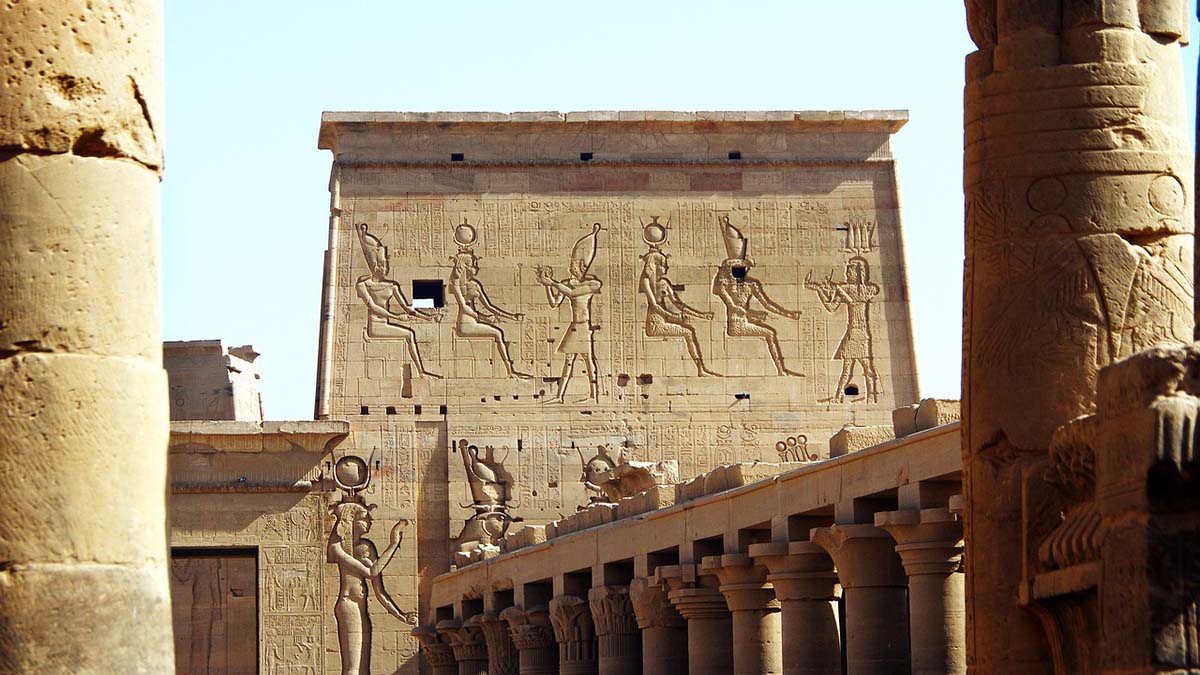
carvings at Philae templeThe large temple of Isis dominates the island, and this is where we started our tour. Crossing a large, open courtyard with a colonnade running down its western side, we were dwarfed by the temple’s first pylon, or gateway. Towering images of various Egyptian gods, among them Osiris, Isis, and their son, the falcon-headed Horus, are carved into its facade. Numerous pharaohs are represented here as well, doing battle with their enemies, and making offerings to the gods to ensure their victory and prosperity. The scenes still inspire a sense of awe today, not least for the amount of work that must have gone in to creating them.

The temple was mostly constructed during the reign of the pharaoh Ptolemy II Philadelphus (284-246 BC) and his son, Ptolemy III Euergetes (246-222 BC). Despite being constructed at a relatively late stage in ancient Egypt’s history, the temple follows a very classical layout. Moving inside, we entered another courtyard, which lies before a second, smaller pylon sitting at a slight angle to the first. To the right of this inner courtyard lie the remains of rooms that used to house the temple priests and guards. To the left is a mamissi, or birth-house. This type of small building became popular after the reign of the female pharaoh, Hatshepsut (1479-58 BC), and was designed to prove a pharaoh’s supposed descent from the god Horus.
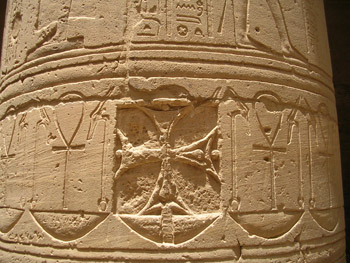
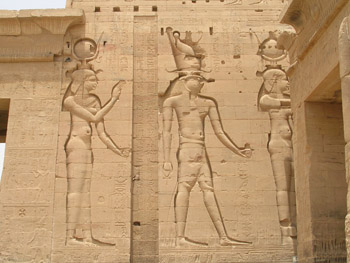
Coptic cross carved on Isis temple columnPassing the second pylon, also adorned with large images of the gods, we entered the temple’s hypostyle, or columned hall. Here you can catch a small glimpse of what the temple must have originally looked like, when much of its stone was adorned with bright colors. On the roof, Mohammed pointed out a row of painted vultures, an ancient symbol of Upper Egypt. He also pointed out a Coptic cross, cut into one of the hall’s columns during the period when the temple was used as a Christian church. Amazingly, the cult of Isis was kept alive here until the Byzantine Emperor, Justinian, finally disbanded the temple’s pagan priesthood around 550 AD. Some believe that for many years before this, Isis was worshipped on the island side by side with Coptic Christianity.

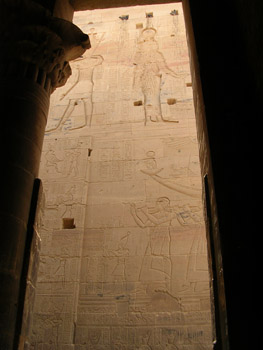
scene from Orisris legend at PhilaeThe hypostyle hall leads though several antechambers into the temple sanctuary. The walls of these rooms are covered with scenes from the legend of Osiris, depicting his death at the hands of his brother Seth, and his eventual resurrection. In the sanctuary, which once only the ruling pharaoh or the temple’s head priest had the right to enter, there still stands the pedestal for the sacred statue of Isis, used in all of the temple’s rituals. The sanctuary’s granite shrines were carried off to European museums during the 19th century, but here in the small, dimly lit room, a strong sense of ceremony still remains.

Emerging back into the glare of the bright sunlight, Mohammed led us around a number of the other small temples and buildings on the island. The oldest of these is a small vestibule built during the reign of Nectanebos I (380-362 BC), founder of the 30th and last dynasty of native Egyptian pharaohs. Also dedicated to Isis, just six of its original fourteen columns remain, linked together by a low screen wall. Close to this, on the western side of the island is one of the few remaining Nilometers. These modern-sounding devices where once used to determine the level of taxes in ancient Egypt, which changed during the year to match the seasonal level of the river.

Hathor temple at Philae AswanOn the eastern side of the island sits a well-preserved temple dedicated to the god Hathor, built under Ptolemy VI Philometor (170-145 BC), and a large kiosk that once served as the formal entrance to the island. This building, sometimes called the pharaoh’s bed, is named after the Roman Emperor, Trajan, but may have been built earlier during the reign of Augustus. It was never entirely completed, but its remains have stood the test of time remarkably well. Ironically perhaps, the kiosk’s fourteen massive columns became an icon of Philae long before the larger and older temple of Isis, featuring on many 19th century postcards.

After finishing our tour, we headed to the welcome shade of the island’s small café for a well-deserved drink. Sitting in the middle of the now much-swollen Nile, the island provides a remarkable setting for what was once a major site of worship in ancient Egypt. At least when we were there, it seemed positively serene in comparison to the hustle and bustle of even a small Egyptian city like Aswan. As we pulled slowly away from the island in the same small boat that had bought us there, we regretted not being able to spend longer taking in the temples’ languid, tranquil atmosphere.


Guided Aswan Day Trip Philae and Kalabsha Temples and Nubian Museum with Lunch

If You Go:

Aswan can be reached from Cairo by either plane, or by a train that also stops at Luxor on the way. From Luxor, cruise boats also make the trip to Aswan. If you haven’t organized a guided tour to the Temples of Philae before you get there, your hotel in Aswan will probably be able to organize one for you. If you want to see the temples by yourself, the point where boats leave for the island is a short taxi ride south of the city centre. This is where the ticket office for the temples is also located.

For more information:
Philae on Wikipedia
Egypt Travel – Aswan: Philae Temple Complex

About the author:
Aaron Robertson left New Zealand in 1999, and has spent the intervening years trying to see as much of the world as possible. He currently lives in Paris, France, where he works as a freelance copywriter and musician. aaronwr@hotmail.com

Photo credits:
First Philae temple image by DEZALB from Pixabay
All other photos are by Aaron Robertson.

Tagged With: Aswan attractions, Egypt travel Filed Under: Africa Travel

A Kenya Photo Safari Adventure

Zebras in Kenya

The Hunters and the Hunted

by Arun Bhatia

“Everyone who has a chance to see nearly two million animals on the move has been touched by the magic of this place. What is it that gets under their skin? The urgency of the movement of the wildebeest? The wide open plains? The African light? Or maybe it is the fact that we all came from here, not such a long time ago, and our deep unconsciousness remembers the time, 60,000 generations ago…Or maybe it is just the sheer number of the migrating animals as they move in the world’s last surviving great migration, ” these words, quoted from Markus Borner, Frankfurt Zoo representative in Serengeti, are about the Great Migration.

I had seen it on the Discovery, National Geographic and Animal Planet channels and elsewhere in vivid detail, helicopter shots with multiple cameras by ace photographers wielding the latest gadgets, backed by satellite image experts, ethologists, cartographers and wildlife scientists.

group of WildebeestWould watching the migrating wildebeest and zebras live be different? Armed with binoculars and an 8 megapixel 35 to 420 mm lens digital camera, I was leaning out of a sliding roof safari van, moving in the amazing Serengeti-Masai Mara ecosystem. Would I get more out it because I am here? I wondered. Indeed I did. I saw and photographed and learned some intriguing facts.

For instance, the White Bearded Wildebeest (Connochaetes taurinus) lives without any family ties. There is no leader. Any individual can start walking, and tens of thousands follow.The wildebeest cross the Mara River near the Oloololo Gate and the crossing is a spectacle. Especially since below, waiting in the river are the enormous Mara River crocodiles.

The river banks are worn down by hundreds of years of crossings, while at other places, they are vertical on both sides. The wildebeest and zebras hurtle down the earth banks, swim 30 or 50 feet and struggle in their teeming hundreds to find a safe way out at the other bank. Many drown or get snapped by crocodiles.

leopard in grassThere are other hunters and predators too. The Masai Mara has the second highest lion density in the world with 500 lions in 1500 square kilometers. Thousands of animals are taken by them and by other predators: leopards, cheetah and hyenas – the latter being serious hunters, not just the scavengers they once were. That said, thousands of animals do cross safely and the statistics for a “good” year say 1.5 million cross safely.

Further along the route of migration, from the roof of our van, I photograph an intriguing face off. A lion family had apparently killed a migrating zebra and sits near the prey. But with huge ears sticking out menacingly, a matriarch elephant protects the dead zebra, so the lions sit well away from the kill, as though waving a white flag. The knowledgeable van driver guide cannot explain this confrontation. The vegetarian elephant herd would not be interested in the kill for food. There is no known affinity between zebras and elephants. What does the matriarch with her long tusks expect to accomplish by coming between the lion and his prey?

herd of elephantsThe whole drama unfolds in leisurely fashion. It is an unhurried face off where one lion, then another, rises and ambles along near the kill, but is under the elephant’s watchful eye. The lion walks right past the dead zebra, turns round to face the kill, and sits down, as the elephant keeps an eye on him. It is near a swamp and while the drama unfolds, there are more photo opportunities with the birds: Egyptian geese, plovers, egrets, jacanas rise from the muddy environs, sometimes circle around and descend to continue preening and feeding.

After an interminable half an hour, the duel ends, with the lions strolling away as the matriarch watches. The elephant herd then crosses the dirt road, just twelve feet in front of our van.

“We don’t do anything to the elephants, so they don’t do anything to us, you take photo” whispers the van driver guide.

Many of my shots of those dozen massive pachyderms passing so close to me are useless because of a camera shake in my nervous hands. Soon, the spotted hyenas are moving in from afar, to claim their share of the killed zebra.

Masai men in colorful tribal wardrobeWanting a better angle for my camera, I open the door to alight from the van. The van driver guard promptly stops me: it is against the law to get off the van when one is inside the park. The only humans that break this law are the Masai tribe members, who nonchalantly roam about on foot in the game park, grazing their cattle. Though they don’t hunt for food, these tall handsome tribesmen are capable of defending themselves with spear and club.

The Masai are yet another plus for me over the TV channels’ enthralling footage. The van driver guide fixes a fee with them and they welcome me at their Masai village with a welcome drink of cow’s blood and cow’s milk (half and half). I am too squeamish to accept the drink. They show how they light a fire using sticks, try to sell trinkets and bangles that they have handcrafted, and do a group dance with the tall handsome men leaping straight upward. Some speak English and joke how the very tall leader is a giraffe. “No”, I say, pointing to his goatee: “He is a goat!”

Everyone bursts out laughing.

“Ok,” concludes the genial leader with a grin, “I am … a … goat giraffe.”

Back home in Bangalore this charming anecdote amuses my family and friends: making a spear wielding ferocious Masai leader admit to being a “goat giraffe.”

If You Go:

The main city is Nairobi.
Amboseli is 120 miles from Nairobi and the usual route is via Namanga. The other route is via Emali on the Nairobi-Mombasa road.
The Masai Mara lies about lies 160 miles from Nairobi (5 hours by road). There are scheduled flights from Wilson Airport, Nairobi, which take about 40 minutes.
Hire a private vehicle to go around the park, or book an organized safari.

Accommodations:
Lodging is available in luxury tents within the reserves (you can even pitch your own as a cheaper option.) There are several hotels around the parks, too.
Best time to visit:
The dry season from July to March is the best time to see wildlife, and the migration occurs in August.

For more information:
Kenya travel details on Wikitravel

3 Days Masai Mara Safari

Kenya Safari Package to Amboseli National Park for 2 days


About the author:
Arun Bhatia is a 73 year old freelance writer/photographer. He began in freshman year as a cub reporter at U.C.L.A. in 1953, contributing to dailies, weeklies, monthlies etc. in India and elsewhere. Working as senior model in ads/adfilms, willing to make whatever monkey faces at the camera as directed, as long as they paid modeling fees. He rides a 10 year old gearless Honda scooter, grumbles about traffic choked Bangalore roads, and does yoga/pranayama regularly.

Photo credits:
All photos are by Arun Bhatia.

Tagged With: Kenya travel, photo safari Filed Under: Africa Travel

Champagne and Warthogs in Masai Mara

Zebras in Masai Mara

Kenya, East Africa

by Margaret Ann Hayes

Mention the word “Africa” to almost anyone in the western world, and you will receive a big smile. Wide-eyed people invariably tell you they have always wanted to go there. I answer, ” Then do it, while there’s still time!”

As photo -journalists, my husband and I lived in Kenya, East Africa, for almost 25 years before leaving to retire in Canada. These days, although enjoying life in our new country, I still think about our times spent on safari (meaning a journey, in the Swahili language); evenings in the bush beside a huge log fire; listening at dusk to a lion’s roar echo across a warm grassy plain; hippos wallowing noisily from the depths of wide rivers and lakes. Even in my dreams I sometimes see a giraffe flickering its long eyelashes at us as it peers over the top of an Acacia tree, known as an umbrella tree because of its flat, leafy shade.

elephants in Masai MaraLast November I was invited to spend an extended holiday in Kenya. With a grin on my face, I stepped aboard the cozy KLM plane and was soon on my way to tropical Africa again. Ready to stop dreaming of the past, I was going to renew wonderful memories and maybe experience new adventures.

A day later, at 7 am (saa moja), a huge saffron- orange sun slipped gently over giant mountain tops, bringing to life Kenya’s part of Africa’s Great Rift Valley below; a land that was split asunder so many millions of years ago. I looked down from the plane’s window with awe; dry red earth, massive escarpments and deep rocky outcrops all touched by Africa’s early morning glow which brought the Rift Valley into an unexpected wonderment of unexpected shapes and configurations. With mounting excitement, I felt the plane making its slow, steady decent into Nairobi’s Jomo Kenyatta Airport.

Later, sitting beside the swim pool in a Nairobi garden, gin and tonic in hand, I watched seeds from the Nandi Flame tree float through the air like a thousand tiny butterflies, each heart-shaped seed set into two see-thru ‘wings’ which helped them land gently on soft earth where little brown birds waited to eat their manna from heaven. Huge Hadada Ibis, black beaks poking enquiringly in all directions, shouted their greetings from the roof top.

local guide and driverWithin a day or two, my friends and I were driven to Lake Naivasha, a 100-square-mile of water about 60 miles west of Nairobi, where over 400 fresh water bird species have been registered. Boats may be ordered for bird watchers to visit famous Crescent Island, a 600-acre volcanic rim in the Lake. Driven by Land Rover to a nearby grass airstrip, we were soon in the air again, comfortably seated in a 12-seater plane, thanks to award winning Bunsons Travel and Safari company, who will arrange any type of safari one could wish for. It was planned we would visit the Masai Mara Game Reserve. An hour later and we were sitting in a safari vehicle looking at elephants!

Moving slowly toward Kitchwa Tembo (meaning Elephant Head), an area in the Mara,there are thousands of plains game to watch and photograph. Herds of buffalo, vast numbers of shy water buck, usually seen peering from behind tall grasses. Lions are often sighted in their prides of about six, rolling about or sleeping under the Acacia trees, resting until the sun goes down when they go hunting. Hippos stay in the river puffing and bellowing until after 7 p.m. when they lumber out of the water to munch grass and bushes for most of the night.

champagne service on the African plainBy midday, we were driven through a cool riverine forest to the Bataleur Eagle restaurant where flutes of chilled Champagne were offered and African chefs served exquisite foods. We watched, from the open-sided restaurant, herds of elephants and giraffe wandering over the plains.

In the air again, and flying low at 300 feet, we counted 32 elephants within the first few minutes. Passing over Lake Nakuru, a soda lake, the water was full of flamingoes – one huge pink blush. More photo opportunities.

Coming in to land, in Naivasha, we could see red-bummed baboons at the edge of the forest and Colobus monkeys, their black and white furry capes and tails flowing, staring up at us from tree tops. They looked as if they were laughing.

Just as we were preparing to land, our pilot suddenly rose again over the lake.

“What now?” I thought.

“Oh dear,” chuckled the pilot, “warthogs on the runway again!”

From the plane we watched a very old African peddling along the runway on a rusty bicycle shooing the warthogs back to the forest. He was laughing fit to bust.

the author, Margaret Ann HayesA few days later, and we were enjoying deep- sea fishing in the clear Indian Ocean at Kilifi. A few nights spent at the Driftwood Club, where we lounged in the sun on the long silver beach, was the rest we needed. The Club serves fresh fish, lobsters, giant prawns, sailfish and other exotic sea food brought in each early morning by local fishermen and cooked by African chefs.

There are so many beautiful places to visit in Kenya, from sea level to mountain tops which can reach up to 10,000 feet or more; and of course there is always Mount Kenya at 17,058 feet, Africa’s highest peak with its famous Club and golf course set on the lower shoulder. Warmer months are between November and February which makes Christmas a favourite time for booking. The Africans you will meet go out of their way to be helpful and friendly. Most of them speak English as well as their national language, Swahili. Don’t wait too long before travelling to this wordly paradise.

If You Go:

For More Information:

Masai Mara on Game Reserve

Bunson Travel Service

Masai Mara Tours Available:

3-Day Masai Mara Safari from Nairobi

3 Days Masai Mara Camping

1 Day Masai Mara flying Safari


About the author:
Margaret Hayes, born in England, went to live in East Africa in 1958. She became a photo journalist in Kenya during the ‘winds of change’ period of the 1960s recording stirring events and meeting many of the leaders who took Kenya, Uganda and Tanzania into nationhood. She also lived in Ethiopia for several years before the reign of Emperor Haile Selassie was ended in revolution. She is the author of a book about her Kenya adventures, Safarini: Many Journeys. Now widowed, Margaret Hayes lives in British Columbia, Canada. She has five children.

Photo credits:
Masai Mara zebras by Vimal Kaul from Pixabay
All other photos are by Margaret Hayes.


Tagged With: Kenya travel, Masai Mara Filed Under: Africa Travel

The Wonders of Kuala Lumpur, Malaysia

Sultan Abdul Samad Building in Kuala Lumpur

by W. Ruth Kozak

In the words of British novelist and playwright Somerset Maugham, “If you haven’t seen this place, you haven’t seen the world.” He was referring to Malaysia. And he was right.

looking up at Petronas twin towersAs soon as I stepped off the plane at Kuala Lumpur International Airport I felt as though I had arrived at a space-age Wonderland. The city sky-line rises out of the misty green landscape, pierced by the spires of the Petronas Twin Towers, once the tallest towers in the world, and the single minaret of the Menora a telecommunications tower.

Truly a wonder! From the futuristic sleek, space-age high-rises to the ornate Colonial buildings it is an architect’s dream and offers the visitor old-world charm, a fascinating history, unique cuisine and a melding of various cultures.

The city began as a tin mining settlement in the late 1880’s and rose to a bustling modern metropolis with a population of two million. Kuala Lumpur (known as K.L.) means “muddy confluence” and is called The Garden City of Light because of its beautiful parks, gardens and brilliantly lit ultra modern buildings.

Mandarin Oriental Hotel, Kuala LumpurArriving at the luxurious Mandarin Oriental Hotel, I was graciously greeted by the staff, all dressed in traditional Malay garb, and escorted to my room. The wonders had only begun though. I discovered that my hotel was right next door to the famous Petronas Towers (owned by the Petronas Petroleum company). These towering edifices, designed in Islamic architectural style as an eight point star, are built of steel and glass and stand 452 meters high, each connected to the other by a sky-bridge mid-way up. They were featured in the movie Entrapment, starring Catherine Zeta-Jones and Sean Connery. You must line up from 8:00 each morning inside the entrance to obtain your free tickets. Because of my short stay in K.L. I was unable too obtain one so I opted instead to walk the few blocks from my hotel to visit the Menora, a telecommunications tower which ranks fifth in the world along with the C.N. Tower in Toronto. A shuttle-bus took me up the hill to the entrance. From the observation deck of the tower I was treated to sweeping panoramic views of the city.

skyscrapers in Kuala LumpurSandwiched between the Mandarin Oriental Hotel and the Petrona Towers is the extravagant Suria KLCC, a shopping centre that is home to every known designer — the real goods, not copies! Alongside the Guccis and Versace are well-known brands such as Bata Shoes and The Gap. I spent a half day there browsing and sampling the variety of excellent restaurants. In spite of its exclusive shops, the prices aren’t all that outrageous. The Malaysian ringgit has been kept at a low rate which makes Malaysia a shopper’s paradise. There are good buys at the British India in the Lot 10 shopping complex too. Prices are low and quality high.

After my first day of exploring the area around my hotel, I treated myself to an culinary experience at one of the exclusive restaurants in the Mandarin Oriental. Whether you’re eating at an upscale restaurant or one of the many outdoor patio cafes, dining in Malaysia is a gastronomic adventure offering a unique profusion of tantalizing flavours and culinary delights from Malay, Chinese, Indian to a host of other cultures. I chose a delicious dish of satay, skewers of marinated chicken served with a spicy peanut dip accompanied with ketupa (rice cubes boiled in palm leaf) and a cucumber salad.

fountain in Kuala Lumpur city parkYou need more than a few days to take in all the sights in this remarkable city. Because I was there for only a limited time before heading north to the islands, I took a city tour to get a taste of the exotic fares offered in K.L’s sensory feast.

The first stop on the city tour passes by the origins of the city. At the murky intersection of the Klan and the Gombak Rivers, the birthplace of K.L. is the quaint Masjid Jameh Mosque styled after the Mogul mosques of North India. All around it are the first of the Moorish-style colonial buildings built in the mid 1800s including the law courts. This is the Official Quarter where the British administrators built their offices around the Padang, a field that used to be a police parade ground and venue for cricket matches. Overlooking the square is the Selangor Club, built in 1890, a charming mock-Tudor building where once K.L.s society held court. Here, at Merdaka Square is the spot where the Union Jack was lowered on August 31, 1957 signifying the end of British colonial rule. Now the 100 metre flagpole proudly displays the Malaysian flag.

Sultan Abdul Samad BuildingAcross a wide swath of green lawn, surrounded by a high black iron fence, is the Istana Negara, the official residence of His Majesty the King of Malaysia, a sumptuous yellow building that was once the home of a wealthy Chinese man who had seven wives. Yellow is the royal colour and once upon a time you were shot if you wore yellow!

In front of the gold crested gates the imposing horse guards perform a changing of the guards ritual reminiscent of the horse-guards in London.

Malaysia gained independence from the British on August 31, 1957. To avoid rivalry, the nine Sultans of Malaysia take turns every five years as King. The country is governed by a Prime Minister from the Cyber-city of Putrajaya, just outside of K.L.

From the palace and elegant law-courts, we drive by the Lake Gardens Park where the original settlement started. This huge park sprawls over 200 acres and is home to the world’s largest covered bird aviary, a walk-in free flight area for about 3,000 birds comprising 200 species and a butterfly sanctuary where you can watch more than 6,000 butterflies of various species flutter around the tropical rainforest. There are also Orchid and Hibiscus Gardens which pay tribute to the bunga raya, Malaysia’s national flower.

the author at Royal Selangor pewter factoryWe stopped at the Royal Selangor pewter factory where the workers demonstrated how pewter is made and the Cultural Craft Museum where we are shown how jewelers make gold rings by a wax molding.

At the National Museum I wandered through galleries displaying the eclectic Malaysian cultural history. The Malay are the largest ethnic group accounting for over half the population and national language. 60% of the Malays are Muslims who co-exist with the Chinese Buddhists and Indian Hindus. The blend of these cultures is displayed in their architecture, crafts, the cuisine and the colourful garments worn by the people.

The National Mosque, an architectural wonder designed with a blue umbrella roof, accommodates 5,000 people. Nearby is the Islamic Arts Museum with its intricately designed mosaic entrance. On display are a variety of artifacts including ceramics, glassware, porcelain, scrolls and bronzes. Many of the textile and jewellery exhibits are from India.

That evening, it was a unique experience to sit by the sparkling roof-top swimming pool at the Mandarin Oriental. As I sipped a cocktail decorated with an orchid, I suddenly heard the captivating, mystical sound of a Muezzin’s call to prayer wafting over the rooftops. My visit to this beautiful city was brief, but unforgettable. Somerset Maugham was right. If you haven’t seen this place, you haven’t seen the world. Kuala Lumpur truly is a wonder.

Kuala Lumpur Tours Now Available:

From Kuala Lumpur: Batu Caves Half-Day Tour

Petronas Towers Observation Deck and KL Tower Tickets

From Kuala Lumpur: Full-Day Trip to Historical Malacca


Private Half-Day Temples and Cultural Tour in Kuala Lumpur

Getting Around:
The city has an efficient transportation network including a light rail transit LRT known as STAR. Trains operate from 6 a.m. to 11.20 p.m. daily with extended hours during public holidays.
Air conditioned buses operate within the city as well as to urban points.
An overhead monorail system lops through the city’s Golden Triangle (business district) and runs past most of the strategic areas.
There are numerous car rentals or taxis may be hired from taxi stands, hailed at the roadside or paged through a radio-phone system.
At Moorish-style K.L. Railway Station travellers may purchase tickets anywhere in the Peninsula.
A wide range of accommodations are available in K.L. from international-standard hotels and resorts to medium priced and budget hotels that offer bed and breakfast.
The Mandarin Oriental Kuala Lumpur (5 star)
All credit cards are accepted and ATMs are readily available.

About the author:
One day W. Ruth Kozak, who has never played the lottery because she usually doesn’t win anything, was lucky enough to win a trip to Malaysia. It wasn’t on her ‘dream destination’ list, but once she’d landed in the amazing city of Kuala Lumpur she knew that she had, like Alice, arrived in Wonderland. Ruth writes, teaches, and publishes travel stories. Now she thinks she should take up playing the lottery!
travelthroughhistory.blogspot.com
wynnbexton.blogspot.com

Photo credits:
First Kuala Lumpur photo by Engin Akyurt from Pixabay
All other photos are by W. Ruth Kozak

Tagged With: Kuala Lumpur, Malaysia travel Filed Under: Africa Travel

Egypt: Pyramid Power

step pyramid, Saqqara
by Doug Matthews

It’s only halfway through the African Football Championship match, Egypt against Cameroon, and already Cairo streets are full of cars, not much different from any normal night, just noisier and slower. We are stuck in the middle of the celebrations in what has to be the most massive traffic jam I have ever seen in my life. I’m trying to catch an overnight train to Luxor, having cut short my tour of the Egyptian Museum in order to navigate through the traffic. We eventually pull up to the Giza train station with minutes to spare.

riding camels at Giza pyramidsI’m in Egypt on a three-week research holiday to study about ancient celebrations for a future book project. An important part of that research was to be the museum and I am annoyed that my visit has been cut short. However, I have managed to see the various mummy rooms and the indescribable treasures of Tutankhamen, jewelry and craftsmanship so ornate that its beauty brings tears to the eyes, considering it was created over 3300 years ago. I quickly schedule an additional full day to re-visit the museum upon my return to Cairo in 10 days. The other main component of my research is to be visits to temples in Upper Egypt (the southern part of the country south of approximately Luxor, as the Nile flows south to north). However, the first part of my trip up to the departure of the train to Luxor has also included the sights in and around Cairo and Alexandria on the Nile delta.

There is no question that “pyramid power” draws millions of tourists to Egypt every year. Indeed, the pyramids are worth the visit by themselves. It sometimes amazes visitors that the pyramid-building phase of Egyptian history only lasted for a relatively short time, from about 2700 to 1800 BCE, mostly during what was known as the Old Kingdom. Another surprising fact is that there are more than 100 pyramids documented in the country but only about four or five are significant tourist destinations. These include the three large pyramids at Giza, the earliest pyramid called the Step Pyramid at Saqqara, and the Red Pyramid and Bent Pyramid at Dahshur. During my first few days in Egypt, I manage to visit all these. Because of the crowds at Giza, I opt to go inside the Red Pyramid at Dahshur, about 64 km south of Cairo where it is much less crowded. The Red Pyramid is actually the third largest in the world after those of Khufu and Khafre at Giza. As luck would have it, I am the only person inside during my visit and can spend time enjoying the double burial chambers, albeit devoid of sarcophagi and treasures! A long steep climb down and up a low-ceilinged shaft may be the reason fewer people choose to visit inside, but by all reports, it is the best preserved. Consider that, in their day, the pyramids would have been covered in white limestone polished to a high sheen and topped with a tip of pure gold, all of which would glisten and reflect the sun over the valley below. Amazing!

the author at Qaitbay Citadel, Alexandria, EqyptThroughout my Egyptian escapades I am accompanied by private guides and separate drivers in air-conditioned cars. In Cairo and Alexandria my guide is Dr. Aziza Ganam, a professor of history at Cairo University who supplements her income with guiding. She is extremely knowledgeable, and explains every detail of each sight to me, taking time to patiently answer my never-ending questions. An added advantage to this form of sightseeing is that it affords one the opportunity to learn more about the culture on a personal basis, and I take advantage of this to delve deeply into Egyptian politics and the religion of Islam. The gulf between cultures becomes noticeably smaller as a result.

My visit to Alexandria is just such a time. We chat constantly for the three hours it takes to drive the distance from Cairo to the coast. Once there, we begin at the new library of Alexandria, the “Bibliotheca Alexandrina.” With an eventual collection of 8 million digitized volumes, the library is a reflection of the ancient library, a world centre for scientific excellence during Ptolemaic times, between 300 BCE and 400 CE. Other stops include a well-preserved Greek theatre and the Qaitbay Citadel (right), a fortress built in 1477 on the exact spot of the ancient Pharos Lighthouse, one of the seven ancient wonders of the world.

Alexandria, although as crowded as Cairo, is very beautiful if one ignores the traffic. A promenade lines the waterfront and many other tree-lined boulevards appear throughout the city. Unfortunately, there are almost no traces remaining of the original city, started by Alexander the Great in 332 BCE, and try though they might, archaeologists seem to be fighting a losing battle in their attempts to locate such important treasures as the tomb of Alexander and remnants of the old library.

Luxor templeTwo days later, I am at the station in Cairo awaiting the overnight train to Luxor. It passes comfortably in a first class sleeper, with dinner and breakfast served right to my private compartment. Arriving in Luxor at 6:00am, I’m greeted by my new guide for Upper Egypt, Mr. Abdelhamed Megaly, a 27 year-old history major with a wealth of knowledge. We immediately strike out for the Valley of Kings, once again in a private car, across the Nile from Luxor on the West Bank. This valley, deep in sandstone hills, was chosen by Pharaohs after the pyramid-building phase of Egyptian history in order to hide their tombs from treasure-seekers. Unfortunately, this was not successful and the many tombs found there today contain only the spectacular frescoes on the walls and ceilings. The one exception of course, is the tomb of Tutankhamen, found by Englishman Howard Carter in 1922. The only reason it was not looted was that it was hidden below another tomb. As my guide states, “Imagine what the tombs of greater kings such as Ramses II would have contained if they were still intact. Tutankhamen was just a minor king.” The valley is now organized completely as a tourist attraction and receives thousands of visitors each year.

From the valley we return to Luxor and spend the afternoon visiting the magnificent temples of Karnak and Luxor (above). Both these were part of an annual festival which I am studying in my research, the Opet Festival, so I am relentless in my questioning. Both temples are amazing. Karnak is one of the largest religious complexes in the world. Like all other temples in Egypt, it was constructed in a specific shape and was dedicated to a local god, in this case Amun-Ra. Pictures do not do justice to the immensity of it, but en evening sound and light show gives us some perspective. Following the show, we board our ship, the Sherry Boat, for four days of peaceful cruising up the Nile to Aswan, with stops at temples in Edfu and Kom Ombo. The ship is well-appointed, meals are substantial and staff very polite. Abdel, my guide, eats with me and once again, I am provided with a wonderful opportunity to make a good friend and to learn more about his country.

locals riding donkeys in AswanOur final destination, Aswan is picturesque and peaceful. I immediately like it – much better than Cairo, with virtually no traffic. Instead, the streets are full of a curios mélange of horse-drawn carriages, donkeys laden with heavy sacks, motorcycles, goats, and assorted other sights. My camera never stops as we take a carriage ride around the older parts of town. The next day we visit the High Dam, built to harness the annual Nile floods, the result of which was the gigantic artificial Lake Nasser, stretching 300 km south to Abu Simbel. In fact, we take a convoy across the desert from Aswan to Abu Simbel beginning at 5:00am the following day. Convoys are the only way tourists are allowed to travel by land in remote regions, mainly for security purposes, and ours is about 100 to 150 vehicles strong. The trip is worth the time. The huge temples of Ramses II and his queen Nefertari were completely dismantled in the 1960s to preserve them from the rising waters of Lake Nasser, and today they stand inside artificial hills looking almost exactly as they would have in ancient times, only several hundred feet above their old location..

Similar convoys over the next two days take us to visit temples in Abydos and Dendara, and finally across the eastern desert to the resort town of Hurghada on the Red Sea for some rest before I fly back to Cairo.


Private Tour Giza Pyramids, Sphinx, Memphis, Sakkara

If You Go:

Egypt is filled with the 5000 year-old stories of kings and deities that ruled the greatest ancient civilization ever known – and that is the reason I and most tourists visit. It takes at least two weeks to barely grasp the immensity of this civilization. Here are some tips that might help if you decide to go there:

• At least take a course or watch some videos on Egyptian history before going. It will really improve your understanding of the culture as it can be overwhelming at first.
• If I were to do it again, I would personally minimize my time in Cairo and concentrate on Upper Egypt, with the exception of the pyramids and the Egyptian Museum. The many artisan shops were not for me but they may be for others. The traffic is relentless and just plain annoying.
• Don’t drink coffee before the long convoys. Usually, there are no planned stops and it could get embarrassing!
• The desert gets very cold at night and in the early morning. Take warm clothes.
• Be open to cultural differences. The continuous barrage of touts trying to sell something can be unnerving but that is how they do it. They are polite but one must also be firm in saying no. People are otherwise extremely friendly and will almost always go out of their way to please. Enjoy it, even though it may require a small tip or “baksheesh.”
• Don’t attempt to arrange a first visit without a guide, either private or part of a group tour. The culture is just too different.

My experience was first-rate. The company I booked through, A-Z Tours is well-organized and efficient. They can be reached at www.a-ztours.com.

Egypt Pyramid Tours Now Available:

Private Day Tour to Giza Pyramids Sphinx and Egyptian Museum in from Giza
Private-Day Tour to Dendara and Abydos temple from Luxor
Private Day Tour to Saqqara, Memphis and Giza from Cairo with Guide
Aswan Day Tour Visiting Philae Temple, Unfinished Obelisk and High Dam in Aswan

About the author:
Doug Matthews is a writer and educator based in Vancouver, Canada, with previous careers as an aeronautical engineer and special event producer. His writing ranges from technical engineering papers to general interest pieces for newspapers and magazines, as well as original music and mini-plays. He has also published three books on special events. Check out my blog about special events at www.specialeventguru.blogspot.com
Contact: gear6@shaw.ca

Photo credits:
Saqqara step pyramid by Enrico Nunziati from Pixabay
All other photos are by Doug Matthews.

Tagged With: Egypt travel, pyramids Filed Under: Africa Travel

  • « Previous Page
  • 1
  • …
  • 8
  • 9
  • 10
  • 11
  • Next Page »

MORE TRAVEL STORIES:

Festival du Bois in Maillardville Celebrates French-Canadian Heritage

Exploring Downtown Spokane’s Historic Spots

Ireland, Land of Monastic Tradition

The Town Too Spirited To Die

Secrets of Riverside, the Farnsley-Moremen Landing

Making Christmas Memorable in Saxony, Germany

Friends Among Strangers

Cape Comorin, the Tip of India


SEARCH

DESTINATIONS

  • Africa Travel
  • Antarctica travel
  • Asia Travel
  • Australia travel
  • Caribbean Travel
  • Central America Travel
  • Europe Travel
  • Middle East Travel
  • North America Travel
  • Oceania Travel
  • South America Travel
  • Travel History
  • Travel News
  • UK Travel
  • Uncategorized
  • World Travel
facebook
Best Travel Blogs - OnToplist.com

Copyright © 2026 Cedar Cottage Marketing | About Us | Contact | Privacy Policy | Terms & Conditions | Copyright Notice | Log in