Travel Thru History

Historical and cultural travel experiences

  • Home
  • Airfare Deals
  • Get Travel Insurance
  • Writers Guidelines

Rambling Around Morocco

vendor selling spices in Morocco
by W. Ruth Kozak

THE OURIKA VALLEY

It was November, and the rainy season had begun in Morocco. The day before our trekking group arrived at the Ourika Valley in the foothills of the High Atlas Mountains, a flash flood had swept down the dry wadi gouging away great chunks of the road and gnawing at the foundations of the mud-build Berber houses that perched precariously along the river bank.

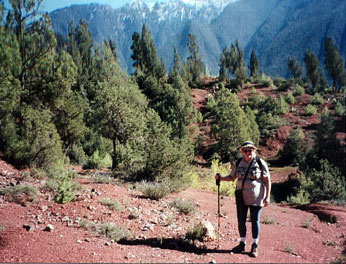
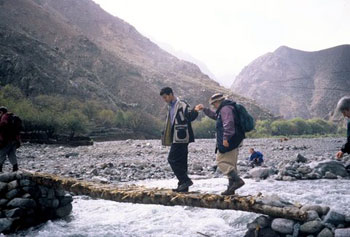
the author, Ruth Kozak, on her Morocco trekMy Moroccan trekking adventure had begun from the beautiful city of Marrakech that nestles like a rose-quartz gemstone near the foothills of the snow-capped High Atlas Mountains. Our first trekking destination was the Ourika Valley. When we arrived at the starting point, we were forced to leave the van walk to the meeting point as the roads were impassable. We had to teeter across foot-wide Berber bridges fashioned out of sticks, suspended over the rushing white water and squeeze behind houses on uneven slippery pathways meant only for goats. In places where the road had washed away the mud-brick houses overhung precariously over the river bed .

The circle trip up the Ourika Valley took six hours, a total of just over seven kilometers. By the time we arrived back to where we had started, some of the road had been cleared. A van waited for us to take us back to the restaurant where our driver would be waiting. It was a ramshackle vehicle, the cabin gutted, with wooden benches along each side. Our group of fifteen trekkers and the tour leader crammed into the back. The driver, his companion and the Berber guides sat in the front and one other man stood on the back bumper. Amazingly, twenty people scrunched into a space that was meant for ten. In places, there was barely enough road left for the van to manoeuvre by. Miraculously we made it to the end of the road construction where our mini-van was waiting to take us back to Marrakech.

AMIZMIZ SOUQ AND A TREK ON THE FORESTRY ROAD

guide helping trekker across narrow bridgeEarly the next morning, we set off for a visit to the Berber market at the town of Amizmiz. A Moroccan souq is a total sensory experience. We were greeted by a cacophony of sounds: goat bells, braying donkeys, merchants calling out their wares and shoppers haggling, coppersmiths and blacksmiths hammering. The souq is comprised of very small shops and canopied stalls selling fish, meat, poultry, and locally grown fruit and vegetables, sacks of mint tea, nuts and dates. Spices such as saffron, cumin, ginger and cinnamon are displayed in colourful cone-shaped piles. The smells of mint, spices and baking foods fill the air with a mouth-watering fragrance. In one lane the barber shops were doing a brisk business. Men can get a shave and haircut while their wives bargain in the market. In another lane a man tends the barbecue coals under a dozen cone-shaped clay tajine pots containing chicken or lamb stewed with eggplant, carrots, onions and raisins in savory spices, to be served over steaming plates of couscous. Dinner’s ready when your shopping’s done!

Leaving the Amizmiz souq, we headed up into the mountains on a well-maintained forestry road. Here the villages are different from those in the Ourika Valley. Tiered on the mountainside, their ochre clay walls almost make them invisible in the mountain landscape. There are well-irrigated terraced gardens and lemon and olive groves. The road is lined with eucalyptus trees; the mountain slopes rocky and arid. The scent of lavender and thyme makes the air fragrant and the walk pleasant.

A WALK IN THE ASNI/OURIGANE FOOTHILLS

view of hillside village in MoroccoThe next morning we set off for another trek to inspect a higher route along the ravine above the River Ourigane. Instead of attempting the more difficult climb up into the mountains with the rest of the group, I opted to cross the valley on the Berber trails instead and was provided with my own personal guide, Mabourak.
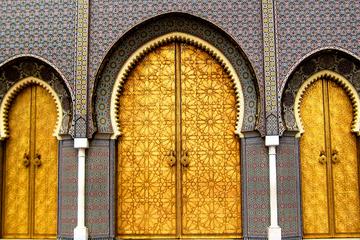
The countryside is stunning with its shrub-covered knolls and rich sienna-red earth. Because my guide was well informed about the flora and fauna of the land, our walk became a geology and botany lesson. Minerals abound in the area and I collected agate, flint, hematite and bits of lapis lazuli. Mabourak showed me wild garlic, thyme and other herbs and wild flowers. Low bush juniper and quince grow in abundance. In the reforested juniper groves wild boar are hunted. Other animals such as fox, mountain sheep and goats, and jackals roam here. There are many wild birds too, such as eagles, hawks, cuckoos and pheasants. The trek with Mabourak, was the highlight of my Moroccan adventure. I was glad that I’d had that time alone to absorb the beauty of the countryside and get acquainted with one of the locals.


7 Days Private Tour of Morocco

If You Go:

Currency in Morocco is the dirham. $1.00 U.S. = 7.91 dirham.
Passports valid from six months of issue are necessary but no visa is required. You must show a return ticket. It would be wise to check the travel immunization clinic before leaving and take along medication for stomach upset.
Travel warning: Be aware of pick-pockets and backpack slashers in crowded markets. If you enter the souks with a guide or hustler the price of everything you buy will be increased to include a commission for them, often as much as 40 per cent. Be prepared for the attentions of faux-guides.
Guides: Licensed guides can be hired for about $30 Cdn a day for sight seeing in the city or trekking in the country.
Clothing: It is advised for both female and male travellers to dress modestly to avoid hassles.
Taking photos: Vendors and performers in the souks expect to be paid. Many Moroccans don’t like having their photos taken so be discreet when doing so.
Tour groups: There are various tour companies offering group tours and treks. I went with Ramblers Holidays from London Eng. www.ramblersholiday.co.uk.
Where to stay: For hotel information: www.wtgonline.com
Or contact: Federation Nationale de l”Industrie Hotelieri, Angle Ave Nado et Rue 3, Quartier Polo, Casblanca 20550 fnih@iam.net.ma www.fnih.ma
Other Accomodation: There are well-organized campsites, youth hostels, self-catering suites and hotels of all categories available in Morocco. See www.travel.yahoo.com for more information on hotels.

About the author:
This trek in Morocco, made with a group of Ramblers from England, was a highlight of Ruth’s travel adventures although she preferred the more leisurely walk with just the guide than the group trek which tended at times to be like a road race.

All photographs are by W. Ruth Kozak.

Tagged With: Morocco travel Filed Under: Africa Travel

Morocco: Adventure in the Sahara

leading camels across sand dune

by Michael Ream

Heat waves rise from the sand as Ahmed hands me a canvas-wrapped water jug, a few beads of liquid glistening on its mouth. “Drink,” he orders as the sun beats down on my back, sweat staining my dusty canvas LL Bean shirt. I tip the jug back with both hands and take a good long swig.

A day and a half earlier I walked into the Sahara, just me, a fellow traveler and Ahmed, our guide. Now the three of us have come to this spot, a windswept patch of sand in the shade of an acacia tree, after walking miles without map, compass or GPS. Setting down the jug, I watch Ahmed saddle up the camels and silently hope for the best.

The road to the desert

The Sahara begins in southern Morocco, its dunes sprawling across the border with Algeria. The village of M’Hamid, a base for desert treks, is located over the Atlas Mountains from Marrakech, where I catch a bus in the city’s sprawling, chaotic transit station.

At Zagora, seven hours into the ride, my bus pulls into a forlorn, empty parking lot. Touts swarm the bus the moment I exit, offering desert treks. The hot breezes blowing across the lot are almost a relief after the erratic air conditioning on the bus.

The oldest – and biggest – of the touts, wearing faded jeans and a smudged polo shirt, pushes through the others, wedging himself between them and me, standing in an unshaded doorway, fanning myself with a map torn from my Lonely Planet. After his French brings only shrugs, he begins halting attempts in English. Simon, a Belgian whom I befriended on the bus, stands taciturnly behind me, arms crossed over his lanky frame.

Striking out with English, the tout follows us onto the bus as it pulls out of the lot. He sits down opposite Simon and jabbers away in French. Simon translates for me. “He’s offering us a trek via camel and four wheel drive, plus two nights in a hotel.” I start talking to the tout, with Simon serving as translator.
“We get two nights in the hotel as well as the trek?”

“Oh yes, very nice hotel,” replies the tout. “Nice dinner as well.” Nice seems to be a word he has practiced quite a bit.

“What about supplies, gear, stuff like that?”

“It’s all included.”

We go back and forth for a few more minutes, talking money, before we finally shake on a deal. The tout immediately dials his cell phone and talks excitedly for a few minutes. For the rest of the bus ride he hovers over us, following us outside whenever the bus stops, perhaps afraid to let us get away.

The sky has turned pitch black by the time the bus wheezes to a halt in M’Hamid’s dusty square. Temperatures are still in the high 80s, and the chocolates I purchased at the duty-free shop in JFK airport have melted in their tin container.

The village is literally at the end of the road, with the two-lane desert highway we just rode across petering out in the drifts of sand that blow through the streets. A scattering of ramshackle shops and cafes stand like lonely beacons in the night. A new group of touts clamors to carry our bags. We make our way to the hotel, a squat, boxy structure built around two courtyards, with a concrete bathhouse. The rooms are cell-like, with mattresses on the floor and wooden shutters with peeling paint. After a sumptuous feast of Moroccan tajine, meat and vegetable stew, with delicious fresh-baked bread, I lie down and immediately doze off.

A Lonely Landscape

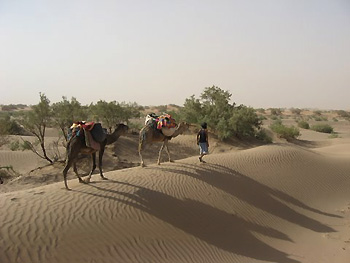
sand and camel in SaharaIn the morning, we meet Ahmed in a vacant lot by the hotel. His sky blue djellaba flutters in the desert breeze as he busies himself heaving baskets bulging with food, water jugs and blankets into large wicker baskets slung over the saddles of two camels.

The temperature is already well into the 90s. We set off on foot through the narrow streets of the village, Ahmed hauling the camels on a length of rope. Within minutes, we have left the village and are heading into a landscape of palm trees and sandy scrubland. Dun-colored dunes loom in the distance.

Ahmed moves briskly, taking a call on his cell phone and greeting a passing goatherd. Without breaking stride, he strips off his robe and turban, revealing a black tank top stretched over a ropy, muscular physique and a mop of thick black hair. He snaps his cell phone shut.

“How old are you?” he says, asking the question using a combination of French, English and hand gestures. We answer and then ask Ahmed his age. “Twenty-One,” he says, although he looks about sixteen.

Complete silence settles in. There’s no hum of power lines or even the chirping of a lone bird. Soon we reach a mudbrick fort. Trickles of shade fall across the weathered walls from an adjacent grove of palm trees. “Entre,” says Ahmed, gesturing toward a low doorway cut into a wall. I duck inside, past straw poking through the mudbrick, into a cool, cavelike room.

I lie down and doze off, wilted from the heat. Minutes later, Ahmed rouses me. He has rolled out a rug and set a sumptuous spread of Salade Marocaine, a colorful mélange of potatoes, green pepper, purple onion and ripe red tomatoes, swimming in the oil of sardines that are piled high on the communal platter. The three of us scoop up morsels of food with hunks of chewy, fresh-baked bread ripped directly from a round loaf. I lick my fingers clean and lounge on the rug, sitting up to accept a glass of sweet mint tea from a pot that Ahmed brews over a portable burner. Not even a buzzing fly can keep me from dozing off again.

Later, I blink in blinding rays of the sun that stream through the doorway. Ahmed and Simon are chatting away. “He’s one of eight children – or maybe it’s ten,” says Simon. “He guides when tourists are here, the rest of the time…” he shrugs. Life is hard in the desert.

Ahmed scurries outside and returns with a plastic water bottle filled with a thick white liquid. Camel’s milk. It’s frothy and very sweet. I drift back to sleep, blissfully dreaming of aquamarine pools and crashing waves.

Under the Stars

Sahara sand dunesWe head out, still pushing toward the dunes, traversing the humps of sand pockmarked with scrubby bushes. Suddenly, Ahmed turns to me and Simon and hands over the rope. He points into the distance and indicates he’ll join us shortly.

“What’s going on?” I say to Simon.

He shrugs, and we begin moving with the camels.

We stumble down a dune. I look over my shoulder. Ahmed turns to face east, drops to his knees and lowers his head to the ground. I continue moving forward. A few minutes later Ahmed catches up.

We crest dune after dune, the sun riding in the sky ahead and painting the sand a rich ocher. A nomad crosses our path, wrapped all in black, riding sidesaddle aboard a donkey laden down with canvas bags.

“Es salaam alaykum,” Ahmed calls out to him.

“Wa alaykum salaam,” replies the nomad, his donkey never breaking stride.

We reach an acacia tree, the only vegetation around, and Ahmed slows the camels, heeling them to the ground. “We camp here tonight,” Simon tells me after conferring with Ahmed. The camels move lazily over the endless dunes, snapping up what few blades of grass they can find.

Soon, Ahmed has a steady fire going from a few branches. As darkness descends, he settles a pot of tajine over the flames. After eating, we recline on the rugs. Ahmed stokes the fire and begins to dance around it, his robe whirling like a dervish. A wailing, guttural sound comes from his lips as he moves past the flames. Then he’s pointing at me and gesturing. “I think he wants you to sing a song from your country,” says Simon. I think for a moment, then begin: “This land is your land…”

Aboard the ships of the sand

In the morning, a slight chill hangs in the air and there’s a thin layer of moisture on my sleeping bag. Ahmed is already up, setting out a breakfast of bread with jam and butter. The water from the canvas jug is warm from the desert heat. I take a look around. No signs of life anywhere.

Ahmed motions to me. He’s rounded up the camels and has the saddles on them. I heave myself into the lead camel and off we ride. Riding a camel is like being atop a slow, rippling wave (Water metaphors come easy in the desert). I rock back and forth, steadying myself with the metal handhold on the saddle’s pommel. After just a few seconds, my hair is caked with sand, and grains have coated my hands like a second skin.

Return to civilization

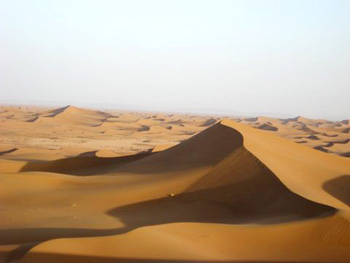
For two more days we bounce about the desert, utterly alone with the silence and emptiness. At another desert camp, a four-wheel drive owned by the tour company picks us up for a trip to the Erg Chigaga dunes, the most impressive yet: Close to 1,000 feet high. From the top, the view is of a full palette of reds, browns and yellows across the desert, with the occasional glimmer of green.

Back in M’Hamid, Simon and I clink two Coke bottles to our journey and successful return. The frosty glass bottles drip condensation onto a café table set on a dusty patio. Ahmed strolls up, and at first I don’t recognize him. He’s swapped his classic desert garb for a t-shirt for a Portugese soccer team. “Inshallah” he says with a wide smile beneath his turban. I smile back. It’s traditional here to tell one to “Go with God,” but it’s Ahmed who took us into the desert and back.


Private Tour: From Fez to Marrakech in 3 Days through the Sahara Desert

If You Go:

The official Moroccan National Tourist Office website: Visit Morocco

About the author:
Michael Ream is a journalist who has published travel articles about Tennessee, Mississippi and Louisiana and has been a reporter for newspapers in Arkansas, Mississippi and Illinois. He has traveled through Bolivia, Morocco, Spain, Ireland, the Netherlands, Germany, the Czech Republic, Slovakia and Hungary. Text and photos Copyright 2009 Michael Ream meream@rocketmail.com

All photos are by Michael Ream.

Tagged With: Morocco travel, Sahara treks Filed Under: Africa Travel

Dogon Cliffs of Bandiagara, Mali

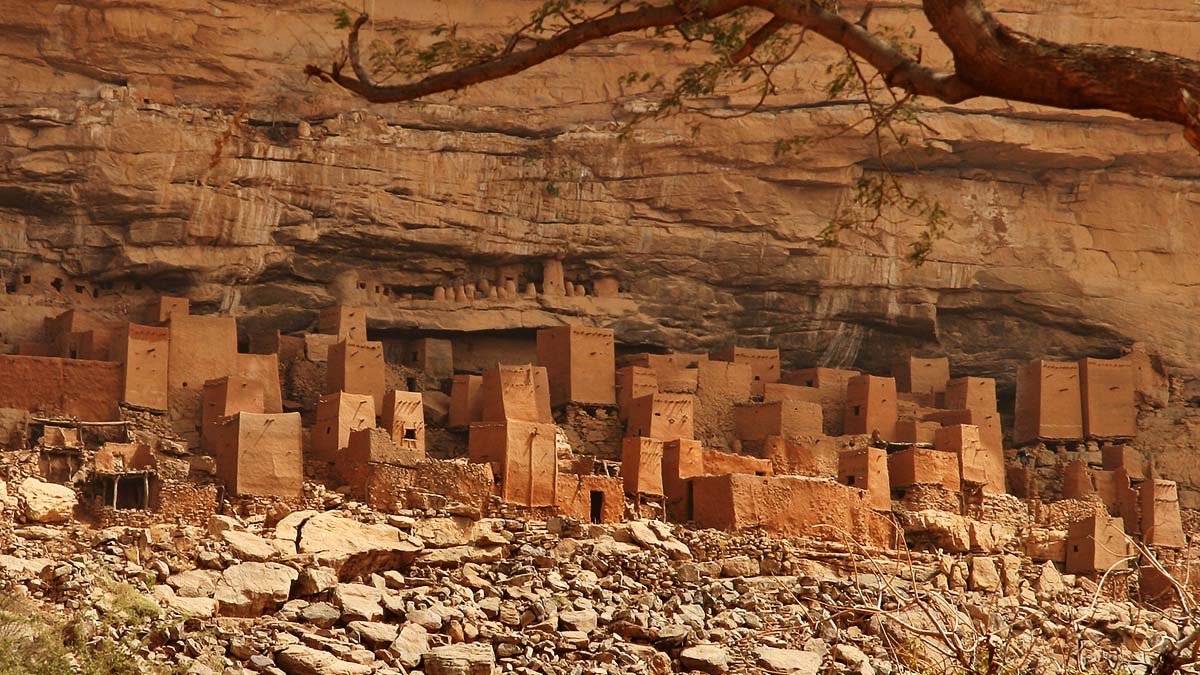
Dogon cliff dwellings in Bandiagara, Mali

by Emma Jacobs

We arrived in Bandiagara, at the edge of the region, before dawn in the dusty lot of the bus station. We had been on the bus from Bamako, Mali’s capital, for twelve hours. Around us, men were dispersing and the families with children were settling down to rest in the dusty terrain of the bus depot until morning. We looked around us, more than a little clueless. The night was pitch black.

Dogon village, MaliA motorcycle came roaring up out of the dark. Its light was blinding, but it honed in on us and approached swiftly. A man descended from it and approached us. Mamadou Traore would be our guide in Dogon Country.

Dogon Country denotes a region of roughly 400,000 hectares, following the Bandiagara Escarpment, an astonishing line of cliffs which climbs up to 500m at its highest points in 150 km. The stunning views from the top went for miles. Savannah went all the way to the horizon, or sand, or rock. The area felt at times impossibly remote, but it was one of Mali’s first tourist groups. Mamadou was one of a few dozen guides who led Americans and Germans and French tourists along the Dogon cliffs each year.

Mali countrysideMamadou had been leading groups through Dogon country for 15 years. Two years ago, he led at Italian on a hike who was so grateful that after he returned home he made Mamadou a website to help other tourists find him. Mamadou checks it every time he comes back to Bandiagara. A town of more than 10,000 people, it has one internet café a mile from the bus station where we’d arrived.

Mamadou would lead us across the expanses of desert and rock and take us up and down the traditional Dogon stairways, cascades of stone down crevices in the cliff face. Dogon women climbed right past us with buckets of water on their head. One woman had a basket on her head and a baby on her breast. Mamadou did all the climbing in a pair of blue flip flops.

The region’s inhabitants mostly belong to the Dogon and Peul ethnic groups, but is identified exclusively with the Dogon, who began arriving from elsewhere in the 15th century. Before the Dogon, the Tellem lived in the Bandiagara cliffs from the 11th century, constructing the top line of shelters bored into the cliffs. In Dogon stories, Tellem may figure in, sneaking back to the Bandiagara escarpment, though no one sees them. A thorough archaeological exploration from the years 1964 to 1971 definitively found evidence of the presence of this Dogon myth.
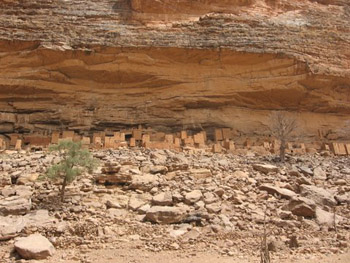
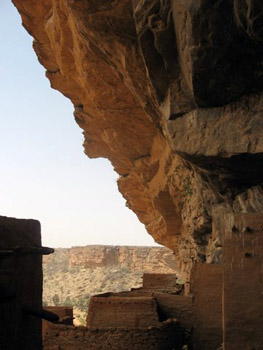
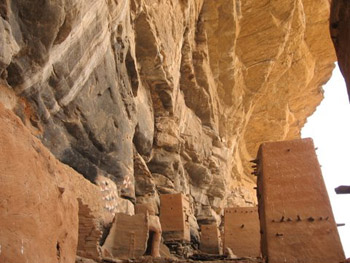
Tellem construction in the Bandiagara cliffsThe Tellem were agriculturalists, traditionally believed to be unusually small, who stored their food and buried their dead in caves high up the face of the cliffs. Caves have been discovered with the remains of up to 3000 people. One theory, ascribed to by our guide, suggests the Tellem ascended the cliffs on vines back when the valley was greener.

Today, Dogon country is dry. The average in 1994 was only 600mm of rain, and droughts generally last 8 months of the year. Desertification has only worsened with scrub clearance. The temperature nears 120 in the summer, when Mamadou takes a few months off. It’s too hot for the hike.

The Tellem disappeared gradually from the valley after the 15th century, forced out by raids, and perhaps by a change in climate. The Dogon are believed to have migrated from the east—their oral history says from the land of Mandé —to this extreme region to escape the spread of Islam, which threatened animist traditions. The Dogon were agriculturalists from the start and arrived and settled in small groups, often isolated from each other. They often constructed their original villages some ways up the cliff walls. The buildings they erected on the sides of the Bandiagara cliffs were built of stones and mortar. The Dogon constructed mainly houses, but also granaries.

The Dogon cultivate rice, millet and sorghum. We would come upon fields of green onions for export to Bamako, a startlingly brilliant green in all that desert. The villages halfway up the cliffs had been gradually abandoned for more accessible terrain below closer to the crops and to available water supplies.

Today the Dogon villages are arrayed along the tops and bottoms of the cliffs. The villages are small and often long distances from each other. There are at least 15 dialects of Dogon today, some of which defy the comprehension of other Dogon speakers beyond the basic, rhythmic greetings.

close up of Bandiagara cave constructionAbove certain villages on the cliff tops, Mamadou showed us crevices in the rocks where masks are stored. The Dogon would fascinate colonial anthropologists and archaeologists, the first European travelers to write accounts of Dogon Country, most of all intrigued by Dogon ritual and exquisitely carved masks. The Sigui ceremony, held every sixty years, is best-known of these rituals and occasion for some of the most elaborate masks. Researchers suggest Dogon culture is fluid and “accumulative” and these festivals could have changed over the many years of their continuation.

Mamadou told us the first tourists to Dogon Country arrived in the 1970s. The interest in Malian antiques began during the same period and the leakage of the country’s national heritage to foreign parts worsened. The head of Mali’s national museum, Samuel Sidibe, has decried the systematic looting of the Bandiagara caves for tellem artifacts for resale to foreign antiquities dealers. Efforts have been made to organize and educate local populations and outlaw the export of Malian artifacts, but the fight is a difficult one in a very poor region in one of the world’s poorest countries.

We were told that the Dogon guides had been put in place to control the influence of the tourists on the Dogon villages. What’s mentioned most often is that the tourists gave the children things, candy and toys, and that their elders fear what will happen to the children’s work ethic.

Granting the validity of their parent’s concern, Dogon Country was also one of the most visibly suffering regions I saw in West Africa: villages where there were more children than not had distended bellies, others where there was only well water, and one village where the well water was such a dark, muddy yellow color that not even the bravest of our group would try to drink it with only our chlorine tablets.

view from in Bandiagara cliffThe Cliffs of Bandiagara were named a UNESCO World Heritage Site in 1989, but the most obvious benefit this seems to bring is more tourists. Our guide helped us climb up to the lowest level of Dogon homes embedded in the cliffs. Walking though the abandoned villages, the structures date back centuries, but still appear virtually untouched. We passed through certain of the doorways and stood inside. At one point, our guide pointed us to a burial site, where a hole had been punctured through the walls. There were bones inside. Bowls and shards of pottery lay abandoned in the rooms of the homes.

Mamadou mentioned with pride the restorations of the cliff dwellings taking place with funding from UNESCO. Some of the buildings on the cliffs have undergone retouching. A man with a clipboard would approach us back in Bandiagara at the end of the week with a survey on sustainable tourism. Mamadou seemed unimpressed. Tourists have been coming to this region for thirty years, he told us. The region didn’t need that study.

When the World Heritage program made its case for the significance of the Cliffs of Bandiagara back in the late ’80s, its report cited the cliff cemeteries and Dogon stairways, but the writer of the essay go on to cite the living Dogon cultural history embedded in this region. You can feel it just beneath the surface, an accumulation of many years of tradition and change.

If You Go:

The Lonely Planet Guide to Mali is an essential on this trip. Visitors usually arrive in Mali’s capital, Bamako. From there, the bus ride to Dogon Country takes about 12 hours. Travelers willing to spend a little more can purchase the services of a vehicle and driver. In Dogon Country, guides can be hired in one of the larger towns you will arrive in. Once you’ve worked out an agreement, they’ll help find your meals and lodging at one of the many encampments scattered throughout the area villages. Hikes cease during the hottest months, beginning around April or May.

About the author:
Emma Jacobs is a student and mostly radio journalist currently based in New York City. She’s finishing up a degree in history and planning her next trip overseas.

Photo Credits:
Bandiagara Escarpment, Mali by Ferdinand Reus from Arnhem, Holland / CC BY-SA
All other photos are by Emma Jacobs.

Tagged With: Dogon, Mali travel Filed Under: Africa Travel

Philae, Pearl of the Nile

Philae Temple Egypt

The Temples of Philae: Aswan, Egypt

by Aaron Robertson

We were tired after arriving in Aswan early in the morning on the overnight train from Cairo. However, it was a beautiful day, and we didn’t want to waste it so we headed off to see the Temples of Philae, which lie just south of the city on an island in the river Nile. With our guide, Mohammed, we arrived at the small jetty where boats leave for the island.

The Isis Temple of Philae at AswanThe completion of the Aswan Low Dam in 1902 meant that several archaeological sites on this part of the river, including the temple complex on the island of Philae, were consequently submerged for most of the year. The construction of the Aswan high dam further downstream, between 1960-70, threatened to leave these sites permanently underwater. Thankfully, UNESCO decided to remove the endangered temples from Philae block by block, and reconstruct them about 500 meters away, on the nearby island of Agilkia, which would remain above water after the high dam was finished. This ambitious project lasted from 1972-80.

As we approached the island, it was not hard to see why Philae was once known as “the pearl of Egypt”. Rising graciously out of the river, the temples exude an air of classical majesty even at this late stage in their history. One can only imagine what they must have looked like in all their splendor. As we docked, Mohammed explained that Philae was formerly a centre of worship of the god Isis. Egyptian mythology says that it was here that Isis found the heart of her husband, Osiris, after his jealous brother Seth had killed him, spreading the different parts of Osiris’s body throughout Egypt so that he could not be bought back to life.

carvings at Philae templeThe large temple of Isis dominates the island, and this is where we started our tour. Crossing a large, open courtyard with a colonnade running down its western side, we were dwarfed by the temple’s first pylon, or gateway. Towering images of various Egyptian gods, among them Osiris, Isis, and their son, the falcon-headed Horus, are carved into its facade. Numerous pharaohs are represented here as well, doing battle with their enemies, and making offerings to the gods to ensure their victory and prosperity. The scenes still inspire a sense of awe today, not least for the amount of work that must have gone in to creating them.

The temple was mostly constructed during the reign of the pharaoh Ptolemy II Philadelphus (284-246 BC) and his son, Ptolemy III Euergetes (246-222 BC). Despite being constructed at a relatively late stage in ancient Egypt’s history, the temple follows a very classical layout. Moving inside, we entered another courtyard, which lies before a second, smaller pylon sitting at a slight angle to the first. To the right of this inner courtyard lie the remains of rooms that used to house the temple priests and guards. To the left is a mamissi, or birth-house. This type of small building became popular after the reign of the female pharaoh, Hatshepsut (1479-58 BC), and was designed to prove a pharaoh’s supposed descent from the god Horus.

Coptic cross carved on Isis temple columnPassing the second pylon, also adorned with large images of the gods, we entered the temple’s hypostyle, or columned hall. Here you can catch a small glimpse of what the temple must have originally looked like, when much of its stone was adorned with bright colors. On the roof, Mohammed pointed out a row of painted vultures, an ancient symbol of Upper Egypt. He also pointed out a Coptic cross, cut into one of the hall’s columns during the period when the temple was used as a Christian church. Amazingly, the cult of Isis was kept alive here until the Byzantine Emperor, Justinian, finally disbanded the temple’s pagan priesthood around 550 AD. Some believe that for many years before this, Isis was worshipped on the island side by side with Coptic Christianity.

scene from Orisris legend at PhilaeThe hypostyle hall leads though several antechambers into the temple sanctuary. The walls of these rooms are covered with scenes from the legend of Osiris, depicting his death at the hands of his brother Seth, and his eventual resurrection. In the sanctuary, which once only the ruling pharaoh or the temple’s head priest had the right to enter, there still stands the pedestal for the sacred statue of Isis, used in all of the temple’s rituals. The sanctuary’s granite shrines were carried off to European museums during the 19th century, but here in the small, dimly lit room, a strong sense of ceremony still remains.

Emerging back into the glare of the bright sunlight, Mohammed led us around a number of the other small temples and buildings on the island. The oldest of these is a small vestibule built during the reign of Nectanebos I (380-362 BC), founder of the 30th and last dynasty of native Egyptian pharaohs. Also dedicated to Isis, just six of its original fourteen columns remain, linked together by a low screen wall. Close to this, on the western side of the island is one of the few remaining Nilometers. These modern-sounding devices where once used to determine the level of taxes in ancient Egypt, which changed during the year to match the seasonal level of the river.

Hathor temple at Philae AswanOn the eastern side of the island sits a well-preserved temple dedicated to the god Hathor, built under Ptolemy VI Philometor (170-145 BC), and a large kiosk that once served as the formal entrance to the island. This building, sometimes called the pharaoh’s bed, is named after the Roman Emperor, Trajan, but may have been built earlier during the reign of Augustus. It was never entirely completed, but its remains have stood the test of time remarkably well. Ironically perhaps, the kiosk’s fourteen massive columns became an icon of Philae long before the larger and older temple of Isis, featuring on many 19th century postcards.

After finishing our tour, we headed to the welcome shade of the island’s small café for a well-deserved drink. Sitting in the middle of the now much-swollen Nile, the island provides a remarkable setting for what was once a major site of worship in ancient Egypt. At least when we were there, it seemed positively serene in comparison to the hustle and bustle of even a small Egyptian city like Aswan. As we pulled slowly away from the island in the same small boat that had bought us there, we regretted not being able to spend longer taking in the temples’ languid, tranquil atmosphere.


Guided Aswan Day Trip Philae and Kalabsha Temples and Nubian Museum with Lunch

If You Go:

Aswan can be reached from Cairo by either plane, or by a train that also stops at Luxor on the way. From Luxor, cruise boats also make the trip to Aswan. If you haven’t organized a guided tour to the Temples of Philae before you get there, your hotel in Aswan will probably be able to organize one for you. If you want to see the temples by yourself, the point where boats leave for the island is a short taxi ride south of the city centre. This is where the ticket office for the temples is also located.

For more information:
Philae on Wikipedia
Egypt Travel – Aswan: Philae Temple Complex

About the author:
Aaron Robertson left New Zealand in 1999, and has spent the intervening years trying to see as much of the world as possible. He currently lives in Paris, France, where he works as a freelance copywriter and musician. aaronwr@hotmail.com

Photo credits:
First Philae temple image by DEZALB from Pixabay
All other photos are by Aaron Robertson.

Tagged With: Aswan attractions, Egypt travel Filed Under: Africa Travel

A Kenya Photo Safari Adventure

Zebras in Kenya

The Hunters and the Hunted

by Arun Bhatia

“Everyone who has a chance to see nearly two million animals on the move has been touched by the magic of this place. What is it that gets under their skin? The urgency of the movement of the wildebeest? The wide open plains? The African light? Or maybe it is the fact that we all came from here, not such a long time ago, and our deep unconsciousness remembers the time, 60,000 generations ago…Or maybe it is just the sheer number of the migrating animals as they move in the world’s last surviving great migration, ” these words, quoted from Markus Borner, Frankfurt Zoo representative in Serengeti, are about the Great Migration.

I had seen it on the Discovery, National Geographic and Animal Planet channels and elsewhere in vivid detail, helicopter shots with multiple cameras by ace photographers wielding the latest gadgets, backed by satellite image experts, ethologists, cartographers and wildlife scientists.

group of WildebeestWould watching the migrating wildebeest and zebras live be different? Armed with binoculars and an 8 megapixel 35 to 420 mm lens digital camera, I was leaning out of a sliding roof safari van, moving in the amazing Serengeti-Masai Mara ecosystem. Would I get more out it because I am here? I wondered. Indeed I did. I saw and photographed and learned some intriguing facts.

For instance, the White Bearded Wildebeest (Connochaetes taurinus) lives without any family ties. There is no leader. Any individual can start walking, and tens of thousands follow.The wildebeest cross the Mara River near the Oloololo Gate and the crossing is a spectacle. Especially since below, waiting in the river are the enormous Mara River crocodiles.

The river banks are worn down by hundreds of years of crossings, while at other places, they are vertical on both sides. The wildebeest and zebras hurtle down the earth banks, swim 30 or 50 feet and struggle in their teeming hundreds to find a safe way out at the other bank. Many drown or get snapped by crocodiles.

leopard in grassThere are other hunters and predators too. The Masai Mara has the second highest lion density in the world with 500 lions in 1500 square kilometers. Thousands of animals are taken by them and by other predators: leopards, cheetah and hyenas – the latter being serious hunters, not just the scavengers they once were. That said, thousands of animals do cross safely and the statistics for a “good” year say 1.5 million cross safely.

Further along the route of migration, from the roof of our van, I photograph an intriguing face off. A lion family had apparently killed a migrating zebra and sits near the prey. But with huge ears sticking out menacingly, a matriarch elephant protects the dead zebra, so the lions sit well away from the kill, as though waving a white flag. The knowledgeable van driver guide cannot explain this confrontation. The vegetarian elephant herd would not be interested in the kill for food. There is no known affinity between zebras and elephants. What does the matriarch with her long tusks expect to accomplish by coming between the lion and his prey?

herd of elephantsThe whole drama unfolds in leisurely fashion. It is an unhurried face off where one lion, then another, rises and ambles along near the kill, but is under the elephant’s watchful eye. The lion walks right past the dead zebra, turns round to face the kill, and sits down, as the elephant keeps an eye on him. It is near a swamp and while the drama unfolds, there are more photo opportunities with the birds: Egyptian geese, plovers, egrets, jacanas rise from the muddy environs, sometimes circle around and descend to continue preening and feeding.

After an interminable half an hour, the duel ends, with the lions strolling away as the matriarch watches. The elephant herd then crosses the dirt road, just twelve feet in front of our van.

“We don’t do anything to the elephants, so they don’t do anything to us, you take photo” whispers the van driver guide.

Many of my shots of those dozen massive pachyderms passing so close to me are useless because of a camera shake in my nervous hands. Soon, the spotted hyenas are moving in from afar, to claim their share of the killed zebra.

Masai men in colorful tribal wardrobeWanting a better angle for my camera, I open the door to alight from the van. The van driver guard promptly stops me: it is against the law to get off the van when one is inside the park. The only humans that break this law are the Masai tribe members, who nonchalantly roam about on foot in the game park, grazing their cattle. Though they don’t hunt for food, these tall handsome tribesmen are capable of defending themselves with spear and club.

The Masai are yet another plus for me over the TV channels’ enthralling footage. The van driver guide fixes a fee with them and they welcome me at their Masai village with a welcome drink of cow’s blood and cow’s milk (half and half). I am too squeamish to accept the drink. They show how they light a fire using sticks, try to sell trinkets and bangles that they have handcrafted, and do a group dance with the tall handsome men leaping straight upward. Some speak English and joke how the very tall leader is a giraffe. “No”, I say, pointing to his goatee: “He is a goat!”

Everyone bursts out laughing.

“Ok,” concludes the genial leader with a grin, “I am … a … goat giraffe.”

Back home in Bangalore this charming anecdote amuses my family and friends: making a spear wielding ferocious Masai leader admit to being a “goat giraffe.”

If You Go:

The main city is Nairobi.
Amboseli is 120 miles from Nairobi and the usual route is via Namanga. The other route is via Emali on the Nairobi-Mombasa road.
The Masai Mara lies about lies 160 miles from Nairobi (5 hours by road). There are scheduled flights from Wilson Airport, Nairobi, which take about 40 minutes.
Hire a private vehicle to go around the park, or book an organized safari.

Accommodations:
Lodging is available in luxury tents within the reserves (you can even pitch your own as a cheaper option.) There are several hotels around the parks, too.
Best time to visit:
The dry season from July to March is the best time to see wildlife, and the migration occurs in August.

For more information:
Kenya travel details on Wikitravel

3 Days Masai Mara Safari

Kenya Safari Package to Amboseli National Park for 2 days


About the author:
Arun Bhatia is a 73 year old freelance writer/photographer. He began in freshman year as a cub reporter at U.C.L.A. in 1953, contributing to dailies, weeklies, monthlies etc. in India and elsewhere. Working as senior model in ads/adfilms, willing to make whatever monkey faces at the camera as directed, as long as they paid modeling fees. He rides a 10 year old gearless Honda scooter, grumbles about traffic choked Bangalore roads, and does yoga/pranayama regularly.

Photo credits:
All photos are by Arun Bhatia.

Tagged With: Kenya travel, photo safari Filed Under: Africa Travel

  • « Previous Page
  • 1
  • …
  • 7
  • 8
  • 9
  • 10
  • Next Page »

MORE TRAVEL STORIES:

Tulum, Mexico: City of Dawn

“Indiana Jones” and the Lost Kingdom of the Submerged Crocodile

Best Time To Visit Tenerife: Weather, Temperature, & Season

Time Travel in Colorado: 10 Historic Places You Can Still Visit in 2025

Bermuda, Jewel of the Atlantic

Why Are Travelers Turning to Boat Clubs: A Guide to Visiting Lake Tarpon, Florida

There’s a Certain Humanity in The Hague

Kazakhstan: Adopting a New Attitude Towards Karaganda


SEARCH

DESTINATIONS

  • Africa Travel
  • Antarctica travel
  • Asia Travel
  • Australia travel
  • Caribbean Travel
  • Central America Travel
  • Europe Travel
  • Middle East Travel
  • North America Travel
  • Oceania Travel
  • South America Travel
  • Travel History
  • Travel News
  • UK Travel
  • Uncategorized
  • World Travel
facebook
Best Travel Blogs - OnToplist.com

Copyright © 2025 Cedar Cottage Marketing | About Us | Contact | Privacy Policy | Terms & Conditions | Copyright Notice | Log in