Bangladesh
by Paola Fornari
‘They used to say that a Dhaka muslin sari [also spelled saree] should fit in a matchbox,’ Mithu says. ‘It could be pulled through a wedding ring. The Jamdani sari is an updated version of the muslin one. Fine, but not matchbox-fine. Anyone in South Asia who knows anything about fashion will recognise a Jamdani.’
 We are weaving our way through the heavy Dhaka traffic towards the eastern suburbs. I heard about Jamdani saris a while ago when I admired a woman wearing one at a reception. I was amazed by the delicate designs woven into the floaty gossamer fabric.
So I hire Mithu to take me to visit a factory. Along the way, he fills me in.
‘They’ve been making muslin here for two thousand years,’ Mithu tells me. ‘The Jamdani weave is a later development. What distinguishes it are the fine geometric designs, often depicting flowers, or fruit, or spices.’
‘What does Jamdani mean?’
 ‘No-one really knows. Some people say it comes from the Persian jam, meaning flower, and dana, meaning vase. Jamdani became popular during the Mughal period. In the sixteenth century there were looms all over Dhaka. The fabric was used for saris, scarves and handkerchiefs. It was highly prized: traders came from all over Asia and Europe to buy it.’
After an hour the shop-lined tarmac avenues give way to wide dusty dirt roads. Packed buses, scores of people balancing precariously on the roofs, vie for space with heavily laden rickshaws, pulled at the front by wiry men, sweat dripping off their brows, and pushed from the back by young children. The temperature outside is a hundred degrees and rising.
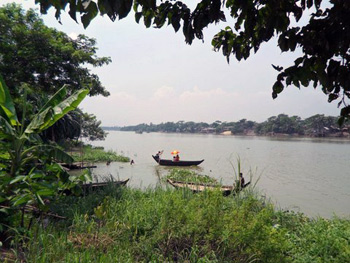 We cross a modern bridge over the huge River Shittalakka, which is a tributary of the mighty Brahmaputra, and turn left into an alleyway. Soon the road is too narrow for the car, so we get out and walk along a brick-paved path skirting the river bank. There are small shops along both sides, selling everything from kapok to bananas and skeins of colourful yarn.
‘It’s cotton and silk,’ Mithu says. ‘They dye it here for the factories.’
Soon we hear a clattering noise, which becomes louder as we approach a simple corrugated iron building.
‘Sheet factory,’ Mithu tells us. We peer through the windows to the dark room inside. One man is supervising the machines. The noise is unbearable—at least for me—so we move on.
‘That man will be deaf in ten years,’ Mithu says.
 We pass groups of people resting under trees, goats of various shapes, sizes and colours, and the inevitable rickshaws collapsing under the weight of their cargo. Everyone smiles and greets us along our way.
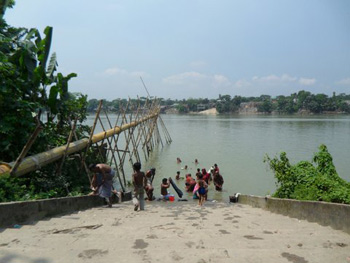
Every now and then there is a break in the line of shops to our left, to allow access to the water, and here, we get a clear view of Dhaka over on the far bank, boats navigating on the wide river, and on our side, groups of people splashing around in the water, taking a bathe and washing their clothes.
The water is murky.
 ‘How clean is it? I ask.
‘Not too bad. It’s much worse in January and February, when it doesn’t rain. In the dry season the water is multicoloured like a rainbow, because of all the dye from the factories upstream. People can’t bathe in it.’
A boatman calls to us. ‘Want a ride?’
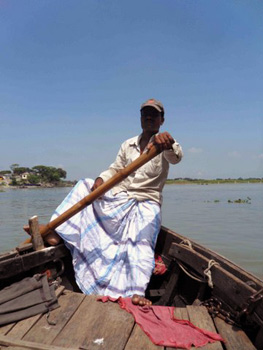
We accept, and step onto his simple craft, which takes us a couple of hundred metres further upstream. We pass a very fancy huge boat, aptly named ‘The Ark’.
‘That one belongs to the owner of The Daily Star,’ Mithu says. The Daily Star is Bangladesh’s biggest English Language newspaper. ‘He also owns several other companies. He comes here sometimes at the weekends to relax.’
You can see why: the atmosphere here is positively rural compared with Dhaka.
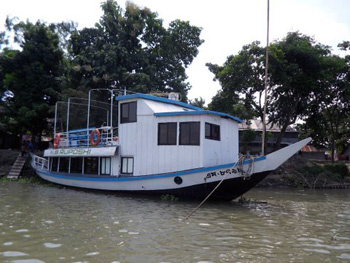
A little further along another, a more modest boat is moored.
‘That’s our boat, the Riposhi’ Mithu tells us, pointing out the Guide Tours logo. ‘We take people on all day cruises, or sunset barbecue cruises, to show them how people live along the river.’
We disembark, and walk a short way to a low building with a corrugated iron roof and latticed wooden walls. ‘This is the Jamdani factory,’ Mithu says.


The owner, a jolly man dressed only in a lungi—a loincloth—stands in front of a low building with a corrugated iron roof and latticed timber walls. He greets us warmly and shows us in.
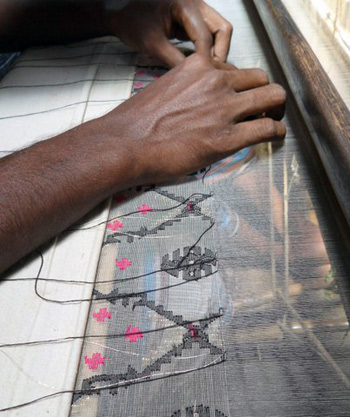
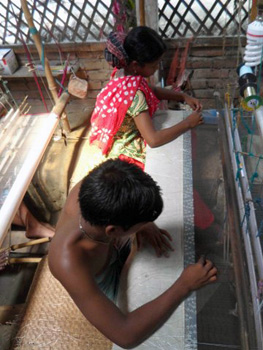
 I am immediately surprised by the silence. Seven wooden hand-looms are neatly lined up along the bright room: the only sound is the whir of overhead fans. Fourteen people sit working in pairs, their fingers dancing across the yarn. The colours are delicate, the patterns intricate, and the fabric as light as a butterfly’s wings.
‘Ask any questions you like; I’ll interpret,’ Mithu says.
‘What are their working hours?’
Mithu talks to the owner and reports back.
‘Seven a.m. to nine p.m. They break for three hours each day.’
‘And how much do they earn?’
‘Depends. The worker on the right is more skilled than the one on the left. He’ll make between one thousand five hundred and two thousand taka a week.’ That’s eighteen to twenty-four US dollars. ‘The person on the left gets half. Often, it’s a brother-sister team.
Or husband-wife. Or father-son.’
It’s mostly men who are on the right, and women and youngsters on the left.
I admire a young boy’s work. ‘How old is he?’
 ‘Fifteen, he says. But he doesn’t really know.’ He looks twelve.
A 2006 law in Bangladesh prohibits employment of children under fourteen, though from twelve they ‘may be engaged in “light work” that does not pose a risk to their mental and physical development and does not interfere with their education’.
This is impossible to enforce. And without the added wage of a working child, many families would not survive.
‘How long does it take to make a sari?’
‘Two weeks to four months, depending on the intricacy.’
‘What do they cost?’
‘From two thousand taka to two hundred thousand.’ (Twenty-four to two thousand four hundred dollars.)
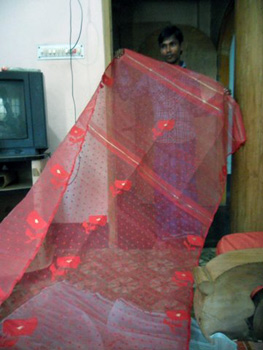
Once we’ve seen the factory, the owner invites us into his home, where I am invited to sit down in his living-room. A couple of assistants start bringing saris out of a wardrobe. They aren’t matchbox-sized, but they are certainly are folded into very tiny bundles.
One or two are opened out for me to see, and as I begin to ooh and aah, more are unfolded. The colours range from gaudy leaf green and scarlet to delicate off white, and black.
‘They make them for Aarong and Aranya. But you’d pay a lot more if you bought them there,’ Mithu tells me. Aarong is Bangladesh’s most successful handicrafts and textiles store, with several branches across the country, and Aranya is a beautiful clothes shop that uses only fabrics with natural dyes.
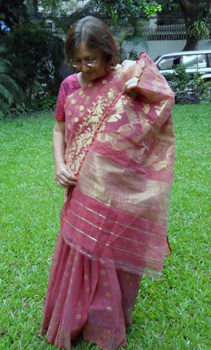
After some deliberation and much negotiation, I select a black and a dusty pink.


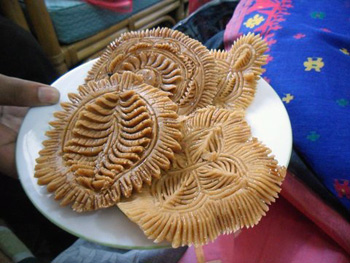 The owner’s wife brings us some beautifully sculpted cookies, which are both oily and crispy, oven-hot, and absolutely delicious.
We take our leave, wave at the workers through the latticed walls of the factory, and wander towards the river, where Mithu has invited me to take a break on the Riposhi.
As we rest, sipping sickly sweet tea and munching a cookie, I wonder about the ethics of it all. Two people have spent weeks slogging over my saris. They have sat at their looms from dawn till dusk, with few breaks. Children are there, working. How long will their eyesight survive the close, detailed work they do? Should I be buying from them?
On the other hand, they are working in a congenial environment—much better than the plastics factories in Old Dhaka where I have seen very young children working. It’s quiet, clean, and cool. These weavers are highly skilled. They take pride in their work. They live near the factory, and don’t have to face Dhaka traffic. And if people like me didn’t buy their saris, they wouldn’t have a wage at all.
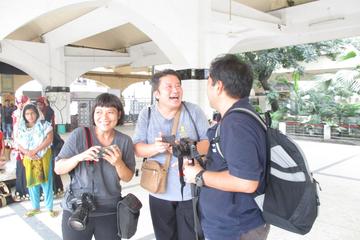
Private Day Tour: Dhaka Photography
If You Go:
♦ For information about Guide tours in Bangladesh, see www.guidetours.com
♦ For information about Aranya and Aarong stores, see www.aarong.com/
♦ For information about travel in Baglasdesh, see travel-in-bangladesh.blogspot.com
About the author:
Paola Fornari was born on an island on Lake Victoria, and was brought up in Tanzania. She has lived in a dozen countries over four continents, speaks five and a half languages, and describes herself as an expatriate sine patria. At present she is living in Bangladesh. An abridged version of this article was published in The Oldie magazine, March 2012
Photo Credits:
All photographs are by Paula Fornari.
- Fingers dance across the fabric
- Families bathe and wash their clothes in the river
- A boatman gives us a ride down the river
- View over the river
- Guide Tours boat, the Riposhi, where we have a cup of tea
- Pair teams, with the more experienced worker on the left
- A sari unfolded
- Trying out my pink Jamdani sari
- The deal is done: cookies to celebrate

 Midway through the dinner, the Maharaja extended his royal invitation to me and my family to be honored guests of his palace. I was absolutely delighted with the offer. A fortnight after the Navaratri festivities, I booked a flight to Ahmedabad and travelled onwards to Gondal by road. By the time we reached Gondal’s magnificent Orchard Palace, it was late evening and dusk had already descended here. I was informed by the palace’s caretaker that the Maharaja was out of town and would be back in a day’s time.
 During his rule, the residents of Gondal were exempt from paying taxes as he evolved an innovative land revenue system. To make Gondal self-sufficient in livestock, he introduced animal husbandry while to improve the agricultural sector, extensive irrigation network was developed, which brought even the wastelands surrounding Gondal under the ambit of modern agriculture. The Maharaja’s visionary outlook ensured that even those with very little academic background too were also offered meaningful employment with the setting up of technical schools that imparted training on domains like carpentry, mechanics, surveyors, painters and engineers.
 However, the best was yet to come viz-a-viz the Royal Garages about which I had heard so much from my Gujarati friends at Kolkata. As I was ushered in to the garage compound by my guide, I was downright stupefied by the huge collection of vintage cars which were stationed in individual sheds. This was easily one of the greatest collection of vintage cars in the whole of Asia. The collection ranged from the 1910 New Engine to the more elegant 1940-50s Cadillacs as well as a few truly impressive American cars of the 50s. The best part of the Royal Garages was the remarkable collection of horse drawn carriages, which was inclusive of the Victorian and Shetland carriages.
 No visit to the Naulakha Palace is ever complete without a visit to the exclusive Palace museum which showcases the rare collection of silver caskets which I was told were used to carry messages and gifts for the erstwhile Maharaja of Gondal.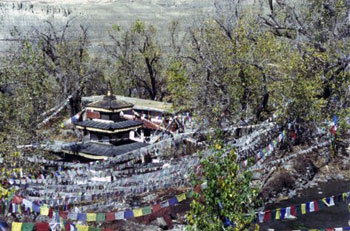
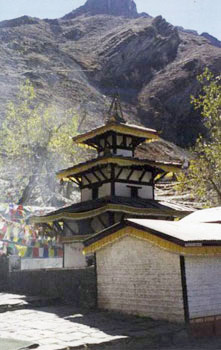
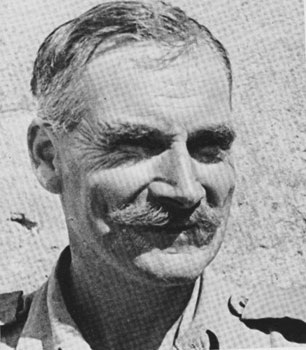 Well over a half century ago the inveterate British mountaineer and travel writer, H.W. ‘Bill’ Tilman (b.1898), was the first European to trek across some of the highest parts of Nepal. It was 1949, and one of his stops was the sacred Hindu/Buddhist pilgrimage shrine of Muktinath, near the Tibet border on the north side of the Annapurna massif.

 Tilman’s Nepal Himalaya was our guide. It’s a classic of the Himalayan literature, one that belongs in the personal library of every ardent or aspiring mountaineer and trekker. It is notable not only for its descriptions of the medieval-like conditions of rural Nepal over half a century ago, but for the author’s unique candor and style.
 Tilman’s prose was more serious, informative and insightful, but no less entertaining. For example, in one chapter of his book he wrote, tongue-in-cheek, that he and his companions failed to summit Annapurna-IV (24,688 ft) simply because of an “inability to reach the top.”
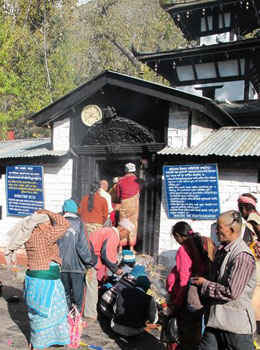 His party “camped near the topmost house of the straggling village where our arrival created no stir. A place to which several thousand pilgrims come every year must be accustomed to strange sights.”
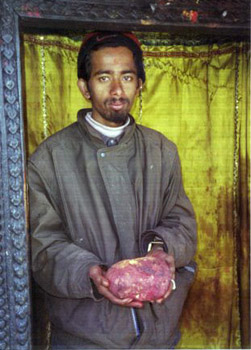 Tilman noted that Muktinath “owes its sanctity to the presence of the thrice-sacred ‘shaligram’,” the local name for black ammonite fossils found in abundance in this locale. Hindus worship the coiled shaligrams as representations of Lord Vishnu. Buddhists consider them to represent Gawo Jogpa, a serpent deity. Geologically they date back 165 million years to a time when this high-rise landscape lay covered by mud at the bottom of the Tethys Sea. Back then, long before the Himalayas were formed, the shallow Tethys separated Gondwanaland (today’s Indian subcontinent) from Laurasia (the Tibetan plateau). You can well imagine the looks of wonder in the eyes of today’s pilgrims from the plains upon finding the encrustations of ancient sea creatures so high in the mountains.
 The fires of Jwala Mai were first described in English by David Snellgrove, a British Tibetologist who visited Muktinath in 1956. In his book, Himalayan Pilgrimage (1961), Snellgrove wrote that “The flames of natural gas burn in little caves at floor level in the far right-hand corner. One does indeed burn from earth; one burns just beside a little spring (‘from water’); and one ‘from stone’ exhausted itself two years ago [1954] and so burns no longer, at which local people express concern.”
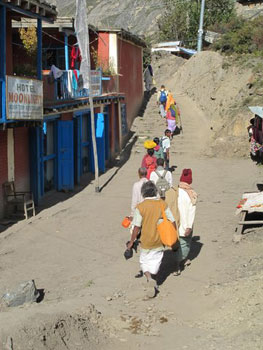
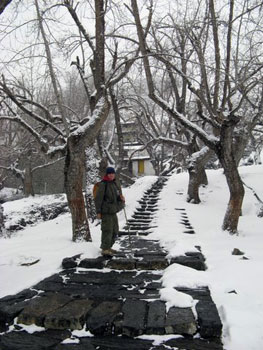 On the secular side of Muktinath, the physical facilities available to pilgrims consist primarily of uncomfortable cold stone shelters wide open to the elements. In recent years, several tourist hotels and trekkers’ guesthouses have been built at Rani Pauwa (‘Queen’s Resthouse’), a small settlement below the shrine. They bear such names as Shri Muktinath Hotel and Royal Mustang Hotel, and one that is inexplicably named after Bob Marley, the renowned Rastafarian musician.
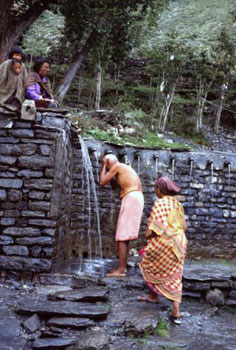
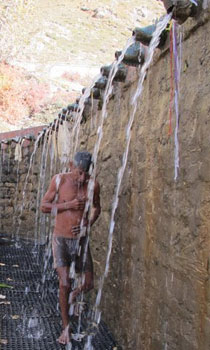 I set out to trace the etymological roots of “resort,” the noun. In Roget’s Thesaurus I found a long list of synonyms: haunt, hangout, playground, vacation spot, gathering place, club, and casino. A place for recreation, like a ski lodge. A health spa, baths or springs. All the things we expect a “resort” to be. The only association between these contemporary descriptors and Muktinath’s ascetic reality are those “hundred-odd” cold mountain springs. But I can’t imagine Tilman cavorting playfully in the frigid waters then calling it a “resort.”

 (1952) is now a rare book. Fortunately, it has been reprinted in Tilman’s Seven Mountain-Travel Books by The Mountaineers (Seattle) and Diadem Books (London) (1983). There are also several biographies of him as mountaineer (in his youth), sailor (in later life), and discerning travel writer (life-long).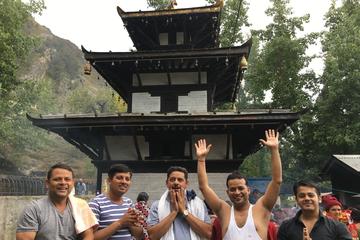
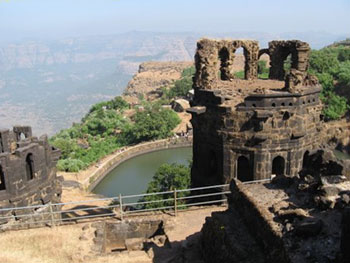
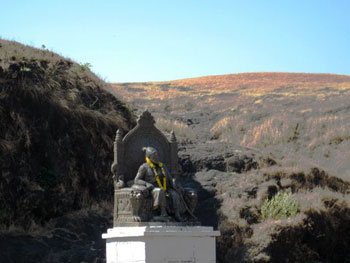 The Ropeway is like an elevator going up and down. Within minutes, it was our turn to get into the cable car and I readied my camera to get some pictures. Before I could catch my breath it was time to disembark at the Mena Darwaza – the alighting point for the Ropeway travelers. There we were met by Mr. Gaikwad, our guide on ‘Raigad’, who took us to a waiting group for further action. The starting point of our tour was the Mena Darwaza – the entrance through which the ladies of the Fort would enter. Fort Raigad was the capital of the most illustrious Maratha sovereign, Chhatrapati Shivaji Maharaj. European historians have described it as ‘The Gibraltar of the East’. The sheer vertical rock face soaring into the sky above appears defiant and insurmountable. As the guide took us along through the various points on the Fort, he explained everything with a great amount of passion. Innumerable tales of Shivaji’s strategies and valor were narrated as reasons towards his many wives. Apparently, he married princesses from various places to ensure that he would not be attacked by the rulers of those states! We counted eight living quarters specifically meant for his queens. He was so organized that he had a full-fledged ‘Secretariat’, the remnants of which can still be seen.
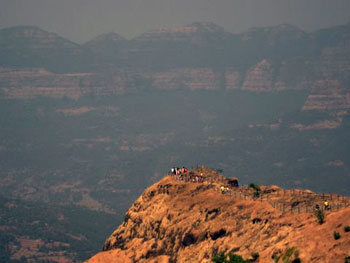 To ensure that his entourage and their families who lived with him on the Fort were comfortable, there was a ‘Bazaar Peth’ that was headed by one Nagappa Seth. Trading of daily consumables was carried out here for the convenience of the Fort residents. However, nowhere on the Fort was anyone allowed to display their name on any property and Nagappa wanted to feature somewhere somehow. Since he was not allowed to display his name anywhere, he displayed a ‘Naag’ or snake on the wall of his shop to symbolize his presence! We were then shown the ‘TakMak’ point, which is the edge of a sheer cliff from where traitors would be thrown off as punishment. This particular point also has a curious tale of steadfast devotion and obedience. Chhatrapati Shivaji used to visit the place often and would always be accompanied by a ‘Chhatri’ or an Umbrella bearer.
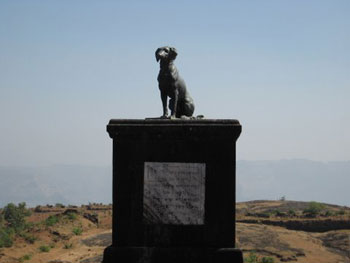 On one of these visits, due to strong winds, the Chhatri bearer who was under orders not to leave the Chhatri under any circumstances, was blown off the cliff but miraculously parachuted down to a village named Nizampur. Chhatrapati Shivaji then announced that the village would henceforth be called Chhatri Nizampur.
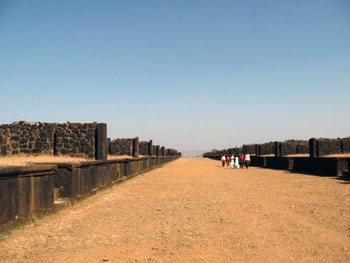 The overall area over which the Fort is built is huge and it would take at least a couple of days or more for a thorough absorption of the history therein. So, with a promise to return yet another day and spend a couple of days in the peaceful environs, we start on our way back. Lunch at ‘Kulkarni’s Suyash’ restaurant near Mangaon on our return trip is memorable for a couple of reasons. The first of course is the delicious food in a natural ambience and second is the crows that descend on the tables at every opportunity to peck at the leftovers. This in spite of the catapult bearers who keep taking potshots at the intruders. It seems like a regular game between the birds and boys!