by Thomas Kenning
Hiroshima. The very name conjures powerful images of mushroom clouds and devastation. The city’s atomic past is an integral part of its identity, but it is also a living city with fantastic opportunities for fun, culture, and entertainment. During my recent visit, I had the chance to meditate on a dark past at the Atomic Bomb Dome, a UNESCO World Heritage Site, take in a major league baseball game with the Hiroshima Carp, and participate in the annual lantern ceremony on the banks of the Ota River.
The Hypocenter
 My first stop is the hypocenter upon which sixty-six years ago, the world’s first atomic bomb was used against human targets. Aimed at the T-shaped Aioi Bridge near the geographic center of town, wind blew the bomb slightly off course some 500 meters to the southwest where it detonated over Shima Hospital.
Contrary to the assertions of U.S. propaganda and President Harry Truman, Hiroshima was not a military base by any stretch. It was a city of about three hundred thousand, seventy thousand people died instantly, and nearly one hundred fifty thousand died by the end of the year. Of that number, only a few thousand were soldiers. The very fact that U.S. military planners were willing to leave the city untouched for so long testifies to its irrelevance as a military target – it was so unimportant that military planes could afford leave it untouched for the last, grand act of the war.
Hiroshima was singled-out early on during the extensive U.S. firebombing raids against Japan that were ongoing through mid-1945. As such, it was spared any preliminary destruction by incendiary or other conventional bombs. Planners wanted a pristine target to measure the true destructive capabilities of their new weapon. Residents of Hiroshima invented sadly misguided explanations for why their city was spared the devastation that rained down on so many other cities that summer. They speculated that they were granted mercy since a large portion of the Japanese population in the U.S. had emigrated from Hiroshima. Instead, the city was chosen as a target for the atomic bomb based on several criteria, its position on a large, level river delta first among those reasons.
Today, the hypocenter is a narrow street where the reconstructed Shima Hospital stands. A block over is the Hiroshima Peace Park featuring the T-Shaped bridge, the Hiroshima Peace Museum, and, for Americans, the most iconic A-bomb-related image aside from the mushroom cloud itself – the Atomic Bomb Dome, formerly known as the Hiroshima Prefectural Industrial Promotion Hall. As a concrete structure designed and built by Europeans in 1921, it was one of the few buildings left standing in the otherwise wooden city of Hiroshima. Today, though the city around it is modern steel and glass, it stands in ruins, slightly reinforced but largely in the same apocalyptic condition it was in by the end of the day on August 6, 1945. A lot more grass grows around it these days, underscoring the fact that time has passed and that for many, even in Hiroshima, life goes on.


The Hiroshima Carp
 I have a special Japanese friend serving as my informal guide on this trip. Her name is Koko, and she is a remarkable woman. She was just eight months old when Hiroshima was destroyed, so has no direct memory of that day. Yet the bomb has shaped and defined her life in many inscrutable ways. Standing not much more than four feet tall with salt-and-pepper hair pulled into a bun, she looks mild, but in relating the story of her journey from infant in the wrong place at the wrong time – the epitome of an innocent bystander – to peace activist and nuclear critic, she speaks with a stirring fervency, translating her Japanese into her own fluent, vivid English.
Aside from a brief stint at American University in Washington, DC to earn her bachelor’s degree, Koko has lived all 66 years of her life in Hiroshima. She remembers when, in 1950, just five years after the bomb, in the lean years when families still lived in temporary housing and school was still held outside for lack of standing buildings, the people of Hiroshima scraped together their yen to start a proper baseball team in their city. A testament to the human spirit as well as to the unrivaled Japanese love of baseball.
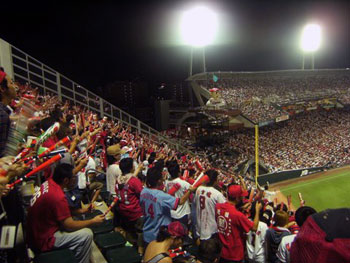
The Carp are still going strong 61 years later, playing their home games in picturesque Mazda Zoom Zoom Stadium. Most American stadiums are surrounded by several square miles of concrete wasteland devoted to parking every individual spectator’s car. The Carp’s stadium is within easy walking distance of the Toyoko Inn where we’re staying, and instead of passing row after row of cars, we pass a much more compact though very densely packed bicycle lot. It’s so full that it’s actually got double-decker racks to handle all of the spectators’ bikes. What a great thing! We’ve got the cheap seats, and I wouldn’t ever want to pay for the more expensive ones. This is where the true action is. From here, you can watch the salmon pink sunset over the mountains that enclose Hiroshima on three sides. The city lights come up, and modern bullet trains come gliding silently to rest in nearby Hiroshima Station.
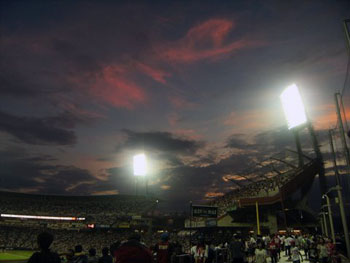 This is the pep block. There is almost no canned music at a Japanese baseball game. Instead, a bare-bones band leads the rabid fans whenever the Carp are up to bat. Bleating trumpets and pounding drums, elaborate sing-song chants with prescribed movements. The crowd cheers, “Bonzai!” then lapses into a pointed silence when the Tokyo Giants are up to bat. They reel their energy in again, least it accidentally offer encouragement to the other team. This is unrivaled in American sports anywhere; American sporting fans would be ashamed.
I look around, and Japanese are eating French fries with chopsticks. Others just enjoy a nice bowl of hot soup at the ball park. Beer-vending women carry backpack kegs. I myself sup on Philly cheese steak as interpreted by the Japanese. It is a strip of actual steak on a hard roll drowning in nacho cheese.
Every attendee receives a green sheet of paper with a prayer for world peace printed on it. When John Lennon’s “Imagine” plays over the stadium sound system, the whole crowd waves their green papers high over their heads. This is the eve of the sixty-sixth anniversary of the bombing. That experience and a subsequent commitment to world peace are fundamental to the identity of this city. There is no escaping it. It is inspirational to see so much idealism spring from such negative roots.
The Lantern Ceremony
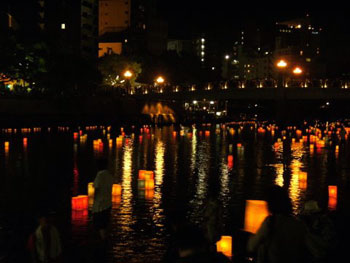 There is a spiritual sense of communion, a union of the intimate and the universal found at the Hiroshima Peace Memorial Park this evening. The park is the site of the toro nagashi, or lantern ceremony, a traditional Japanese memorial service for the dead. It is by far the most moving part of the day. The skeletal A-Bomb Dome glows bright in the dark, its reflection dancing and shifting shape on the dark surface of the river like some Rorschach test of tragedy, an all-purpose steel and stone reminder of the fragility of even the most durable of man’s accomplishments.
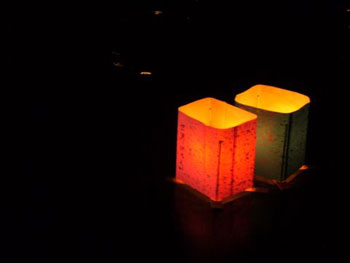
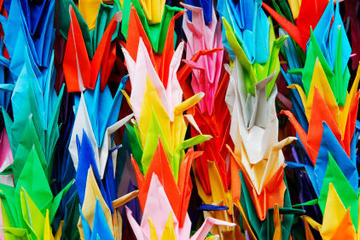
By this light and the light of the primeval moon, people gather to write messages of peace and love on colorful paper, which they proceed to fold into lantern shades. I join several of my new Japanese friends to decorate one, adding the message, “No nations, just people. Peace.” This is written beside the kanji script peace messages of my Japanese friends. This is beautiful, because when you think about it – our grandfathers were trying as hard as they could to kill each other.
We place a lit candle inside our lantern and join thousands of others – Japanese, Americans, Asians, Europeans – on the banks of the Ota River. Lanterns of dozens of colors, the collaborative work of many hands, drift like luminescent souls toward the unknown sea. This communion is profound. Your feet get wet, and you cannot help but feel connected on a spiritual level to what happened here. Suddenly the people who died here are your own people. They are your mothers, fathers, brothers, and sisters.
It is so calm, you can feel every heartbeat in your chest. And if you let yourself, you will almost certainly be moved to tears. My friends and I stake out a spot on the river, and watch the lanterns drifting slowly past our position downstream. We reflect in sparse language on everything we have seen and done these past few days. Hiroshima has the power to chance you. That much is apparent, even if we can’t articulate just what we will carry home from this very special place.
Eventually we find ourselves in Hiroshima’s downtown nightlife district. It’s not very busy for a Saturday night, but that is perfect for our purposes. We’re just looking for a quiet dinner, and we’re rewarded with an intimate little place – shoes off at the door – serving contemporary Japanese cuisine and the best sake I have ever tasted.
Hiroshima Peace Memorial Park and Miyajima Island Tour from Hiroshima
If You Go:
The Hiroshima Peace Memorial Park is easily accessible from the Hiroden Genbaku Dome-mae Station, a clearly labeled stop on the extensive Hiroshima street car system. The Lantern Ceremony takes place only once a year on August 6, the anniversary of the atomic bombing, but it’s well worth your effort to plan your visit to coincide with this beautiful service.
The Hiroshima Carp play in the beautiful Mazda Zoom Zoom Stadium which is an easy ten minute walk from central Hiroshima Station, the main JR West and Shinkansen terminal for the whole city. Tickets are often available right up to game time.
About the author:
Thomas Kenning decided to leave his life as a high school history teacher in order to do crazier things. One of those crazy things was traveling to Japan to study the legacy of the atomic bombs. He’s written about this and other foolhardy experiences in zines and on his blog at cattywampus.tumblr.com.
Photo credits:
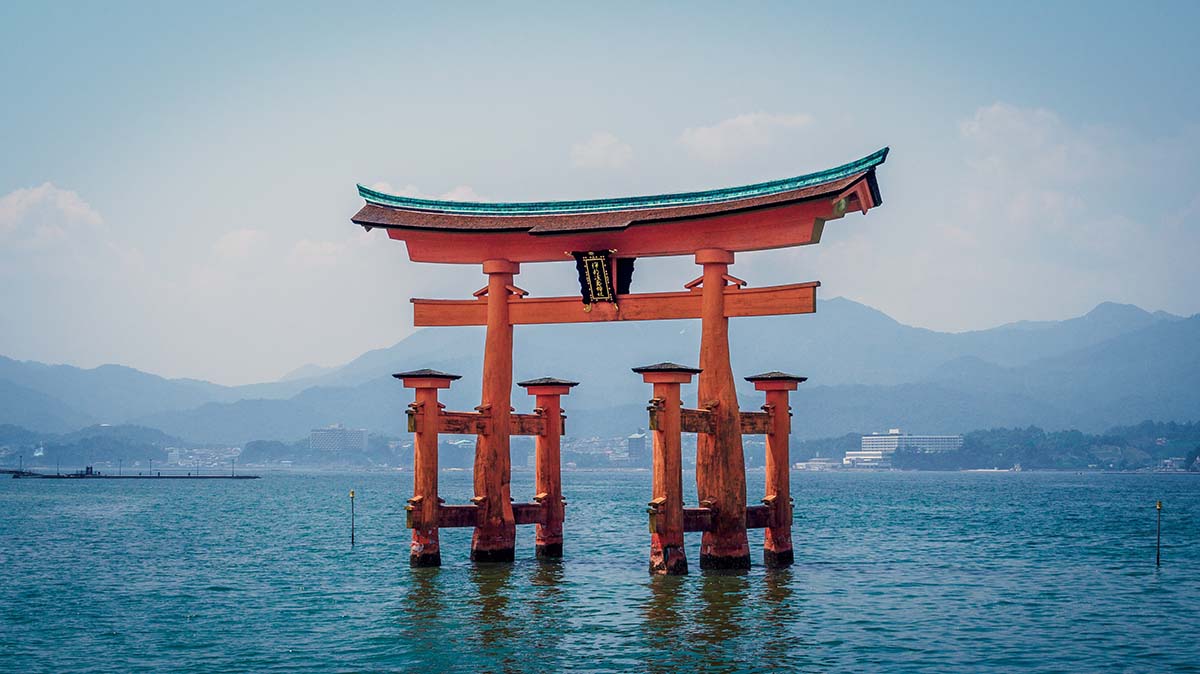
Itsukushima Shinto shrine at Miyajima island, near Hiroshima photo by Nicki Eliza Schinow on Unsplash
All other photos are by Thomas Kenning.
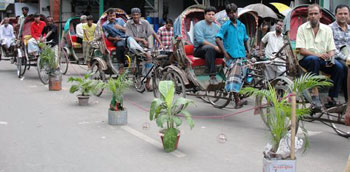
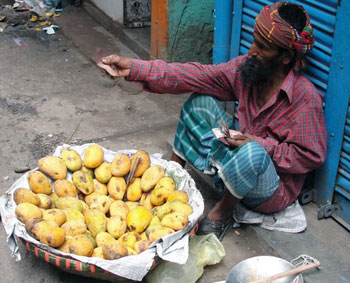 With a population of fifteen million, Dhaka is not the easiest place to get around. It takes about an hour and a half to drive five miles, and it’s not safe to walk or cycle. So you eventually give up trying.

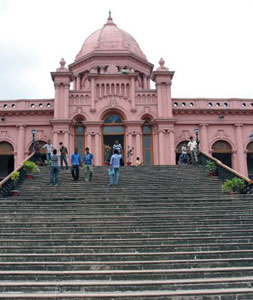
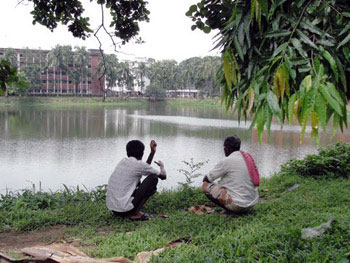 Our two-hour journey was not wasted: Mithu, speaking excellent English, gave us his views on Bangladeshi politics, current issues, transport, and so on. Our first stop was Curzon Hall, named after Lord Curzon, the former British Viceroy to India. It was built in 1904 as a Town Hall, and is now part of Dhaka University’s science faculty. It is a harmonious blend of Mughal and European architecture, built in red brick. Set a little back from the busy main road, near a small lake, it has a peaceful feel about it. Curzon Hall is historically significant. In 1948, after the partition that established what is now Bangladesh as East Pakistan, this was the seat of the language movement, which opposed the imposition of Urdu as the sole national language of Pakistan.
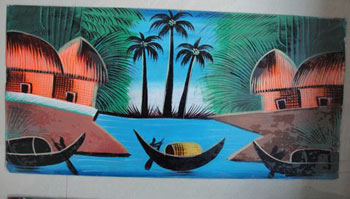
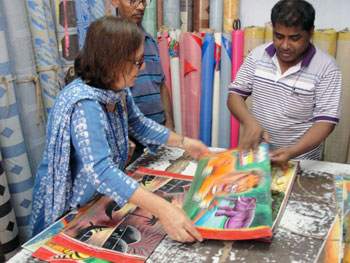 We were in luck. Several shops sold them, and after some good-humoured bargaining, we had bought nine. From Virginia’s e-mails, I understood she fancied animals, which we found, and aeroplanes, which we didn’t though there were pictures of several other scenes depicting forms of transport which we bought. (Example below)
 The street was lined with tightly packed with tailors, hairdressers, and hawkers. Women filled up their pitchers at standpipes, and carts laden with pineapples wove their way through the general chaos.
 Our last stop was the Sadarghat, Dhaka’s boat terminal. It is from here that you can head south towards the Bay of Bengal – or simply cross the river.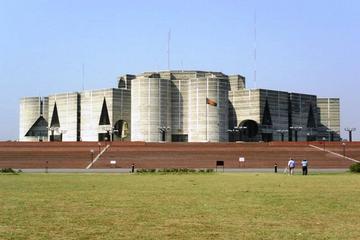
 I started my search in Jinli Ancient Street, one of the few remaining spots where the vestiges of a rapidly disappearing culture are permitted to shine through, albeit under the strict control of the local tourist board. I walked along the cobbled streets determined to ignore the overhead neon lighting and pumping music.

 It was when I was hanging around one of the quieter stalls that I truly felt like I had found a moment to enjoy the China that was spread over the glossy pages of the travel magazines. Beneath bobbing red lanterns and the dangling sea of wishes entwined within the branches of a clematis, a crowd gathered to watch the shadow play of the Hidden People.
 The following day I decided to head to Chengdu’s must-see panda sanctuary. I eagerly welcomed the green haven after the polluted streets, yet it was still impossible to escape China’s infamous crowds. Through the throngs of tourists and clapping children, I eased my way to the front in time to see an incredibly docile panda obligingly pose for pictures next to newly-weds. They had tentatively entered the enclosure and now grinned into the flashing cameras.
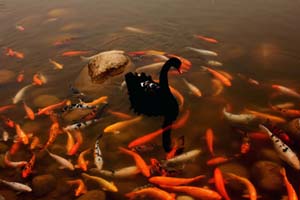
 Having had my fill of panda enclosures, I wandered down to the lake for green tea and noodles. It seemed even the massing fish had learnt to manipulate the tourists, and as I watched them writhing to the surface to chow down upon the tossed breadcrumbs, I wondered what this place would be like without the protection of the sanctuary. It seemed to me the only animals in the park that were not somehow manipulated by the crowds were the unusual black swans that glided across the surface of the lake. Necks outstretched and wings beating in harmony with their mates, they seemed oblivious to the snap happy tourists.
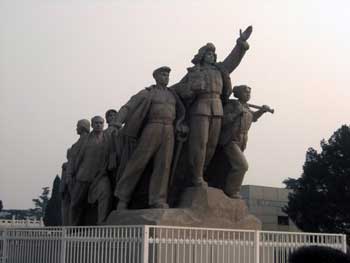
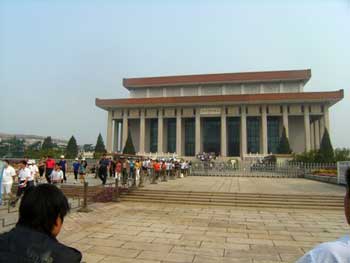 Pale and blond, I stand out everywhere I go in China, but never more so than at this precise moment, I realize. Literally, every other person in this line – all several thousand of them – is Chinese. I feel not just self-conscious, but downright uncomfortable. People are looking at me. Staring at me. Chinese have no compunctions about this, it seems. They’re eyeing me openly. I’m sweating, and the sun is barely even up yet.
 But I thought about this in advance, and I’m ready with a sincere answer. “I’m very interested in China and its leaders. I want to learn.” This is a nice value-neutral statement.
 “Ah, yes!” He is pleased with this answer, and he decides in this moment that I am alright. He is going to be my new best friend until we get through this line. He turns to the crowd which is still staring shamelessly at me and offers a translation of our exchange. Smiles and waves all around. And I rejoice, not only because I am no longer quite so isolated in this sea of humanity, but because seeing Mao is only half of the experience – it’s not complete without the interactive and earnest reactions from a real Chinese. I wanted to learn, and I am going to.
 We draw near the door, through several layers of security, and Dalian wants to buy a yellow carnation to leave as an offering to Mao. But he misses the flower stand in the heat of our conversation, and the soldiers won’t let him go back for one. Despite his pleading. Here’s where he comes closest to tears. But the line toward the inner chamber of Mao’s Mausoleum is ever-moving and inexorable. Even though he says he has been here so many times that he can’t count them, this ritual clearly means a lot to him. It is secular religion here, and I have brought a modicum of shame upon him before his Lord. He tells me that having the chance to guide an American through this experience is honor enough.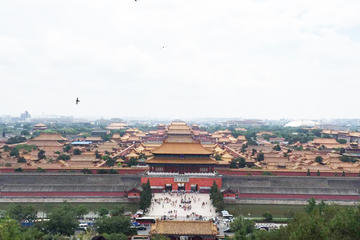
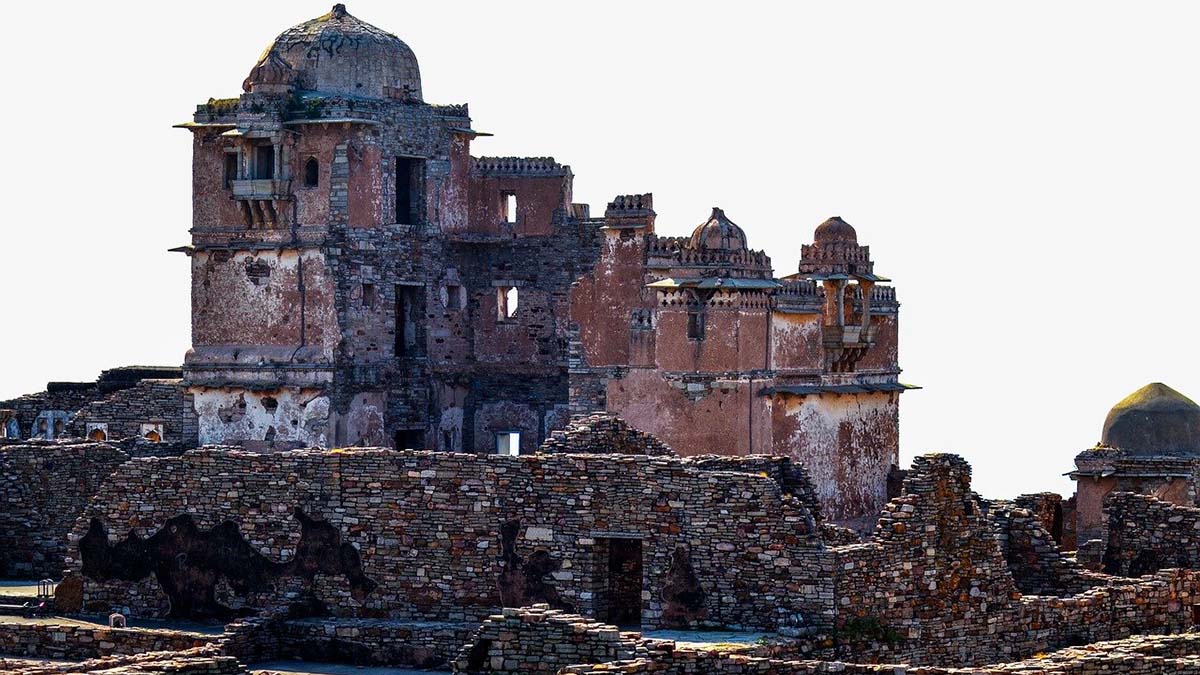
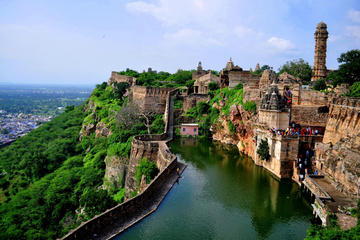
 We stand at the edge of a huge clearing. At one end is a temple, an ancient one, built centuries ago, broken but re-built time and again. All around us are fragments of carved stones. They once adorned temples built around the clearing, and are now waiting to be replaced and returned to at least a shadow of their former glory. The clearing itself is not empty. There are remnants of a huge platform, and some smaller ones. Each one had a role to play in history – a history I have grown up hearing, which has brought me all this way. The story is stuff that legends are made of, and I wanted to see for myself what it felt like to stand at a place where thousands and thousands of women had sacrificed their lives, and the lives of their families, for their honour, and for the honour of their clan. As I stand there, oblivious to the tourists who throng the place, I can’t help but feel the devastation and the sadness that lingers on, centuries after the events have taken place. We are at Chittorgarh, also called Chittaur, in Rajasthan, one of the oldest and biggest forts in India. It was once the bastion of the Mewar Rajputs and was ruled by various kings famed for their courage, but more than them, it is the story of their women that dwells in people’s hearts even today. Not just one woman, but many. There are some whose names we know, and many whose we don’t, but each one of them attained immortality in the hearts and minds of Indians. This is the story of some of these women.
 Padmini was the queen of Rana Ratan Singh, who ruled Chittaur around 1303 AD. She was rumored to be among the most beautiful women in the world. The rumor reached the ears of Sultan Allaudin Khilji, who then ruled Delhi. He attacked Chittaur at once, hoping to add Padmini to his harem. Chittaur however was invincible, and Khilji found himself at the losing end, so he resorted to trickery. He convinced Ratan Singh that all he wanted was a glimpse of the beautiful queen, and that he would leave immediately. The kindhearted Rana agreed, and an ingenious system of mirrors was designed so that Khilji could see Padmini’s reflection in a mirror without setting his eyes on her directly. (The Rajput women were never allowed to be seen by men!) Khilji had no intention of leaving empty handed. He captured the Rana who, with true Rajput hospitality, had gone to the fort entrance to send him off. The queen however, wasn’t just beautiful. She also had brains. She agreed to go to the Sultan, but instead sent her guards in disguise, who succeeded in releasing the Rana. However, by now, the Sultan’s army was at the gates of Chittaur, and defeat was imminent.
 Amidst stories of war and death is another story – that of a young girl who came to Chittaur in the 1500s as a bride. She was married to the prince, but refused to accept him as her husband. She was mentally wed to Lord Krishna and her life was dedicated to Him. She spent her time singing songs in praise of the Lord, and talked to Him as if He was present in flesh and blood. This was Meera – the poetess-saint, whose songs on Krishna are sung across the country even today. Her attitude was never appreciated, and after her husband was killed in war, the situation only worsened. She was continually troubled and insulted, until at last, she decided to leave Chittaur and go to the land of her Lord – Mathura and Brindavan. With the departure of Meera, Chittaur seemed to lose its greatness. The locals till today believe that it was Chittaur’s treatment of Meera that instigated the ultimate defeat and destruction of the once-invincible fort!

 Years passed, and once again Chittaur was invaded – this time by the Shah of Gujarat, in 1535. The Rajputs were not strong enough, and Queen Karnavati this time decided to take matters into her own hands. She sent an emissary to Humayun, the new Mughal ruler of Delhi, with a fragment of her sari as a ‘Rakhi’ – a thread tied by a woman to her brother, which binds them together. When a woman ties a Rakhi to her brother, he promises to protect her, and it was this protection that Rani Karnavati asked for, from Humayun. Most of Humayun’s supporters were against his going to help a Rajput on the grounds of religion. It took Humayun some time to convince them, but he marched towards Chittaur to help the queen. However, the argument had delayed him by just a day. Sensing defeat at the hands of the enemy and disappointed at the lack of response from Delhi, the queen had taken the path of her ancestor. The funeral pyre had been lit again in the huge clearing near the temple, and the queen had entered it along with all her women. Humayun was too late to save them, and it is said that he felt deeply for not being able to protect his sister. It is said that he continued to wage war against the Shah, and eventually succeeded in defeating him.
 The Rajputs were now dwindling. There were just a few who had escaped the wars, and none had the stature and power of their ancestors. Petty jealousies and greed ruled many of the scions of the dynasty. One such scion was Banbir, who killed his brother in order to become the king. Drunk with power, he attempted to kill the crown prince Udai Singh, then an infant. News travels fast, but bad news faster, and the prince’s nurse heard of the impending calamity. A quick thinking and courageous woman, she bundled the prince into a basket of flowers, handed it to a maid and asked her to carry it out of the fort. She then placed her own son dressed in the prince’s clothes on the royal bed, and waited for the traitor. Intent on saving the prince, she watched as her son was killed, cremated him, and then walked out of the fort, taking the prince to safety. History tells us that her name was Panna Dai (Dai means nursemaid), but that is all we know of the woman who gave up her own son to protect the prince.
 Chittaur’s fortunes were declining. The year was 1567 and this time, it was Akbar, Humayun’s son, who invaded Chittaur, in an attempt to bring the land of Mewar under his rule. By this time, it was apparent to all that the fort was no longer invincible, and it was time to move. This time, the prince was convinced to escape and find another place to establish his kingdom, while the rest of the army turned once again towards the last resort – Jauhar and saka. Once again, (thankfully, for the last time), the women ascended the pyre and the men fought with a vengeance, earning the reluctant admiration of Akbar himself. Akbar won the fort, but never ruled it. He took back with him some of the most beautiful things in the fort – its door, a huge drum, and such other things – as mementos of the war, but he never ruled over the fort, which was soon abandoned, and slipped into the misty realm of history.
 The stories are not new to me. I have grown up with them. But standing at the edge of that clearing seems to make them seem more real. On one side is the temple dedicated to the Lord of destruction – Shiva – undoubtedly a fit location for such a temple. On the other side, a little farther away, I can see the spire of the temple of Krishna – the protector – where Meera spent her days in prayer. I can almost imagine the massive funeral pyre and the tongues of flames eagerly lapping up the human sacrifice, of cries rending the air, and the complete stillness at the end, the ground covered in ashes. I can’t help wondering about these women – women who had jumped into the fire, who had been ready to give up everything for what they believed, who sacrificed not just themselves, but their nearest and dearest ones, for the cause they believed in. What kind of women were these? Was it bravery or escapism of the extreme kind? What would have been their thoughts? Ballads have been written about these women, but I know that I will never know the answers to my questions. As we move towards the other parts of the fort, I turn back one last time, for one last look, committing every inch to memory. The women surely deserve that.