Australia is, by no means, a hidden gem. Still, for some reason, most people forget there is much more to it than Sydney and its famous attractions. To be frank, if I hadn’t married an Australian a couple of years ago, I probably wouldn’t be writing this article now. But the fact that most of this vast, beautiful country still hasn’t been brought into the spotlight might just be what inspired me to dig a little deeper in search of unique sights and odd places to visit. And although it probably seems counterintuitive to tell the whole world about something you wish would remain somewhat under the radar, I firmly believe these places deserve to be heard of. So, without further ado, here are 6 strange places you can only find in Australia.
1. Squeaky Beach

Wondering how this seemingly ordinary beach got its name? You’ll realize the moment you step foot on it – quite literally. The beach is comprised of fine quartz sand, and its rounded grains are the culprits behind the sounds you will hear while walking on it. Moreover, your ears are not the only ones that will get a treat. The turquoise water, white sand, and incredible views of neighboring islands are a true sight for sore eyes.
Squeaky Beach is located in Wilson’s Promontory National Park in Victoria, and it is surrounded by massive granite boulders, making it all the more spectacular. While this might not be the strangest place you can explore in Australia, it certainly is well-worth visiting.
2. Umpherston Sinkhole
The New Year is nearing, and one thing you should definitely include on your list of resolutions is visiting the Umpherston Sinkhole.
This strange place, also known as the sunken garden, is located in South Australia’s Mt Gambier. It used to be a cave, and it became what it is today when the top collapsed in the 19th century. In 1886, James Umpherston, a farmer and politician, turned the sinkhole into a garden.
Here, you can expect to take many fantasy-movie-like pictures, feed possums, and even have a drink and a snack yourself!
3. The Pinnacles
This list of strange places you can only find in Australia wouldn’t be complete without the Pinnacles – one of the most peculiar sights you can see in the Nambung Desert. These unique rock formations, some of which are up to four meters high, provide a genuinely otherworldly experience. While the limestone that comprises the Pinnacles was shaped by natural erosion, the Aboriginal owners believe that the rocks represent people who died in the quicksand.
If you decide to include this unique place in your itinerary, make sure to bring a camera as the shadows created by the rock formations make for a stunning backdrop for photos.
4. Devil’s Marbles
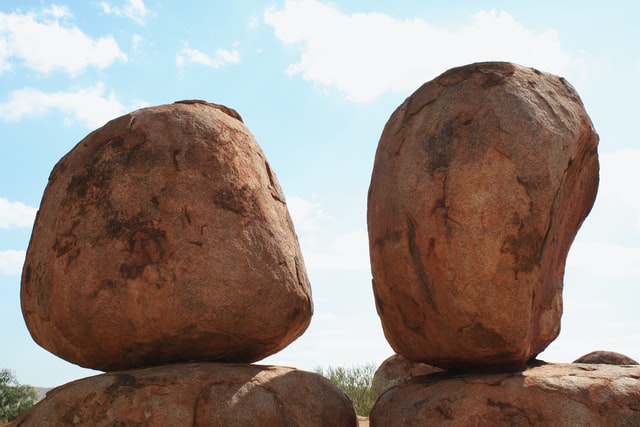
The Devil’s Marbles are another rocky surprise of the ‘Land Down Under.’ The circular rock formations made out of granite are located in Warumungu in Northern Australia. Otherwise known as Karu Karu by the Aboriginal owners of the land, this sacred area is a must if you want to experience Australia’s spiritual side.
Millions of years needed to pass for the massive boulders to be shaped. Some of them balance gracefully on top of each other, making the place that much more unusual.
5. The Twelve Apostles

The limestone stacks, otherwise known as the Twelve Apostles, are located in Port Campbell National Park in Victoria. Despite the name, you can only see seven stacks – one of them collapsed in 2005, and the rest are located a little further from the group. Once again, nature is the artist behind this beautiful attraction.
The best way to get to the Twelve Apostles is to go on a road trip down the Great Ocean Road, along which you will be able to enjoy Australia’s stunning coastline.
6. Wave Rock
The last on this list of Australia’s strange places is Wave Rock, a 27 million-year-old granite cliff that looks strikingly like a wave. Although it seems man-made, this rock formation is entirely natural. And climbing it is a one-of-a-kind experience undoubtedly worth the four-hour drive from Perth. If you get to the top, you’ll be able to enjoy a stunning view of the surroundings.
Want more?
These 6 strange places you can only find in Australia are only a fraction of what this beautifully unusual country has up its sleeve. If you decide to visit some of them, one thing you need to know is that you will crave more! If you choose to move from the US to make Australia your backyard, make sure to get some help from the professionals. Only this way will you be able to relocate to the other side of the world without losing your hair.
If you go:
- Unless you are visiting from New Zealand, you will likely need to acquire a visa. Research the requirements before you do anything else!
- Proof of vaccination and a negative COVID test taken up to three days before your flight are necessary if you want to travel to Australia.
- One of the reasons Australia is so popular among tourists is its beautiful weather. Still, remember that with plenty of sunshine come plenty of harmful UV rays. Make sure to protect your skin by wearing sunscreen whenever outside.
- The Land Down Under is not a small place. To explore the strange places you can only find in Australia, you will probably need to utilize different forms of transportation, from rental cars, buses, and trains to planes.
About the author:
Sadie James is a blogger and avid traveler. History and culture are her passions, and she cannot imagine a trip without trying local delicacies and exploring everything a place has to offer. Moreover, these experiences are what she draws inspiration from for her articles and stories. When she is not traveling or planning another trip, Sadie likes to spend her time at home, relaxing with a good book or movie.




 Fast forward a few hundred nautical miles. The Tofua volcano was erupting nearby, an ideal backdrop to the escalation of tempers aboard the Bounty, a director’s symbolic dream. Clark Gable, Marlon Brando and Mel Gibson all portrayed Master’s Mate Fletcher Christian, born from a long line of sailors who led the mutiny, effectively giving the crew the choice of carrying on to England with the Captain in a dinghy or joining him in taking the Bounty back to Tahiti where they could, in theory, live happily ever after.
 by Robert Etheridge
 by Max Nicholls
 , by Simon Dodd
 and
and  . His articles and columns are published in Canada, the US, UK, Europe and Asia. When not trekking the globe with a small pack, weatherproof journal and horribly outdated camera phone, he can be found on Canada’s west coast, making friends and generally misbehaving. @billarnott_aps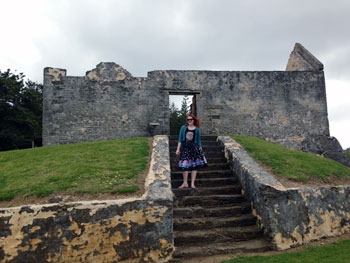
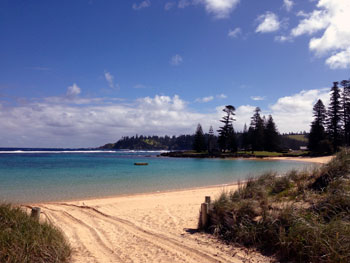 Norfolk Island, a self-governing territory of Australia is small, only 8 kms by 5kms. Two hours from Auckland and two and a half hours from Sydney by air it was a popular holiday destination in the 1970s and 1980s for Australians and New Zealanders keen to have a relaxing holiday and do some duty free shopping. The shops are still there, now rather jaded, but what drew me to Norfolk was its history, in particular its history as a penal colony and as a second home for the Pitcairn Islanders.
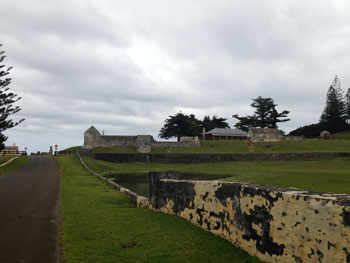 The second penal settlement on Norfolk Island was built in 1825 on the same location as the first. It lasted until 1856. During this period Norfolk was used as a punishment destination for the most hardened criminals and conditions were harsh. The UNESCO World Heritage site of Kingston has many remains of the stone buildings of the second settlement. These are extensive and you can wander around at will; there is no admission charge.

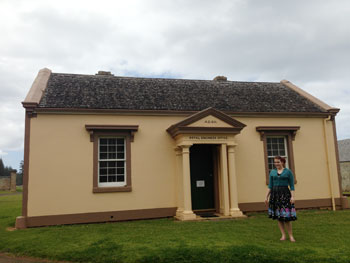 Walking up Quality Row, where the free men and their families lived, we saw the women working at their needlepoint and tending their gardens while close by convicts toiled, chained, often hungry and ill-treated. One of the houses in Quality Row has been restored and decorated to reflect what it would have looked like during the second penal settlement. A pretty little house set in a cottage garden it is light and airy, no doubt quite a contrast to the conditions in which the convicts were housed. It is one of a number of museums that give an interesting insight into not only Norfolk Island’s convict past but other aspects of its history.
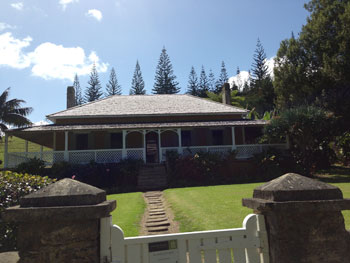 In 1856 the British troops, convicts and free men were taken off the island and Norfolk Island was given by Queen Victoria to the Pitcairn Islanders who had outgrown their tiny island rock. Some of the Pitcairners later returned to Pitcairn but most remained and many of their descendants live on Norfolk Island today. The Pitcairn Islanders took over the buildings that had housed the convicts and their captors. Not all are ruins. Government house, the military barracks, several homes and other buildings still survive intact.
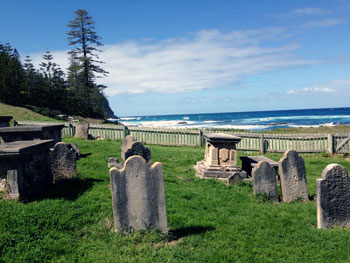 A fascinating slice of island history can be seen in the graveyard, framed by large Norfolk pines and overlooking the sea. The days we had on Norfolk were gloriously mild and sunny but many of the headstones bore testament to harsher weather. In the graveyard there is no distinction between free and captive. All are buried here, convicts, gaolers, military, men, women, children, Pitcairn Islanders, and their descendants. The cemetery is still used today and for those fascinated by the Pitcairn story like me it’s fascinating to trace the generations of Pitcairn names like Fletcher, Quintall, Nobb and Buffet.
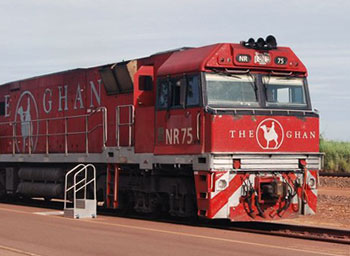
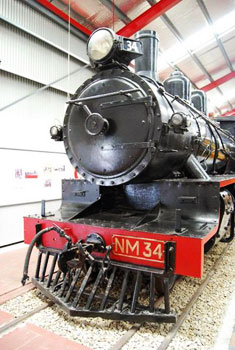 New South Wales used the British ‘standard gauge’ of 4’8″; in Victoria, they preferred the ‘Irish’ gauge of 5’3″, which was probably best for the distances involved, as it allowed for larger and more powerful locomotives. Queensland and Western Australia opted for the narrower, 3’6″ ‘country railway’ gauge, as they could use lighter, less expensive trains. And, South Australia, with borders to all, used all three!
 However, the line from the south did reach Alice Springs, and there it terminated. The first train to run along it was called the ‘Afghan Express’, after the Afghan camel wranglers who pioneered the route, and carried goods along it before the railways came. With usage, this became simply known as the ‘Ghan’.
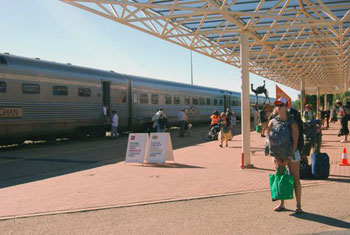 So, usually, the train rarely got above 17 mph, even in the best of conditions. The railway people like to tell the story of the young lady who approached the conductor, and asked when the train would get into Alice Springs, for she was heavily pregnant, and didn’t want to give birth on the train.
 There were no direct trains from Adelaide. Owing to the three gauges in use at the time, intending passengers would travel to Port Pirie on a broad-gauge train; transfer to a standard gauge one to Maree, thence on to the narrow gauge Ghan. That situation was to change in 1980, when a new, standard gauge line came into use. This line was laid well to the west of the troublesome flood plain, and on concrete sleepers, so the termites wouldn’t eat them. The old line was abandoned, and all that remains is the name.