Prien, Germany
by Inka Piegsa-Quischotte
I came to Prien am Chiemsee in the south of Bavaria, half way between Munich and Salzburg, by accident. Or rather because of these spur of the moment decisions, only born travelers are capable of.
 It was the second week of December and I sat on the train from Munich to Salzburg with the intention to visit the Austrian Christmas market and to do some shopping. The sky was blue, snowflakes were falling softly, dusting the dense pine forest on both sides of the line.
Then, the train went around a bend and I was greeted with – forgive the cliché but there is no other expression for it – a picture postcard perfect scene. The vast expanse of the Chiemsee glittering in the sun and partly covered with ice, spread out on my left and a small utterly romantic town nestled on its shore. Some signs read: Prien am Chiemsee, visit our Christmas Market. You guessed correctly. Salzburg can wait, I thought, this looks much more promising. I grabbed my bag and got off at the next stop.
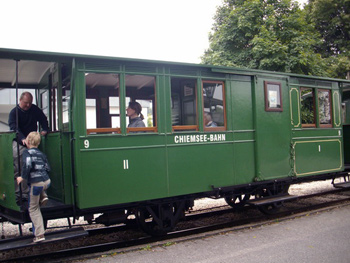
On the forecourt of the small train station I was greeted by the green cars of the Priensee Bahn, as it turned out, the world’s oldest steam operated tramway continuously in use since 1887.
History in Prien starts as soon as you get off the train and continues with many more aspects. The Priensee Bahn operates only in the summer months, so the snow covered cars were stationary and I made my way on foot towards the town center, which, of course is around the market square, following a rather modest sign indicating the Christmas Market.
 Actually, no sign was needed. I only had to follow the wafting scents of Gluehwein and Bratwurst and the sounds of Bavarian horns and German Christmas carols to find the market.
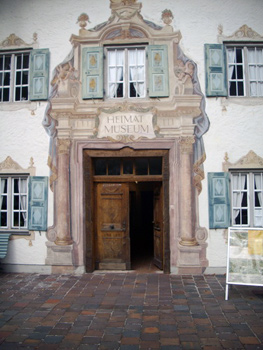
It must be one of the tiniest Christmas markets in the world. About 15 stalls were cozily arranged between the church and, as I notice with delight, a colorful Heimatmuseum. The museum was my first port of call to learn more about this lovely place and its traditions.
 I got lucky insofar as I was the only visitor, the majority of people were enjoying the market and its delights, something which I reserved for later. The lady who sold me the ticket and acted as curator was so pleased to have something other to do other than sit at her desk, that she personally lead me around and told me story after story about the customs and traditions of this part of Bavaria.
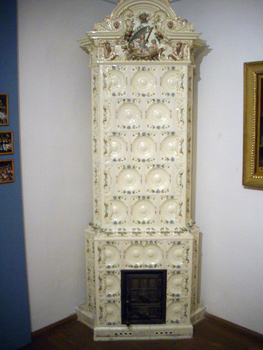
Prien, it turned out, has always been famous for its skilled artisans and craftsmen. In centuries past, people mostly made a living from fishing, but otherwise, they were (and are) carpenters and wood sculptors as well as the makers of the most gorgeous often hand painted tiles which decorate massive Kacheloefen, many of which found their way into castles such as King Ludwig’s nearby Herrenchiemsee.
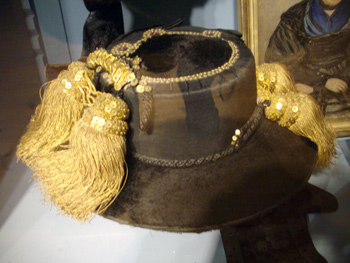
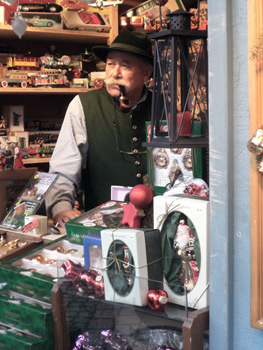 The 16th century wardrobes, carved with the finest details, are called Chavari and were used to store a bride’s trousseau. One such chavari is kept in the museum and filled with traditional clothing as well as examples of another art: gold embroidery. Bridal headgear and lace is made from real gold thread, an art which my friendly guide herself is skilled in, as proven by a growing strip of gold lace which she was working on whilst waiting for visitors.
“Today, there are only four women left who know how to work real gold thread, my grandmother is one of them and she taught me”, she explained.
“Will I be able to buy a piece of gold lace outside in the market?” I asked. ”I doubt it,” she replied. “The pieces we make are all to order, often from museums and collectors and they are very expensive. But, look out for the Rauschgoldengel. You won’t find more beautiful anywhere and the dresses of some of them are embroidered with silver thread” .
Then, I was allowed to have a close look at the exhibits and she even took some of the valuable hats out of the showcases for me to try on. Finally, she made me a cup of hot chocolate and then sent me on my way to explore the Christmas market.
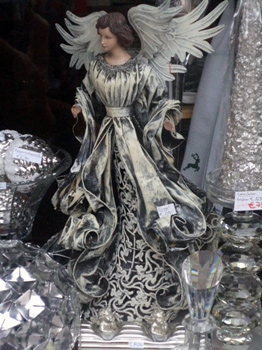 Plenty of visitors were around, but it felt rather like a huge family. Everybody seemed to know everybody else and as soon as they noticed that I wasn’t ‘einheimisch’, they explained the specialties to me and directed me to the stalls with the Rauschgoldengel and other beautiful Christmas decorations.
Naturally, I couldn’t resist a particular angel and that went into my bag together with hand knitted woolen slippers, bee wax candles and glittering baubles to hang on my tree. Food and drink are a big part of any Christmas Market and Prien was no different. As I don’t drink alcohol, I was delighted to discover a stall selling Childrens’ Gluehwein, which tastes just the same but without alcohol.
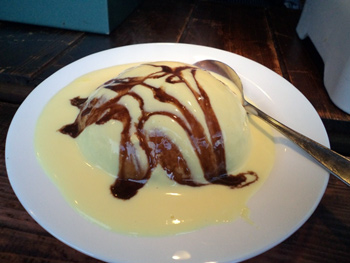 Next was Dampfnudel, which literally translated means steam nudel but has nothing to do with pasta or steam. It’s a huge lump of sweet dough, covered with vanilla custard, whipped cream and chocolate sauce. I could never have managed one on my own, but my new best friends from Prien, standing next to me and putting the sweet away in incredible amounts, gave me a spoon and let me have a few mouthfuls.
With the exception of a few modern touches and the clothes, I could well imagine that the atmosphere and the people would have been much the same 100 years or more ago. Tradition is highly valued in Prien am Chiemsee and commerce plays second fiddle. I was very glad to have followed my whim and got off the train where and when I did. The angel will be with me for many Christmases to come.
If You Go:
♦ Prien is a sought after destination in summer as well as in winter. Boat trips on the Chiemsee with stops at Herreninsel and King Ludwig’s castle as well as the famous convent on Fraueninsel make a great day trip from Munich.
♦ In winter there is skiing in and around Prien. It’s easily reached from Munich or Salzburg by train or motorway, the train runs every hour and takes 1 ½ hours from each end.
♦ If you want to stay in Prien there are several good hotels as well as self catering apartments.

Born in Germany, Inka Piegsa-Quischotte trained as an international lawyer and ran offices in Marbella/Spain and London for over 20 years. A few years ago, she turned novelist and travel writer. Her second novel, The Househusbands’ Club

All photos are by Inka Piegsa-Quischotte.
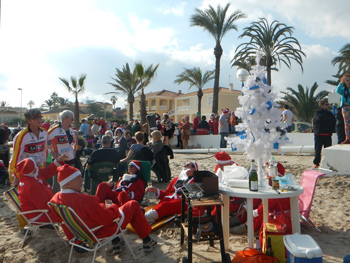
 Our appetite satisfied, we line the streets with the throng to watch a parade of marching bands and representatives from local organizations carrying flowers to the Inmaculada Church in the main town square for the traditional Floral Offering. Caught up in the excitement, we follow the parade to the square.
 A large Christmas Belen, a Bethlehem Nativity scene, is set up in the main square. This amazing display depicts scenes from the life of Jesus including day to day life, local businesses and of course a wonderful nativity. The details are incredible, from a little girl on a swing to hens in the yard. The Belen is up until January 7 for everyone to enjoy at no cost. Every time I walk around the display I notice something new.
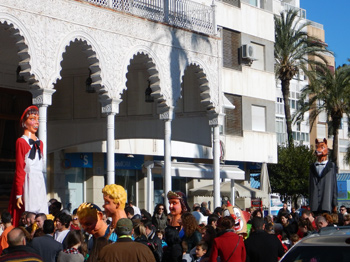 Just as we are about to call it a day, we stumble upon a parade of unique paper mache giants and big heads outside the Casino. Delighted adults and children of all ages follow along. Monday is a holiday, Dia de la Inmaculada Concepcion, beginning with an early morning parade and ending with a solemn evening procession with the statue of the Inmaculada Concepion. The procession stops at the Casino for a fireworks display before returning back to the church. A perfect ending to a fabulous weekend of festivities to start the Christmas season.
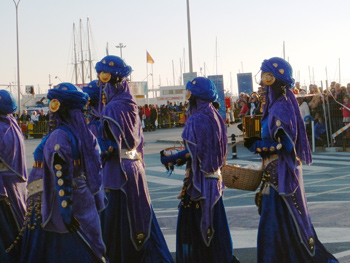 In Spain, the most important date in the Christmas season is not December 25. It is January 6, Epiphany, the day Three Kings from the east brought gifts to the infant Jesus. Fiesta de Los Tres Reyes Magos (Three Kings Day) starts on January 5 when the Three Wise Men arrive and parade through the streets handing out candies to all the children eagerly waiting. The parade ends at a church where the kings become part of a human nativity scene. That night the children put out their shoes and in the morning, if they have been good all year, they find them filled with gifts from the Magi. They leave out treats for the kings and water for the camels. Like children in North America do for Santa Claus and his reindeer.
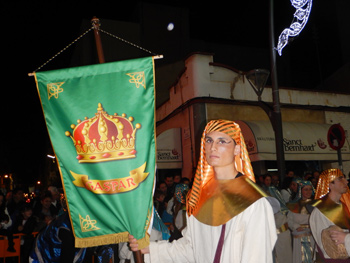 Along with their entourage, the kings participate in the traditional Epiphany parade that winds its way through the town. It is quite a spectacle with a variety of participants including Mary, Joseph, baby Jesus, Roman centurions, Egyptians, dancers, decorated riders, royal pages and a menagerie of animals. Excited children line the streets holding out bags for the many candies they receive from the participants in the parade, including the Three Kings. We enjoy the pageantry and spirit of the evening. Some of the children share their sweets with us.

 , England and Alberta, where she always has an adventure. Darlene divides her time between the west coast of Canada and the Costa Blanca of Spain. Visit
 Before the meal can start, the Christopsomo, or ‘Christ-bread’ must be broken and offered round. There is a small ceremony, where the eldest member of the gathering places a towel on the head, with the bread on it, and a young child breaks it in half. It is put straight into a basket and offered round. This is the signal that two things can begin: the meal and the dancing. Greek folk dancing can be very energetic, and I was glad that I was prepared. As a visitor, I did not know all the steps, but the local people were happy to see me join in and very welcoming. Nobody minded the odd mis-step.
 Santa Claus in Greece is known as Ai Vasilis,or St Basil, and he comes at the New Year. In Alexandroupolis, his coming is heralded on New Year’s Eve by a wonderful street pantomime involving two people dressed as a camel, complete with hump, and a third person who wears a strange sheepskin suit that tapers to an almost triangular point above the head. This is the camel driver, and he chases the camel around, mock threatening it with a stick, to great hilarity from the spectators. While this is going on, a group of people dressed in traditional costumes and with traditional instruments put on a display of folk dancing. The camel and companion go around the dancers, sometimes directly in their path, but somehow it all works out and no one falls over. Some years, Ai Vasilis will put in an appearance and march through the town, followed by the camel and driver as he leads them away at the end.

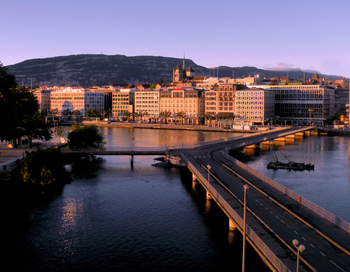
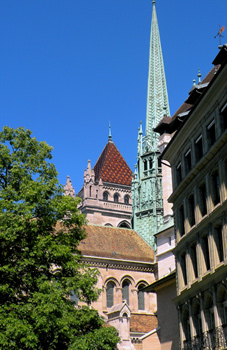 It became a key Protestant city-state during the Reformation in the mid-1500s, when French theologian John Calvin was the dominant figure. Geneva offered safe haven to Protestants persecuted in Catholic countries. French Huguenots, including prosperous professionals and craftsmen, poured in. Ursula points out medieval buildings with arched Gothic windows on the lower floors, but a simpler and contrasting style above. To make room for all the newcomers, Ursula tells us, extra stories were hastily added to many houses, hence the quirky architecture.

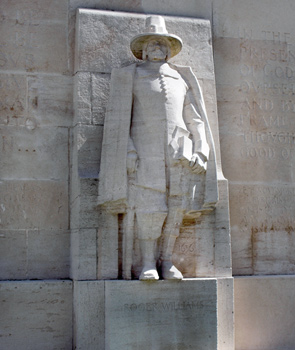 We come to a park on the grounds of the university fringed by a long, high rampart of stone. Formerly a section of the medieval city wall, this is now known as the Reformation Wall. Inaugurated in 1909 to commemorate the 400th anniversary of Calvin’s birth, it is the backdrop to ten giant statues of key Europeans from Reformation times, including Calvin himself. There is also the Scottish Presbyterian, John Knox, who sought refuge in Geneva when Mary Tudor (“Bloody Mary”) ascended the English throne and restored Roman Catholicism in Britain. Some of the figures, including Oliver Cromwell and Roger Williams, never set foot in Geneva itself. Born and raised in England, Williams studied theology, became a Puritan, and rejected the Church of England. He sailed to Boston a decade after the first Pilgrims arrived in Salem and shortly after the Massachussetts Bay colony was founded.
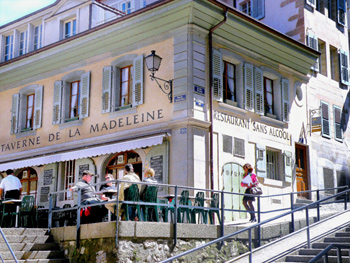 Ursula tells us how his ideas eventually had impact in the Old World as well, especially influencing the constitution of Geneva. During the era of Calvin, the city was entirely Protestant. No Catholic churches were allowed. But by 1847, times had changed. Geneva’s leading statesman, James Fazy, was drafting a new constitution. Years earlier, in Paris, Fazy had been friendly with the French General Lafayette, who had fought the British alongside George Washington and admired the American political system. Fazy incorporated many principles derived from the U.S. Constitution. Church and state were separated, and religious freedom guaranteed. Catholicism was again tolerated in Geneva. Protestantism lost its exclusive status.

 About the author:
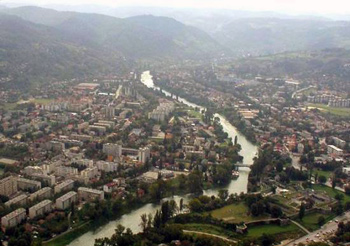
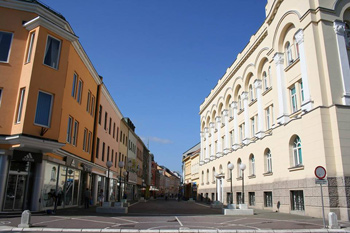 The town doesn’t have any notable architectural structure. The buildings are mostly in a style of socrelism, which are legacy of the communist architectonic style. There are some old buildings and homes in the centre of city from Austro-Hungarian (19th century) time or even earlier from Ottoman Empire period. The rest of the city looks like a small village with modest homes, often with huge gardens with vegetables, fruits and animals.

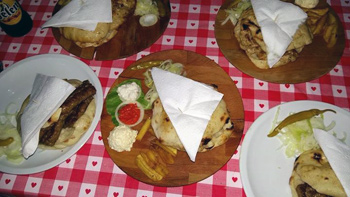 The food is a mix of Turkish with Serbian traditional food. The most popular meal is pork or lamb called cevapi. I had chance to visit all the ex-Yugoslavia countries and found that Bosnia is the cheapest. An order of five huge portions of cevapi and one medium portion of cevapi, lots of drinks (beers, coffees, waters, juices…) and the whole bill was less than 25€. Visit the restaurant Mujo’s. This restaurant has a long tradition since 1924 and the famous and traditional recipe of Banya Luka’s cevap began from this place. The owners suggest taking yogurt with cevaps, Order a salad and try kaymak (a type of salty cream cheese). After this huge portion of meat you will pass the dessert, but leave space for one Turkish coffee at the end. If you are vegetarian you may have a problem to find something to eat. Even at the bakery the products are mostly with meat, but you can find some nice pies with cheese. They have also very famous pie with meat called burek.
 In the Bosnian region of the Republica Srpska, the food is very healthy. You can find organic food here because it is a culture of growing fruits and vegetables. Almost every family has some space out of town or on the edge of city for a garden.

 About the author:

