Germany, Austria & Slovenia
by Larry Zaletel
Maybe it’s a little crazy and it may not be the best time of the year to visit Europe, however there are fewer crowds, airplanes are under booked, and automobile rentals cost less. Enjoy the Alps and the mountains of Europe; experience a European Christmas in Germany, Austria, and Slovenia.
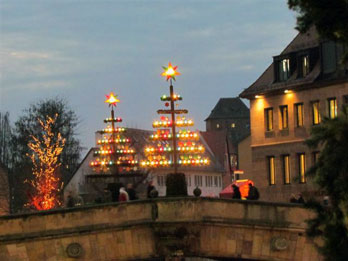
The Christkindlesmarkt (Kris Kringle’s Fair) in Nuremberg, Germany located in the heart of Bavaria begins in early December and lasts until Christmas Eve. It dates from the 1700 century and has evolved over the years and starts Friday before the first Sunday in Advent. It is one of the most traditional of Germany’s many holiday fairs held in the old town’s marketplace.
 No one remembers its history exactly but there is some thought that the fair originated in the middle ages. In 1697 the historian Christoph Wagenseil, a native of Nuremberg, mentioned the Christkindlesmarkt in the second history of the town where he described the event much as it is celebrated today.
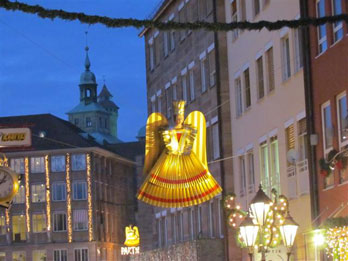
The event begins with a speech by the mayor. Then, to the accompaniment of Christmas music, a child dressed like Nuremberg’s “gold angel” makes a dramatic appearance and welcomes visitors in verse. During the middle ages people who came to the fair saw in church a replica of the Christ Child in the manger. It was customary to give the Christ Child away to the children in the form of a doll. This custom of the Christ Child gradually became a Christmas angel and today’s angel is dressed in gold-colored robes in the style of the eighteenth century and hovers as guardian over fair-time festivities.
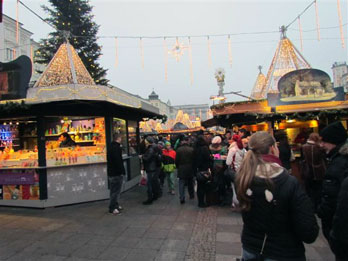
 My wife and I are visiting with relatives and enjoying the brisk air. There are golden angels hanging everywhere. This is a very popular festival in Germany and one that is also enjoyed by tourists. We pass by rows and rows of colorful booths, each filled with such holiday delights as glittering Christmas tree decorations, clever toys from Nuremberg craftsmen, marvelous Lebkuchen, a cookie usually made from honey, spices, nuts, or candied fruit, and pungent gingerbread. Then are also figurines of the Christ Child in his crib, surrounded by Mary, Joseph, and adoring shepherds. Faintly in the distance there is music and as we draw nearer we hear the sound of a children’s choir performing a variety of Christmas songs. We linger awhile to enjoy the moment and the spirit of Christmas.
 There are booths filled with such specialties as savory-smelling roasted sausages, delicately grilled herrings, and my favorites schaschlik (skewered meat usually lamb) and mulled wine. We partake of the mulled wine to help warm us in the cool winter air. There are sweets, of course, all kinds of traditional candies and all manner of cookies. The Nuremberg Christkindlsmarkt is full of wonderful sights, sounds and smells. It symbolizes for adults unforgettably beautiful childhood memories and it is little short of paradise for all age groups. However, it is also important to discover other Christmas markets in Europe.
Visit the Christmas Market in Linz, Upper Austria and enjoy the fragrance of gingerbread and the scrumptious Linzer Torte from the various pastry shops and cafes. See the lights of the city skyline glitter, view the old and new architecture, and enjoy the enticements of shopping in this city on the Danube River.
My wife and I and her niece rode the train into the city and strolled through the Volksgarten market toward the city’s baroque main market square. The two markets, the shopping mile of Linz, are connected by the colorful Landstrasse tram which takes you from one market to the next so you can enjoy the holiday spirit and inhale the scent of bratwurst and mulled wine.


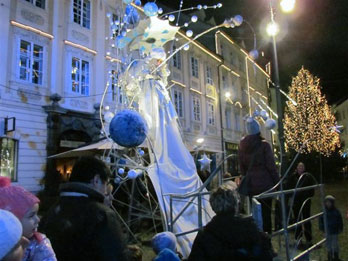 The Christkindlesmarkt on the Main Square begins November 23 and ends December 24 with hours from 10:00 a.m. – 8:00 p.m. Throughout December there are various performances by music groups, brass orchestras and choirs on the stages at the main square and at the Volksgarten. The area is lit up with a modern dream world of lights and presents Christmas in Linz at its most enchanting side. The Main Square combines the old and new with the modern booths of the Christmas Market with the fairy-tale worlds at the Christmas Market of the Volksgarten public gardens whose entrance and trees are decorated with lights and Christmas decorations that delight all who visit.
Visit one of the many cafes that abound with scrumptious food, fresh pastries, luscious cakes, coffee, and spirits. Linz is full of atmosphere, the smell of chestnuts, punch, and gingerbread.
The Festival of Lights are observed in Ljubljana the capital of Slovenia. Surprisingly there was still no snow on the streets of Ljubljana or on the willow trees lining the Ljubljanica riverbank. It was December 30, 2013, a cold afternoon and the light was beginning to fade slowly into dusk. People were heading toward the Christmas Market of Ljubljana known as the Festival of Lights set up along the Ljubjanica River in the center of the town. Ljubljana’s center was dressed up in colorful Christmas lights that transformed downtown into a beautiful winter scene.
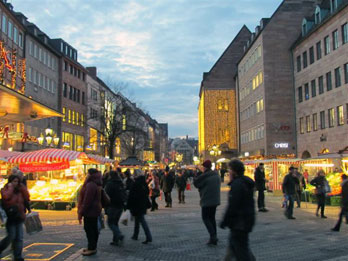 My wife and I and my cousin and his wife walked toward the Ljubljanica River. This year the Christmas season began on Tuesday, December 3, 2013 with the decoration of the town’s buildings and Christmas trees with lights that were switched on throughout the city. There was about 64 kilometers of lighting sculptures and light garlands installed on the trees and seven spruces located in the Preseren Trg (Market), at Figovec, in Levstikov Trg, Pod Tranco, next to the City Hall and in its Atrium as well as on the Ljubljana Castle. This was the beginning of the festive season that lasted until the December 31 New Year’s Eve celebration.
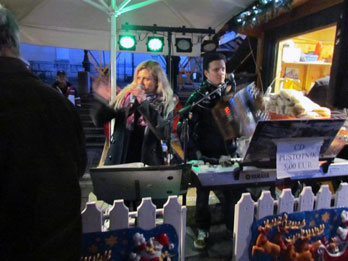
There were strains of Slovenian music in the air from the numerous street musicians performing on their button accordions. We found a table and my cousin and I bought some mulled wine to warm us. On stage was a young man on a button accordion and electric keyboard and a female vocalist. They were strategically set-up between two food and drink stalls, to draw in the revelers and judging from the large crowd they appeared to have succeeded. There were various other musical venues on the the stages in Novi Trg, Kongresni Trg, Mestni Trg, Trg Francoske Revolucije and Pogacarjev Trg that offered music presented by numerous well-established Slovenian and foreign music performers offering their best entertainment to passers-by. As we stopped to visit Kongresni Trg a folk group performed the song Dolini Tihi by Lojze Slak. The square was filled with people singing along with the band.
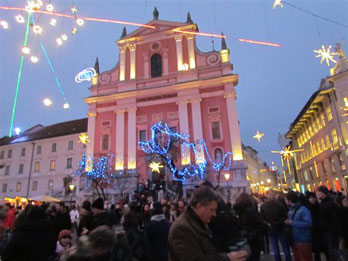
 Along the banks of the Ljubljanica River there were wooden stalls set up, decorated with Christmas ornaments and the scent of sausage; pastries, roasted chestnuts, and hot mulled wine filled the air. Vendors were also selling an assortment of unique Christmas gifts. All around us the varied colored lights begin to sparkle. The Franciscan church of the Annunciation on Preseren Square its pink façade aglow and its statuesque columns were bathed in white lights highlighting the face of the church. On the steps there was a crowd of people exiting while others patiently waited to enter the church to view the nativity scene and numerous religious displays inside.
Another site visited by many was The Good Fairy who fulfilled the wishes of everyone young or old, big or small that approached her. This was one of the most delightful projects at the festival presented by Zmago Modic and fulfilled the children’s wishes for the 2014 New Year.
 New this year to the festivities was an open-air life-size outdoor Nativity scene with a wooden manger, figures of the three Magi, shepherds, sheep and other animals all made out of straw. This was made by the Anton Kravanja Christmas Cribs Association.
If you wander away from the market area, Ljubljana’s Old Town features a picturesque river, cobbled streets dotted with quaint squares and interesting shops, a colorful food market, wide choice of restaurants and mix of Baroque, Art Nouveau and 20th century architecture. Ljubljana also has a very lively atmosphere with a choice of stylish bars and clubs, romantic cafes and riverside restaurants, and an active and varied cultural life ensuring a wonderful and exciting Christmas stay for everyone.
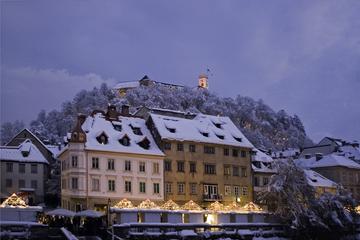
Ljubljana Lights and Delights Winter Christmas Market Tour with Mulled Wine and Local Snacks
If You Go:
Getting there
There are direct flights from the United States or Canada to Frankfurt, Munich, or Paris. Round trip fares average $1000.00-$2000.00.
Where to stay and eat
In Germany, Austria and Slovenia there are many places to stay including hotels and Gasthaus; in Slovenia they are called a Gostilna. They are modest country inns serving home cooked meals. There is no hard and fast rule but many Gasthaus/Gostilna have sleeping arrangements especially if there is a picture of a bed hanging out in front of the establishment.
Germany and Austria have many bed and breakfasts called Zimmer Frei and Slovenia has Sobes. They are highly recommended as a delightful way to meet the people and make new friends. Usually the price can be negotiated. Prices average about $45-$80 per night and they are much cheaper than hotels and normally include breakfast. We have stayed in bed & breakfasts in Germany, Austria, and Slovenia and have revisited them on several occasions. The local tourist bureaus usually have list of bed & breakfast with prices and further information. Information on accommodations is available on the Internet as each country has its own tourist websites.
The Gostilna Pri Belokranjcu, Kandijska cesta 63, 8000 Novo Mesto, Slovenia is situated almost in the center of town across the street from the Renault factory and is close to two shopping malls. This family bed and breakfast has 28 rooms with double beds. The owners Branko and Mojca Vrbetic offer daily menus with homemade bread and a local wine called Cvicek. Refrigerators and laundry services for extended guests are available. Slovenian, Serbian/Croatian, Russian, German, Italian and English are spoken. Tel 386 7 30 28 444, Price $60-$80 per night. Very good home cooked food.
Gostisce Na Pajcni, about 5 kilometers from Zagradec on the road to Zuzemberk, Male Rebrce 6, 1303 Zagradec, Tel. 386 178 86 800, email na.pajcni@siol.net. Several decades ago there was a tavern at the roadside between Ivancna Gorica and Žužemberk, a very popular stop for coachmen. Today it is a hotel and restaurant offering excellent wines and delicious food.
About the author:
Larry is a freelance travel writer, an avid and dedicated traveler, and a recurring visitor to Europe, the Caribbean, and the Far East. He writes about the various people that he has met and places that he has visited during his travels.
All photos by Larry Zaletel.
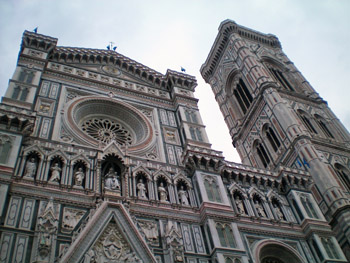
 Recognizable to any medieval citizen, the Baptistery and Duomo remain the heart of Florence. Dante’s ‘bel San Giovanni’ is one of the city’s oldest and most famous buildings. Medieval houses still line the Piazza Duomo, many still proudly displaying a stone coat of arms. Like many Florentines of the time, Dante was baptized in the large octagonal font of the Basilica. The building itself dates back to the 4th century. The 13th century mosaics covering the ceiling show with graphic detail the horrors and glories of the Last Judgment. Dante never saw Ghiberti’s famed doors, for they would not grace the building for another century.
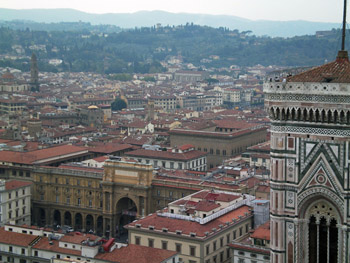
 For the hardy, 463 steps lead from the floor of the Duomo and up through a labyrinth of corridors and stairwells to the top of the cupola. (The most difficult part of the climb is over the arch; there is a spot here for lovers to place a padlock and throw away the key. In hidden corners remain marks left on the brickwork by the medieval builders.) The cupola soars to the height of the neighbouring hills. The view embraces the history of Florence, with many a medieval street following the course of their Roman precursors. Private palaces survive, and a few towers – or torre, outlawed in 1250 – still remain.
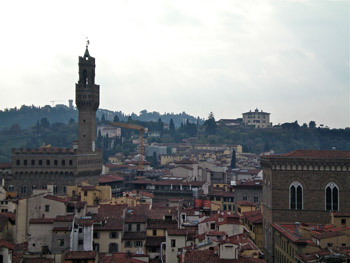 Dominating the Palazzo Vecchio, the Piazza della Signora has continued as the centre of political activity since the Middle Ages. Heavy traffic has been banned since 1385. The imposing façade of the Palazzo Vecchio has remained virtually unchanged since it was built (1299 – 1302) – Dante writes of how the houses of the Ghibelline Uberti were demolished after the triumph of the Guelfs, and the new Palazzo built on their ruins. (The Piazza della Signora is itself built over Roman ruins.)
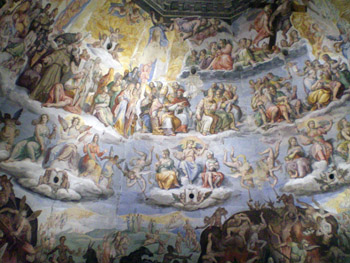 Walking beneath the arch into the Via Santa Margherita leads past the 12th century Santa Margherita de’ Cerchi, where the poet married Gemma Donati (they were betrothed when Dante was nine). It is also where he first saw Beatrice Portinari, the woman he immortalized in his writing. Beatrice’s father, Folco Portinari, is buried here.

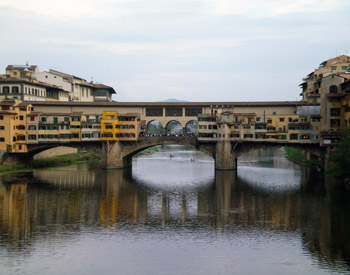 Standing near the site of the original Roman crossing of the Arno, this was the city’s only bridge until 1218. In Dante’s time the Ponte Vecchio was home to butchers and grocers; since the 16th C it had been the place to shop Florence’s most spectacular jewellery.
 On the left of the church runs the Costa di San Giorgio; Galileo once lived at No 9. At the end of the road stands the Porta San Giorgio, the oldest of the surviving city gates (Florence was still a wall city in Dante’s time.) A steep walk away is perhaps the most unspoilt of all the Romanesque churches in Tuscany: San Miniato al Monte. It’s classical façade of green-grey and white marble has looked down over Florence since 1018.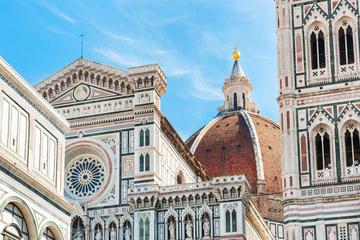
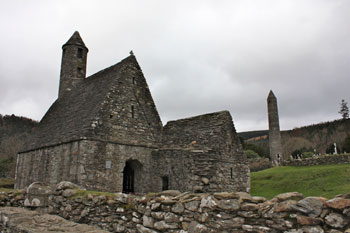
 As we stood outside the former monastic site at Glendalough, our guide, Joan, directed us to the 900-year old gateway and indicated that the original structure had two round-headed granite arches supporting a timber roof. This was the gateway to civilization at the time. The lands beyond the monastic settlement teamed with highwaymen and other dangers. I imagined terrified individuals running past us through the gate to reach the cross-inscribed stone set just inside on the right as Joan explained that Glendalough was a place of refuge. The so-called “Sanctuary Stone” defined the point of safety for those on the run. Once a refugee passed inside the gate beyond the stone, he/she was safe.
 In the vicinity of the round tower, the remains of a cathedral, dedicated to St Peter and St Paul, consist of a 10th century nave and a 12th century chancel. The arch, once finely decorated, is constructed of limestone imported from Bristol, England. A wall cupboard and basin used for washing the sacred vessels used in the mass is still visible in the sacristy.
 The postcard-like view of the upper lake features green hills gently rolling into the water on your left and trees at the water’s edge on your right. Opposite you in the distance, a stream descends the mountain into the lake. This tranquil setting greeted St. Kevin almost 14 centuries ago.
 Walking on, you enter a grove of trees to find the derelict 11th century Reefert Church with its stone nave and chancel. This church was a major attraction for those on pilgrimage to Glendalough as St. Kevin’s relics were housed here after his death.

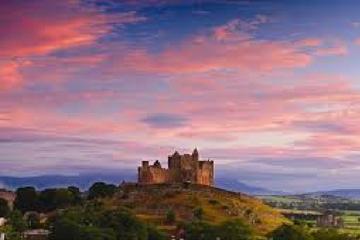
 Slowly Diane and I climbed to the summit of the 300-foot high limestone promontory known as the Rock of Cashel. At the top, we were rewarded with a panoramic view of the green fields of County Tipperary below and the town of Cashel at the base. Despite the presence of the town below, the rock feels isolated.
 Set next to the round tower, you find the shell of the second cathedral on site, dating to 1235. The current gray stone structure is cruciform with a central tower. The nave, which was never completed, is shorter than the choir. The north transept houses three sarcophagi, dating the 16th century, each with carved bas reliefs of the apostles around the periphery. The Protestant Church of Ireland abandoned this cathedral in the mid 17th century and then had the roof removed to collect the lead for ammunition. The cathedral lacks a roof to this day.
 Inside the chapel, you find a white vaulted ceiling with plaster fragments falling off. The whitewash, dating from the Reformation in the 16th century, was used to cover the oldest frescoes in Ireland including those of the Nativity. An intricately carved sarcophagus at the back of the chapel might possibly be that of King Cormac himself.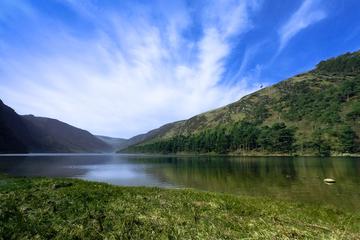

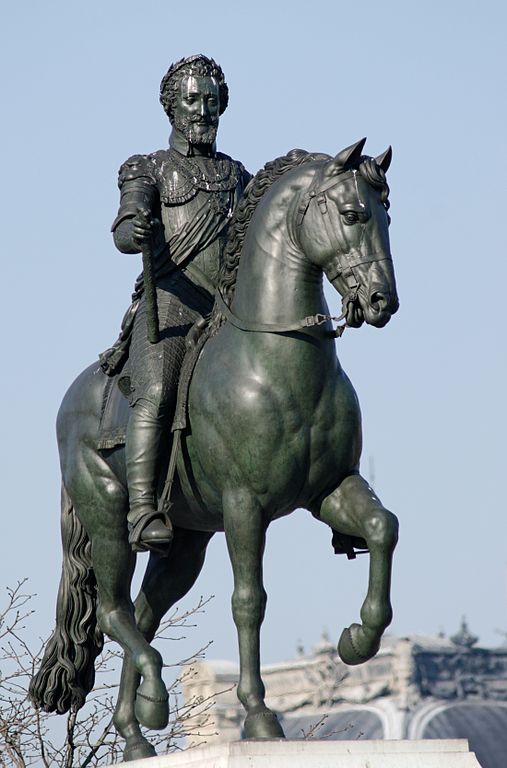


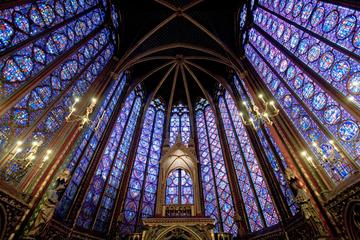
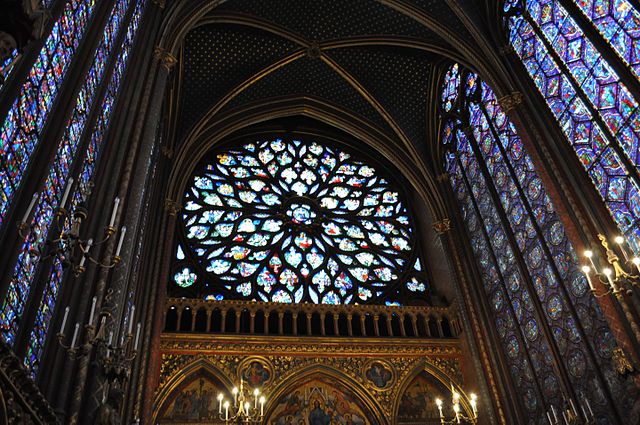 On a previous visit to Paris, I had been soundly rebuked by an elderly French gentleman when I told him that I’d never visited Sainte-Chapelle, so on this visit I was determined to rectify my earlier omission. I’m so glad I took that gentleman’s advice, for Sainte Chapelle, with its glorious stained glass windows is a sight not to be missed.
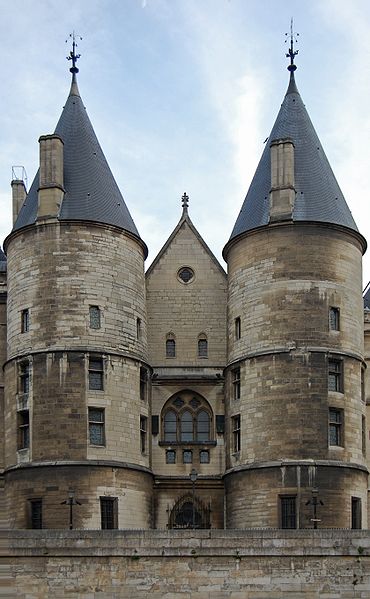 My next port of call, still in the same Palace of Justice complex, was the Conciergerie, on the west side of the island, facing the Quai d’Horlage. The Conciergerie takes its name from the post of the Concierge, a high-ranking official who was placed in command of the Palace of Justice when Charles V moved his royal palace to the Louvre. Part of the Palace was converted to a prison in 1391 and, over the centuries, criminals from all walks of life whiled away their miserable years in the dank cells. The Conciergerie is best remembered, however, for those imprisoned during the French Revolution, when citizens suspected of being counter-revolutionaries were incarcerated in the Conciergerie while they awaited their turn at the guillotine. The most famous prisoner of all was Marie Antoinette, wife of the ill-fated Louis XVI, who awaited her execution in a tiny cell, only separated from her guards’ constant surveillance, by a curtain drawn across half the cell.
 The Ile Saint-Louis was originally called the “Island of the Cows” but was renamed in honour of Louis IX. The connecting bridge to the Ile de la Cité was completed around 1628 and a bridge to the mainland was built in 1635. Once access to the island was accomplished, building began in earnest – all the nouveau riche – the wealthy farmers, merchants and members of the bureaucracy – hurriedly bought land and built beautiful hôtels on the eastern half of the island. Development on the western side came later, where the houses were built in the same elegant design.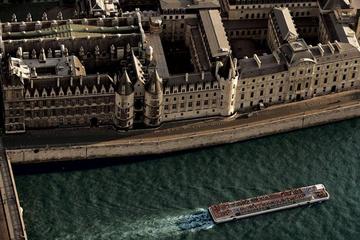
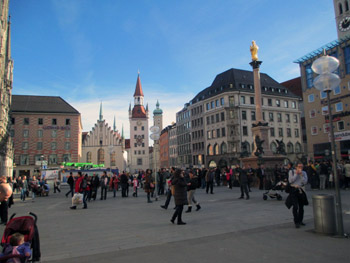
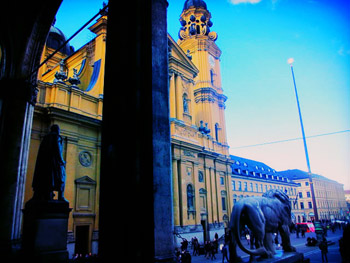 Instead of carrying around a thick guide book which forces visitors to stare down at the tiny print and flip pages, a great option for those seeking to learn about the war-related history is to sign up for Sandeman’s New Europe, Third Reich walking tour. For 12 euro, my journey through the dark history began at the center of the city, at the beautiful Marienplatz. Immediately, the tour guide, who was a walking treasure chest of knowledge instructed the group of 10-15 people to look up at our surroundings. After explaining how the majority of the area was completely bombed out during World War II, he pointed to the main spires of the Marienplatz, and the giant green domes from the Frauenkirche. He explained how the bomber jets from the allied forces used them as landmarks in their bombing campaign, therefore they were spared and remained mostly intact. Chills immediately shot down my spine, as I felt the realness in which surrounded me. This was real, and these were not events which took place in the Dark Ages; this was a time that our close relatives could have lived through. It was a time in which the desperation of the German people gave way to the rise of a former painter from Austria, and allowed Adolf Hitler to guide his people, and the world into a conflict that took the lives of nearly 85 million people.

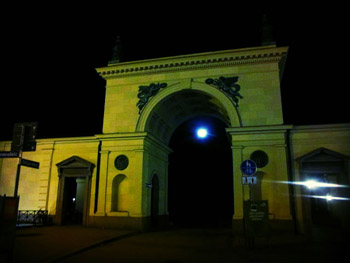 Walking through the streets of the 1,000-year-old city would lead most to believe that the surrounding buildings go back hundreds of years, but they would be greatly mistaken. Following the rise of Adolf Hitler in the early 1930s, Munich became the birthplace of the Nazi Party, and eventually one of the biggest targets for the allies during World War II. The result was thousands of bombs being droppedtact on the city, and to this day, an estimated 2,000 un-detonated bombs are still buried beneath the city. Since nearly 90 percent of the city was completely demolished, everything has been rebuilt, and reconstructed in the 70 years since to end of the war. While construction continues in the Bavarian capital, bombs are still discovered on a weekly basis, and teams have to come in to safely detonate the bombs which range anywhere from 4 lbs to 22,000 lbs. Our tour guide told stories how entire street blocks have to be closed, and entire apartment complexes cleared out when one is discovered. Life goes on, and the residents of Munich accept it as if it is nothing more than a minor inconvenience.
 Prior to the air-raids by allied troops, Adolf Hitler was well aware that Munich would be a major target, and knew the city would be leveled. Planning ahead, he ordered photos be taken throughout the city, so that when the war ended, the city could be built exactly as it was prior to its near destruction. Following the death of Hitler and the fall of the Nazi’s, the German people voted to restore the city to its old glory, resulting in a complete rebuild. Since everything has been rebuilt, it gives visitors a unique perspective roaming the streets, and ducking into beer halls and cafes that fill the city. While the history is thick, and I could nearly feel it hanging in the air, it also felt like stepping into a movie set. Along the guided tour, we were taken to places of historical significance, such as the world-famous Hofbräuhaus. We were taken upstairs into the beautiful beer hall, and shown the place where the Nazi leader once spoke. However, the reality is that the building is a complete replication of the original, somewhat taking away some of the powerfulness which stood before me. It is fascinating, yet saddening how such beautiful architecture and sights were destroyed, but in spite of the restoration, there is still the ghost of the German dictator that echoes throughout the halls.