Volcanic Remains in São Miguel, Azores
by Dene Bebbington
A picture in a brochure was all it took. I had to go and see the Sete Cidades caldera.
We’re on the island of São Miguel, known as the green island. It’s the largest of the nine islands in the Azores archipelago – Madeira’s quiet cousins farther out in the mighty Atlantic. Though it stuck, the name Azores is actually a misnomer from when the sailors who discovered the islands mistook buzzards for goshawks – the word açores is plural for goshawk in Portuguese.
Normally I don’t want to drive when on holiday, but São Miguel is an intimate island. It’s less than 50 miles end to end, and well connected with coastal roads offering glorious views. It’s no stranger to tourism yet is mostly free of the throng who squeeze into Europe’s well trodden tourist spots. Maybe Madeira was like this a few decades ago. I’m feeling brave and prepared to sacrifice our usual package holiday with excursions to one requiring a bit more effort.
My confidence at driving even on a quiet island is shook not long into the journey to Furnas in the early hours. After coming off the expressway and going through Ribeira Quinta I ignore my wife pointing out a sign to Furnas, confidently thinking I’m taking a different route. It is a different route: one which ends on a narrow country lane! Eventually I realise it must be a road to a farmhouse or country dwelling. By the time I’ve reversed (head out the window to see and avoid scraping the hire car on stone walls) for about half a mile to a spot wide enough to turn around, my blood pressure is at levels normally experienced at work on a bad day.
The drama doesn’t end here. On winding coastal roads a car behind is full of young people shouting, exhorting us to drive faster or pull over. Finally we arrive in Furnas only to have trouble finding the hotel in the village’s one-way system. It’s gone 3am when we arrive. We have never been so glad to see a hotel.
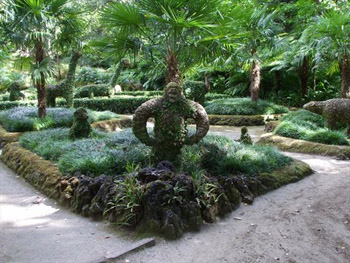 The old spa village of Furnas is our tranquil retreat for a few days before we head to the capital, Ponta Delgada. Here in Furnas is the delightful Terra Nostra Park, a botanical garden created in the 18th century by the American Consul Thomas Hickling. Walking the avenues and winding paths of these gardens we pass monuments, grottos, koi carp ponds, and a whimsical area of animals carved in stone – my favourite is a laughing gorilla stood with hands on hips. Also in the grounds an ochre coloured geothermal lake overlooked by Hickling’s house is popular with many visitors for a restorative swim. Perhaps less popular is the yellowing of swimming gear from the water. I opt not to ruin my swim shorts and instead enjoy an hour lazily swimming in the hotel’s otherwise empty indoor pool.
It takes us a day to relax and settle into the village. Then it’s time to seek out the first crater lake. We slog out-of-breath up a steep hill that soon opens up to a pastoral valley. In the steep sided valley the only people we see are farmers checking on their cattle and crops. Sweetcorn grows in fields next to the road.
My excuse to my wife for doing part of the walk twice is that it’s easy to miss the track leading off between trees up into the side of the valley. Unconvinced, she points out a slightly battered sign to the lake on our second lap, no doubt wondering if I’m exhibiting early signs of dementia!
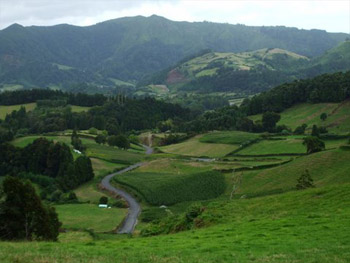 The track could be a tricky ascent when wet and muddy, and is best tackled in dry weather. A few minutes hard walk is amply rewarded by a view across the verdant valley in one direction, and to the other Furnas lake with Jose do Canto’s chapel visible at the far side. A reminder of the volcanic nature of this land is the eggy aroma of sulphur wafting up from the fumaroles below. A young bull chained up nearby is less than enthralled by our presence. His distressed calls eventually signal an end to our viewing. We start the trek back to the village in search of somewhere to get a cold drink.
Volcanic heat provides a novel and environmentally friendly method of slow cooking in this area’s famous “hollow’s meat course” stew. A large pot containing meat and vegetables is put into a hot hole in the ground to cook for several hours. Hearty eaters can sample large servings of the stew in one of the village’s restaurants.
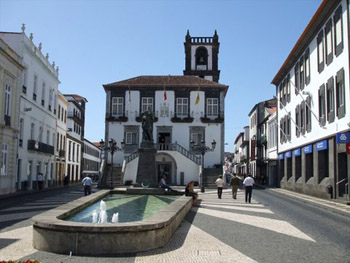 After a mellow few days in Furnas we head to the other side of the island where Ponta Delgada lies in the south-west corner. Here trappings of modern life mix happily with traditional Portuguese architecture – monochrome stone buildings of whitewash edged with black basalt. Squares and narrow cobbled streets in the old part of town can become crowded. So it’s with some relief that we find the drivers to be mostly tolerant of pedestrians.
When stopped at a café or restaurant for lunch we’re as likely to be sat among local people as tourists. After a couple of meals it comes as no surprise to learn that the Azores aren’t known for gastronomy. Most menus are dominated by palatable but unimaginative meat and fish dishes. Our favourite lunchtime haunt is a small café serving pizzas, sandwiches, burgers etc. It’s popular with both schoolkids and workers.
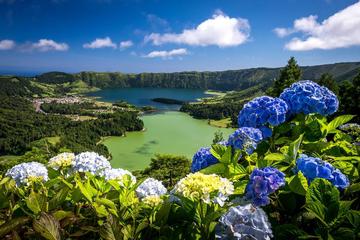
Venturing back into the car and onto the roads we head off to the iconic Sete Cidades (Seven Cities) caldera. The half hour drive from Ponta Delgada along the north-west coastal road is a pleasure thanks to the scarcity of traffic. Remarkably tidy roadside verges are often lined with colourful hydrangeas. By now I’m getting used to driving on the right and coping better with left hand drive. Changing gear with the right hand seems unnatural for a while. It only becomes easy when our trip is almost over.
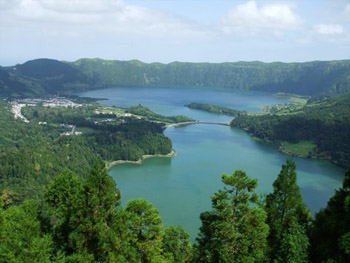 We arrive at the best vantage point, Vista do Rei, where all the brochure pictures of the caldera are taken from. It’s located just off the main road opposite an abandoned concrete hotel, just before the road heads down to the village. Our reward is a superb panorama of the caldera: its twin lakes Azul and Verde, and the village of Sete Cidades nestled on the flat land to the western side. Giant blobs of cloud shadows move across the murky green and blue lakes like giant Rorschach tests. From this spot the adventurous can embark on a long walk around the ridge of the caldera on a narrow path edged by vertiginous drops through trees and other foliage.
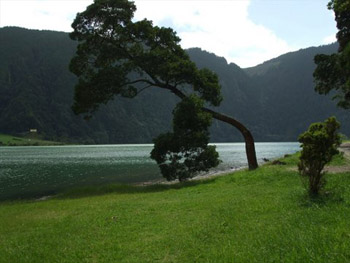
In the mouth of the caldera a footpath around lake Verde beckons enticingly. The chance to stroll along it between tall evergreen trees growing up the steep ridge and water gently lapping the shore is too good to be passed up. It’s September, we see about half a dozen people. Coach parties keeping to schedules mustn’t venture down here. While stopped for a picnic at the lakeside it’s like being in a land forgotten by the modern world. Only fish occasionally breaking the water’s surface hunting insects disturb my reverie. I wish life could always be this peaceful. If our lottery numbers ever come up then maybe we’ll find a place to stay in Sete Cidades for a couple of months of the year.
Of course, a place as magical as Sete Cidades wouldn’t be complete without a story behind it. According to legend, the lakes were formed from the tears of a king’s daughter and her true love lamenting the end to their doomed romance. On the journey home I can’t help thinking that if William Blake were alive today and visited São Miguel he’d surely realize that it also deserves the epithet “green and pleasant land.”
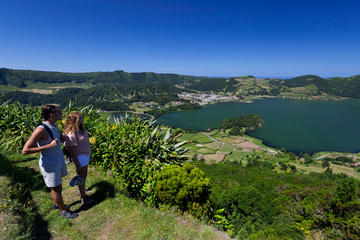
Sete Cidades Hike and Termas da Ferraria from Ponta Delgada
If You Go:
Walking tour to Sete Cidades with picnic lunch
About the author:
Dene Bebbington works in IT but his real passion is writing. He’s had articles published in various magazines and online, and in the last couple of years has started to write short SciFi & Horror fiction.
All photos are by Dene Bebbington:
Leaning Tree
Laughing Gorilla
Furnas
Ponta Delgada
Sete Cidades
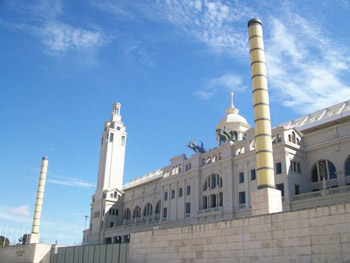
 I settled in on the first two days, and on Saturday visited Montjuic Park for the marathon expo; to collect my race number and timing chip. The Museum of Arts towers over the front of the park; above cascading fountains framed by rows of steps. Musicians and giant dolls entertained in the square at the bottom of the cascading fountain.
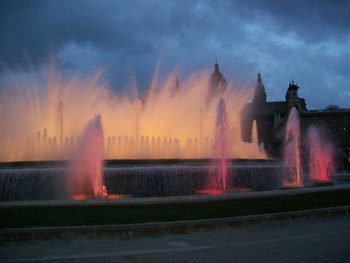 I returned in the night to watch the Magic Fountain show. Every fifteen minutes between 7pm and 9pm the circular fountain at the foot of the hill seems to be awakened by music, spraying water high in the air while changing colours.
 After about four miles the circuit took us past Camp Nou; the 98,000-capacity home of FC Barcelona is the largest stadium in Europe. That night I joined 68,000 people at the stadium to watch Barcelona beat Rayo Vallecano 3-1. Climbing to a seat about five rows from the top of the 150-feet-high stadium was hard work, but worth it, with the sensation of emerging into the steep-sided seating above the bright green pitch reminding me of the Lost Horizon story of a Shangri-La hidden in the Himalayan mountains.
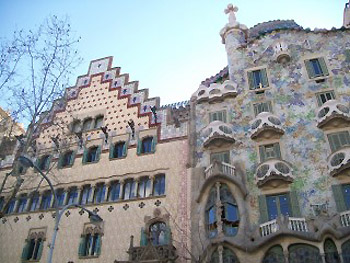
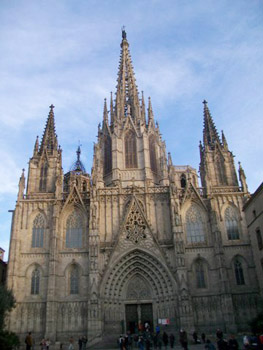 Antoni Gaudi was Modernisme’s most famous artist, and a couple of miles later we passed the movement’s crowning glory. La Sagrada Familia is still under construction a century later. The 13,000-capacity cathedral’s size distinguished it from other cathedrals while passing, and on closer inspection so does its blending of nature into the design. Gaudi liked curves rather than straight lines, claiming there were none of the latter in nature; and some spire-tops are decorated with balls of fruit-colours.

 The sky cleared the next day, and temperatures rose into the 60s Fahrenheit. I took the train out to Monistrol de Montserrat, and hiked to the Santa Maria de Montserrat monastery. To the north-west, snow-capped Pyrenees signified the border with France, while the Mediterranean Sea was visible to the east.
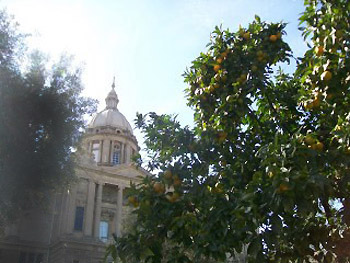 The next day I returned to Montjuic Park, going past the Arts Museum to the Olympic Stadium, which brought back memories of the 1992 Games. I walked past torch-pillars and the Telefonica tower to the tree-filled green zone leading up to Barcelona’s castle. Cannons point up and down the coast and there are great views of the city all the way to Tibidabo Mountain, overlooking Barcelona on the western horizon. The castle has a chequered past, being used to hold and execute prisoners in the civil war and other twentieth-century conflicts.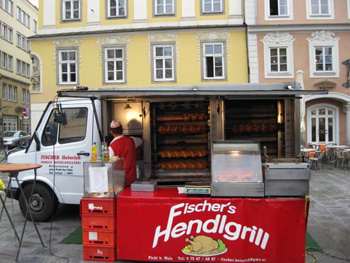
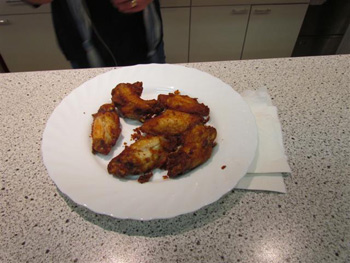
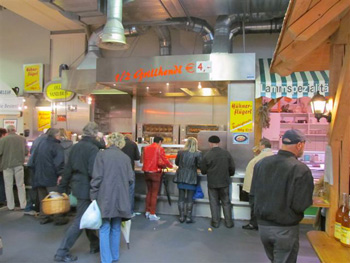 Some of my personal favorite ethnic eats are in Austria. In Wels a small town in the Northwestern section of the country there is a local market which is very similar to the Westside Market in Cleveland, Ohio. A new building was recently constructed to house the vendors. On the outside of the market vendors sell various fresh fruits and vegetables etc. Nothing there is prepackaged. Inside the building the vendors provide various types of fresh food including meat, poultry, eggs, cheese and even schnapps (whiskey). My favorite vendor has barbecue roast chicken on a spit and as of late a new item lightly breaded chicken wings which go well with a stein (a traditional German beer tankard) of beer. Priced by the kilogram (2.2 pounds) US $3.00-$5.00.
 There are other taste treats to learn about and experience. Crossing from Slovenia into Croatia passing through village after village the signs for roast pork (svinjina) and lamb (jagnjetina grilled lamb both roasted on spit) began to appear. The local Gostionas (Restaurants, Bars) were preparing their grills for roasting. As luck would have it, we always seemed to miss many of these establishments. It might have been sheer luck and or just bad timing. We were either too early or too late for lunch or there was not a Gostiona located in the area where we were.
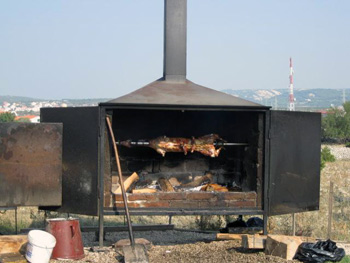 Having been in the former Yugoslavia a few times we learned over the years on what to look for when it comes to roast pork and lamb. Normally vendors and restaurateurs post signs advertising their wares along the road. Driving through Split on the Jadranska Magistrala along the coast toward Dubrovnik about lunch time we just could not find an establishment that had roast lamb or pork. Either we missed the signs or there just weren’t any. Finally we stopped at a local restaurant and we were given directions on where to find janjetina. Down the road and up the side of a sparsely covered mountain, we traveled higher and higher on the narrow pebbled road turning this way and that as the road curved back and forth along the side of the mountain, my cousin sitting in the back seat hanging firmly on to the hand strap fixed to the car roof. We drove on and on for over an hour. Finally we found it. The war had taken its toll. It was a bombed out building and on the side of the building a faded wooden sign advertised jagnjetina. My cousin started laughing hysterically!!! Someone was having a good laugh on us. Consequently we did not have roast pork or jagnjetina this day.
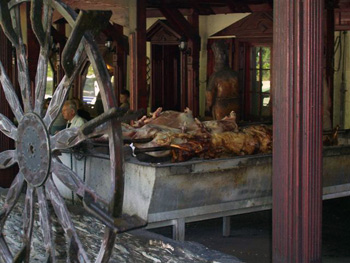
 On another occasion we were traveling by bus from Sarajevo to Mostar we stopped in the town of Jablanica to view the local historical sights. We learned from the locals just on the outskirts about one kilometer south of Jablanica was the restaurant Zdrava Voda (Health Water). There on six roasting spits was lamb grilling on an open fire continuously throughout the day enough to quell the hunger for both the tourist traveling between Sarajevo and Mostar and the local population. The price was US $15.00 which included potatoes, salad, and bread. Jablanica is known for this mouth watering delicacy and that there are over 8 restaurants in the vicinity that serve it. www.zdravavoda.co.ba

 In Sarajevo the restaurant Cevabdzinica Zeljo, on street Kundurdziluk 18, in the Bascarsija seems to be the favorite place for locals to enjoy a “healthy” meal of cevapcici with onions, sour cream and yogurt. Cevapcici is beef minced meat in a roll served with pita bread and priced under US $7.00. Other versions of this delicacy are made with ground lamb, veal, and pork.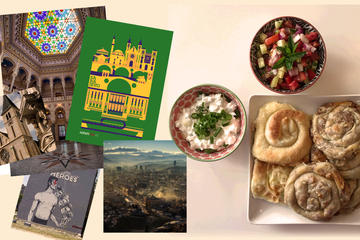
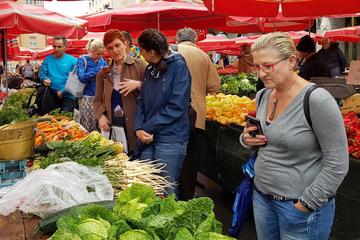
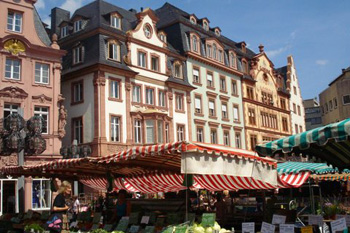
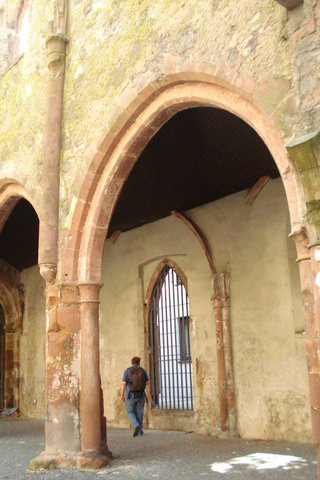 Mainz history goes back to when the Romans built a fort here around the 1st century BC. The name “Mainz” may have derived from the Roman name for the river, Main. But until the 20th century it was referred to in English as Mayence. Besides this temple there are other ruins nearby including the site of the original Roman citadel where there is a cenotaph raised by legionaries to commemorate their hero Drusus. Among the sites are the ruins of an aqueduct and theatre. Some of the artifacts of Roman times can be viewed in the Museum of Antike Schiffahrt and Mainz most important museum, the Landesmuseum.

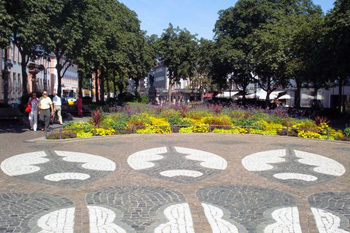 Mainz is home to a Carnival, the Mainzer Fassenacht, originating in the 19th century. We walked around the carnival square where there’s a statue of Friedrich von Schiller, a 19th century writer and poet for whom the Square is named. The Carnival is held on Rosenmontag (Rose Monday), before Ash Wednesday and is one of the city’s biggest celebrations.
 The immense Cathedral of Saint Martin is nearly 1000 years old, built in Romanesque style. It has six individual pipe organs inside all accessed from one large console. The Augustine Church with its magnificent Baroque facade was built originally as a hermit’s monastery in the mid l700’s and is now a seminary church noted for its beautiful interior with ceiling frescoes that provide insights into the life of St Augustine. The Catholic Church of St. Peter is one of the most important Baroque building in the city. Originally a monastery, the present church was built between 1740 and 1756 by architect Johann Valentin Thoman. Inside you’ll see amazing Baroque altars and ceiling frescoes. Christuskirche is an evangelical church in an Italian High Renaissance style. It serves as a music venue as well as church. The old Gothic Church of St. Christoph dates to the 9th century. It contains an original 15th century baptismal font. Johannes Gutenberg, inventor of the first printing press was baptized here.
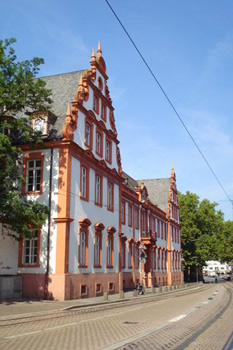 There are several interesting day-trips out of Mainz. The region is rich in variety with idyllic river scenery, historical towns and picturesque villages. The Rhineland-Palatinate is famous as a wine region and the romantic castles along the river and was named by UNESCO as one of the most beautiful landscapes and world heritage sites.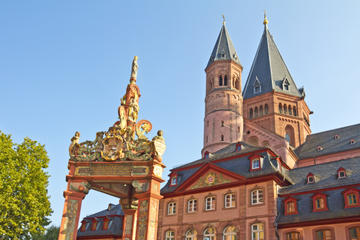
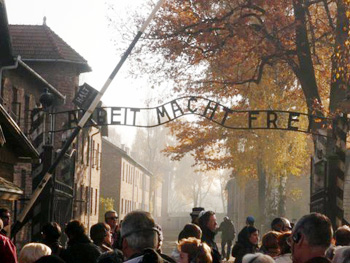
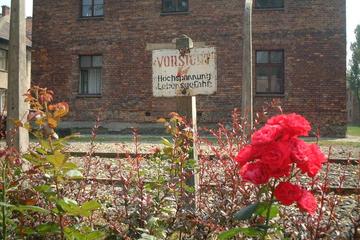
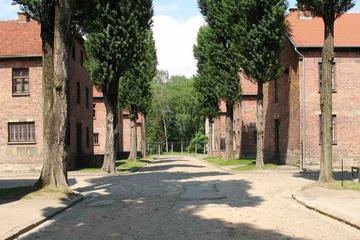
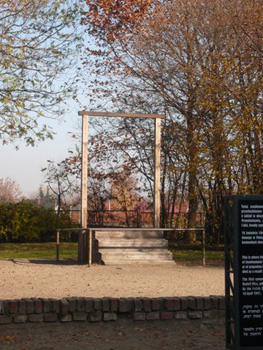
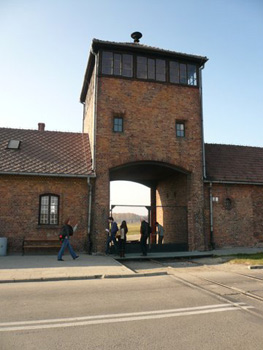 We were part of a continuous line of visitors from around the world who did not need a Silence sign. The only noise came from the shuffling of feet. We were on a tour of Poland and had been visiting Krakow. After making the one hour drive from Krakow, we arrived at Auschwitz I. (Auschwitz II or Birkenau, is a mile away). Admission is free.
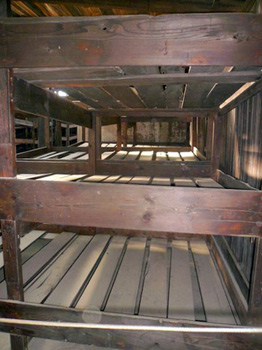 During the early days, the Nazis would take pictures of each inmate. These seemingly endless 8 x 10 glass-covered photographs surrounded a long narrow hall. The inmates looked healthy, for they had just arrived. The name was printed below each photo and included the date of arrival and the date of death—sometimes just days apart. When photography became too expensive, the Nazis started tattooing numbers on the inmates’ arms.
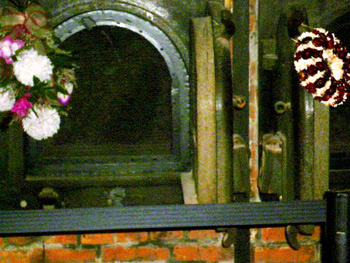
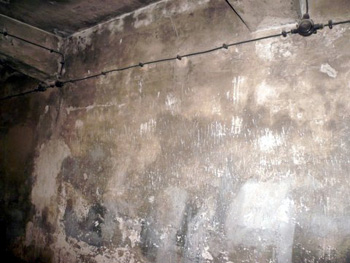 Those who were not selected for the barracks were told they were to take showers. Only Zyklon-B gas was used instead. (The shower heads are still embedded in the cement wall). From there, their bodies were taken to the crematorium The Nazis destroyed evidence of the gas mass killings by blowing up the buildings. Anya told us they liked to use gas because they didn’t have to look at the person while he was being killed.
 This was confirmed by Jerzy Kowalewski, an eighty-eight-year-old Auschwitz survivor. We attended a seminar he had given in Warsaw.
 At the daily roll call, the entire camp stood in their meager rags as the SS guards called out their names. The roll call was given as a collective punishment for the wrongdoing of just one prisoner. The inmates stood for up to four hours in the rain and snow. Some of the extremely weak and sick prisoners would die in the lines during the roll call. After roll call, the prisoners received their ration for breakfast. They were given 10 ounces of bread with a small piece of salami or one ounce of margarine and brown, weak coffee, with no sugar.

 In the Block (or Building 5), on either side of the middle aisle, behind glass, were piles fifteen feet high of human hair on both sides. Rows of long braids popped out at me first.