 by Connie Pearson
I thought I had her figured out. After all, I saw the movie Titanic and the musical The Unsinkable Molly Brown. But this remarkable woman was so much more. Margaret (Molly) Brown died at the age of 65 – the exact age that I am now – but she made such a big splash in her ocean of influence that surviving the sinking of the Titanic was only a small piece of her powerful life story.
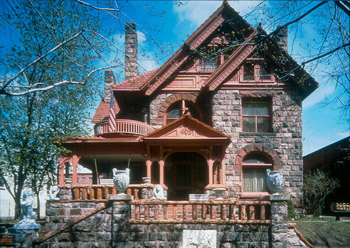
 During a recent conference in Denver, my fellow attendees and I were given a 3-hour time period and told to “go out and explore Denver.” I chose to take a taxi from my downtown hotel and visit the Molly Brown House Museum. Dubbed “The House of Lions” because of the imposing lion statues the Browns purchased for the front of the house, it is located at 1340 Pennsylvania Street. Very few of the furnishings and artifacts are original to the time Molly Brown lived there, but careful study of photos made in 1910, have helped Historic Denver, Inc. with their extensive restoration efforts. Visitors have an authentic experience.
During the guided tour, it would have been entertaining enough if I had just learned of traits and tendencies that I have in common with Molly Brown. For instance, we’re both considered feisty, and, like her, I play the piano, love to entertain, and work in my church. Green is even our favorite color. She was born in Missouri. I was born in Alabama. Both states are in the Southeastern Conference for college football. Does that make us both Southerners? She once said of herself, “I’m a glutton for knowledge.” What a great way to describe curiosity and a desire to keep learning. Qualities I hold dear.
 The trivial threads holding us together end at that point. Molly’s life story, as shared by the docent, unfolded as an amazing inspiration and picture of the power of what one determined woman can accomplish.
Even though she and her husband, James J. Brown, were millionaires because of a discovery of gold in Leadville, CO, her thoughts were on exposing unfair labor practices she saw in those mines and working in soup kitchens and charity efforts. She worked closely with Denver judge Ben Lindsey in the creation of a national juvenile court system.
 In 1901, she attempted to win a seat in the state senate, in spite of a popular saying of the day (one that was strongly supported by her husband): “A woman’s name should appear in the newspaper only 3 times: at her birth, when she gets married, and at her death.” The pressure must have been tremendous, because she withdrew from the race before Election Day. It was no surprise to learn that she was active in the women’s suffrage movement.


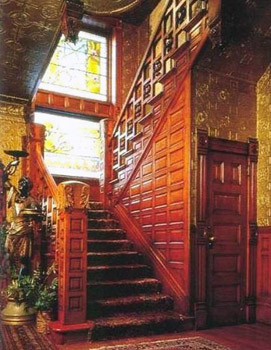
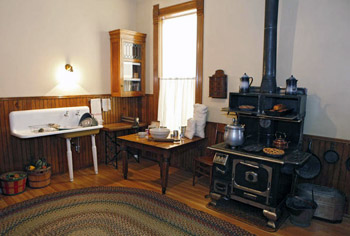 You will see colorful stained glass windows, ornately-carved woodwork, and anaglypta wall coverings. You will learn that this house had indoor plumbing, electricity, central heat and a telephone long before other homes had these conveniences. But, most of all, you will leave wanting to know more about Margaret Tobin Brown and her indomitable – yes, unsinkable – compassion for others and zeal for life.
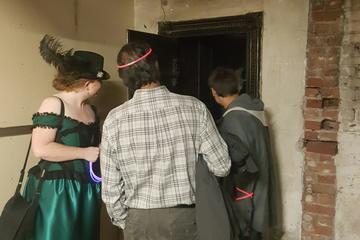
Haunted Denver Evening Pub Tour
If You Go:
Molly Brown House Museum website
Upcoming Events:
Skeletons in the Wardrobe Tea
Saturday, October 31st 11:00 am, 2:00 pm – $24.00 / $18.00 children (6-12)
It’s no secret, Victorians loved Halloween and so do we! The holiday looked a little different back then, though. Do you know what costumes were popular or what games were played? How did the Victorians decorate their homes? Learn the history of Halloween and show off your own ghostly get-up at our spookiest tea of the year! Suitable for ages 8 and up.
A gift shop is behind the house where you can purchase postcards, books and videos, as well as vintage clothing, accessories, toys and games.


About the author:
Connie Pearson is a native Alabamian, wife of 44 years, mother of 3, grandmother of 12. A retired elementary music teacher/former missionary/now budding weight-lifter, travel writer and blogger. www.theregoesconnie.com
Photos are used by permission, courtesy of the Molly Brown House Museum:
House Exterior
Front Hall
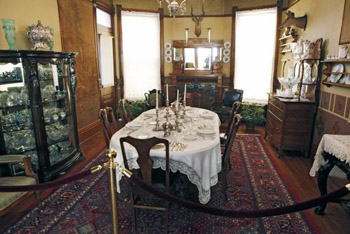
Dining Room
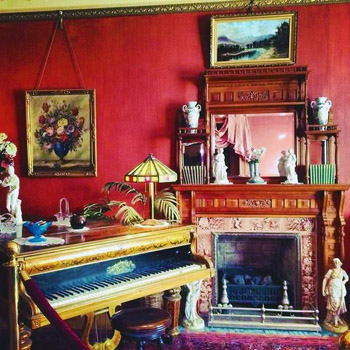
Front Parlor
Kitchen
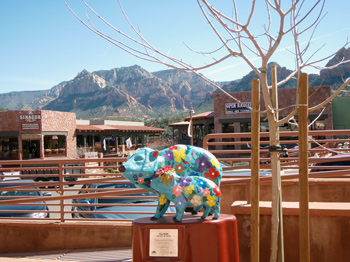 The town provides a relaxed atmosphere with a creative flair. The soothing terracotta buildings blend in perfectly with the surroundings. The town centre displays samples of local paintings, sculptures and carvings. We enjoy the delightful mama javalina (a wild pig-like animal) sculptures in colourful print dresses, with their babies beside them. Wandering the streets of Sedona is like walking through an outdoor art gallery. There are many impressive inside galleries to visit, such as the Sedona Arts Centre. The numerous shops make it difficult not to come away with a special treasure to take home. I can´t resist purchasing a Snoopy Rock T-shirt for my grandson.
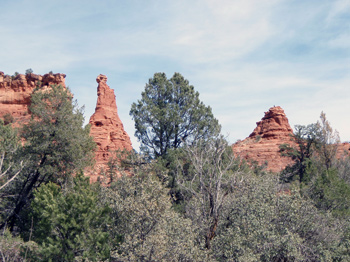
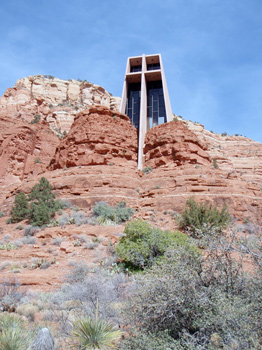 The Church of the Holly Cross built high amongst the bluffs overlooking Sedona is a remarkable work of art. Designed by architect and sculptor Marguerite Brunswig Staude in memory of her parents, it was completed in 1956 and is open to people of all faiths. The view through the picture window, divided in four by an enormous cross, is spectacular. Outside the chapel are perfect photographic opportunities of the area’s stunning rock formations and the valley 200 feet below. An appropriate configuration nearby resembles the Madonna and child and surrounding it are three rock figures that remind you of praying nuns.
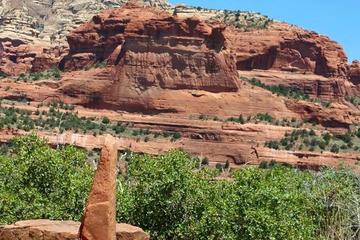
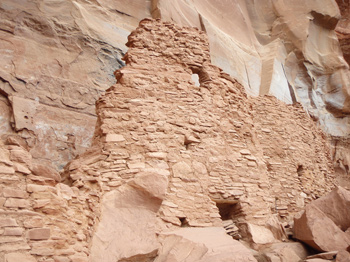 On another day we visit the Palatki Red Cliffs Heritage Site to view pictographs and visit cliff dwellings built by the Sinagua Indians 900 years ago. Walking sticks are provided to get to the sites situated on the steep sides of the cliffs. Due to their location, the well preserved dwellings have not been touched by rain. The masonry blends well with the red sandstone providing security to the dwellers. No one knows what eventually happened to the inhabitants, but the sense of family can be felt as we peer into the rooms where people carried out their day to day activities. The finger prints remain, if not to the human eye. This is not a place to wear white as I soon learn. The iron oxide that makes the sandstone red leaves evidence of your visit. We are also careful to dodge the Costco sized prickly-pear cacti that are everywhere.

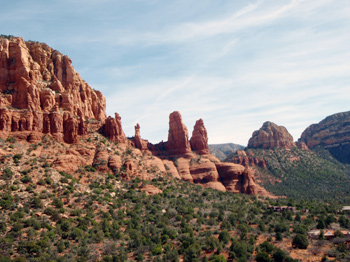 Sedona has a unique blend of history and new ageism. The area is well known for the energy originating from its many vortexes. My daughter finds the vortex sights fascinating. She visits the Boynton Canyon vortex and discovers a positive magnetic energy near a tall majestic rock called Kachina Woman. She comes away feeling energized and contented. There are many vortex tours available, but you can wander the sites yourself as well.
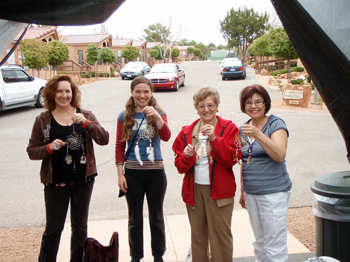 A short drive takes us to Jerome, an old mining town built on a hill. Home to many brothels in its day, these former houses of ill repute now house unique shops displaying artists’ wares, next to clothing and odds and ends. We chat with a nonchalant painter perched by her easel on the sidewalk, painting a gnarled old tree overlooking the russet cliffs.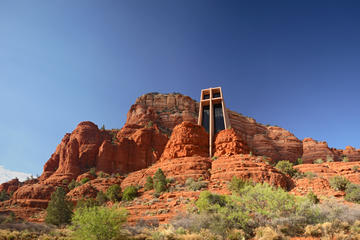
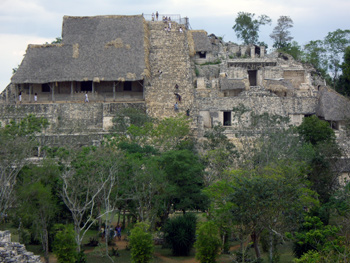
 I had visited Ek Balam for the first time in 1995. I was on the way to Chichen Itza from Coba, on the old road. After passing the town of Valladolid, a dirt road led to this small site. It was called Ek Balam, Night Jaguar. I ended up there about midday when it was hot and humid, with no breeze at all. However, after driving all morning on a dirt road that seemed to be in the middle of nowhere and leading to nowhere, I spotted a small palapa hut. It was the ticket booth, and it looked deserted, just like everything else around us. When I stopped, an old Mayan man came out to the front of the hut. He was the caretaker of the site, or the ticket agent. I wished that I could speak Mayan, and his Spanish wasn’t much better than mine, so I felt like it was a missed opportunity to get to know someone interesting and to learn more about the place I was visiting from a local. I purchased my ticket from him and he pointed me in the right direction and I set off to see this little-known site.
 I realized that the tallest pile of rubble, overgrown with trees, was a good sized pyramid. Although steep, with a barely visible trail on it, I climbed to its top. It was a real challenge for me since there were not even tall enough trees growing on it to shade me from the scorching sun. In spite of it, I still made it to the top and was rewarded with a great view. I could only guess how important this site would have been with a structure this big. I fantasized on seeing the pyramid and its features, wondering what they were like. I noticed big pieces of cut stones, that I recognized as part of a building. As I learned in later years, I had been standing on top of the Acropolis, indeed the biggest structure at the site.
 After getting off that mound, I kept walking through the small site. I noticed a pile of rectangular stones, cleaned and gleaming in the bright sun. Most of the stones were numbered, like pieces of a puzzle. It was such an exciting discovery for me, a sign of the work of archeologists. I knew now that they were in the process of reconstructing the site, or at least some of the buildings. I also knew that I would return to see it excavated and rebuilt.
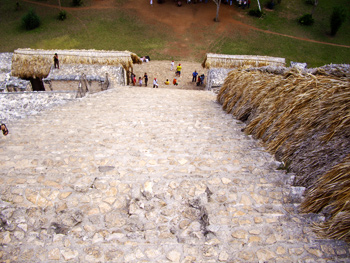
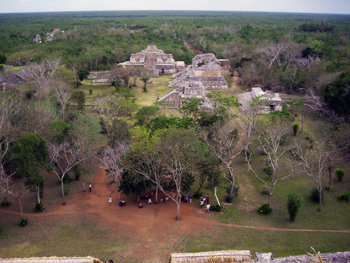 Years later, there I was standing on top of the same tall mound, but this time I had climbed it on a stairway, stopping along the way to marvel at the statues on its sides. The view from the top was pretty much the same though there were a lot more structures standing.
 Ek Balam is a very compact site. Although it was a larger city, only the center of it, the main plaza has been excavated, which covers about one square mile. This makes it very easy to walk, though. A large arch stands at the entrance of the city, with the remains of a sac-be going through it. The sac-be, or ancient Mayan road (translated as “white road”, due to the color of the limestone that it had been constructed from), connected Ek Balam to other sites, like Coba and Chichen Itza. When I passed through the arch, I felt like I had entered the ancient city.
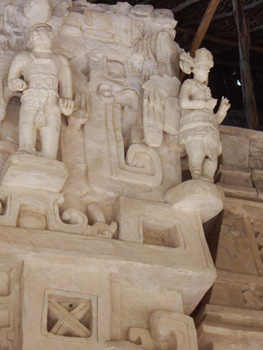
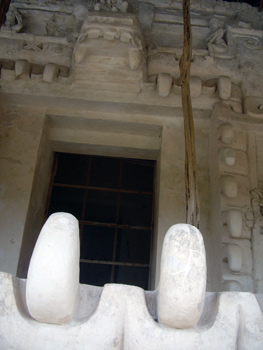 The Acropolis is definitely one of the most impressive structure in all of the Yucatan, a palace and pyramid in one. Though not as tall as Nohuch Mul in Coba, it is much larger overall, measuring 480 ft in length, 180 ft in width and 96 ft in height. Since it has been excavated, it is definitely the most spectacular, with all of the intricately carved figures, unlike any other we’ve seen in all of Yucatan, standing on its walls. The palace has six levels, and at the entrance a monster-like figure, possibly a jaguar, with huge carved teeth is guarding the entrance to the Underworld, the place the Ancient Maya went after death.
 Inside the pyramid is the tomb of a great ruler, Ukit Kan Le’k Tok’. Other than the jaguar, many other carved figures, some of the warriors, decorate the walls.
 There is no Mayan site without at least one stelae, a large standing stone, filled with drawing and writing, and Ek Balam is no exception. The one here depicts a ruler, with the hieroglyphic writing around his figure, erected in honor of Ukit Kan Le’k Tok’. Writing in stone was very important to the Maya. They have erected stelae in every known site. It was a way for them to record history and preserve their past. They have also written codices or books, however, most of those didn’t survive, burned by the Spaniards or just disappeared in the jungle, so stelae are very important for the study the Mayan writing and history. They were usually erected to commemorate a moment in history, a moment important to someone, mostly to the rulers of the cities. Because of this, stelae have a figure of the ruler they are talking about, with the important dates in his life. They have the date of his birth, of his accession as a ruler, some important dates of his rule, and finally the date of his death or descend into the Underworld.

 All photos by Jeff Fromm: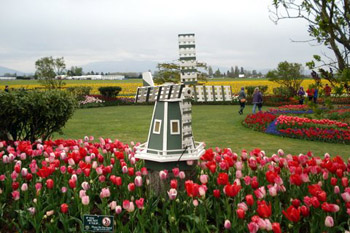
 The Spa is part of the resort and offers a tranquil setting for spa treatments and a large outdoor swimming pool that even in the Spring season was warm enough to enjoy. The spa treatment was a highlight of my stay there, a great way to relax after a long journey or a busy week in the city. If you make physical fitness part of your day, the resort has an excellent fully equipped Fitness Centre ringed by an indoor running track.
 There are many things to enjoy at Semiahmoo and in the Watcom Country area. If you’re a golfer you can enjoy a day on the two golf courses at the Semiahomoo Gold & Country Club. The resort is surrounded by nature so whether it’s a walk on the beach or on a forest trail, exploring the historic outlying buildings, a picnic at Peace Arch State Park or an afternoon of gambling at a nearby casino, there is something for everyone to enjoy. Boat cruises are available as well as whale watching, sea kayaking, scuba diving or fishing. We enjoyed wandering around the resort area exploring the old boat sheds and waterfront area where they have signs posted with bits of local history or of ecological interest.
 Several miles south, located just a few minutes east of the 1-5 exit 201, an hour north of Seattle, is the newly refurbished Angel of the Winds Casino Hotel in Arlington. It is owned by the Stillaguamish Tribe which has operated the casino since 2004 on their lands. The new hotel just opened in December 2014 and has 125 guestrooms as well as gift shops, dining and entertainment.

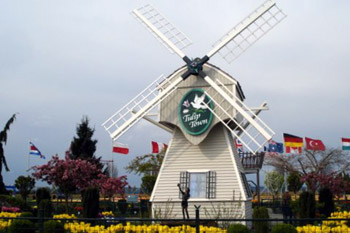 Our first stop for the morning was Tulip Town The landmark windmill was built by owner Tom de Goede, a replica of his family’s windmill in Holland. We enjoyed an hour of browsing among the gorgeous varieties of tulips still blooming In the vast fields as well as displayed in the beautifully decorated gallery where there are landscape murals depicting various scenes in Holland . We were greeted by the owner’s wife, Jeanette Boudreau, who happens to be originally from French Canada. She explained the various species of tulips and told us about the operation of the farm. There is entertainment for children at Tulip Town too, with face painting and a kite flying display every weekend.
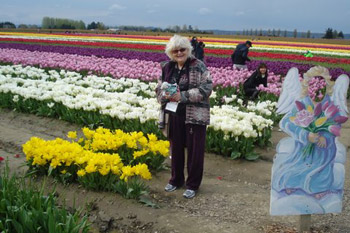 Next on the road trip was RoozenGaarde, another lovely tulip farm near Mount Vernon Wa. Where the flower fields were still blooming. I was especially impressed by the wide yellow fields of daffodils. There were flower beds and a picturesque park area to browse through. The founder, William Roozen emigrated from Holland in 2947 and started a bulb farm on five acres of land which has now grown to be the largest tulip-bulb grower In the country. Roozen Gaarde was established in 1985 by the Roozen family (the name means ‘rose’) and is an official sponsor of the Skagit Valley Tulip Festival.
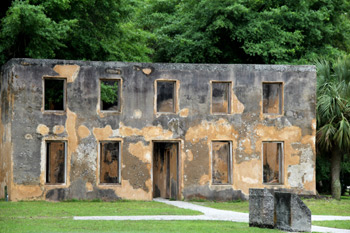
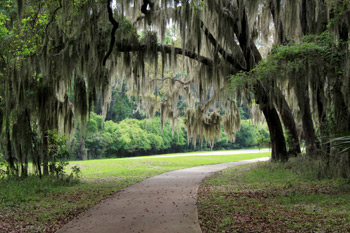 He explained that Horton House was one of the oldest standing tabby structures in the state of Georgia. When I looked at him strangely, he laughed again.
 When I told him I was interested in hearing more, he continued: “They’d pour it into large forms that had been made with two parallel planks of wood These would measure the length of the structure’s outer walls. When each tabby mixture had set, the boards would be moved upwards repeatedly, until the desired height of the home was reached. If you really love history, you don’t want to miss this piece of it!”
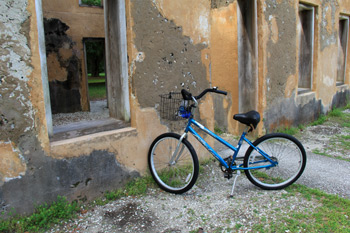
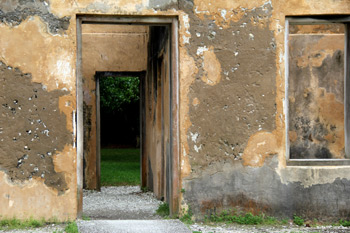 The moment I caught sight of the ruins of Horton House, I stopped short. With its scarred openings for windows and wide-open doorways, this deserted house echoed with the drama of its last inhabitants. Its two-story structure stood proudly beneath the overhanging beauty of gigantic tree branches. I jumped off the bike and parked it nearby.
 The house was built by Major William Horton, second in command, serving under General James Oglethorpe and in charge of troops that were entrenched further North, on St. Simon’s Island. Horton House is surrounded by rich land, which was perfect for harvesting cotton and indigo, as well as hops and barley. Horton actually produced Georgia’s first beer and supplied ale to the troops and settlers at nearby Ft Frederica. I wondered what a cold glass of that had tasted like, way back when!
 One of the land grant conditions stated that Horton would have to bring 10 indentured servants with him from England, one for each fifty acres of land. He was also required to have 20% of the land cultivated and sustainable, within the first ten years of his settling in Georgia.

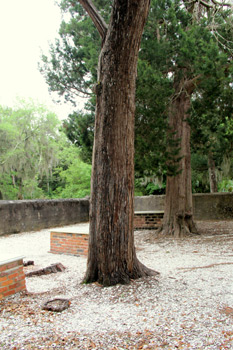
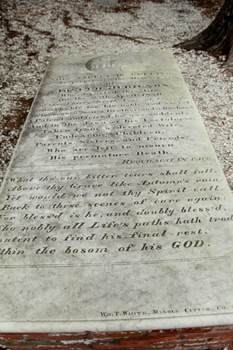
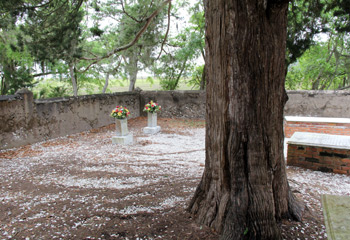 In 1791, four Frenchmen from Sapelo Island jointly purchased Jekyll Island. Later, one of them, Poulain du Bignon, became the sole owner. As a young officer, Poulain served in the French Army in India, fighting against Great Britain. Later, he commanded a French Naval vessel. He moved into Horton House in1792, several years after the American Revolution. Bignon died in 1825. He was eighty-six. He’s buried with other members of his family, across the street from Horton House, with a peaceful view of Bignon Creek. A single oak tree marks his passing.
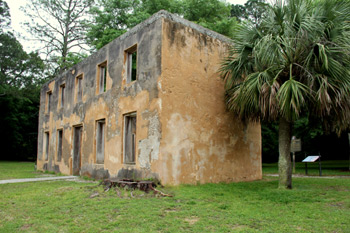 The remaining Bignon family continued to own Jekyll Island, working together to manage the plantation and it’s crops. Eventually they decided to sell the property to a group of millionaires in 1886. They, in turn, promptly formed The Jekyll Island Club, a playground for the rich and famous. Many of the world’s wealthiest families became members in it’s heyday. Most notably were the Morgan, Vanderbilt and Rockefeller empires.Today, the Jekyll Island Club is a luxury resort and a member of the Historic Hotels Of America.

 About the author:
