by Paul Norton
Remember when then Vice President Dick Cheney shot his hunting buddy in Texas? That took place a couple of days before I first visited Austin, in early 2006. I thought to myself ‘I’d better watch what I say. This is the land of George W. Bush, and the socialist views of this Canuck might be mis-interpreted.’
I was delighted at how alternative Austin was – not just the music, but the food, the businesses and the general attitude of the residents in general. And I heard more jokes about Bush and Cheney that week than I ever had, before or since!
It wasn’t my choice to go there that first time. I was attending the annual Folk Alliance International conference. It wasn’t until 2012 when I returned. I wanted to see more of what made Austin so different, and to show it to my partner Sue Malcolm.
The Live Music Capital of the World
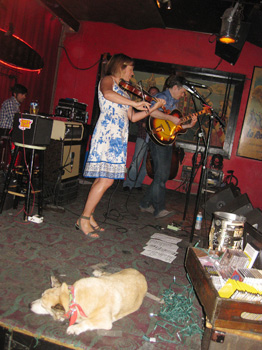 The 1970s brought about the Austin music scene as it is now. Recording artist Willie Nelson was prominent among the artists that helped bring it to life. PBS’s Austin City Limits show is the longest running live performance TV show in US history, and it produces a massive music festival there each September.
We took full advantage of the lively and unique music scene, and hit the clubs just about every night during our visit in April 2012. We experienced the great roots rocker Dale Watson along with the “you-gotta-see-it-to-believe it” ‘Chicken Shit Bingo’ held on Sunday afternoons at Ginny’s Little Longhorn. Just a few other venues worthy of mention are the Austin Music Hall, Stubb’s Bar-B-Q, La Zona Rosa, Antone’s, The Broken Spoke and Threadgill’s. Of special note is the Cactus Café at the University of Texas. You get the idea – Austin is a VERY musical city! Pick yourself up a copy of the thoroughly awesome Austin Chronicle and let it be your guide.
Our hands-down favourite? That’s easy. The Continental Club on South Congress Avenue. Great country and roots music artists like Junior Brown, The Hot Club of Cowtown, Redd Volkaert and Toni Price appear there each and every week in the 6:30 to 9:00pm slot. Later in the evening artists like Alejandro Escovedo, James McMurtry, The Red Elvises and Southern Culture on the Skids appear. And that was just in the week we were there!
South Congress Avenue
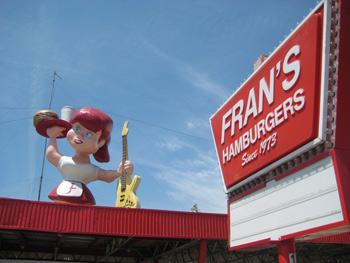 Just a short walk from downtown over the Colorado River, the South Congress area is one of the most interesting in Austin. And with all the city has to offer, that’s saying something! We found ourselves returning there over and over to browse. Block after block is full of great vintage clothing stores, restaurants, and shops crammed full of folk art curios.
Some of our favourite places were Allen’s Boots, Tesoros Trading Company, Amy’s Ice Cream, Mi Casa and the Lucy in Disguise with Diamonds costume shop. There are lots of food trailers everywhere serving a wide variety of great grub. While you’re there, don’t miss the legendary and decidedly retro Austin Motel, still pretty much the same as it was when it was built in 1938.
North of the Colorado River
 There’s a plethora of great stuff to see in the downtown core. Here are just five of our faves.
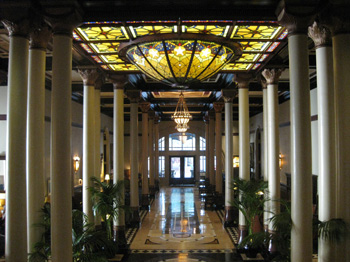
Above all else, make sure that you check out the exquisite Driskill Hotel on Brazos Street. Excellently preserved and maintained, the polished panelling, wrought iron, massive pillars, stained glass and tile floors will take your breath away. Their rates are probably beyond many people’s price range, but you could stop in for lunch or even just a drink in the bar.
As you are leaving the Driskill, walk across East 6th Street and check out Wild About Music. This store describes itself as dealing in “Art, Gifts and Apparel for your Music Lifestyle”. Whether you’ve always yearned for a set of coasters fashioned as little Beatles album covers, a pair of DayGlo cowboy boots, or a toilet seat that’s the spittin’ image of a Fender Telecaster guitar, this is the place for you.
Not too far down 6th at North Lamar is Waterloo Records. Their slogan once again pretty much sums it all up – “Where Music Matters”. Aside from seemingly every CD ever made, they have serious sections devoted to vinyl, DVDs and used items. They average two free in-store performances a week, too.
 In 1960, the Colorado River, which runs through the centre of Austin, was dammed to create a huge reservoir originally called Town Lake, recently renamed Lady Bird Lake in honour of celebrated Austin patron Lady Bird Johnson. There is a well-appointed trail (approx. 16 km, or 10 miles long) all around the lake, complete with pedestrian-only bridges at either end. A walk around it is a great remedy for the excesses of the night before in the local watering holes. Try and get an early start to avoid the mid-day heat.
Last but not least is the Black Star Co-op Brew Pub. A bit of a hike from town centre, it is “the world’s first co-operatively owned and worker self-managed brewpub”. The staff is paid a decent wage and tipping isn’t allowed. You don’t have to be a member to attend, but it’s cheaper if you are. There are typically 16 beers on the menu, from basic to exotic, and they often brew up a special small batch of something unique. Members can vote on which of those get produced. The food’s great too.


Wine and Guitar Making
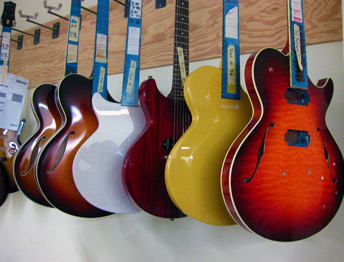 Just a forty minute drive west of downtown Austin is the world-famous Collings Guitar Factory. We were expecting something a bit short and superficial, but were pleasantly surprised to discover it was an extremely comprehensive look at every phase of instrument building. The 90 minute journey took us from a climate-controlled warehouse full of blocks of exotic wood to the final room where the guitars, mandolins and so on were shipped out. There is only one tour a week, so it’s best to book ahead by phone or email.
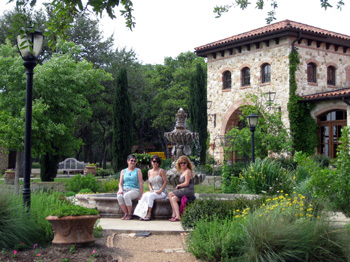
If you are like us, probably the first image that pops into your head when you think of Texas isn’t wine. But in fact the hill country just west of Austin has many vineyards producing world-class vino. We spent a very enjoyable afternoon with friends visiting five wineries. They all had tasting rooms where you could buy a sampler of several small glasses of wine. The buildings were beautiful, and you could usually buy a whole bottle and go for a picnic on the grounds if you wished. Some of the establishments, like Saltlick Cellars, had restaurants as part of the operation. There are bus tours available out of Austin.
Austin is a State Of Mind
More than one resident proclaimed to us “I’m not from Texas … I’m from Austin”. It gradually dawned on me that this is more than a cute turn of phrase. The reason why we love Austin so much is because it’s so different from the rest of Texas. It’s like a little Democrat island in the middle of a great big Republican sea. There’s a very vibrant “Buy Local” movement in the city that seems to be embraced by merchants and customers alike. The city has an unofficial slogan … “Keep Austin Weird”. You see it all over. There’s a sense that its residents feel that they are part of something special – something that they are striving to keep. They are fighting the good fight against big chain stores and high-rise developments that most of us view as inevitable. They are regrettably losing some ground here and there. There was noticeable gentrification since my last visit six years ago. But that spirit of independence that some call weirdness still prevails. And hopefully it will remain so. Long live Austin!
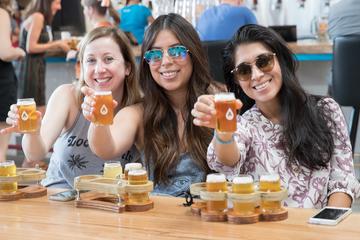
Austin Live Music & Brewery Tour
If You Go:
♦ Austin Chronicle – www.austinchronicle.com
♦ Austin Motel – www.austinmotel.com
♦ Black Star Co-op Brew Pub – www.blackstar.coop
♦ Cactus Café – www.cactuscafe.org
♦ Collings Guitar Factory – www.collingsguitars.com
♦ Continental Club – www.continentalclub.com/Austin.html
♦ Driskill Hotel – www.driskillhotel.com
♦ Saltlick Cellars Winery – www.saltlickcellars.com
♦ Waterloo Records – www.waterloorecords.com
♦ Wild About Music – www.wildaboutmusic.com
About the author:
Paul Norton does many things – Radio show host/producer, graphic artist and web designer to name just a few. He’d love to be able to travel more. Visit www.paulnorton.ca.
All photographs are by Paul Norton or Sue Malcolm:
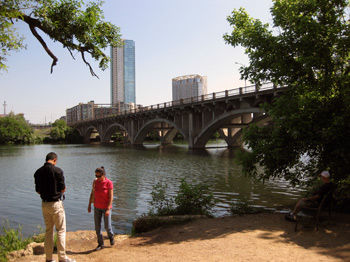
Congress Avenue Bridge and Lady Bird Lake
Hot Club of Cowtown at the Continental Club
Fran’s Burgers Drive-in on South Congress
The lobby of the Driskill Hotel
The Duchman Family Winery
Guitars nearing completion at Collings Guitars
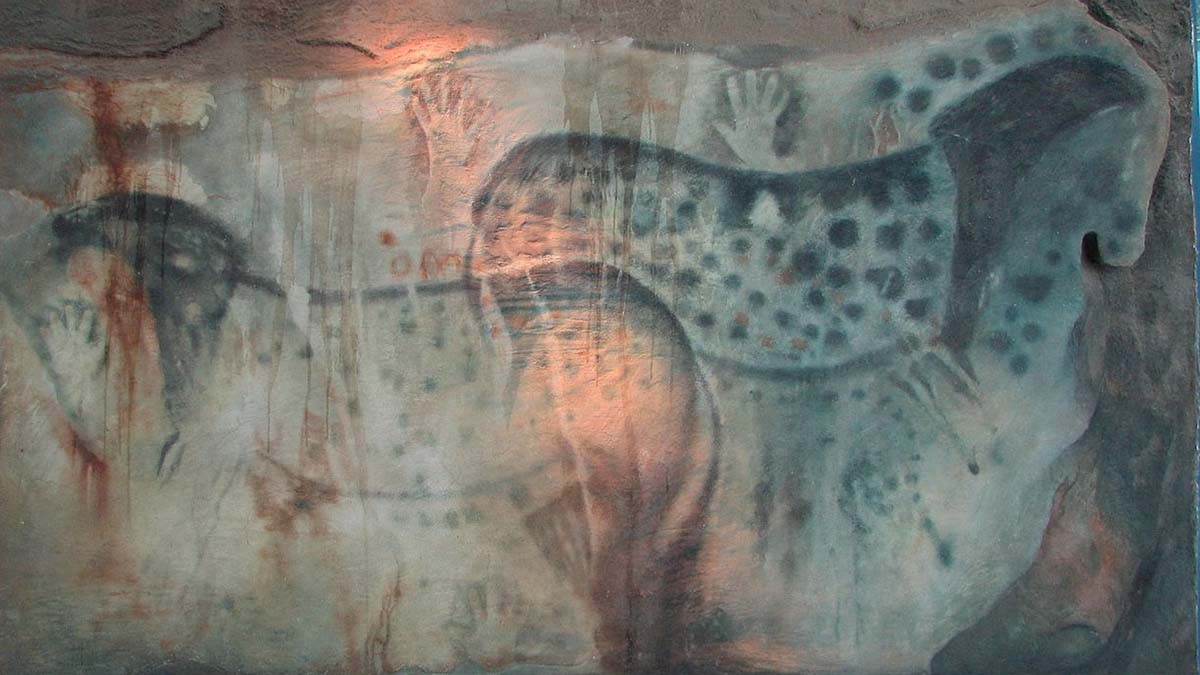
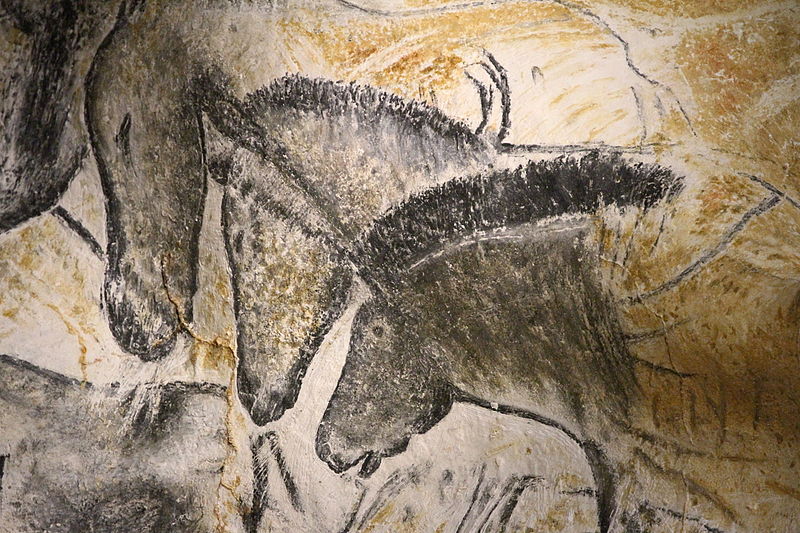
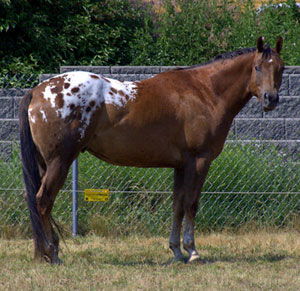 By 1680, the year of the Pueblo Revolt in New Mexico, horses spread rapidly through the plains and prairies of North America, probably reaching the Northwest around 1700. And the Nez Perce tribe, long known for their dog-breeding skills, quickly adapted to the horse, harnessing it as an invaluable aide in hunting buffalo. Because of the horse’s speed, they were able to cover more territory in less time and thus extend the expanse of their hunting grounds. Life was good and meat became more plentiful as a result.
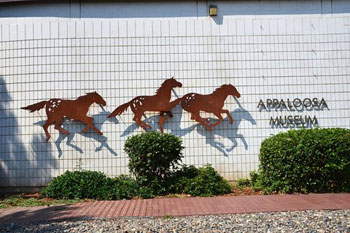 Over the following years, Chief Joseph of the Nez Perce found that his tribal homelands were increasingly encroached upon by white settlers, despite signed treaty promises to the contrary. Rather than continue to fight against overwhelming odds, he mustered a band of his people consisting of several warriors, elders, and many women and children, embarking on a 3-month, 1,170 mile journey to sanctuary in Canada.
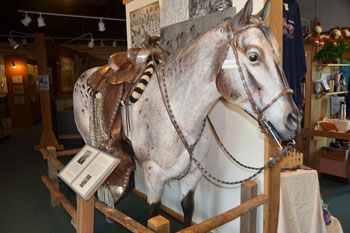 Nowadays, the Appaloosa horse breed is enjoying a resurgence in popularity and can often be seen exhibited at county fairs along with their young mounts. Besides being popular with young horse riders, Appaloosas are also used as working ranch horses and trail horses. The Appaloosa Horse Club, an international breed registry, has records of more than 635,000 Appaloosas and 33,000 members. The horses excel in many competitive events, including racing, jumping, dressage, reining roping gaming, pleasure and endurance.


 Photo credits: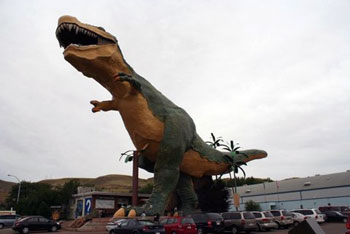
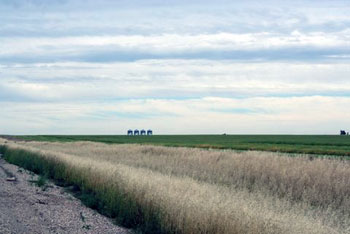 The grasses were high, it was hot but not sunny, the huge domed sky blanketed with a thin layer of clouds. We were not beset by any pesky bugs like mosquitoes, but there was a fair share of crickets which seemed the only wildlife we could detect. The roads were lined with wire fences, and every now and then we would see a row of modern silos, which are metal and tubular rather than wooden like the classic grain elevators that are almost nearly extinct on the Canadian prairies. We came to a row of four which appeared to us to be very far away, but as we approached them, we found they were near and tiny. Our eyes had been fooled! The flatness of the land and the lack of any defined shadows had really played a number on our depth perception.
 Drumheller is the heart of the Badlands and the dinosaur fossil capital of the world. Its main industry is dinosaurs and the town lets you know it. Look, there is Fred and Barney’s All You Can Eat Chinese and Western Buffet! Many businesses had fiberglass dinosaurs in front. The fire hall had one painted like a dalmatian, and another one had been painted all steampunk and metal. Well, no one knows what a dinosaur’s skin really looked like, do they? A lot of kids like dinosaurs so many of the town’s visitors were families with children. The downtown is small with no structures over two stories, with little cafes that serve grilled cheese sandwiches and chicken fingers and not very good coffee. We felt like no real living was done there, as if the town only existed so the children and their parents had some infrastructure to meet their needs after they were done looking at dinosaur bones.
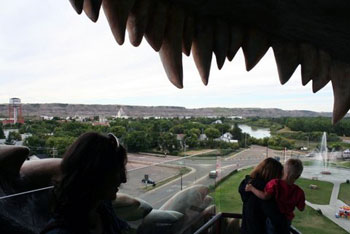
 In front of the Dinosaur Museum there was a T-Rex so large we could climb steps inside and six or seven people could gaze out of it’s mouth for a sweeping view of the town with the Badlands behind it.
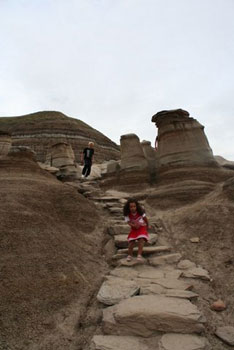
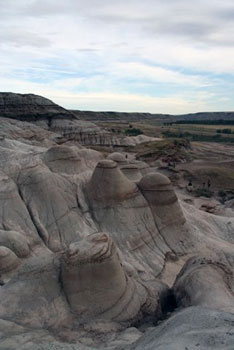 The road to the Hoodoos, although along a river, was not verdant at all. The dry, golden road with its walls of striped history really did make us feel like we were in the wild west, heading for the canyons. We were prepared for Nature’s majesty! But upon arrival at these Hoodoos, we discovered them to be few and only four feet tall.


 Our AAA paper map in hand, the GPS stored away safely in the glove box we set out starting with a short stretch of the I5 from Bellingham to Burlington. There we exited taking Hwy. 20, followed by a thirty minute ferry ride to Historic Port Townsend and continued south on the inland highway, yes there are two Highways numbered 101. At this point we make sure to take the road to Leland and along the Hood Canal.The route was clearly shown on the map which is important as between the towns of Shelton and Arctic Wash. the highway number changes no fewer then four times. A more enjoyable journey the road snakes through Washington State from Burlington to the Oregon border passing through small communities rather then blasting past blurred exit signs to distant places. While the inland 101 is for the most part two lanes with lots of curves and a long stretch of logged off forest that also took the brunt of the November 2007 wind storm, it is still a much more relaxing drive then the I5. Our drive home will be the same restful route.
 It’s late August the afternoon of day one of our road trip. We’ve made good time as we pass Dismal Nitch and cross the Megler Bridge over the Columbia River on the border of Washington and Oregon. Through the fog and far below we can see a large sandbar and deteriorating pilings, remnants of canneries and a once vigorous fishing industry. Astoria is our first stop in part because it is the perfect days drive from the Canada/U.S. border and we can sleep under the bridge. Don’t worry we do have a hotel room.
 The first permanent U.S. Pacific Coast settlement, Astoria was incorporated in 1876 by settlers attracted to the fur trade, fishing and canneries. The town’s future became shaky when those employers packed up and left town so Astoria reinvented itself as a tourist destination. Key to the town’s undertaking is the River Walk a five mile ribbon extending along the river and serving both as a pedestrian walk, a cycle path as well as a trolley route that runs adjacent to quaint cafes, small shops and working wharves.
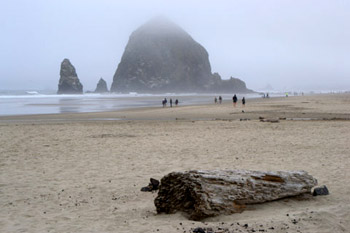
 Day two of our Oregon trip, it’s foggy and cool. Cannon Beach is a short drive south of Astoria on the 101 and is so named for a cannon that washed ashore from the U.S. Navy Schooner Shark in 1846. A touristy community, Cannon Beach is also more family oriented complete with beach bikes,horse back riding, sand castle contests, kids in I heart Cannon Beach hoodies, ice cream and gift shops. There’s motels, hotels, B&Bs and family style restaurants all within walking distance of the beach. We include it in our journey for the miles of sandy beach, the open ocean and Haystack Rock. Stopping just long enough to stretch our legs and let Islay have a run on the beach,we continue in our search for the sun. It’s on to Lincoln City.
 South of Tillamook the 101 heads inland through farm country passing towns with names such as Beaver, Hebo, Oretown and Neskowin before it veers west again offering a peek-a-boo view of the Pacific Ocean. Smiles appear on our faces, the dog wakes from her nap with a shake seemingly aware that she is minutes away from chasing gulls on the beach while barking at the wind. After a day and a half on the road we are nearing our road trip’s southern destination, Lincoln City Oregon.
 Lincoln City is an incorporation of several small communities, it’s name courtesy of a children’s naming contest. It’s economy dependent on tourism, retired folks and a casino. While it may not have the history or the character of some other coastal towns Lincoln City does have its own characters. Ken Morris is a trained chef, his persona and Humble Pie reminiscent of a sixties low budget movie and the home of possibly the best pizza on the Oregon Coast. Don’t get me started on his freshly baked chocolate éclairs.
 To soon our week has ended but unwilling to rush home we stop again south of Cannon Beach. This is a much quieter area,the beaches more vast while the restaurants and shops are minutes away. Always open to new epicurean treats, on a recommendation from the lodge staff we try the Sweet Basil Café. The café is small, the décor is Louisiana rustic, the Chef’s leanings are Cajun.The food is local and delicious, it’s a gem in the state known for Red Bull Slushies, pancake dispensing machines and where size matters when it comes to meal portions.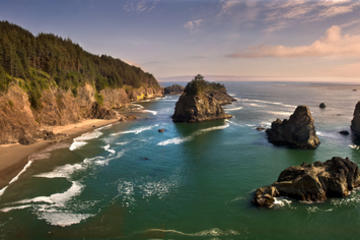
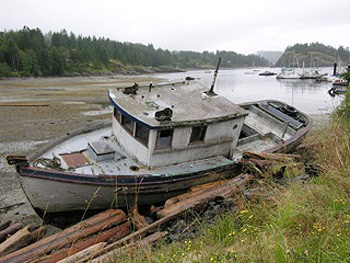


 The 10 minute ferry ride from Campbell River, which has been running since 1960, deposited us at the tail end of an armada of vehicles unloading at our destination; which proved ideal as it allowed us a leisurely drive and opportunity to gawk. That in turn gave us the opportunity to pull in for a coffee at the Cafe Aroma and drink in a little island atmosphere, replete with eclectic decor, local folks chatting, laid back pace and friendly servers. We garnered a coffee and discussed our touring route.
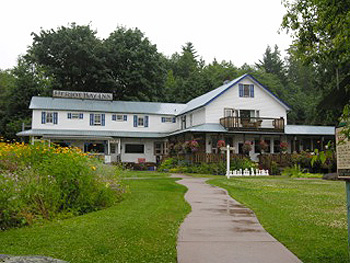
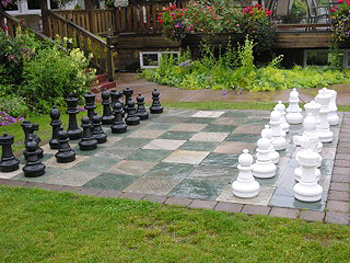 The hotel has been serving the island in one form or another since 1895 when Hosea Arminis Bull built the first incarnation. It lasted until a 1912 fire wiped the slate clean and it was rebuilt. Bull sold the place in 1926, two years after his wife had passed away and it remained in private hands until 2008 when it was purchased by the Community Custodial Concept Group with the stated desire of maintaining the edifice and service for the residents of Quadra and visitors. The stately lodge contains much of the old 1912 building but has been modified and expanded over the years. It gazes out over the bay and to the distant coast mountains beyond; enfolded in its gardens and lawn complete with a giant sized and manned chess board.
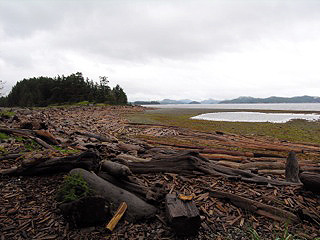 Our server at the pub suggested a trip to Rebecca Spit Provincial Park for a great look-back perspective. So informed we found and took the gravel roadway onto the thin two kilometre spit of land and found ourselves the chance to explore beach and trail; offering panoramas on either side of the spit. Driftwood and sea-lost logs were strewn about the seaward shoreline, like pick-up sticks, whilst the opposite shore hid the protected inner anchorage of Drew Harbour. A defined trail led through the trees running the spine of the spit and chanced us an opportunity to meet and chat with a local dog and his valet. None of us hurried in such a setting we chatted for a considerable while before returning to our respective treks.
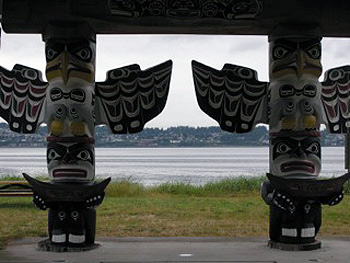 Putting aside our camera, as no photos are allowed in the building, we paid our admission of $10 per adult and began the experience. Cultural artifacts seemingly incorporating every conceivable aspect of the surrounding natural environment filled glass enclosures with captions telling of their story, purpose and people associated with them. Stories of the great potlatches, their purpose, nature and persecution by non Natives and eventual rebirth spelled out. We learned how the ceremonial treasures and regalia had been repatriated from museums and galleries throughout North America and a new home built for them overlooking the waters of their home, opening in February 1979. The present day centre was re-opened in May 2007. It is recommended you allow at least 45 minutes to make your way through this stunning collection and display of First Nations’ culture and artistic skill.


.jpg)