A War Was Fought In This Peaceful Canyon
by Glen Brewer
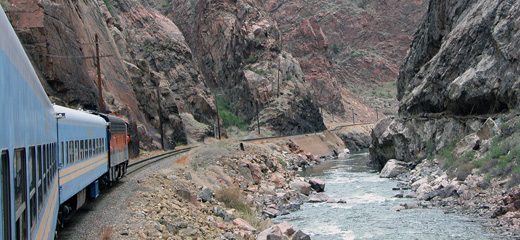
A hawk soars far overhead as the train leaves the little town behind and enters the canyon once known as the Grand Canyon of the Arkansas. Cholla cactus bloom bright yellow along the tracks. Except for the river itself, all is quiet. No highway invades the canyon, and the only people along the line are riding rafts or kayaks down the Arkansas River or enjoying a bit of fly fishing after a long hike.
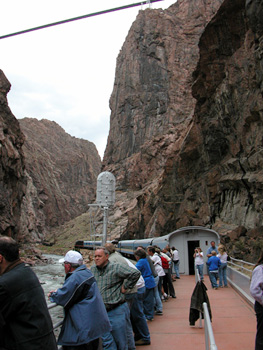
 As the vintage blue and white train climbs upstream following the banks of the Arkansas, the canyon walls grow ever closer and higher. Soon a fragile looking suspension bridge comes into view high overhead. It spans the width of the canyon from north to south. From the unobstructed view of an open railroad car, passengers can actually see light between the wooden boards that form the deck of the bridge.
A funicular railway brings people down from over 1000 feet above. Its tracks descend at a 45 degree angle with two cars balancing each other as one goes up and the other down. From the train an Alpine like cable car is also visible spanning the canyon near its top. Most people who visit the Royal Gorge see only this part of the canyon and often just from high above where the Royal Gorge Bridge & Park has been one of Colorado’s most popular tourist destinations for over 75 years.
 Beneath the suspension bridge, the canyon is so narrow and the walls so steep that a place for railroad tracks seemed impossible. The river simply must occupy the entire canyon bottom. But in 1879 a “hanging bridge” was devised and built to allow the tracks to pass through the narrow space suspended above the rushing water. This bridge still serves today.
Further up the tracks towards Parkdale, the canyon opens up a little. Many little placements of rocks can be seen above on the canyon walls. These are the remains of forts built to defend the canyon. Old photos show these rock forts bristling with men and rifles.
A war of sorts was fought in this canyon. Armies were recruited, crude forts were built, and there was much brandishing of weapons.
 It wasn’t a Civil War skirmish; the only one of those fought around here was at Glorietta Pass just south of the New Mexico border. This was a war for territory between two railroads: Colorado’s “baby road,” the narrow gauge, Denver & Rio Grande, and the big, standard gauge, Atchison Topeka & Santa Fe. But, many of the men involved had been soldiers in that bloody war: quite notably the D&RG’s president, General William Jackson Palmer.
In February of 1878, the Santa Fe had grabbed Raton Pass from the D&RG mere hours before crews were to start their surveys of that route. Only two months later, with the rich prospects of the Leadville mining boom in the daily news, the Santa Fe was attempting to do it all over again in the Arkansas River canyon. Clearly, there was barely enough room for the tracks of one railroad – certainly not two.


 Santa Fe seized the entrance to the canyon west of Cañon City cutting off the D&RG for the second time. The outraged D&RG built forts upstream in the canyon to block the rival’s progress. Both sides recruited men well accustomed to the use of firearms – the Santa Fe brought in Bat Masterson with a crew of men from Dodge City. The resulting standoff was widely known as “The Royal Gorge War”.
Fortunately the battles were fought mainly in the courts – all the way up to the U. S. Supreme Court. In the end, Santa Fe was awarded Raton Pass, while the D&RG received the Royal Gorge route.
For many years afterward, the Royal Gorge was on one of the most scenic of several alternate transcontinental railway routes across the American west. Once the domain of such suggestively named trains as The Scenic Limited and The Panoramic, regular passenger service through the gorge ended July 27, 1967. The last regular passenger trains were D&RGW east bound Train 1 and west bound Train 2 proudly named, “The Royal Gorge”.
In 1999, trains of a new operator, The Royal Gorge Route Railroad, renewed service along the route. Trains travel twelve miles through the canyon as far as Parkdale and return to Canon City two hours later. The railroad operates year around (except for January) with more departures available during the summer peak season. Classes of service available include basic coach class, club class and various dining car options. Except aboard the special murder mystery, dinner trains, all is peaceful and quiet along the line, and the scenery is still as grand as ever.
My own memories of the Royal Gorge railroad go back to 1958 when I photographed a train at the bottom of the gorge. Denver & Rio Grande Western’s Train Number 1, The Royal Gorge, arrived and stopped just beyond the hanging bridge. It was a long standing tradition on the D&RGW to stop all passenger trains at the bottom of the gorge so that passengers might get off and enjoy the exceptional view. A concrete platform was provided for just that use.
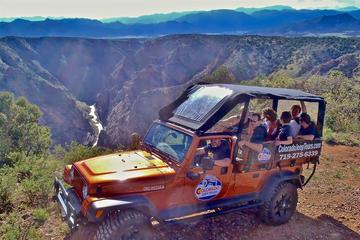
Full Day Royal Gorge and Red Canyon Jeep Tour
If You Go:
♦ Royal Gorge Route Railroad
401 Water Street
Canon City, Colorado 81212
For more information call: 888.RAILS.4U or 303.569.2403
Or see their web site at: www.royalgorgeroute.com
♦ Canon City, Colorado
Canon City is 115 miles from Denver, 45 miles from Colorado Springs and 39 miles from Pueblo.
♦ Lots of information on dining, lodging and other things to do in the area may be found at: www.canoncitycolorado.com
All photos ©copyright Glen Brewer:
Headed down the canyon with a vintage, first generation, diesel locomotive
The old Santa Fe station now serves the Royal Gorge Route
Entering the canyon
Vintage diesels power the train
Open cars allow for an excellent view
About the author:
Glen Brewer’s previously published travel and features have appeared in Travel Thru History, The Chicago Tribune, The Denver Post and the Vancouver Province. For more info: RailroadGloryDays.com
 Seymore went on to report Brother Gudmundsen’s birth in Stevanger, Norway on December 11, 1851; that he came to San Francisco in an English ship at the age of seventeen, and followed the sea – as mate of sailing vessels plying between San Francisco and Honolulu. He came to Bremerton in the year 1901 – a skilled workman in the Shipyard – petitioning for and taking the degrees of Freemasonry in the Bremerton Lodge. “We know that he enjoyed the privileges of Lodge membership and that Masonry had meaning for him. Honest his life, faithful his work, peaceful his death,” eulogized Seymore. “And now, my friends, as he lies here so still and silent, these cold lips are teaching us a lesson, if we could but realize it; and that is: to put our house in order, for no man knows when the reaper cometh. With our house in order, we can meet death, not as a grim tyrant, but as a kind friend who has come to give us rest.”
 Bremerton Cemetery? I remember puzzling over just what had happened to that old pioneer’s cemetery – not enough to do any serious research to find where it had been – but still, more than just idle curiosity – and mystery. Then, this last summer – while aggravating over a traffic revision that forced a detour off of Eleventh Avenue to Naval Avenue – Eureka. There it was: Ivy Green Cemetery, over fifteen picturesque acres of peace, tranquility, history and memories.
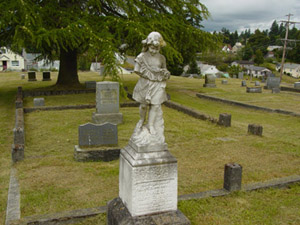
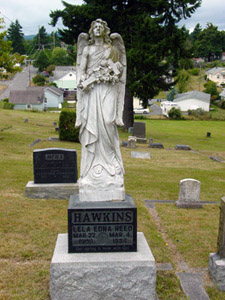
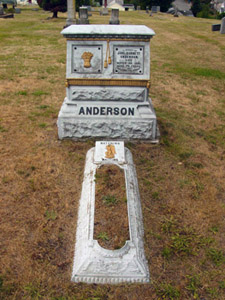 I strolled among stone lambs, angels and books, crosses, broken columns and scrolls. I found the imposing stone obelisk of Thomas Wren Gorman, born April 12, 1841 at Tulicrimin Kerry County Ireland, died August 31, 1929; and the simple stone of Dr. Carrie E. Logan, PH.D. NYU, “born Mt. Shaster, Calif., 1873-1914 – Daughter of a Union Soldier and a Descendent of a soldier, War of 1812 and the Am. Revolution.” I found Bremerton’s own Tomb of the Unknown Soldier; and the plot dedicated to the Grand Army of the Republic and the final resting place of John H. Nibb, Civil War hero and one the first recipients of the Congressional Medal of Honor. A plot dedicated to U.S. War Veterans of the Spanish American War commemorates veterans of “Cuban, Porto Rico and the Philippine Island campaigns.”
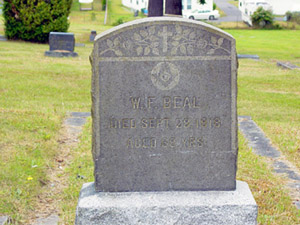
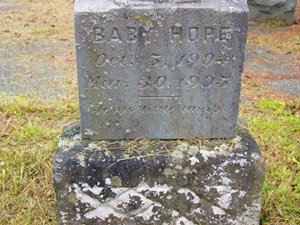 The fifteen acres were surprisingly easy to cover – and I pretty much visited every grave site, without success. Well – without that particular success. I found the last resting places of many Masons who have gone before. I found sites commemorating Matildas, Cornelias and Getrudes – names once as common as Heather, Kimberly and Keisha may be today. I found Woodmen of the World, and I found Leda Nelson, born September 20, 1838, died September 20, 1902, “A little time on earth she spent, Til God for her his angels sent,” and little Baby Hope, October 5, 1904—March 30, 1905, “Jesus’ Little Lamb.”
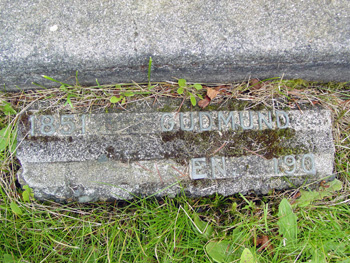 But still no Brother Gudmundsen—until I ran into City of Bremerton Parks Department Specialist Chris Smith. After a brief consultation with the Register, Chris led me to RI 962, Lot 08, North Side and there, just below the Pederson Column and an inch from the stone border of another family plot, was a modest stone marker, maybe 18 inches by six inches – much eroded and defaced by time: 1851___Gudmund ____en ____19___. Brother Gudmundsen died just days after his 56th birthday, and was respectfully interred through the disinterested friendship of his brother Masons over one hundred years ago. The acacia tree was long gone, but the grave marker remains, weathered—but readable.

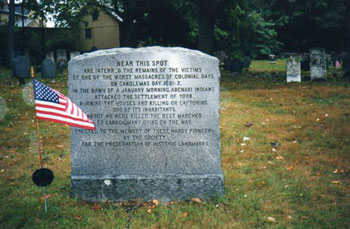


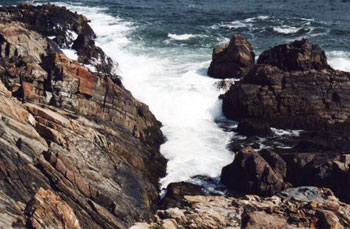 In Ogunquit the attraction of the Maine coastline with its powerful, relentless sea is no better advertised. The long marshy estuary of the Ogunquit River is a tended conservation area playing home to the restoration of endangered wildlife while at the same time a secluded and quiet finger of tranquility hidden behind the long sand bar facing the pounding Atlantic.
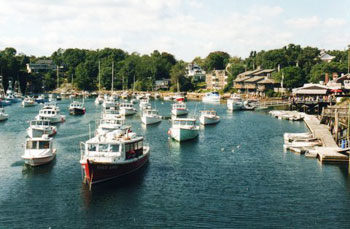 Perkins Cove housed all the trappings of a tourism centre, its protected harbor filled with a broad assortment of sea craft from sailing vessels to fishing boats. At the end of the sheltering peninsula a village of restaurants and gift shops wound along a narrow street. A salt water taffy shop tempted us, and more than a few others, with bin after bin of differing flavours .
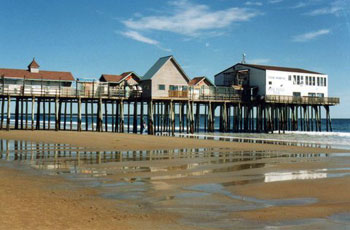 The commercial centre of Ogunquit, stretched in large part along Shore Road and Main Street, suggests a community taking pride in itself and its environment. Gardens, well kept homes, sea views and a lighted downtown evening atmosphere complimented the well cared for beach, estuary and Marginal Way. Ogunquit is much more than a summer holiday land or Kodak moment.
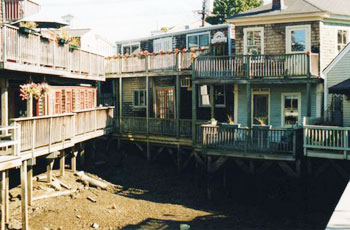 No trip to Maine would be complete without a visit to Kennebunkport and a drive by of the Bush’s summer home where we joined others snapping pictures of the home of two US presidents. Even without a peak at the primary attraction there were lots of other spots to visit along the winding seacoast or in the small town of Kennbunkport where the tides leave exposed naked pier pylons supporting an array of buildings like some fishing village of old.
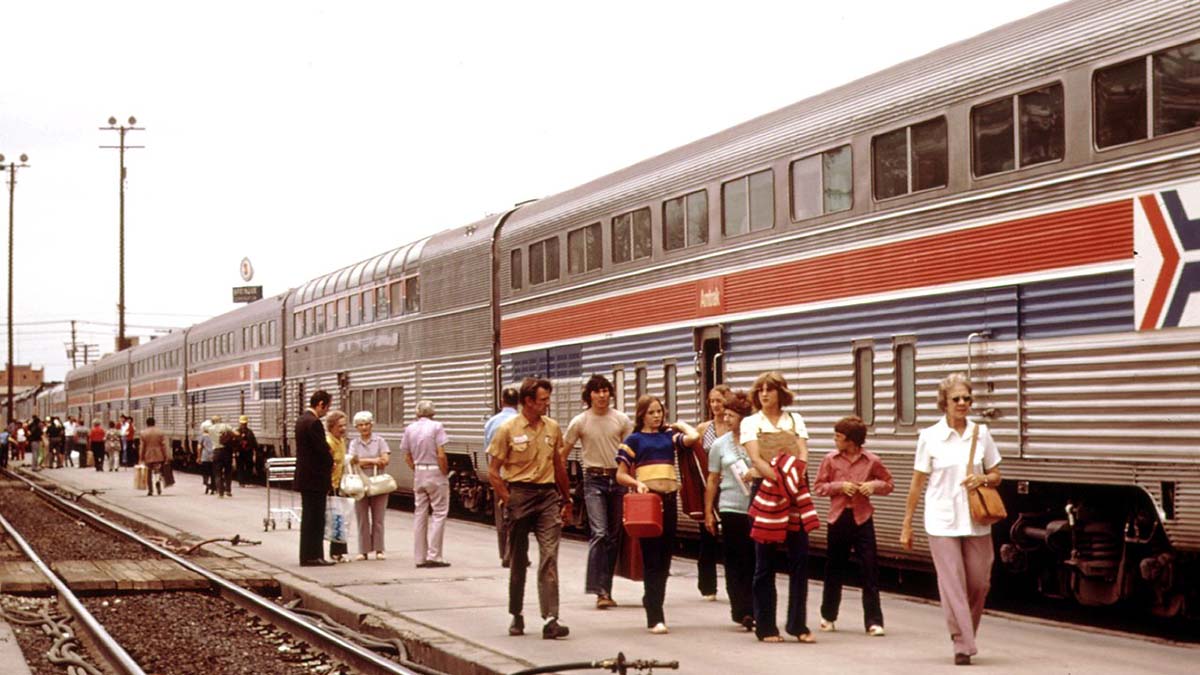
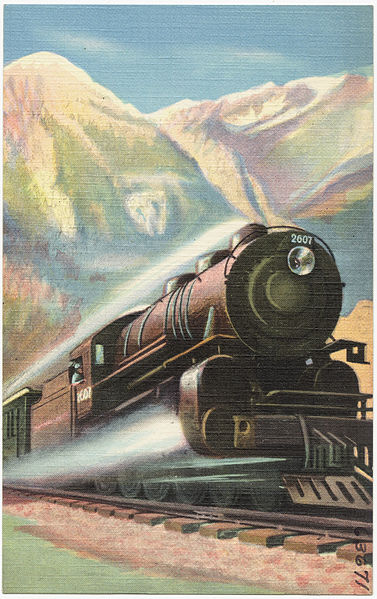

 Make no mistake here; the Northern Pacific was in it all the way to make a profit – an idea that rankled historian Haines no end. What the motive of the railroad should have been he did not say.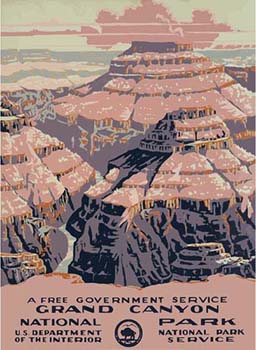

 So, while the famous delightful over-night experiences of comfy beds and pillows, expertly prepared meals, and the perfect pace for traveling are available on precious few Amtrak trains, the National Parks are still there, beckoning with their ageless wonders. And, if you plan it correctly, you can still fall asleep to the rhythm of the rails. So, Happy birthday National Park Service; Happy birthday Amtrak!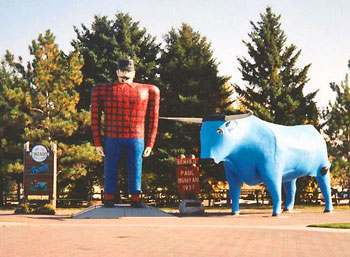
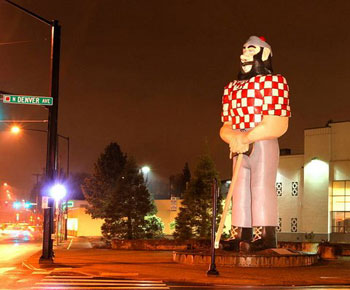 A ‘tall tale’ is one that exaggerates, and the Paul Bunyan tales are among the tallest. Paul was the imaginary hero of the strong men who felled trees, the lumberjacks of the North Woods of America. Tales told how he used whole pine trees to comb his grizzled hair and dark beard. The griddle for his pancakes was as large as Lake Bemidji (Minnesota), which resembles Paul’s giant footprint; lumberjacks greased it by skating over it with strips of bacon strapped to their feet. And it took two acres of brush fire to heat the griddle..
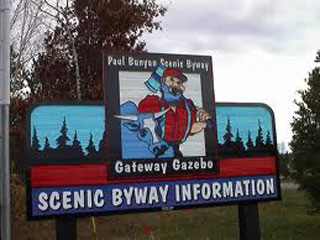 Babe the Blue Ox was Paul’s best friend. According to legends Babe was found during the winter of the Blue snow, the year that it was blue with cold. He was measured forty-two ax handles and plug of tobacco between the horns; he lived in harmony with his mate Bessie, the Yaller cow. Legend has it that Babe together with Paul Bunyan had footprints were so large that they created Minnesota’s ten thousand lakes. Babe when thirsty could even drink a river dry.


.jpg)
