Travel Thru History

Historical and cultural travel experiences

  • Home
  • Airfare Deals
  • Get Travel Insurance
  • Writers Guidelines

Ancient Ephesus, Turkey

Ephesus Turkey
by Elizabeth von Pier

The bus travels up the side of the mountain, and I look out at the stunning landscape, dotted with lemon groves, olive trees, and vineyards. The rugged landscape is dramatic and I hold onto my seat as we take hairpin turns a little too fast. We have just finished a tour of ancient Ephesus and are heading to relax and have lunch in a guesthouse up here in the mountain hamlet of Sirince. Our visit and lunch are arranged in conjunction with Food and Wine magazine.

Sirince lies about eight miles outside of Ephesus but it seems to be of another world. It is famous for its location, fabulous vineyards, and rich fruit wines. It is so beautiful that, at one time, the natives decided to name it Cirkince, meaning “ugly” because they wanted to deter foreigners and tourists from taking over their lovely little town. But today it is called Sirince, meaning “pretty”. It contains a dollhouse collection of square white stucco homes, a quaint downtown, and friendly people.

Narrow streets are filled with trucks delivering fresh produce and there are food and wine shops to lure you in. Bright red tomatoes are available for sale from the back of the proud farmer’s pickup truck. We stop to sample some olives and bread dipped in cold-pressed extra-virgin olive oil. Next door is a shop selling fresh lemons the size of cantaloupes and locally-made lemon products. A tiki-style bar offers wine-tasting, and next to it you can order a freshly made dish of moussaka and a traditional salad made from sun-ripened tomatoes, thick slices of cucumber, green pepper, red onion, olives, and feta cheese.

At the end of the main street and up a short flight of stone stairs is the boutique hotel, Gullu Konaklari, where we will have lunch. We are a small group and two tables have been set up for us in the outdoor vineyard house overlooking the mountains. A canvas roof over the tables provides protection from the hot September sun and fans keep the air moving. The sides are open, a warm summer breeze blows, and there are breathtaking views of the mountains. This is good for the soul.

Two young servers dressed in starched white shirts and black pants start by pouring each of us a glass of wine made from locally-grown grapes. We toast our fellow travelers and enjoy good conversation about hometowns, recent travel, and shipboard experiences. We nibble on freshly made pita bread, hummus, tzatziki, and a creamy fava puree made from mashed yellow split peas and topped with sauteed red onions, capers, and a dollop of yogurt.

Next comes a large salad made from sun-ripened tomatoes, thick slices of cucumber, green pepper, red onion, olives, and big chunks of fresh feta cheese. Vinegar, extra-virgin olive oil, salt, and freshly ground black pepper are available on the side. Although the salad can be served at any time during the meal, it is traditional to serve it as a starter.

kofte balls with tomato pilafThe first course is borek, a savory spinach and cheese pie similar to the Greek spanikopita. Buttery filo crust is wrapped around the filling and baked to a light and crispy perfection. The main course consists of local specialties—kofte balls of ground beef served with tomato pilaf and grilled vegetables made from locally grown produce like we saw in the markets in the town. Dessert is a sweet berry tarte, delicious with a dollop of tangy yogurt.

Be sure to order a frappe at the end of the meal. This is not what you might think. It is an iced coffee drink made from water and instant coffee granules which are mixed to a froth that fills the top third of the glass. It is a pick-me-up at the end of the day—and it has no calories. It may take several sips to learn to enjoy the strong brew with a bitter aftertaste.

The Ancient City of Ephesus is not far away

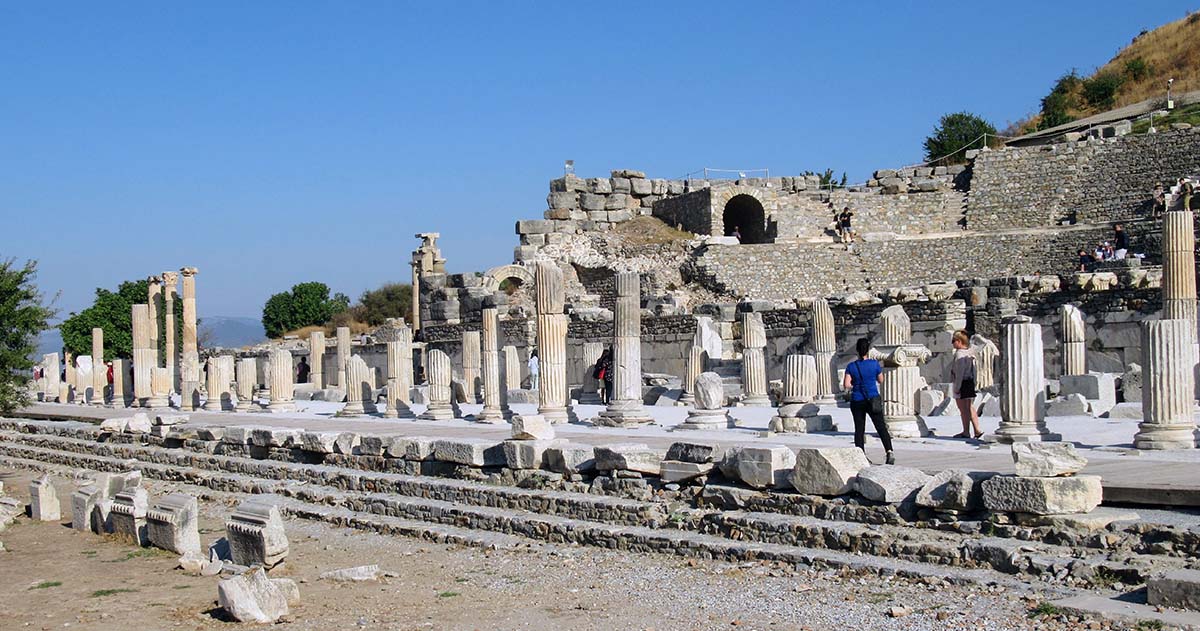
Sirince is not far from Ephesus, a classical ancient city in Asia Minor within the border of present-day Turkey. It was colonized mainly from Athens with the result that it is very “Greek” by nature. It is one of the most magnificent and best-preserved archaeological sites in the world.

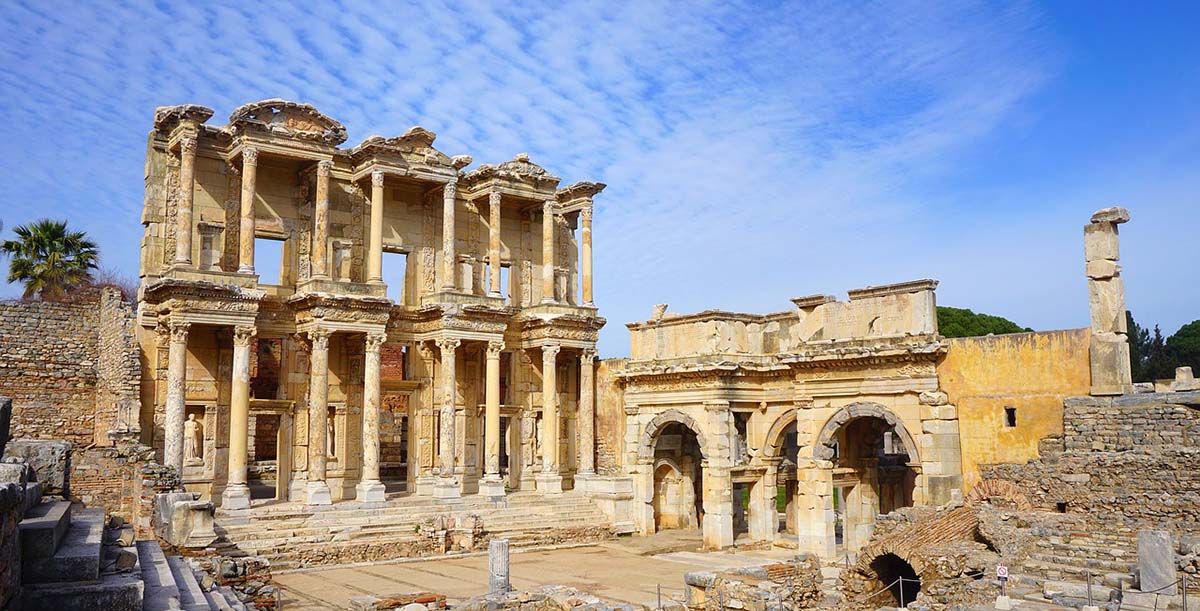
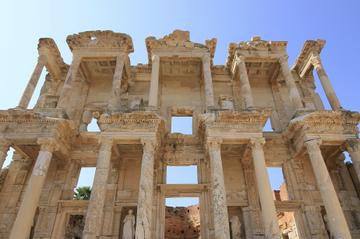
The Library of Celsus is a highlight of the site. Named for Julius Celsus, a Roman governor of the Asian provinces, its classical architecture dates from 110-135 AD. Scrolls and old manuscripts were stored in bookcases in the top two stories and dispensed by librarians. The lower niches on the exterior of the library contain four statues with Greek inscriptions said to represent Wisdom, Knowledge, Destiny, and Intelligence. These are copies; the originals are in the Vienna Museum.
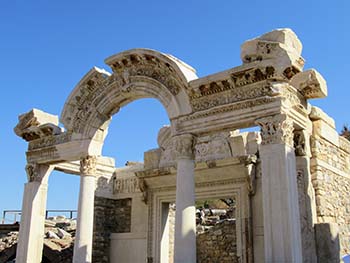
Temple of Hadrian remainsThe Temple of Hadrian is the most attractive structure on the “main street.” It has an arched top and intact facade with four columns that lead into an inner chamber.

Interior of terraced house, EphesusThe stunning Terrace Houses are in a newly excavated section. Wealthy and important people lived here. They have incredibly well-preserved mosaics, tiles, and frescoes decorating their interiors and are sheltered from the elements under a protective covering. They are in their original locations, and walkways and staircases have been set up so you can see them up close. They were built in the first century AD and used for 600 years, and consist of entryways with water features, reception rooms, kitchens with arched hearths, and bedrooms. The Hall of Muses contains particularly beautiful and well-preserved frescoes.

The Ionic Temple of Artemis was considered one of the Seven Wonders of the ancient world. All that remains today are the columns. At one time, the famous statue of Artemis, goddess of fertility, was housed here. It is now in the Ephesus Archaeological Museum.

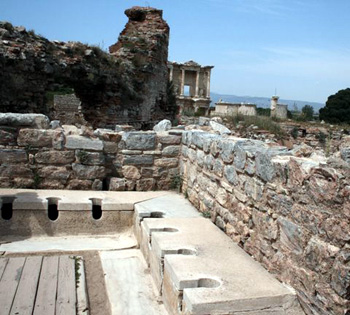
The site offers a peek into the private lives of the inhabitants. A latrine is located near the brothel. Thirty-five toilet holes were cut into a marble slab and were continuously cleaned by running water. It was used by both men and women.

If you go

Holland America, “11-Day Ancient Empires”, round-trip Civitavecchia (Rome). Ports of call include Kusadasi (Ephesus), Turkey; Katakolon (Olympia), Greece; Piraeus (Athens), Greece; Mykonos, Greece; Rhodes, Greece; Santorini, Greece; and Salerno (Amalfi Coast, Pompeii, Sorrento), Italy. On this cruise, there is an overnight stop in Piraeus (Athens).

About the author:

Elizabeth von Pier loves to travel. After she retired from her lifetime career in banking, she has been traveling the world, photographing, and writing. She has been published in the Los Angeles Times and many online travel magazines including In the Know Traveler, Go Nomad, Wave Journey, Travelmag—The Independent Spirit, and Travel Thru History. She also recently published her first book, “Where to Find Peace & Quiet in London” and is now working on another volume in this series, “Where to Find Peace and Quiet in Paris” which is expected in 2020. Ms. von Pier lives in Hingham, MA.

Photos by Elizabeth von Pier
Tagged With: Elizabeth von Pier, ephesus attractions, ephesus history, Turkey travel Filed Under: Europe Travel

Ancient Ephesus, Turkey

An Afternoon With The Romans

by Chris Millikan

Joining other excited history buffs, my husband, daughter and I leave Kusadasi’s docks and head into Turkey’s arid northwestern hills. As archeology-student guide Tino sets the scene, we roll along a pretty coastline in our comfortable coach, then onward through pastoral countryside dotted with fig and apricot trees, Mediterranean pines and olive groves…

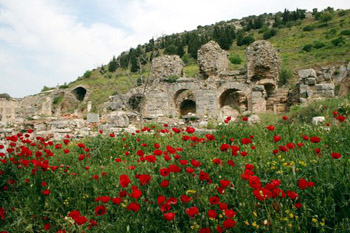
flowers in front of Roman ruins“A major trading center during the mighty Roman Empire, Ephesus prospered between 600 BC and 500 AD,” he begins. “Where the Cayster River emptied into the sea at Harbour Gate, fleets of wooden sailing ships unloaded exotic foreign cargoes and hordes of travelers from afar. Over centuries though, the sea has receded nearly ten kilometers away from that once-flourishing seaport.”

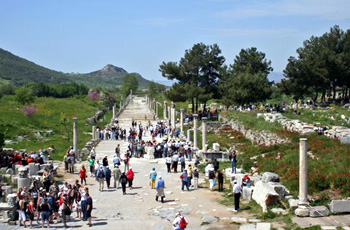
Afternoon sunlight gilds landscapes yellow and gold as we enter Asia Minor’s most sophisticated ancient capital through Magnesia Gate, a key entrance in this city’s heyday. As we explore timeless neighborhoods, Roman life emerges along entire streets reconstructed from rubble; majestic colonnades line marble-paved roadways. Plazas filled with magnificent monuments characterize this once influential city, the majority of which remains buried…

Magnesia gateStill marked by an undamaged marble post, the ancient medical center had performed history’s earliest surgeries. And opposite, a Nike marker with the now familiar ‘swoosh’ denotes former temples, replaced nowadays by masses of scarlet poppies dancing in summer breezes.

On down Curetes Street Tino explains, “When over 250,000 people inhabited this magnificent cosmopolitan metropolis, streetlamps shone all along here; countless shops prospered up and down this street.”

Just through the Gates of Hercules, exquisite relics survive time’s ravages: the two-storied Fountain of Trajan’s cascading waters had surrounded polished columns and life-sized statues of Dionysus and Aphrodite; the roofed Odeon hosted small concerts in its theater seating 1500 patrons; an intact stone staircase at the Baths of Scolastika leads to a second floor where networks of hot water pipes had steam-heated communal thermal baths and pools for 1000. One of the city’s best-preserved monuments…and the first made of marble…Hadrian’s elegant Corinthian-style Temple crowns this hill where the wealthiest rulers lived.

remains of Roman housesOpposite Hadrian’s Temple, terrace houses hint at Roman family life. Known as “houses of the rich,” the oldest dates to the first century BC. Mostly two-stories, gracious living and dining rooms had opened to airy hallways on the ground floor; bedchambers and guest rooms were upstairs. Although they seem plain from outside, intricate mosaics and fascinating frescoes decorated them inside; central interior courtyards were filled with exquisite statuary. Remarkable original mosaics still pave the sidewalks out front…

Even in the worlds of Augustus and Alexander the Great, these privileged citizens enjoyed heating systems. Similar to the steam baths, terracotta pipes under floors and behind walls warmed them; elaborate marble bathrooms featured both hot and cold running water…

The upper Agora had been adorned with ornate fountains and elaborate temples. At one time, the Egyptian Temple of Isis had dominated the center of this roofed gathering place. Surrounded by law courts, official buildings and stock exchange during ancient times, this immense public space would have been alive with shops and eateries of every description. We imagine eminent toga-robed citizens in leather sandals discussing politics, sharing the news of the day or philosophizing endlessly…or even playing backgammon in the shade next to the well-preserved town hall.

Ephesus upper agoraThe nearby communal baths and toilets demonstrate surprisingly sophisticated sewer systems running beneath the pavements. Pausing ‘to visit’ these public latrines, we discover an unexpectedly large privy! A smooth polished marble ledge provides twenty-five perfectly round holes; sitting there side-by-side, I wonder whether aristocrats of old ever had to line up to get a seat here…

Following Marble Street to the breathtaking Library of Celsus, this two-story structure proves most glorious of all. Exquisitely carved columns soar into sapphire skies, enduring monuments to 2000 year-old artistry. Behind the exquisitely carved front columns, four alcoves held replica statues representing Wisdom, Excellence, Goodwill and Knowledge. At one point, the library held an estimated 12,000 volumes, all hand-written papyrus and parchment scrolls stored in niches around the walls to protect them from humidity. Borrowed manuscripts had to be read in a central on-site reading room flooded with light from upper balconies.

Amusing us with stories of secret underground passages connecting this resplendent library to a luxurious brothel just across the street, Tino winks, “I guess in those days, when guys said they were off to read a few good scrolls in the library…it might mean something else!” Reclining awhile on the timeworn library steps, we let our imaginations run wild, speculating about grand schemes and mysterious intrigues of those days…

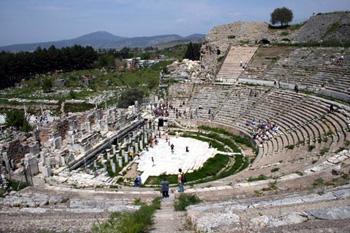
amphitheaterFrom Library Square, the partially excavated lower commercial Agora beckons. Towering marble columns had defined the immense square; along the sides, porticos had sheltered long rows of busy shops, trading markets and cafes; at the center stood a sundial and water clock. Approaching the open-air amphitheatre nearby, I could almost hear chariot-wheels cutting ruts into marble pavements as they ground around the corner…

Those carved grooves remain in the marble roadway near the spectacular amphitheatre. Tino observes, “Built by Greeks, this Great Theatre was the largest of its time, especially important during the annual Festival of Artemis. As well, it became an important religious center for early Christians. Saint Paul regularly preached here before capacity crowds of over 25,000. Arrested for denouncing fertility goddess Diana, some say Paul fought wild animals in the amphitheatre before he was cast out from the city…”

Dwarfed among row-upon-row of smooth stone seats curving upward forever, we cautiously climb steep aisle-steps to what had been a grand columned gallery at the top, over 30 meters from the orchestra. As if auditioning for a chorus or drama, we take turns doing experimental sound checks from the stage below…and are amazed to hear every word spoken or note warbled, even from the loftiest of heights.

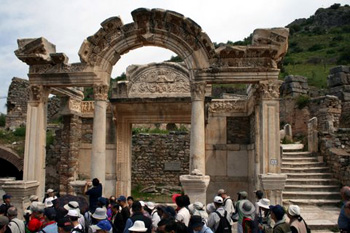
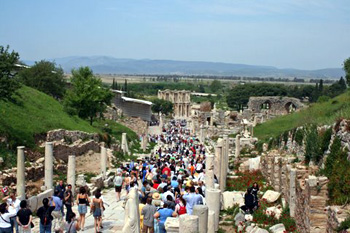
tourists crowd among Ephisus ruinsMoments later, our daughter reveals a newsy tidbit, “Remember Sting… you know, British rock-musician? Well, this is where he performed in a sold-out concert years ago…I can see why: perfect acoustics…no echoes!”

Parading ourselves back to the bus down the Arcadian Way, we feel a bit like the celebrated Mark Anthony and Cleopatra. During their legendary glory days, they’d ridden here in grand processions, their elegant golden chariots pulled by plumed horses prancing past crowds of passionately cheering Ephesians…

Down the hill outside Ephesus, Tino points out the bus window, “At one time, multitudes of pilgrims flocked to that Temple of Diana, revered Seventh Wonder of the Ancient World. Now derelict, only one column and scanty fragments remain there.”

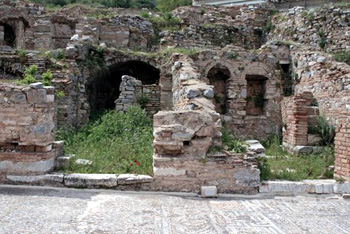
remains of Roman wallsNot far away, we stop at a humble chapel standing on the site of a little house where the Virgin Mary lived her last days. She is thought to have come to Ephesus with Paul around 37 AD. Tino tells us, “In the 1960’s, Paul VI was the first pope to visit this place. And in the 1980’s, Pope John-Paul II sanctioned this Shrine of Virgin Mary as a Christian pilgrimage place. On August 15th every year, a ceremony commemorates Mary’s assumption.” I learn that Muslims also recognize Mary as mother of one of their prophets and visit this holy shrine…

Returning to the bus, we fill our bottles at the fountain; the water of Mary is said to have curative powers. “And atop that distant hill,” Tino points out, “In the 6th-century, Emperor Justinian built a domed Basilica over Saint Paul’s grave, recognizing his years of preaching at Ephesus…

Though abandoned in the 6th century, Ephesus still attracts pilgrims from far and wide, just as she did over two thousand years ago. Like us, countless travelers trek to the Eastern Mediterranean’s best-preserved classical city where Roman grandeur outlasts time.


Private Tour: Ephesus and St. Mary’s House

If You Go:

• Check out Hello Turkey
• Most tourists visit Ephesus by taking a ferry tour from the Greek islands or mainland Greece, arriving in Kusadasi in the morning and leaving before dinnertime.
• Buses depart Kusadasi for Ephesus every half-hour.
• Some visitors tour Ephesus as part of eastern Mediterranean Cruise ship itineraries.


About the author:
A retired Elementary School Principal living in Delta, BC, Chris Millikan enjoys traveling the province and the world with husband Rick and sharing her tales with others in local newspapers and magazines. Experiencing zany, off the beaten track, historical and cultural adventures for many years, she looks forward to introducing Willamina, her first grandchild, to the wonders of travel.

Photo credits:
First photo of Celus by Salih Altuntaş from Pixabay
All other photos are by Rick & Chris Millikan.

Tagged With: Ephesus, ephesus attractions, Turkey, Turkey travel Filed Under: Europe Travel

MORE TRAVEL STORIES:

A Pleasant Afternoon at the Stavros Niarchos Cultural Center, Athens

Experience Fall in Vermont and New Hampshire

Best Time To Visit Tenerife: Weather, Temperature, & Season

From LaGuardia to the Heart of New York: Embark on an Exquisite Journey of Elegance and Comfort

In Memory of the Titanic

Cusco, Peru: City With a Storied Past

France: Celebrating Citrus in Menton

Christmas on the Costa Blanca


SEARCH

DESTINATIONS

  • Africa Travel
  • Antarctica travel
  • Asia Travel
  • Australia travel
  • Caribbean Travel
  • Central America Travel
  • Europe Travel
  • Middle East Travel
  • North America Travel
  • Oceania Travel
  • South America Travel
  • Travel History
  • Travel News
  • UK Travel
  • Uncategorized
  • World Travel
facebook
Best Travel Blogs - OnToplist.com

Copyright © 2025 Cedar Cottage Marketing | About Us | Contact | Privacy Policy | Terms & Conditions | Copyright Notice | Log in