by Becky Garrison
According to my UK friends, only tourists visit the Tower of London (aka Her Majesty’s Royal Palace and Fortress). But just as they frequent Times Square whenever they come to New York City, I had a hankering to play tourist for a bit and visit this historic castle located on the River Thames in Central London.
 This massive twenty-one-tower complex built by William the Conqueror shortly after he came into power in 1066 served a variety of functions, including a fortress against foreign attack, a repository for the crown jewels, and a refuge for the royal family in times of civil disorder. However, the Tower of London remains notorious as the site for some of England’s bloodiest bits, a living testimony to the hell that happened when certain royals ruled the roost.
In preparation for my mini-historical trek to the Tower, I uploaded the soundtrack from Spamalot onto my smartphone. Listening to how Sir Robin the Not-Quite-So-Brave-As-Sir-Lancelot personally wet himself at the Battle of Badon Hill put me in the right frame of mind to visit England’s most infamous house of horrors.
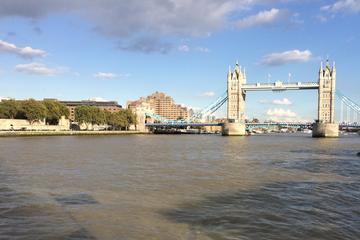
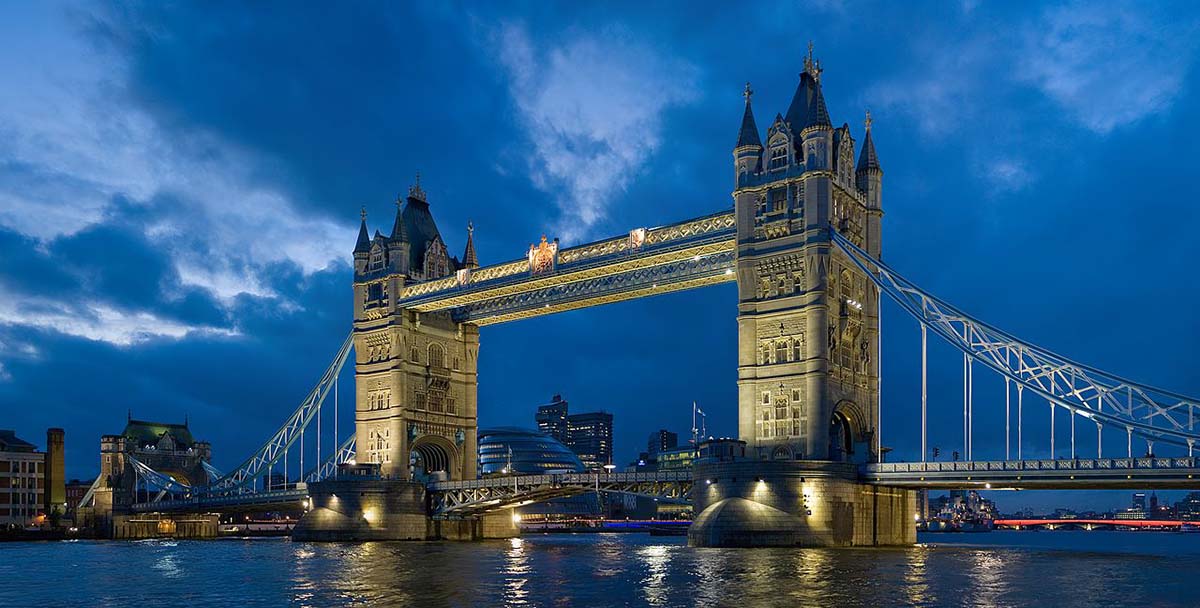
Instead of heading straight for the tower, I decided to stop at the London Bridge station and then walk across Tower Bridge. Despite this landmark’s medieval appearance, this famous drawbridge didn’t grace the London skyline until 1894. As I surveyed the growing mound of ant-like figures converging on the Tower of London, I began to wonder if perhaps I should heed my UK hosts’ advice and just skip this site. But given I already had my press ticket in hand, I figured I’d give it a shot.
Once I entered the complex, I found myself accosted by a gentleman dressed in regal robes. At first I thought he was another out of work actor looking to play dress-up but I soon learned he’s a bona fide Beefeater, the Yoemen of the Guard who formed the Royal Bodyguard since at least 1509. While he proved to be quite the expert guide, after getting elbowed one time too many by some twittery tourist, I set out on my own.


 After I passed by Traitor’s Gate, the famous entry to the Tower where prisoners would enter from the River Thames to the Tower, I took a counterclockwise tour of the various towers. Passing by a sequence of cells and chapels, I almost felt as though I was traversing through a medieval monastery. That is until I stumbled upon a display of torture instruments clearly designed to stretch someone into submission.
I made sure to stop by and see the greatest working collection of Crown Jewels— scepters, orbs, swords, Oh My! Though to be honest, I found myself more impressed by the armor worn by a succession of kings, most of whom appeared to be quite short of stature.
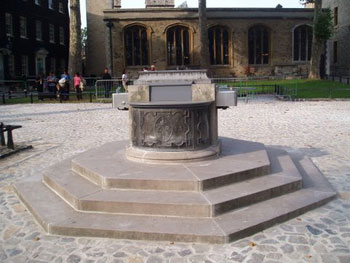
In recent years, the Tower underwent a thorough “out, damned spot!” removal program. The last execution at the Tower transpired when an eight-man firing squad shot Corporal Josef Jakobs in 1941, the same year that Hitler’s Deputy Führer, Rudolf Hess, was held there briefly. Even the famous Bloody Tower now glistens in the golden sun. A pastoral patch on the Tower Green marks the spot where the more prominent prisoners, such as two of Henry VIII’s wives (Anne Boleyn and Catherine Howard), lost their pretty heads. All that’s left now are a few implements of torture ensconced in glass cases. Let’s hope they stay that way.
Private Guided Tour: Tower of London
If You Go:
The Tower of London Official Website:
About the author:
Becky Garrison is a freelance writer who has authored six books including Jesus Died for This?: A Satirist’s Search for the Risen Christ
All photos are by Becky Garrison:
1. Site of the scaffold were Anne Boleyn was executed.
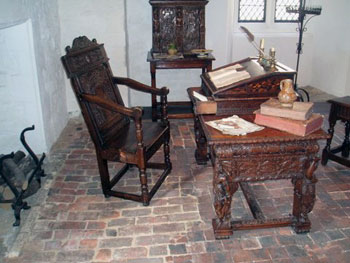
2. The Sir Walter Raleigh Room.
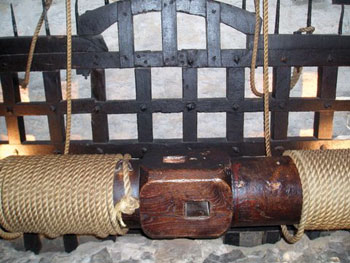
3. The Portcullis.
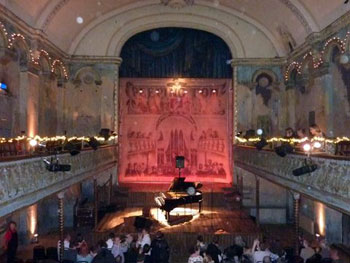
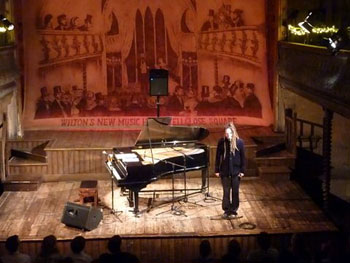 Wilton’s, the world’s oldest surviving music hall, was opened in 1858. If its disintegrating walls could talk, they would have a few tales to tell. It began its life as a sailor’s club (and possibly a brothel); then became a music hall. The burlesque lyricist and performer, George Leybourne, aka Champagne Charlie stepped onto the stage here, as did the dancers of the risqué can-can (only to be promptly banned). Sadly, Wilton’s only initially survived a short 20 years as a music hall. In 1877, the hall had to be rebuilt after a disastrous fire. Soon after, this place of twilight glamour was closed down and it took on a series of very different functions from Methodist mission hall, soup kitchen, refugee centre, safe house (from the fascists) to a sorting house for rags.
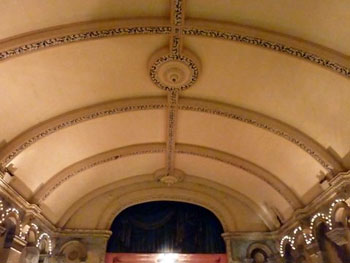 It’s an almost impossible task, and the building (in its unsafe state) has come very close to closure. When I was there, I could see daylight appearing through the rafters in places. There were unsafe electrics, leaking plumbing, and floorboards in the bar so rotten that the number of people permitted at any one time restricted. The whole of the second floor was boarded up, unfit for public use. Even the stone walls were eroding in places. Yet, it’s this forgotten, neglected state that’s given Wilton’s its indescribable atmosphere. It has the feel of Miss Havisham’s mansion in Great Expectations – as if someone had stopped the clock on time and left the building in a state of decaying beauty.
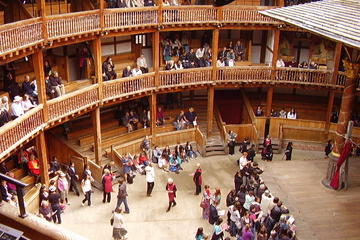
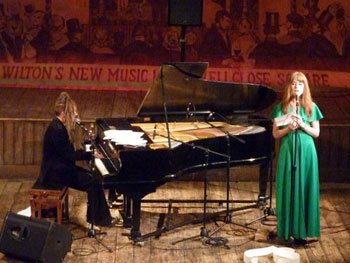 I head upstairs and into the Great Hall. I’ve walked into a Victorian fable. From the gallery a hundred fairy-lights cascade outwards from the centre of the ceiling. Yet more fairy-lights line the gallery’s railings. Pastel frescos fill the peeling walls between great arches. The gilt banister is decorated with delicate, intricate detail. A red silk curtain drapes the stage. Musician and artiste Duke Special enters the stage, eyes black with kohl, long dreadlocks, draping shirt cuffs and velvet jacket. To his left sits a string quartet: Behind him a projector screen. For two hours, he sings and plays the piano – songs he has written to accompany the black and white photos of the renowned early twentieth century American photographers, Stieglitz, Steichen and Strand. The music (commissioned by the Met Museum in New York) is heart-wrenchingly moving, the images haunting. The beauty and timelessness of the music and the photographic images fit perfectly in this magical, ethereal building. A great deal of thought is put into the theatre pieces and concerts that are produced at Wilton’s. The art, like the building, is sumptuous. So the next time you are in London, take the tube out to Wapping and to Wilton’s Music Hall and step back in time. Book a tour, or better still, one of their exceptional shows. You won’t regret it.

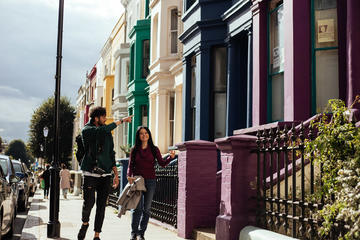
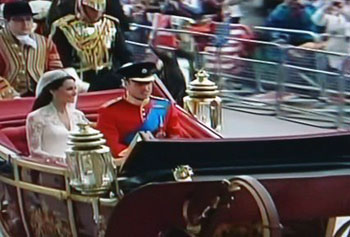
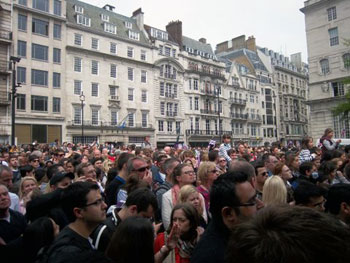 One third of the world’s population tuned in to watch the Royal Wedding coverage on TV, and nearly one million people took to the streets of London on Friday, April 29th just to be at the epicenter of all the festivities. Luckily for me, I was one of those people.
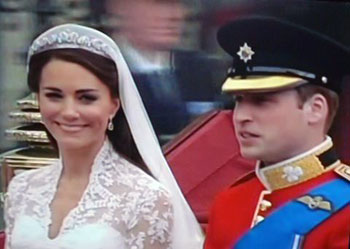 Believe it or not, when Kate was growing up in Bucklebury, England she used to have posters of Prince William and Prince Harry hanging up in her bedroom. Little did she know that a few years down the road she would end up meeting her beloved Prince William while studying at St. Andrews University in Scotland and end up becoming his wife nearly ten years later.

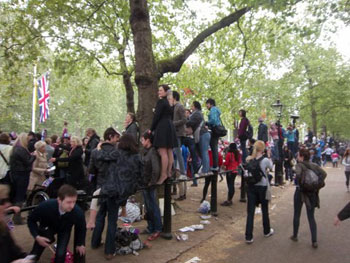 I woke up at the crack of dawn (6 a.m. to be exact) just so I could grab a good spot along the royal carriage route near Buckingham Palace. (Not being a particularly upbeat morning person I was committed to waking up early because I spent close to $100 USD so I could stay at a centrally-located hostel).
 I talked to one Londoner who said he was in London celebrating Charles and Diana’s wedding in 1981 and felt that it was only right to attend William and Kate’s wedding 30 years later…only this time he was celebrating with his daughter.
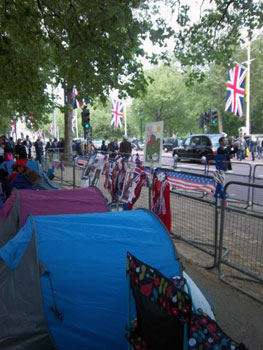 As the start of the ceremony edged closer and closer we started to see cars driving wedding guests and buses of foreign royals being escorted to Westminster Abbey. The ones who were smart enough to bring radios with them were listening through their headphones and shouting out reports about who was in the vehicle. Word started to spread that we would soon see members of the royal family being escorted to the service.
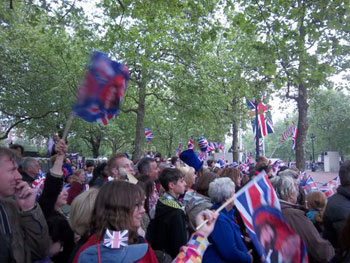 People were shoving each other and getting their cameras ready, and some children in the crowd broke out into tears because the atmosphere was so intense.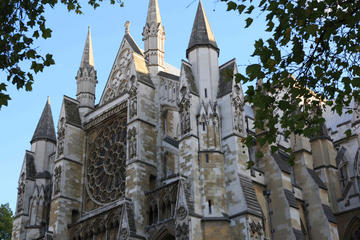



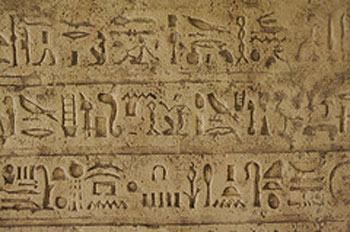 I’ve been told that the Petrie museum contains 80,000 separate objects. I couldn’t begin to count them. But hold that number in your head and just think, if you had to collect 80,000 objects to represent your own life, what would you include? A Tetrapak of milk? An iPod? One of those coffee mugs with ‘Dad’ written on it, or perhaps a much loved fountain pen, or an old pair of trainers? You’d end up with a fascinating collection of bits and pieces – some bling, some fine art, some things that we find utterly boring but which, in 7,000 years’ time, will come to seem amazing and rare. 80,000 objects, 7,000 years old; these are huge numbers.
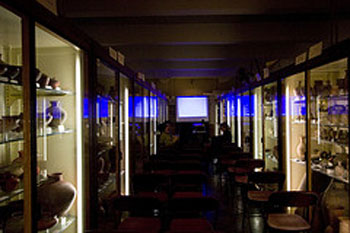 There are pots and pans, there are ancient sandals and socks and hair curlers, there’s a horse harness and if the horse got sick, there’s a veterinary papyrus explaining how to heal various animal hurts – the only one of its type that still exists. There’s a gynecological papyrus, too, the oldest known – the ancient Egyptians might not have had Prozac or CAT scans, but their medical knowledge was more advanced than you might think.
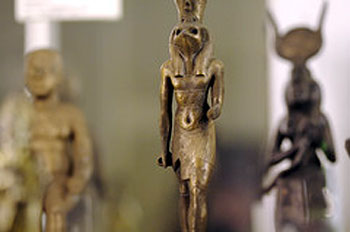 Unlike many collections, the Petrie Museum contains artifacts from every period of Egypt’s history. There are prehistoric mace heads, for instance, in gleaming polished stone. (Later, the mace became a ceremonial weapon, often decorated with scenes of the victorious Pharaoh. In prehistoric Egypt, though, it was still a functional weapon; even so, some of these pear-shaped or disk-shaped maces are of astonishing beauty.) From later Egypt come Coptic textiles, with bright colours and lively designs. The collection includes more recent artifacts from Islamic Egypt, and the museum has even started to amass a small selection of objects from the present day.

 The museum hosts some really quirky events, too. For instance if you want to give yourself the shivers, you can attend a Hammer Horror film screening – starring, naturally, a malevolent Egyptian mummy. (I wish they’d show Carry On Cleo, though.) There are object handling seminars; one a little while ago gave attendees the chance to hold a two-thousand-year-old basket and work out how it had been woven. The title of a talk last year shows just how intimately archaeologists now know the people of ancient Egypt – “Pinch pots and nappy rash – early childhood at Lahun”.