Travel Thru History

Historical and cultural travel experiences

  • Home
  • Airfare Deals
  • Get Travel Insurance
  • Writers Guidelines

England: A Literary Stay in London

London, England city

by Susan Radcliffe

London, city of Shakespeare, has an illustrious literary history. If you’re taking a trip to England’s capital on the trail of your favourite writers, you might like to stay in a hotel with some kind of literary connection. There are several of these to be discovered if you know where to look.

Brown’s Hotel
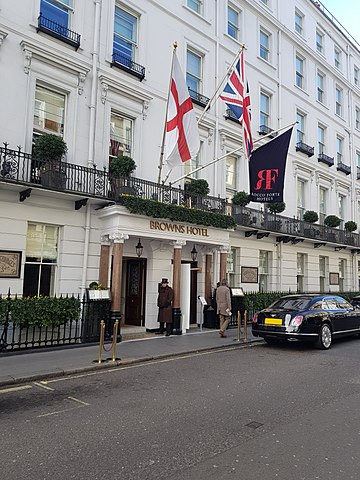
Brown's Hotel, LondonThis is a quintessentially English place, in the heart of Mayfair. It opened in 1837 to provide accommodation for genteel people and is said to be the oldest hotel in London. Going inside this Georgian building is a little like stepping back in time; you can take a traditional afternoon tea with scones and sandwiches whilst listening to the sounds of the Baby Grand Piano.

It’s the perfect setting for a period story and you can see why it inspired Agatha Christie to write the murder mystery “At Bertam’s Hotel.” This is Brown’s Hotel, disguised beneath a layer of fiction. Christie often stayed here, and her novel delves into the lives of the upper class guests and the darker secrets hidden beneath the highly polished veneer.

The Cadogan
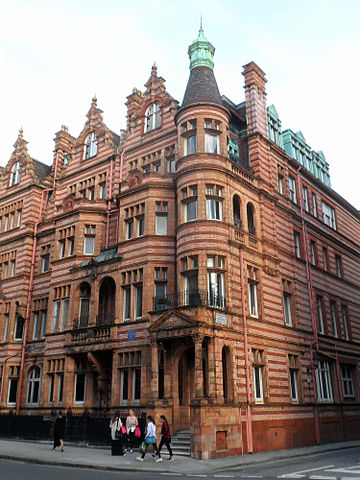
Cadogan Hotel, LondonThis Edwardian town house in Knightsbridge has been a hotel for more than 100 years. Outwardly elegant and respectable, it was the setting for some scandalous and controversial events during Victorian times. Modern guests climbing under the velvet-edged bouclé bedspreads can remember the stories of forbidden love that have flourished inside the damask papered walls. It was here that the future King of England, Edward, carried on an affair with the courtesan and actress Lillie Langtry. And it was here that the writer Oscar Wilde was arrested for having a relationship with another man. Until then, he had been enjoying the critical and financial success of his plays, such as “An Ideal Husband” and “The Importance of Being Earnest.” In happier times, he made frequent and decadent visits to the hotel, always accompanied by plenty of Perrier Jouët Champagne and Green Carnations. But this would all come to an end in 1895, as he awaited the police in room 118, where he was arrested on a charge of gross indecency. He was subsequently convicted and sentenced to two years’ hard labour. Before his trial, Wilde had been a celebrated and successful artist; after his release, he was a broken man, and he never recovered his creative powers.

Hazlitt’s Hotel
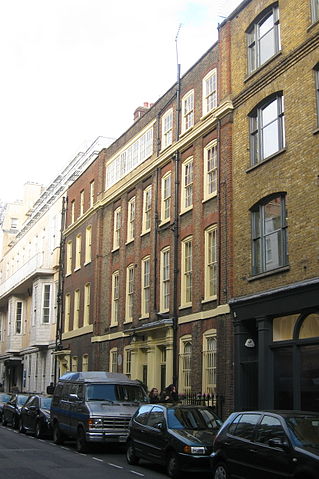
Hazlitt's Hotel, LondonThis hotel occupies a Georgian building off Soho Square. It was once the home of the famous essayist William Hazlitt. He was a contemporary of Wordsworth and Coleridge and, during the early 19th century, he published books on philosophy and grammar; he was also a gifted political journalist, art and literary critic. Many features that he would recognise have been preserved in the hotel. All the guest bedrooms and suites are kept in traditional style, with paneled walls and antique furniture. Many of them have four poster beds. They’re named after other writers like Jonathan Swift, as well as Hazlitt’s friends, associates and lovers. One of the suites bears the name of Teresa Cornelys, a beautiful courtesan. As you might expect, it features a show-stopper of a bed, decorated with hand carved gilded cherubs. There’s another treat in the bathroom, which has a period bathing machine, designed to squirt water onto surprising parts of your anatomy. Hazlitt’s is still a favourite with writers today; JK Rowling of “Harry Potter” fame likes to stay in the Lady Frances Hewitt room when she visits London.

The Kingsley

Kingsley Hotel, LondonA stay at this hotel will bring you a little closer to the legacy of the Bloomsbury Group, who lived, worked and studied in this area of London between the turn of the 20th century and World War II. It was a hotbed of revolutionary thought and creativity, with writers, intellectuals and artists producing work that would have a lasting influence on literature, aesthetics and economics, as well as shaping progressive attitudes towards feminism and sexuality. The hotel is named after the author Charles Kingsley. It was known for a time as the Thistle Bloomsbury, but has reverted to its original name. E M Forster, one the Bloomsbury Group’s most distinguished members, lived here between 1902 and 1904. The hotel’s beautiful Edwardian façade has recently been restored, but inside the building has been made over with new décor and furnishings, so it’s perfect for those who like a little modern comfort along with their history.
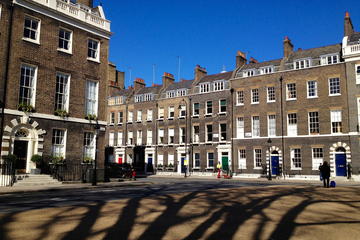

London Literary Walking Tour Of Bloomsbury

If You Go:

www.brownshotel.com
Nearest tube station is Green Park.

www.cadogan.com
Nearest tube stations are Knightsbridge and Sloane Square

www.hazlittshotel.com
Nearest tube station is Tottenham Court Road

www.kingsleyhotel.com
Nearest tube station is Holborn.

About the author:
Susan Radcliffe is a writer and researcher, with a passion for travel. She lives in London and loves to share her knowledge of its historic sights and hotels with visitors. She writes for London Hotels, a price comparison site for London hotels.

Photo credits:
London by Seoyeon Choi on Unsplash
Brown’s Hotel by CVB / CC BY-SA
Cadogan Hotel by Spudgun67 / CC BY-SA
Hazlitt’s Hotel by See page for author / CC BY-SA
Kingsley Hotel by Jim Linwood via CC BY 2.0


Tagged With: England travel, London attractions Filed Under: UK Travel

England: Shakespeare’s London

Staple Inn, London

by Andrea Kirkby

Little appears to be left of Shakespeare’s London. We know where he worked, and where he lived; but the Blackfriars theatre is no more, and though Ireland Yard (where Shakespeare bought a house when he could afford it) still exists, the buildings are much later. Nothing’s left of his successive houses in Bishopsgate, Southwark, and Cripplegate, and the Globe has gone along with all the other theatres.

So you might think an article on Shakespeare’s London would be quite short. But in fact, it’s amazing how many places are left that are linked with his life. Let me take you along on a tour of Shakespeare’s London; though we’re going barely a couple of miles in distance, we’ll be going back four centuries in time.

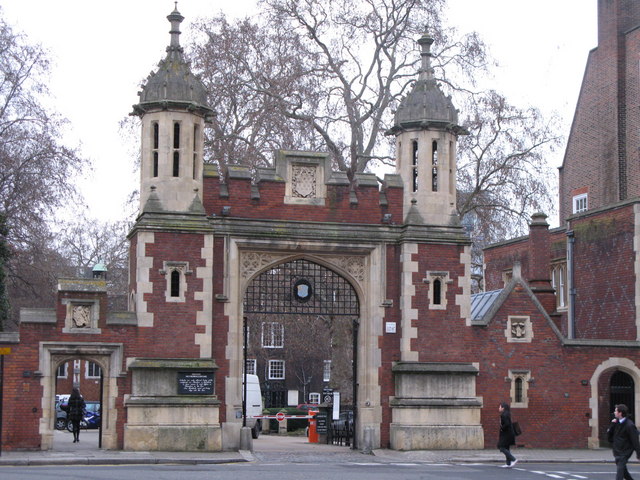
Lincoln's InnLet’s start at the Inns of Court, the centre of London’s legal world. In Queen Elizabeth’s day they represented an alternative to the great universities as a place of education, and had their own literary subculture. The poet, and later divine, John Donne, studied at Stavies Inn and then Lincoln’s Inn after three years at Oxford; masques by Francis Beaumont (one half of Beaumont and Fletcher), and George Chapman were performed in the Inns – they also sponsored a performance at Whitehall, with scenery by Inigo Jones. Plays and masques were put on every year to celebrate Christmas – which then stretched all the way from the beginning of Advent in November to Candlemas, in February. In 1602, the Middle Temple hosted the premiere of Shakespeare’s Twelfth Night by the Lord Chamberlain’s Men; Shakespeare himself probably took a role. Amazingly, Middle Temple Hall, scene of that performance, is still not only intact, but almost unchanged from how it looked then.

The hall was completed in 1573, and is one of the latest works of Gothic architecture in England. It’s a refined work, with lozenge patterns in the brick of its walls, and a glorious double hammer beam roof. (I’m blasé about hammerbeams. I’m East Anglian, and in my home counties of Norfolk and Suffolk we have some of the greatest hammer beam roofs around. But this is an immensely impressive roof, among the best anywhere.) The wooden screen is finely carved, and the stained glass shows the coats of arms of Elizabethan members of the Temple. You see just what Shakespeare himself would have seen – even down to the way the tables are still arranged in long rows, since Middle Temple Hall is still in use as the dining hall in which students eat their dinners. (That explains why it is not always open. It’s worth visiting when the Middle Temple has an open day.)

Prince Henry's Room, LondonIt’s a short walk from the Middle Temple to one of the few buildings in City of London that survived the Great Fire of 1666 – Prince Henry’s Room, a superb testament to the richness of Jacobean architecture and decoration. Its proud wooden façade, two huge bow windows surmounting a minor entrance to the Temple, gives you some idea of its wealth; inside is a splendid plasterwork ceiling, decorated with the three feathers that are the badge of the Prince of Wales.

It was built in 1610, when James I’s son Henry was Prince of Wales, and when Shakespeare was writing his last play, The Tempest. (Henry died young; that’s why you haven’t heard of Henry IX. Instead, we got Charles I – and a Civil War.)

The Middle Temple wasn’t the only one to host a Shakespeare premiere. Gray’s Inn Hall – neater, and smaller, and twenty years older than Middle Temple Hall – hosted an entertainment by a then relatively little known playwright in 1594: The Comedy of Errors.

The Inn’s Chronicles show that actors were not considered respectable enough to consort with up-and-coming young lawyers; they refer to the play being put on by ‘A company of base and common fellows.’ Presumably that included one William Shakespeare.

Although, like Middle Temple Hall, Gray’s Inn suffered damage from bombing in the Second World War, it’s been well restored. The hammer beam roof (only a single hammer beam here) was rebuilt; but the wooden screen, said to have been built from the timber of ships in the Armada, was saved. So again, what you see is pretty much what Shakespeare saw.

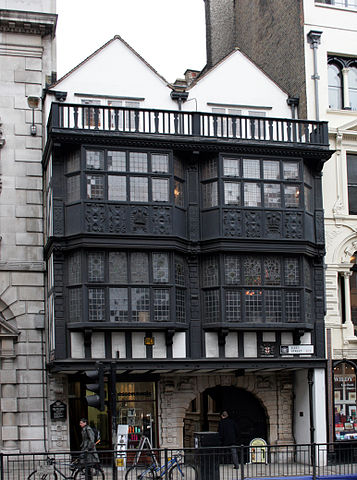
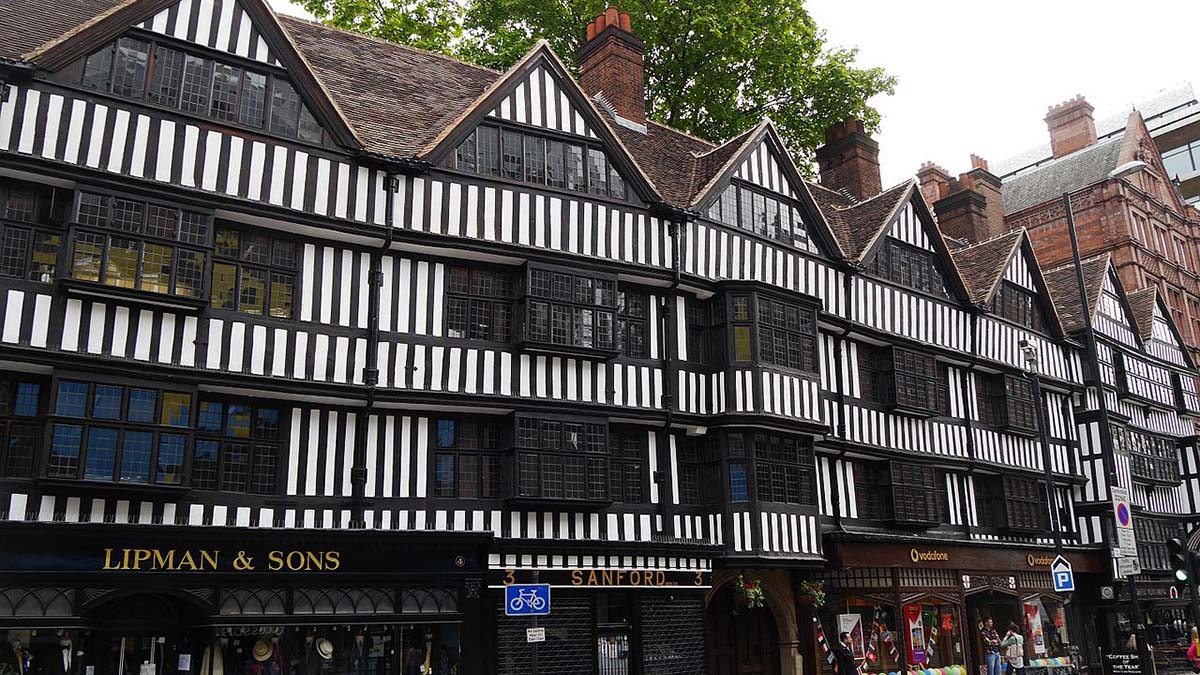
Ely Place gatehouseStaples Inn [TOP PHOTO], on Holborn, has no Shakespearian connection as far as I know, but it is one of the best examples of half timbered building remaining from his London. It was another of the Inns of Court in those days, before they consolidated into the four that remain today. Its long façade and many gables curve sinuously where the wood has warped with age, and the timber beams set up an insistent rhythm that beats against the whitewashed plaster between. Outside, traffic hoots and purrs its way down Holborn; but in the little court inside the Inn, it’s quiet and cool, as if you’d stepped back five centuries in time.

Further down Holborn is Ely Place, and here again the Shakespearian connection is a little tenuous; it’s mentioned in Richard III:

My Lord of Ely… when I was last in Holborn
I saw good strawberries in your garden there;
I do beseech you send for some of them.

This was the London palace of the Bishop of Ely; you can still see his chapel, the Gothic church of St Etheldreda. But Shakespeare being a man of the theatre, I think you would have been more likely to find him in the little pub that is tucked away down a dark little passage, drinking a pint of beer. The Mitre was originally the hostelry for the Bishop’s servants, and you can still get a pint of beer here, and admire the remains of a cherry tree in the front bar round which Queen Elizabeth was said to have danced on May Day.

And there is still a Strawberry Faire in Ely Place every summer.
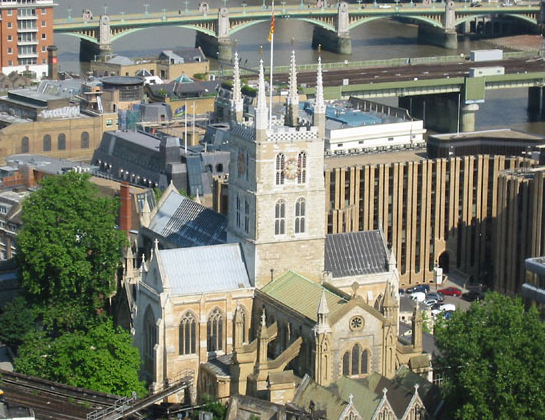
Southwark CathedralBut to track Shakespeare down in the theatreland of his day, you’ll need to cross the river Thames, and head to Southwark. The theatres came here because it was outside the boundary of the City of London, and so outside its restrictive by-laws. As well as the theatres, there were bear-pits, taverns, bath houses, and brothels; Southwark was where London came on holiday. It must have had something of the atmosphere of Coney Island or Blackpool.

A lot of what you see this side of the river is nineteenth century; the railway arches, the fine Victorian buildings on Borough High Street, the old warehouses by what used to be docks and wharves. But look hard and there are still vestiges of Shakespeare.

For instance in Southwark Cathedral – which was, in Shakespeare’s day, just the parish church of St Mary Overy – you can find a monument to Edmund Shakespeare, the playwright’s brother. When he was buried here in 1607 the family had enough money to send him off like a gentleman, with the tolling of the great bell, for which they paid 20 shillings; even so, he was buried in an unmarked grave.

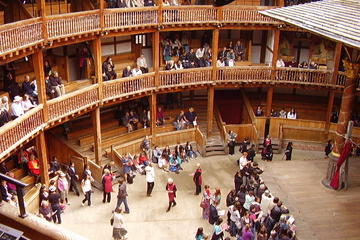
Nearby is the new Globe Theatre, a rebuilt Elizabethan theatre that looks like a half-timbered gasometer. American director Sam Wanamaker had the idea of rebuilding it after a fruitless search for traces of Shakespeare’s theatre; the Globe now plays both classical drama, and contemporary pieces, throughout the summer. It’s an authentic audience experience; ‘groundlings’ are admitted for only five pounds, but have to stand in the pit throughout the performance – no sitting allowed.

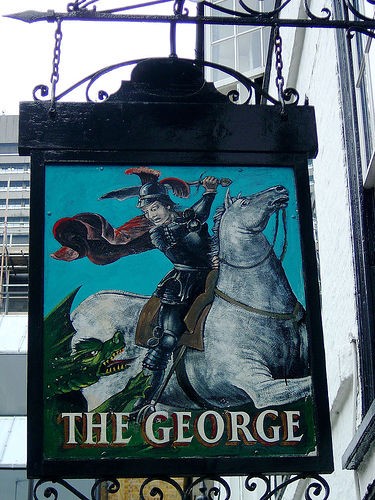
George Inn signBut again, I feel closest to Shakespeare in the pub. Pubs and theatre were always linked, and a number of inns’ courtyards served as impromptu theatres, with actors performing on a cart in the yard, and the audience leaning over the balustrades of the galleries all around.

Southwark’s inns and taverns were notorious. Borough High Street was the main road south out of London; the Tabard tavern was where Chaucer’s Canterbury pilgrims began their journey. Shakespeare sets Jack Cade’s plea in Henry VI Part II at the White Hart, and there’s a strange back-story link too; Sir John Fastolf, the ‘original’ of Falstaff, owned a tavern just down the road, the Boar’s Head. Though most of the taverns have gone, the names of the little alleyways that run off the High Street still commemorate pints sunk and pubs past.

Head for the George and you’ll see a rare survival; the last galleried inn in London. What you see dates from 1676, and is only one wing of what would have been three, surrounding the entire yard; but what you see probably isn’t very different from the inn Shakespeare might have known, since the rebuilding was faithful to the original design.

And the George might not be a bad place to stop. But I’m off up the road, to the Market Porter in Borough Market, for a bag of crisps and a pint of porter – or as Shakespeare might have said, cakes and ale.


Shakespeare Walking Tour in London

If You Go:

Tube stations for the tour: Temple; Chancery Lane; London Bridge.

Photo credits:
Staple Inn: Edwardx / CC BY-SA
Lincoln’s Inn, off Lincoln’s Inn: Mike Quinn / Gateway to Lincoln’s Inn, off Lincoln’s Inn Fields, WC2
Prince Henry’s Room 17 Fleet Street: User:Mahlum / Public domain
Gatehouse, Ely Place: Colin Smith / Ely Place
Southwark Cathedral: Kevin Danks / CC BY-SA
George Inn pub sign: Nickfraser / CC BY-SA

About the author:
Andrea Kirkby has been traveling since her grandfather took her off to Bergen and Hardangerfjord at the age of nine. She has walked to Santiago de Compostela, climbed Oman’s highest mountain, and drank an awful lot of Belgian beer. After too many years in investment banking, she now works as a freelance writer – and has more time for traveling, by plane, train, 2CV and camel.

Tagged With: England travel, London attractions Filed Under: UK Travel

Touring the Thames

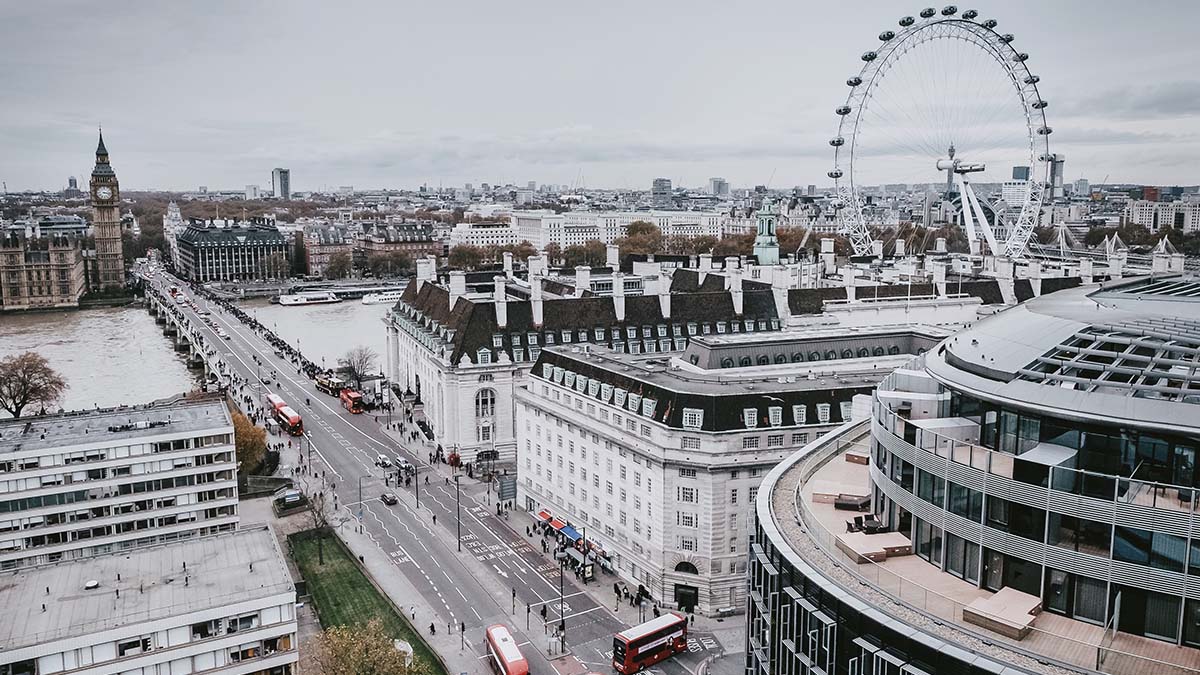
London skyline including the Eye

The Architectural Jewels of London

by Guylaine Spencer

England’s Thames River is one of the most celebrated bodies of water in the world. The section that runs through London and its outskirts has inspired artists for centuries. On my last trip to London, I discovered the reasons for its reputation when I toured the river on two boat trips: one from Westminster Pier in London to Greenwich Pier, the other from the city of Richmond to Hampton Court.

Thames River, LondonOne of the first things you notice on any Thames trip is how many of England’s political, economic and cultural icons are situated on its banks. Chief among them is The Palace of Westminster, the home of the British Parliament, with its famous Clock Tower and Big Ben bells. Although this site has been occupied by England’s rulers since King Canute built his residence here in 1016, most of the sprawling neo-Gothic structure you see today only dates back to about 1840-1870. This is because the bulk of the older palace was destroyed in 1834 by a fire. Westminster Hall is the oldest surviving remnant, dating back to 1097. The hall has seen its share of coronations, royal trials and funerals. It’s still used every year by the Queen for the State Opening of Parliament.

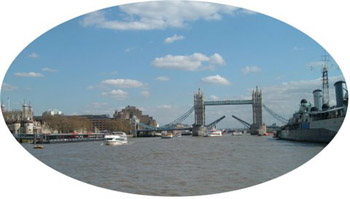
Tower Bridge, LondonFurther east along the river lie the Tower of London and the Tower Bridge. The bridge opened in 1894, but the Tower is much older. Ironically, this foreign-looking Norman fortress built of French stone is considered the most important castle in English history. In 1078, William the Conquerer ordered its construction to protect his new territory from invaders, and to overawe and terrify his new English subjects. William took advantage of the work of earlier conquerors and built his fortress into the side of a Roman wall. For five centuries, in addition to defensive purposes, the Tower served as a royal residence. After that, the building became primarily a prison and place of execution. The wheels of fate have turned again, and today the castle is one of the city’s top tourist attractions. In addition to showing off the Crown Jewels, its current promoters like to play up its lurid past; the Tower has seen its share of murdered innocents — Anne Boleyn, Lady Grey and the Little Princes, to name just a few. Even now, the building gives off a foreboding aura and looks as if, at any moment, blood may start to run down its lily-white walls.

fountain at Hampton Court palaceHampton Court Palace, on the other hand, twelve miles west of the London, impresses visitors with a very different sensation. Is it the red brick walls, the chimney pots, or the sixty acres of gardens that enclose it on three sides that makes it feel so warm and domestic? Perhaps this aura has something to do with the fact that it was originally built as a home for a private citizen, Archbishop Wolsey. Historians tell us that Wolsey’s new home was so grand that it inflamed the jealousy of the king. Word soon spread that Henry had plans to seize the property and throw the cardinal in prison. To escape this fate, Wolsey offered the property to the King as a gift instead.

The Queen’s House, at Greenwich, is another former royal residence. For readers with a taste for the romantic, this one comes with a tragic tale. King James I originally planned it for his wife, Queen Anne. Construction began in 1616 but before it could be completed, Anne died. Work on the building was abandoned for ten years, when another king, Charles I, took it up again and had it finished for his wife. Later, the building served as a naval school and it is now part of the National Maritime Museum. The American White House was based on this serene and classically inspired building.

Given the number of palaces that dot the Thames, it’s easy to picture the parade of royal barges and boats filled with liveried nobility floating down the river from one luxurious home to the next, entertained by musicians playing Handel’s Water Music. But this famous royal highway has always been shared with “tinkers, tailors, soldiers and sailors” as well. You can still see the architectural legacy that England’s commoners left behind, in the wharves, warehouses, mills and factories that line its banks.

Greenwich pier with Cutty Sark mooredThe Romans were the first to make London an international port back in the first century A.D. During the sixteenth century the area became a major shipbuilding centre. In the eighteenth century the port was crowded with the world’s ships waiting to dock and unload. Throughout the nineteenth century and right up to the World War II, London’s port was the busiest on the planet. If you want to learn more about the role of the port in England’ s economic history or just hear some stories about the “romance of the sea,” disembark at Greenwich and make your way to the National Maritime Museum. While you’re there, stop in and pay a visit to that old tea clipper, the Cutty Sark, too, which lies just off Greenwich Pier.

While the heroes of England’s imperial and seafaring age were her mariners, the heroes of her industrial revolution were her factory workers. Their home was then Southwark, on the south bank of the Thames. Many of the factories and warehouses that laborers used to haunt have been converted into pricey condominiums, but the structures still retain a pragmatic, workaday look. Dickens, who at the age of twelve was held in debtor’s prison in this district, described the lives of workers in this area in some of his books.

Somerset House, LondonThe Thames has been called “a string of pearls,” a fitting description when you consider numerous cultural sites that line its banks. One of the most striking jewels is Somerset House, constructed for King George III and opened in 1776. The current building boasts dramatic entrances on both the Strand and the Embankment sides. The structure was designed to house not only the offices of the navy, the tax office and the royal barges, but the Royal Academy of Art, the Royal Society and the Society of Antiquaries. Today, the grand neo-classical building shelters The Courtauld Institute of Art, Gilbert Collection and the Hermitage Rooms.

Another cultural gem that travelers can spot from a boat ride on the Thames is Shakespeare’s Globe Theatre, or rather a faithful reconstruction of the original Globe that once stood a few streets south of this location. The building which opened in 1997 is constructed of oak and water reed thatch and covered in white lime wash. Even if you don’t get a chance to see a play, you can still take a guided tour and visit a permanent exhibit about the history of theatre. Fans of the stage will also be happy to catch a glimpse of the twentieth-century National Theatre and Royal Festival Hall as they glide along the Thames.

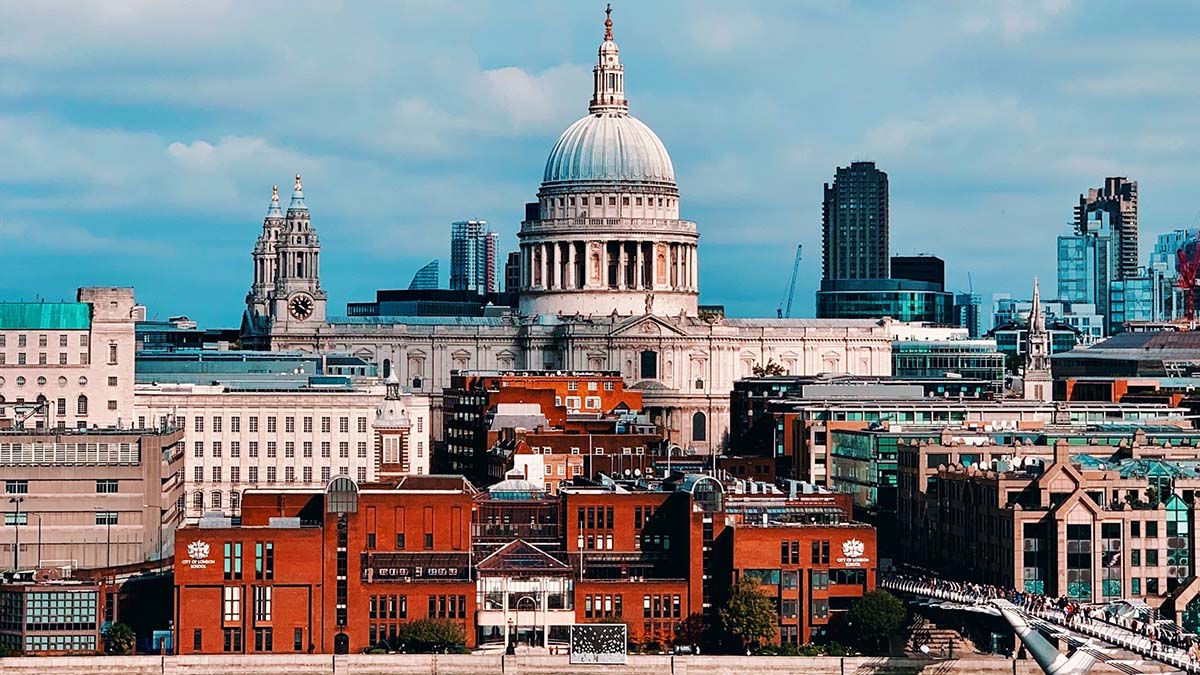
London is a city of monuments, and the most famous one of all is simply called The Monument. That spire you see from the river was designed by the city’s most famous architect, Christopher Wren, to commemorate the Great Fire of 1666. After the disaster, Wren almost single-handedly rebuilt London’s churches, including his famous masterpiece: St. Paul’s Cathedral. Its impressive dome looms large on the city’s skyline and is the second biggest in the world.

Most of the beloved treasures along the Thames have stood the test of time. However, there are some recent additions of note. Three in particular that opened around the millennium come to mind.

Millennium Bridge across the ThamesThere’s the Tate Modern Art Gallery, opened in May 2000, which is housed in a converted power plant. Nearby is the Millennium Bridge (opened in June 2000), a pedestrian pathway connecting St. Paul’s Cathedral with the Tate. The narrow structure rests upon tapering metal pier heads that resemble the upturned fins of sea monsters. Perhaps this explains why it’s so shaky and had to close down two days after it opened when it began to sway uncontrollably. After tests lasting two years, the bridge reopened. However, it still feels.well, wobbly!

Finally, there’s that striking new landmark, the London Eye. In what looks like the world’s biggest Ferris wheel (technically, it isn’t one), adventurers can ride the 140 meters to the top for a unique view of the Thames and London at large.

It remains to be seen whether recent additions to this history-drenched landscape will be standing beside their famous fellows a hundred years from now. We can only hope that the older treasures that have lined its banks for so long will remain as well, a century from now, to awe and inspire future visitors to the Thames.

If You Go:

Visit London: www.visitlondon.com
River Thames: www.riverthames.co.uk
Historic royal palaces: www.hrp.org.uk
Greenwich: www.greenwichwhs.org.uk
Somerset House: www.somersethouse.org.uk
Shakespeare’s Globe Theatre: www.somersethouse.org.uk

London Tours Now Available:

Literary Pub Crawl and Tavern Tour in London
Haunted London Pub Walking Tour
Private Best of London Tour: Sights and Secrets
Jack the Ripper and Sherlock Holmes Tour of Haunted London
London Literary Walking Tour Of Bloomsbury

About the author:
Guylaine Spencer is a Canadian writer specializing in travel, history and the arts.
Contact: www.freelancesuccess.com/guylaine

Photo credits:
First London photo by Mavis CW on Unsplash
Cutty Sark, Greenwich by © User:Colin / Wikimedia Commons
All other photos are by Guylaine Spencer.

Tagged With: England travel, London attractions Filed Under: UK Travel

  • « Previous Page
  • 1
  • 2
  • 3

MORE TRAVEL STORIES:

Hillsborough: A Town of History, Cuisine and Creativity

Mas a Tierra: Robinson Crusoe Island

Discovering Split, Croatia’s Coastal Gem

The Majestic Scenery and Wildlife of Banff, Canada

Italy: Aesculapius In Rome

France: Finding the Real Paris

Why Are Travelers Turning to Boat Clubs: A Guide to Visiting Lake Tarpon, Florida

Greece: Christmas in Evros


SEARCH

DESTINATIONS

  • Africa Travel
  • Antarctica travel
  • Asia Travel
  • Australia travel
  • Caribbean Travel
  • Central America Travel
  • Europe Travel
  • Middle East Travel
  • North America Travel
  • Oceania Travel
  • South America Travel
  • Travel History
  • Travel News
  • UK Travel
  • Uncategorized
  • World Travel
facebook
Best Travel Blogs - OnToplist.com

Copyright © 2026 Cedar Cottage Marketing | About Us | Contact | Privacy Policy | Terms & Conditions | Copyright Notice | Log in