Travel Thru History

Historical and cultural travel experiences

  • Home
  • Airfare Deals
  • Get Travel Insurance
  • Writers Guidelines

Top Tourist Attractions in Vancouver, Canada

bridge leads into park with city skyscrapers in background

Vancouver is the perfect Canadian city for an escape into nature. You will find diverse landscapes here, from snow-peaked mountains and lush green forested trails to expansive sandy beaches. Tourists love this city because it perfectly blends urban lifestyle, entertainment, and captivating natural beauty. You just have to know about the top tourist attractions in Vancouver to ensure you have an unforgettable time in the region.

Not many people who want to explore destinations enriched with natural beauty consider visiting Vancouver. This is because people know it as a bustling urban destination. Therefore, it is time to learn about the breathtaking natural sites here to refresh your mind.

Are you a UK citizen who wants to explore the spectacular Canadian city? Browse flights to Canada from London from reliable airlines to get the best deals. After booking your flight, make your Vancouver itinerary with the help of this blog.

Must-Visit Top Attractions in Vancouver

  • Stanley Park

jogger on seawall in Stanley Park, Vancouver

Stanley Park is the most prominent tourist attraction in Vancouver. This 1000-acre greenery is a sight to behold and a source of escape from the bustling city life. There are endless activities that you can indulge in this urban oasis. Look at the giant, well-preserved trees here, and walk around the 20-mile Seawall for stunning views of the head inland and Burrard inlet. You can walk, jog, and cycle here.

Take a bike and explore this park’s 17 miles of forest trails. Locals love biking on the South Creek Trail, which leads to the scenic lily pad-covered Beaver Lake. If you don’t want to indulge in heavy exercise, you can also take a horse carriage or a train to explore this natural site.

  • Granville Island 

Granville Island, Vancouver

Granville Island is a charming neighbourhood in the city. This buzzing town is located beneath a bridge in downtown Vancouver. Here, you will find a hub of dining, entertainment, and shopping that will be pretty fascinating. This lovely neighbourhood provides all the entertainment you might need, from trendy restaurants to galleries and theatres. Visit the public market to have the most exciting experiences.

Stroll around the shops here. You will find many local crafts and fresh produce. Moreover, endless food possibilities exist here, including Mexican cuisine and freshly baked goods. It is one of the city’s loveliest neighbourhoods. So, make sure you spend one day in Vancouver here.

  • Kitsilano Beach

You are mistaken if you think you won’t find the perfect beach escape in Vancouver. Kitsilano Beach is an expansive stretch of sand along the shoreline of the northern edge of Kitsilano. This beautiful beach offers a wide range of activities. Therefore, you will not be bored here even for a minute. You can sunbathe with the views of the city’s glorious skyline. Once you get all the vitamin D you need, you can swim or participate in an exhilarating game of volleyball, tennis, in-line skating and many other activities.

This beach also has a heated saltwater pool. Nearby are many refreshment stalls and restaurants where you can get a filling meal. You can also explore the Vancouver Maritime Museum near this beach.

  • Queen Elizabeth Park

Queen Elizabeth Park, Vancouver

Vancouver is known for its refreshing outdoor spaces, and Queen Elizabeth Park is one of them. This park covers 130 acres and has many trees and plants, a beautiful rose garden, an arboretum with around 1500 native and exotic trees, and a well-maintained quarry garden.

A conservatory within this park also features 100 free-flying exotic birds, three climate zones, and 500 tropical plants. Outside of this conservatory is a picture-perfect fountain with statues surrounding it. Moreover, Queen Elizabeth Park is at a high point in the city. Therefore, you get panoramic views of the city’s spectacular skyline from here.

  • Grouse Mountain

Grouse Mountain is another favourite tourist spot in the city for adventure lovers and outdoorsy people. This mountain provides you with the most stunning views of the whole city on a clear day. But more than that, it offers countless winter outdoor activities like hiking, chair lifting, and snowboarding. You will also find a zipline and a skating pond here.

But this mountain provides countless adventurous activities, many fine-dining restaurants, and a high-definition cinema. So, it is entertainment-packed at one tourist destination.

Summing Up

Do you want to travel to Vancouver soon? You can find reliable and comfortable flights from the UK to Vancouver with WestJet, British Airways, Air Canada and Iberia. There are other airline and flight options that you can consider, too. But book your flight as early as possible to get the best deals. Once you have sorted out the flight, browse through tourist attractions in Vancouver, including the ones mentioned in this blog, to plan your holiday in this beautiful city.


Tagged With: Vancouver attractions Filed Under: North America Travel

Pauline Johnson, Vancouver’s Mohawk Princess Poet

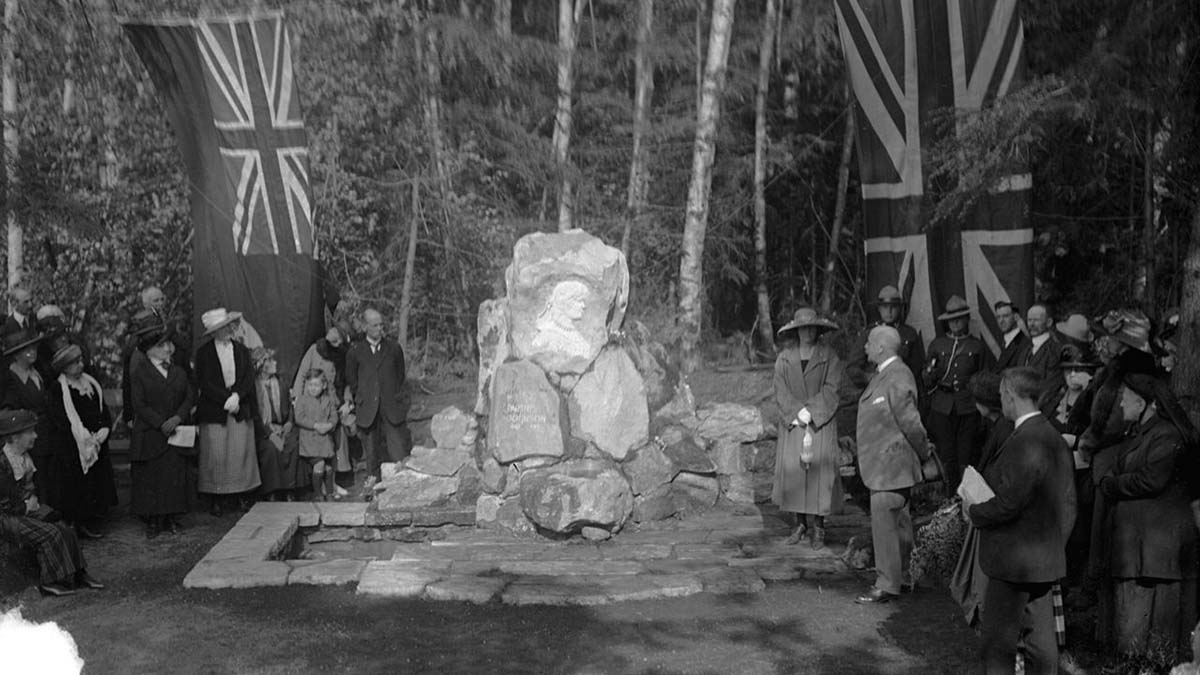
Ceremony at Pauline Johnson's grave, 1920

by W. Ruth Kozak

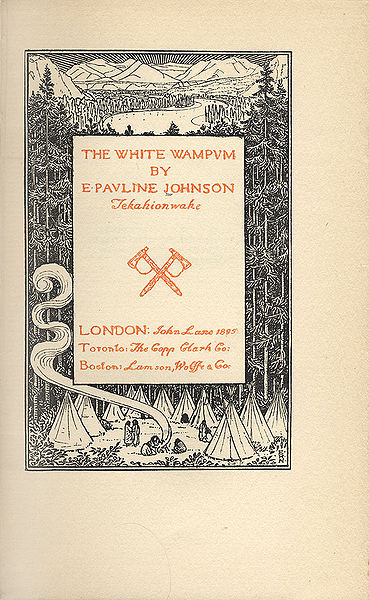
If you visit my city, Vancouver, British Columbia, Canada, you are sure to spend some time in one of Vancouver’s unique tourist attractions, Stanley Park. The park covers 404.9 hectares (1,000 acres) of rainforest and is the largest city park in North America. It was named for Lord Stanley, 16th Earl of Derby who became Governor General of Canada. Stanley Park was first opened as a public recreation area in 1887. The park, which is located at the western entrance to Vancouver’s harbour, was originally settled by the Coast Salish people. It was their hunting and gathering ground and became the favorite haunt of an Indian princess/poet, Pauline Johnson, the first Native Indian to be published in Canada. Her book “The White Wampum” gained her high literary standing.

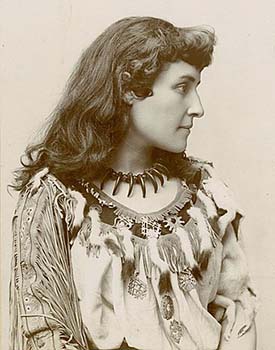
Tekahionwake circa 1895Born March 10, 1861 on her father’s estate “Chiefswood” on the Six Nations Indian Reserve near Brantford, Ontario, Pauline was the youngest child of G.H.M. Johnson, head Chief of the Six Nations and his English wife Emily S. Howells. Her Indian name was Tekahionwake. She was considered a “princess” because her father was the scion of 50 noble families which composed the historical confederation founded by Hiawatha, a noble chief made famous in a poem by Alfred, Lord Tennyson. It was known as the Brotherhood of the Five Nations.

Pauline’s education was meagre — a nursery governess for two years, attendance at a Native Canadian day school, and two finishing years at the Brantford Central School — but she was well educated in the School of Nature. With her voracious reading, retentive memory, and keen mind, Pauline acquired a wide knowledge of literature, especially poetry. Before she was twelve, she had read all the classics. Her fiest poems were published in New York and Toronto. By the time she was in her 20’s she became known for her public appearances and poetry readings, traveling from the Atlantic to the Pacific coasts of Canada. She also made several trips to England to perform and was presented to the Queen. She performed in dance halls across the country often clad in a buckskin outfit and a bear claw necklace to represent her Mohawk heritage and then later in the performance she’d change into a silk evening gown honoring her British ancestry.

Much of Johnson’s poetry focused on her cultural back-ground. In A Cry From an Indian Wife she wrote:

Go forth, nor bend to greed of white man’s hands.
By right, by birth, we Indians own these lands,
Though starved, crushed, plundered,
Lies our nation low;
Perhaps the white man’s God has willed it so.

Pauline Johnson made many trips to the west coast, eventually settling in Vancouver. She spent much of her time in Stanley Park. She was an ardent canoeist and a great lover of nature and wrote many poems about the park.

As I enter the Park, I cross under the causeway and take the path to Lost Lagoon. Originally part of Coal Harbour, it was a tidal basin where Indians dug clams. In the early days, visitors to the park had to pick their way over a large log anchored in the mud flats until eventually wooden bridge was built. The causeway, constructed of earth, ashes and street-sweepings, was built in 1888. Pauline Johnson loved to paddle her canoe here. She named this tidal pool “Lost Lagoon” because of the way it emptied when the tide ebbed, and she wrote:

O! lure of the lost Lagoon/ I dream tonight my paddle blurs/ The purple shade when the seaweed stirs/ I hear the call of the singing firs/ In the hush of the golden moon.

The native name for Lost Lagoon is “Chul-Wah-Ulch” which means “a bog which is dry when the tide is out” Once there were Indian dwellings on the north side of the lagoon. Now, trumpeter swans, mute swans, duck families and grey herons make their home on the lagoon.

As I walk along the lagoon, I can feel Pauline’s presence and recall her poem about the Lagoon:

It is dusk on the Lost Lagoon,
And we two dreaming the dusk away,
Beneath the drift of a twilight grey-
Beneath the drowse of an ending day
And the curve of a golden moon.

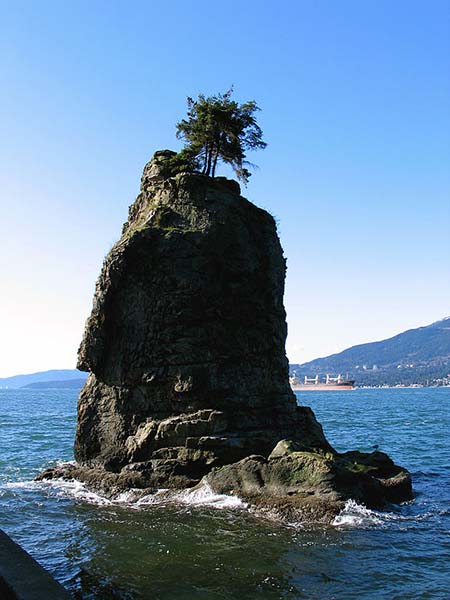
Siwash Rock, VancouverI follow the path to the end of the Lagoon to the seawall at Second Beach. As I walk along the seawall I come to another place that Pauline Johnson liked to visit in the park —Siwash Rock “where the twining roadway branches in two.” This monument of nature stands as a reminder to the Squamish people of one man who lived a good life. The tall pinnacle of rock that rises just off the shore represents Skalsh, a warrior who was turned into stone by Q’Uas the Transformer as a reward for his unselfishness. It is one of the best known legends about a young Indian who was about to become a father and decided to swim in the waters of English Bay to purify himself so his new-born son could start life free of his father’s sins. The gods made Sklash immortal by turning him into a pinnacle of rock. Two smaller rocks representing his wife and son stand in the woods overlooking Siwash Rock.

Pauline Johnson died in Vancouver at the age of 53, on March 7, 1913. The hardships of travel in those days had taken a toll on her health and in the latter years of her life this remarkable woman, known to her friends as ‘a beloved vagabond’ became an invalid. The last thing she wrote was her will, nine days before her death at 53, in which she requested no public mourning, no tombstone or monument. But a huge funeral was held with hundreds of people in the streets to honor her. Her will and ashes were lost for 43 years before they were found in the vault of a Vancouver law firm. Her ashes and two of her books Legends of Vancouver and Flint and Feather were eventually buried near Siwash Rock. In 1922 the Women’s Canadian Club of Vancouver erected a monument in her honour.

I visit the cairn in a cedar grove at Prospect Point near the Stanley Park Tearoom. It’s a simple relief carved out of a large piece of natural rock, where water flows from the rocks into a small hollow pool at its base. This day, someone has left a bouquet of flowers in her memory. I pause, engulfed in the silence of the tall cedars that surround the shrine, and pay homage to this remarkable woman whose beautiful poetry has given such a special meaning to Stanley Park.


If You Go:

Explore Chiefswood

Vancouver Archives

If you visit Vancouver BC be sure to go to Stanley Park and you’ll see Lost Lagoon. Or take the road around the Park to 3rd Beach and up the steps by the roadside you’ll find the memorial stone to Pauline.

More Information:

PAULINE JOHNSON’S BIO
E. Pauline Johnson at Digital Library

BOOKS

Paddling Her Own Canoe: The Times and Texts of E. Pauline Johnson (Tekahionwake) (Studies in Gender and History)


Buckskin and Broadcloth: A Celebration of E. Pauline Johnson — Tekahionwake, 1861-1913

Flint & Feather: The Life and Times of E. Pauline Johnson, Tekahionwake

POETRY COLLECTIONS

About the author:
W. Ruth Kozak is a historical fiction writer, travel journalist, poet and playwright who lives in Vancouver B.C. Canada. She is the former editor and publisher of TRAVEL THRU HISTORY. When she was young, Ruth lived in Brantford, Ontario and became interested in First Nations history and the story of Pauline Johnson. One of her favorite places in Vancouver is Stanley Park. www.ruthkozak.com and www.inalexandersfootsteps.com

Photo credits:
Ceremony at Pauline Johnson’s grave by Thomson, Stuart / Public domain
Tekahionwake ca 1895 by  Cochran / Public domain
Cover of 1895 edition of White Wampum by Pauline Johnson – Public domain
Siwash Rock, Vancouver by Andrew Raun under the Creative Commons Attribution-Share Alike 2.0 Generic license.


Tagged With: canada travel, Pauline Johnson monument, Siwash Rock, Vancouver attractions Filed Under: North America Travel

Welcome to My City: Vancouver, BC

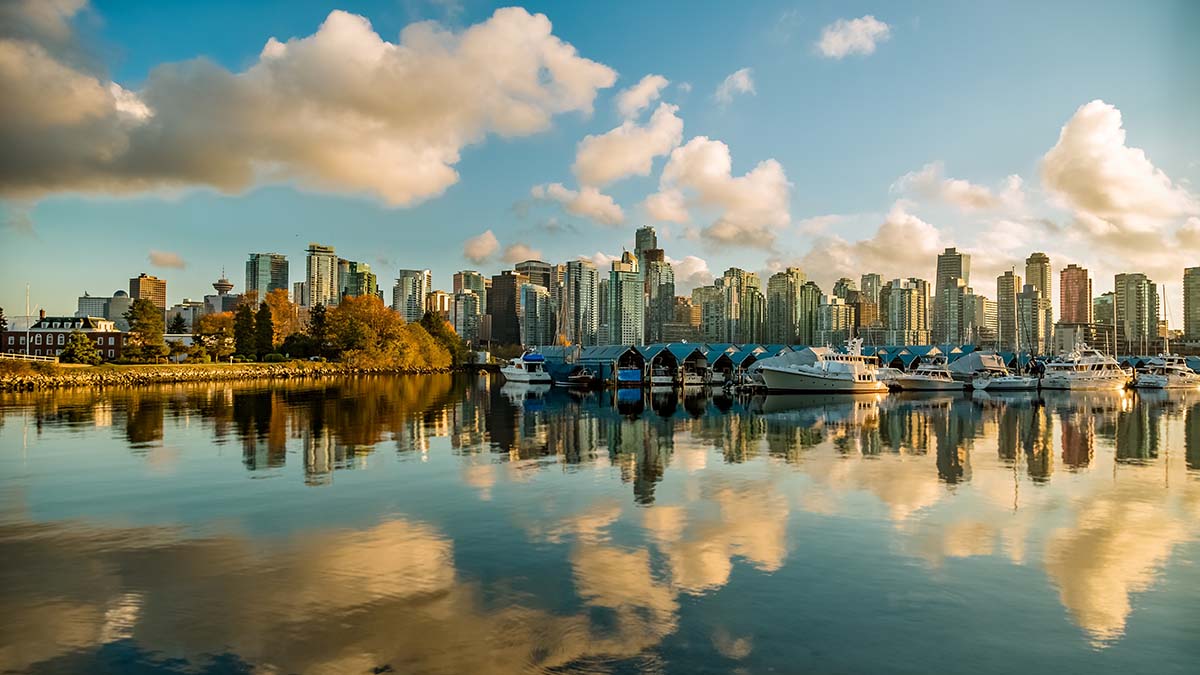
Vancouver, British Columbia skyline

Hosting the World for the 2010 Winter Olympics and Paralympic Games

by W. Ruth Kozak

With its balmy climate, the natural surroundings of sea and panorama of mountains, Vancouver is one of the most beautiful cities in the world and a major tourist destination. As Host City of the 2010 Winter Olympics and Paralympic Games, we Vancouverites will welcome the world this February. I’ve lived here most of my life and will share with you all the sights and attractions my city has to offer, including Vancouver’s colourful history.

West End of VancouverThe city area was first settled in 500 BC by Coastal Indians. The Spanish navy explored the area and in 1792 the British naval captain George Vancouver arrived here. When Captain George Vancouver sailed into the inlet he was greeted by the First Nations people who paddled out to meet his ship and welcomed him with a shower of white feathers. Vancouver has always been a city of many cultures, from the First Nations Coast Salish people who originally inhabited this area, the early British and Portuguese sailors who decided to jump ship and stay, the Chinese who arrived, inspired by the gold rush in the ‘80s, the Japanese who came to fish, to other immigrants such as the Indo-Pakistanis who brought their logging skills; and other cultures including the French, Italian, German, Scandinavian, Ukrainians and Greeks that have given Vancouver its rich cultural heritage.

Van Dusen Garden, VancouverToday’s population is 550,000 people who reside within a larger area of two million, forming the Greater Vancouver region. It is the third largest city in Canada.

With it’s gorgeous setting, some people call Vancouver “Lotus Land”. It’s a year-round paradise for sports and outdoor activities with easy access to the North Shore mountains for skiing. You can go golfing and sailing and then take in an opera at the theatre or a sports event at BC Place at night.

Yes, it rains a lot of in Vancouver (on the average 1.117 m. over the 164 wet days annually) so bring your umbrella when you come. But Vancouver boasts some of the most spectacular public gardens in North America such as the VanDusen Botanical Garden on Oak Street (left) and the Nitobe Memorial Garden at UBC. Just across the Lions Gate Bridge on the North Shore you’ll find the Capilano and Lynn Canyons where there are forest walks and suspension bridges.

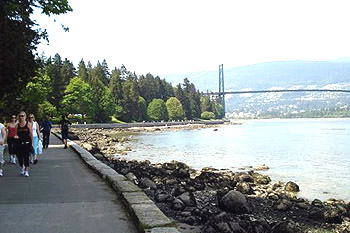
Stanley Park sea wall, VancouverVancouver has outdoor activities all year round, rain or shine. Locals don’t let the rain stop them from going out to enjoy the sights, walking, jogging or cycling. And if you don’t like being out in the rain, hunker down in one of the many coffee shops that you’ll find in every area of the city, or take in an exhibit at the Vancouver Art Gallery or Museum. Several of the gardens, such as the Dr. Sun Yat Sen Classical Chinese Garden in Chinatown, have covered walkways and pavilions. And the trees in Stanley Park provide a natural umbrella.

Stanley Park (400 hectares) is the soul of the city, slightly bigger than NYC’s Central Park, making it the largest urban park in North America All around the park is a seawall with nine kilometers of spectacular waterfront views (above right) and beaches where you can walk, cycle or in-line skate. The Vancouver Aquarium is located in the park as well as Malkin Bowl where outdoor concerts are held during the summer.

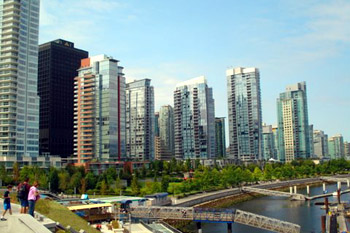
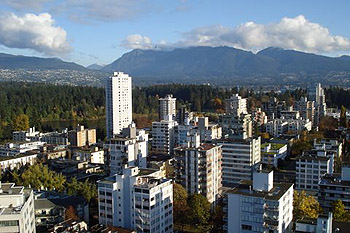
highrise buildings in Vancouver's West EndIn Vancouver’s West End (left), a high density residential as well as business area, you’ll find many excellent restaurants and shopping areas as well the Vancouver entertainment hub with theatres and cinemas.

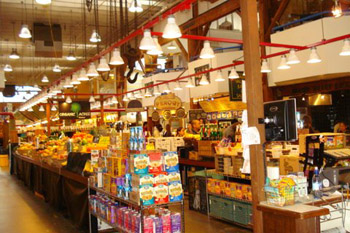
Granville Island Public MarketThere are several large shopping malls in Vancouver, including Pacific Centre downtown, Oakridge, Metrotown in Burnaby, and Park Royal in West Vancouver. But one of the biggest tourist attractions is the Granville Island Market (right), located across the Granville St. Bridge on Granville Island in False Creek. This was once an industrial area of ironworks and shipyards and it’s now a highlight for visitors and locals and includes a moorage for yachts and houseboats. The Market specializes in local BC produce. As well, there are art galleries and craft shops, boutiques, restaurants, pubs and several performance theatres. You can get there by bus or take the little striped Aqua buses that stop all over False Creek and English Bay.

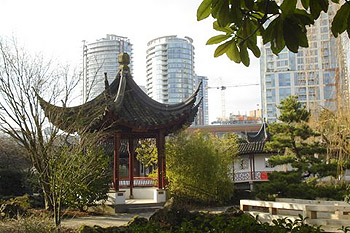
Dr. Sun Yat Sen GardensBecause of the city’s multicultural heritage you’ll find ethnic enclaves such as Chinatown and Little India. Vancouver’s Chinatown is the third largest in North America after NYC and San Francisco. It’s a busy marketplace crammed with shops and restaurants. Be sure and visit the Chinese Cultural Centre and the Dr. Sun Yat Sen Gardens (left) while you’re there.

Up at Main and 49th Ave you’ll find the Punjabi Market where you can buy exotic merchandise and groceries. In Vancouver’s East End, Commercial Drive, once known as “Little Italy” is now one of the city’s most bohemian areas where you’ll find shops and restaurants including Jamaican, Ethiopian, Mexican and Moroccan as well as Spanish tapas bars and Portuguese and Italian coffee shops, Chinese grocers, and French and Italian bakeries.

Vancouver's downtown shopping areaCulturally Vancouver has a lot to offer. Downtown at the Vancouver Art Gallery you can see paintings by BC’s beloved artist Emily Carr as well as collections of work by other Canadian or internationally known artists. The Museum of Anthropology at UBC is Canada’s largest teaching museum, designed by Vancouver architect Arthur Erikson. It displays aboriginal sculptures, totem poles, and a rich display of First Nations art including works by famous BC artist Bill Reid’s Cedar Bear and Sea Wolf.

If you’re looking for entertainment the Chan Centre at UBC holds impressive concerts as does the Orpheum Theatre, once the largest theatre on North America’s Pacific Coast. This is the permanent home of the Vancouver Symphony Orchestra. The Queen Elizabeth Theatre hosts ballets and theatrical productions. This will be the site of the Aboriginal Pavilion during the 2010 Winter Olympic Games. For sports events, if you come for the Games, you’ll be attending GM Place and the Pacific Coliseum or the BC Place Stadium.

Aqua bus water taxi crossing Vancouver's False CreekAs prestigious and beautiful a city as it is, Vancouver has its ‘dark’ side too. If you’re coming for the Olympics, you can expect higher prices and road restrictions.Security will be tight around the Olympic venues such as the Olympic Village, the Convention Centre, the Richmond Oval and the Vancouver International Airport. In the Downtown East Side area, you can also expect to see Vancouver’s growing homeless population. (It’s estimated that between 500 – 1200 people sleep on the streets each night, although recently more shelters were opened.) About a quarter of the population here lives below Statistics Canada’s low-income level and there is a growing concern regarding the drug trade and crime. Although Vancouver has sometimes been dubbed the ‘no fun city’, because of strict liquor laws, some of these have been relaxed in time for the influx of thousands of guests coming for the Games. Bylaws prohibiting singing and dancing in restaurants were repealed and bars and nightclubs have had their hours extended (up to 3 a.m. in the Granville Street area downtown).

looking across English Bay towards West VancouverVancouver is served by the Vancouver International Airport (YVR), the second busiest airport in Canada with the second largest international passenger gateway on the West Coast of North America. The public transit (Translink) include trolleys, buses, a sea-bus service and a sleek Skytrain (monorail) that will take you across town in minutes.

We Vancouverites are proud of our city. How many other cities can claim to have ocean beaches and lofty mountains just minutes away, a huge park in their midst, a striking array of architecture and cultural opportunities and performing arts? And now, we are hosting the biggest show of the year with the 2010 Winter Olympics and Paralympic Games. Come and join us for the fun!


Full Day Best of Vancouver Private City Tour and Alpine Adventure

If You Go:

www.discovervancouver.com
Vancouver Tourist Info Centre:
Downtown Vancouver, Plaza Level 200 Burrard St.
TEL: 604-683-2000
Information about the 2010 Winter Olympics:
www.tourismvancouver.com
www.HelloBC.com

About the author:
W. Ruth Kozak has lived in Vancouver since she was 13 years old so she knows the city well. She is the ‘roving reporter’ for Planet Eye’s “Vancouver Guide” – www.planeteyetraveler.com where you can read all about what’s going on in the city.

Photo credits:
First photo of Vancouver by Mike Benna on Unsplash
All other photographs are by W. Ruth Kozak.

Tagged With: British Columbia travel, Vancouver attractions Filed Under: North America Travel

Vancouver Celebrates Lunar New Year

Chinese dragon in Vancouver parade

Gung Hay Fat Choy, British Columbia

by W. Ruth Kozak

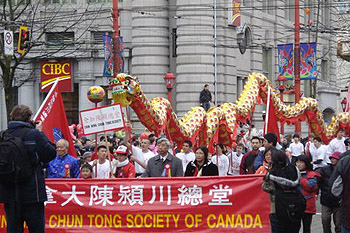
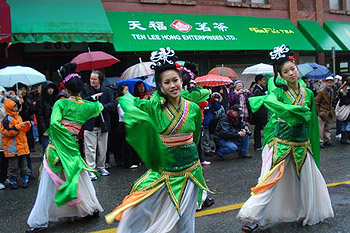
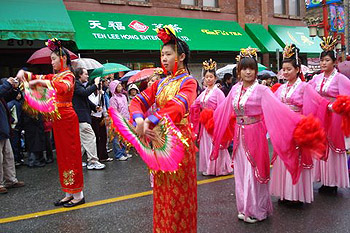
A West Coast mist that quickly turned into an icy downpour didn’t dampen the enthusiasm of the spectators or stop the lions and dragons from dancing in this year’s Chinese New Year’s parade. From marching bands, politicians, police, banner waving martial arts groups and pretty dancing girls, there was entertainment for all ages.

In spite of the weather, it was hard to find a good vantage point the crowd was so dense. I managed to wangle a spot close to the front where the little folk stood collecting the traditional red and gold envelopes containing gold-wrapped chocolate ‘money’. The giving of money gifts in these little red envelopes at the lunar new year is a Chinese tradition.

To the sound of clanging gongs and cymbals, and the thrumming of drums, the dazzling spectacle passes by. Red and gold are the predominant colours as red brings luck and scares away evil and gold attracts prosperity. Gold dragons weave and circle; bearded lions approach the crowd snapping their jaws; dancers twirl, their silk skirts whirling in a kaleidescope of vivid colours; Chinese elders march by proudly holding banners while troops of smiling youngsters: cadets, scouts, guides and marching bands, strut behind them.

Chinese dancers in Vancouver paradeVancouver has one of the largest Chinese communities in North America and Chinatown is one of the city’s most historic areas with distinctive architecture that has been carefully preserved.

The first Chinese immigrants came here from California in 1858 following the streams of fortune seekers who travelled north to find gold. British Columbia came to be known as “Gold Mountain” attracting many more immigrants from mainland China. After the gold rush ended, those Chinese immigrants found work in canneries or lumber mills and later helped build the Canadian Pacific Railway line. But once the railroad was built the unemployed Chinese men were limited to more menial jobs and restricted to living in an area of Vancouver that became known as Shanghai Alley. There was racial tension in the city causing riots, and the head tax imposed on the immigrants was increased limiting immigration from China. It was known as the “Chinese Exclusion Act”.

head of Chinese dragon costumeFortunately these enterprising, hard working people survived, and today the Chinese community in the Lower Mainland of Vancouver has increased with many new immigrants arriving from Taiwan and Hong Kong. Chinatown was designated a historic area in 1971. The old Chinatown area is now being revitalized since a great many of the Chinese community now live in other areas of the city, in particular Richmond.

It’s the Year of the Rat, 12th year of the lunar cycle, and although I saw very few ‘rats’ in the parade, there were plenty of colourful dancing dragons and lions. The dragon, like the lion is a symbol of good luck to the Chinese who often use the term ‘descendants of the dragon” (long de chuan ren) as a sign of ethnic identity. The bold but frightening appearance of the dragon masks it benevolent disposition. The power and dignity of the dragon have given it a historic roles, as well as the symbol of fertility, wisdom. The dragon dance originated in the Han dynasty and was believed to have begun as part of the farming and harvest festivals. Like the lion dance, it is closely connected to the learning of Chinese Martial Arts. So the dragon dancers are usually members of local martial arts clubs. The teams carry the dragon on poles. They lift, dip and thrust as they coil around undulating in a sinuous manner, the dragon’s head sweeping up and down mimicking the movements of this powerful river spirit.

Accompanied by gongs, drums, cymbals and the crackle of exploding firecrackers the parade makes it way along Pender Street past throngs of delighted onlookers. I soon forget the weather and get into the spirit of the moment, jostling for a good viewpoint as I snap photos galore. I even collected a few of those lucky red envelopes.

women in Lunar New Year paradeAt the start of the parade, the five fluffy official mascots of the Beijing Summer Olympics are escorted by Chinese youths. Once the politicians, public service groups and various Chinese societies pass by, along with an impressive show of First Nations people dressed in their traditional button-blankets, comes the most vibrant display of beautiful Chinese women and young girls performing dances that show off their lovely silk garments. The crowd cheers with delight and the photo enthusiasts crowd to the front to capture the iridescent colours of the swirling skirts and sparkling head-dresses.

As the parade disperses, the crowds move along Pender Street to the Chinese Cultural Centre where a tent has been set up in the courtyard. Spectators are entertained with Silk road music and dancers and there is a display of paintings by the Canadian Chinese Artist’s Federation. It was a good opportunity for visitors to stroll the pathways of the Dr. Sun Yat Sen Gardens, a serene sanctuary after the busy excitement of Pender Street.

celebrating Lunar New Year in VancouverLater, I follow the lion dancers around from shop to shop where they perform their traditional choi chang. The lion is considered a guardian creature. There are lions of many different colours: gold representing liveliness, red for courage and green for friendship. The Lion Dance originated in China close to 1000 years ago. As it has a close relationship to kung fu, usually the dancers are members of a kung fu club. During Chinese New Years, shop owners tie a red envelope filled with money to a head of lettuce and hang it high over the door of their shop. The lion dance brings good luck and fortune to the business and the dancers receive money as a reward. The lion approaches the lettuce, acting curious as he moves in a cat-like manner, and finally bats down the head of lettuce which he pretends to eat. The lettuce leaves are spewed out but the money in the envelope is kept. There is a snap and crackle as a bundle of firecrackers explodes and the lion is enveloped in a cloud of smoke. The crowd cheers. The lion dancers move down the street to the next shop where the same ritual is performed.

The whole area of Chinatown is a delight to walk around in as you explore the well preserved historic buildings and shops with their decorated doorways, red signs, gold fabric rat souvenirs, crepe paper dragons, lanterns, intriguing trinkets, money envelopes, and mounds of exotic and local fruits and vegetables, fish (dried and fresh) bins of herbs and condiments. It’s a real cultural experience, especially on a day like this when the entire community is out to celebrate the Lunar New Year.


Vancouver Private Walking Tour of Downtown Chinatown and Gastown

For More Information:

Vancouver Chinatown History
Virtual Vancouver: Chinatown
Canadian Encyclopedia: Vancouver Chinatown

About the author:
W. Ruth Kozak has been a historical fiction writer since her teens and a travel journalist for more than 15 years. What began as a personal journey to visit, then live in Greece, motivated by her life-long interest in ancient history, has now emerged into this travel ‘zine where other writers can share their experience of travel and life abroad. She also instructs classes on travel writing, creative and novel writing and memoirs. She has traveled extensively, often solo and always on a budget. Her website is www.ruthkozak.com

Photo Credits:
All photos are by W. Ruth Kozak.


Tagged With: British Columbia travel, Vancouver attractions Filed Under: North America Travel

MORE TRAVEL STORIES:

Enigmatic Stones of Stonehenge and Avebury

Gold Rush Legacy: Exploring America’s First Gold Rush in North Georgia’s Mountains

Start Your 2025 Vacation Planning with Must-Visit Canadian Festivals

A Personal Visit to California’s High Sierra Ghost Towns

Easter Pilgrimage to Patmos, Greece

Australia: Mutineers and Sea Serpents – Lord Howe Island, Oceania

Viñales, Cuba: A Step Back In Time

A Guide to the Most Scenic Spots in Luxembourg City


SEARCH

DESTINATIONS

  • Africa Travel
  • Antarctica travel
  • Asia Travel
  • Australia travel
  • Caribbean Travel
  • Central America Travel
  • Europe Travel
  • Middle East Travel
  • North America Travel
  • Oceania Travel
  • South America Travel
  • Travel History
  • Travel News
  • UK Travel
  • Uncategorized
  • World Travel
facebook
Best Travel Blogs - OnToplist.com

Copyright © 2026 Cedar Cottage Marketing | About Us | Contact | Privacy Policy | Terms & Conditions | Copyright Notice | Log in