Travel Thru History

Historical and cultural travel experiences

  • Home
  • Airfare Deals
  • Get Travel Insurance
  • Writers Guidelines

10 Things You Need To Know Before Going On Safari

Hippos in Africa safari
Before going on a Safari in Africa we are invaded by a thousand doubts, many of which go along the same lines: what will it be like and what things we can or cannot do, especially taking into account aspects related to safety. Will we get out of the vehicle? How many hours does it take to go on Safari? How many animals will I get to see? Is it easy to see the “big five”?

We are going to focus mainly on safaris in Kenya and Tanzania, although many of these data and tips are also applicable to safaris in other places or on your own, such as safaris in South Africa.

Taking all this into account, we will tell you today what you need to know before embarking on a Safari in Africa. Ready? Let’s get started!

 Manage your expectations: remember that the animals are in the wild and this is not a zoo.

It is not guaranteed that you will be able to see all the animals, nor those “Natgeo” images where the lions run at the zebras, or the hippo opens its mouth, or the giraffe is drinking water. This will depend on being in the right time and place.

Zebras on Africa Safari

Guides make a difference, as an experienced guide will assess situations and know the best times or places to find each animal, but nothing is 100 percent certain. Sometimes there will be luck, other times maybe not so much.

In our case for example we cannot complain, we saw everything and in many special situations, and above all, it was as Colleta (our guide) said a “baby safari”, because we saw babies of almost all animals! But no two safaris are alike.

Wildebeestes on Africa safari

The parks and reserves are huge.

Related to the above, you have to know that the parks and reserves are gigantic. They are not territories that can be easily covered in a short time, and although there are roads, there are places that cannot be reached (as vehicles are not allowed to drive).

This implies that maybe there is a situation that is going to be out of our reach, in those cases you can get to see it through your cameras if you have a powerful zoom/lens or binoculars.

Elephant in Africa safari

Never, but never, get out of the vehicle without asking your guide.

Getting out of the vehicle during a safari is clearly not the smartest decision in the world, let alone doing it without asking your guide if it is safe to do it in that place. There are authorized areas to get off, there are areas that are less risky, there are areas designated for picnicking, in other words, always consult beforehand.

It’s hard to believe, but there are still a lot of accidents because of this kind of thing, especially because people want to take a better picture, or take a picture with a certain animal… it’s easy to feel like you’re in the middle of a field! Of course, until you come across a lion or an elephant walking around.

On the other hand, in some places there are toilets but if you are in a hurry, you can stop in certain places to urinate exactly where these wild animals do it haha Always let the driver and guide know, and they will make the decision that is safest for you. If you are a student, who went on a safari for the first time and want to write a fascinating essay about it, you can turn to the professional team of studycrumb. They can help you write a terrific article that will stay in your memory forever.

When staying in campsites or places that are not fenced in any way, the guide is also asked to accompany them from the camping area to the dining area.

The dining area is fenced and enclosed (like a trellis) as food is more tempting for the animals to approach. It is important to be aware that we are sleeping in the middle of natural parks and that this has a certain risk, even more so when we do not take care of these basic aspects.

Besides, our night vision, for example, is not the same as that of the animals, so they will surely see us long before we even know they are near. The idea is not to scare them, but to make them aware that it is our life and the lives of those who are traveling with us that we put at stake by doing stupid things and not following the basic rules. And of course, also the life of the animal itself.

Africa safari tent accommodations

You cannot feed the animals.

They are wild animals, therefore, feeding them is not allowed. They go on with their normal life and are fed according to their needs. This is why although it may be tempting for some people to feed them, especially if they get close, this is not allowed as it may cause changes in their diet, and even cause severe damage.

A safari is done in silence.

It is an experience to live with all the senses, and this applies especially when you share the trip with other people. You have to be respectful of the experience, learn to listen to the sounds of nature, it is part of making a safari.

Baboon on Africa safari

On the other hand, making very loud noises or shouting can exasperate the animals, driving them away from us or even making them feel annoyed (which is risky for our safety).

We saw a safari car pass by, with the roof open, and a gentleman singing opera-style loudly standing inside the car with half his body outside… we were thankful we were not in that same vehicle! We also saw cars where when we saw an animal, everyone was commenting, or listening to loud music… we even saw people shouting at the animals to call them! Yes, there are people for everything.

The Safari day is linked to the driver’s and guide’s working hours.

What does this mean? That we must take into account that, at least in Kenya and Tanzania, the working hours are 8 hours, so the time that exceeds that duration will be at their own will. They are not “obliged” to do so as part of the contracted service.

For example, if they started the day at 6am, it would be fair to finish it at 4pm, although in many cases they continue a little longer. This is at the will of the guides and drivers, in any case we can clarify that we do not expect them to extend the day for more than that amount of hours.

On the other hand, the parks have a schedule, which is usually from 6 am to 6 pm, so you can not exceed it. At a certain time the driver must take the road to get closer to one of the exit points or to the campsite, depending on the case, since this is regulated and fines are applied for those who do not comply.

The entrance fees to the parks are for 24 hours, so if they paid a ticket one day at 9 am, the next day if they come back they must leave the park before 9. Otherwise they should pay another ticket.

It is always a matter of discussing everything with the team, so that the experience is pleasant for everyone. For us it is a once in a lifetime experience, but you have to remember that for them it is their job and obviously they feel tired, they know if a route will take longer, or if it is convenient to go another way.

Logically we can suggest, we can ask and we have our rights; it happened to us that the driver of our first days in Kenya did not turn off the engine when we braked to see an animal, or his cell phone rang (it was not silent). We talked about this with Colleta (a total genius) and there was no problem, she talked it over with the driver and we were all happy.

That is to say, do not be afraid to ask questions, to raise your expectations or discomfort, as this also makes the job easier for them. For example, we explained that we wanted to appreciate the details in silence, that we wanted to film, that the vibration of the vehicle did not allow us to take pictures with the camera still, so from then on they knew what we expected.

Then during our Safari days in Tanzania this happened in a more natural way, the group was divine and made the experience even more special.

On the other hand, I love elephants, so my biggest expectation was to see big herds, giant elephants with their huge tusks and ears, and Colleta was very attentive to emphasize this, explaining things to us and giving us many facts about the herds, their habits and other details that for me at least are exciting.

cheetas in Africa

It is forbidden to throw things out of the vehicle and leave garbage.

This sounds obvious, and logical, but for some people it may not be so… so it is always worth clarifying. Not only do we put the animals at risk, but we also generate pollution to the environment… watch out, if something gets blown away, which although it may seem silly, they always warn their guide so that he/she can take the most appropriate decision.

We are talking about maybe you are drinking water and you drop your bottle, or your hat, or your camera cap, or even your cell phone (may it never happen to you!). Haha It reminds me of when mine flew off a tuk tuk in the middle of Bangkok traffic, but that’s another story). If something like this happens to you, let your guide know so he/she can make the most appropriate decision for that moment and situation.

It is forbidden to leave the trails.

As we mentioned today, there are established trails in the park where you can go. There are other roads that are closed, or even marked indicating that only Rangers, who are the park’s caretakers, are allowed to drive on them. This is done mainly to prevent soil erosion, which as we know has serious consequences for the different ecosystems.

Let’s be aware of this and not put pressure on the driver, since many times in order to keep the travelers happy, who ask to get closer and closer to the animals, they end up giving in, putting not only the environment at risk but also exposing themselves to economic sanctions by the rangers.

two zebras in Africa

A safari is a once-in-a-lifetime experience.

A safari has to do with observation, with looking, with listening, with seeing the panorama, the landscape… it has to do with living the moment, with feeling the air when you go with the roof of the truck open, with feeling the smell of wet earth when the rain starts to fall, with learning, with seeing different situations. Because it is not only about seeing a certain animal, because you can see 200 giraffes, but you can always see them in different situations and live a special moment.

Because no, it is not the same to see lions when they are sleeping, than to see them again when they are eating, or when they are walking looking for shade, or when they are drinking water, or when they are with their cubs.

It is not the same situation to see giraffes eating than to find them in the rare and vulnerable situation when they are drinking water, or when they are fighting… and to feel how the blows on their necks sound, and to learn that the “horns” they have are made of bone and yes, they hurt.

And to see that the Pumbas or warthogs walk with their elbows, and run with their little antenna-like tails; or that elephants also get into the water and eat the plants that are floating there… Or how the dic dic always go together in pairs, or how a Thomson’s gazelle stays still when the rain falls on it, or how the zebras cross themselves in order to chase the flies away from each other… Or how you can see the pulse of that leopard in its neck, while it rests calmly after climbing its prey to a tree.

giraffe on Africa safari

Every situation has its magic, its appeal, and no two moments are ever the same. Because that is the rule, that there are no rules, that it is unpredictable, that you can suddenly see something unique in a matter of seconds and go from a normal day where “nothing interesting has happened yet” to the best day of the safari.

Or because you can be excited to see a bird, and its colors, because it is an African bird and you don’t have those at home, or because you can find it incredible to see such animals so close to you, or to see the spots of a zebra and not be able to believe that nature is so perfect.

African lion in safari

That’s what a safari is all about, so the best thing to do and our final recommendation is to be open to the experience.

We all have thousands of expectations, but the best thing is what you will really live once you are there, nobody will take that away from you… and I assure you that it will be an unforgettable experience.

author RachelAbout the author:
Rachel is a writer on Study Crumb, who has a passion for teaching. She has experience in human resources, working as a departmental assistant and sharing her skills with students. Now she is ready to branch out online, giving advice to a larger audience. She is ambitious and talented, with a great deal of enthusiasm for her work.

Tagged With: africa safari tips Filed Under: Africa Travel

Alexandria, Egypt – Pearl of the Mediterranean

alexandria egypt at sunset

By W. Ruth Kozak

I had always dreamed of visiting Alexandria, the fabled city on the Nile delta established by Alexander the Great back in 332 BC. While I was researching my novel SHADOW OF THE LION, I delved into the history of this remarkable city. When I was invited to Egypt last March on a travel writer’s press trip, I told the organizers about my novel and the research I had done about the founding of the ancient city. Because of this I was given a special two-day tour of Alexandria, with an escort of three handsome Egyptian men, one of the highlights of all my travel experiences.

Alexandria is a setting in the story. Ptolemy, Alexander’s illegitimate half-brother returned to Egypt after Alexander’s death to oversee the building according to Alexander’s wishes. Ptolemy Soter became the first of the Ptolemaic dynasties of Egypt that lasted up until the era of Cleopatra.

It is said that Alexander had a dream in which he recalled the lines from Homer’s Iliad of an island, Pharos, by the surging sea.’ Alexander had come to Egypt to drive out the Persians and to him, this dream was an omen. He wanted to build a new city by the sea, and chose this location near a small village called Rhakotis. He ordered his architect and city planner Dinocrates to design and build it but Alexander died before its completion. After Alexander’s death, Ptolemy hijacked the funeral carriage when it was being transported from Babylon to Macedon and brought the body to Egypt where, it is said, Alexander had wanted to be buried. It was interred first in Memphis, then when the temple for Alexander’s friend Hephaestion was completed, Ptolemy had Alexander’s body laid there where it remained at least until the arrival of the Romans, because it was visited by Julius Caesar and Cleopatra.

Under Ptolemy, Alexandria became a center of Hellenism. It was the home of many Greeks and also home of the largest Jewish community in the world. It took over the trade and commerce of Tyre between Europe and the Arabian and Indian East and soon expanded until it was the largest city in the world, second only to Rome. Over the years, Alexandria was visited by Julius Caesar, Mark Antony, Nelson, Napoleon, and was home of others such as Archimedes, Euclid, Mohammed Ali Pasha and the Greek poet Cavafy.

 The ancient Greek city had three regions, The Brucheum, Royal or Greek quarter which formed the most magnificent part of the city. The Jewish quarter formed the northeast and Rhakotis, occupied mainly by Egyptians. The city consisted of the island of Pharos which was joined to the mainland by a mole nearly a mile long. There stood the famous Great Lighthouse, one of the Seven Wonders of the World, 138 meters high, a project begun by the first Ptolemy and completed by his son. The lighthouse was destroyed by an earthquake in the 14th century and was replaced by an Arab fortress using some of the original bricks.

The author, Ruth KozakI was curious to learn how much of Alexander still exists in Alexandria, the city named for him. As the van approached the outskirts the first thing I saw was a monument of Alexander riding his horse. At our first stop we were greeted by a young tour guide, Sarah, who showed us around an extensive excavation known as Kom al-Dikka, which has revealed many Roman era ruins including a theatre. We didn’t have time to visit the catacombs which are located near Alexander’s best-known monument, ‘Pompey’s Pillar. The catacombs, known as Kom al-Soqqafa, are a multì-level labyrinth reached by a spiral staircase where there are dozens of chambers with sculpted pillars and statues, burial niches and sarcophagi.

Our next stop on the tour was the Qaitbay Citadel, built on the site of the ancient lighthouse, and established in 1477 AD by the Sultan Qaitbay. It was one of the most important defensive strongholds on the Mediterranean coast.

Unlike Cairo which is densely packed between the Nile River and the vast expanse of Sahara desert, Alexandria sprawls out along the seacoast, a sparkling bright city surrounded by the verdant Nile Delta, the ancient’s ‘Land of Goshen’. It is the second largest city in Egypt. The city is divided into six neighbourhoods, each with a large population. Alexandria is an important industrial area and Egypt’s largest seaport with two harbors, one facing east, the other west. There is evidence of the ancient harbour on the edge of the island of Pharos, but little else remains except what the underwater archaeologists have discovered under the sea. Some of these finds can be seen in the Alexandria Museum and on display outside of the new Alexandria Library.

The Alexandria Museum contains a number of exhibits dating back to the Ptolemaic dynasty as well as Roman. What I found most interesting were some of the relics that have been brought up by the maritime archaeologists in the harbor which reveals details of the city both before Alexander’s time and during the Ptolemaic dynasty. Where is Alexander’s tomb? Most likely at the bottom of the sea. Evidently they have discovered parts of Cleopatra’s palace and in the front of the new library is a tall weather-worn statue of one of the Ptolemys brought up from the seabed.

After my tour of the Roman ruins and museum, I was taken to my hotel by the seaside, surrounded a beautiful 350 acre park of palm trees and flowering bushes, the Montazah Palace Gardens. The elegant Helnan Palestine hotel is on the grounds next to what was King Farouk’s summer palace. Farouk became king at the age of 16 and lost his throne at the age of 32 in 1952. The hotel was built in 1964 to accommodate the Arab Kings and Heads of States participating in the Second Arab Summit in Alexandria. Members of Royal families and Presidents have stayed there. This made my visit even more special to know I was on royal territory.

Alexandria LibraryThe next day was the highlight of my visit when I was taken to the New Alexandria Library, the Bibliotheca Alexandrina, which opened Oct. 16, 2002. It’s an immense cylindrical shaped modern structure separated from the University of Alexandria by a wide concourse where I posed under a bust of my hero, Alexander. The library is spectacular in its design with constant light filtering through the specially curved domes. It houses over 8 million books.

The first Library of Alexandria was created by Ptolemy I Soter in the 3rd century BC. Most of the books were papyrus scrolls on great value. It was dedicated to the Muses and functioned as a major center of scholarship. Many of the most famous thinkers of the ancient world studied here. It was in Alexandria where Euclid devised geometry and Herophilus discovered that the brain, was the seat of thought, not the heart. A wealth of works from the classical world were housed in the old library, including those of Aristotle and Plato, original manuscripts of Sophocles, Aeschylus and Euripides, Egyptian treatises on astronomy and medicine; Buddhist texts, original Hebrew scriptures and many of the works of the lyric poet Sappho.

In 48 BC when Julius Caesar laid siege to the city, a fire was set and the library was partially destroyed. Later there were other attacks until finally the library was in ruins and thousands of ancient works were destroyed. I wondered what Ptolemy would think now, if he saw this amazing work of art which has replaced the library he first created.

The new library features a museum dedicated to science and history. There is also a large planetarium at the entrance. There are all the modern amenities such as Internet Archives, several specialized libraries, academic research centres and various permanent exhibits. It is also the home of several institutions including The Arabic Society for Ethics in Science and Technology, the HCM Medical Research, the Anna Lindh Foundation for Dialogue Between Cultures and many others.

There is an international spirit in the Bibliotheca just as there was back in Ptolemy’s time. Italians and Egyptians work together preserving rare manuscripts; Greeks help with antiquities; French are in charge of the science museum and Americans are the computer experts.

The famous burning of the ancient Library of Alexandria became the symbol of the irretrievable loss of knowledge, but the new Bibliotheca Alexandria has revived that legacy and the staff works together to maintain this great Temple of Learning.

Not only was this two-day visit to Alexandria, one of the most memorable times of my visit to Egypt, but I enjoyed the company of my Egyptian travel escorts and especially the lovely young woman who was my tour guide, Sarah Ibrahim. I felt such warmth from her that we immediately bonded. She had read all about me on the internet and knew an amazing number of stories about me from my blogs. So I would certainly love to return there someday to see my new friend and visit more of this wonderful country that is so rich with history and its warm, friendly people.

IF YOU GO:

Discover Alexandria

The library of Alexandria

 About the author:
Ruth had always dreamed of visiting Egypt, and in 2014 she was offered a press trip to that amazing country by the Canadian Egyptian Tourism. The tour included all the major sites such as Karnak, Giza and the Red Sea area and when the tour operator learned of Ruth’s novel SHADOW OF THE LION, part of which takes place in ancient Alexandria, she was offered a special trip to that amazing city. It was probably one of the most memorable trips she has ever made!

Ruth’s novel, the story of the fall of Alexander the Great’s dynasty, is available on Amazon.com in two volumes: Shadow of the Lion: Blood on the Moon and SHADOW OF THE LION: THE FIELDS OF HADES. It is also available in full on Kindle ebook SHADOW OF THE LION. Check out Ruth’s travel blog.

Photo credits:
Alexandria at Sunset by David Evers under the Creative Commons Attribution 2.0 Generic license
Ruth Kozak at statue of Alexander by W. Ruth Kozak
Bibliotheca Alexandrina outer view by Mahmoud Saaid under Creative Commons Attribution 2.5 License


Tagged With: Alexandria tours, Egypt travel Filed Under: Africa Travel

Marrakech: Awakening the Senses in Morocco

Marrakech morroco

by Lynne Howden 

Three servants climb the stairs, each one carrying a freshly-slaughtered lamb, dripping blood. We later learn that Eid al-Adha, the Festival of Sacrifice, is about to take place. This is one of two main Islamic holidays in Morocco, a three-day event marking the end of the hajj rituals. (1) The festival commemorates the prophet Abraham’s willingness to sacrifice his son, when God commanded that he kill a ram instead. (2) Moroccans celebrate with feasting and visiting family and friends, not unlike our Thanksgiving.

Upon arriving in Marrakech from Tangiers, we are met by a local guide who says he can show us to “his” hotel, nearby. We follow him through the streets, weighed down by our backpacks, only to find the hotel is full. Not his hotel, apparently and no tip! We turn down his offer to take us to another hotel. The manager of the hotel takes pity on us, offering to accommodate us in his home nearby in the Quartier Hivernage. It’s exciting, and a rare opportunity, to get to see inside a Moroccan home, in a quiet residential neighborhood near the medina. We share the second floor, and a bathroom, with his daughters, one of whom has been moved out of the room where we’ll sleep. There is no lock on the bathroom door, so we have to listen to be sure it is empty before entering. Also, on this floor, is an opulent salon, with low tables, divans and cushions for lounging. A carpet, spread with scented leaves, covers the floor, while a sparkling chandelier illuminates the room.

As we approach the Marrakech medina, the old walled Arab quarter, we are accosted by several of the guides who lie in wait outside all the medinas in Morocco. A heavy-set man, dressed in a long, loose white djellaba, is particularly tenacious, insisting we can’t enter the medina without hiring the services of a guide, cursing us when we refuse. We had bargained and hired guides in Tangiers, where they promised to take us where we wanted to go each time, only to lead us eventually to a carpet seller. The merchant, though graciously seating us and serving steaming cups of mint tea, had trotted out carpet after carpet, until we were finally able to escape.

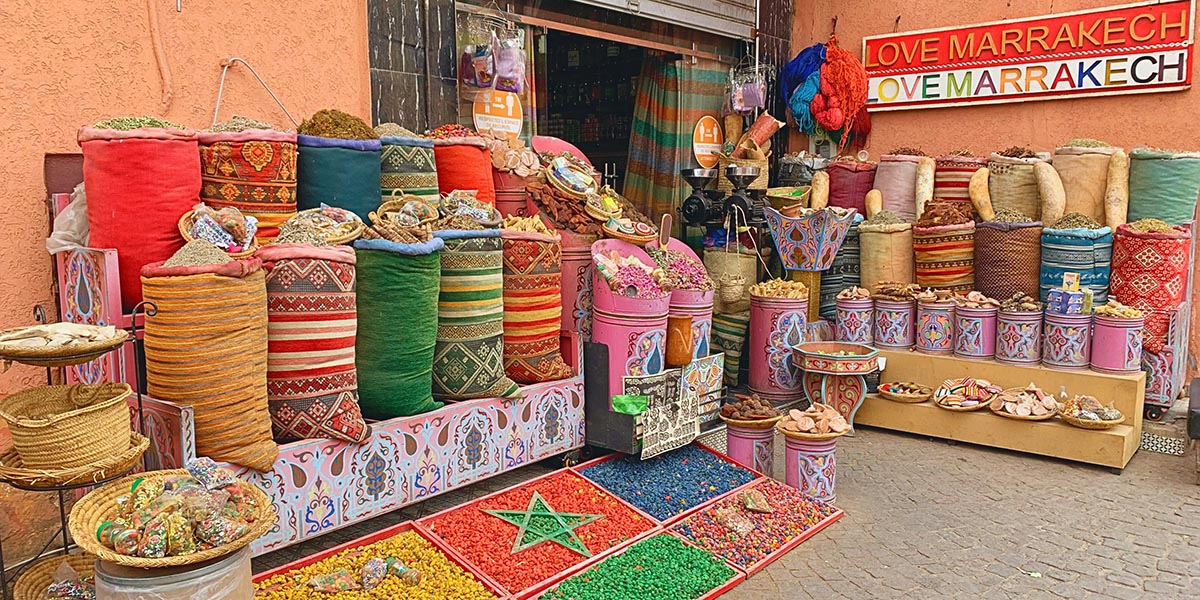
 Feeling confident we can fend for ourselves we enter the medina and are swept into the honeycomb of connecting labyrinths leading to the souks, the small stalls of vendors, organized by craft. Shafts of dusty sunlight penetrate the narrow alleyways between the stalls. Suddenly, we feel we have gone back in time to a medieval market where all our senses are stimulated: glittering trinkets and steel plates hang in doorways; the pungent aroma of exotic spices awaken our sense of smell; the sounds of voices calling, bargaining to get our attention; colorful sacks of fruit, decorative ceramic plates and vibrantly woven Berber carpets; the feel of soft leather accessories. “Speak English? Come see my goods. I give you best price!”

Upon entering the Jemaa el-Fna, an enormous terra-cotta square in the heart of the medina we are at first struck by the sounds of the snake-charmers’ pungi (a wind instrument) mesmerizing the snakes as they wind themselves around the necks and shoulders of somewhat nervous tourists. Fortune tellers, henna artists and monkey-handlers compete for the tourists’ attention and dirhams. Food stalls waft tempting odors: kebabs cooking on braziers, freshly-squeezed orange juice, just-baked breads served with zesty dips.

From the square, we make our way through the Bab Agnaou, Gate, (gate of the hornless ram) the entrance to the royal kasbah in the southern part of the medina. Here you will find the ruined palace of El Badi, and the Saadian Tombs. The ornate gate, made of ochre brick and stone surrounding its horseshoe arch, is decorated with cursive writing and floral designs. El Badi, completed in 1593, then the most opulent palace in the Islamic world, survived less than 100 years.

After the fall of the Saadians, Sultan Ismail Ibn Sharif stripped the walls of its marble, gold and onyx for use in building his new palace at Meknes. The ruins of the palace are echoed in its reflecting pool, inviting you to imagine its former glory. The tombs, walled off to conceal them, were only rediscovered during the 20th century by a French aerial photo, and have been restored to their original splendor.

We retreat to a restaurant overlooking the medina at the end of a stimulating day, to relax and reflect on all we’d experienced. Over a meal of tagine (beef stew) with olives and beef brochettes, accompanied by salad, vegetables and dessert, we look down at the street below. It is 8:00 pm and the thoroughfare is still a hub of activity: pedestrians artfully dodge each other and give way to vehicles in a perfectly-timed rhythm. Calèche drivers carry their charges home as night falls. A sad-looking donkey, head hanging low, pulls an empty cart and dusty driver behind. Motorbikes zip along, beep-beeping to warn the pedestrians, like angry buzzing bees, contributing to the street noise, muted from where we sit. From our vantage point, we also miss out on the pungent odors of Marrakech street life: horse manure, urine, exhaust fumes and food smells all blending together in this North African mélange of medieval and modern.

On our way home, we are stopped by a taxi-guide, trying to line up business for the next day. We explain we’ve been here a few days and have been through the medina. We tell him how much we are enjoying our time in Marrakech; accepting this, he wishes us well as we part ways. It is not easy to adapt to a different and sometimes difficult culture but is worth doing for a new, stimulating experience. The sights, sounds, smells and tastes of Morocco will remain with us for a long time.


If You Go:

Getting There:

Marrakech has an international airport with direct scheduled flights coming in from London, Amsterdam, Berlin and Paris and many Charter flights arriving from all over Europe. If you are flying from the US, Canada, Asia or elsewhere, you’ll have to change planes in Casablanca. The airport is only about 4 miles (15 minutes) from the city and buses as well as taxis operate throughout the day. You should set the taxi fare before you get in. The major car rental companies are represented at the airport.


3 Day Marrakech-Marrakech Desert Tour

Accommodation:

One of the most sought-after accommodations in Marrakech is a riad, a traditional Moroccan house situated in the Medina (old town). All riads have a central courtyard that will often have a fountain, restaurant or a pool. Some riads also have rooftop terraces where you can eat breakfast and look out over the city.

Marrakech has lots of luxury hotels available including the famous La Mamounia. There are also several popular chain hotels like the Le Meridien and Sofitel. These hotels are often housed in historic buildings and retain the Moroccan character and style. The most famous luxury hotel in Marrakech is La Mamounia which Winston Churchill described as “the most beautiful place in the world”.

Budget hotels are also plentiful, ranging from €45- €100 per night. Since many of the smaller budget hotels won’t have web sites or online booking facilities you should get a good guide book, like the Lonely Planet and follow their recommendations. Most budget accommodation is situated south of the Djemaa el Fna.

References:

(1) www.wikihow.com/Perform-Hajj The Hajj (pilgrimage to Mecca) is one of the five pillars of Islam, the obligations that all Muslims must uphold. Every adult Muslim (male or female) who has the physical and financial means is required to travel to Mecca to perform the Hajj once in his or her lifetime. In Mecca, Muslims from all over the world gather in a display of faith, unity, and solidarity by recreating the ritual that the Prophet Muhammad (peace and blessings of Allah be upon him) performed in his last pilgrimage.

(2) www.thespruceeats.com/eid-al-adha-in-morocco-2394819

Photograph:

Image by Piet van de Wiel from Pixabay

About the author:

Lynne Howden is a retired ESL teacher who has been interested in history, writing, travel, photography and learning about other cultures for most of her life. She and her husband live in Vancouver and have travelled to all continents, except Antarctica. You can follow her travel blog, with photos at travellingfools.blogspot.com and her photos on Flickr at www.flickr.com/photos/26058675@N02/albums.

Tagged With: marrakech, morocco tours Filed Under: Africa Travel

Alexandria, Egypt: Digging A Little Deeper

Fort Qaitbey Alexandria Egypt
by Troy Herrick

Present day Alexandria is seemingly disconnected from its ancient past. Visitors are drawn here by images of Alexander the Great, and the tempestuous romance between Cleopatra and her lovers Julius Caesar and Marc Anthony. Unfortunately, nothing related to these people remains. Alexander’s tomb has been lost to history and Cleopatra’s palace is now submerged under water somewhere offshore. Even the Pharos, one of the seven wonders of the ancient world, and the Great Library of Alexandria were destroyed.

What should a traveler explore when visiting this fascinating city? While a number of the historic sites that you can visit are above ground, you should still dig deeper. Beneath your feet, you find fleeting glimpses of a Ptolemaic-Roman city. After you have seen the light, there are also Byzantine and Mamluk-era ruins to explore above ground. Where should you begin your tour? Why not get into the spirit of adventure at the catacombs.

The Catacombs at Kom al-Shoqafa

The Catacombs at Kom al-Shoqafa, in use from the 2nd to the 4th centuries CE, were discovered in 1900 after a donkey accidentally fell through an access shaft. Fortunately, your entry will be a great deal safer. Descend the spiral staircase down to the first level in a clockwise fashion as it runs around the periphery of a 6-meter wide circular shaft. This shaft may have been used to lower mummies into the catacombs using a rope and pulley.

The rotunda is a circular chamber at the bottom of the stairwell which served as the junction for all three levels of the necropolis. At its center, a 10-meter deep shaft descends to the third level, now closed to the public due to flooding. Just look for a dome set upon 6 pillars over the shaft.

TricliniumA short distance away is the triclinium or banquet room, approximately 9 meters wide and 8.5 meters long. The dining area is defined by four square sandstone pillars. Carved platforms extend between the columns on three of the four sides. Cushions were placed on top of these platforms and the family reclined around a central table in the company of their deceased relatives.

The name Kom al-Shoqafa translates to “Mound of Shards” because of the discarded pottery fragments found over this site. The family would discard all food containers after having visited this house of the dead.

tomb exteriorReturning to the rotunda, descend the stone staircase down to the second level and the Greco-Egyptian temple-like tomb. Carved from the surrounding sandstone, the porch-like pronaos is absolutely stunning with its two columns topped with papyrus, lotus and acanthus leaves. The façade is adorned with a winged solar disc flanked by two falcons. On each side wall, behind the columns, you find a statue set within a recessed area. Presumably these were the owners of the tomb; the husband is on the right and the wife is on the left.

Pass through the doorway flanked by two serpents into the naos or burial chamber. The finely decorated burial chamber houses three sarcophagi recessed into the walls. The lids were carved so that they could not be removed. Mummies were likely inserted from behind by means of a passageway running along the exterior of the tomb.

Exit the naos and walk around to the passageway. Here you find loculi on both sides to accommodate more than 300 mummies. I examined the passageway for any possible openings into the naos sarcophagi through which mummies might have been passed, but I found nothing. When you are finished, return to the rotunda and ascend the spiral staircase back into the light of day. Your next stop is Pompey’s Pillar.

 Pompey’s Pillar

pompey's pillarSet on top of the Acropolis of Alexandria, Pompey’s Pillar is a 285-tonne column of red granite standing just over 20 meters high. Pompey’s Pillar is actually a misnomer. During the Middle Ages, Crusaders mistakenly believed that the remains of the Roman General Pompey, who was murdered in 48 BCE, had been placed in a container at the top of the column. According to an inscription at the base, this was a Roman triumphal column dedicated to Emperor Diocletian in 297 CE. Diocletian was commemorated for having saved the city from a famine. Nearby is an honor guard consisting of two granite sphinxes.

Our guide, Sherif, indicated that Pompey’s Pillar is all that remains of a colonnade that consisted of 400 columns. This colonnade was part of a Serapeum, an ancient Greek temple dedicated to the god Serapis; Serapis was represented by a sacred bull. The Serapeum, constructed in 280 BCE, remained in use until 391 CE when the early Christians thought that this cult was a lot of bull and leveled the structure. Only two underground passages remain.

 statue of SerapisThe first passageway is the Sanctuary of Serapis. Passing by an altar just outside the entrance, I entered a warm, humid tunnel roughly carved from the soft sandstone. Slowly, slowly, inch by inch, I crept along the dimly lit corridor, noting the irregularly-sized niches carved into the walls. These recesses may have accommodated statues at one time. Finally, I did not see the light at the end of the tunnel, I came face-to-face with a statue of Serapis, a large black basalt bull. This statue is a copy of the original, now housed in the Greco-Roman museum of Alexandria.

After finding your way out of the Sanctuary, enter the nearby underground gallery known as the Daughter Library. This 75-meter long tunnel with rough carved recesses in the walls was believed to house as many as 7,000 papyrus scrolls as overflow from the Great Library of Alexandria. Find your way down the finished white marble stairway and savor your connection with the Great Library of Alexandria. When you are ready, exit the Daughter Library and move on to the first above-ground site at Kom El-Dekka.

Kom El-Dekka

Kom El-DekkaKom El-Dekka (“Mound of Rubble”) is the site of a Greco-Roman residential community and various amenities. During the 1st and 2nd centuries CE, opulent homes like the Villa of the Birds occupied the area. This home is named for the seven colorful avian floor mosaics that include pigeons, peacocks, quails, parrots and flowers. There is even a panther if you look carefully. This villa has not been completely excavated but you will find traces of a triclinium. Look for the black and white mosaic floor.

What is the value of being middle or upper class without being surrounded by culture and higher education? Set inside a grassy hill, a short distance away from the villa, is the Odeion. Dating to the 2nd century CE, this theatre is believed to have been originally used for concerts rather than plays. Looking down from the side I was struck by the gleaming marble reflecting the mid-day sun.

The Odeion was badly damaged due to an earthquake in 535 CE and then reconstructed during the Byzantine period when it was transformed into a large lecture hall for a university. Perhaps this is why the structure, 33.5 meters in diameter, is shaped like a horseshoe. Looking around along the top edge of the theatre, you find 5 pillars. These are believed to have supported a roof at one time. Thirteen semi-circular tiers of seats accommodated an audience of around 600 people. The front row is carved from red granite; the others are white-gray marble.

This university also had at least 22 smaller classrooms or lecture halls. Each was approximately 5.5 X 11 square meters, with a stepped podium and at least 3 tiers of stone seats. During this period, Alexandria was a center for higher learning, so having a university would make sense. After graduating from this university, it was time to study Mamluk architecture at Fort Qaitbey.

 Fort Qaitbey

Fort Qaitbey [Pictured at top – Ed] (pronounced “kite bay”), a Mamluk fortress, was constructed in 1477 CE on the ruins of the Pharos of Alexandria. The Pharos was reduced to rubble due to earthquakes in the 11th century CE and in 1383 CE. Sultan Qaitbey incorporated some of its honey-brown limestone into the fort that bears his name.

The site, roughly 150 X 130 square meters, was protected by an inner and outer wall; the latter has been badly damaged by the sea over time. Four crenelated defensive towers along the outer wall, two of which straddle the main entrance, protect the fort from invaders. If you smile when purchasing your ticket, you might just be able to enter unopposed.

Once inside, you are standing opposite the keep at the far end of the courtyard. This crenelated rectangular keep is three stories high with cylindrical towers at each corner.

Pass through the very solid wooden door and quickly look up at the octagonal opening in the ceiling known as an “oil fall”. From here attackers were provided with a warm welcome of boiling oil. If you make it safely past this point, you are inside the mosque.

This impressive mosque features richly decorated marble mosaic floors and walls and a decorative semi-circular mihrab. A mihrab normally serves to orient the congregation toward Mecca during prayer, but not in this case. The architect was more concerned with the military functionality of the fort rather than proper worship.

This mosque has four iwans. An iwan is a rectangular gallery with walls on three sides; the fourth side is open. These were used for religious teaching.

Climb the stairs to the second floor which consists of rough-cut limestone corridors and many small rooms which possibly served as barracks. The third floor features the Sultan’s iwan. This open-air rectangular room, approximately 4 X 6 square meters, was where the Sultan could meet with visitors. Nearby are two brick ovens for baking bread. While on this floor, take the opportunity to climb one of the defensive towers to enjoy a panoramic view of the area. After completing your guard duty, exit the keep.

A short walk away, I was able to climb the crenelated outer wall, some sections of which are as much as 8 meters high and 2 meters thick. At the top, I found two cannon mounts upon which a cannon could be swiveled to any angle. With this, I focused on the Bibliotheca Alexandrina in the distance.

Bibliotheca Alexandrina

The Bibliotheca Alexandrina is a modern reconstruction the Great Library of Alexandria. Built between 1995 and 2002, this storehouse of knowledge holds over 2 million books and employs over 2000 librarians.

The exterior of the library struck me as being a giant “eye” with the curved exterior walls (eyelids) constructed of Aswan granite. The rough-hewn blocks are decorated with ancient languages. The “ocular surface” or roof consists of many glass panels all sloped towards the Mediterranean Sea.

As you walk through the courtyard running along the western periphery of the library, you are greeted by a bust of Alexander the Great. Unfortunately, I did not have time to visit the interior of the library, but I had the feeling that Alexander was directing me to go south along the Nile and learn more about Egypt. And who would dare to refuse a command like that?

 If You Go:

A private tour to Alexandria from Cairo can be part of your Egyptian vacation. I booked my complete vacation package through Egypt’s Best Day Tours.

If you travel to Alexandria independently you will require a taxi to reach the sites.

The Catcombs at Kom al-Shoqafa are located on Tawfikeya Street. Admission is 80 Egyptian Pounds.

Pompey’s Pillar is located on Amoud el Sawary Street. Admission is 80 Egyptian Pounds.

Kom El-Dekka is located on Ismail Mehanna Street. Admission is 80 Egyptian Pounds.

Fort Qaitbey is located on the end of the breakwater at the east side of the harbor. Admission is 60 Egyptian Pounds.

The Bibliotheca Alexandrina is located at 63 Shar’a Soter.


Full-Day Tour of Historical Alexandria from Cairo Egypt

About the author:

Troy Herrick, a freelance travel writer, has traveled extensively in North America, the Caribbean, Europe and parts of South America. His articles have appeared in Live Life Travel, International Living, Offbeat Travel and Travels Thru History Magazines.

Photo credits:

Diane Gagnon, a freelance photographer, has traveled extensively in North America, the Caribbean, Europe and parts of South America. Her photographs have accompanied Troy Herrick’s articles in Live Life Travel, Offbeat Travel and Travels Thru History Magazines.


Egypt Shore Excursion Alexandria Port Shore Excursion Full Day

Tagged With: Alexandria tours, Egypt travel Filed Under: Africa Travel

Zimbabwe: Riding High at Victoria Falls

Victoria Falls Zimbabwe

by Gail Meyer 

elephantThe elephant was covered with the red mud of Africa and walked with dignity into the clearing. Fortunately we weren’t aware that he was an alpha male who sometimes had a strong streak of independence and had been known to charge. Pomelo, his handler, coaxed him into a kneeling position and Edmundo and I climbed onto his back with me in the middle and Pomelo up front. Once we were comfortably seated, the beast ascended to his full height and suddenly we were on the move.

This elephant africana felt graceful to me rather than lumbering and we were riding high above the scrub where we could watch giraffe graze in the distance. A family of common warthog, with long canine teeth curled over their snouts and tails held strictly vertical, scrambled out of the way. Edmundo and I were on a day safari in Zimbabwe because I needed a holiday before embarking on a volunteer teaching position in Namibia. We had ventured to the town of Victoria Falls and being a person “who rides,” I had to ride an elephant even before visiting the largest waterfall in the world.

giraffeThe giraffes’ heads were above elephant height and I noticed their mouths turned crooked when they chewed on leaves ripped from lofty branches. They stood with an elegant giraffe aloofness, large ears and straight short horns positioned on proud heads; gold and milk chocolate geometric patterns glistening as the sun illuminated their bodies. We passed by the ugly scavenger marabou storks: black wings, unfeathered heads and necks, pink fleshy pouches under long clappering beaks and a two meter wingspan. Plains zebra babies nuzzled their mums and their bodies radiated black stripes alternating with black shadow stripes on a white background. Greater kudu, a timid antelope with curly horns on the male and prominent ears on the female, gave us a quick look. At the end of the afternoon, our rogue elephant meekly knelt down and we dismounted. Edmundo, who contrary to me is crazy about hugging animals, sat on his knee, fed him maize and molasses tidbits and then embraced his trunk in a gesture of farewell.

Pamusha Lodge had a friendly staff, a manager named Wisdom and a sweet flowery aroma in the tropical garden. A small hotel with simple rooms, I found it casual and welcoming and preferred it to the large hotels that tend to dominate well known tourist sites like Victoria Falls.

“Do you know what kind of tree that is?” I queried Edmundo, as we sipped dark brewed coffee and admired a 50 foot trunk growing through the thatched roof of the restaurant.

“Yes, he replied, it’s a teak tree. Edmundo walked over to take a closer look and came back with a one inch fat frog sitting on his hand. As I admired it from a safe distance, fat frog urinated through his fingers and we both burst out laughing.

“That frog lives in the grass roof,” our waiter Edwin remarked as he cleared away the coffee cups.

“Very cute,” responded Edmundo, gently putting frog back on a low part of the restaurant’s roof. I’ll wash my hands and we’ll swim before dinner.”

The pool felt deliciously cool in the late afternoon heat. A Southern yellow billed hornbill flew overhead. Teak tree blossoms, smelling like honey suckle, floated down from above and Edmundo tucked one into my auburn hair. A short siesta seemed appropriate.

For dinner the waiter brought a delicious grilled Zambezi River bream served with stir fried peppers, onions and carrots plus steamed rice and a spicy mango salsa. While savouring a South African pinot gris, we chatted with a guest from Australia who worked as a nurse for Doctors Without Borders. Kelly had been working in a malnutrition clinic in Nigeria where women give birth to as many as 15 offspring and there is insufficient food. Parents eat first, then the oldest children and starvation is not abnormal for the youngest. Babies were near death when their mother’s brought them to the clinic. Kelly was in Victoria Falls for a few days to de-stress from the tragedy of dying babies in Nigeria before flying home to Australia. Talking to Kelly put into perspective a harsh aspect of African life that most tourists never see. Victoria Falls itself is prosperous because of tourism, but Zimbabwe also has food shortages and extreme poverty, problems made worse under the dictatorship of Robert Mugabe. The Chinese harvest diamonds in Zimbabwe and consequently refused to vote against him at the United Nations. For those of us who love Africa, it’s essential to come to terms with the dichotomy of economics. Some black Africans live a comfortable life but most are always struggling to have a job, to feed their children, to earn enough money for school fees and basic necessities.

Victoria FallsVictoria Falls is 108m high and 1708m wide. We rented green plastic rain capes at the entrance and carried them in the rising morning heat as we walked along stone pathways to get our first glimpse. The Zambezi River, golden with silt and flowing fast because of the rainy season, plunged into the depths of a narrow gorge creating billows of misty spray. Edmundo pulled the rain cape over my head and we shared a moment of euphoria gazing at a golden waterfall descending into wild rapids. As we continued along the walkway the clouds of mist intensified and a magic rainbow appeared. Each viewpoint demanded photos and I removed the zip lock camera protector from under the rain cape and quickly snapped for memories. After completing the circular walk we sat by a shady tree to digest the extraordinary experience. Vervet monkeys frolicked around us and their babies crawled along branches and were groomed by their mothers. As the monkey families leapt from branch to branch, we observed their alert black faces, long tails with a dark-brown tip, and blue male scrotums which provided a bright splash of colour.

Edmundo, as my soul mate, had also become “a person who rides” and now it was a helicopter to experience an aerial view of the Falls. He sat under the glass nose-dome beside Spanda, the South African trained pilot. The gorge was surprisingly narrow and long and looked mystical with its glistening puffs of spray. Spanda beamed when complimented for giving us exceptional vistas. An alluring ultra-light flew lower and closer and I quietly mentioned to Edmundo that we should consider it. The powerful rain-engorged Zambezi River, which divided the countries of Zambia and Zimbabwe, dropped the 108m to the rapids below. Edmundo and I agreed that our aerial view of the Zambezi River flowing over Victoria Falls, had created twelve minutes of bliss and an absolute adrenaline rush!

“High tea” at Victoria Falls Hotel permitted us to gaze across expansive lawns to the bridge, which was surrounded by mist and another brilliant rainbow. A full teapot arrived, then a three-tiered china plate piled high with delectables: dainty sandwiches, scones, strawberry jam, cream, and cakes made with banana, chocolate and vanilla cake filled with custard.

“Jolly nice,” Edmundo said in his Argentinian accent.

“Yes, indeed,” I replied in my Canadian as we laughed in appreciation.

There was one table of black Africans in a sea of white faces. Fortunately our black waiter knew them and gave them good service. The black faces look uncomfortably nervous but were determined to enjoy the occasion. Most of the white faces pretended the black table was invisible.

tribal dancers entertainIn the evening Bob Selinger, a Rotarian from the U.S., joined our table. In his retirement, Bob spends about half the year in Africa doing good works. He was raising money to build 600 bush wheelchairs which would go to four African countries and these would be built by disadvantaged youth in the U.S. He talked about the Rotarians funding a residence for abused women in Zambia; a playground where a USAID merry-go-round could pump water; and a science lab for a Zimbabwean secondary school.

The difference between tourism dollars and what filters down to the man on the street is substantial. We paid $50 each to go to a Boma restaurant where we dined on crocodile tail, warthog, Cape buffalo and stir fried ostrich. Barefoot tribal dancers entertained us with animal themed costumes and the men’s bare torsos gleamed in the spotlight. Women danced opposite the men, sometimes confrontational, sometimes making fun, always seductive. The audience were each given a tall African drum decorated with geometric designs. We could feel the beat and participate. I stood drumming with my hands on the tonal skin and felt extraordinarily joyful.

Edmundo remarked, “You’re dancing with your drum.”

I responded, “Would you like to fly over the Falls in that ultralight tomorrow?”

If You Go:


Majestic Victoria Falls 3 Day Package

Victoria Falls Travel Guide

Victoria Falls Tourism

Guide to Victoria Falls


Half-Day Local Village Tour from Victoria Falls

About the author:

Gail Meyer’s outdoor, travel writing and photos have been published in Canadian newspapers including the Times Colonist, Calgary Herald, Edmonton Journal, and the Gulf Islands Driftwood. She worked for many years as an educational video script writer and professional photographer. Her travel experience, often with a purpose, have been extensive. She taught English in Nicaragua, Galapagos, Malta, Buenos Aires, Tunisia, and Barcelona. Sub-Sahara Africa is a passion and she volunteered in Kenya for an education non-profit, in Uganda for an HIV project and spent three months in Namibia teaching grades 4,5,6,7 and 8 Life Skills. Gail is an inquisitive traveller who strives to gain more understanding of our complex world. To keep the memories alive, she writes about her travels and enjoys sharing her adventures with others.

Photo credits:
Victoria Falls, Zimbabwe #1 by Bernard Gagnon under the Creative Commons Attribution-Share Alike 4.0 International, 3.0 Unported, 2.5 Generic, 2.0 Generic and 1.0 Generic license.
Photos #2 – 5 by Gail Meyer

Tagged With: Africa safaris, Zimbabwe travel Filed Under: Africa Travel

  • « Previous Page
  • 1
  • 2
  • 3
  • 4
  • 5
  • 6
  • …
  • 11
  • Next Page »

MORE TRAVEL STORIES:

Feliz Navidad From Isla Cozumel

Building the Future While Preserving the Past: Sustainable Construction in Historic Cities

India: Bhul Bhulayah, An Unusual Wonder

Remember The Maine

Trekking in Nepal: Why Annapurna Circuit and Langtang Valley Are the Best:

Sibenik, Croatia: A Hidden Beauty

Experiencing the Harmony of History and Modern Life in Malta

RV Adventures: Freedom, Flexibility, and Unforgettable Journeys


SEARCH

DESTINATIONS

  • Africa Travel
  • Antarctica travel
  • Asia Travel
  • Australia travel
  • Caribbean Travel
  • Central America Travel
  • Europe Travel
  • Middle East Travel
  • North America Travel
  • Oceania Travel
  • South America Travel
  • Travel History
  • Travel News
  • UK Travel
  • Uncategorized
  • World Travel
facebook
Best Travel Blogs - OnToplist.com

Copyright © 2026 Cedar Cottage Marketing | About Us | Contact | Privacy Policy | Terms & Conditions | Copyright Notice | Log in