Travel Thru History

Historical and cultural travel experiences

  • Home
  • Airfare Deals
  • Get Travel Insurance
  • Writers Guidelines

Visiting a Summer Festival Dance in Japan

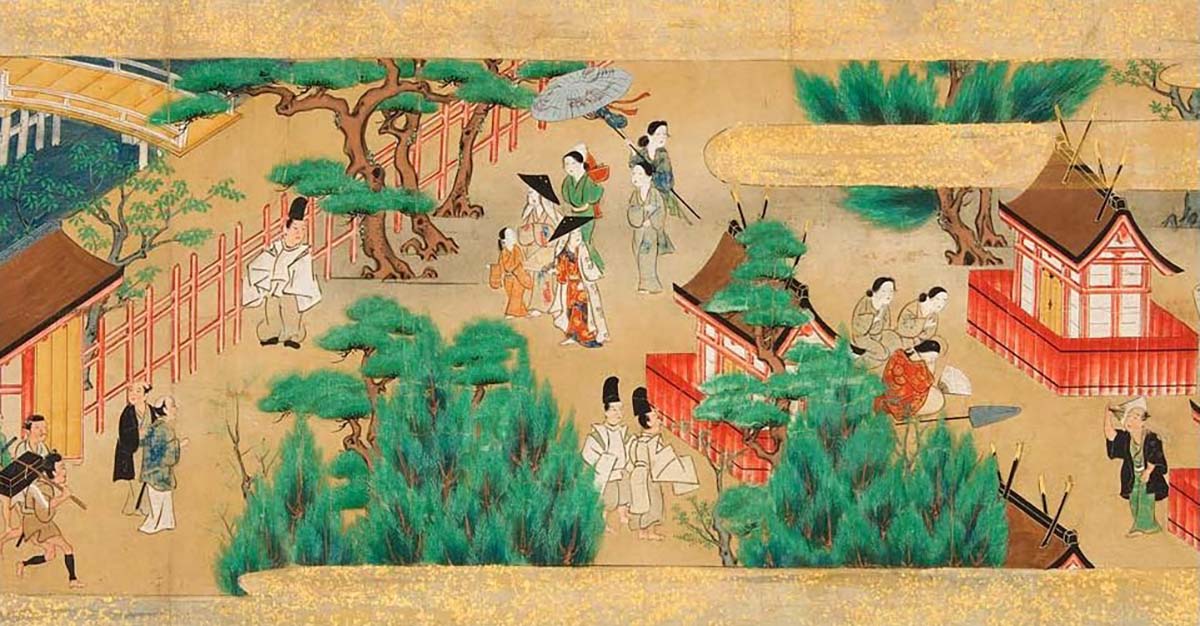
17th century painting of Sumiyoshi Shrine festival

by Jason Templer

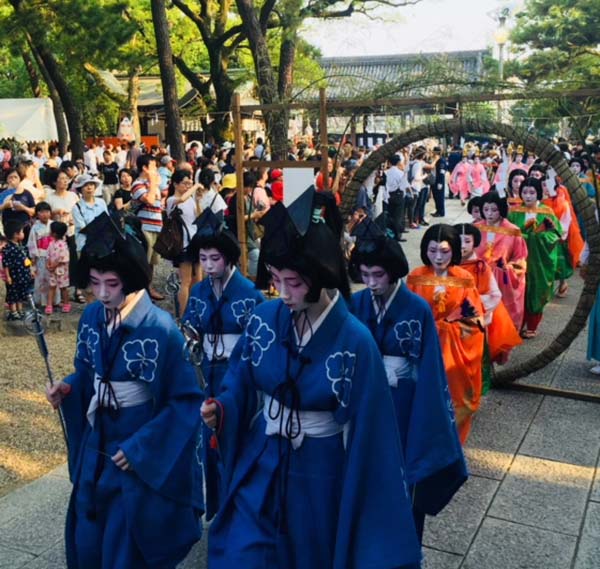
Sumiyoshi festival participantsDoe-eyed and powder-faced, the girls march in single file through a wooden hula-hoop, flourishing their Muromachi-style kimonos as camera shots fill the air like a multitudinous flutter of pigeons. Sitting down to perform the rice dance, Reiko peers back at the throng of camera-toting tourists in a wizened look of innocence, as if disapproving the vain Instagram and twitter paparazzos.

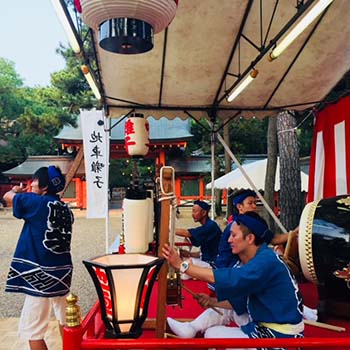
Waving straw fans, a kin-blooded group of elders appraise the ceremony with austere silence. The Osaka sun painting yellow splotches on their meditative frown lines. Bandana-headed boys pound the Taiko drums as the first group of flat-hatted girls bow deeply in a circle before Sumiyoshi shrine. Then with the syncopated rhythm of drums and woodblock strikes, they dip down into the earth with invisible plows, performing the first moves of the Sumiyoshi harvest festival dance.

It can be challenging to find active celebrants of cultural heritage in a country brimming with high-tech electro gadgets, cars, and robots – a tech junkie’s utopia. But as policemen wielding mini light sabers herd me into the siphoned viewing areas of one of Japan’s summer throwback festivals, my hopes of witnessing authentic local traditions are realized.

Donning a Spiderman hat from Osaka’s Universal Studios, I crop out the outstretched forearms of iPhones and cameras to capture photos of the anachronistic dance.

The warbling hum of seated monks on the backstage of Sumiyoshi shrine’s cypress wood floors leaves me oddly enchanted. The ceremony makes me think of old school teachers haranguing students on correct behavior; but the kids aren’t coaxed by singing lectures nor monkish divinity, they continue skipping and clapping as if never returning from playground recess.

The Shinto priests croon their incantations like a chorus of exotic birds, some of the monks whistling through bamboo flutes that give off the airy overtone of meditating in a peaceful temple garden. Wearing oversized green night gowns, thin ballooned pants, and black pouch hats, I imagine the monks are like divine parakeets, flying to the heavens in inflatable pajamas, and singing their prayers to Sumiyoshi Sanjin – one of the three deities of Shinto religion in Japan. In the dusty foreground of the shrine, the paddle-clapping girls chant and clap like playing a game of ring-around-the rosy tethered to an imaginary maypole, and keeping in perfect rhythm with the drummer boys.

No doubt the melodious effect of this quirky ensemble is blessing for a propitious harvest, one marked by youthful vitality and elderly wisdom.
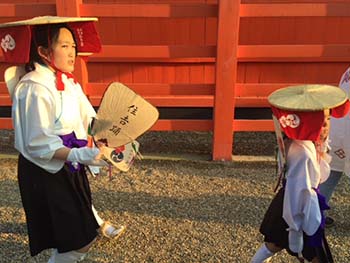
Reiki, a Japanese dancerPeace-fingering me in a yellow-flowered kimono, I meet Reiko as one of the dance performers, a high-school student from the Kansai area of Japan. “It’s fun to dance in summer with friends and family.” She says, fanning a plastic-Mickey Mouse fan over the runnels of sweat trickling down her powder-caked face.

We eat kakigori (shaved ice) in a teeming plaza of Vendors and tourists near Sumiyoshi shrine. Reiko goes on to tell me the folk legend of the harvest dance tradition, known as dengaku. Reputedly, empress Jungu, a Japanese empress from the early 3rd century AD, prepared for an invasion of Korea. The legendary queen, born from parents with mouthful-pronouncing names (Okinaganosukunenomiko and Kazurakinotakanukahime) dispatched young female rice planters to Sumiyoshi shrine to plant rice – thus to covet her war campaign as an auspicious event with divine favor. After receiving seeds from the main temple sanctuary, they walk to a sacred field. The seeds cultivated on this holy soil are given to farmers so that when the seeds sprout, the crops are harvested as magical grains of rice, believed to have power from Sumiyoshi Sanjin.

Warned by an oracle, the empress instructed the temple’s architect named Tamomi no Sukune, to enshrine the Shinto god before eventually immortalizing herself there.

Touted as one of the greatest summer festivals in Osaka city, Sumiyoshi festival is held over four days and congregates at the Sumiyoshi Grand Shrine or (Sumiyoshi Taisha). The Shinto temple garners an ancient reputation for being one of the oldest in Japan, only third to the Ise and Izumo shrines.
As a signature of its popularity, the temple brandishes a roofed hip-knob or okichigi, a samurai-crossed wooden centerpiece over five horizontal billets of timber. Without using a plethora of gaudy religious ornaments, the use of woodwork evokes a certain warrior attitude and simplistic charm – an aesthetic background for spiritual warriors like Empress jingu to meet and receive blessings for future battles.

Worshipped as the headquarters for 2,000 of Japan’s Sumiyoshi shrines, Sumiyoshi Taisha enshrines Sumiyoshi Sanjin as not only a god of harvest, but a protector of land, sea, and patron of waka, a Japanese style of poetry that implements 31 syllables in comparison to haiku’s truncated 17 syllable form. Holding her hand to hide her mirth, Reiko fails to suppress a schoolgirl giggle. “At some Sumiyoshi temples men bathe in the rice water.” According to folklore myth, a crane dropped the first seed, which sprouted as a rice-deity at Izu shrine. To honor this humble beginning, naked men climb down into the flooded farm field and jump and splash like skinny-dipping in a giant mud bath.

Sumiyoshi festival drummersOstensibly, the purpose isn’t just to create a full-monty like spectacle but to divine answers from a symbolic deity; a giant pole standing in the field, representing Sumiyoshi Sanjin, falls down at a certain side of the rice field (maybe due to the pool’s build-up of testosterone or from an all-together masculine pull) which answers fortune-telling questions for local villagers.

After a monk’s closing speech, the performers march back in procession through the city streets. “Walking through the Chinowa (a ring of straw) is good luck” says Reiko. “I want to do well on tests and go to a good university.”

She notes that the festival starts with a purification shower on Umi no hi (Sea Day July 3rd) and climaxes around the end of July known as Nagoshi Harai Shinji, where starry-eyed fortune-seekers not only duck their heads through for good luck, but to purify oneself of negative energies.

If You Go:

You can travel to the Otaue rice harvest festival on June 14th in Osaka. Please visit www.jnto.go.jp/eng/spot/festival/otauericeplanting.html

You can also attend the summer matsuri festival on Marine Day in Japan (July 16th or the third Monday of July) and from July 30th to August 1st.

The festival location is about 3 minute walk from Sumiyoshi Taisha Station on the Nankai Dentetsu line coming from Shin-Imamiya station. Or you can get off at Sumiyoshihigashi Station by taking the Nankai Koya line on the Nankai Electric Railway in Osaka city.

About the author:
Jason is an aspiring free-lance writer who has pitched his tent abroad in Czech Republic, Korea, and Japan, empowering youth and consulting foreign businesses and governments on English language skills and professional development. In his spare time, he finds time to write, energizing his synapses with quirky travel memoirs and budget-roughing misadventures, believing his endless vagabonding is on a fruitful quest for authenticity.

Image credits:

17th Century Festival at Sumiyoshi Shrine (detail), Japan, Edo period, 17th century, anonymous handscroll, ink, color and gold on paper, Honolulu Museum of Art by Unknown author / Public domain

All photos by Jason Templer, jasonw4770@yahoo.com

Tagged With: Japanese festivals, Sumiyoshi shrine, Travel Japan Filed Under: Africa Travel

Cape Town South Africa

South African Museum

Top Historical Places And Monuments You Can Visit

by William Taylor 

If you are passionate about history and about learning more about other countries’ heritage, your visit to Cape Town will offer you a lot of opportunities to explore the vibrant past of the city. You can either go on an organized tour or create your own itinerary to visit some of the exquisite historical buildings and museums of Cape Town.

The city itself is an open museum, with national parks, mountain tops and scenery that will you breathless. Table Mountain in particular, is Cape Town’s “watcher”. The view of the bustling metropolis is outstanding from the top. As for historical places, avid travelers might want to cross off the following from the list:

1. South African Museum

A good place to start is the South African Museum, which focuses on the anthropological, geological and marine life of the continent. Their collection includes thousands of objects, some of them dating 120.000 years back. You will be able to admire fascinating rock art and stone tools, traditional costumes from centuries ago and objects from the everyday life of the people living here thousands of years ago. The museum also holds animal specimens, like 700-million years insect fossils, whale skeletons and depictions of dinosaurs that once inhabited the South African plains.

2. Bo Kaap

You will be mesmerized at the sight of this neighborhood in Cape Town, as all the houses are brightly colored in contrasting shades of yellow, fuchsia, green, blue and many more, making this area a breathtaking sight and wonderful destination. The romantic cobbled stone streets date back to the 18thcentury, making Bo Kaap one of the oldest residential areas in the South African city. The residents of Bo Kaap are the descendants of slaves that were brought here by the Dutch; after their emancipation in 1795, they formed this community and settled in this incredible place of amazing historical meaning.

3. Castle of Good Hope

castle of good hopeNot only a destination for the history buffs, Castle of Good Hope is a top historical site to explore when visiting Cape Town. This is the oldest surviving building in South Africa and after its restoration in the ‘80s it is considered one of the best preserved examples of DEIC (Dutch East India Company) architecture in the world. Not only the Castle of Good Hope provides an insight on the country’s colonial past, it also hosts numerous art and photography exhibitions for the tourists and locals, being an active cultural site.

4. District Six Museum

District Six is a former residential area of Cape Town that used to be a lively community of former slaves of all ethnicities and races. In 1966, during the apartheid era, the district was declared a whites-only area and more than 60,000 of its inhabitants were forcibly removed, on the counts that it is a crime ridden district that has no chance of improvement. In 1994 the District Six museum came into being, as a reminder of the lively community that once thrived here. The museum has a map of the district depicted on its floor and several formal residents had written notes on the places where they used to live. It’s an emotional experience and it will teach you more the struggling past of this wonderful country.

5. Houses of Parliament

houses of parliamentThis impressive historic building has been the seat of the National Parliament since 1910 and it opens its gates for tourists each year when the Parliament is in session (first part of the year). Be sure to book a visit in advance if you’re traveling from another country and get informed about any closed doors events. You can admire over 4,000 artworks collected by the gallery of the House of Parliament and enjoy a walk around the premises. The guided tours are free of charge and you can also book tours for groups of up to 25 people.

If You Go:

Cape Town is outstanding from all points of view. There are lots of other monuments, museums and places of interest travelers can visit. Most of them reveal valuable information about South Africa’s culture, customs and traditions. Make sure to check out the ones above, and you’ll learn to value the places and the people of the city even more.


Cape Town City Tour: Culture and Community Projects

About the author:
William Taylor is a traveling freak who has traveled many destinations around the world. He also loves writing about his traveling experiences and the places he has explored.

All photos by William Taylor

Tagged With: cape town attractions, south africa travel Filed Under: Africa Travel

Morocco: Medinas, Minarets and Mountains

Mosque in Morocco

by Elizabeth von Pier 

Marrakech was our first stop in Morocco. Founded in 1062 and known as the “ochre city” for the color of the buildings and walls in the old Arab section, we entered the city on wide boulevards teeming with traffic, chain hotels, modern white stucco buildings and palm trees. I felt disappointed; we could have been somewhere in Florida. But then we passed through the old city walls and a park where camels were sitting in a shady grove. People strolled the streets wearing their traditional jellabiyas and “calls to prayer” were coming from loudspeakers on the minarets of the mosques. This was Morocco!

minaretWe were staying in a riad, and this one turned out to be a destination in itself. A “riad” is a traditional Moroccan house, located within the ancient medina and designed around a central courtyard, pool or fountain, and garden. The owners had purchased several adjoining houses and combined them so that there are two courtyards and 26 guest rooms, several sitting rooms, two restaurants, a jazz bar, and a spa. The hotelier gave us a tour and showed us to a lovely room which faced the pool and inner courtyard. As I stood on the balcony, I looked out over rooftops of the old city and a minaret a short distance away. Down below was a pool, trees, potted plants, tables covered with white tablecloths, pierced pendant lanterns, and lovely tile work. Each morning at dawn, we were awakened to the “call to prayer” from the mosque. A traditional afternoon tea is offered in the courtyard each day, and we enjoyed typically Moroccan mint tea served with an assortment of tiny cookies. It felt like something out of “Arabian Nights”.

Majorelle Garden Within walking distance of the riad is the Majorelle Garden, a botanical and landscape garden that was created in the 1920’s by French painter Jacques Majorelle. It is a fantastical delight and beautiful to behold. Special shades of bold cobalt blue are used in the gardens and on the buildings, walkways and pergolas, and are a stunning accent to the greens of the cacti, palm trees, bamboo, bougainvilleas, and ferns. Neglected after the painter’s death in 1962, the property was later restored by fashion designer Yves Saint-Laurent who bought the garden and used it as his residence. After he died in 2008, his ashes were scattered in the garden and a memorial was built in his honor.

At the top of our “must see” list was a visit to the old tannery that processes hides using a method that is almost one thousand years old. Hides of cows, camels, sheep and goats are soaked for three days in stone vessels containing a mixture of pigeon droppings, limestone, water and salt. The limestone helps to remove the hair and the acid in the pigeon droppings softens the hides. We watched workers standing waist high in this mixture as they removed the skins for the next step in the process, scraping away the excess hair fibers and fat. Then the hides are moved to stone vats containing dyes of many colors where they sit until they are finally ready to be placed out in the sun to dry. At this point, they are sold to the craftsmen who will make them into an assortment of leather products you can buy in the souk. The smell in the tannery was offensive and our guide Mohammed gave each of us a bouquet of mint to hold under our noses as we watched the process.

Tannery workerThe “souk” is the commercial quarter of the medina and we went there to experience the activity and to bargain for some souvenirs. Colorful stalls line the alleyways, selling everything from carpets to clothing, scarves, jewelry, leather products, olives and housewares. We were on a quest to find a decorative tagine like the ones used on our riad’s breakfast buffet for fruits, nuts and pastries. Mohammed patiently took us from stall to stall until my sister finally found one to bring back home with her. There are no set prices in the souk so she had to use her bargaining skills. It can get rather tense as the seller dramatically tells the buyer that she is “killing” him with the low price she is offering. But in the end, she prevailed and took home a beautiful tagine to use for entertaining in the Moroccan style.

We expected to engage in this type of buying and selling process in the souk. But we did not expect the tactics used on the street to capture the attention of the unsuspecting tourist. Men posing as workers in our riad who had the day off said they recognized us from the riad and shared important information about a special shop a couple of streets away. A co-conspirator “happened” to overhear the conversation and offered to show us the way. We started to follow, but then thought better of it. A sign on the wall in the riad warned about these tactics, but we had not noticed it. And to think we almost fell for it! We probably won’t see these “actors” on the big screen anytime soon, but their performance and timing was so well executed that I feel they deserve every dirham of their commissions.

TaginesThere also was an interesting specialty shop in the souk where three Berber women were laboriously extracting oil from the nuts of the argan tree to make food products and cosmetics. Argan trees are endemic to Morocco and the oil that is extracted is very precious and has many health benefits. A salesman let us sample some of their special products, and we filled our baskets with gifts for people back home. There was no bargaining here because supposedly this is the only place where the skin products are pure and the oils used for cooking are not diluted.

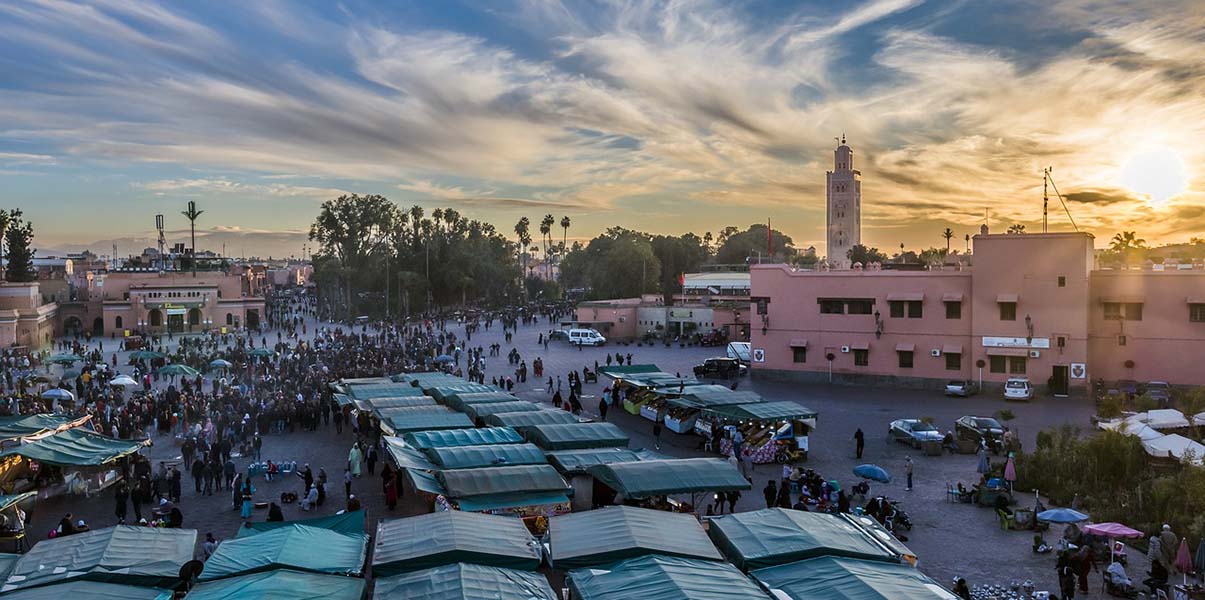
Leaving the souk, we entered the beating heart of the city, Place Jemaa El Fna, which dates from the 12th century and was designated a UNESCO world heritage site in 2001. This is a large square inside the walled city, lined with restaurants and shops and the setting for performances by snake charmers, musicians, storytellers, fortune-tellers, henna artists, monkey performers, acrobats, and transvestite dancers. It indeed is an assortment of fantastic sights and smells of Moroccan folklore. One photo here will cost you ten dirham.

Women extracting argan oilThe Koutoubia Mosque with its 254 foot high minaret is a landmark and symbol of the city. We were just outside the mosque when the “call to prayer” came from the loudspeakers above. Not far away is the Bahia Palace, a masterpiece of Moroccan architecture with its brilliant mosaics, carved woodwork and gorgeous marbles. Like most Arab palaces, it contains charming and tranquil gardens, beautiful patios and rooms richly decorated with tiles. And we visited the tombs of the Saâdi rulers which date back to the 16th century but were only discovered and restored around 1917. These tombs shelter the bodies of about 60 Saadian sultans and their families and are an outstanding example of Moorish tilework and art.

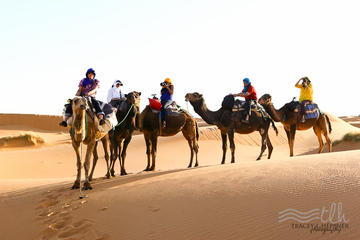
Leaving Marrakech two days later, we transferred to a four-wheel drive vehicle for our trip over the High Atlas Mountains via the Tizin Tichka Pass. Our destination was Ouarzazate, five hours away. Mohammed expertly navigated the vehicle around hairpin turns and over narrow roads that came within inches of steep drop-offs into canyons below. Besides the scenery, the sights we saw along the way are memorable. Donkeys loaded with meat, produce and wheat were led by jellabiya-clad men to village markets high in these mountains. We passed caves used by the Bedouins, nomadic tribes who live mainly in the desert but use the caves when crossing the mountains on their camels. We caught a glimpse of a road worker pausing for prayer on an outcrop of the mountain. And we saw stork nests, shepherds tending their flocks, and tiny villages made out of sandstone and hay that blend into the color of the hillsides on which they are built. No matter how small the village, there’s always a mosque with its minaret towering above everything.

Snake charmersOuarzazate, nicknamed “the door of the (Sahara) Desert”, was built as a garrison and administrative center by the French, but today it serves as the Hollywood of the Kingdom. This is where “Lawrence of Arabia”, “Jesus of Nazareth”, “Gladiator”, “Indiana Jones” and many other films were made. While it is in a lovely setting, the town itself is somewhat tacky. There are several movie studios that you can tour and new housing developments are springing up in the otherwise beautiful landscape.

There are some interesting and beautiful casbahs nearby that have also been the setting for movies. Mohammed led us through the old rooms of the Kasbah de Taourirt and the alleyways of the more famous Ait Benhaddou, both sandstone in color and very picturesque. They show how tribes lived and protected themselves in former times. The pathways into Ait Benhaddou are filled with shops and artisans working at their crafts. A woman sitting on her stoop invited us to see her home. She showed us her “old” kitchen with its bee-hive oven, her “modern” kitchen with its fifties-style sink and tile backsplash, and a small room open to the sky where the sheep were housed in very tight quarters. The living room was full of carpets that she supposedly made herself and would sell for a good price. So the tip we gave her was really for the privilege of visiting her shop. Fooled again!

Villiage in high Atlas mountainsLeaving casbah Ait Benhaddou, we drove for miles through the foothills of the mountains and the rolling sand hills of the desert and started to wonder where we could possibly be staying for the night. Hopefully not in a Bedouin tent! But when we finally came upon our riad, we drove through a large sandstone arch and entered a typical Moroccan courtyard, set in an oasis with palm trees and beautiful plantings around a central pool and fountain. You’d never expect to find a place like this here in such a remote location. But it does make sense—a Frenchman opened it to cater to the movie industry.

In order to get to Casablanca, our next and final destination, we had to drive back over the High Atlas Mountains. Casablanca is very busy and teeming with traffic but it has a beautiful new mosque. Hassan II is one of the world’s largest and it was built over six years from “contributions” made by every family in in the city. We also drove by and took photos of Rick’s Café made famous by the film “Casablanca”, and toured the medina with its maze-like streets that are almost impossible to navigate in a car. Everywhere in Casablanca, the driving was terrifying, partly because people play “chicken” as they maneuver in and out of traffic. Unfortunately for us, Mohammed was very good at playing “chicken”.

The Islamic month of Ramadan had just started and Mohammed had fasted all that day as we made the long journey from Ouarzazate. Ramadan is a time of spiritual reflection and increased devotion and worship which is observed as a month of fasting from sunrise to sunset. So early that evening, we arrived at the hotel very hungry after the long drive and had to wait until the sun set for food to be served. We were the first ones in the restaurant when the sun hit the horizon!

If You Go:

♦ Riad in Marrakech, La Maison Arabe in the Medina
♦ Riad in Ouarzazate, Riad Ksar Ighnda
♦ Hotel in Casablanca, Sofitel Tour Blanche

About the author:
Elizabeth von Pier is a retired banker and photojournalist who travels extensively throughout the world. In her retirement, she has written and published articles in travelmag.co.uk, WAVE Journey, Travel Thru History and hackwriters.com. Ms. von Pier lives in Hingham, Massachusetts.

First photo by danyloz2002 from Pixabay
All other photos are by Elizbeth von Pier:
Minaret
Majorelle Garden
Tannery worker
Tagines
Women extracting argan oil
Snake charmers in Place Jemaa El Fna
Village in High Atlas Mountains
Movie studio

Browse Morocco Tours Now Available

Tagged With: Marrakesh attractions, Morocco travel Filed Under: Africa Travel

Travel South Africa

Giraffe in South Africa

Stretch Your Canadian Dollar

by Theresa (Therri) Papp 

If you want to get the biggest bang for your buck in the declining Canadian dollar consider South Africa. I had been told to bring an empty suitcase and that would be my recommendation to travellers as well. All around, food, drink, clothing and mementos are beyond reasonably priced by Canadian standards while maintaining quality on all accounts that I experienced. If that hasn’t got your attention, then how about seeing animals that we would only see in a zoo just metres away from you. I experienced three weeks in South Africa and will share my experiences and provide some recommendations.

elephantAs you fly into Johannesburg you would expect to see the wild game from the runway. Close to the tarmac is a beautiful view of elephant grass (tall grasses) and native trees that bring memories of photos depicting Africa or the Lion King. I travelled there in August which would be the southern hemisphere winter. Well, if that is winter, it sure does not resemble the Canadian winters. Each day, whether in Johannesburg, Pretoria, Durban, or Capetown all provided an average temperature between 26 to 29C each day and sunshine over my three week adventure. South Africa winter certainly is quite manageable.

While in South Africa (SA) I experienced Sun City, Johannesburg, Pretoria, Durban, Stellenbosch and Capetown. Wherever possible, I always take advantage of the hop on, hop off experience. The price is reasonable and I get a good overview and history of the area. Notable mention would be to do the Johannesburg Soweto combo and gain an understanding of the SA history. Various historic memorials can be seen on the tour not to mention seeing Nelson Mandela and Desmond Tu Tus’ homes. Imagine two Nobel Peace prize winners hailing just blocks from each other and family still live there. If you are interested in history and wine tours to vineyards, Capetown can satisfy those needs. Wine tours are available in Stellenbosch or part of the hop on hop off ticket by selecting the Purple tour with three stop options. All wine tours are for the transportation only and tasting fees are extra.

giraffesMy first experience in SA was a 1.5 hr drive to Sun City. If you have watched the movie Blended you will have seen one of the hotels as the movie was filmed at Sun City Palace and the complex. There are four hotels on the premises ranging up to $8000 per night. Something for everyone, Players golf course, a children’s arcade, spa, casino, and high tea at 3 pm is highly recommended to see the Sun Palace hotel as that is the only access to this posh hotel.

SA is a shopper’s paradise. The SA dollar is the rand and currently our dollar has the buying power of 1 CDN to 10 Rand. For example, an item priced at R100 (100 rand) translates into $10 approximately. There are designer outlets and stores for the elite shoppers and bargains to be found. Woolworths seems to be the most popular chain store in SA along with other shopping meccas to be found. New clothing there is as inexpensive as used clothing at Value Village. Imagine buying new jeans for the equivalent to $15 and tops or pullovers starting at under $10. A very startling experience was the parking. Large malls charge for outdoor parking whereas our shopping malls are free unless underground. The first hour is free. Strip malls have “car guards” that escort you to a parking spot, greet you, and assist you in reversing out of the parking lot. All this service in return for a coin or two at your discretion. Bad parking habits are not tolerated. You are warned upon entering a parkade that if you do not park between the lines your wheels will be locked and you must pay a fine to get your wheels unlocked in addition to the parking fee. You can also get your car washed while you shop as attendants are available in the parkade.

zebrasFood is also a bargain either at the grocery store or at the restaurants. Kentucky Fried Chicken appeared to be the most popular fast food to be found in SA with Macdonald’s a close second. KFC signage is atop the illuminated street names and almost on every street corner similar to Starbucks can be found in Canada. Both KFC and MacDonald’s offer free scooter delivery service for orders. Other restaurants offer bountiful breakfasts that can be found for around $3. Restaurants are also inexpensive offering lunch specials ranging from R57 ($5.70 CDN) which includes a salad and portions that are monstrous. Bottles of wine can start at R110 and up in a restaurant and beer at R25. Evening dinner options can be a full chicken and salad for R90. That would be a feast for a big appetite or a feast and a take home feast for the lighter appetites. Don’t worry if you don’t finish that bottle of wine. You can take it home. Most places appear to be children friendly with play areas and some even have child attendants. Some restaurants offer a complete experience for children to order their own pizza and help the chef make their pizza. Children put on their own toppings while the parents can enjoy a leisurely lunch or dinner.

BuffaloDriving is an experience. Although sidewalks are a rare finding, the large dirt sections next to the road offer opportunities for vendors to set up business and cars can pull off the road to shop; SA people are very enterprising. On most traffic lighted city street corners, men can be found wandering between the lanes selling most anything: Newspapers, toys, pens, crafts, computer gadgets, but I did not see a kitchen sink. Companies and businesses also hire people to advertise at the street light corners to hand out pamphlets. It is always recommended, no matter where you may be in the world, to travel and drive with your doors locked. As anywhere, there are places that you should not venture for safety reasons. Having said that, I did not experience any adverse experiences. In SA taxi services are communal for the locals. Specific hand gestures indicate where you want to travel as the taxi vans travel the streets. People are packed 4 across and 5 deep holding over 20 people per taxi van.

A safari or multiple safaris are a must when traveling to SA. The “Big Five” are the dream citing for anyone visiting SA. The Big Five are the Rhinoceros, Buffalo, Lion, Elephant, and the Leopard that is interchanged with the Cheetah by some. I recommend going with experienced drivers or rangers. There are rules that must be followed for your safety. If you are out with a ranger and follow the rules you will have the most surreal experience of your life! To calm my nervousness, after all these are wild animals and no wild animal should be disrespected or challenged, I heeded the rules. The animals view the jeep as one unit and do not see the numerous people sitting in the open. Do not leave the jeep, no sudden movements, no loud noises, no leaning or extending outside the jeep. The rangers are well trained and know the area well and know the animals. The rhino, buffalo and elephant are not predators but herbivories but can get upset if you enter their space or separate their herd. Once winter sets in on the game reserves, there is no fresh food or greenery to feed the animals and the reserves feed the animals large bails of grasses to sustain them through the winter. At one reserve they were feeding the animals since April. One can only imagine how much an elephant or rhino can eat every day!

Mabalingwe was my first experience in a wild game reserve. This is under two hours from Pretoria. Your first view of a kudu, impala or warthog is exhilarating and you can’t get your camera poised fast enough. After a while the appetite for photographing new wild game gets more and more intriguing. The first 24 hours I had sited and photographed 14 different wild African animals in their natural environment. This included the ostrich, impala, kudu, baboon, warthog, bandit mongoose, giraffe, zebra, hippopotamus, crocodile, hyrax, duiker, hyala, and jackal. Patience is a virtue and wild animals do not pose or come out from behind the brushes. They do, however, need water and that is a good place to see many different animals. The best time of the day to find animals is the early morning and closer to the end of the day. Even in winter, midday is too warm for the animals and they siesta until closer to the end of day. Our morning safari were as early as 6 am and the sunset safari started at 3 pm as it becomes dark around 6 pm.

The next safari experience was at Tshukudu. This was a phenomenal experience. This is a family run private game reserve that borders Kruger National Park and was started in 1980. Other people that have opted for the “do-it-yourself” drive through Kruger reported not much success of spotting all or any of the “Big Five” and some reported far distance viewing. This lodge offers nearly all-inclusive accommodations and an experience of a lifetime. There is no “roughing” it at the lodge, but camping experiences are available. The rooms are a generous size and mine had a deck to enjoy the outdoor experience along with a refreshment and a view that would include wild animals virtually at your back door. Also included was a hearty breakfast buffet with many choices and diversity each day, lunch buffet, high tea before the sunset drive, and an evening dinner buffet. Each day included a morning drive and walk as well as a sunset drive. That is a lot of value in my opinion for top rate service! I paid $200 CDN per night which included a single supplement. Shared double occupancy room for two was around $300 per night. Prices may vary due to season and other factors as it does everywhere. Four meals, two drives and complimentary wi-fi – what more could you ask for? You are allowed to bring your own wine to dinner or you can purchase your choices from the bar. Yes, I also saw all the Big Five within 24 hours of arriving. Three of them were seen from the deck within the first few hours of arriving while enjoying a refreshment and the animals were just metres away! Imagine buffalo walking by your cabin followed by two rhino walking off into the sunset. The elephant walked by when it was dark but the lights illuminated the animals. A photographer’s dream come true.

I am returning to Canada with the most amazing memories, spectacular photographs to capture those memories and treasures to share of my experiences that will last me a lifetime. I had been warned and arrived with uncertainty about the safety of South Africa. My experiences can only say that there are unsettling and unsafe places in any town or city and travelers always need to exercise caution. My travels to SA has been an experience of a lifetime.

If You Go:

♦ I typically plan to travel well in advance (approximately a year) and take full advantage of Aeroplan points or Air Miles. That certainly cuts down on expenses.

♦ I always travel with an additional folding bag in my luggage, just in case I find some real bargains.

♦ There are no entry or exit requirements for Canadian travellers. A passport that is valid 30 days after departure is a typical requirement for any country that you visit outside of Canada.

♦ I did not get any additional vaccinations or boosters to routine vaccinations. Most travellers should have a hepatitis A/B vaccine and you may consider a Yellow

♦ Fever vaccination is you plan to venture to other parts of Africa. Check with your health professional before you leave for their recommendations.

♦ These are the websites of the places that I visited:

– Sun City South Africa

– Tshukudu Game Lodge

– Mabalingwe Nature Reserve

– City Sightseeing Cape Town (Save your ticket stubs from the City Sightseeing tours and you will get a discount on your next booked tour.)


South Africa 14-Day Tour from Johannesburg


About the author:
Therri is an educator, researcher, photographer and writer that enjoys travelling with or without a travel companion. She is a Ph.D. candidate and has contributed articles to newspapers, journals and books. Therri lives in Saskatoon, SK and awaits her next travel adventure.

Photo Credits:
Giraffe by Kelly Arnold on Unsplash
All other photos taken by Theresa (Therri) Papp


Tagged With: south africa travel Filed Under: Africa Travel

The Walled Medina Of Fes: A Stroll Through The Middle Ages

Fes, Morocco street

Fes El Bali, Morocco

by Rick Neal 

Narrow street in Fes, Morocco“Balak!”

A stout man shrieks this single word as he slams me against a stone wall. Before I can react a donkey cart laden with white pomegranates whooshes by, missing me by centimeters. As I catch my breath, I guess that balak must mean something like “Look out!”

I’m in Fes El Bali, Morocco, or the medina as it’s more commonly known. My tour group and I have entered through Bab Boujeloud (The Blue Gate), one of fourteen gates that lead into the old city. Swarms of people haggle over tables of leatherwork and silverware inside the horseshoe-shaped entranceway. This is one of the few open areas we’ll encounter today. Steps away an endless maze of slender roads and enticing alleyways will carry us back in time.

Tracing its origins to the 9th Century, the medina is a winding labyrinth of over 9,000 cobblestone alleys, some of which are barely wide enough for two people to pass. The ancient walled city occupies 540 acres and comprises 187 quartiers, each of which contains a mosque, Koranic school, fountain, and a hammam, a traditional bath house. In spite of the recent appearance of satellite dishes and the tourist invasion its 150,000 inhabitants pretty much live as they have for centuries. This is the Morocco of one’s dreams, a place of teeming souks, tantalizing odours, and venerable mosques, a place where the Middle Ages are alive and well.

Fes street signsWe amble down Talaa Kebira, one of the medina’s principal roadways, and soon come to Bou Inania Medersa. This is the most awe-inspiring Koranic school in Fes, and one of the few open to the public. Every room has lofty, sumptuously detailed ceilings with carved cedar beams and stunning onyx marble floors. The walls are covered with handcrafted tiles adorned with dazzling gold and turquoise geometric motifs. Intricate lime-coloured geometrical designs are also on display in the courtyard, where the 14th Century fountain still gushes today. In a corner an imam, a priest, kneels and chants verses from the Koran.

Back on Kebira we continue past mosques, hammams, and fundouks, medieval merchants’ stalls arranged around a central courtyard with overhead sleeping quarters. A myriad of single vendor stalls hawk everything from carpets to herbal remedies, from fake Rolexes to babouches, traditional leather slippers often yellow-coloured and usually with pointy toes. A wrinkled woman crouches by the roadside and sells nougat and bunches of fresh mint from a blanket. A smiling elderly man in a jellaba, a traditional men’s robe, tries to lure me into his antique store with promises of “the best prices in all of Morocco.” In one square, men hammer copper and brass cookware beneath the shade of a sprawling tree as American rap music blares out of a nearby radio.

The medina, FesAs we descend further into the bowels of the medina, our guide urges us to stay close together. She doesn’t have to tell me twice. I would love nothing better than to wander the zigzag of avenues on my own, but finding my way out would be nothing short of a miracle. I’m told that even the best maps are unreliable. The streets are swarming with humanity today; the thrum of voices is omnipresent. Since none of the roads are wide enough for cars to navigate, donkey carts and scooters are the accepted modes of transport, making this the world’s largest urban car-free zone.

Our next stop is one of the medina’s many hidden treasures. In a tranquil square a Henna Souk is shaded by two graceful plane trees. Vendors sell dyes, hennas, and henna leaves from tiny stalls. Moroccan women decorate their bodies with henna tattoos to bring good luck and ward off the evil eye. The night before her marriage a bride is adorned with henna tattoos, a rite of passage that symbolizes her transition from a girl into a woman.

Ceramic shops offer a stunning array of Fassi pottery. The clay stoneware vessels produced here are the most highly prized in the country. Shaped by hand and set in the sun to dry, the pots are then painted with fine horsehair brushes in a multitude of designs and colours.

Cosmetic stalls are the perfect place to pick up rose-oil face cream and argan oil soaps, inexpensive items here in Morocco. A gap-toothed man offers me some khoudenjal, a mixture of spices whose main ingredient is galangal, a medicinal plant closely related to ginger. “Khoudenjal will make you strong, my friend,” he grins, “we call it Moroccan Viagra.” I’m not sure if I should be insulted, but I simply reply “La, Shukran” – no, thank you – and continue on my way.

Around the corner we stumble upon the spice sellers of the Souk Attarine, reputedly the busiest souk in Fes. Tables overflow with richly coloured mountains of fragrant saffron, aromatic cumin, pungent paprika, and spicy cinnamon. There are also mouth-watering mounds of black, green, and red olives that just beg to be devoured.

Man on street, FesFrom the Souk Attarine our odyssey continues. Blind alleys that seem to lead nowhere open onto swarming fundouks with gurgling fountains. We pass countless vendors that hawk candles, wood carvings, jewelry, and fresh herbs from shops hardly bigger than a closet. A posse of young boys plays a boisterous game of soccer with two rocks serving as goalposts. The frenetic energy of it all is exhilarating.

Our next stop is one of Morocco’s largest and most important cultural monuments, the Karaouiyine Mosque and University. The university, founded in 859, is recognized as the world’s oldest and still functions as an important school of religious learning and physical sciences. With space inside for 20,000 worshippers, the mosque is the country’s second largest, but it’s so tightly wedged between the surrounding shops and homes that one could easily pass by and not even realize that it’s there.

Like most mosques in Morocco, infidels are not permitted to enter, though no one seems to object as we peer into the courtyard from the street. The floor is covered in multi-hued diamond-shaped tiles, while a series of gigantic doorways lead to the main prayer area which is hidden from view. Two lanky bearded men wash their feet in a fountain before entering to pray.

Open-air tanneriesThere is one last stop on our schedule, and we don’t need a map to find it. The rank stench of the open air leather tanneries serves as a guidepost to one of Fes’ most famous attractions. We’re led up a staircase to a leather shop that opens onto a terrace where we view the tanneries below.

Dozens of workers dip animal hides into a giant honeycomb of vats that contain white, yellow, and red softening solutions and dyes. The ingredients, unchanged since the Middle Ages, include salt, lime, cow urine, pigeon excrement, henna, poppy flowers, and pomegranate powder. The dyers wade through it all in shorts and bare feet no matter what the weather. Many are crippled by rheumatism by the time they reach forty.

After we pick up some leather ware, we head back to our hotel in Nouveau Ville, the city’s newest district. However, we’re not done with the medina just yet. That night we head back there for dinner, this time clutching flashlights as we negotiate an endless series of narrow warrens and rickety stairways before we locate the Restaurant Dar Hatim. The dimly-lit exterior looks a bit dubious, but the moment I step inside I know this was a good decision.

We’re seated on plush cushions around hand-carved wooden hexagon-shaped tables. The high ceiling is covered in gorgeous inlaid wood painted in shades of emerald, burgundy, and cobalt. It feels like we’re dining in someone’s home, and with good reason. A couple of years ago owners Fouad and Karima turned their sitting room and courtyard into a restaurant. They don’t have a liquor license, but they have no objections when we bring out cheap bottles of Moroccan wine that we bought at the supermarket.

After a round of appetizers that includes olives, kefta, and stuffed pastries called briouats, we feast on delicious Lamb Tagine. One of Morocco’s signature dishes, the casserole is baked in a conical-shaped dish along with apricots and vegetables.

Hours later we thank our genial hosts and return to our hotel completely satiated, slightly intoxicated, and truly grateful for an extraordinary day that none of us will ever forget.


7-Night Morocco Imperial Cities Private Tour from Fez

If You Go:

GETTING THERE

Royal Air Maroc offers daily flights to Fes airport from Casablanca, London and Paris. Ryanair offers non-daily flights from several other European cities. The airport is about 15 km. from the city center. A taxi into town will cost about 150 Dirhams (US$15). If you’re not packing a lot of luggage, a #16 local bus only costs 50 cents.

The train station is at the northern tip of the Ville-Nouvelle, the modern area of Fes. Trains run every day to and from Casablanca (4 hours 165 Dirhams), Marrakech (7.5 hours 295 Dirhams), Rabat (3 hours 105 Dirhams), and Tangier (4.5 hours 155 Dirhams). Prices quoted are for first class compartments.

WHERE TO EAT

There are endless dining options in the medina. Street food near the Bab Boujeloud gate is delicious, usually safe and less than half the price of restaurant food. Many restaurants cater to tourists and tend to be a tad pricey. The cosy Café Medina serves up tasty Moroccan fare though it can get crowded. Try the Boricuas – deep-fried strips of dough wrapped around meat and veggie fillings. Mains start around 50 Dh.

WHERE TO STAY

The New City is a fair distance from the medina so most visitors prefer to stay in Fes El Bali. Dar Adam Fez offers a convenient medina location, clean budget rooms, rooftop terrace, and free wifi from only 240 Dh per night. Riad Verus has beautifully restored rooms with original mosaic tiles and inlaid cedar motifs, as well as panoramic medina views from their rooftop terrace. Staff are extremely helpful. Rates start around 400 Dh. There are a number of riads (guest houses) in the medina that offer boutique hotel luxury for about half of what North American properties charge. Expect to pay at least 1000 Dh. Most hotels will also arrange medina tours and even trips to the local hammam.

About the author:
Rick’s travel career began as a college student when he impulsively signed up for an international student exchange program and spent that summer working in Turkey. “Don’t go there!” the naysayers said, “it’s not safe!” Luckily, Rick ignored their advice and discovered that the outside world is a place of wonder worth exploring. Since then his wanderlust has taken him to Central and South America, England, Vietnam, Morocco, and China, where he spent an unforgettable year teaching English. Rick makes his home in Vancouver, Canada, where he writes for various travel publications.

Photo credits:
First photo by Vince Gx on Unsplash
All other photos by Rick Neal.


Tagged With: Fes attractions, Fez tours, Morocco travel Filed Under: Africa Travel

  • « Previous Page
  • 1
  • …
  • 3
  • 4
  • 5
  • 6
  • 7
  • …
  • 11
  • Next Page »

MORE TRAVEL STORIES:

The Badass Days of Sidney, Nebraska

England: A Day In Oxford

Why Mountain Getaways Are Perfect for Family Adventures

Hidden Gems of Bali: Kuber ATV & Tunnel Waterfall Ride

Bali’s Trend from Budget to Luxury Resorts

Family-Friendly Fun in Sydney

Loire Valley: Chateaux and Croissants

Australia: Mutineers and Sea Serpents – Lord Howe Island, Oceania


SEARCH

DESTINATIONS

  • Africa Travel
  • Antarctica travel
  • Asia Travel
  • Australia travel
  • Caribbean Travel
  • Central America Travel
  • Europe Travel
  • Middle East Travel
  • North America Travel
  • Oceania Travel
  • South America Travel
  • Travel History
  • Travel News
  • UK Travel
  • Uncategorized
  • World Travel
facebook
Best Travel Blogs - OnToplist.com

Copyright © 2026 Cedar Cottage Marketing | About Us | Contact | Privacy Policy | Terms & Conditions | Copyright Notice | Log in