
by Chen Yiying (Rosalind)
Hello, my name is Yiying, but my English name is Rosalind. I took up the former name because many people refer to me as a ‘rose’ or like a certain delicate flower.
But more important than that, I want to talk today with all of you about my hometown. The most beautiful place on earth, Chaozhou. A special place in Southern China that’s like heaven to me. And why is it special?
Because it’s a city all my own and moreover, I want to talk about our traditional ‘beef ball’. Friends, you can’t beat it!
The shape of it is not only circular, and most importantly, people make this recipe in a very a slow way. It’s a tiresome motion.
However, this dish cannot be prepared too fast. It needs the art of perfection.
First, you need to put the beef in a basin after marinating and making it into the shape of a big ball! Get the image, right! Then, with a rolling pin you beat it. Those experts who make it, have to do this for three-whole hours, wow!


Finally, we can talk about the third and most important dish. Do you know? Yes, it is fruit, of course. The Chaozhou mandarin orange is too special. This particular mandarin orange is too small, but at the same time, tactile in its feel. It’s concave-convex. The skin is so thin and it’s full of natural sweetness, making it almost syrupy and with great zest.
Chaozhou is the perfect place for me and it can be for you. Just take a trip and you’ll enjoy our gorgeous environment. Then the foods, which you all can already try three different foods and delicacies, etc. But not only that, it’s the place itself. Full of love, food, the environment, ceramics/pottery and most importantly, its people. All of them are almost perfect. I’m sure that you’ll indulge in it for the first time and I guarantee, it won’t be your last!
If You Go:


About the author:
Rosalind is a 15-year old young lady and native from Chaozhou, Guangdong. Her target is to study in the EHL (Switzerland), that’s the university of her dreams. About her hometown, she expresses, “I want to say, I love it! There are hundreds of foods here and the places are also beautiful and famous. Chaozhou has a great tradition for people, food and those who come here fall in love with it!”

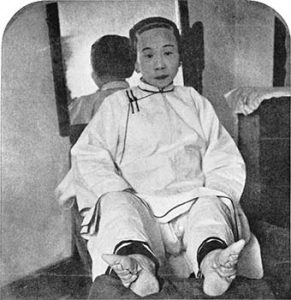 Before the modern era, young Chinese girls from wealthy families would have had their feet bound. When a girl was about four years old, a professional footbinder would break her tender foot bones, turn her four small toes under the soles of her feet, and bandage them tightly. As the child grew and developed, her instep would be virtually bent in two, and the growth of her deformed and tightly bandaged feet would remain stunted. As a fully grown woman, she would be forever destined to walk painfully on the tiny, four inch long “lotus feet” or “lily feet” which were considered the ultimate standard of feminine beauty.
 Yingtai fell in love with Shanbo and tried to share her feelings with him. At first, she tried subtle hints, but without success. Totally focussed on his studies and completely unaware that Yingtai was a girl, Shanbo did not pick up on any of her clues. When the two of them were walking by the lake, Yingtai pointed to a pair of mandarin ducks swimming nearby, pointing out that these lovely little ducks, who the Chinese believe mate for life, were symbols of a loving and faithful marriage. But Shanbo still did not understand what she was trying to tell him.
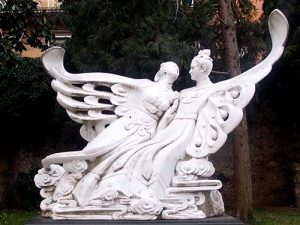 On the day of her wedding, Yingtai dressed in her bridal gown and climbed into the litter which was to carry her to her new home. A storm forced the wedding party to stop for shelter near the spot where Shinbo was buried. Yingtai climbed out of her litter and ran over to her true love’s grave. Magically, the tomb opened up and Yingtai leaped in and disappeared. Finally, the storm ceased, the sun came out and the wedding party went to investigate. They found no sign of Yingtai. Instead, they saw a pair of butterflies flying away together. It is said that these were the souls of Liang Shanbo and Zhu Yingtai, finally united in death.













 About the author

 It is about 37 degrees out. When the wind blows, it feels like standing in front of an open oven. A few team mates stand with me while we wait for everyone to arrive. The monks in their priestly maroon and gold garments congregate, drinking chai out of tiny clay cups, silently watching us. I wonder what they are thinking; if they are listening, whether or not they understand English.

 Even the hotel we decide to stay in has massive cracks in the walls. Some of the guys scout out opportunities and we find out that there’s a doctor who runs a children’s hospital here who is in desperate need of help. She needs volunteers to help her move the makeshift hospital from one set of tents to another location farther away so they can blow up the old building and rebuild. She has already set the date and scheduled the “blast-man.” A team of volunteers was set to come help her out but they cancelled at the last minute. Two other girls and I are sent to prepare the area for the new tents. We sweep up cow dung and level the sand as best we can with our brooms. There is a cow wandering around the site. First we make sure no one’s looking, then we shoo it away.

 If You Go:





 If You Go: