by Martin Kafer
“Oh no! we are stuck!” Esther cries in dismay. The Land Rover, driven by a quiet native man, is mired down deeply. We are on the way to the trailhead for a mountain trek to view the Mulu Pinnacles and now we are stopped in a huge muddy section of the narrow, tree lined jungle track that follows the shore of the Menilau River. The driver tries to pull his way out forward and backward without any luck and, in desperation, finally commands with a shout: “Everybody out and walk along the track!”
Everybody means our local guide Sham and the two of us, my wife and myself. With the vehicle emptied of passengers he is able to get the mud-spattered car onto solid ground, hurray! We can get back in again and then are bumped for about another hour’s slow ride closer to today’s final destination, camp #5 in Gunung Mulu Park. But then suddenly the driver stops again just before we hit a second, larger and impassable looking mucky bit. We are shooed out of the car, there is no choice now, and we have to continue on foot. Sham shoulders his large bundle and we both put on our daypacks, grab our hiking poles, and I strap on my camera bag last.
Our young, good looking native guide, Sham, whose services we had arranged two days earlier at a travel office in the town of Miri on Borneo’s Northwest coast, has joined us at the Royal Mulu Resort. This luxury lodge has two larger service buildings and quite a few smaller guest bungalows, all built from local wood and set on an elevated, snake-proofed platform. For guests the access is by small plane from Miri to the nearby gravel airstrip carved out of the forest along the Menilau River, it is the only way for tourists to get to this remote, fantasy vacation place.


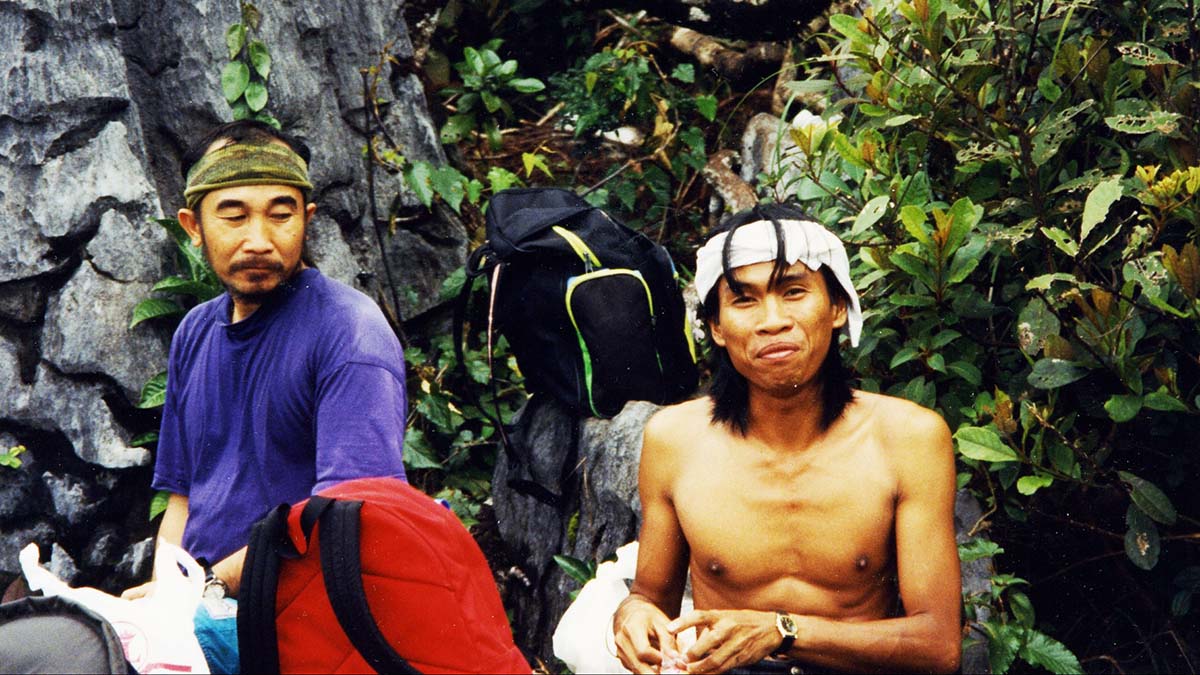
On the morning of the trek Sham came to the door of our bungalow and immediately offered an effusive greeting in his stilted English and right after he added with a smile: “This is only my second guiding trip, I hope you are both happy at the end!” On our three-day wilderness hiking trip he will have to carry the heavy stuff, including food and cooking gear, all in a large woven bamboo basket with ridiculous shoulder straps made from string. When we pitied him he laughed: “No sweat, I am used to it!”
A short twenty-minute walk along the muddy track from where we were so unceremoniously dropped off, Sham stops suddenly. He points at the unfriendly looking, fast flowing and oily green Menilau river and says: “Here is the place where we have to cross!”
There is only one option to get to the other shore, we have to wade with boots off and pants rolled way up. Esther ties the bootlaces and hangs the boots from her neck and puts rubber sandals on, Sham and I do the same to our boots and the two of us go barefoot. The bottom is sandy, the water is quite warm, the current is very strong and the waves reach part way up my thighs. By walking side by side with Sham in the middle and all three of us holding onto our hiking poles as a steadying brace, we manage to reach the far side without stumbling or getting too wet.
Safely back on solid ground on the other shore we begin the hike in the big trees of the park, a wonderful contrast to the road side of the river outside of the park, which has been extensively logged. We follow a flat trail with lots of shade – even the hot humid air feels good. We hear lots of birds sing and some frogs, but are unable to spot anything moving in the dense forest as we are trekking along slowly through heavy underbrush, still wet from the previous days rain. Further along the rough trail we easily cross two small fast running side creeks on stepping stones. After about three hours of steady hiking we arrive at camp #5: a shabby looking duo of wooden huts huddled in the narrow Menilau river canyon under the steep limestone cliffs of Gunung Mulu. There is just enough daylight left so the two of us can have a quick swim in a calm pool adjoining the river while Sham is brewing tea at the hut. We just make it back safely by about six when darkness falls like a curtain and a tropical downpour starts with a thunderous drumming on the sheet metal roof.
To our and Sham’s dismay the sleeping mats and blankets, supposedly always stored in the huts, as we had been assured by him, are nowhere to be found. The two long nights we spend on the bare wooden boards with pack sacks as pillows and some spare clothes as mattresses turn out to be ordeals – bruised hips, mostly sleepless nights with only short naps to relieve the misery. This is especially ironic since we spent the previous two nights in the lap of luxury at the five star Royal Mulu Resort.


Morning cannot come too soon for us, luckily the sun is out, as Sham had predicted in the evening. After a quick breakfast, we set off in the early heat of the new day with Sham leading the way. The fourth member of the party is a park ranger, who has somehow appeared out of nowhere and volunteers to come with us. The trail soon steepens with roots, limestone boulders, long steps in slippery dirt and often thorny tree branches in the way.
We stop a few times for a rest, a drink of water and some dried fruit. The hike is on a narrow, but well marked trail straight up the steep mountain side, which is festooned with lush vegetation – trees, roots, giant ferns, bushes, rocks, dirt, hat grabbers and eye pokers. The sweat pours off me and I am soaked through. It is a relentless climb until we come to a flatter area, where there are many deep and dark pits in the karst limestone. The smaller ones we have to jump across, but the larger ones have been bridged with slippery planks or metal beams. It is quite a balancing act to cross on one or two narrow girders without railings over the gaping black holes: fortunately, we get a helping hand from our guide and the ranger, one at each edge.
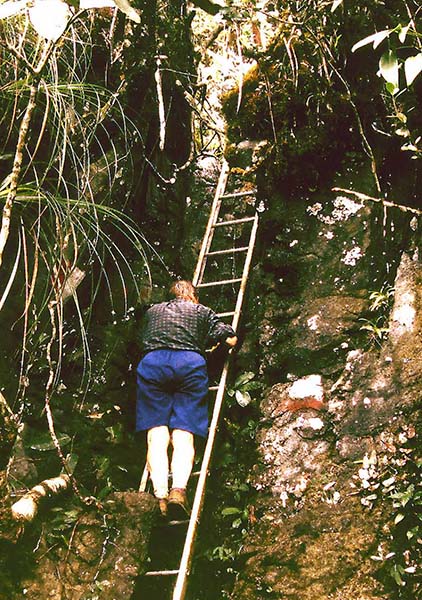 To make the trip more exciting we have to climb aluminium ladders for many steep or vertical rock sections. A total of fifteen ladders, Sham tells us, since he was a member of the trail crew that installed them. This trek turns out to be quite a workout for the old legs and arms. The hiking poles are life savers even if they are sometimes in the way, dangling from our wrists, as we scramble up the many ladders.
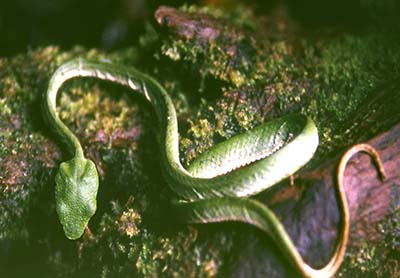 I have just reached the top rung of another steep ladder leading to a wide, rocky platform when I come face to face with a snake coiled on a boulder, staring at me. “Watch out! a snake here, it’s a green one!” I shout as a warning to Esther who is climbing on the ladder just below me. “It’s only a small pit viper!” is Sham’s reassuring cry. I am lucky enough to have the camera ready, the little creature must be scared because it stays absolutely motionless while I quickly take a shot.
Finally, after nearly four hours of strenuous ascent we reach our goal, the Pinnacles view spot, congratulations all around, we made it, picture time! The panorama of the many sheer limestone pinnacles we can see across the deep canyon is very impressive, especially with the late morning mists drifting around the top of the steep, pyramid shaped rock towers. It’s a unique and once in a life time experience and to me, worth all the drudge and toil of the climb.
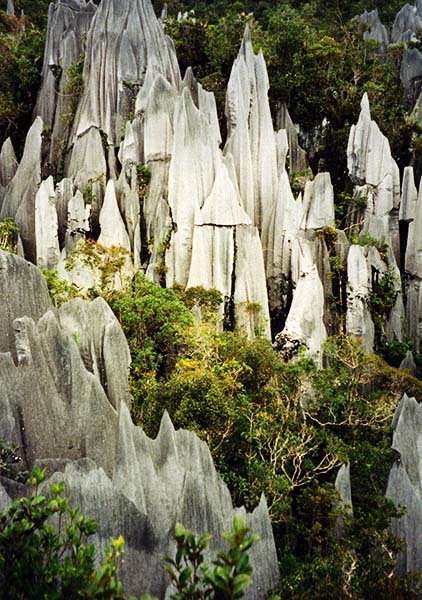 Within less than half an hour the view of the fantastic limestone “forest” is obscured by the lowering clouds. As a consolation, we have a nice lunch and a good rest with leisure to admire the beautiful red throated pitcher plants growing profusely on the inside edge of the platform and nearby a small garden of white Impatiens flowers.
The trek down to camp #5, the second painful night on the boards and the long hike out to the river in heavy tropical rainfall are a bit of a blur, but we certainly remember being pounded by a continuous downpour in the lush forest undergrowth. This day provides us with our first unpleasant and messy encounter with blood sucking leeches which Sham tells us should just be ripped out of the skin, since the bleeding will clean out the “poison”! This procedure was especially painful for Esther who, at the end of the trip, discovered that two leeches had fastened themselves near her private parts!
On the other hand, the heavy rains turn out to be very helpful, since the resort’s boatman can use the swollen Menilau river to navigate his large motorized dugout right to the spot where we had to ford on foot two days ago. We are quite pleased when he arrives with a smile, serves up a nice picnic lunch and then takes us in the boat along the flooding river quickly right back to the Royal Mulu hotel and airstrip, no complaints from us about a shorter, smoother and more comfortable return trip.
That same afternoon we fly back to Miri and on to Kuching for more Borneo adventures.


If You Go:
The most important probably is to make early reservations for the expensive, fly-in (from Miri) accommodation and the obligatory local guide, the jungle hike is quite remote and may-be difficult to arrange. The other three factors for a successful hike are: you have to be physically fit, be prepared for hot and exhausting bush travel and put up with the bugs etc. while enjoying a unique adventure.
About the author:
Martin, who recently celebrated his 90th birthday with a day’s downhill skiing at BC’s Whistler Mountain, was born in Switzerland, has been a mountaineer and ski enthusiast since he was nine years old and a travel adventure seeker since his early twenties. He has, together with his wife Esther climbed over five hundred mountains, including the Matterhorn on their honeymoon. They did many of their climbs during their extensive travels which has taken them to more than sixty countries on five continents during their more than sixty years of marriage. Writing his book of memoirs has been a more recent, but hopefully also successful endeavour.
All photos by Martin Kafer
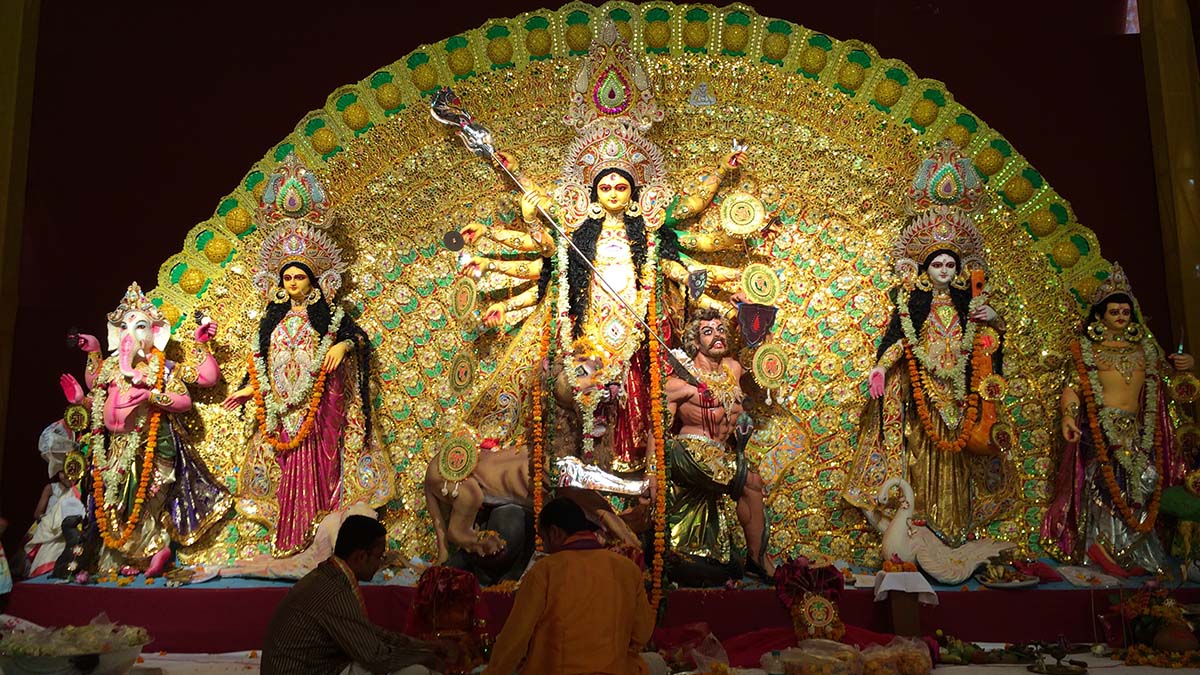


 Curiously, from the 1930s an early morning radio program has become synonymous with Mahalaya. This audio program known as “Mahishasur Mardini” or “The Destruction of Mahishasur” is a compilation of chants, devotional songs and recitations from “Chandi Mangala Kavya”, a holy scripture that can be translated as “The Auspicious Poetry of Chandi”, where Chandi is a namesake of Durga. These poems are a hallmark of medieval Bengali Hindu literature that eulogizes the worship of a particular god or goddess. Mahishasur Mardini was recorded by All India Radio and is narrated by Birendra Krishna Bhadra who, because of this recording is an iconic name in all Hindu Bengali households.
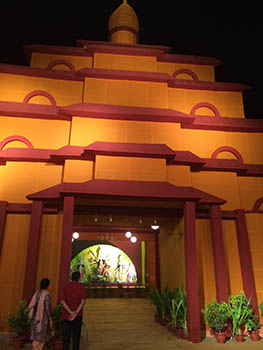
 Following the day of Mahalaya, the preparations for Durga Puja begin in earnest. Statues of Durga and her children are put up in neighborhoods of cities, towns and villages. The artisans or idol makers had started their work in the month of July. Traditionally, a dollop of mud from a prostitute’s home is used to start the creation of the clay mix for the Durga idol. It is then mixed with clay from various sacred river beds and patted on to the basic grass model that gradually takes the idol shape. The idols are painted and dressed in the finest of silks and bedecked with flowers and jewelry and transported to all corners of India and even abroad for the Puja. In anticipation of the arrival of the idols, parks, community centers, or any available block of land is rented by Puja organizers weeks before the beginning of the festival. Money for all expenses is raised through donations and sponsorships by local residents and businesses. The venues are transformed into an arena for celebration by the putting up of pandals which is a kind of a temporary shelter or tent. While some of these pandals might just be a simple construct consisting of a large colored cloth on upright poles covering a swath of space, most nowadays are complex, artistic and architectural structures built exclusively with bamboo, clay, cloth and coir.
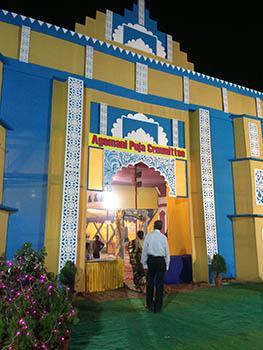 The best of the innovative pandals with highly creative and inspiring decorations can be seen in Kolkata, in the eastern part of India, capital of the state of West Bengal and the true hub of Durga Puja. In recent years, pandals in Kolkata have taken shapes of the London skyline, Buddhist temples, illuminations of dinosaurs and other prehistoric animals, replicas of historic Indian temples and even highlighting issues of social cause such as empowerment of women. Pandals are lighted up with thousands of twinkling lights and chandeliers and devotees after entering would make their way in to see the Durga idol. Pandal hopping is now a time honored ritual of Puja and it is not unusual to see long lines of people waiting to get a glimpse of a magnificent pandal. The number of Pujas in Kolkata, whether communal or in households have numbered upwards of four thousand. An air of fun and frolic, devotion and gaiety fills up the city.
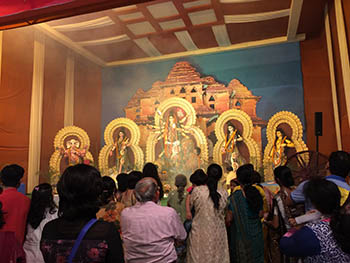 No matter where Durga Puja is celebrated, whether in India or abroad, the rituals and traditions followed are the same, handed down over hundreds of years.

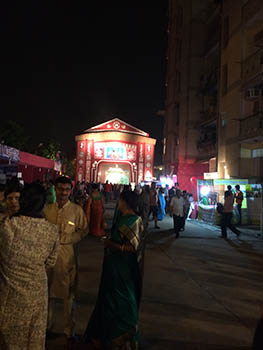 The five days of the Puja are observed as Shashthi, Saptami, Ashtami, Navami and Dashami, also known as Vijayadashami or Dusshera which is also the penultimate day of Navratri. On Shashthi, the first day of Durga Puja, there is celebration of the arrival of the deity to the mortal abode of earth by the symbolic unveiling of her face. The next three days are devoted to the worship of the goddess, with devotees on all days offering Pushpanjali, meaning offering of flowers, accompanied by Sanskrit chants. Ashtami, the third day of the Puja is characterized by Sandhi Puja, when the goddess is worshipped in her warrior form to the accompaniment of 108 oil lamps and 108 lotus flowers along with clothes, jewelry, sweets, vegetables, fruits and flowers. Sandhi Puja which begins in the last 24 minutes of Ashtami ends with the arrival of Navami, the fourth day of the Puja.
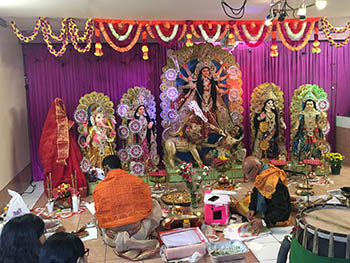 On the last day of Dashami, all the idols are carried in a procession with much fanfare and are immersed in a nearby lake or river. This event, known as Visarjan, meaning immersion in water, marks the end of Durga Puja.
 About the author: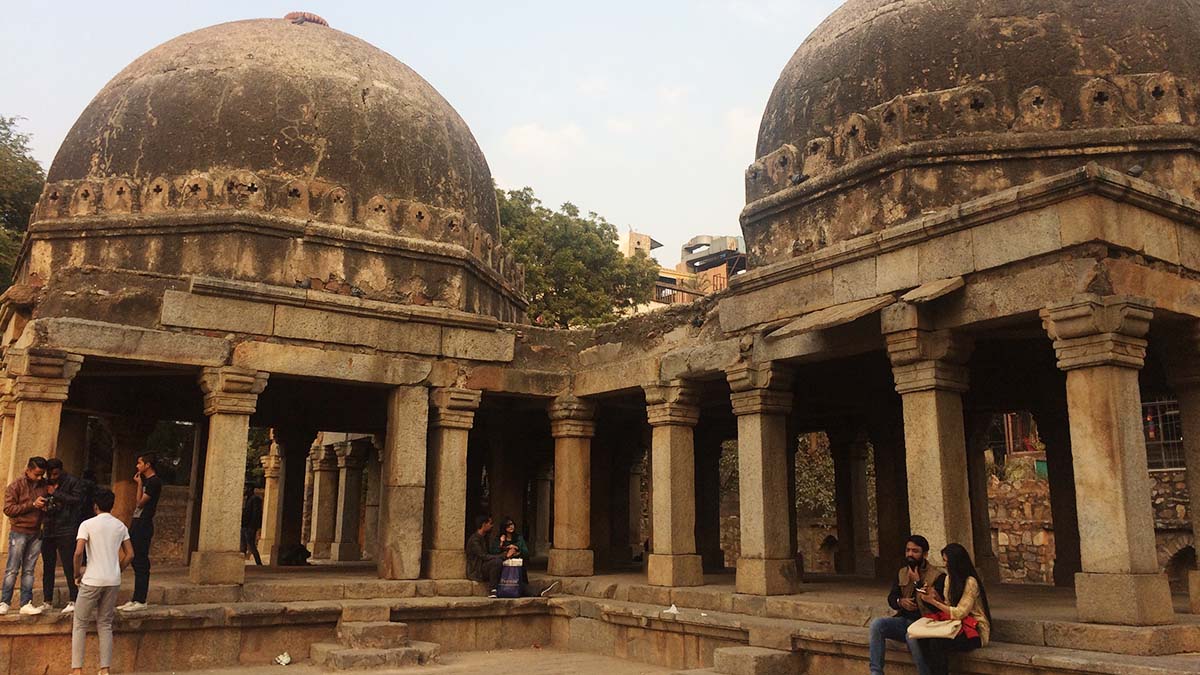
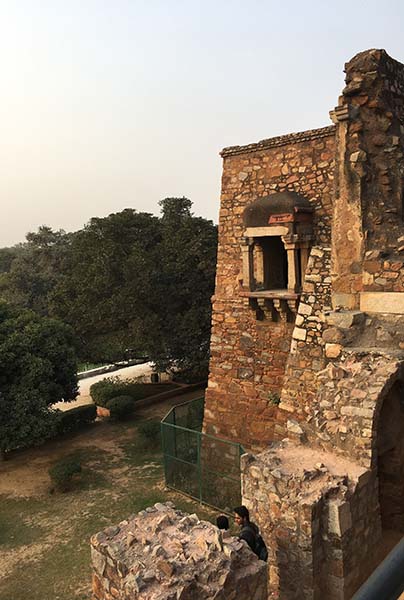 On our recent annual trip, my family and I decided to visit some of the oldest monuments in Delhi. We started at the Hauz Khas Complex, a set of monuments built during the reigns of Allauddin Khilji (1296-1316) and Feroz Shah Tughlaq (1351-1388). The area around the complex is where Khilji, considered one of the most powerful rulers of the Delhi Sultanate, set up his capital of Siri. This would be the third of the seven cities of medieval Delhi. It contains an Islamic seminary or madrasa, the tomb of Feroz Shah Tughlaq, a mosque, six domed pavilions and a water tank or Hauz Khas, meaning literally Royal Tank.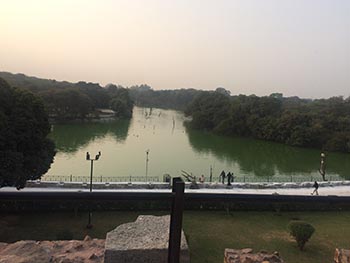

 The notorious Turkic invader Timur, also known as Tamerlane, who raided Delhi in 1398 to wage a holy war, set up camp in Hauz Khas. It is interesting to note that while he ransacked the riches of Delhi, he documented the Hauz Khas monuments in his memoirs. “When I reached its gates, I carefully reconnoitered its towers and walls, and then returned to the side of the Hauz-i Khas, a reservoir constructed by Sultan Firoz Shah, and faced all around with stone and cement. Each side of this reservoir is more than a bow-shot long, and buildings are placed around it. It is filled by the rains in the rainy season and supplies the people of the city with water throughout the year. The tomb of Sultan Firoz Shah stands on its bank,” wrote Timur in Turkish which was translated into Persian nearly two centuries after his death in 1405.


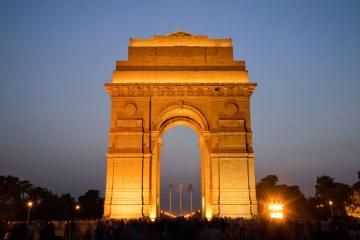

 About the author: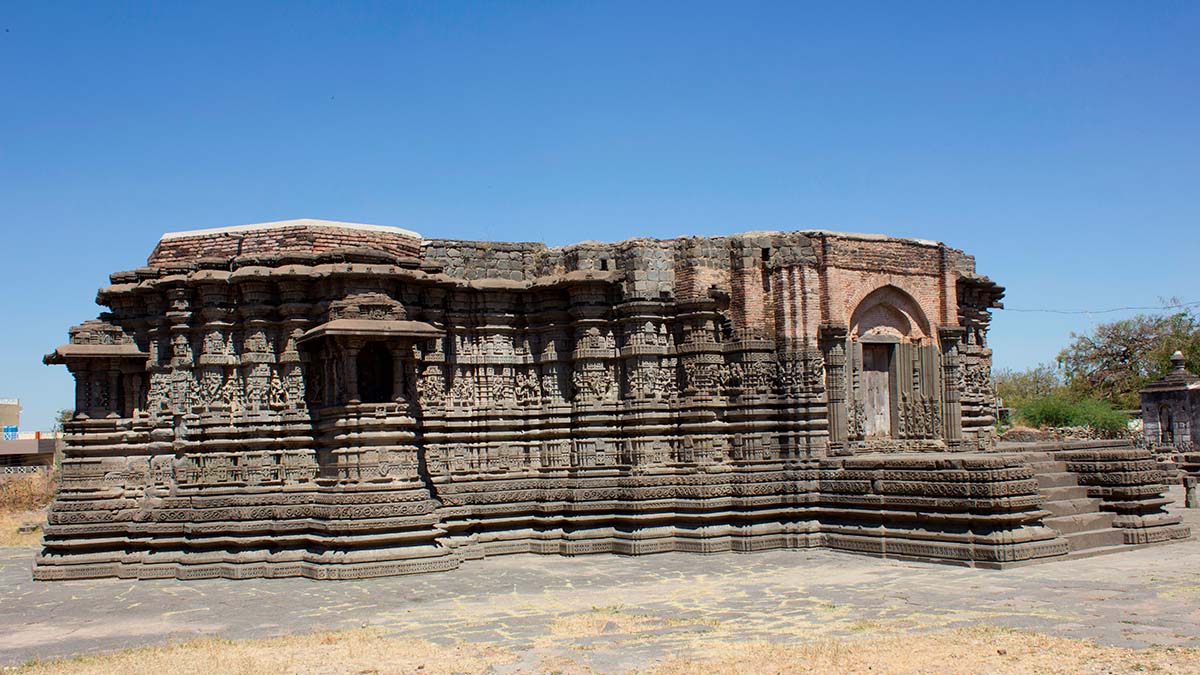
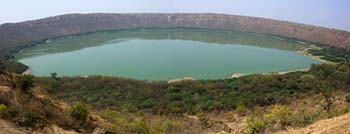


 The water of the lake is extremely salty and has a very high pH value, indicating high alkalinity. Yet despite the high alkalinity algae of a peculiar kind thrive in the waters of the lake. The lake and the surrounding area are also home to several water birds. I could spot the Rudy Shelduck (Tadorna ferruginea), Black-winged Stilt (Himantopus himantopus) and Red-wattled Lapwing (Vanellus indicus) among others. Adding a dash of history to the lake are the numerous ancient temples lying in the surroundings. I decided to do a circumambulation of the lake and say “Hello” to the ancient temples dotting its periphery. Sadly, most of these temples are now ruined and deserted. Worth mentioning though are the Yajneshwar Temple, Wagh Mahadev Temple and Kamalja Devi Temple. The Yajneshwar Temple has fine carvings and the Wagh Mahadev Temple, though plain from outside, is finely carved from inside, especially on the roof and on the pillars. Disclaimer – one has to tolerate the obnoxious stinking of bat droppings that litter the interiors of this temple.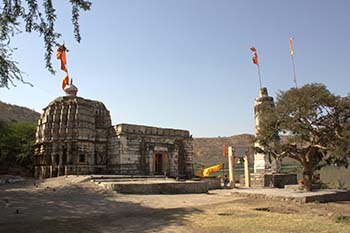




 by Anne Harrison

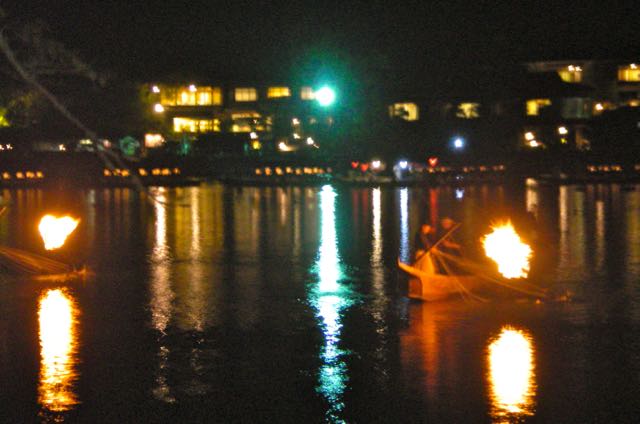
 We crossed the Moon Bridge just as the cormorant boats set off across the bay. Still in a state of disbelief, I walked closer to the bay, expecting to pass some Omiyabito (or court nobles) sitting by the shore, as they did every summer in the Heian Era (794 to 1185 AD). Their arrival to watch the cormorant fishing marked the start of summer.