by Alex Dragas
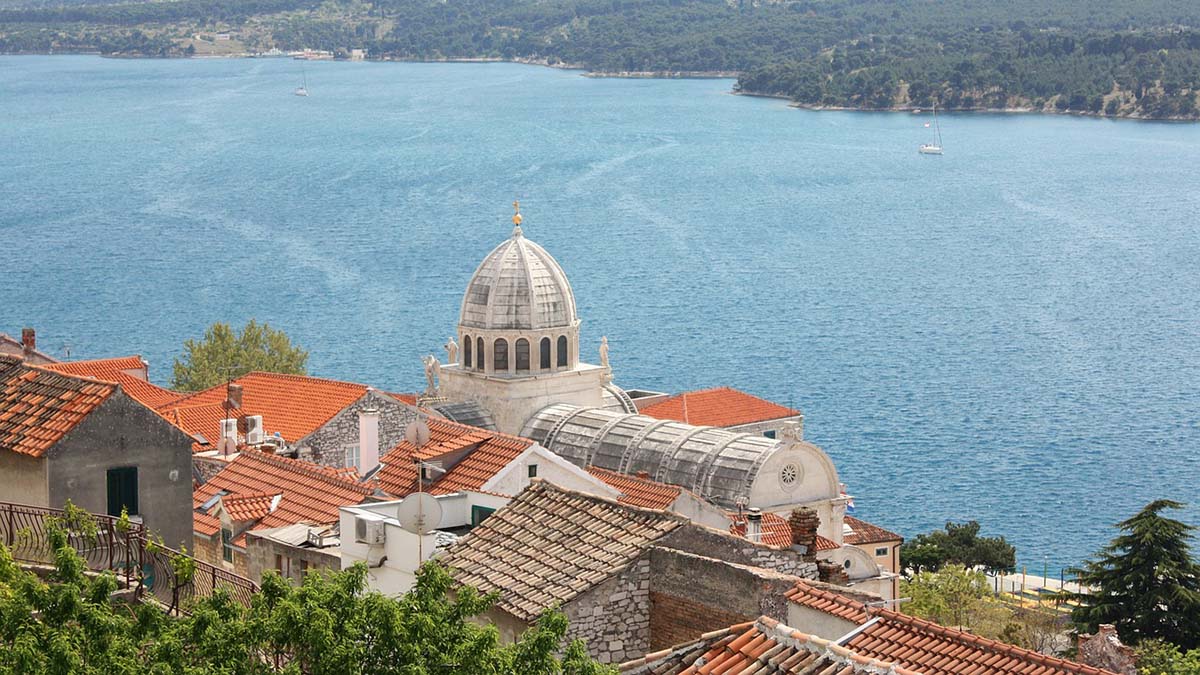
One of the jewels on the Adriatic coast is Sibenik, a city nestled along the coastline and surrounded by fortresses. It is a spot unique for many things, not only as far as strategic significance is concerned, but historical effect too. Its view, together with its fortresses and the surrounding town testify of its tumultuous past and continuous resistance for centuries. But even with all the wars, Sibenik has remained firm in all its magnificence. I visited this city once a couple of years ago and it really stuck with me, its architecture, people, food and overall atmosphere of the town are really welcoming and it is a city you can easily feel like you are at home.
EARLY HISTORY
Unlike other Croatian cities on the Adriatic coast, which were established by Romans, Greeks and Illyrians, Sibenik was instituted by Croats. Created as an ancient encampment base, at the foot of St Michael’s Fortress, Sibenik was first cited in a document issued by the then Croatian ruler Peter Kresimir IV in 1066. However, it did not gain the status of a native town until the year 1290 when the Diocese of Sibenik was built.
 LEADERSHIP STRIFE
 LEADERSHIP STRIFE
Sibenik’s rule changed hands several times from the 12th to the 15th century. It was a battle of Croatian, Byzantine, Hungarian, Venetian, Herzegovinian and Bosnian reign until 1409 when Venice took the crown. However, there was a back and forth wrench for about three years before it was finally brought under the radar. In the 17th century, the Turks attempted their luck with the town but were not successful due to the strengthened fortresses. It was not until 1797 that the Venice fell, and the city was taken over by the Austrians.
ELECTRIC STRONGHOLD
Sibenik was the first Dalmatian town to have electricity thanks to an engineer Vjekoslav Meichner and the then mayor of the city. In 1895, they built the first transmission of generating and distributing alternating current. They say that the Forbes hydropower plant in USA’s Niagara Falls started operating in the year 1895, but the town got electricity almost a year later. So with that said, it can only be safe to assume that Sibenik got public electric lighting before any other capital in the world.


GENERAL FEATURES OF THE TOWN
Sibenik is a small town of about 35000 inhabitants. It is situated in a picturesque bay at the mouth of Krka, one of the most stunning rivers in Croatia which also encloses a national park that goes by the same name. What sets Sibenik apart, is its superbly manicured appearance featuring limitless sights that attract tourists from all corners of the world year on year.
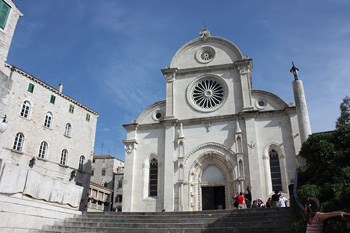 The cathedral of St James is by far the most impressive achievement in the city and it defies comparison due to its excellent construction. This three-nave Gothic Renaissance is the brainchild of Juraj Dalamanatic and was built during a period of Turkish attacks. What you see today actually took more than a century to build. Interestingly, there are 72 stone heads around the cathedral which represent locals who did not care to give a hand in the construction of the cathedral. I read a lot about this cathedral before visiting it and my friends told me that I should definitely go and check this building out when I visited Sibenik so of course I did. It is a massive building that towers over you but every piece of it contains a different kind of beauty that you just cannot stop looking at. I spent a couple of hours there just enjoying the view and learning a bit about this marvelous building, completely mesmerized.
Neighboring the cathedral is the Duke’s palace, a major defensive system in the 13th and 14th century. What remains of it today is the part where the Duke stayed. The rest of it has been taken up by three beautiful museums- Archeological, Historical, and Ethnographic. On the wall, there is a coat of arms representing St Michael, the patron of the city.
In the center of the city, sits one of the most valuable buildings, Renaissance Town Hall built in the 16th century and the Bunari (four wells) dug to supply drinking water to the town during the 17th century. The wells were also another masterpiece created by Juraj Dalmatinac, the inventor of all important buildings in Sibenik. Today, the locality has been turned into a museum where various cultural manifestations are showcased.


REAL ESTATE
Real estate in Sibenik continues to be popular among foreign buyers. This is partly attributed to the fact that it is only an hour drive from the second largest city in Croatia-Split. Additionally, the prices are generally cheaper compared to other touristy towns in the country. Its real estate is in its prime, with deep-rooted stone houses, nestled in picturesque bay overlooking the cool azure waters, it gives you a nice historical feeling that you crave for. Due to its rich history this town is very popular with the tourists and visitors thus giving this city a big spotlight, that is one of many reasons why Sibenik is one of the most sought after cities for tourists plus due to its position it is close to everything you could possibly want.
Sibenik may be historically one of the richest cities in Croatia but modern Sibenik provides you with plenty of activities, sights, happenings and much more so visiting this town is a no-brainer. No matter how young or old you might be, in this city you can find something that will peak your interest. I visited this city when it was summer and there were a couple of festivals and fairs going on that were really unique and fun to be a part of. Go and see for yourself and enjoy everything this marvelous city has to offer.
If You Go:
♦ Cathedral St. James and Bunari are all accessible by bus or if you are an explorer who do not want to be limited by time and schedule just rent a car and go explore yourself.
♦ Since Sibenik is a small town you can pretty much go by bus everywhere.
♦ For National Park Krka you can book a bus.
Adriatic Coast Nature: Sibenik and Krka National Park Private Day from Split
About the author:
Alex Dragas enjoys researching and learning new things, eating foreign food and visiting places. Traveling and writing are his passion and he tries to combine those as much as he can.
Photographs are from Pixabay


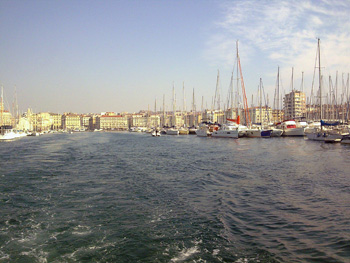
 So far, I followed almost exactly in the footsteps of Edmond Dantes, but perhaps it would be just as fitting to say that I was following in the footsteps of Dumas. An avid traveler, Dumas wrote as widely as he journeyed, inspired both by the places he visited as by the stories, legends, and history he collected on his travels. The world was his plaything, an endless well of opportunities to transform history and reality into fiction; everywhere he went, words and stories sprang forth, until the original sources had become obscured by the wild, sweeping stories of intrigue, suspense, and humanity that he penned. Marseille was no exception; Dumas visited the town on numerous occasions, treading where his literary creation had supposedly walked and using it as fodder for his story. Dumas always had a knack for hanging the romance over the reality – a sterner reality that hits me square in the face as I emerged from the Marseille metro.
 This also happened to be almost exactly what Dumas had done – except that in his day one did not take ferries. Instead, standing on the quay, he demanded the first available boat, only to watch a transaction between two boatmen as one quite obviously purchased Dumas as a passenger from the other.
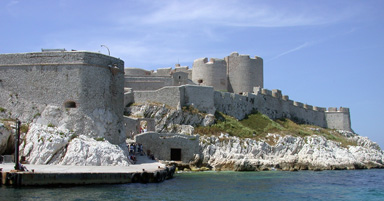 Finally, we approach the island harboring over the fortress, and I look over the side eagerly, recalling the foreboding words from the novel:
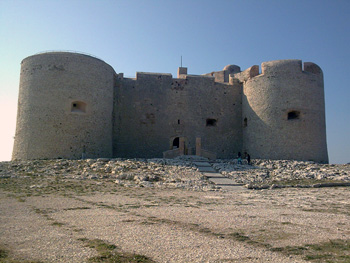
 I mount the craggy steps hopefully and enter eagerly, only to be confronted by a squat building of yellow stone, square in its shape and with short, stubby towers at each corner. The fortress itself is small centerpiece on the craggy island surrounding it, the ground around it pebbly and barren.
 Two hundred years later, little has changed. The shadow of Dumas’ story – and his marketability – hangs over every inch of the monument the way it did two hundred years ago, obscuring its historical significance. Stepping inside, I find myself in the courtyard of the fortress, and my first care is to find the “cell” of the Edmond Dantes – the same one, probably, that Dumas himself was shown as he was recounted the tale of his famous fictional prisoner. Blithely ignoring the historical reality that states that Dantes didn’t actually exist, everything here is rendered as closely to the novel as possible.
 Having explored the cell itself, I wander around the rest of the chateau, climbing its three stories to the rooftop and gazing at far-off Marseille on the coast. Then I wander the rocky, barren island, passing the half-hour until the next ferry arrives to take visitors back. Lost in thought, I venture into the tall, wild grasses to gaze down at the sheer drop into the sea. Despite the warm sun illuminating the scene, there’s a hopelessness to these barren crags. Standing at the very edge, I reminisce about how Edmond Dantes escaped by being thrown into that very water as he played dead and wonder if perhaps I’d picked the exact spot from which they had thrown his body into the depths, unwittingly allowing him to escape.

 Photo Credits: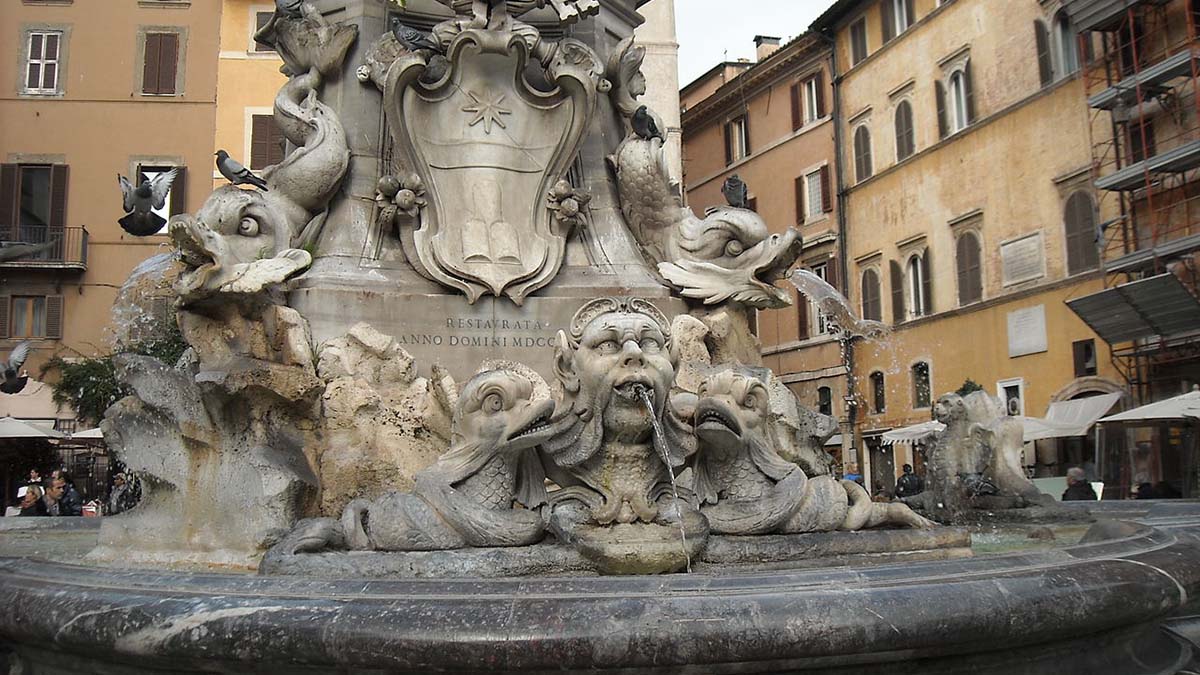
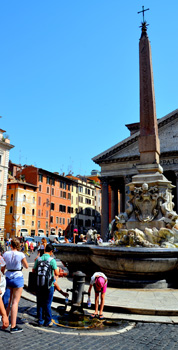 My husband and I arrived in Rome during the heat wave that broke records all across Europe in the summer of 2015. After a week of sweltering in temperatures up to 36.7 (99.68 F) in London and 39.7 C (103 F) in Paris, we were resigned to buying bottled water at every possible opportunity. We were about to learn that Rome is actually better prepared to handle thirsty tourists than most major cities, and that it has been for centuries.
 I was surprised to find the water clear and cold, the perfect temperature for drinking. I filled my bottle, guzzled half while standing there—it had been a long wait in the strong Mediterranean sun to get into the Colosseum — and refilled it again.
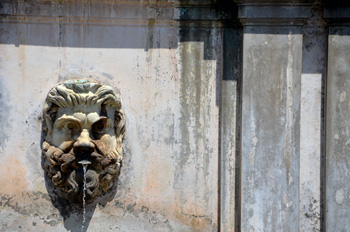 The apparent wastefulness of all that water flowing 24/7 isn’t lost on the city. During the 1980s the city added taps to the fountains, requiring that thirsty Romans operate a nob or button in order to drink. The results were far from satisfying. On hot days, water standing in the pipes heated up, making it less than appealing. Vandals broke the new taps, freeing the flow of the water, and officials gave up on the project. The water doesn’t go entirely to waste. It’s recycled to grow gardens, flush sewers and in industrial cleaning.
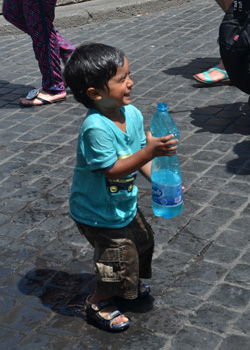 I found one that wasn’t in use on a side street as my husband and I walked back to our hotel from Trevi Fountain on a very hot afternoon. I wondered for a second if it was functional, but as I stepped around it I found a stream of fresh cool water splashing into a grate at my feet. I splashed my face and filled my bottle. By the time I was done, a couple of people had queued up behind me. I felt as much like a native as a brief visitor can feel.
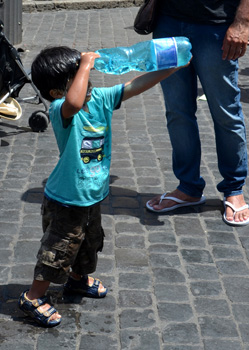 Do give the nasoni of Rome a try while you’re there. Your first time may feel a bit daunting, but once you try it, I’ll bet you’re sold on this delicious free resource.


 Latvia now attracts tourists with a mix of modernity at Riga bars and beaches; history in Riga’s Old Town, museums and countryside towns; and one of the most conserved natural habitats in Europe. I fitted in a little of each, but my main reason to visit the Baltic nation was to take part in the 2016 marathon.
 I completed a little personal history of my own with my fifth marathon at fifty, after setting a target of running one every three years until this year after running my first in 2004. The marathon dominated my five days in Latvia, but I still managed to see a lot of sights, while preparing for the run, during the event, and the day afterwards.

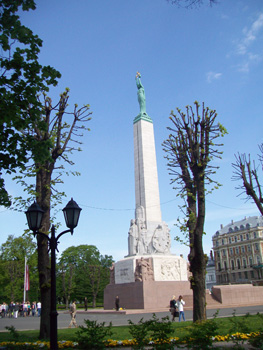
 I arrived in the centre from the eastern park belt, seeing the 150-foot high Freedom Monument without previously knowing about it. The next day it was the starting point for the marathon’s Parade of Nations, and during the marathon two lines of local volunteers in traditional costumes and enchanting music provided a magical passage at the end of the course. The monument was built in 1935, and wasn’t harmed by the Soviet army during its control of the region from World War Two to the Gorbachev presidency. The monument was a rallying point for independence rallies from 1987 to Latvia’s independence in 1991.
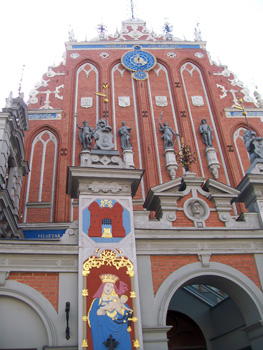 Walking directly down from the Freedom Monument takes you between the two main historic sites in Riga: Doma Laukums (Cathedral Square) and Town Hall Square. In the former, Riga’s cathedral is the biggest in the Baltics, according to the Rough Guide, ‘…it was begun in 1211 by Albert von Buxhoeveden, the warrior-priest who founded Riga and became its first bishop.’ In the latter, St. Peter’s church combines with Melngavju Nams (House of the Blackheads) and City Hall to create an excellent panoramic circuit. Melngavju Nams was the meeting place for a 14th-century brotherhood of traders that venerated St. Maurice, a warrior of North African descent. The area has been extensively rebuilt since independence, after the original buildings were bombed and demolished during twentieth-century wars.

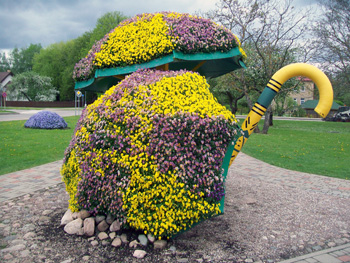
 I was impressed by Sigulda’s wide spaces and parks as I walked towards the Gauja River. Paramount was Walking Stick park, a colourful tribute to the region’s top souvenir, with cane-making having a 200 years history in the area. Sigulda is also the adventure capital of Latvia, with summer and winter activities, such as cable car bungee jumping, tobogganing and a ski slope. I had intended taking the cable car across the lush Gauja valley, but instead found myself hobbling down the steep slope to the river. Seeing a little beach on the other side drew me across the bridge, and I sat in the sun on the sand for a little while.
 There was much more to see and read though, starting with an old church, and followed by an excellent little museum tracing the ancestry of the region over its last 1000 years. The Gauja Livs who built Turaida were of Finno-ugrian heritage, in the southern Urals, like many in the north-east of Europe. They were a pagan people who resisted Christian crusaders, but were eventually integrated into western Medieval European culture. A film in one of the rooms showed how the castle looked in its prime, and it was easy to imagine the inhabitants of 800 years ago riding into the forecourt and dismounting after a long ride through pristine forests. The castle was centrally heated below the archbishop of Riga’s room, in the south of the castle, overlooking the valley. The castle was a refuge for the archbishop, as well being economically important.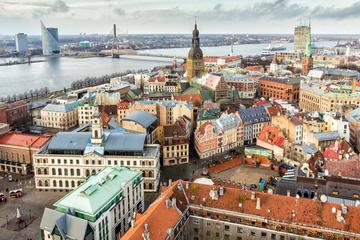


 All photographs are by Marc Latham: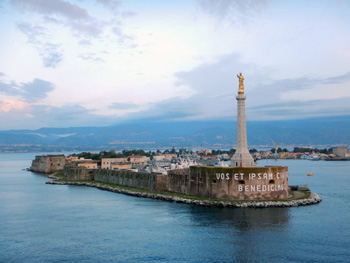
 I visit the gift shop to buy postcards and ask questions. The friendly shop keeper is happy to oblige a curious Canadian. She explains that the words under the Madonna at the entrance of the port translate into – “We bless you and the city.” It is believed that this message had been written in a letter to the people of Messina by the Virgin Mary when they converted to Christianity in 42 AD, after a visit from the apostle Paul. This explains why she is called Madonna della Lettera or Madonna of the Letter. I purchase a ticket for five euros to visit the museum and attached clock tower.

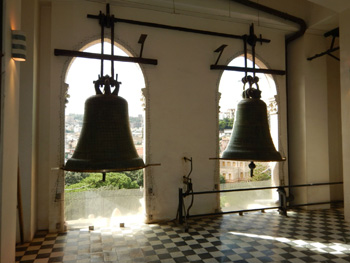
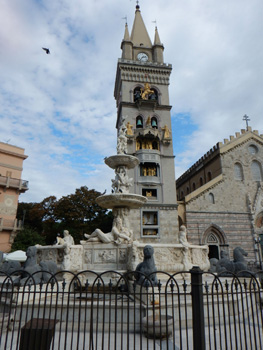
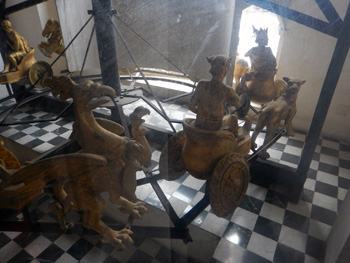 I venture next door to climb the 236 steps to the top of the bell tower. It is worth every step. This belfry houses the largest and most complex mechanical and astronomical clock in the world. On the landings I am able to view, from the inside, the amazing mechanically animated bronze images that rotate on the façade of the tower at the stroke of noon. At the top levels hang the massive bells that ring out the time. I am fortunate I timed my visit between the ringing of the bells. Once at the top, I am rewarded with a splendid view of the city from all four directions. The rain has stopped and the sun is out in full force. I feel I am in heaven, or close to it. I take my time descending, in order to have a better look at the intricate figures, aided by explanations on boards in English as well as Italian. The carousel of life, composed of four golden life size figures representing childhood, youth, maturity and old age, has death in the form of a skeleton following behind. Biblical scenes are depicted on other carousels and changed according to the liturgical calendar. One scene is dedicated to the Madonna of the Letter, where an angel brings the letter to the Virgin Mary followed by St. Paul and the ambassadors who bow when passing in front of the virgin.
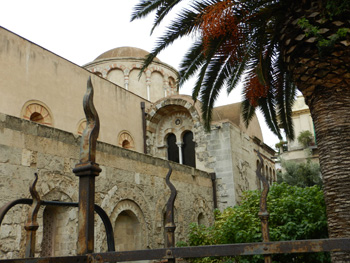 The vibrant plaza in front of the cathedral holds the gorgeous Fountain of Orion. A great place to view the clock tower from the outside and watch it come to life, should you be there at noon. I remove my raincoat and wander the streets. I find an iron worker creating figures in front of his shop called Hollywood. Many sculptures are scattered throughout the town including an imposing conquistador. The picturesque Church of the Catalans, built before Norman times on a pagan site dedicated to the god Neptune, provides different views from each side. A quote from Shakespeare catches my eye, “I learn in this letter that Don Pedro of Arragon comes this night to Messina… He hath an uncle in Messina will be much glad of it.” from Much Ado About Nothing.
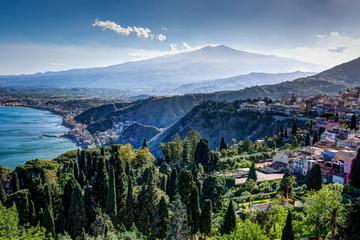
 Messina has always been the main portal to Sicily. Founded by the Greeks in the eighth century BC, the influence of Romans, Byzantines, Arabs, Normans and Swabians, who have landed on these shores over the years, contributes to the rich culture.



.JPG)

