by Keith Kellett
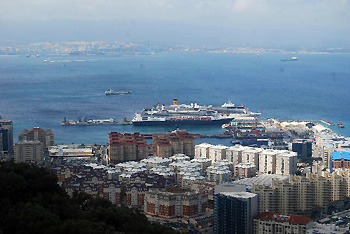
Our cruise ship sailed into the Bay of Gibraltar, and the Rock loomed large above us. I remarked that I hadn’t seen it from this angle before, and a lady nearby said:
‘You’ve been here before? You must know all about it, then?’
Actually, I didn’t. I have visited Gibraltar before, but on duty with the Royal Air Force, and, on the rare occasions we left the airfield, it was just to check out the bars. So, on the old military principle of ‘What happens on deployment stays on deployment’ … I held my peace.
 As it happens, our grandson is a Sapper in the Royal Engineers, and Gibraltar has a proud place in their history. Indeed, when they’re not Royal Engineering around the globe somewhere, their home, in Surrey, is called Gibraltar Barracks.
But, the history of Gibraltar long predated the Royal Engineers. It’s been inhabited since the earliest times. Evidence has been found that suggests Neanderthal Man may have lived there, and, indeed, some archaeologists think it was their last foothold in Europe.

 The whole Spanish peninsula was ceded to the Romans after the Second Punic War, in 150 BC; the Romans, called the Rock Mons Calpe.

The promontories guarding the Straits of Gibraltar were known to some as the Pillars of Hercules. It’s not clear which one was the southern one; the most likely are Monte Hacho, in Ceuta or Jebel Musa in Morocco. But, the northern one is, indisputably, Gibraltar.
 It owes its present name to the Moors, who captured it in the 8th Century. They called it Jebel Tariq (Tariq’s Hill), after the Moorish commander Tariq ibn Zeyad. Over time, it became … Gibraltar.
The Moors were to remain in Spain right up until 1472, when the last Moorish outpost at Malaga was taken by the Spanish.
The British arrived on the scene in 1704, during the War of the Spanish Succession, when Gibraltar was captured by Admiral Sir George Rooke. He immediately saw its important strategic position, and Britain has held on to it ever since. This arrangement was formalised by the Treaty of Utrecht in 1713, which ceded the territory to Britain ‘in perpetuity’.
 However, this arrangement has long been a bone of contention between Britain and Spain … but, in referenda held in 1967, and again in 2002, the Gibraltarians elected to remain a British territory.
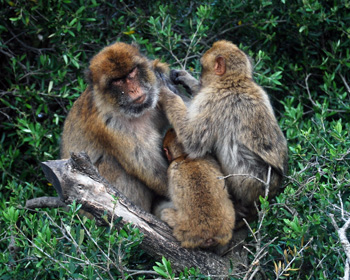
Folklore has it that the Rock will remain in British possession as long as the Barbary Apes, which roam freely around the Rock, stay. So, they’re cared for and pampered … there was even a wing of the Military Hospital devoted to their care. Generally, they just sit around being apes, and pose shamelessly for the camera.
 Europa Point is the southernmost point. and here is the Trinity lighthouse, the only one outside the British Isles administered by Trinity House. Here, also, is a picturesque mosque endowed by the King of Saudi Arabia.
Of course, the guide took us up the Rock to ‘meet his family’ … the famous apes.


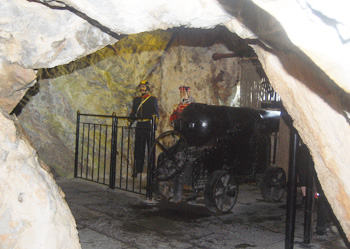
 Most of the resultant rubble was dumped in the bay … to eventually become the site of the airfield runway. And, that’s no ordinary runway. It used to be that the road had to be closed to allow aircraft to take off and land, but now, there’s a tunnel under it.
A cable car took us up to the very top of the Rock, where there wasn’t really much except a souvenir shop and more apes. But, they say on a clear day, there are excellent views of Spain and Morocco. Closer to hand, there’s a superb view of the harbour, and its many ships. Not one single Royal Navy ship, though; a far cry from bygone days. In fact, during the visit, we didn’t see a single soldier although there was plenty of evidence of their former presence.
If You Go:
♦ Gibraltar has an airport, which accommodates flights from the United Kingdom, Morocco and Tangier. From other cities in Europe, you can fly to Malaga, Jerez or Seville, from where it’s a two hour drive to Gibraltar.
♦ You can travel by rail to Algeciras, from where buses leave every 30 minutes to La Linea, which is within easy walking distance of Gibraltar. Algeciras can also be reached by ferry from Morocco.
♦ Most attractions on Gibraltar are within walking distance, but there’s also a fairly efficient bus service and plentiful taxis.
About the author:
Having written as a hobby for many years while serving in the Royal Air Force, Keith Kellett saw no reason to discontinue his hobby when he retired. With time on his hands, he produced more work, and found, to his surprise, it ‘grew and grew’ and was good enough to finance his other hobbies; travelling, photography and computers. He is trying hard to prevent it from becoming a full-time job! He lives near Salisbury, in the south of England, and has published in many UK and overseas print magazines, and on the Web. He is presently trying to get his head around blogging, podcasting and video. keith-kellett@tinyworld.co.uk.


All photos by Keith Kellett:
Barbary Apes
Europa Point
Lighthouse at Europa Point
Inside Windsor Tunnel
Inside a Tunnel
Mural in the Tunnel
The Harbour
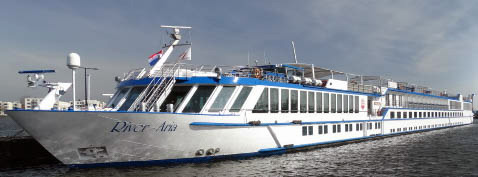
 On the Aria, all meals of 14 breakfasts, 14 lunches and 14 dinners included wine, beer or soda. A cold/hot buffet was available for all meals and the chef prepared a ‘local specialty’ dinner in the evening. Open seating was the standard in the restaurant. The four courses served at lunch and dinner included soup, salad, entree and dessert. The servers were very attentive to the needs of the guests and always wished us a “Bon appetite” before the entre. While on the ship, a tour of the galley offered guests the opportunity to see where the food was prepared. It was amazing to see the small area where all the chefs prepared, plated and served the meals. A tour of the pilot room was very informative.

 The Great Rivers Cruise began in Amsterdam and cruised to Cologne, Koblenz, Heidelberg and Wertheim, a fairy-tale town where the Main and Tauber Rivers meet. Onward, we cruised to Wurzburg on the Main in Bavaria, walking the bridge with wine in hand and Bamberg, a city on the Main River in Bavaria where the onions are huge and the cold smoky bacon beer was a welcome delight. Nuremberg explored the past and tragic time in history. Regensburg, Passau, and Vienna completed our cruise. Optional tours to Rothenburg on the Tauber River, the Bavaria: Baroque & Beer, with beer, pretzels and mustard and cruising thru the beautiful Danube Gorge to the Weltenburg Monastery provided more opportunities to explore the region. In Melk, a bus transported us to the magnificent Abbey and Baroque Church. Sailing through the Wachau Valley we reached Vienna, an Imperial City, for a Musical Tour of Vienna.
 This is not a trip for individuals who have great difficulty walking. Some individuals used scooters and walkers and were accustomed to the cobblestone streets and stairways. During the evenings, we sailed the rivers to a new destination and the tours would begin. Some tours began at the water edge and was a half-day trek through the medieval cities walking on the old cobblestone streets always watching out for bicyclists. Other tours required a comfortable coach ride to the sights. The Grand Cruises employs four Program Directors, men, and women from the area where they have lived. They are very knowledgeable about the history of the country and city, the architecture, museums, churches, castles, UNESCO sites, city life, and stories told over the ages. Some cities provided additional city guides and we met people who lived in the city and they spoke with us about their lives, the war, and refugee crisis – some rather controversial topics. The educational focus of the Grand Circle Cruise Line makes it a leader in river cruising worldwide and the recipient of numerous awards. Every Program Director had approximately 25 guests and were given headsets to hear the director while walking in the cities.

 The Rhine River journey from Koblenz, Germany to Ruedeshiem, Germany revealed many castles, 24 in all. The 760 mile voyage up the Rhine River moved at 9½ mph upstream. Each village had a castle on a high hilltop for protection in ages past and a church or two. Along the river, there appeared fortresses, ruins, castles and the legendary Lorelei statue and rocks.
 The cruise offered multiple opportunities for enrichment learning. Speakers, singers, dancers and a glass blowing demonstration entertained guests while in port before leaving and in the evening, a crew show on the lounge floor demonstrated additional talents of the crew.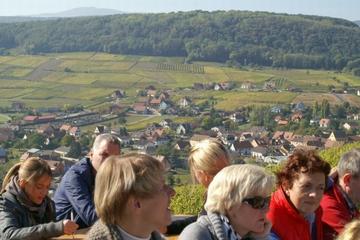

 About the author:
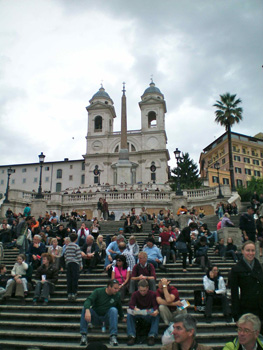
 The heavy wooden door closed and I stood surrounded by silence. Flying anywhere from Australia takes a long time, and after a night and a day and a night I was exhausted. Tired and befuddled, I emerged into the chaos of Rome. I finally found a taxi, with a driver who careened down tiny streets where footpaths were more a suggestion than reality.
 Rooms may be simple, but this does not imply austerity. Convents and monasteries are often to be found in Renaissance palazzos, Medieval walled towns or set amongst lavender fields and vineyards. Many hide artistic treasures; a painting by Rubens, or walls adorned by Fra Angelico. Each religious house has its own character, such as the monastery Convento Sant’Agostino in San Gimigiano which refused entry to HRH The Prince of Wales when he arrived after closing time. (Although probably apocryphal, the story alone makes the place worth a detour.)
 Rome boasts a convent or monastery in whatever quarter of the city you choose to stay. The rooms of Domus Carmelitana overlook the Castel Sant’ Angelo, while from those of Casa da Accoglienze Tabor you can see the Vatican. Near the Colsseum, the Cistercian Monastery of Santa Croce is in a 10th C building. Some of the balconies overlook ancient ruins and archaeological digs.
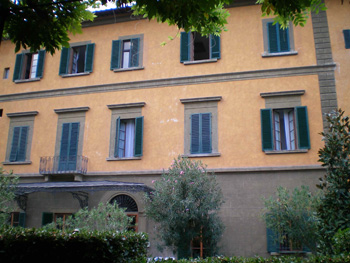 In Florence, the Casa Santo Nome di Jesu is in a 15th C palazzo. I reached my room via a marble staircase, complete with trompe l’oil ceiling of putti and plaster relief. The window overlooked a large garden, complete with kiwi fruit, persimmons, pomegranates, grape vines and wisterias, with trunks as thick as my body. The arbour was a perfect place to sit and pass the afternoon when exhausted by sightseeing.
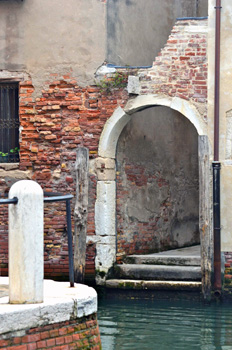
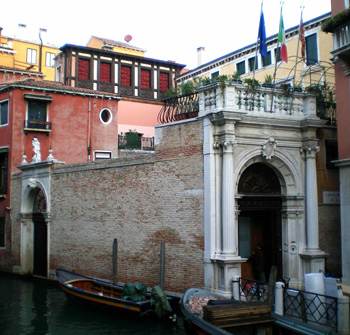 Most convents provide breakfast – fresh rolls and strong coffee are a staple – and often dinner as well. In some, monks still make wine to recipes centuries-old. My first time in Venice, my choice lay at the end of a maze of cobble-stoned side streets and piazzas. The Instituto San Giuseppe stands beside a canal, with a door opening directly onto the water. As I crossed a small limestone bridge a gondola came to a boisterous stop to collect passengers.
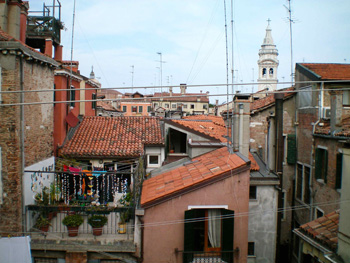 My room was simple and clean. The windows opened onto a terracotta skyline, with clothes strung on a line between two buildings. Across a flower-strewn courtyard a woman in black was busy in her kitchen, filling the air with delicious aromas. Every evening an extended family materialised for dinner. Geraniums hung everywhere in pots. In the distance a camponile tolled away the hours while towering (at a slight angle) over the other buildings,
 The next essential is catching a boat from the airport to the city, either on the public vaporetto, or by a much faster private boat. Our vessel was all streamlined wood, the skipper as sleek and polished as his vessel. Despite a complete lack of Italian, as soon as my husband began admiring the boat (being a long-time sailor himself) the skipper happily displayed the boat’s paces. As the rain finally poured down and visibility vanished, he raced along the narrow channel to the city, overtaking every other boat in a shower of spray.
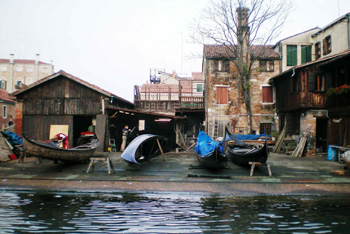
 Next came a gentle cruise through a network of tiny canals. Some were barely wide enough for the boat, the wash lapping against the buildings and doors in a moss-tipped waterline. Crumbling buildings complete with Juliette-balconies and geraniums stood tranquilly along the canal, as they have for centuries. Seagulls called overhead, bridges arched gracefully over the water, and the chaos of travel and Italian airports floated away. We even passed the gondolier repair shop on the Rio San Trovaso, one of the few remaining squeri in Venice.
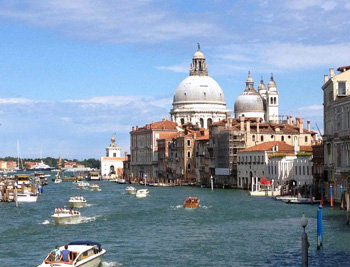 The entrance to the convent Canossian Institute San Trovaso lies on a pretty canal, devoid of tourists. Being in the Dorsoduro area of Venice, the streets are far less crowded than the more popular areas, locals outnumber the tourists, and at night the area is quiet. An elderly nun opened the door, and we walked into tranquility. She led us through an inner courtyard, where some other guests sat sipping wine as their kids feasted on gelato.
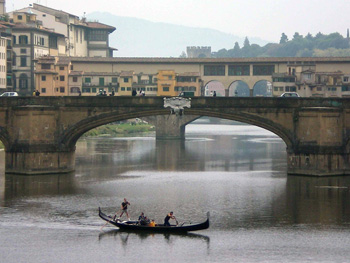 Convents and monastery are not only in cities, but also in idyllic countryside settings. Stays are not restricted to Italy, and some are to be found in the most unexpected of places. An example is the 12th century monastery Kriva Palanka, hidden in the Osogovo Mountains of Macedonia [TOP PHOTO]. It is worth a visit for the medieval frescoes alone.

 Photo credits: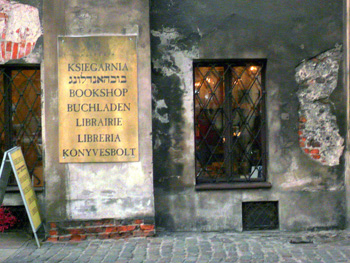
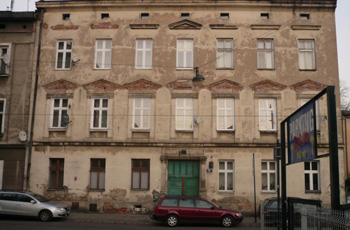 In March 1941, the Germans forced all Krakow Jews to resettle in the newly created ghetto of Kazimierz. The Nazis liquidated it only two years later on March 13, 1943. Most of the 17,000 inhabitants perished in the Nazi concentration camps. Today Krakow has only about 200 Jewish residents.
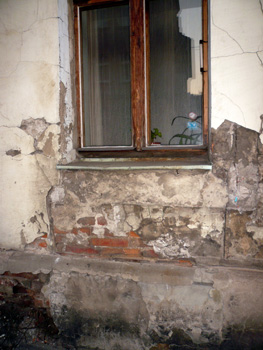
 Kazimirez is not beautiful; many of its buildings are run down. A few night clubs have emerged around the Square. We enjoyed just sitting and people watching… modern day residents and a few Jews dressed in shawls and yarmulkes. And, of course, the foreign tourists.
 At Szeroka Street 40, we entered the Remuh Cemetery. A few worshipers were praying or cleaning grave sites. The cemetery had been widely used from 1551 to 1800. It has hundreds of old tombstones, dating mostly from the Renaissance…still readable.
 The next thing on our list, however, was to sample some of the local food. There was no shortage of Jewish themed restaurants and shops.
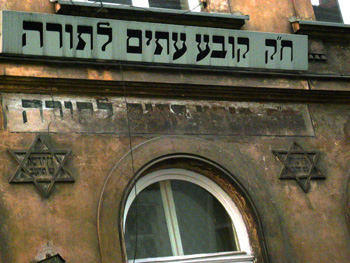
 Another interesting feature are the walls in the prayer hall. Prayers have been painted on the walls for worshipers who couldn’t afford prayer books. Most readings have even been translated into English. A plaque outside states the synagogue was constructed in 1638, so there is some serious history attached to this place of worship.
 In addition to the Jewish element, Christianity also had a role in Kazimirez. The Church of Corpus Christi has an awesome historical interior. There are stalls going back to 1629, the altarpiece of 1634, and the ornate mid-18th-century pulpit.

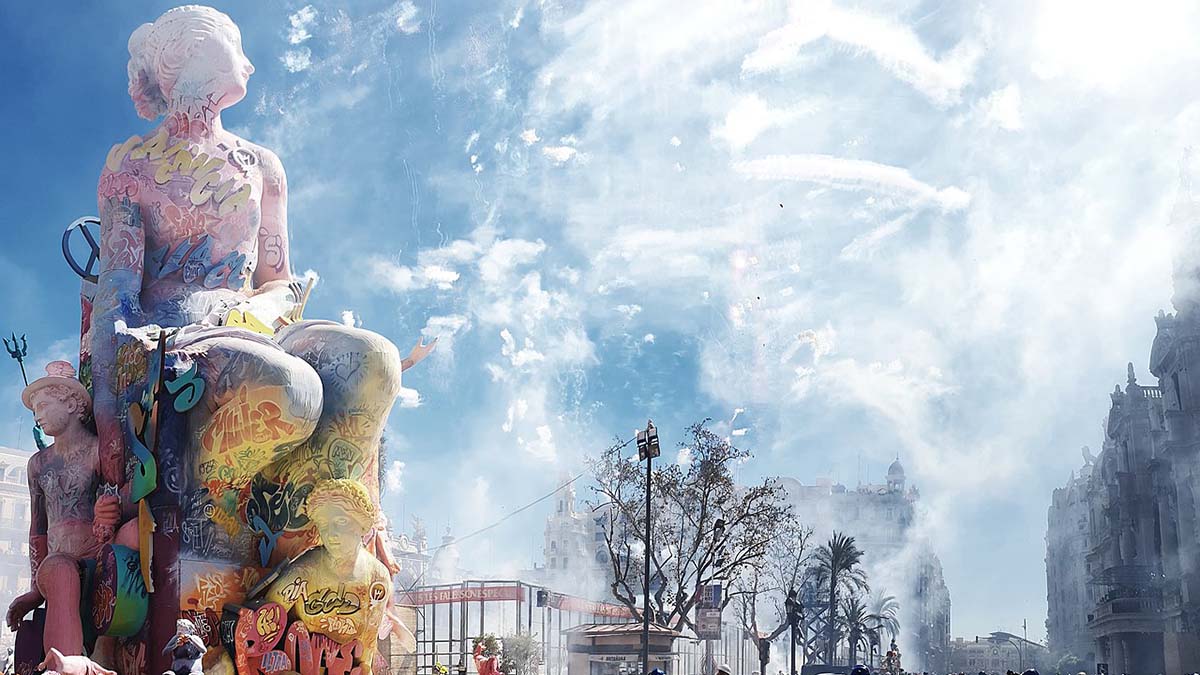

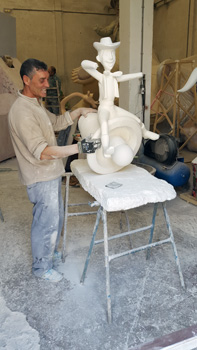 Those simple early ninots have evolved into magnificent wax and polystrene figurines that require such precise skills that the artists who create them now have their own guild, The Guild of Falleros Artists; at least two schools who specialize in training them; two museums dedicated to their work and a part of Valencia known as Cuidad del Artisto Fallera (the City of Falleros Artists) where many of them have full-time workshops.
 One of the largest workshops belonged to Manolo Garcia whose team had been selected to create the 2016 fallas monument representing the City of Valencia displayed in the Plaza del Ayuntamiento; the one subjected to the blasts of the daily Mascleta of gunpowder explosion and traditionally the last fallas to get burned in the fire on March 19th.
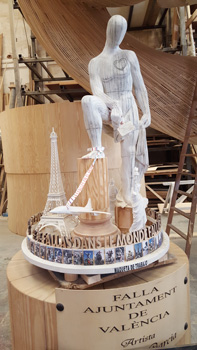 The scale model and the massive pieces of the scene in the workshop did not do justice to the full scale of the monument as it was being constructed. Because of its sheer size, much of the actual carpentry happened in the plaza where the public could watch its daily progress. The monument, called Fallas of the World, consisted of a tall wooden human figure surrounded by world “monuments” that had been part of previous years’ fallas structures – the EIffel Tower, the Statue of Liberty, the Concorde jet, the statues of David and Moses.

 About the author:


