Montségur, Mirepoix and Carcassonne
by Karoline Cullen
The rocky trail angles steeply upwards and demands all my attention.
Protruding rocks and roots make for slow progress as I try not to trip. Looking at the foreboding ruin above, I find the cool, gray weather an appropriate and atmospheric match. I tackle the trail once more, clambering over obstacles to finally arrive, huffing and puffing a bit, at the entrance.
In the Languedoc region of southwestern France, I am meandering through a medieval hit list of sights. From a remote Cathar outpost to a busy market town to the stunningly restored walls of a major fortified city, these places ooze atmosphere. It is a short drive through rolling vineyards from the ruin of Montségur to the market in Mirepoix to Carcassonne, but each offers a distinct glimpse into the past.
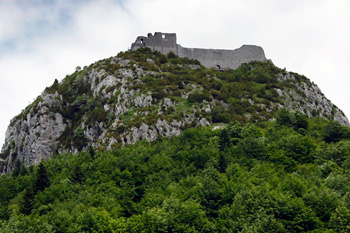
 The ruin of Montségur perches on a hilltop in the foothills of the Pyrenees. My arduous climb to this lonely crag is rewarded with panoramic views of lush hillsides dotted with purple blooming wild sage and silent sheep. All that remains of the castle are crumbling walls and part of a keep. A sighing wind whispers over the walls.
As it takes no time at all to walk around the inside, I try imagining how hundreds of people survived months of siege in such a small space during the Albigensian crusades of the 1200s. The crusades were mounted against the Cathars, whose beliefs mixed Christian and Middle Eastern philosophies. All across the Languedoc, Cathars took refuge in hilltop fortresses such as this, but to no avail. Many were martyred and the faith destroyed. I slowly circumnavigate the hilltop outside the walls. The surrounding green hills are a soothing antidote to the somber history of this windy place.

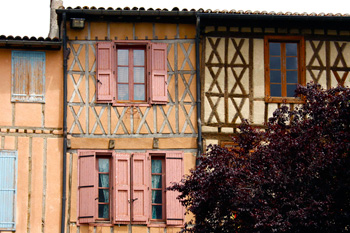 In contrast to the desolate loneliness of Montségur castle, Mirepoix is a bustling market town. Pastel coloured, half-timbered houses above wood frame arcades line the main square. Gargoyles on the church supervise the crowds around the curlicue adorned market. At the other end of the square sits the 14th century town hall. Each decorative wooden beam has a different carved head, demon, or animal.
As in medieval times, vendors and shoppers jam the streets on market day. Mouth-watering aromas from meats cooking on rotisseries perfume the air. Sellers compete for customers with raucous cries extolling the virtues of their melons, strawberries or asparagus. A cheese maker brandishes a long saber and deftly cuts a sample of his goat cheese. I happily tell him it is marvelous and buy a piece. In a country where markets are an art form, this ranks as one of the best.
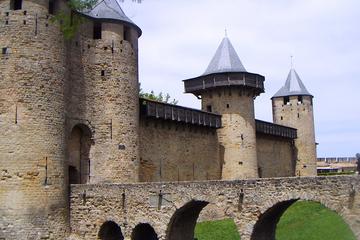
 On the opposite end of the spectrum from Montségur’s crumbling castle are the immaculately restored walls, bastions, and towers of Carcassonne’s Cité. Viewed across vineyards, the fortress stands as if from a fairy tale. Fortified since Roman times, Carcassonne was a Cathar stronghold in the Middle Ages. In the 1800s, Viollet-le-Duc imaginatively restored the double walls and the chateau they shelter. At a time when so many of France’s monuments were being neglected, he rallied for restoration. The project took fifty years and sadly, he did not live to see its glorious completion.

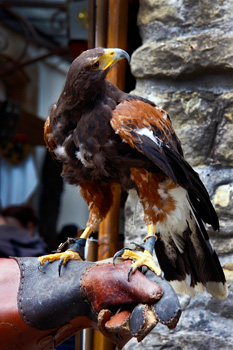
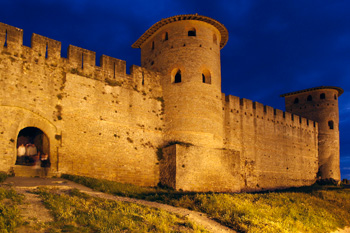 Inside the fortress, crowded narrow streets are lined with souvenir stands, restaurants, and half-timbered houses. I wander past patrons dining at tables under a leafy canopy, artists painting water colours and children in crusader outfits brandishing plastic swords. Two falconers, with their beady-eyed charges gripping their leather-gloved arms, add to the medieval atmosphere. On the grass lices between the long inner and outer sheer rock walls, I stroll in relative solitude past black slate roofed towers and square cut bastions. Carcassonne is a World Heritage Site and the fortress, while impressive by day, is stunningly lit at night. As the evening sky fades to a dusky blue and the spotlights come on, the fairy tale towers and walls glow golden. I readily imagine a centurion slowly patrolling the walls.
René Descartes said, “Travelling is almost like talking with men of other centuries.” In the medieval Languedoc, their stories are as varied as the places they lived.
Medieval Cité of Carcassonne Guided Tour for 2 Hours
 If You Go:
 If You Go:
♦ Carcasson Tourist Information
♦ Cathar & other Medieval Castles in the Languedoc-Roussillon
♦ Montségur to Mirepoix is a 40-minute drive and Mirepoix to Carcassonne is about the same distance.
About the author:
Karoline Cullen is a Photographer and Journalist
Director, British Columbia Association of Travel Writers
♦ www.bcatw.org/karoline-cullen
♦ www.cullenphotos.ca
Photos by Cullen Photos:
Montségur castle on its lonely peak
Montségur walls
Mirepoix houses
Inner and outer Carcassonne walls
Carcassonne at night
Carcassonne falcon
 It’s Remembrance Day, 2014 and I’m interlocking the sleeves of my parents’ Air Force jackets. They are arm in arm once more, laid out on the bed. Mum, a coding and deciphering officer with the RAF, and Dad, an air observer/navigator with the 10th Squadron, Bomber Command, met at a dance in Gander, Newfoundland in December, 1944. They’d both already served five long years. I salute them. Then I hug their blue-gray wool serge, touch their caps, and straighten their belts.

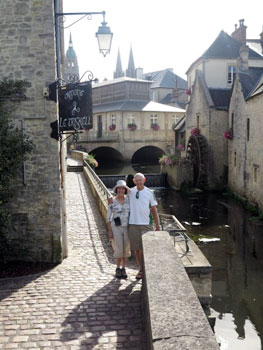
 A visit to Notre-Dame Cathedral’s Romanesque and Norman-Gothic edifice which pre-dates Mont-Saint-Michel was a must-see. It was consecrated in the fourth-century and flourished in King William’s reign. Its façade, chapter-house labyrinth, choir, as well as its fifteenth-century frescoes of angel musicians in the crypt, all captivate.
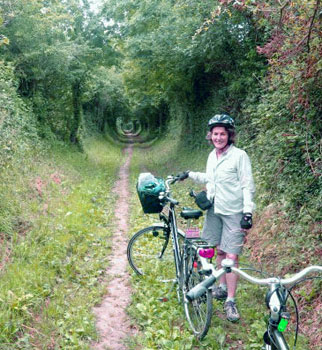
 A yearning to be in the open air brings us to Velos Location: We rent bikes for eight hours at 16 Euros apiece and are transported to countryside where we hear the farmer’s tractor mowing hay. Or are those really tanks approaching? The trees that line the roads look mature, but aren’t they uniformly pushing the seventy years since peace was brokered? In 1944, trees provided fuel or defensive barriers on low-tide beaches, and their removal meant less shelter for an enemy. Today, those same trees flicker from shadow to light like newsreels, transmitting ticker tape noises to our spokes, and crank us forward.
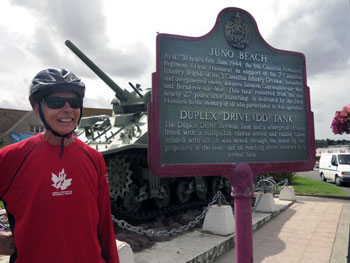 We chance upon the British Cemetery of War Graves of Bazenville-Ryes en route to Juno. Among its nearly 1000 souls, it shares the high ground with British, American, Canadian and German soldiers. The only borders here are lovely weed-free plantings of roses, oregano and lavender.
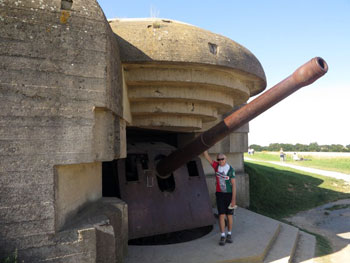 Longues-sur-Mer, the German Battery, still houses a 150-millimeter gun and four bunkers. Martine conducts the tour of the only battery to retain its original naval gun. These powerful long-range guns could have devastated had they functioned properly. The four guns were up, ready and firing over the 20-kilometer range, but a sand dune blocked the telescopic view for the shiny new range-finder still in its box. Without a range-finder, the guns fired blindly like big barking dogs, until direct hits silenced two of them just before the surrender.
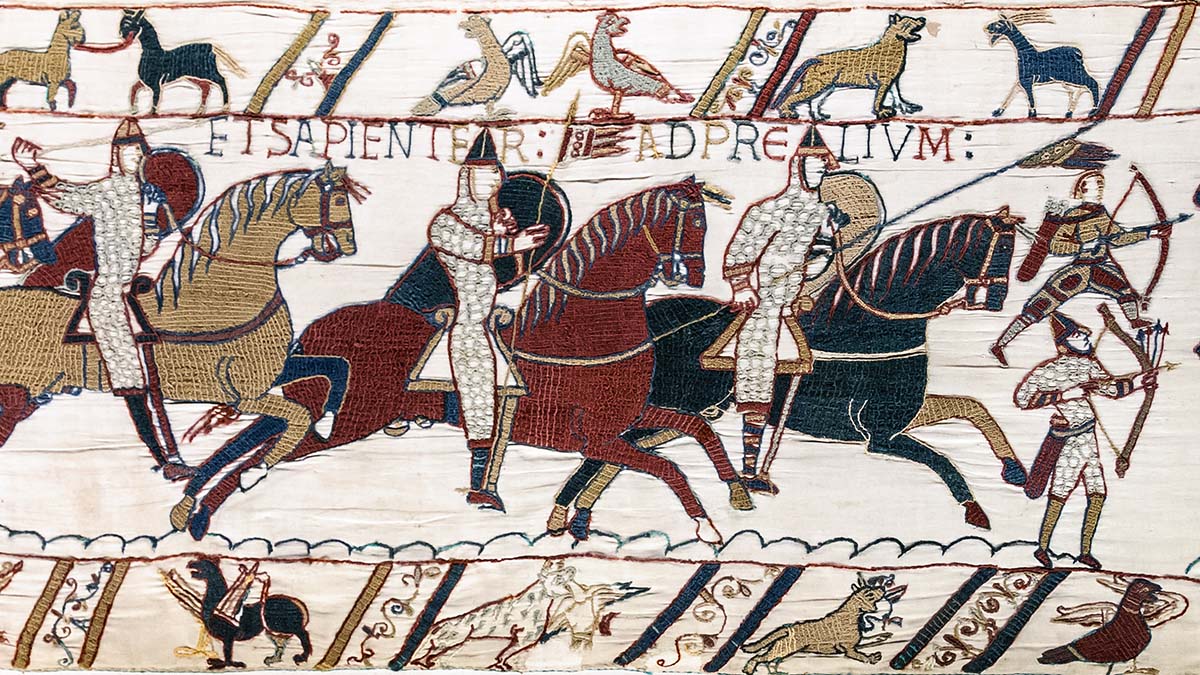
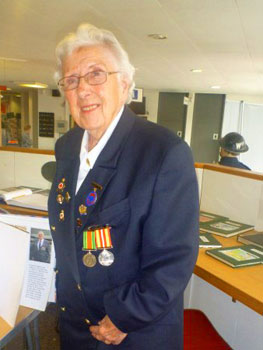 This summer, 2014, we visited Portsmouth’s D-Day Museum to view the recently-completed Overlord Tapestry that commemorates D-Day. I met Mary Turner Verrier, a 91-year-old Red Cross Nurse and veteran of Dieppe, Dunkirk and D-Day. Mary treated casualties of war, both civilians and servicemen, primarily for flash burns.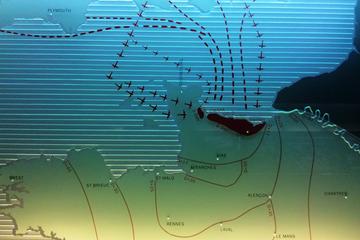
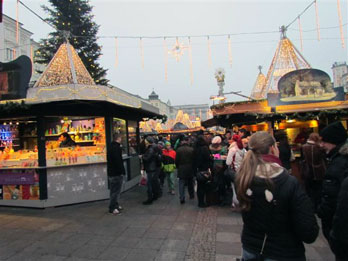 No one remembers its history exactly but there is some thought that the fair originated in the middle ages. In 1697 the historian Christoph Wagenseil, a native of Nuremberg, mentioned the Christkindlesmarkt in the second history of the town where he described the event much as it is celebrated today.
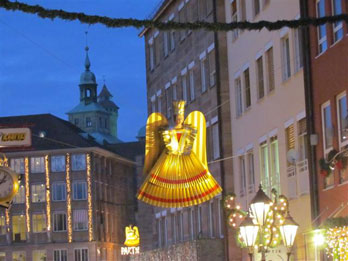
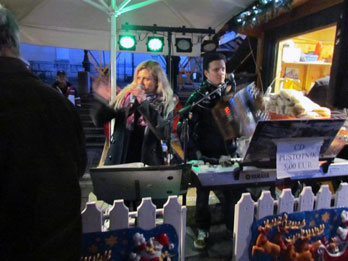
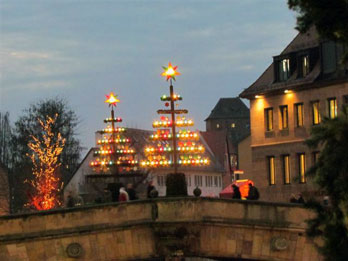 My wife and I are visiting with relatives and enjoying the brisk air. There are golden angels hanging everywhere. This is a very popular festival in Germany and one that is also enjoyed by tourists. We pass by rows and rows of colorful booths, each filled with such holiday delights as glittering Christmas tree decorations, clever toys from Nuremberg craftsmen, marvelous Lebkuchen, a cookie usually made from honey, spices, nuts, or candied fruit, and pungent gingerbread. Then are also figurines of the Christ Child in his crib, surrounded by Mary, Joseph, and adoring shepherds. Faintly in the distance there is music and as we draw nearer we hear the sound of a children’s choir performing a variety of Christmas songs. We linger awhile to enjoy the moment and the spirit of Christmas.
 There are booths filled with such specialties as savory-smelling roasted sausages, delicately grilled herrings, and my favorites schaschlik (skewered meat usually lamb) and mulled wine. We partake of the mulled wine to help warm us in the cool winter air. There are sweets, of course, all kinds of traditional candies and all manner of cookies. The Nuremberg Christkindlsmarkt is full of wonderful sights, sounds and smells. It symbolizes for adults unforgettably beautiful childhood memories and it is little short of paradise for all age groups. However, it is also important to discover other Christmas markets in Europe.

 The
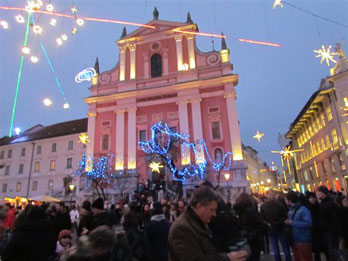
The 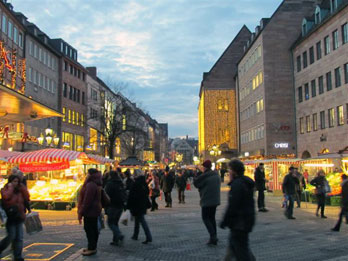 My wife and I and my cousin and his wife walked toward the Ljubljanica River. This year the Christmas season began on Tuesday, December 3, 2013 with the decoration of the town’s buildings and Christmas trees with lights that were switched on throughout the city. There was about 64 kilometers of lighting sculptures and light garlands installed on the trees and seven spruces located in the Preseren Trg (Market), at Figovec, in Levstikov Trg, Pod Tranco, next to the City Hall and in its Atrium as well as on the Ljubljana Castle. This was the beginning of the festive season that lasted until the December 31 New Year’s Eve celebration.
 Along the banks of the Ljubljanica River there were wooden stalls set up, decorated with Christmas ornaments and the scent of sausage; pastries, roasted chestnuts, and hot mulled wine filled the air. Vendors were also selling an assortment of unique Christmas gifts. All around us the varied colored lights begin to sparkle. The Franciscan church of the Annunciation on Preseren Square its pink façade aglow and its statuesque columns were bathed in white lights highlighting the face of the church. On the steps there was a crowd of people exiting while others patiently waited to enter the church to view the nativity scene and numerous religious displays inside.
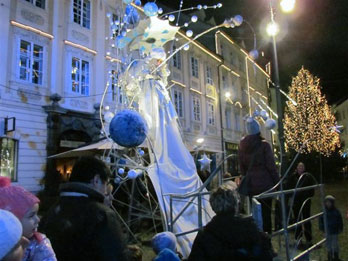
 New this year to the festivities was an open-air life-size outdoor Nativity scene with a wooden manger, figures of the three Magi, shepherds, sheep and other animals all made out of straw. This was made by the Anton Kravanja Christmas Cribs Association.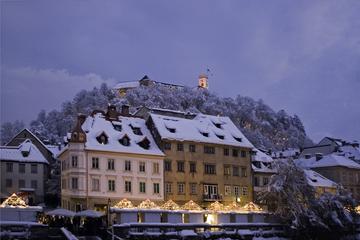
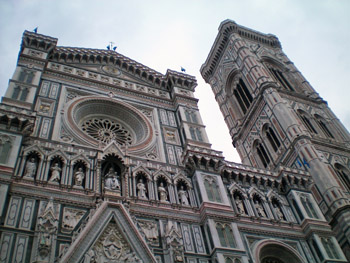
 Recognizable to any medieval citizen, the Baptistery and Duomo remain the heart of Florence. Dante’s ‘bel San Giovanni’ is one of the city’s oldest and most famous buildings. Medieval houses still line the Piazza Duomo, many still proudly displaying a stone coat of arms. Like many Florentines of the time, Dante was baptized in the large octagonal font of the Basilica. The building itself dates back to the 4th century. The 13th century mosaics covering the ceiling show with graphic detail the horrors and glories of the Last Judgment. Dante never saw Ghiberti’s famed doors, for they would not grace the building for another century.
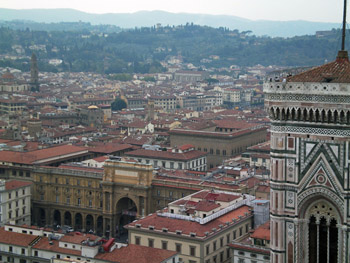
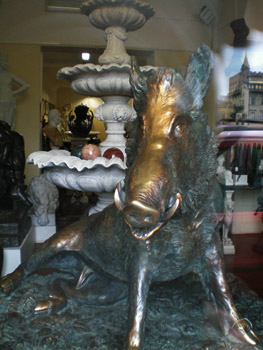 For the hardy, 463 steps lead from the floor of the Duomo and up through a labyrinth of corridors and stairwells to the top of the cupola. (The most difficult part of the climb is over the arch; there is a spot here for lovers to place a padlock and throw away the key. In hidden corners remain marks left on the brickwork by the medieval builders.) The cupola soars to the height of the neighbouring hills. The view embraces the history of Florence, with many a medieval street following the course of their Roman precursors. Private palaces survive, and a few towers – or torre, outlawed in 1250 – still remain.
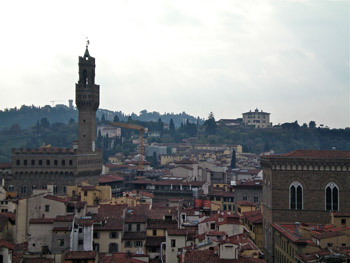 Dominating the Palazzo Vecchio, the Piazza della Signora has continued as the centre of political activity since the Middle Ages. Heavy traffic has been banned since 1385. The imposing façade of the Palazzo Vecchio has remained virtually unchanged since it was built (1299 – 1302) – Dante writes of how the houses of the Ghibelline Uberti were demolished after the triumph of the Guelfs, and the new Palazzo built on their ruins. (The Piazza della Signora is itself built over Roman ruins.)
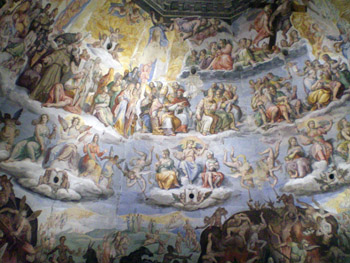 Walking beneath the arch into the Via Santa Margherita leads past the 12th century Santa Margherita de’ Cerchi, where the poet married Gemma Donati (they were betrothed when Dante was nine). It is also where he first saw Beatrice Portinari, the woman he immortalized in his writing. Beatrice’s father, Folco Portinari, is buried here.

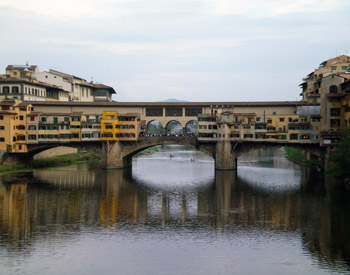 Standing near the site of the original Roman crossing of the Arno, this was the city’s only bridge until 1218. In Dante’s time the Ponte Vecchio was home to butchers and grocers; since the 16th C it had been the place to shop Florence’s most spectacular jewellery.
 On the left of the church runs the Costa di San Giorgio; Galileo once lived at No 9. At the end of the road stands the Porta San Giorgio, the oldest of the surviving city gates (Florence was still a wall city in Dante’s time.) A steep walk away is perhaps the most unspoilt of all the Romanesque churches in Tuscany: San Miniato al Monte. It’s classical façade of green-grey and white marble has looked down over Florence since 1018.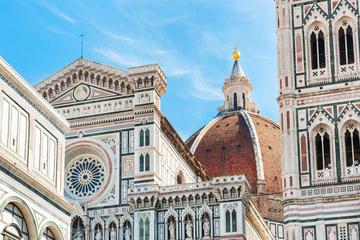
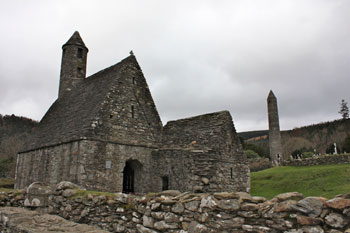
 As we stood outside the former monastic site at Glendalough, our guide, Joan, directed us to the 900-year old gateway and indicated that the original structure had two round-headed granite arches supporting a timber roof. This was the gateway to civilization at the time. The lands beyond the monastic settlement teamed with highwaymen and other dangers. I imagined terrified individuals running past us through the gate to reach the cross-inscribed stone set just inside on the right as Joan explained that Glendalough was a place of refuge. The so-called “Sanctuary Stone” defined the point of safety for those on the run. Once a refugee passed inside the gate beyond the stone, he/she was safe.
 In the vicinity of the round tower, the remains of a cathedral, dedicated to St Peter and St Paul, consist of a 10th century nave and a 12th century chancel. The arch, once finely decorated, is constructed of limestone imported from Bristol, England. A wall cupboard and basin used for washing the sacred vessels used in the mass is still visible in the sacristy.
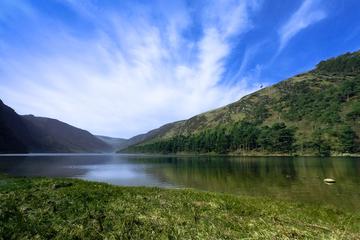
 The postcard-like view of the upper lake features green hills gently rolling into the water on your left and trees at the water’s edge on your right. Opposite you in the distance, a stream descends the mountain into the lake. This tranquil setting greeted St. Kevin almost 14 centuries ago.
 Walking on, you enter a grove of trees to find the derelict 11th century Reefert Church with its stone nave and chancel. This church was a major attraction for those on pilgrimage to Glendalough as St. Kevin’s relics were housed here after his death.

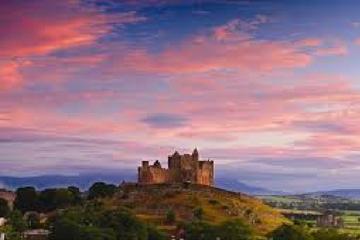
 Slowly Diane and I climbed to the summit of the 300-foot high limestone promontory known as the Rock of Cashel. At the top, we were rewarded with a panoramic view of the green fields of County Tipperary below and the town of Cashel at the base. Despite the presence of the town below, the rock feels isolated.
 Set next to the round tower, you find the shell of the second cathedral on site, dating to 1235. The current gray stone structure is cruciform with a central tower. The nave, which was never completed, is shorter than the choir. The north transept houses three sarcophagi, dating the 16th century, each with carved bas reliefs of the apostles around the periphery. The Protestant Church of Ireland abandoned this cathedral in the mid 17th century and then had the roof removed to collect the lead for ammunition. The cathedral lacks a roof to this day.
 Inside the chapel, you find a white vaulted ceiling with plaster fragments falling off. The whitewash, dating from the Reformation in the 16th century, was used to cover the oldest frescoes in Ireland including those of the Nativity. An intricately carved sarcophagus at the back of the chapel might possibly be that of King Cormac himself.