Avila, Spain
by Inka Piegsa-Quischotte
Finally, I was on my way. For some time I had made plans to visit the city of Avila, also known as the city of saints and stones in the Spanish province of Castilla Leon. As the train was on its way from Madrid, I didn’t dare take my eyes off the window because I didn’t want to miss the first glimpse of the famous Walls of Avila as they rise from the shores of the river Adaja.
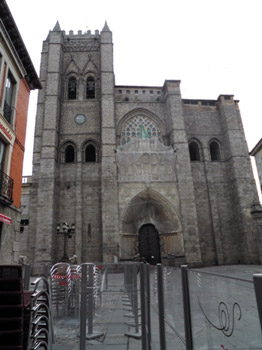 The walls and the iron grey Gothic cathedral are the ‘stones’ and Santa Teresa is the ‘saint’. My incentive to finally make the journey was the fact that this March saw her 500th anniversary. What better reason to travel than to follow in the footsteps of one of the foremost and most proliferate writers of Christian mysticism and the founder of the Discalced Carmelite nuns. An added bonus is the fact that Teresa would also have seen and been able to walk along the walls which encircle the old town of Avila with a perimeter of 2,516 kilometers.
Built between the 11th and 14th century, the walls were only completed for about 200 years when Teresa was born on 28th March 1515 in a small town near Avila.
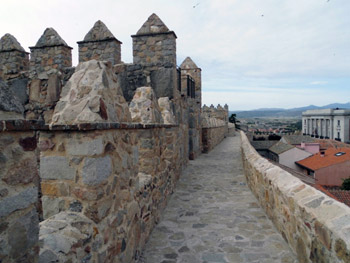
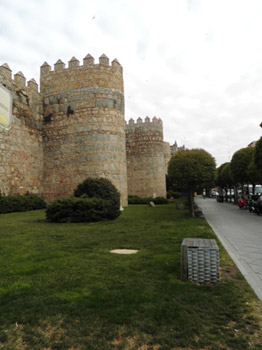
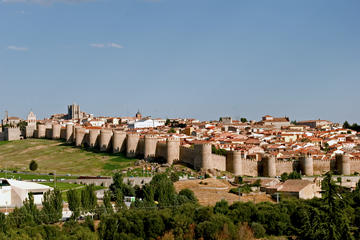
The train rounded a last bent and there they were! I have experienced the sensation many times during my travels. You know exactly what to expect, you have seen the sites and monuments countless times in photographs, but, when you are confronted with the reality it’s always awesome. The walls consist of several massive gates and 88 semicircular towers. What’s even better is the fact that of the approximately two-kilometer perimeter you can walk about half on a narrow walkway on top of the walls, giving you views of the old town below as well as of the surrounding countryside.
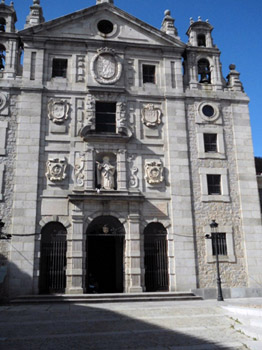 I had chosen a small hotel which was adjacent to one of the gates, so I just dropped my bags and went out to explore. Directly in front of me was Plaza de Santa Teresa with a church bearing her name and a small museum.
Canonized by Pope Gregorius XV, Teresa is a saint, but not a martyr although due to her teachings, she has suffered some confrontations with the Inquisition. Of Jewish heritage, her father converted to Christianity and her mother was intent on Teresa having a Christian education and upbringing. At age seven she was already fascinated with stories of the lives of saints and ran away with her brother to go to the Holy Land and become a martyr. Needless to say, that the pair didn’t make it far.


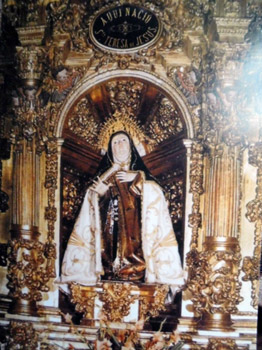 Poverty, serenity, mental prayer and meditation practices are the keystones of Teresa’s writings. She finally entered a Carmelite convent and was appalled to find that the nuns of her times adhered to none of them. Life in a convent in the 16th century was very worldly and she decided to change that and bring the order back to what it was intended to be.
Together with John of the Cross, she founded the Convent of San Jose in 1562, the first monastery of the Discalced Carmelite nuns and at a short distance from the church dedicated to her. I decided to make my way to the first possible access to the walls and to start walking. Monument after monument unfold from the height of the towers. At one point it leads very close to the cathedral which you can see from here at a very unusual angle.
Teresa is everywhere in Avila. Statues, fountains, images, paintings you can’t take a step without meeting something related to the favorite saint of the city.
 The month of October is dedicated to a festival of Santa Teresa, with processions , concerts and other festivities. As I found out when walking further into town, sweets form a part of the cult of Santa Teresa. To this day, the nuns produce Yemas de Santa Teresa, a sort of biscuit made from egg yolk and sugar and little chocolate nuns making the yemas are displayed in every patisserie. They make a nice souvenir and gift.
As I wandered the street of Avila, I soon discovered that there are many more ‘stones’, particularly in the form of palaces. Predominantly medieval, Gothic or renaissance one is more eye catching than the next. I happened upon one palace called Caprotti which is also a museum and, more interesting, has s story to me heart. An 18th century Italian painter by the name of Guido Caprotti was traveling to Toledo when he got caught in a snow storm in Avila. So fascinated was he by the town, that he never went further. He bought the palace, established his home and atelier there and became famous for his paintings of the walls in every season. I could certainly sympathize. I won’t move to Avila,much less be able to buy a palace but I can fully understand the attraction of this unique city.
If You Go:
Avila is the highest altitude province capital in Spain. The climate is continental which means hot summer and very cold winters. It’s best to visit in spring or fall. It’s also not a tourist resort, so you find small hotels at an average price of €40 for a single including breakfast. Go for one close to the walls and enjoy the all night illumination.
Avila Cathedral website
About the author:
Inka Piegsa-Quischotte is an ex-attorney turned travel writer and novelist. She writes for online travel magazines and has two novels and a travel guide to Galicia/Spain published. She currently lives in Spain. Blog: www.glamourgrannytravels.com
All photos are by Inka Piegsa-Quischotte:
Walkway on city wall
Avila Cathedral
Church of Santa Teresa
Image inside the church
Towers
 by Ellen Johnston
 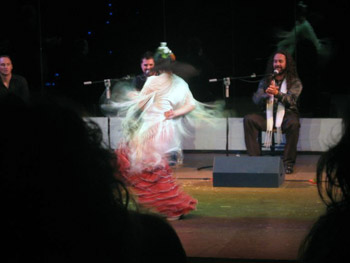 Of course, to say that Granada is the home of Flamenco is a very controversial thing. Seville also claims this title, and competition between the two cities is fierce. But whatever your opinion on the matter, it is undeniable that Flamenco inhabits every nook and cranny of this place, from the street corners where buskers play for spare change, to the smoke-filled caves of Sacromonte (the traditional Gypsy quarter), to the grand stages that draw large tourist crowds.
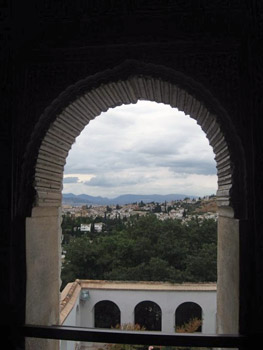 When García Lorca wrote about his Granada, he was keenly aware of living in a forgotten, lost world, not only inhabited by Gypsies, but also by those who came before. When the Moors ruled Spain, a policy of tolerance called La Convivencia (the Coexistence) led to the creation and preservation of a very multicultural society. While Spanish tradition sees this era as a dark period before the glorious Catholic Reconquest, Lorca felt quite the opposite. For him it was a Golden Age of reason and beauty, lost. However, traces of this world still remain in Granada to this day – in the terraced gardens of the Jewish quarter, in the winding narrow streets of the Albayzín (the Muslim quarter), and in the many churches that were once mosques (and mosques that were once churches) sprinkled throughout the city.
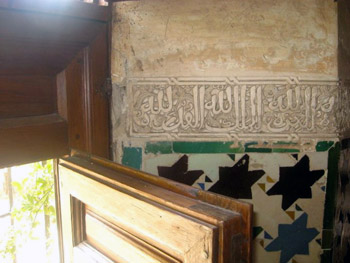
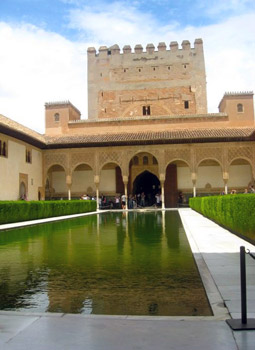
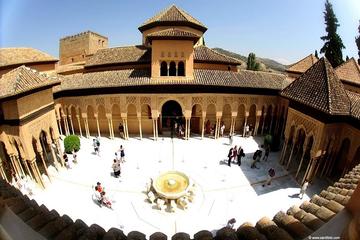
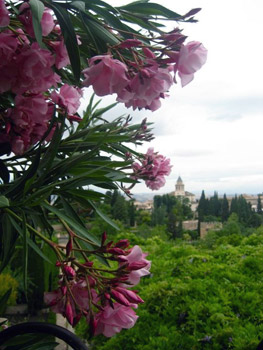 It’s not worth dwelling too much on the Alhambra, as every guide book on Granada mentions it, and it’s an absolute must-see whether you’re following in the footsteps of García Lorca or not. However, it is important to understand that it is one of the greatest examples of medieval Islamic architecture in the world, and that the soul of the city is inherent within its walls: in all that was lost, in all that was built over, and in the mysterious, magical energy that remains, nonetheless. In fact, García Lorca was so moved by the energy of this place that he chose it to be the staging ground for the Concurso de Cante Jondo, a contest of the Deep Song that he helped to organize in 1922. If you visit Granada in June, you can catch a glimpse of this contest’s modern descendant: the International Festival of Music and Dance, which features music concerts, dances and traditional Flamenco events, all on the grounds of the ancient red fortress.

 While the Alhambra is the most significant and audacious example of the ancient cultural mix that García Lorca so revered, there are many much smaller, simpler pleasures that tell the same story. Among the lovelier of the city’s customs is the tradition of convent sweets, baked good that are made and sold by cloistered nuns. The recipes are as old as the city itself, influenced by ingredients brought by foreign invaders: almonds, spices and citrus peels, among others. Because the nuns are cloistered, an unusual retail system prevails in order to actually buy these sweets. Upon arrival at a convent (of which there are many sprinkled throughout the city), you are greeted by a buzzer, a price list and a lazy Susan. When you’ve made your order, the lazy Susan spins, revealing tasty treats. An honor system prevails, and you pay the same way, via another spin.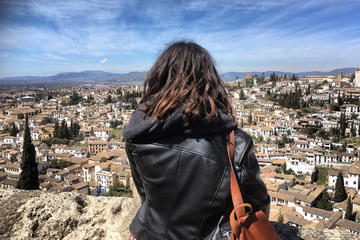
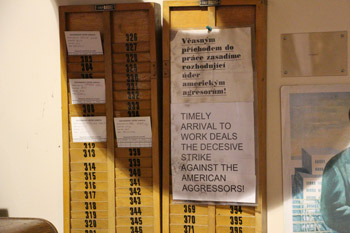
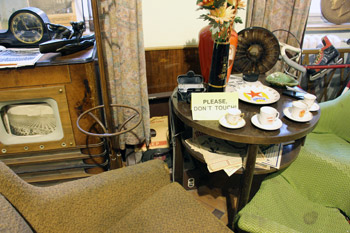
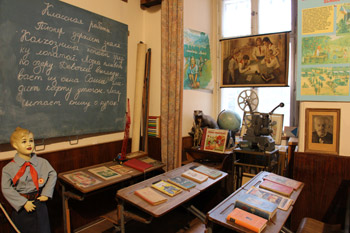 In order to understand Prague’s revolution, one must understand what led to it, and there’s nothing better than the Communism museum for this. The museum is full of exhibits of life under the regime, though one gets the feeling that it’s rather tongue in cheek, given the postcards devoted to life under Communism – “You couldn’t get laundry detergent, but you could get your brainwashed”; “It was a time of happy, shiny people. The shiniest were in the uranium mines.” That was my first clue that music had something to do with all of this dark history.
 The Prague Spring came about in 1968, when reformist Alexander Dubcek was elected as the First Secretary of the Communist Party of Czechoslovakia. Reforms by Dubcek were intended to grant more rights to citizens, including loosening strict restrictions on media – for the first time, young Czechs could listen to the Beatles on the radio. That was one thing that surprised me as I wandered the Communist museum – how willing locals were to seek out their favorite rock groups from America, buying records on vinyl from Western Europe and listening to them in secret.
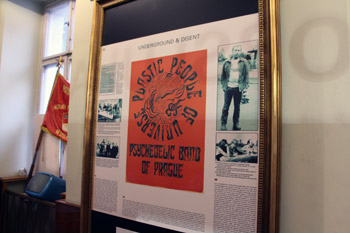 Inspired by the Velvet Underground, a group of Prague natives formed a band called the Plastic People of the Universe, just a month after the Prague Spring was suppressed by Warsaw Pact troops and just after Jan Palach, a philosophy student, set himself on fire on Wenceslas Square, issuing a warning before his death not to follow in his footsteps, a warning displayed on the walls of the Communism museum. The Plastic People played psychedelic garage rock typical of American FM stations of the time – led by front man Milan Hlavsa, a butcher by training, the group sang controversial songs of freedom, first in English, then in Czech. Their first studio album was called “Egon Bondy’s Happy Hearts Club Banned,” an ironic spin on poems by outlawed Czech poet Egon Bondy and the everpresent Liverpudlian Fab Four.
 In 1970, the Communist government revoked the license for the Plastics to perform in public, forcing them to take the second part of the band title that had so inspired them literally – the Plastics were going underground. For years, they remained relatively off the radar, until 1976, when they played a music festival in the town of Bojanvovice, leading to arrests of all of the band members on charges of “subversive activities against the state.”
 Marta Kubisova is just one of the many Czechs who was inspired by the “Hey Jude” single. The actress and singer first graced the public eye when “Prayer for Marta” became a symbol of national resistance in 1968, during the Prague Spring. And in the same year, when “Hey Jude” was released, Marta adapted it, releasing her own translated version in 1969 – the cover made her a local star.

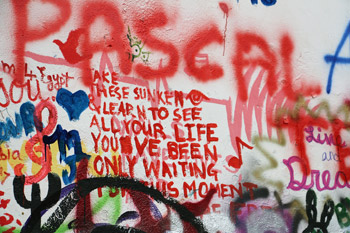
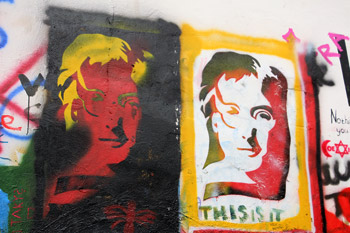
 Today, the John Lennon wall still attracts hundreds of tourists, who come to look at the ever-changing paintings. The Knights of Malta have long since ceased trying to stop the graffiti. But while John Lennon is a meaningful symbol for many, it’s hard to understand just how much his music meant to young Czechs in the 80s.
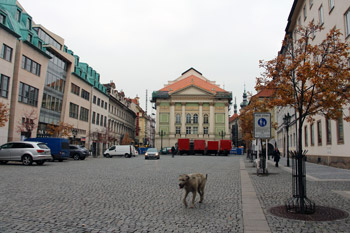 The wall first popped up in 1980, just after Lennon’s death, just a few years before Prague students took to the streets. The wall was created in memory of the man who, for them, embodied the freedom and liberation they so craved. “Lennonism,” then, a celebration of freedom and independence, became the counterpoint to Communism, and the evidence remains in Prague today, years after the fall of the Iron Curtain.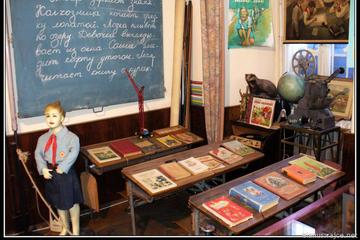
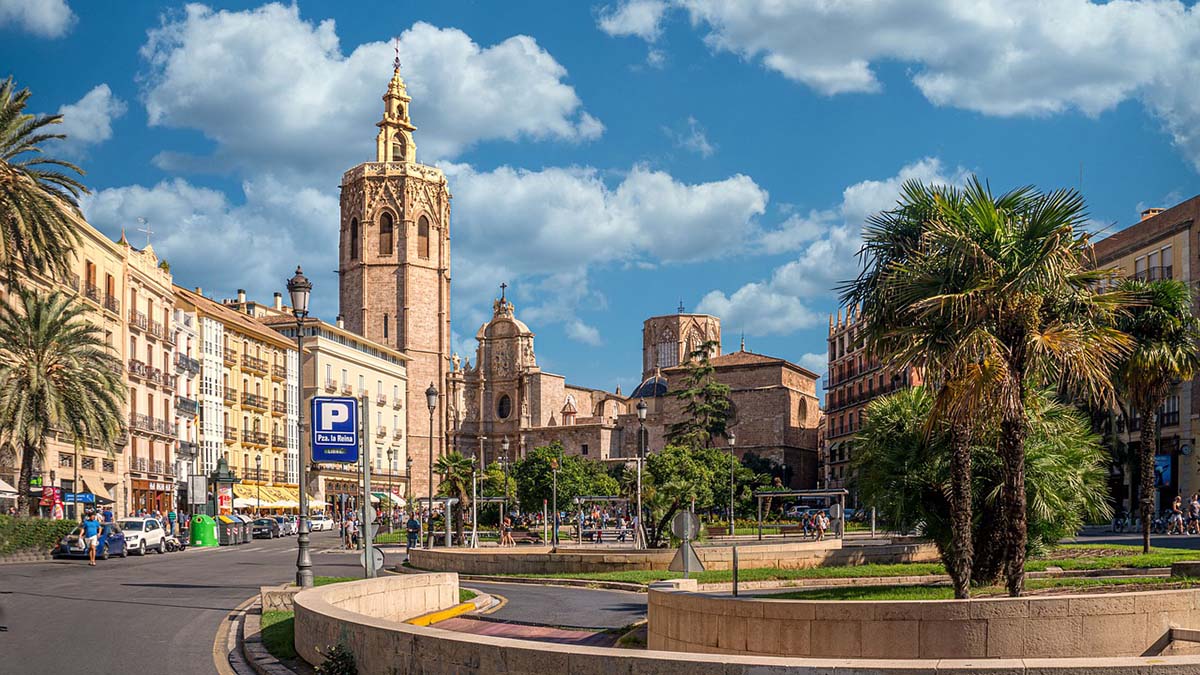
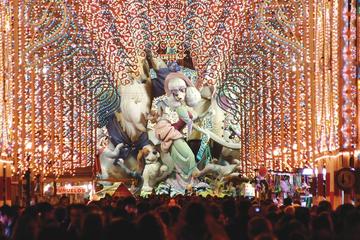
 When, just over a week ago, I arrived in Valencia, Spain’s third largest city located on the Mediterranean and full of history, I did so, literally, with a bang. It’s the time of year when a spectacular festival, known as Las Falles, is celebrated, culminating on the 19th of March with a parade of gigantic ninots, papier-mâché effigies which are, at the end, burnt in a massive bonfire to chase winter out and welcome spring. Fireworks, crackers, you name it, anything which makes noise and has color will assault the senses.
 The story of the Holy Grail or chalice, which is the cup Jesus supposedly used during the Last Supper, has fired the imagination over centuries. Did it survive, where was it, is the story really true?
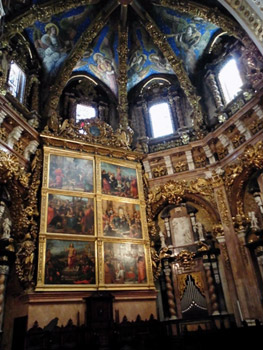 Given the many legends, it is not surprising that there are more than one chalice which lay claim to being the ‘real thing’. It will appear though that the chalice kept in the cathedral of Valencia has the most valid claim to authenticity. At least, it has been the official papal chalice for centuries, last used as such by Pope Benedict XVI in June 2006. It was given to the cathedral of Valencia by King Alfonso V of Aragon in 1436.
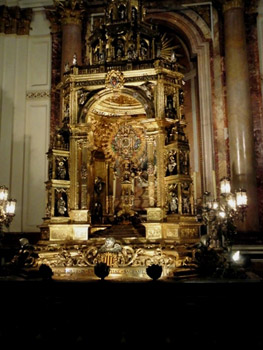 It’s very easy to get around Valencia’s historic center on foot, leading past several other landmarks like the Central Market and La Lonja de la Seda, the silk exchange. The cathedral was consecrated in 1238 and is basically a Gothic structure. Built over a former Visgothic cathedral which was turned into a mosque during the occupation by the Arabs, the cathedral also shows Romanesque, Renaissance, Baroque and Neo Classical elements. What first catches the eye is Miguelete, the octagonal bell tower which looms up near the main portal and can be climbed, offering a fabulous view over the city, port and river.
 A richly decorated interior, particularly the blue and gold ceilings and many important paintings leaves art lovers mute in admiration. And then, on your right, in a chapel of its own, there it is: the Holy Grail. I was a bit disappointed, because you can’t really get close to see the cup. Not only is it kept in an illuminated glass show case, but it’s also roped off quite a distance away. Even so, remembering all the stories about the quest of finding the grail and then standing there, close to what many believe and archaeologists have confirmed to be the chalice used at the Last Supper, gave me a frisson. Experiencing history up close and personal always is a thrill.
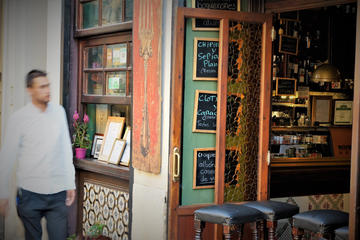
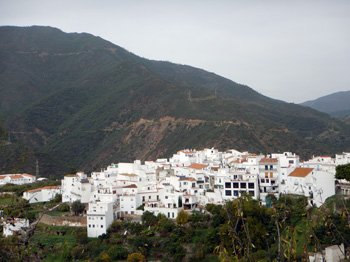
 Created for mules and packhorses, the narrow streets are steep and best experienced on foot. We park the car and explore this village of Moorish roots dating back to 1448. A map painted on a whitewashed wall provides a guide around the historic section. We wander the almost perpendicular avenues, passing quaint tiled courtyards decorated with flowers and greenery in terracotta pots. The pristine white houses accented with charming old wooden doors are postcard worthy. We soon reach Juana de Escalante Passage, the remainder of the centre of the old Muslim town, tucked in a side street.
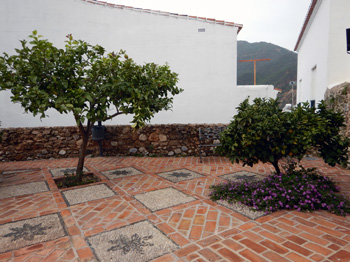 This was the site of a Moorish rebellion in 1568. The niece of the cleric, Juana de Escalante, stopped the rebels by throwing stones at them from the tower until aid came from Marbella. All that remains is the site the tower once stood on, the round archway and the courtyard through which horses passed through on the way to the stables. Standing there I sense the walls could tell many stories over the centuries. I look down and observe the detailed tile work on the ground. It is a work of art.
 Throughout the village is a series of water fountains providing fresh water for the inhabitants over the centuries. The fountains are as attractive as functional; decorated with blue and white tiles, some painted with scenes of the area. The mountain water is prized for its purity.


