Andalucia, Spain
by Tina Irving
Romantic Spain is a land of castles and fortresses, relics of the Arabs and Romans. Andalucia has its image of flamenco and bull fighting. West of Malaga the old Spain has been erased and replaced by the glitzy coastal resorts of Fuengirola and Marbella, better known for their sun drenched beaches and package tours than for their castles. To the east lie the towns of Nerja, Torrox Cost, Almunecar and Salobrena steeped in history. In Nerja the caves have drawn visitors since the 1950s; But what of the castles of area, and Roman ruins?
Volumes have been written about the palaces of Granada, the last stand of the Moors against the mighty armies of Castille and Aragon led by Ferdinand and Isabella, the Catholic Kings. Little has been chronicled of the castles of the eastern Costa del Sol, the gateway to North Africa, ripe with piracy in the Middle Ages and attacked by generations of would-be Arab rulers. The gloss of the travel brochures show scantily clad bodies and relentless sun but nothing of the magnificent peaceful gardens of the castles of Almunecar, Salobrena and Almeria.
Almunecar is situated 15 kilometers west of Salobrena, 56 kilometers south of Granada and 18 kilometers east of Nerja. En route from Nerja you witness such beauty spots at La Herradura, “the horseshoe,” an apt name for the shape of the bay. The salubrious development of Marina del Este snuggles amongst the trees on the hillside. The road winds down to the coast when you leave the main road, and runs beside a shingle beach lined with cafes where you can sip your beer and watch the waves roll on to the shoe.
Follow the road towards town and take the turning for Castillo San Miguel. The road twists and turns and suddenly you arrive at the ruined Moorish castle. It was a stronghold of the Kings of Granada and where they kept their treasure before being ousted by Ferdinand and Isabella in 1492, the same year as Columbus discovered America. The narrow cobbled streets between cube-shaped houses are negotiable by car, and, if you have a good sense of direction, you can drive through to the centre of town.
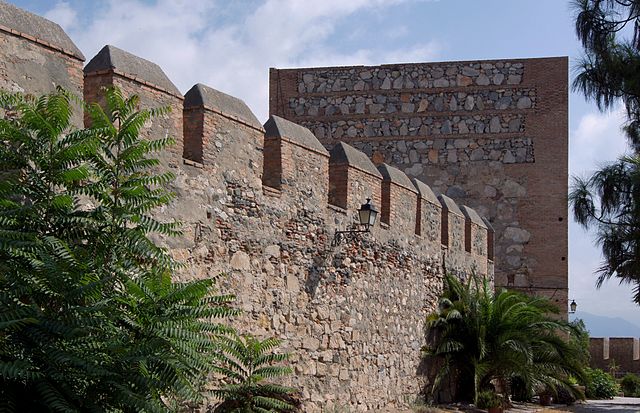 The coastal town of Salobrena is 10 km east of Almunecar. The coastline to Salobrena along the tropical coast is wild and rugged. To the left the awesome peaks of the Sierra Nevada and to the right the glistening blue of the Mediterranean. Salobrena stands unmolested by mass tourism, although now boasts an eighteen hole golf course. In the winter, the snow capped Sierra Nevada provides a magnificent backdrop to the green of the third hole.
The narrow winding streets of the town remain as a tribute to the Moorish era, the cube shaped buildings nestle together beneath the looming fortification of the Arab castle. The maze of streets defy the sense of direction and one encounters colourful plazas and little cafes tucked away in the back streets. Calle Anton Segovia leads directly to the gates of the castle, a pretty paved avenue with plants and flowers. The castle has served as a retreat for the Muslim Kings, a defender of the port and beach, and also as a prison. It was one of the most important strongholds on the coast of Granada both from civil and military point of view. Most of the restoration work was done during the Muslim period, but there is evidence that other work was carried out during the reign of the Catholic King and Queen after the earthquake of 1494. The work continued in the 16th and 17th Centuries. During the late 17th Century and 18th Century the importance of Salobrena deteriorated despite being kept as a defense against pirates.
In the 19th Century its prestige was restored when the castle was used as a fortification against the invasion of the French troops. No further news can be found until 1956 when restoration began again and the Granada newspaper “La Patria” uncovered some earlier articles about the castle as well as some hand dawn plans. The castle is now fully restored and summer festivals are held in every year in its grounds.


The road snakes along the coast and eventually straightens into long avenues. Almeria looms, its Alcazaba is the focal point of the town. The Arab fortress was built by the Caliph of Cordoba Abder-Rahman III, enlarged by Almanzor and completed by Hairan, and covers an area of 35,325 sqm. with a perimeter of 430 metres and an average width of 83 metres.
The castle is situated on a small hill, 95m high, close to the sea and lying east-west, which provides a natural defensive wall and shelters the ravine of La Hoya, site of the original city on the side of the hill. The hill also overlooks the small cove formed between the foothills at the edge of the Sierra de Gador and the mount of the Rambla de la Chanca river – a fishing district whose name still recalls tuna fishing store.
Some kind of fortress must have always existed on the castle hill for defence and look-out purposes to guard the natural harbour of La Chanca, which was used firstly by the inhabitants of Iberian Urci, then came under Roman occupation, and although its population disappeared or was dispersed during Byzantine and Visigoth eras, the settlement reappeared during Arab domination under the name of Bayyana (Pechina) using La Chanca as its port and the castle for the defence. The castle was enlarged and modified in the time of Abdurahman III ad the Almedina was built in front of it, by the sea, surrounded by walls. This led to the founding of the city of Almeria in 955, the Arab town of Bayyana gradually ceding to Almeria as the capital of the region, due to the importance and security afforded by the castle to the Moors of the Almedina.


On 26th December 1489, it was surrendered to the Catholic Kings and subsequently, in 1522 and 1560 – was partially destroyed by earthquakes. Having been abandoned since 1800, its reconstruction was begun in 1950 to restore it to its former glory and today it stands as a reminder of the fierce and warlike past of the area, representing to the Almerians the history of the founding and origins of their city. Much of the grounds have cultivated and developed into beautiful gardens, a tranquil place to visit on a sunny afternoon. It seems impossible that the rigours of war and earthquakes once threatened to destroy the castle.
Southern Spain is littered with such remnants of the past, pieces of history fitting into a jigsaw and enriching our knowledge of another way of life.


If You Go:
The south of Spain is well known as a destination for beach holidays. The focus is on sun, sea and sand. However, there is a lot of history in the region and many hidden corners which are still relatively undiscovered. Almeria, Almuñecar and Salobreña are just three of those destinations. July and August can get very crowded as not only do the north Europeans have their holidays then, but the Spanish from other parts of Spain travel to the south coast for rest and relaxation.
Be prepared for a more relaxed, laid back way of life. Even though Almeria is a town, it has the feel of a “rural” town without the hustle and bustle of a town. Salobreña is even more laid back and has beautiful beaches to relax on after your history tour.
About the author:
Tina Irving is an established travel writer, having had articles accepted by The Lady magazine, New Panorama and Market Place as well as writing for the local press in Scotland and Spain. She also writes articles about economics and tourism. Tina is a member of the National Union of Journalists (NUJ) in the UK, although she is based in the Malaga region of Spain. Web: www.tinasfreelance.com
Photo credit:
Alcazaba almeria fortress andalusia by ddzphoto from Pixabay
Fortres Salobrena by Jebulon / Public domain
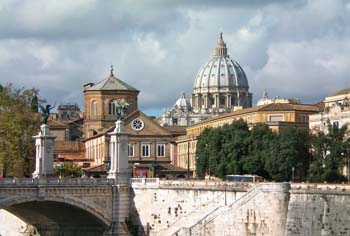
 In 293 BC, Rome suffered from one of the many pestilences which proved the tribulation of the Ancient world. Seeking divine aid, a delegation of high priests and doctors made a pilgrimage to Aesculapius’ temple at Epidaurus. In response to their prayers and offerings, one of the temple’s sacred The success of the quest was thus assured. Upon the ship’s return to Rome, the snake slithered into the Tiber and crossed to the reed-covered island, which lay opposite the city’s port. This was so obvious a sign Aesculapius desired a temple here, not only was one built but the island itself hewn to resemble a ship. Large structures of white travertine were built at either end to augment the resemblance to prow and stern, complete with a bust of Aesculapius and his caduceus. In the centre of the island an obelisk was raised to suggest the main mast of a Roman galley. Thus dedicated to the powerful god of healing, the Isola Tiberina has been associated with the care of the sick ever since.
 With the growth of Rome, the reputation of the Isola Tiberina’s temple and its doctors grew such that the sick ventured here from all over the Empire to seek healing. Like its namesake at Epidaurus, the temple became famous for the drinking of its miraculous waters, and for dream cures. Most probably opium (or a similar opiate) was used to produce a drugged state filled with dreams, hallucinations, and a susceptibility to suggestion. Hypnosis was a key factor; priests appeared in the dim, smoky light dressed as Aesculapius, and sacred snakes and dogs flickered their tongues over ailing body parts. The fame of these cures was to outlast both the Roman and Greek Empires.

 The hospital can be reached from the Left Bank via the Ponte Fabricio, which links the Old Ghetto to the island. At the junction of the two join stands the Pierloni-Caetani Tower. Built by the Pierloni family before 1000 AD at one of the most strategic approaches along the Tiber to Medieval Rome, it was used first by the Pierlonis and then the Caetanis for control of the river. Jewish in origin, the Caetani family was to produce a pope, Anacletus II. The Adjacent Pierloni-Caetani Castle, which fronts onto the Piazza San Bartolomeo, served as a fortress for several fugitive popes in the Middle Ages. It became a Franciscan monastery in the 17th century, and is now the Tiber Island History museum.

 About the author: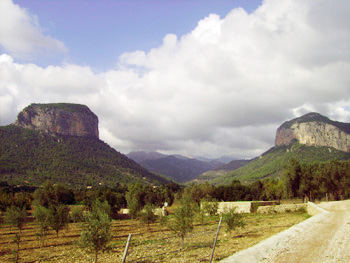
 Seeming to grow out of the craggy mountaintop, the castle has panoramic views of the Bay of Palma, the mountain range and much of the flat Mallorcan hinterland. Starting at the foot of the mountain the walk, which takes you past an agrotourismo hotel, takes around two hours. If you have faith in your driving reflexes and you have a hire car with a relatively good ground clearance you can continue to drive, shortening the walk to about forty-five minutes, and park amongst the goats at the smallholding adjacent to the Es Verger restaurant. Inside, the family are inevitably sat having one meal or another, while the wooden furniture, assorted mismatched objects around the walls (and the local matriarch) emit a faint smoky smell; a mixture of tobacco and the winter fires fuelled by the tonnes of wood piled up around the courtyard all year round. The jangling bells of the goats, which starts echoing down here and follows you all the way up to the castle, are enchanting and, were it not for the refrigerator of cola in the restaurant, you could be in a long-forgotten world of knights, serfs and Saracens.
 From this point, again, you can continue the drive but it’s not advisable. The few vehicles that do brave the stony track are usually taking supplies up to the hostel and ‘bar’ which is located within the 17th century church complex in the castle. Even these must stop at a final way-station where the last few hundred metres up the ancient steps are made with the help of donkeys, who you may see tethered in the shade along the flat ridge beneath the castle. Up here, in the still, warm air, with the craggy parapets looming down like an old eagle waiting to pounce from its precipitous eyrie, it’s easy to understand how this castle was a key defensive centre for both the pre-Islamic inhabitants of Mallorca and the subsequent Muslim and Christian rulers.
 The Balearic Islands came under the dominion of Islam perhaps as early as 707-8 AD but, as the Muslim world fragmented with civil wars, which saw the Abbasids emerge triumphant, the now independent Umayyad Emirate of al-Andalus, today’s Spain and Portugal, was forced to wage a series of wars in the Western Mediterranean to solidify its authority. It is from this period that we have the earliest historical mention of the Castell d’Alaro.
 The remaining walls around the castle are still an impressive sight and as you meander up the steps, cut out of the cliff to serve the pilgrims who would later trek to the church in the 17th century, you can feel the history coursing through the stones. Unlike many of the other castles in Mallorca there has been relatively little done to ‘restore’ the walls and what modern work there is tends to be associated with the church buildings which now house the hostel and bar.
 At the side of the mountaintop opposite to the gatehouse there is a completely sheer drop down to the farms in the valley below where birds swoop in out of their nests in the cliff’s crevices. Apart from them, and the deafening cicadas, it is completely still and you can almost imagine a scene from El Cid playing out on the plains far below. There are few views on the island to rival this and the ruin, unadulterated by heavy handed restorers, has maintained an allure that is unrivalled by the busier historical sites like Palma’s Almudaina and Capdepera. Just as the Banys Arabes offer a retreat from the clamour of modern Palma, Alaro transports you back in time to the age of chivalry, crusades and Andalusi enlightenment.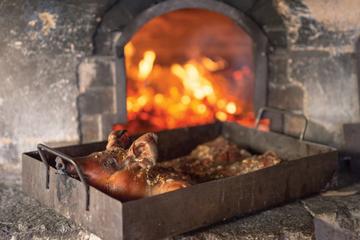
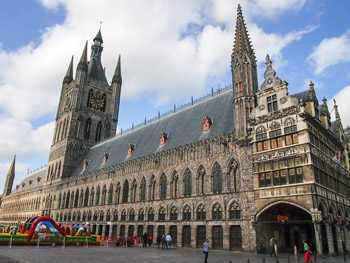 If you’re ever thinking about visiting Belgium, there are many, many places that are worth visiting. An excellent suggestion would Flanders Fields. The historic area known as Flanders Fields is the part of the province of West Flanders that had the misfortune of being one of the front lines during the First World War.
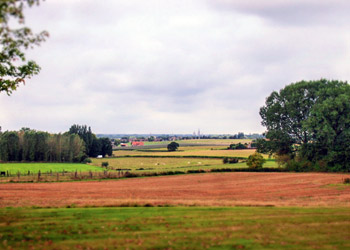
 After the war, Ypres was rebuilt from scratch and nowadays it’s a nearly perfect replica of the pre-war city. Although there is not a single building that is older than a century, the city center looks exactly like the old medieval city that was leveled by mortars. Its beautiful town square, lined with typical narrow Flemish row houses with crow-stepped gables, is dominated by the magnificent Cloth Hall, now the home of the downright fabulous Flanders Fields Museum. This is the place where you should start your visit of Flanders Fields, emerging yourself in the interesting history and unimaginable horrors of the Great War. By being aware of what happened in this region, you’ll look at the following landmarks, which are now set within a peaceful landscape of flat fields and slowly meandering rivers, from a completely different perspective.
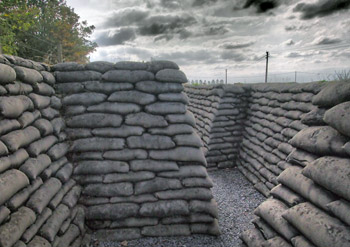
 After exploring the Flanders Fields Museum in the morning, head out of the city for a tour of the surrounding area. The Trench of Death is located near the River Yser and the city of Diksmuide. This was by far the most feared part of Belgian front, a part where the Allied and German trenches were only a few dozen steps apart. The trench was feared by all front line soldiers, for being positioned there meant almost certain death. Nowadays, a section of the trench system has been beautifully preserved and is free to visit. The remains can be explored on foot and offer an impression of what life in the trenches must have been like.
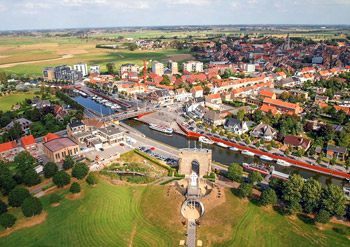
 Another nearby highlight is the 84-meter-tall Yser Tower, which is the tallest peace monument in Europe. You can get to the top with an elevator, enjoy great panoramic views of Flanders Fields and head back down the stairway, leading through a museum of war, peace and the emancipation of Flanders.
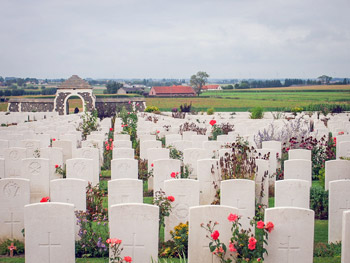
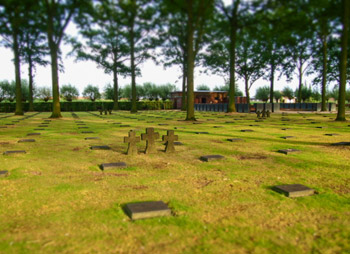 Properly visiting Flanders Fields can’t be done without a visit to a few war cemeteries. The region is home to literally hundreds of those, so you’ll have to make some choices. The most notable cemeteries are the Vladslo Soldatenfriedhof (the resting place of more than 26,000 German soldiers), the Langemark Soldatenfriedhof (the largest German war cemetery, with more than 44,000 soldiers), the iconic British Tyne Cot War Cemetery, and Polygon Wood Cemetery and Buttes New British Cemetery. All of these cemeteries were built near battlefields, making it easy to bury the dead after the battles ceased.
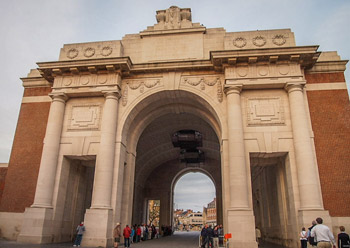 Back in Ypres, you should definitely head to the imposing Menin Gate, where the Last Post ceremony is still held every evening at 8pm sharp. The ceremony has taken place every evening since 1928 in commemoration of the British soldiers who gave their lives for the Belgian people. The huge Menin Gate in itself is a major landmark, a war memorial dedicated to fallen British and Commonwealth soldiers whose bodies were never found. The enormous Hall of Memory contains nearly 55,000 names of missing soldiers, but, as large as it may be, is still too small to contain all names. The rest of the names of missing soldiers are inscribed on the wall that surrounds the British Tyne Cot War Cemetery.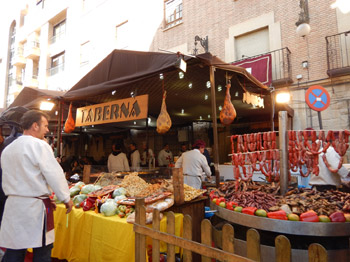
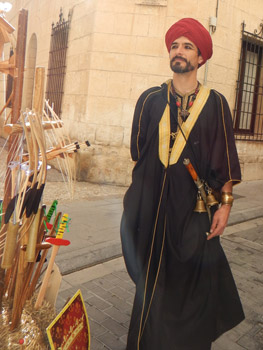 We wander aimlessly around the numerous stalls of artisans, bakers, butchers, fishmongers, drummers, acrobats, camels, ponies and much more scattered throughout the town. Every corner we round, we see new and exciting sites. A troupe of drummers march down a street and stop at the cathedral to put on a show. Knights Templar serve special cakes. Bread is baked on site in ancient wood-fired ovens. Belly dancers greet us on a side street. A camel tender gives rides to children while an ancient merry-go-round and a puppet show, including a dragon, delight the little ones. It is truly a family event with all ages taking in the festivities.

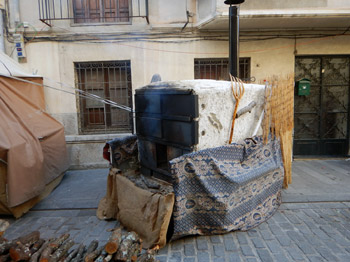 We stroll aimlessly around the various tents and stalls, tempted by the food for offer until we stop for a relaxing tea and delicious tapas. For dessert we share a bag of warm, freshly made churros sprinkled with sugar. Nibbling on our tasty treats, we wander some more, stopping to watch a sculpture at work and a blacksmith create a sword. Along one avenue is a display of birds of prey with an authentic falconer present. He allows a young boy to put on a glove and hold a falcon on his wrist. The smile never leaves this young man´s face. I particularly like the owls as each one seems to have a personality of its own.