by Lynn Smith
Some seven hundred years ago an anonymous author wrote: “To be in Paris, is to be.” How apt those words were, I thought, as I strolled along the streets of Paris early one morning some months ago. My goal was to explore the two beautiful gems lying in the River Seine – the Ile de la Cité and the Ile Saint-Louis.
Paris at 6am on a crisp, spring morning is mercifully devoid of all but the most robust tourists. At that hour, I had the city virtually to myself, except for the waiters opening up the restaurants and setting out the dainty chairs and tables on the pavements and the cheerful delivery men, offloading their fresh produce. From the bakeries came the enticing aroma of freshly baked baguettes and croissants, reminding me that I’d had no breakfast as yet.
My first stop was the Ile de la Cité. This island, and it smaller sister, the Ile Saint-Louis, are the two boat-shaped islands lying in the Seine, connected to each other via the Pont St. Louis. The Ile de la Cité is considered to be the heart of Paris and the original settlement of the Parisi, the boat people, a Celtic tribe who settled on the island from the 3rd century B.C. Then, in 53B.C. Julius Caesar and his Romans arrived and camped on the Ile de la Cité. They named their settlement Lutetia Parisiorum. The settlement was connected to both the left and right banks of the Seine by wooden bridges, which were later burnt by the Parisi during the Gallic Wars. The Bridges, however, were soon rebuilt and the town walled and enlarged by the victorious Romans. By 200 A.D. the Roman settlement had expanded to the mainland.
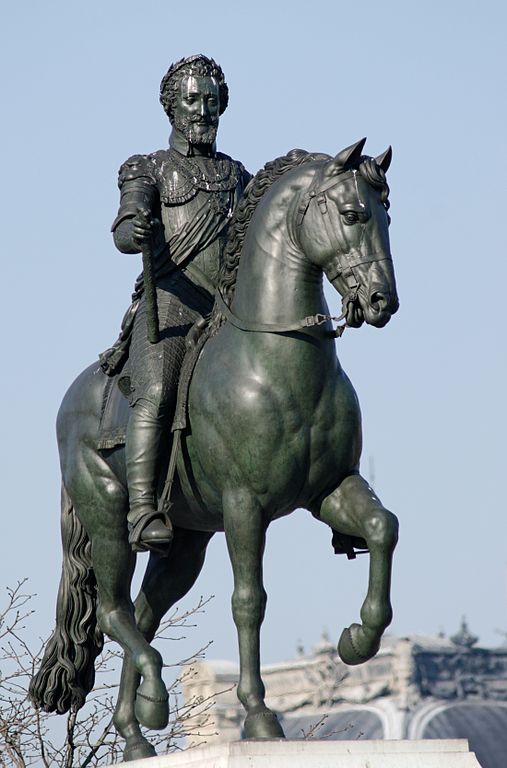 One of the four bridges connecting the Ile de la Cité to both the left and right banks and the one I used to gain access to the island, is the Pont Neuf. On the north side of the bridge is the elegant equestrian statue of King Henry IV, poised in front of the delightful garden called the Square du Vert-Galent. King Henry, known as the Vert Galent (Gay Spark) was a notorious ladies’ man and it is believed that he dallied with his lady loves in those gardens – a tradition which the young Parisians of today still uphold and one to which I can attest, as even at that early hour, I noticed a young couple, seated on the grass, locked in a passionate embrace.
On the other side of the bridge and facing Henry’s statue are two symmetrical buildings, known as the Pavilions. These two elegant structures stand guard over the passageway which leads to the entrance to the Place Dauphine. The Place Dauphine is commonly referred to as a square, but it is actually a triangle, surrounded by gracious redbrick buildings and shady chestnut trees. On that spring morning, as I entered the square, it was almost deserted except for two elderly ladies, sitting on a bench with their two little dogs. Seeing them, I, too, decided that a little rest was in order and sitting down on a nearby bench, I contemplated the idyllic scene before me and breathed in the history of the place.
Henry of Navarre (Henry IV, 1553-1610) was the first Bourbon king of France. A protestant, he ascended to the throne amidst much religious turmoil. As a Huguenot, it took him five years to realise that Paris would never be in his grasp unless he converted to Catholicism. Bowing to the inevitable, he remarked “Paris is worth a mass”, promptly renounced his protestant faith, converted to Catholicism and was accepted in to the Catholic Church in 1593. After his coronation, he lost no time in making Paris his own.
In 1607 work began on the Place Dauphine, according to Henry’s design. The square was built in honour of his son, the Prince Dauphine, the future King Louis XIII, who was born in 1610.
Henry placed his financial minister, the Duke of Sully, in charge of the building. The houses facing the square were all built with the same tasteful redbrick façade. They were of a uniform height and less pretentious than the hôtels (urban mansions) but more elegant than the normal bourgeois houses. The area signified a new style of living, where the neighbourhood was refined, genteel and friendly.
In the 19th century, Baron Haussmann, the renowned town planner, with true reconstructive zeal, swept away almost all the 17th century structures and other medieval buildings to be found elsewhere on the island, but luckily he was fired before he could start demolishing the houses in the Place Dauphine.
Today, in addition to the lovely old chestnut trees and grand houses, there are several cafes and restaurants surrounding the square. I visited one of the cafes in search of a hasty breakfast and ordered an espresso and a chocolate croissant. Delicious! Both hunger and thirst then satisfied, I continued my exploration of the island.
To the east of the Place Dauphine, the triangle opens up to the imposing and somewhat formidable façade of the Palace of Justice, the seat of Paris’s legal and judicial systems. The original site had, through the centuries, been the home of the French kings. Today, much of the complex is of modern construction and visitors are not allowed into the offices or law courts; tourists are, however, able to visit two fascinating areas within the complex and these are Sainte-Chapelle and the Conciergerie.


Sainte-Chapelle
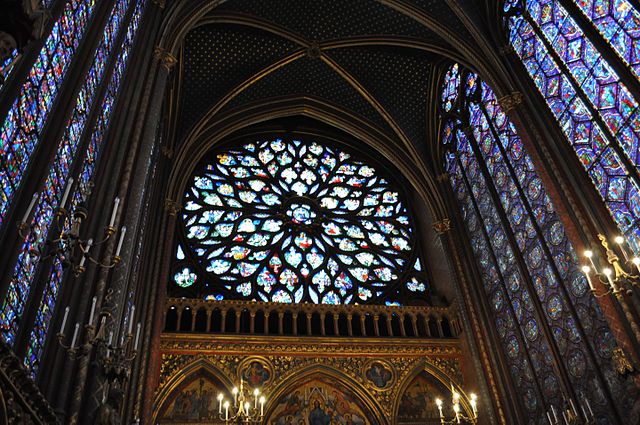 On a previous visit to Paris, I had been soundly rebuked by an elderly French gentleman when I told him that I’d never visited Sainte-Chapelle, so on this visit I was determined to rectify my earlier omission. I’m so glad I took that gentleman’s advice, for Sainte Chapelle, with its glorious stained glass windows is a sight not to be missed.
Work on Sainte-Chapelle began in 1245 and was completed in 1248. It was commissioned by Louis IX for use as his private chapel and to house the sacred Crown of Thorns brought back from the Crusades. The upper level of the chapel was linked to the king’s royal apartments in the Palace de la Cité (now the Palace of Justice). The lower level served as a chapel for the servants of the royal household.
In 1485 Charles VIII added the rose window and in the 19th century, interior decorations were made by Emile Boeswillwald. The chapel has had many lucky escapes; from fire in 1776; from revolutionaries in 1789-93 and from the Communards in 1876.
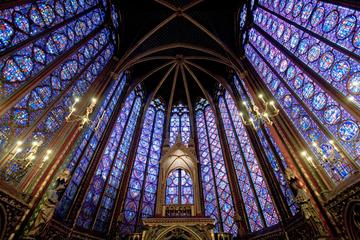
The 50ft high windows of stained glass are such a profusion of glowing colour that one’s eyes are dazzled. The windows on the east side depict events from the New Testament, including the Passion of Christ and the life of St. John the Baptist, while the windows of the nave portray scenes from the books of the Old Testament. These windows are the real gems of Sainte-Chapelle, its raison d’etre, as it were, as the chapel is no longer used as a church except for once a year, when a special mass is said on St. Yves’s day in May. The chapel is now a tourist attraction and is used as a museum and concert hall.
The Conciergerie
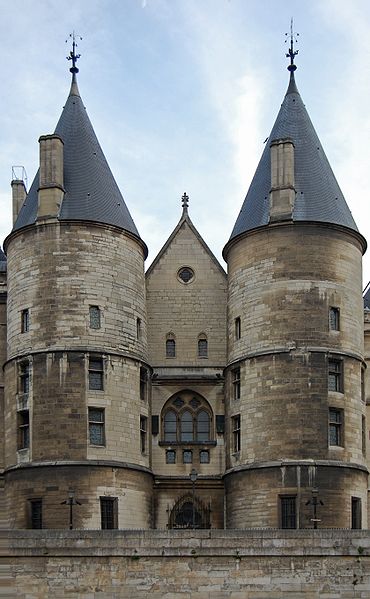 My next port of call, still in the same Palace of Justice complex, was the Conciergerie, on the west side of the island, facing the Quai d’Horlage. The Conciergerie takes its name from the post of the Concierge, a high-ranking official who was placed in command of the Palace of Justice when Charles V moved his royal palace to the Louvre. Part of the Palace was converted to a prison in 1391 and, over the centuries, criminals from all walks of life whiled away their miserable years in the dank cells. The Conciergerie is best remembered, however, for those imprisoned during the French Revolution, when citizens suspected of being counter-revolutionaries were incarcerated in the Conciergerie while they awaited their turn at the guillotine. The most famous prisoner of all was Marie Antoinette, wife of the ill-fated Louis XVI, who awaited her execution in a tiny cell, only separated from her guards’ constant surveillance, by a curtain drawn across half the cell.
In the Salle des Girondins, there is a guillotine blade on display, also Marie Antoinette’s crucifix and the lock from Robespierre’s cell. The female prisoners of the Revolution were allowed to take their last exercise and final farewell from their loved ones in the Cour des Femmes (Womens’ Courtyard).
The three towers which distinguish the Conciergerie were built between the 13th and 14th centuries. In the 13th century, Louis IX built the Tour Bonbec, so named because prisoners were so cruelly tortured there, that they lost their reason and became babbling idiots or “bonbecs.” The Tour d’Argent (or Silver Tower) was the place where the royal treasure was stored and the Tour de Caesar was named in honour of the Romans.
The Conciergerie continued to be a prison until 1914, after which the building was declared a national monument.
 So much violent and sad history had happened in those forbidding walls that I was quite pleased to emerge in to the sunny outdoors once more. Before proceeding to the Ile Saint Louis, there was one more place of interest that I wanted to see, just a short way from the Conciergerie, in the Place Louis-Lépine. This was the beautiful Art Nouveau Metro sign, the “Metropolitain”, painted in typical Art Nouveau manner, and just one of the two remaining original Metro signs done by Hector Guimard. Nearby, is the famous Marché des Fleurs, the wonderful flower market, which has been on this site since 1830. On Sundays this market becomes a bird market.
Anxious to visit the Ile Saint-Louis, I hurried down the street and there, before my eyes, rose that great medieval structure, the Notre Dame. This amazing cathedral is a “must” for all visitors, but having previously seen it on a number of occasions, I decided to forego a visit this time. Suffice to say that the site of Notre Dame has had religious significance for over 2000 years. The main part of the Cathedral took 167 years to complete, transitioning (with consummate ease) from the Romanesque style of architecture to the Gothic, thus creating a medieval masterpiece.
Time for a late lunch at one of the many bistros located in the side streets and after a simple, but enjoyable meal, I was soon on my way again. On the Pont St Louis, I stopped to watch the street performers on the bridge and marvelled at their talent and creativity.
The Ile Saint Louis
 The Ile Saint-Louis was originally called the “Island of the Cows” but was renamed in honour of Louis IX. The connecting bridge to the Ile de la Cité was completed around 1628 and a bridge to the mainland was built in 1635. Once access to the island was accomplished, building began in earnest – all the nouveau riche – the wealthy farmers, merchants and members of the bureaucracy – hurriedly bought land and built beautiful hôtels on the eastern half of the island. Development on the western side came later, where the houses were built in the same elegant design.
The main street, the Rue Saint-Louis en île, runs the whole length of the island from west to east. The long street, with its fine old buildings, is today much as it was in the 17th and 18th centuries. The streets are narrow, mainly one-way and there is no metro station, nor are buses allowed. There are many shops, a couple of hotels and lots of restaurants – all up-market, as befits the ethos of the island. Ile Saint-Louis is a quiet, relaxed place to visit – perhaps not a great tourist attraction – but I fell in love with it and found it absolutely charming. It is not surprising that the Ile Saint-Louis contains some of the most expensive real estate in Paris.
I spent a happy couple of hours on the island, thinking of the many thousands of feet which had trodden across the island, from the days when it had been a pasture for cattle, to the 17th century when the wealthy bourgeoisie began to reside there.
It was with genuine regret that, with dusk approaching, I decided to make my way back to my hotel, a fair distance away, in the VIII arrondissement. My last view of the two islands was of the setting sun casting its shadows over the buildings and its reflection on the still waters of the Seine.
It had been a memorable day for me – a wonderful exploration back in time, to the history of this beautiful and elegant city – a city which never fails to leave an indelible impression on every person who visits it.
References:
♦ 1997. 2nd ed. Cole, Robert. A Traveller’s History of Paris. Moreton-in-Marsh, Glos. : Windrush Press.
♦ Personal travel diary of the author.
Ile de la Cité Walking Tour with Lunch and Boat Cruise
Paris Ile de la Cite Medieval Private Walking Tour: Notre Dame, Sainte Chapelle and Conciergerie
If You Go:
The Cité metro station is on the Ile de la Cité and is very central for all the tourist attractions on the island. The best way to see the island, however, is to approach it by foot, via the Pont Neuf. There are several walking tours which one can take, but in my view, the most relaxed way is to visit the islands on one’s own – this way one is not regulated by time and can wander at will. A good map and guide book are all one needs to explore both islands. I do recommend, however, a guided tour of Notre Dame. The queues to visit the cathedral are quite daunting and it’s best to have a guide who can smooth the way, explain the various parts of the cathedral and give a detailed account of its history.
The links below can supply information on when and where to arrange for a guided walking tour:
Paris Walks – Summer
Discover Walks – Top Paris Walking Tours
Discover Walks – From Notre Dame Cathedral
About the author:
Lynn is a retired librarian who lives in Durban, South Africa. She lived in London for some time many years ago and has returned to visit several times in the past few years. Her last visits overseas were to Eastern Europe where she fell in love with Prague and Budapest. When not travelling, Lynn enjoys writing articles for the internet and does freelance editing and proof-reading. She is a keen gardener and shares her home with her six beloved cats.
Photo credits:
Pont Neuf, with the Square de Vert-Galent in the foreground Copyright © 2003 David Monniaux under the Creative Commons Attribution-Share Alike 3.0 Unported license.
Equestrian statue of King Henry IV by Jastrow / CC BY
Stained glass windows, Sainte Chapelle by Bill Peloquin / CC BY-SA
The Towers of the Conciergerie by King of Hearts / CC BY-SA
Hector Guimard’s Art Nouveau Metropolitain sign by John Pannell / CC BY
A panoramic view of Il de la Cite and Ile Saint Louis by: Myrabella / Wikimedia Commons
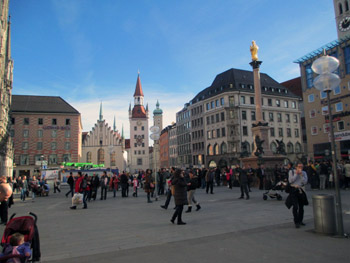
 Instead of carrying around a thick guide book which forces visitors to stare down at the tiny print and flip pages, a great option for those seeking to learn about the war-related history is to sign up for Sandeman’s New Europe, Third Reich walking tour. For 12 euro, my journey through the dark history began at the center of the city, at the beautiful Marienplatz. Immediately, the tour guide, who was a walking treasure chest of knowledge instructed the group of 10-15 people to look up at our surroundings. After explaining how the majority of the area was completely bombed out during World War II, he pointed to the main spires of the Marienplatz, and the giant green domes from the Frauenkirche. He explained how the bomber jets from the allied forces used them as landmarks in their bombing campaign, therefore they were spared and remained mostly intact. Chills immediately shot down my spine, as I felt the realness in which surrounded me. This was real, and these were not events which took place in the Dark Ages; this was a time that our close relatives could have lived through. It was a time in which the desperation of the German people gave way to the rise of a former painter from Austria, and allowed Adolf Hitler to guide his people, and the world into a conflict that took the lives of nearly 85 million people.

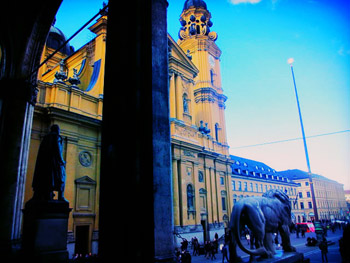
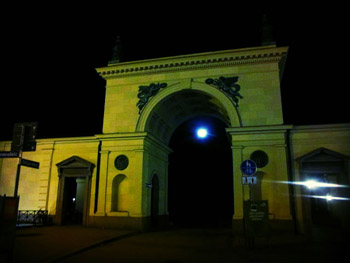 Walking through the streets of the 1,000-year-old city would lead most to believe that the surrounding buildings go back hundreds of years, but they would be greatly mistaken. Following the rise of Adolf Hitler in the early 1930s, Munich became the birthplace of the Nazi Party, and eventually one of the biggest targets for the allies during World War II. The result was thousands of bombs being droppedtact on the city, and to this day, an estimated 2,000 un-detonated bombs are still buried beneath the city. Since nearly 90 percent of the city was completely demolished, everything has been rebuilt, and reconstructed in the 70 years since to end of the war. While construction continues in the Bavarian capital, bombs are still discovered on a weekly basis, and teams have to come in to safely detonate the bombs which range anywhere from 4 lbs to 22,000 lbs. Our tour guide told stories how entire street blocks have to be closed, and entire apartment complexes cleared out when one is discovered. Life goes on, and the residents of Munich accept it as if it is nothing more than a minor inconvenience.
 Prior to the air-raids by allied troops, Adolf Hitler was well aware that Munich would be a major target, and knew the city would be leveled. Planning ahead, he ordered photos be taken throughout the city, so that when the war ended, the city could be built exactly as it was prior to its near destruction. Following the death of Hitler and the fall of the Nazi’s, the German people voted to restore the city to its old glory, resulting in a complete rebuild. Since everything has been rebuilt, it gives visitors a unique perspective roaming the streets, and ducking into beer halls and cafes that fill the city. While the history is thick, and I could nearly feel it hanging in the air, it also felt like stepping into a movie set. Along the guided tour, we were taken to places of historical significance, such as the world-famous Hofbräuhaus. We were taken upstairs into the beautiful beer hall, and shown the place where the Nazi leader once spoke. However, the reality is that the building is a complete replication of the original, somewhat taking away some of the powerfulness which stood before me. It is fascinating, yet saddening how such beautiful architecture and sights were destroyed, but in spite of the restoration, there is still the ghost of the German dictator that echoes throughout the halls.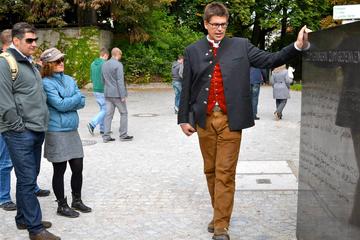
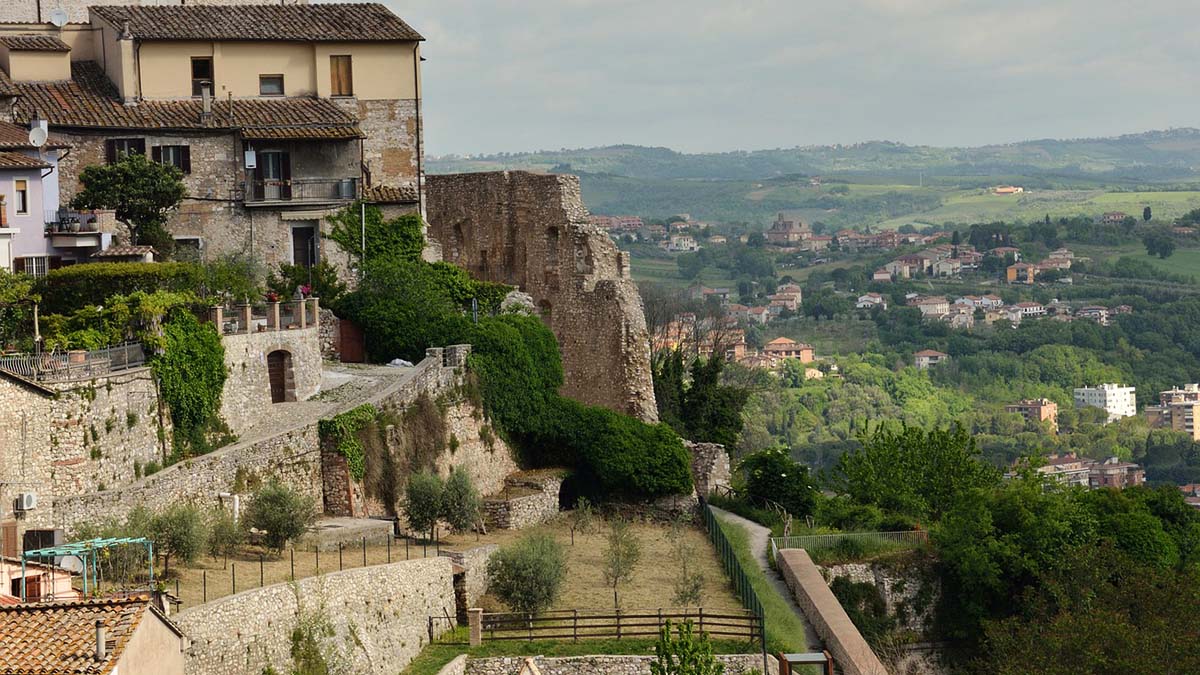
 The delightful medieval town of Narni in Umbria would perhaps have gone almost unnoticed, apart from being considered to be the exact geographical centre of Italy, if it hadn’t been for C.S.Lewis. While examining a Latin atlas of Europe, he came across the name Narnia, which soon took on a whole new meaning. Although Lewis never visited Narnia, or Narni, as it is now known, it may not be pure coincidence that the tomb of Blessed Lucy of Narni can be found in the town’s impressive cathedral. Images of mythical beasts in stone and iron decorate the ancient buildings and streets. The lion features prominently.
 Guided tours of Narni Underground nowadays begin in the church, which was consecrated as “Santa Maria delle Rupe”, although the discovery of a copy of a fourteenth century contract revealed the church’s original name as being Chiesa di Sant’Angelo or S. Michele Archangelo (St Michael The Archangel). Although the church has sustained considerable damage, due to water infiltration, beautiful frescos of Christ on the Cross and symbols of the evangelists still adorn the walls and the ceiling is painted with stars and a symbol of The Lamb of God. The Archangel Michael features fighting a dragon and weighing souls. Several skeletons were found in tombs in the floor of the church, which has still not been completely excavated.
 Convinced there was still more to discover, in May 1979, the young potholers, whose efforts to draw attention to their discovery were largely ignored, found a blocked up door in a garden on the other side of the wall. Being denied permission to try and open the door, the friends took advantage of boisterous festivities, during the local medieval celebration the “Corsa all’Anello”, to cover noise while they made a hole in the door. They were stunned by what they discovered. A short passage led to a large windowless chamber, which later came to light had been used by The Court of the Inquisition to “extract” confessions from those accused of polygamy, blasphemy, witchcraft and adultery- crimes which labelled them as heretics. “The Room of Torment” now contains models of gruesome torture instruments used on these ill-fated souls, including the rack and Judas cradle. Beyond the chamber, the group came across a tiny cell, completely covered in mysterious graffiti. The inscription “Santo Uffizio” (Holy Office), was the key to leading them to understand the area had been used by The Inquisition.
 The graffiti in the prison cell appears to have largely been the work of one desperate prisoner, Giuseppe Andrea Lombardini, whose name is inscribed on the wall under the date 1759 and the remains of the word “Innocent”, which was erased by his guards. Lombardini left a series of cryptic messages and mysterious symbols ,made from a mixture of brick dust and urine, that seem to have a peculiar mixture of origins. Masonic symbols, such as a triangle with a dot, symbolising the eye of the Grand Architect of the Universe merge with strong Christian symbols such as crosses, religious monograms and a representation of the legend of St Nicolas. An image of a tree surrounded by doves is thought to symbolize the tree of life. A sinister falconer catching birds under the tree may represent the church, or the Inquistion itself, destroying freedom. The sequence 7, 24, 42, 70 is repeated in 3 areas within the cell. The sum of the interior numbers is 66, whereas that of the exterior numbers is 77, therefore implying the battle between good and evil. It is interesting to note that the graffiti artist deliberately replaces the letter D with the letter T in his inscriptions, which is believed to express hatred for the Dominican order who ran the Inquisition. Suns, moons, ladders, Jesuit and cabalistic images leave secret messages that have still not been completely deciphered.
 In 2004, it was discovered that Trinity College, Dublin housed a number of important documents referring to the Inquisition including transcripts of the trial of Domenico Ciabocchi, confirming the existence of The Inquisition in Narni. Following this discovery, Robert Nini, one of the intrepid potholers and now president of Narni Underground, wrote to Cardinal Ratzinger (later Pope Benedict XIV) who granted him permission to consult the secret archives in the Vatican.

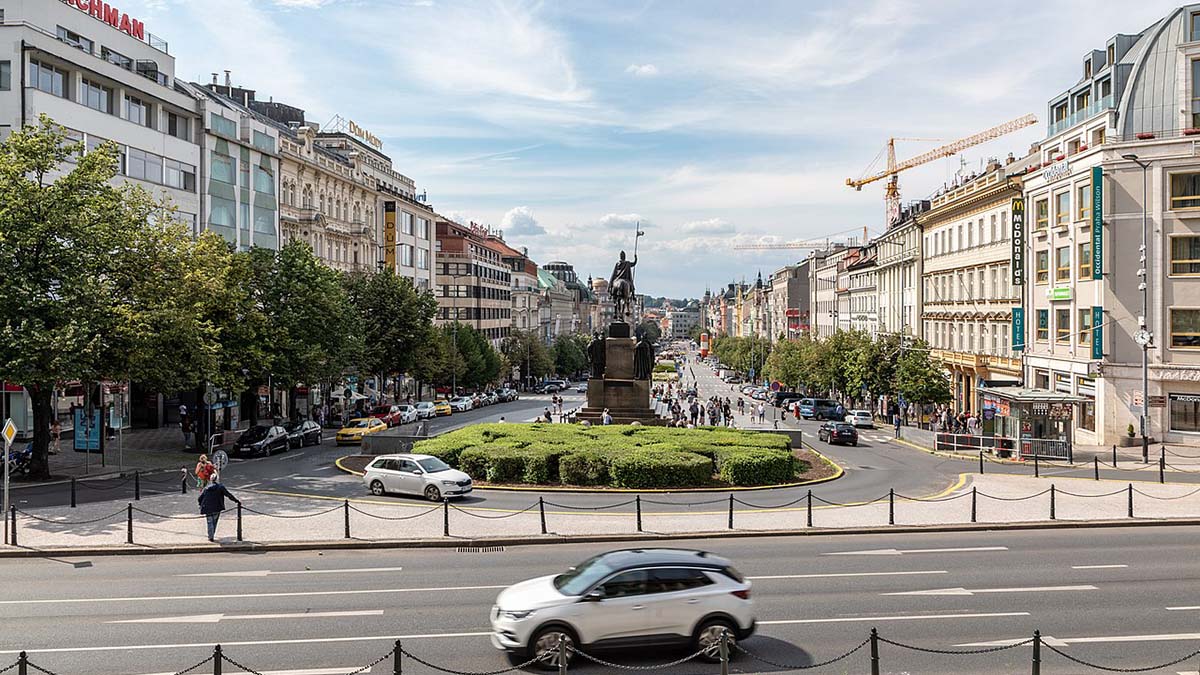
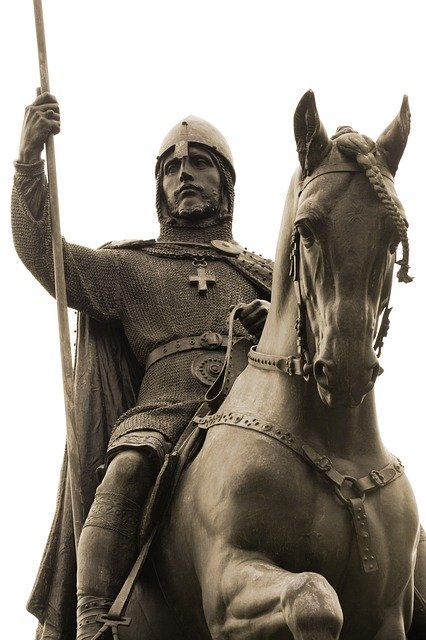 Wenceslas Square, one of the most legendary squares in Central Europe, in Prague, Czech Republic, has played host to a number of fitting names as well as false names. In tandem with the Czech people daily traversing its dark cobblestone, political subjugation in the 20th century led to cultural suppression and the great Wenceslas Square- named after a beloved Czech Saint and hero- was known momentarily by other names. Wenceslas Square (Vaclavske Namesti in Czech) was victimized by names and ideals forced upon it first by Adolf Hitler and then by Josef Stalin.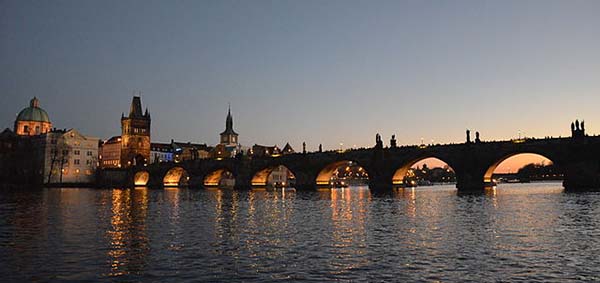

 I imagine Saint Wenceslas Square to be like a Czech person itself. She is (for I see her as a woman-elderly and strong) as much a part of Czech history and cultural identity as any other momentous figure- like say Saint Wenceslas himself, or King Charles for whom the oldest bridge in Europe was constructed, or the famously brilliant and brave Vaclav Havel.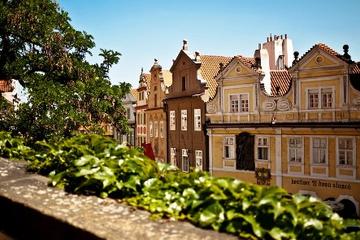

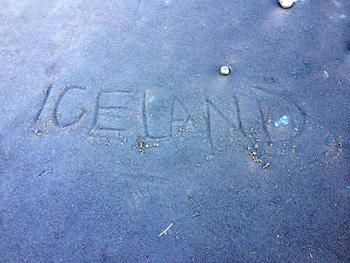
 I am writing this brief tour of the Icelandic Poetry Tradition from a loft in New York, where I am being visited by a poet I met in Iceland, HEK. He is also a musician, and was just signed yesterday. Not bad for five days in New York. The assessment of the current poetry scene in Iceland comes from HEK. The summary of the tradition comes from careful Googling.
 Icelandic Skaldic poetry tradition was written by skalds, which referred to Icelandic poets. Skaldic poetry was sung to honor nobles and kings, and to recall historic events or battles. Many are satirical and witty, using employing quirky language and humor. These poems are known for their complexity. Each has eight lines, each with six syllables and the lines are rhymed utilizing, alliteration, half rhyme and full rhyme.
 Before Skaldic poetry there was the Eddas, which is an Old Norse word that means great-grandmother. These were written in the 10th century and are a collection of poems of Norse mythology and legends.
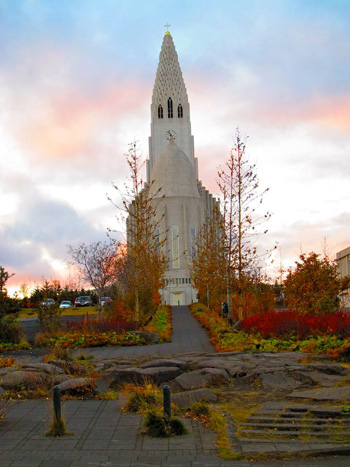 But in the 19th Century the romanticism that was invading the world arrived in Iceland and poetry returned in full force to the elf swept lands. The tradition in this period developed from the Old Icelandic Poetry before it. These poems utilized alliteration, steadfast rhythm, and a coherent length of line and stanza. Imagery comes from old mythology and medieval literature.