Florence, Italy
by Peppa Martin
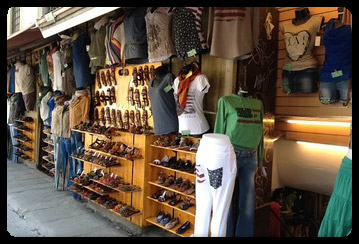
Bands of Senegalese boys wander Florence selling fakes. From random perches around the city, they hawk all kinds of coveted trinkets — sunglasses with luxury brand logos up on the Piazzale Michelangelo, Mont Blanc pens near the Bargello, Tiffany bracelets along the Arno’s bridges. Sometimes, they spread out their seductive goodies right under the official government-installed “Don’t Buy Fakes” sign in the sprawling Piazza Della Repubblica.
 I am amused and entertained by the wooing of passersby that ensues, the waltz of gestures and pivots, the come-hither looks. Economic casualty aside, I presume the pride of owning an un-Burberry outweighs the pesky oppression of jail. Yesterday, I watched as they installed themselves in front of the Prada store, selling fake Prada bags. Some laugh, some applaud, I cringe.
When word of approaching polizia comes via cell phone relay from their cohort scouts, they quickly roll everything up in woven blankets, and with lightning speed disappear down narrow alleyways. I understand this is a tedious, daily war between the cat army and mouse rebels– complete with sorties, offensives, strategies, troops and embedded spies.
 Rashid tells me he came from Marrakesh a couple of years ago. He is 25 and comes every day to the Palazzo Vecchio to surreptitiously sell cheap posters depicting iconic artworks hanging in Italian museums. With knitted brow and eyes cast to the clouds, he proceeds to say that on a good day he’ll sell 10 or 20 at five euros each. He leans in closer and whispers to me, proudly, his biggest seller is Botticelli’s ‘Primavera’.
This, on most days, he sells right under sweet Venus’s nose in front of the Uffizi Gallery where she hangs.
Today, that smart cookie Venus would have locked down her rights, copyrights, licenses, trademarks, proprietary website and endorsement contracts in perpetuity..
I pass legitimate kiosk vendors in the Piazza Della Signoria who sell miniature copies of Michelangelo’s monolithic ‘David’, right in front of the monolithic fake David which was installed in the former spot of the real David which was moved indoors to the Accademia Gallery to protect it from weather and depraved nutjobs. Now the fake David gets vandalized by wallclimbers, counter-culturists and ignoramus graffiti-taggers.
 I learn the real David, though housed in a quiet museum, has been attacked a few times, recently by a hammer-wielding fanatic. It was repaired by marble restorers, so is it disqualified from being truly real?


Da Vinci was an illegitimate child — is he disqualified too? I’m told he was later referred to as a ‘Native Son’, in an effort to cloak the shame of his status in more respectable terms.
We are awash in fakes, copies, imitations, lies, faux this, ersatz that, imposters, replicas, reproductions and simulated, airbrushed, retouched bogus posturing phoneys.
From derivatives to lovers, the world is full of Great Pretenders.
It was Anna Maria Luisa di Medici who, upon her death in 1642 decreed that all Florentine art and artifacts be retained in Italy for the benefit of the public. Thus, with great foresight, she preserved the country’s great works of art from sale abroad or theft by rival dynasties.
The real ones, mercifully, are still here — proof that authenticity does exist.
You can feel it too, because they emanate a near-imperceptible low-grade hum of exquisite grace.
And this, I accept, briefly satisfies the elusive quest for the real thing.
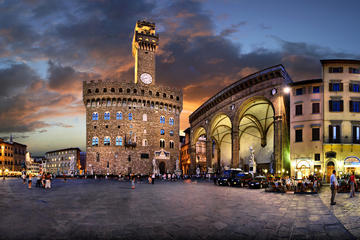
Florence Art and Street Food WalkingTour
If You Go:
Plan an easy day trip to ‘Il Palagio’, one of Tuscany’s most famous 14th century castles, which has produced wine and olive oil for the past 300 years. Originally owned by the Visdomini family, it became a fortress in the 15th century of the Repubblica Fiorentina for two centuries. Later, the City of Florence gave the castle to the Miniati family, who own the property to this day.
The splendid gardens are thanks to the Grand Duke of Habsburg-Lorena, and features a Cypress of Lebanon planted by a Napoleonic official. One can visit the resplendent, self-contained chapel adorned with frescoes, and then traverse to the chilly, damp subterranean dungeon cum cellar that today is home to huge oak barrels aging the eponymous Chianti Classico wines.
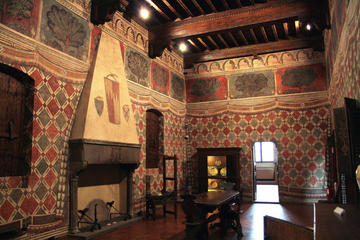
Private Tour: The Art of Living in Florence in the Renaissance with Exclusive Private Palace Visit
About the author:
Peppa is a full time professional photographer and gallerist, living in Vancouver BC. She runs her own business, “truth and beauty,” a commercial studio and boutique gallery of contemporary photography. www.truthandbeauty.ca Peppa is interested in ideas, people, art, places, design, architecture and gardens; loves to cook, read, dance, and be with family and friends. Her (fab) four adult children are strewn around the globe on three continents. Follow Peppa on twitter @4truthandbeauty and at instagram.com/pepstagrams
All photos are by Peppa Martin and Terri Fogarty (San Florenzo Market scene)
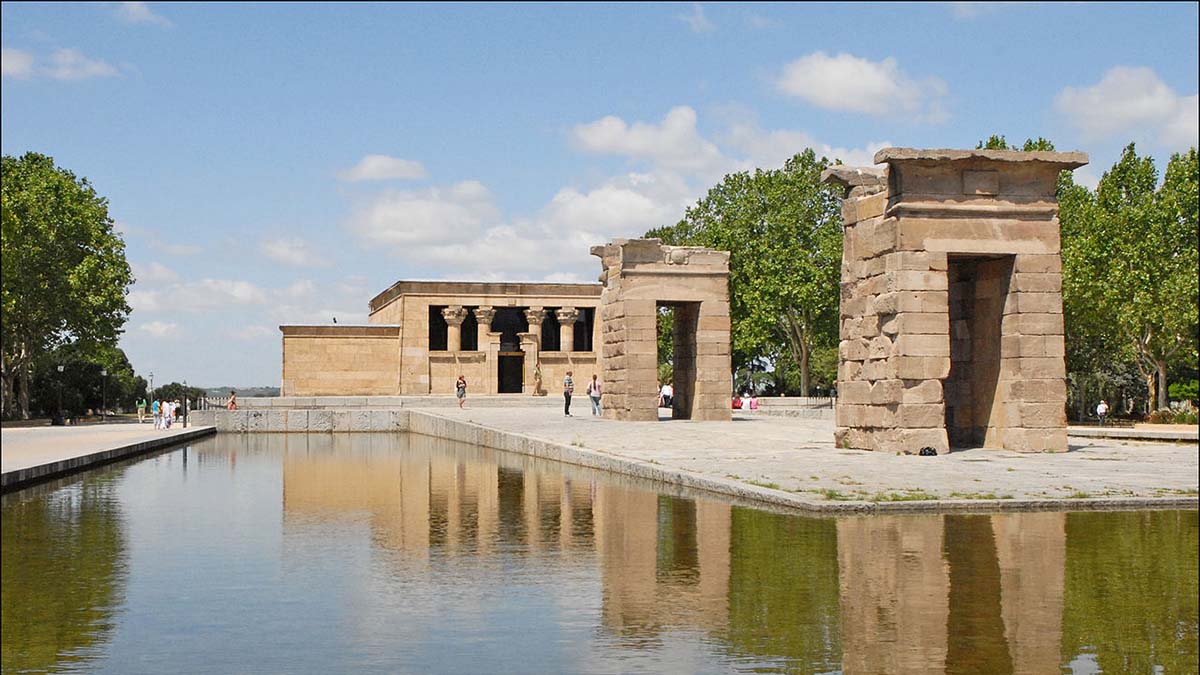
 Originally, the Temple of Debod stood on the right bank of the River Nile, just above the First Cataract near Aswan, dedicated to the god Amun and the goddess Isis. In 1898, the British, who then controlled Egypt, decided to dam the Nile at Aswan, the work being completed in 1902. With typical short-sightedness, they completely disregarded the fact that some important monuments would be lost beneath the surface of the resulting lake … including the beautiful Temple of Isis on Philae Island, and the not-so-well regarded Temple of Debod nearby.
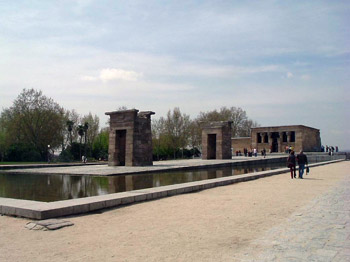 Immediately on boarding the boat above the Aswan Dam, the popular concept of modern Egypt was left behind. There’s only the boat, the lake and the temples … and tranquil, unhurried peace. On the way to Abu Simbel, the boat calls at the Kalabsha Temple site, Wadi el Seboua and the Amada Temples, all of which were rebuilt above the waters of the lake.
 For thousands of years, the temple was buried under the sands of the desert, until, one day in 1813, a sandstorm revealed a portion of it to Swiss explorer and archaeologist Jean-Louis Burckhardt. Four years later, an Italian named Belzoni managed to dig out enough of the façade to enter the temple.
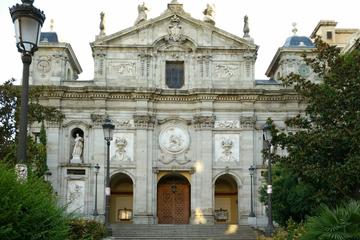
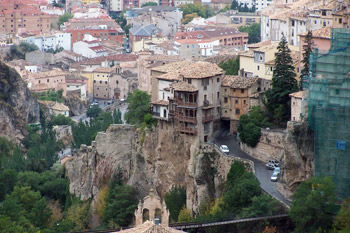
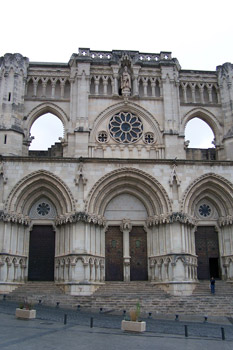 The hanging houses are the draw to this remote city but the old part of town itself is worth exploring. We take a short walk downhill from a lookout point to the Plaza Mayor where the Cuenca Cathedral is located. Dating from 1177, the building is impressive with its three arches. The Gothic Anglo-Norman façade is the only one of its kind in Spain with construction on the cathedral continuing for 300 years and never quite completed. I enjoy wandering the medieval cobblestone streets that wind past old stone houses, adorned with colorful plants spilling over the balconies and climbing up stairways.

 We spend the night at Hotel Cueva del Fraile or The Cave of Friars, an enchanting place seven kilometers up the road. This 16th century building hidden in the rugged mountains was once a monastery (for the devout), later a workhouse (for the poor) and now a luxury place of refuge (for the weary traveler). I get lost finding my room as I wander the myriad of stairs and hallways, which only adds to the charm. The structure has stayed true to its original construction and surrounds a peaceful courtyard. The rooms, with high ceilings, thick stone walls and wooden beams, have no doubt been made more comfortable since the days of the friars. Antiques depicting former times are found throughout the building. The hotel restaurant features delicious, authentic Castilian cuisine for dinner and breakfast. It’s impossible for me to resist the thick, creamy hot chocolate and chocolate filled croissants on offer. Staying at Cueva del Fraile is a memorable experience for someone with an overactive imagination. Rumour has it that there is even a hotel spook!
 What faithfully happens, as summer turns to autumn in Tuscany, is that people come down with a pernicious fever – let’s call it ‘acute funghiosis’ – which causes a delirious devotion to truffles. Truffles are discussed with the same intensity and fervor usually reserved for Plato. They are hunted, worshipped, prized, prepared and savoured — after which, the experience of hunting, worshipping, prizing, preparing and savoring is again examined with near-religious ecstasy. This epidemic grips the palate of anyone who eats, and can be cured foremost with a generous serving of taglierini alla tartufo.
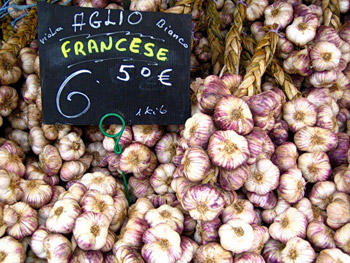 Now, this is also Olive Oil season, with capital ‘O’ s , and everywhere you go is the promise of 42 extra-virgins in heaven. Hand picked, hand pressed, home bottled, first run, double extra, organic, small batch, cottage industry silken oil flows more vigorously and greener than the Arno. Beautiful handblown bottles with delicately drawn artisanal labels beckon you from shop windows and market stalls with their liquid treasure of early fresh earthen green oil. Sadly, by the time it hits our shores, its colour and flavour have mellowed and that newborn nutty taste is but a memory of the motherland.
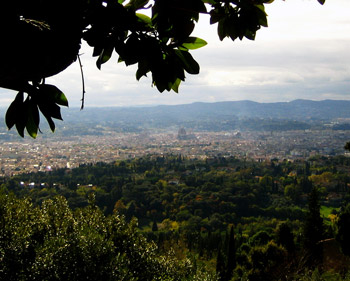
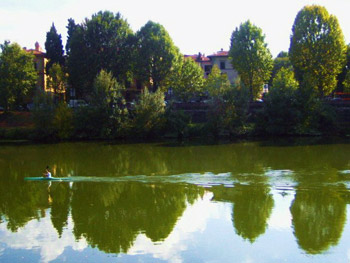 The next day, with late October sun on the city’s shoulders, I headed by local bus to the nearby borough of Fiesole, perched high in the emerald hills overlooking Florence. There is a spectacular hotel here, The Villa San Michele, of the Orient-Express group, that delivers luxurious vistas of the Florentine valley while dining al fresco. Skipping an overnight stay, I opted for the ‘express’ route of lunching like a local.
 Seated on the wide veranda, seduced by breathtaking views and splendid food, I felt fully intoxicated by all that seemed an enchanted illusion. It occurred to me then : Could this be a condition for which there is no cure ?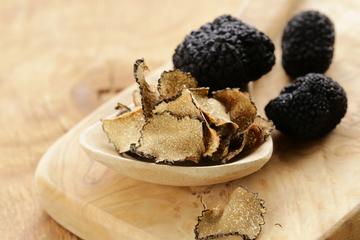
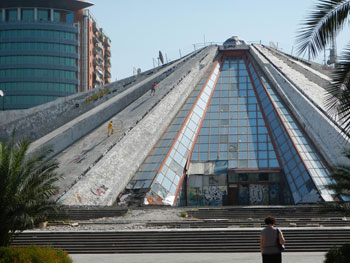 Another intriguing sight is the city’s huge pyramid, built in 1988 as a museum dedicated to the life of Enver Hoxha – the harsh dictator ruling Communist Albania from 1941 until his death in 1985. With the end of communism in 1991 it became a conference and music venue (you can still see the fading signage on the door of its defunct club). War in Kosovo saw it repurposed as a NATO base, and its current use is as TV broadcasting center…and climbing wall…and canvas for graffiti. The future plan is to demolish it to make way for a new parliament building. Climb up it, admire the artwork on it, and then get a bird’s eye view of it – as well as a generally spectacular view of the city – (preferably at dusk) from the Sky Hotel’s breath-taking revolving bar/restaurant .
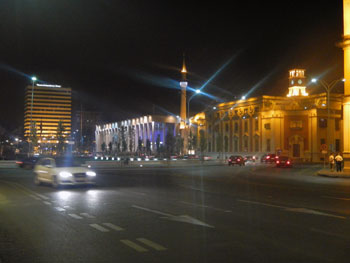 Move onto Tirana’s cultural centre, Skanderbeg Square, where you can admire the statue of Albania’s national hero, Skanderbeg, and the following:
 From Skanderbeg Square, catch a free, comfortable shuttle bus to either of the two recently established shopping malls. The 20 minute trip allows you to see the outskirts of Tirana and is a great way to meet people. Just act like a tourist when getting on, i.e. ask passengers whether you’re on the right bus or what time the last bus leaves. Doing this, I met a guy who worked at a university and a Japanese engineer who’d been in Albania for 3 years establishing a sewerage plant. Two fascinating conversations. Then, when you’re at the shopping centre, you can ‘people-watch’ while you ‘donate’ to Albania’s developing economy.
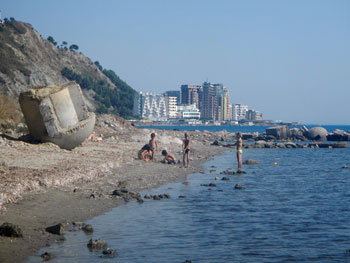
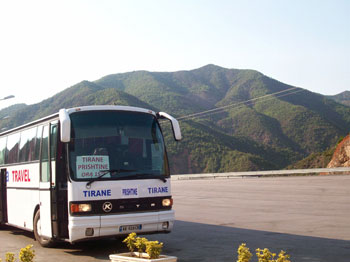 Durres isn’t the nicest of beaches. Go to the south of Albania if you want a nice beach. What Durres is good for is bunkers. In fact, you can find these all over Albania (although often on privately owned land), a legacy of Hoxha’s paranoia that built 700 000 of them to guard against anticipated nuclear attack. Another Durres oddity is its inundation with resort hotels and bars named after world famous beaches and backing onto crumbling village huts. Chickens are the last things you expect to see at the beach, but there they are ruffling their feathers in the sand! There’s a lot of atypical juxtapositioning like that in Albania: sheep graze around Tirana’s train station, universities stand side by side with car dealerships and industrial plants. Prepare to think you’re ‘seeing things.’
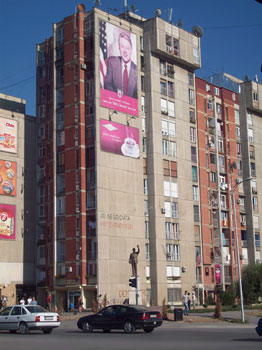 Everyone’s patriotic about their new country. Kosovo and Albanian flags wave proudly down the street, the words ‘Kosovo Republik’ are graffitied on every blank space of concrete, and there’s even Kosovo-brand Petrol stations (with Kosovo’s flag as its logo). Giant letters spelling the word NEWBORN celebrate Kosovo’s recent independence. What a spirit in the air! And, again, it was refreshing to be somewhere where it’s not fashionable to hate America. Indeed, in Pristina, it’s possible to go down Bill Clinton Boulevard and see a giant waving statue of former US President Bill Clinton!Clinton gained hero status among Albanians for launching NATO’s bombing campaign against Serbian forces attacking a newly independent Kosovo.

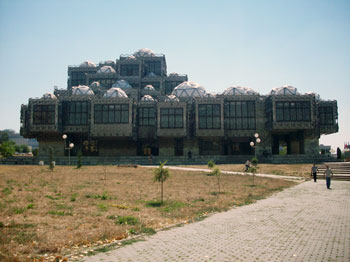 Nearby, you can see pacifism Communism-style in the curious looking Monument of Brotherhood and Unity (facing imminent demolition). And check out the equally unusual looking National & University Library of Kosovo, which includes, among its collections, an American Corner of English resources, events and conversation classes.


_31.jpg)

