Tuscany, Italy
by Sarah Humphreys
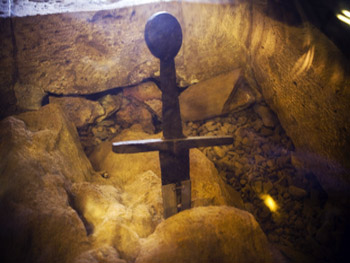
Unlike Arthur’s mighty weapon, The Italian version of Excalibur is on display for all to see, firmly wedged up to its hilt, in a smooth stone in the tiny round chapel of Montesiepi in Southern Tuscany.
Legend states that on Christmas Day 1180, a cruel arrogant knight named Galgano Guidotti had a vision of the Archangel Michael who urged him to renounce his evil ways. Galgano followed the angel to the top of Monte Siepi. Galgano claimed it would be easier to split rocks with a sword than give up his worldly pleasures. Fully expecting his blade to snap, he thrust his rock at the rock and was amazed when it penetrated the stone, leaving the hilt exposed. Galgano was immediately converted, became a hermit and befriended the wild animals in the area. He apparently performed 19 miracles and was eventually canonized.
 Cistercian monks built the round chapel of Montesiepi around the “cross” in the stone. The domed roof is built of concentric circles of alternating white stone and terracotta and frescos by Sienese painter Ambrogio Lorenzetti decorate the walls. It has been claimed that the chapel itself is a “book in stone” hiding the location of The Holy Grail.
The sanctuary features two minuscule side chapels. One houses mummified arms, whose origins are surrounded in legend. One version of the story says they are the arms of an assassin sent by the Devil to kill San Galgano, whose wolves protected him and “gnawed the bones” of the Devil’s servant. Other stories say that anyone who tried to remove the sword from the stone had their arms ripped off. The second chapel originally contained San Galgano’s head, which supposedly continued to grow blond curls for years after the saint’s death. The saint’s head can now be found in the small church in Chiusdino, where he was born.


 Italian scholars claim that Galgano’s Sword in The Stone precedes Arthurian legends and the original story may well be Italian. The first stories of King Arthur appear decades after Galgano’s canonization, in a poem by Burgundian poet Robert de Bron. It has been suggested tales of The Round Table may have been inspired by the round chapel and the name Galgano was altered to become Gawain. Claims that the Italian sword was a fake, made to echo Celtic legends of King Arthur, have been recently disproved. The skeletal arms in the chapel have been carbon-dated to the 12th Century, and metal dating research in 2001, by the University of Siena, indicates the Italian sword has medieval origins. Could it be that the stories of King Arthur are really based on Italian history?
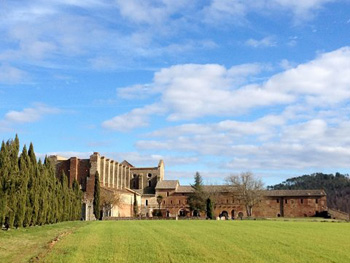
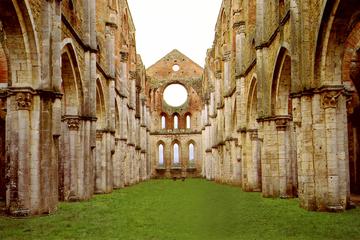
The crush of visitors flocking to the chapel of Montesiepi meant the Cistercians were authorized to build an abbey named after the Saint in the valley below. This masterpiece of Cistercian sobriety, consecrated in 1288, is one of the most beautiful Gothic buildings in Italy. Eventually assigned to a group of absentee abbots of noble lineage, a certain Giovanni Andrea Vitelli removed and sold the leading of the abbey in 1548. The roof of the abbey subsequently collapsed. Today, only the walls remain and the roof is open to the incandescent Tuscan sky. The imposing abbey of San Galgano, surrounded by fields of sunflowers and rows of cypress trees, is a magnificent sight, visible for miles around.
 Every summer the company Opera Festival Firenze holds classical music concerts and operas in this splendid setting. Performed annually, a spine-tingling rendition of “Carmina Burana “ under the Tuscan stars, is unforgettable. Other favourites include Vivaldi’s ”Four Seasons, “Swan Lake” and “La Traviata.”
Just thirty kilometres from Siena, the abbey is immersed in history and mystery and stunning in all seasons. An ideal spot for a romantic picnic, quiet contemplation and a gentle stroll through the incredible countryside, you can even enjoy a fine glass of Chianti at the little wine bar at the top of the hill near the chapel, San Galgano really should not be missed.
If You Go:
♦ The nearest airports are Pisa and Florence
♦ San Galgano is best reached by car. It is 30 minutes drive from Siena, 55 miles from Florence and 99 miles from Pisa.
For more information: www.sangalgano.org/ENG/howtogetthere.htm
♦ There are infrequent buses from Siena bus station.
For more information: www.sangalgano.org/inautobus.htm
♦ The Abbey is open every day during the hours of sunlight.
♦ For information on The Opera Festival: www.festivalopera.it
♦ For details on accommodation and restaurants in the area:
www.sangalgano.org/ENG/hospitality.htm
Full-Day Private Tour to San Galgano and Montalcino from Siena
Photo credits:
1.The Sword in The Stone by Giacomo Calossi
2. The Abbey of San Galgano by Gaylene Galardi
3. The Abbey of San Galgano by Gaylene Galardi
5. Scene from ‘Aida’ by Sarah Humphreys
About the author:
Sarah has been writing since she could hold a pencil. She is originally from near Liverpool in the Uk but has lived in the USA, Greece, the Czech Republic and Italy. She has been living in Pistoia, near Florence for 15 years, where she teaches English. She is passionate about poetry, literature, music and travel.
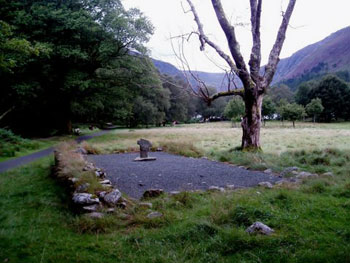
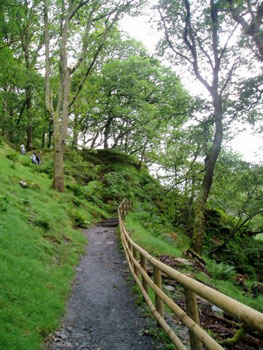 Stuck in Glendalough, I grabbed a quick late lunch from a local food cart and set out for a late-afternoon five-mile hike on Miner’s Road. This route took me by the two lakes toward the ruins of an 18th century mining village that closed down in 1965. Rows of purple heather greeted me with pine trees serving as an umbrella to shade me from the sun. Finally I got to sample paradise almost all by myself.

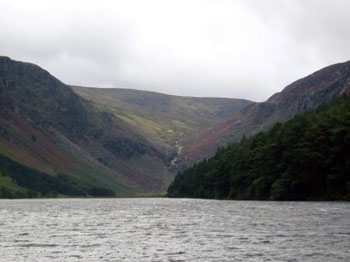 The next morning stopped by the Glendalough Visitors Centre where I bought a
 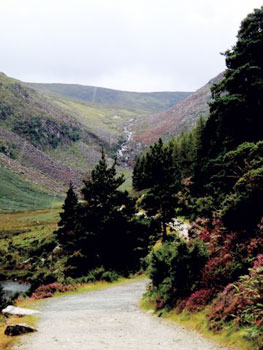 After I climbed down, I stopped by a shack located at the foot of Upper Lake for a quick snack and then set off on the Green Road Walk. This flat mile long trail that meandered around the oak woodlands and then continued to the edge of Lower Lake. Along the way, I passed by the outskirts of Monastic City where I saw more busloads of tourists, most of whom seemed more intent on taking photographs of stones than actually walking on Kevin’s soil. Hopefully some of them will leave the city for the hills and have their own encounter with Kevin.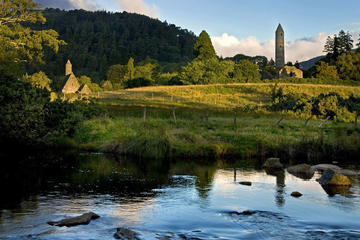
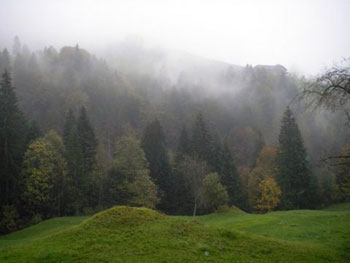
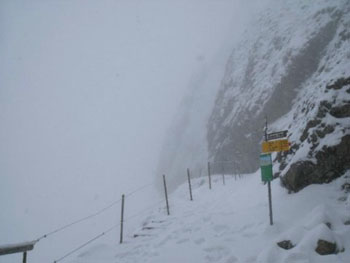 I’ve daydreamed about one day being able to scale a European mountaintop so I could sing that quintessential European classic pop song “Una Paloma Blanca.” It was in my grasp, but the Mt. Pilatus’ dragons and ghost of Pontius Pilate would not hear of it. Instead, they had a more memorable adventure in store for me. You see, I planned my day to go to the top of Mt. Pilatus via The Golden Round Trip. Mt. Pilatus is one of the Swiss Alps gateways that helped usher in Switzerland as a tourist hotspot in the late 19th century. I expected to do a good amount of hiking, but steady rainfall in the lower elevations of Luzern and reports of snow up the mountain before I even left Luzern appeared to hamper my day.

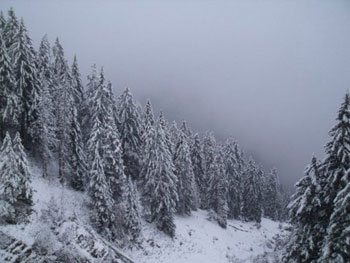 My second leg of the “Golden Round Trip” proceeded on the world’s steepest cogwheel railway from Alpnachstad, where us passengers experienced gradients as high as 48 per cent at speeds of about six to seven miles per hour. Going up, we were surrounded by thick evergreen forests being hammered by rain, then light snow, and then heavier snow as the visibility decreased. But I began to notice something on my ascent: I wasn’t feeling queasy anymore and my sinuses were clearing up as the 33 minute ride (that’s half price with a Swiss Pass) proceeded through several tunnels barely wide enough for the cog way carriages. The driver masterfully had to navigate the heavier snow amidst sudden jerks and stops. He laughed even though I was anxious (because there are three braking systems to prevent catastrophe).
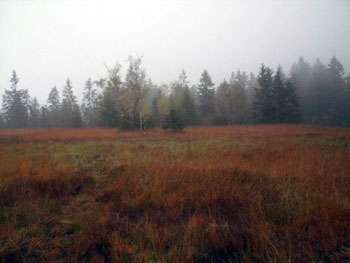 The Entlebuch resides west of Luzern, about 35 minutes by train at the stop called Schupfheim. It’s made up of eight villages and spans some 154 square miles and contains many of the Alps’ rolling foothills: roughly one per cent of the total land area of Switzerland. One fourth of this area is now protected moors (highland marshlands), which exuded a pleasantly eerie feeling amidst the fog, making me wonder if any monsters were lurking there.
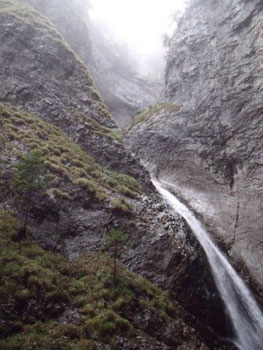 The town of Fluhi is on the other side of the Entlebuch, and provided me a great opportunity to see more breathtaking fall scenery in the Pre-Alps (foothills), ending at Cheesiloch, a canyon with a 130-plus foot drop. Prior to the path leading directly to the canyon, a 45 minute hike from town begins that has winding roads, cows who love being photographed (kept apart by a “fence” made of just one rope), and rolling meadows. The last 30 minutes to the canyon would be one of my most challenging hikes I’ve ever taken, and once again, my walking pole saved the day, for the narrow pathway was sharp and rocky, and drenched with wet maple leaves. Nature’s soundtrack included hearing the pleasant babbling of the Rotbach stream as I proceeded deeper into the dense evergreen forest with deep drops to the canyon below.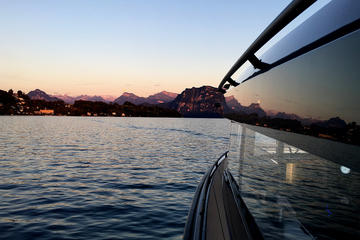
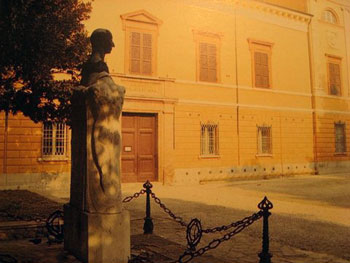
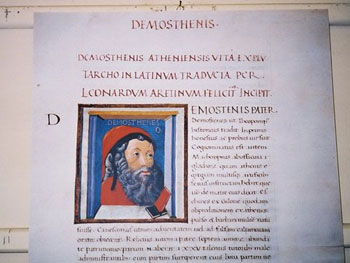 When I first approach, the exterior seems unremarkable, a rather austere, two-storey, peach-coloured building on the edge of a small square that serves mainly as a parking lot. This is the pride of Cesena? I can’t say I’m impressed so far. I enter a long, echoing hallway with a display of photos of brilliantly illuminated pages from Plutarch’s Lives. It feels so modern and barren. I wonder where the actual books are.
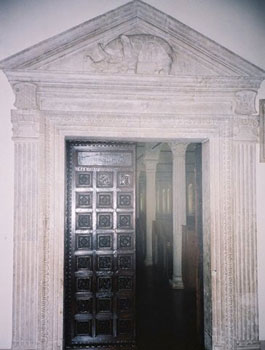 ‘The elephant is the symbol of the Malatesta family,’ Alberto tells me, ‘because elephants are powerful and have good memories. The Malatestas haughtily regarded their enemies as merely annoying ‘mosquitoes’. They also were known for deformities of their heads and their very long noses. In fact, Malatesta means bad head. Portraits of them are always in profile to show their good side.’
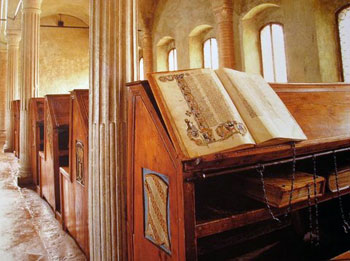 The more I look around this hushed, ancient space, and the more Alberto tells me, the more awestruck I become. In the 15th century, one large book would have been worth about the same as a country home with all its livestock, and 343 manuscripts are kept here. All are hand-printed by the Franciscan monks on pages made of goat and sheep vellum. The covers are leather-bound wood, with metal studs so the leather doesn’t rub on the shelf. A perfect micro-climate, unheated and with air circulation from the vaulted ceiling, has protected the books. In fact, the Malatesta Library is recognized throughout the world as the only humanist library whose buildings, furnishings, and book collection are fully and perfectly preserved.
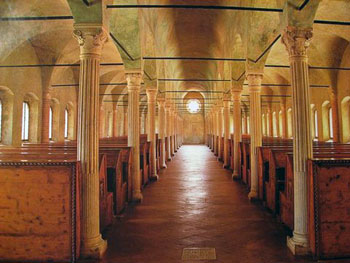 Because this library was so well lit, it was one of the first where books could be read in the same room in which they were shelved. The circular rosette window faces east and the sunlight pouring though is the main light source. Along the south and north walls are also numerous arched Venetian-style windows. The panes consist of many circular bottle bottoms tinged pink and green, which act as lens to magnify and radiate the light onto each row of desks. I squint my eyes and can imagine robed Franciscan monks toiling to copy manuscripts in fine, painstaking calligraphy, illuminating the margins with brilliant colours. As the sun and shadows shift, the monks pick up their pages and pens and follow the daylight around the room.

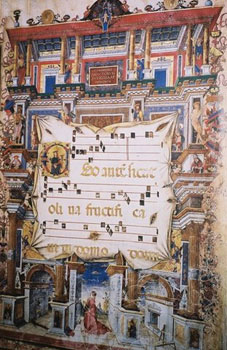 Numerous books are open and on display in glass cases. One, from 1444, is a book of legal trials and sentences from Florence. Another, from 1496, is a book of liturgies, a different one for each Sunday’s mass for a year. I’m especially drawn to seven huge choral books, made large enough for a whole choir to view. The capital letters and borders are amazingly intricate, illuminated with real gold leaf and brilliant green, pink, blue, red, and purple. Many also have postcard-sized illustrations, of strange beasts, birds, flowers. I even notice that pictured inside some of the capital letters are toiling monks.
 It is an awakening visiting the country of my family’s heritage. There is much to see and learn, understanding about the village and adjusting to the differences in customs, the diversity of rural life and the outlook on life in general. This is an opportunity to observe and live village life on a daily basis.
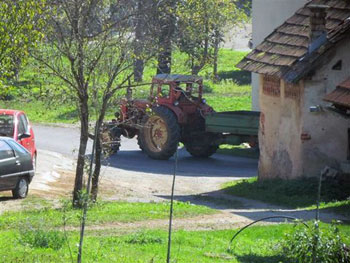
 I faintly hear the sounds of a rooster crowing somewhere in the valley and also ringing faintly in the distance is the sound of church bells from the Church of the Assumption in Zagradec. The sunlight begins to invade the room and my slumber is shattered by the heavy gong of the bells of Saint Primoz. Added to this myriad of sounds a tractor heads out to the fields just beyond the village edge.

 Good fresh bread does not last long in Slovenia due to the lack of preservatives so frequent trips to the market are required. To obtain groceries and bread we drive to Ivancna Gorica, a city complete with a small train station. The rail line connects Ljubljana and Novo Mesto and is used by passengers. Ivancna Gorica has a population of about 14,000 people and grocery stores of Mercator, Tus, and Hofer. Hofer is the Slovenian version of Aldi. The Mercator soon is our favorite. It is somewhat larger than the others and has a better selection of groceries. We obtain certain staples that should last us for the duration and learn quickly the differences between grocery stores in Slovenia and the United States. The cuts of meat are not the same so we must make due and improvise. It has been a long time since we ate brown eggs (jajce). We were able to purchase some in the Mercator and they were good. But the best and tastiest were provided by some of the neighbors in the village. They have thick shells and rich yellow yolks. We enjoy them for breakfast in the morning and they are delicious with ham (sunka). One day we have a taste for hotdogs or wieners and they have a variety with pork, beef, and some with horsemeat. However they are just not the same, but their homemade sausage is tastier.