by Iolanda Scripca
I boarded Lufthansa Airlines from LAX with a certain giddiness and anticipation. I was ready for a long flight over the U.S., Canada, Iceland, the Northern Sea and Germany – my final destination being Bucharest (or Bucuresti), the capital of Romania.
I landed in the capital at 3:00 a.m. My childhood friend, Gabriela, was waiting for me at Bucuresti’s International Airport Otopeni. The next day we took the train from Bucuresti to Suceava – the main city in Moldova.
Romania’s southeastern European location holds thousands of years of history, culture and tradition. I had to decide where my visit would take me this time: the Black Sea and its luxury resorts, the beautiful Carpathian Mountains with cozy cottages and hotels, a cruise along the Danube River and the Danube Delta, Transylvania and its relentless Dracula and his castle, the cultural life of the major cities, or the Eastern Orthodox monasteries of Moldavia.


 In the twenty-four years of my life I spent in Romania, I only once had the occasion to visit a unique region of Romania called Moldova and I was just nine years old then.
Moldova’s beautiful landscape takes you back to a time when life was simpler. Village houses are still built the traditional way, and the residents still wear traditional, handmade clothes decorated with colorful patterns and from cloth that originated from local fields. The villagers are particularly helpful and friendly.
Once we arrived in Suceava, we stayed in a four star hotel. From there we joined a touring bus and headed for the renowned monasteries of Moldova.
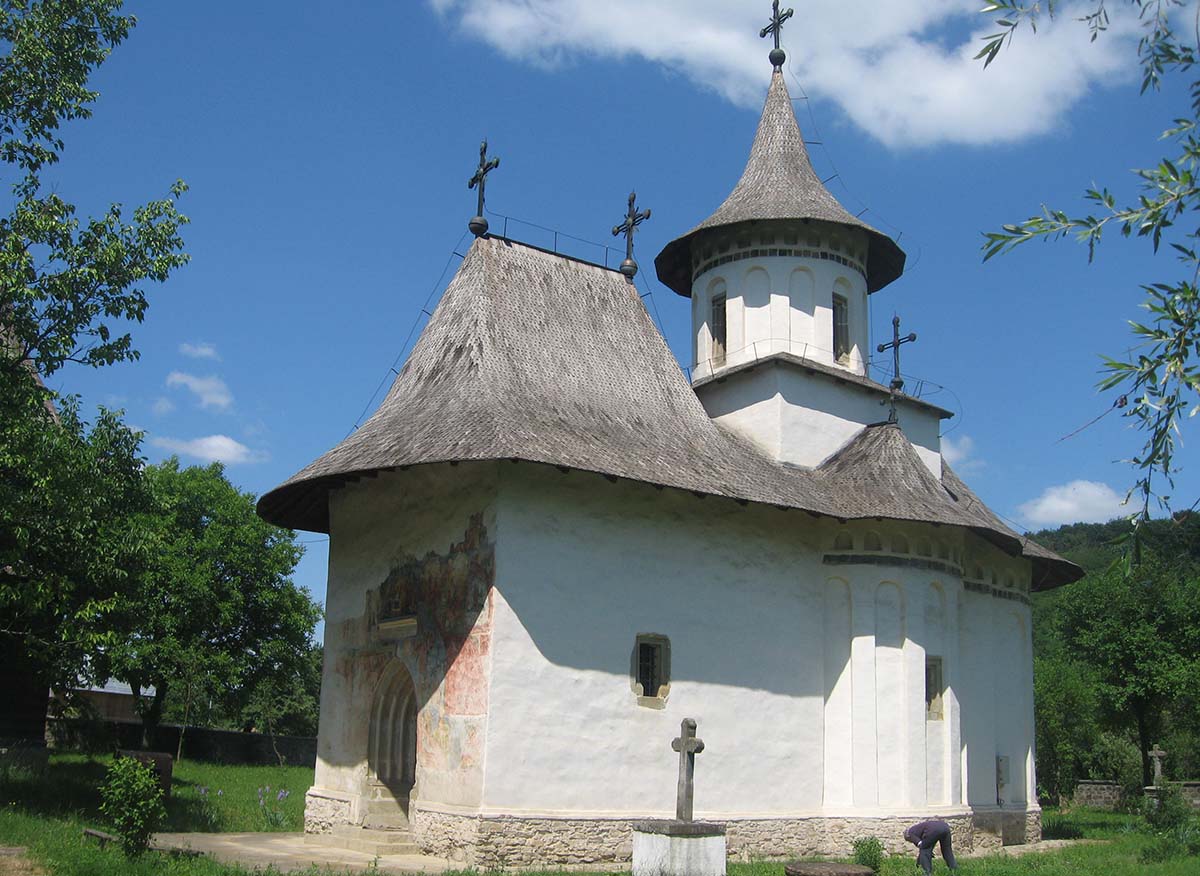
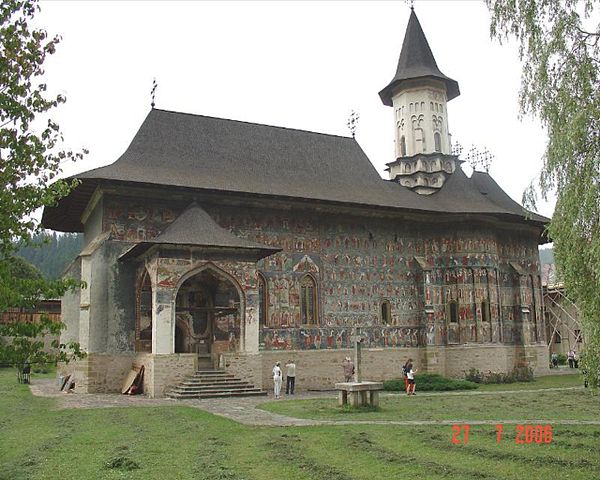
I chose a spiritual journey to the ancient Moldavian monasteries: Arbore Monastery (built in 1503), Humor (1530), Moldovita (1532), Patrauti Monastery (1487), Suceava (1522), Voronet (1487) and Sucevita (1583). Each monastery has its own personality and architectural style. Outdoor and indoor frescoes depicting religious scenes fascinate the eyes and minds of tourists.
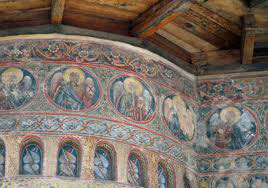
 Entering the church, you are inclined to approach solemnly and humbly. Passing two separate stands that hold hundreds of thin yellow candles lit for the souls of the departed, you head slowly towards the altar, mesmerized by Byzantine-influenced icons and priests in holy attire. It was quite a thrill to be free to explore my own religion, free from the Communist regime which totally discouraged the population to go to church and believe in a higher power.
Later we had the unique experience of dining with the nuns at a long wooden table – so long it felt like one could unroll a scroll of the entire history of Christian religion. As I ate the meal the nuns cooked, I peeked a little at their faces: so much peace and purity of the soul…so much resembling the icons with no lines of worries…as if time had stopped indefinitely.
This interesting, fulfilling trip that reunited me with my childhood friend Gabriela couldn’t help but make me become more aware of what life is all about – remembering your family and friends and how important they should be here, now, and forever!
If You Go:
♦ Romania Tourism: www.romaniatourism.com
♦ Suceava travel info: www.romaniatourism.com/suceava.html
♦ The Painted Monasteries: www.romaniatourism.com/painted-monasteries.html
Tours of Moldava Now Available:
3-Day Wine Tour of Moldova from Chisinau
2-Day Gastronomic Tour in Moldova from Chisinau
Private Soviet Era History Tour of Moldova from Chisinau
Day Trip to the True Castles of Vlad Dracula
About the author:
Iolanda Scripca is a published poet, journalist, translator, and photographer who lived in Eastern Europe for the first twenty four years of her life, in a loving family. Her mom was a teacher, a high school principal, and a cultural promoter. Her dad was a published novelist, poet and TV producer. An unforgettable moment was her collaboration with her Dad in the translation and adaptation of a children’s book by the Bulgarian author Leda Mileva. She is a graduate of Foreign Languages and Literatures from the University of Bucuresti/Romania. Nowadays she enjoys living in Southern California and possesses a CA Teaching Credential from Chapman University. Ms. Scripca publishes in several Romanian-American Newspapers both in Romanian and English. “Lava Of My Soul” is her recently released collection of poems and essays. Her photography has been featured recently on the national TV station HLN.
Photo Credits:
Biserica Inaltarea Sf. Cruci din Patrauti by Cezar Suceveanu / CC BY-SA
Church interior by Iolanda Scripca
Sucevita Monestry by Monikad at English Wikipedia / Public domain
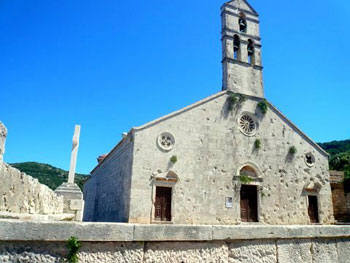
 Vis was christened Issa by 4th century BC Greek settlers. The town site and well-protected harbor of Vis, off the Croatian coast, was once the most powerful Greek colony in the Adriatic Sea, a city state with its own rulers and currency.
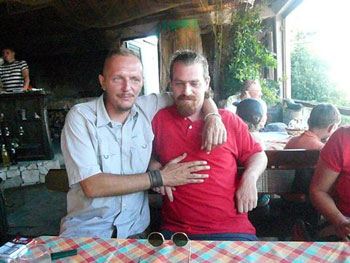
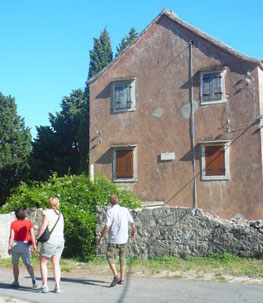 Our guide was Jurica Zitko, a community leader and paragliding instructor. Dimar, our driver, worked for the San Georgio Hotel where we were staying and just happened to have a Land Rover. Perfect!
 Today, the simple sign, “Tito’s Cave”, at the entrance, announces his former presence. About two hundred steps bring you to Tito’s meeting rooms; another hundred will take you to his living quarters. . Now, all we saw of past military occupation were a few strands of barbed wire, bent over by winds and neglect.
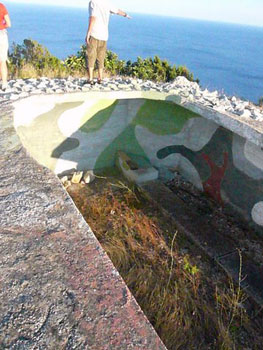 No signs announced the remains of Fort St. George built by the British in 1813 to guard the harbor. After vanquishing Napoleon in 1815, they abandoned the Fort to the elements. Parts of it have crumbled, but most of it, including walls and cannons are still intact. We were the only people there. It seems commercialization has not yet taken hold.
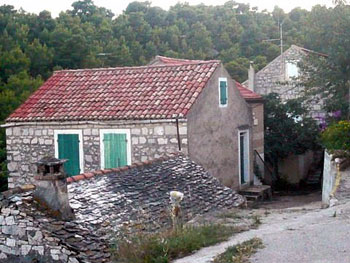 The inland villages, are very tiny—stone houses with red tile roofs surrounded by vineyards, olive trees and cattle. The vines wind around the hillside and over stone walls. It is totally unspoiled. Life revolves around wine, olive harvests, fishing and local festivals. Wild herbs, such as thyme, rosemary and lavender are hardy perennials.

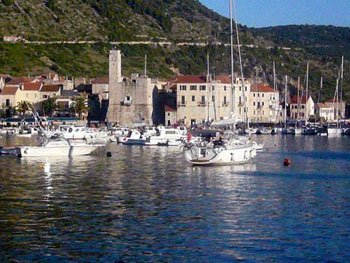 Our headquarters, the San Giorgio Hotel in Kut, was a twenty-minute walk from Vis Town. It was July. Yachts pulled up and its occupants dined al fresco on the decks. Tourists can have their pick… sailing, snorkeling, and swimming. Not to mention exploring nearby coves and caves. (Sunken ships from the 1866 War are a great draw, also, subs and an airplane or two) Incredibly the water is so blue, you can almost see to the bottom. All the beaches are rocky, but no one seems to mind.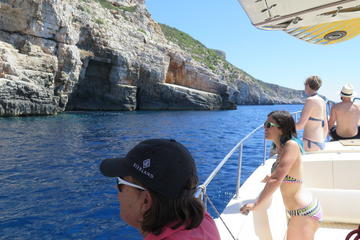
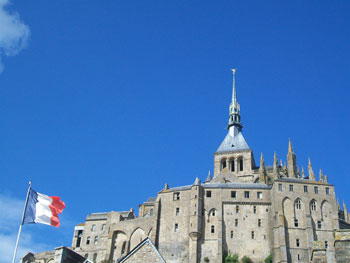
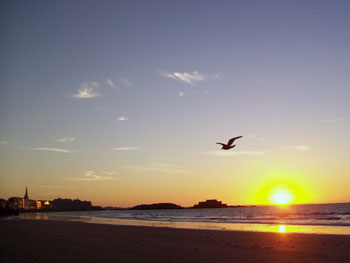 The ancient abbey rises out of sea and silt like the most triangular of mountains, seemingly balanced precariously on its rock without an inch of land wasted; and is big enough to be seen from the edge of its bay, over thirty kilometres (twenty miles) away. After I reached its public-access summit half way through my week-long holiday in France, Mont-St-Michel became the peak of my visit in more ways than one; a week that had started unplanned, and turned into an enjoyable trip down memory lane as well as one full of new sights.
 I relived some of my traveling past by hiking about 10km from the airport to my hotel, on the southern edge of Saint-Malo. The local bus service does not cater for the airport. I crossed the Rance estuary below Saint-Servan, which was called Aleth when a Welsh monk called Maclow became its bishop in the 6th century. It was from Maclow that a new community to the north took its name; Saint-Malo has since incorporated Saint-Servan within its city boundaries. Brittany still has a Celtic identity.
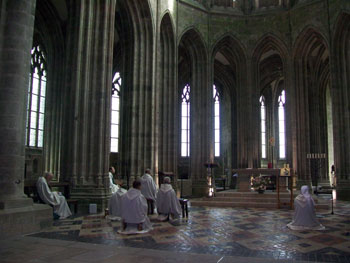 The next day I moved to Saint-Malo’s only hostel, which is ideally situated only two blocks from the Grand Plage: two miles of beach between the walled old town and the district of Parame. There hadn’t been any room at the hostel on the Saturday night. I spent the next couple of days getting to know the landmarks and beaches of Saint-Malo.
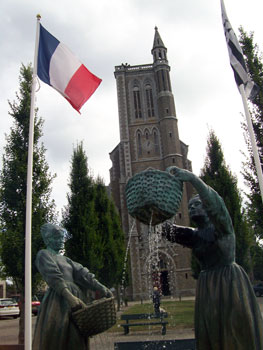 At low tide you can walk out to Fort National, Île du Grand Bé and Fort du Petit Bé. The former was built during the reign of Louis XIV in the late 17th century, and was named Fort Royale until the French Revolution a century later. It is open to visitors during the summer. Malouin writer Chateaubriand, cited as the founder of French Romanticism, is buried on Île du Grand Bé; a hilltop cross marks the site, and views stretching for miles to the western edge of the bay explain its Romantic reason.
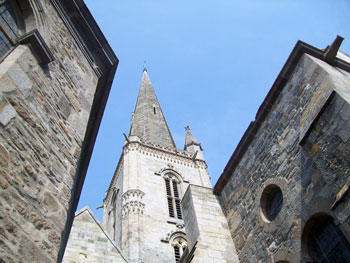 The cathedral is a central landmark and highlight, rising high above streets full of gift and clothes shops; crepe and seafood restaurants. Museums, a twentieth-century war memorial, and a central park are also of interest within the city walls; and regular plaques tell the historical significance of streets and buildings. Exiting the walls to the south, corsair sailing ships in the harbour are another reminder of the past.
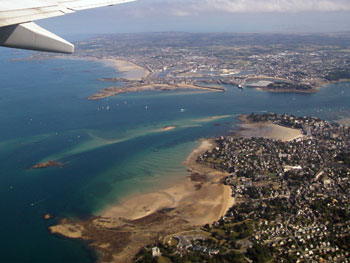 I took the coach from Saint-Malo to Mont-St-Michel at 9.15 the next morning. It is the only bus on that route, and a 20 Euros return ticket is required. The journey takes 75 minutes, and with the return leaving at 15.45 you have about five hours at the Mont. You cross from Brittany to Normandy on the journey.
 There were grey skies when we arrived, but the view was still spectacular. I walked up the narrow winding streets crammed with shops and tourists to the abbey gift shop, where you buy a ticket to enter the abbey and highest tier possible. On the ascent, the causeway linking the Mont with the mainland stretches out to the south, between the grey silt of low tide sea and the green vegetation of natural land; dividing the bay arcing to the east and west. To the north there is only the abbey towering above you, crowned by a golden Saint Michel statue.
 On my penultimate day I took the local bus to the quiet town of Saint-Briac-sur-Mer, via Dinard, traveling north of the airport; and spent my final day among the gift shops of Saint-Malo. I walked down memory lane once more before leaving, entering the airport the same way I’d exited it the week before. Although this time I only walked from Dinard, after busing it across the Rance.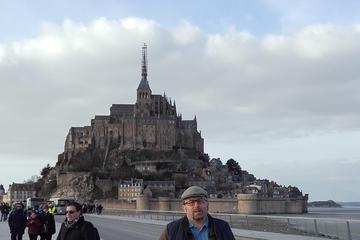
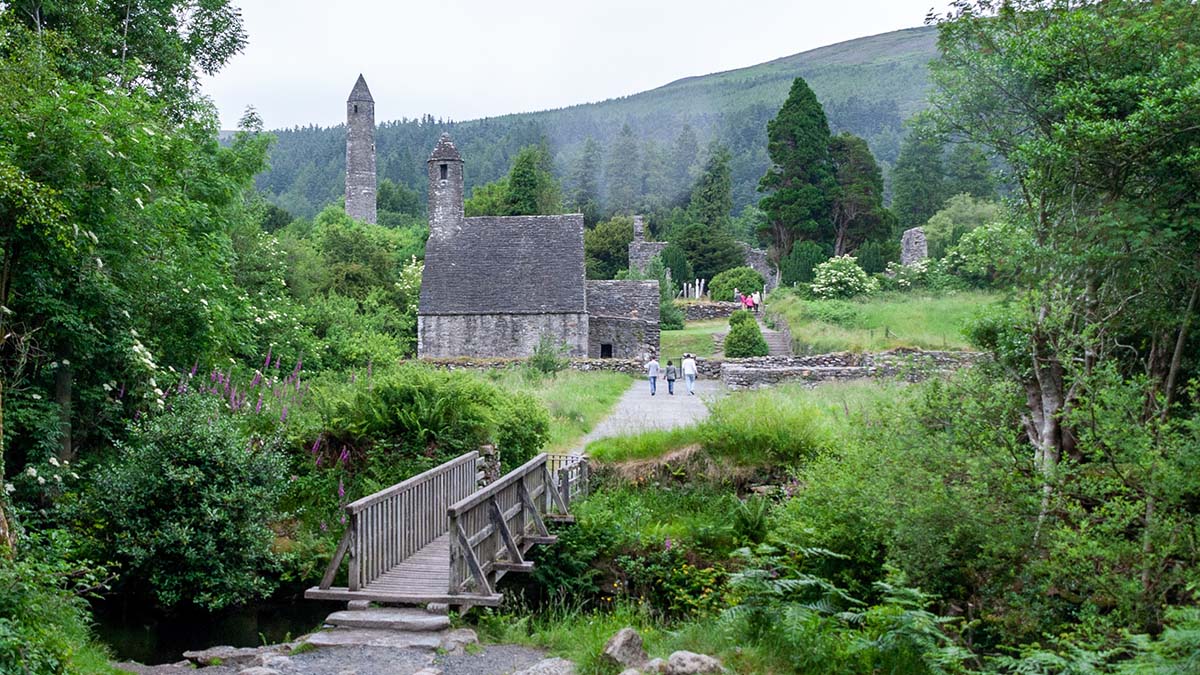
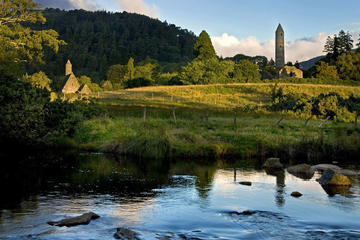
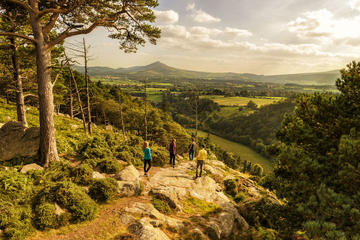
 It is a sunny spring morning, perfect for a trip to Glendalough, an ancient “monastic city” set in a surround of Wicklow Mountains National Park, about an hour south of Dublin. Our local guide keeps us alert on the bus ride, pointing out the flora and fauna–the beauty of the yellow gorse which in other non-flowering seasons gets pelted with words such as weed, invasive, and noxious, the blossoming white thorn hedges, shades of green in the long vistas. As we zoom past farms and real estate signs, she chats about the state of the nation in this time of recession. “People cannot sell their properties; their mortgages are worth more than their houses. There is no longer a construction industry.”
 But the Roman church had crossed the choppy waters of the Irish Sea. Representatives had been dispatched from Rome in the 400s and the escaped slave Patrick had returned as a missionary in that same century. Glendalough was established in the early 500s by Coemgen (Caoimhin), St. Kevin. His Gaelic name means “fair-begotten.” Does it refer to his royal Irish birth or to his good looks? As a child, Kevin was tutored by Petroc of Cornwall, a Welsh-born Irish-educated saint. Kevin lived and studied with the monks and was eventually ordained himself.
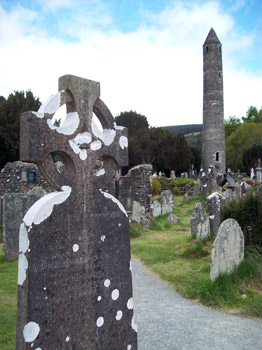
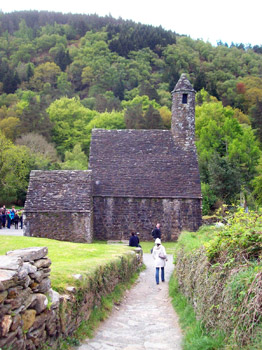
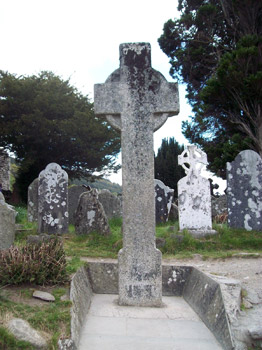 What compels me to forgo another day in Dublin for this side trip into the country? Being neither Irish nor Catholic nor even very religious, what can explain my interest in, my attraction to, this site? I have been to one of these ancient monasteries before–to Clonmacnoise on the River Shannon. Is it nostalgia, for that much earlier life-changing visit? It was from the friend who guided me to Clonmacnoise that I learned how to pronounce Glendalough. Glen da lock (loch). Not loo; it does not rhyme with slough, as I had incorrectly assumed that first time. Glenn da locha, the valley of the two lakes. The two communities were connected in the sixth century, by the friendship of Ceiran and Kevin. Both locations feature thirty-metre-tall round towers, thought to have been used like beacons, for navigating, as bell towers to signal distress, as safe storage for valuables such as psalters and illuminated manuscripts, and as places of refuge during times of attack. The monasteries include hermit cells, probably the only constructs that either saint actually touched. St. Kevin’s is a cave above the lake. The chapel, St. Kevin’s Kitchen, the rest of the existing ruins, date from between the ninth and twelfth centuries.
 Both monasteries contain a collection of ruined buildings with designations such as cathedral, church, chapel, along with a profusion of Celtic crosses and gravestones. Here those who found a community while living are surrounded still in a community of the dead. Both sites have high crosses–the Cross of the Scriptures at Clonmacnoise and St. Kevin’s Cross at Glendalough, and evidently, a second high cross, the Market Cross, in the visitor centre.

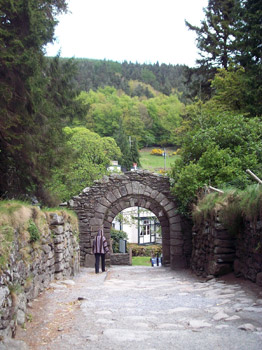
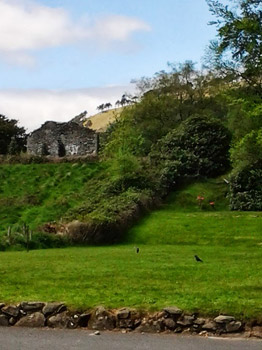 Just outside the double-arched gateway is a midway of tents and caravans. Linen tea towels, woolen “jumpers,” potato scones, postcards. Today the market of souvenir and food vendors does not even make me think of the temple and the moneylenders. After all, everyone has to eat, and it is a recession, and loaves and fishes no longer magically appear.