Italy
by Wynne Crombie
In the early sixties, I had explored Pompeii. Now, over 40 years later, my husband and I set out to investigate Ostia Antica, the “other Pompeii.” After arriving at the Ostia Metro station, we strolled the few blocks to the entrance. Ahead of us lay the mile-long Decumanus Maximus, the main drag of its day. From here we embarked upon travel, not just through a collection of 1st century artifacts, but what had been a real town.
The Decumanus is paved with dinner-plate sized stones enabling the rainwater to drain off and the Romans’ sandaled feet would stay dry. As we walked, we realized that our feet were stepping into the same ruts left by carrucas, the four-wheeled carts and cisia, the two- wheeled public transportation of the day.
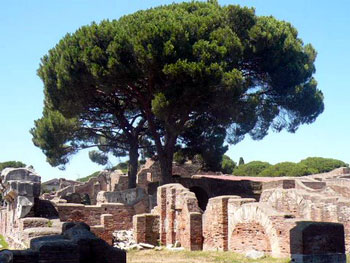
From the site there are no modern houses, roads or telephone wires visible. It gave us the feeling of really being, one with antiquity. The only sound was the breeze coming through the fluffy tops of the Roman pines.
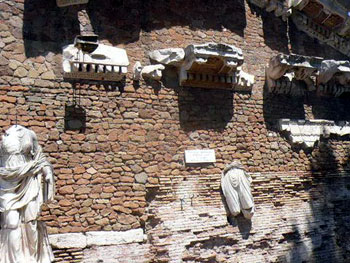 The Italian government has done a great job instructing visitors with strategically placed information about the site. We also liked the fact that they give you the freedom to discover Ostia on your own. Signs warn visitors to have respect for the artifacts. Because of atmospheric exposure and those created by the nearby airport, some of the monuments are wearing down. We wandered off the Decumanus, and. onto narrow paths scattered with pine needles, ducking under archways, and poking around alleys.
The early Romans believed that the dead should be buried outside the city to avoid contamination. After seeing the stone sarcophagi, it’s hard to believe that any infection could penetrate the covering. Not only did they house the dead, but the sculpturing on the outside were works of art. Some of these early citizens preferred cremation, a common method of the day. Niches in the walls can still be seen where the urns were deposited.
We found a series of warehouses located near the entrance, just past the sarcophagi. Ostia was once a port, and grain was an important commodity. Letters can be seen chiseled on stone tablets – sort of first century billboards.
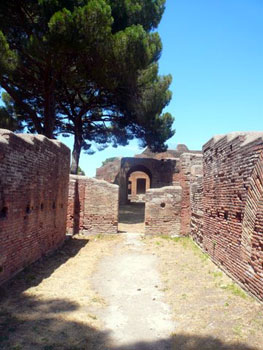 Just beyond the warehouses we climbed the few steps on our right. Here were the Baths of Neptune, a gathering place for the locals. An amazingly preserved mosaic, measuring 55 feet by 36 feet, is of the sea god riding a chariot drawn by four pawing horses.
The elite lived in one-story homes; all the rooms led into a central courtyard. Hot running water, which also fed the baths, was channeled through lead pipes in the wall.
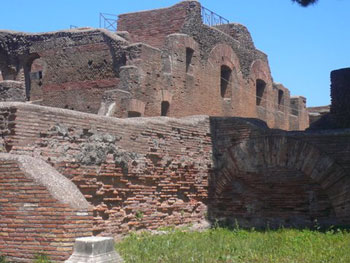
The less wealthy lived in multi-storied (up to five floors) dwellings. Woe to the penthouse dweller climbing all those stone steps. Many of these are still in tact. Apartment buildings still show the second floor balconies. The arched doorways on the ground floor led to shops, many of which are still there.
For an excellent taste of what life was like, my favorite was, the Insula of the Thermopolium (name means ‘Sale of hot drinks’) This was the local tavern where the workers of the day shot back a few swigs of the local brew. What is amazing is the almost perfect condition of the shelves: earthenware jugs, not glass bottles were used here. There were even remnants of a sink and a few glimpses of a wall painting.
 We pictured the locals sitting in baths, then walking down the Maximus to imbibe a few cups of wine at the Insula of the Thermopolium.
The Forum of the Corporations, which housed the offices of sixty-four maritime companies, was a sort of the Wall Street of its day. This was where you would come if you needed to ship something to Rome, be it wheat from Spain, sugar from India, or African beasts for the Coliseum games. To find the most suitable shipper, you would examine the mosaic names and icons in front of each establishment. The sign signifying the owner’s occupation was a floor mosaic. For example, an elephant announced a trader in exotic animals. Judging by the numbers of fish mosaics, the fish business was flourishing.
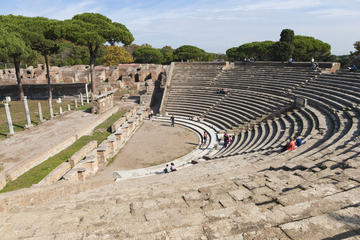
Towards the end of the Maximus, we got an idea of ancient Roman entertainment at the amphitheater. The three tiers of marble steps at the amphitheater’s base were the box seats of the day. Here the elite cheered their favorites. Behind them, the stone bleachers rose in a semi-circle. Erected in 12 BC, Ostia’s amphitheater is a wonderfully preserved series of semicircular stone bleachers. It once held 3500 spectators.
The tiny stage is still intact; now, this very same stage area gives 21st century performances. A series of theatrical masks, chiseled in stone, are still on view, right off the performance area.
Most ancient remains of Ostia date from the second half of the 4th century BC. Its original purpose was to serve as a naval base for Rome. By the 2nd century AD, it had become a flourishing commercial center inhabited by upwards of 100,000 people. But, like the Roman Empire, Ostia began its slow decline in the 3rd century AD. By the end of the 5th century AD, Ostia had seen its best days.


 After navigating almost the length of the Maximus, we came to the Forum, the main square of the town. Here were the remains of important government and religious buildings. Many of the pillars and building foundations have been left standing. The huge Capitolium Temple dominates the right-hand side. Most Roman forums were dominated by a temple – to bring the deity to the people. The Capitolium Temple was dedicated to the pagan trinity of Juno, Jupiter and Minerva. Columns flank the massive staircase leading to the entrance. At least two stories are visible. Before heading back, we stopped at the near-by museum to view the busts and statues of the local citizenry. Most amazing is the detail to features, hair styles, and dress. My favorite was a soldier in a pleated kilt, headpiece, shoes, and weapon. There is also a room with more of the marble sarcophagi showing carvings of Dionysus, the Greek God of wine.
Then it was back to the Metro stop for the return to Rome. As the train was approaching, one last exhibit caught our eye: the monument containing the ashes of one, Flavio and his wife, 1st century AD.
The guidebook allotted two hours to see Ostia. We stopped at five; it was not nearly enough.
private tour of ancient Ostia from Rome
If You Go:
At Largo Argentina, take the number 30 bus and get off at Piramede. The Metro station is right across the street. Take the Metro to Ostia Antica. The entire ride takes about 45 minutes and costs €2 each way.
Ostia has fewer crowds, is cheaper and much closer to Rome than Pompeii. (€2 each way by bus/train from central Rome). Admission to Ostia Antica is €6.50. There is free admission for seniors, but, alas, it’s only for European Union members. Pick-up the guidebook for seven Euros. It’s worth it. Hours: Tue-Sun. April-Oct. 8:30 – 19:00. Nov-Feb. 8:30-16:00.
About the author:
Wynne Crombie has a master’s degree in adult education and has been published in Travelthruhistory, Christian Science Monitor, Catholic Digest, Cat Fancy, Boys’ Life, Real Travel (UK) Air Force Times and Stars and Stripes. Wynne met her husband in 1967 while both were with the US Air Force in Berlin. They have four grown daughters and two granddaughters. Wynne teaches ESL at a Chicago community college. She and her husband enjoy travelling.
All photos are by Wynne Crombie.
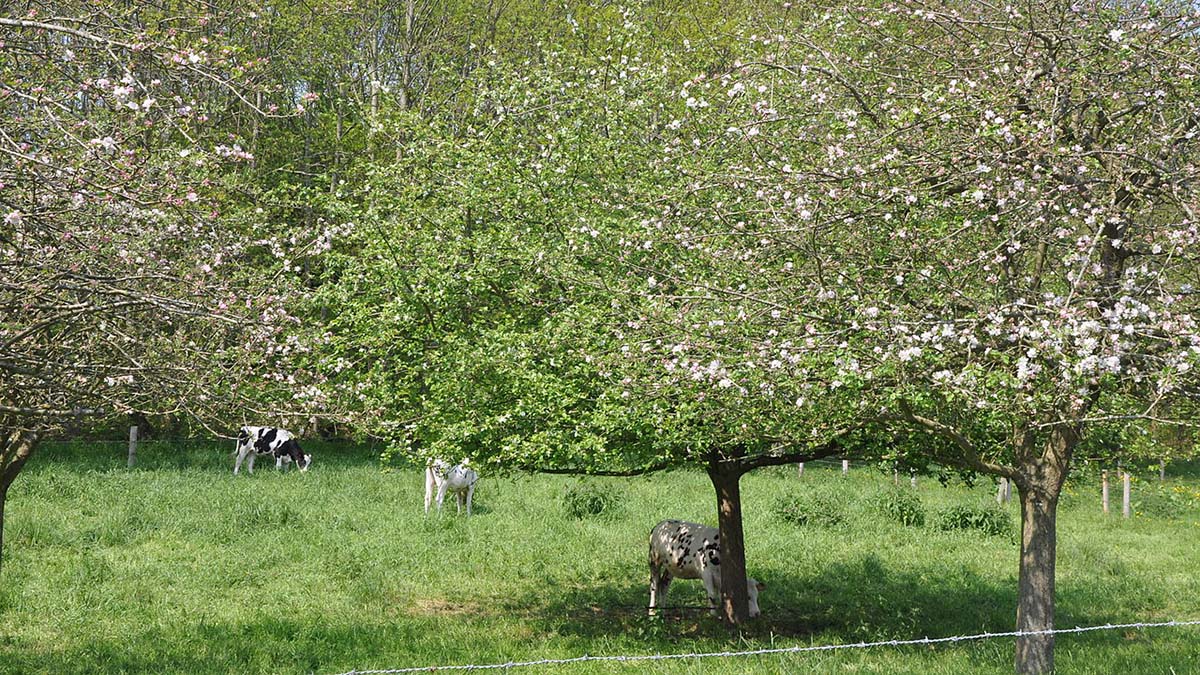
 We headed for this scenic route, officially inaugurated on 25 May 1975, on a sunny day in July. It took us less than one hour, by taking the N13 from Caen, to reach the starting point of the Cider Route, Cambremer.
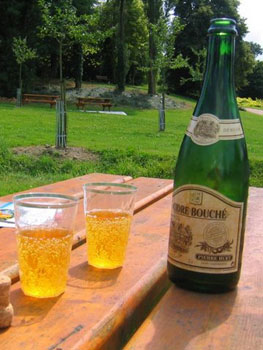
 Cider-makers on the Cider Route compete annually and those selected display the sign “Cru de Cambremer” on the roadside at the entrances to their farms. Nineteen producers have been awarded the “Cru de Cambremer” in 2010 and nine of them offer guided tours. The specified products of these “Cru de Cambremer” can be marketed under the label Cidre du Pays d’Auge (AOC), Cidre du Pays d’Auge Cambremer (AOC) or Calvados du Pays d’Auge (AOC).
 We were looking at the seemingly boundless farmland while our guide went on with her talk. “The yield per hectare is limited to 30 tonnes for low-stemmed apple trees and 20 tonnes per hectare for high-stemmed ones. This ensures the quality of the apples. Many farms prefer the low-stemmed apple trees nowadays as they can be machine harvested which saves a lot of manpower.”
 Our next stop was the distillery for making calvados – an apple brandy produced from cider by double distillation. The liquid, which was just 10% in volume of the pre-distilled cider, was kept in large oak barrels between three and 30 years to give different brands of calvados.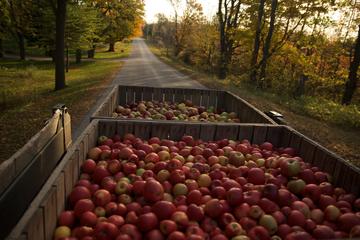
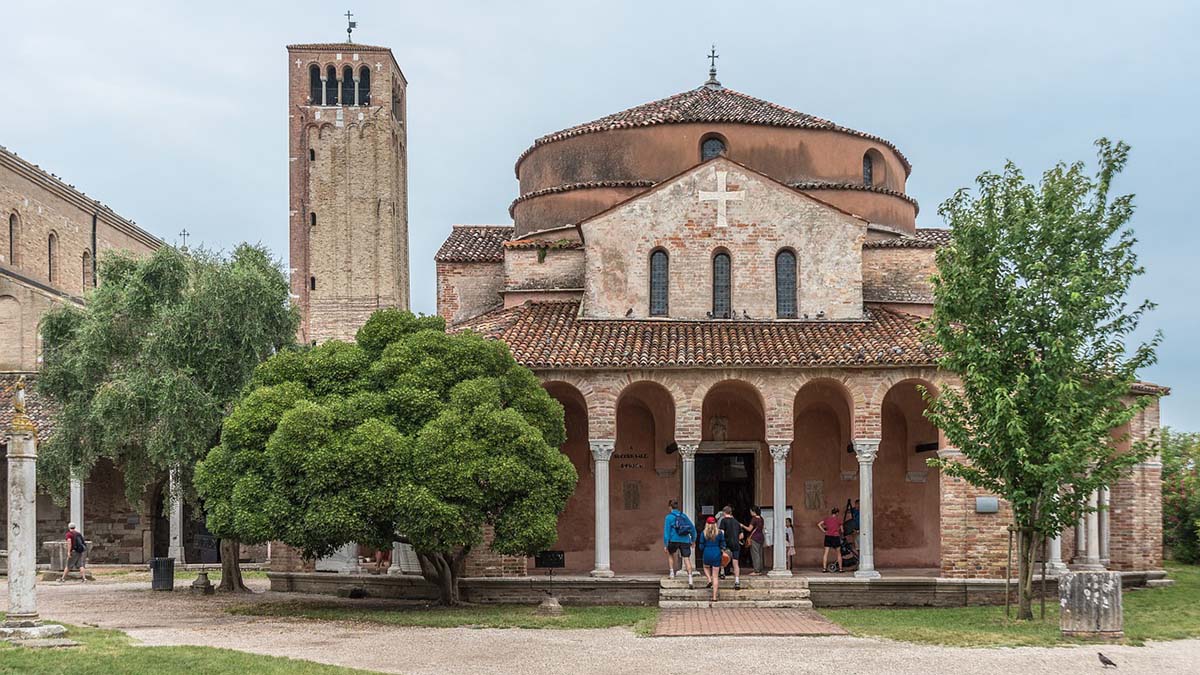
 Out here in the open, away from the confines of the city, the unique light of the Veneto takes centre stage and the whole lagoon becomes bathed in pure luminosity. It is a scene of wide horizons where sea and sky merge into a pool of rainbow like reflections. The light continuously shifts and I am lulled into a tranquil, hypnotic state, lost in an other world of translucence.
 Torcello was the first island to be settled in the lagoon, long before the present day Venice. Its origins are founded on a series of mystical revelations. The people of the lagoon were originally from the Roman city of Altino which came under threat in the 5th century from barbarian invasion. As the Germanic hordes from the north approached Altino many of the residents fled in blind terror, but some remained under the leadership of the Bishop who waited for divine inspiration.
 Until the 10th century Torcello was the greatest commercial centre in the lagoon, full of palaces, churches and even a grand canal. Like the lost mythical Camelot, Torcello offers a tantalizing glimpse of a golden utopia, where an egalitarian social hierarchy developed which was uniquely progressive for the time. Cassiodorious wrote “There is no distinction between rich and poor, the same food for all; the houses are all alike and so envy – that vice which rules the world – is absent here.” Here we see the roots of the liberal democracy which became such a feature of the Venetian Republic.
 Today Torcello is largely deserted with probably no more than twenty people who are actual permanent residents here. It has a rustic and decaying atmosphere with just a few houses dotted about among the overgrown meadows leaving the island in an other worldly limbo of tranquil silence. Apart from a few farmers with small holdings most of the people who work here are involved with the tourists who come to see the few places of interest remaining on the island: the two churches. a small museum and the restaurant.
 Next to the cathedral is the little church of Santa Fosca. This simple but charming Romanesque construction provides the setting for romantic weddings which are discreetly open to public view. In Venice it is so easy to casually become part of some intimate and private ritual. I remember being here once when a wedding was taking place and a crowd of people were milling around, peeping into the church with hushed curiosity. I had earlier seen the bride arriving in traditional Venetian mode: the young beauty standing motionless in her gondola, a vision in white, drifting gracefully along the canal.
 Augustus the Strong, the Prince Elector of Saxony and King of Poland, was jealous of great Catholic cathedrals, so he had this Lutheran house of worship built between 1726-1743 by George Bähr (mostly completed by 1736). Johann Sebastian Bach gave an organ recital there in 1736.
 In 1982, the ruins became an area for protest gatherings against the Communist regime. But in January 1993, original plans from the 1720’s were used to reconstruct the church, using thousands of recovered stones which were put back in their original place (including ones darkened from the firebombing. This is why you see the exterior walls in checkered patterns). Photos and computer technology were used to reconstruct the church in as close of detail as possible, which took until 2005, costing 100 million Euros, 90 percent of that coming from global donations. The church is 92 meters high (about 302 feet) and you can take in a view from 85 meters (about 279 feet), according to the guided tour I took. You must climb some 220 steps to get up there. Near one of the Frauenkirche’s entrances are remains of the World War II destruction (that look like a sculpture) for people to ponder.

 This Catholic church was built between 1739-1754 so August the Strong could become King of Poland, a Catholic country. It has the look of Roman Baroque style and is a stone’s throw from the River Elbe. The crypt contains the heart of August the Strong, too. The only aspect of the church building that was reconstructed from the ruins of World War II is the organ backdrop, containing a restored Sibermann organ that contains 3,000 pipes, in which I heard a beautiful Bach organ concerto playing during the noon hour. There are 78 figurines on the exterior of the church that were created by Lorenzo Mattielli.
 The church has been onsite since 1215, making it the city’s oldest church. It held the first Lutheran service in Dresden, Germany in 1539, and has been destroyed several times: by fire in 1491, 1699; by war in 1760 (Prussians); and much of it was destroyed in the February 13, 1945 bombing raid. I toured the venue that was rebuilt and reconsecrated February 13, 1955. Professor Anton Dietrich’s painting, called Golgotha, survived the World War II bombings and subsequent fires but lost its luster until it was restored in 2001. This church has the second largest peal bells in Germany weighing over 28 tons, according to one of the church’s English brochures. They are still in disrepair, according to the church attendant I spoke to there. But the church can hold 4,000-5,000 people currently, making it the largest house of worship in Dresden.
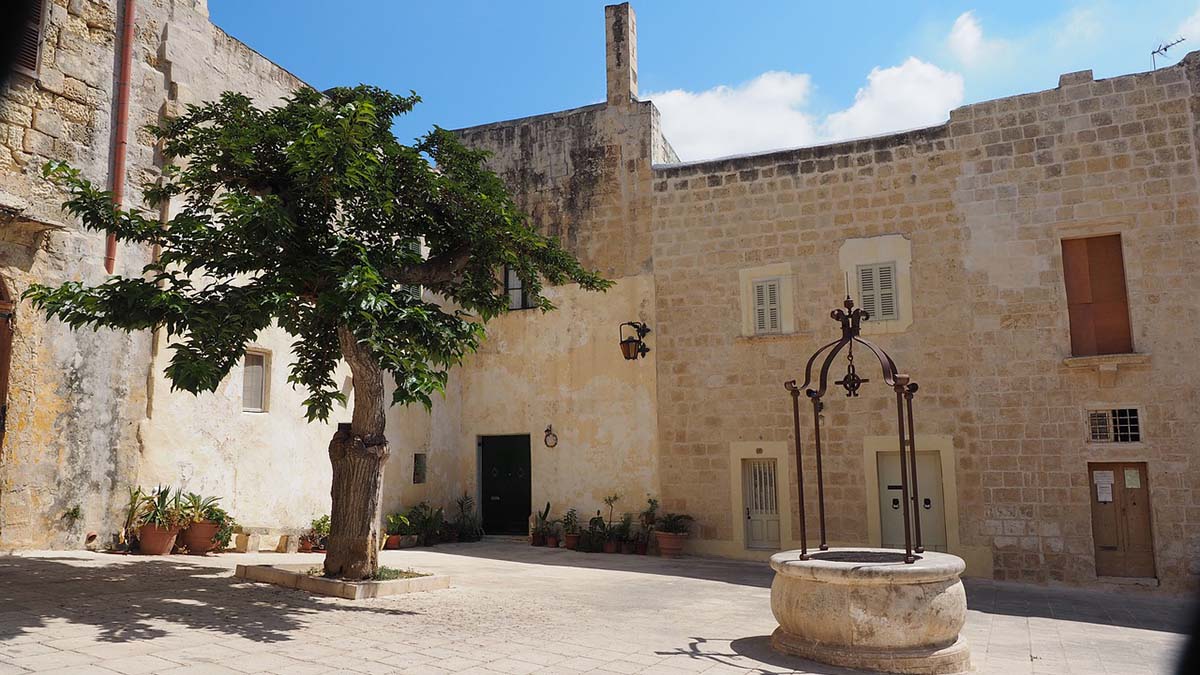
 Listening to this raucous chant that ardent citizens – of whom I am proud to be one – learn practically while still in the womb, it is hard to believe that the official name the Sovereign Military Hospitaller Order of Saint John of Jerusalem, Rhodes and Malta gave to the City was Humilissima Civitas Valletta, indicating it as a ‘city bound to humility’.
 The plans had another purpose besides aesthetics. Fresh air from the Grand Harbour and from Marsamxetto Harbour would provide the natural air-conditioning breeze. Laparelli, with his carte blanche, could also project fresh water supplies being piped in all the way from Citta’ Notabile (Rabat), and sanitation; concepts obtaining in very few cities of the time.

 On a walking tour of Valletta, one is spoilt for choice. Will it be the Auberges and the Cavaliers? Will it be the multitude (about 32) of churches and chapels, including the Anglican Cathedral of Saint Paul and the Greek Orthodox Chapel? Will it be a whistle-stop tour practically at every street-corner, in order to photograph the votive statues or niches, fountains that decorate them?
 This glorious gem, truth to tell, is also a medley of traffic, pedestrians, business concerns as well as the historical monuments we all take for granted, not even affording them a casual look as we go about our business … echoes of the yells, bells and smells label. A time-travelling Knight would however have his sense of déjà-vu tempered with a feeling of uncertainty. The British rule left their mark by widening gates, altering or downright demolishing certain buildings, and commissioning other infrastructural projects. Added to this, there are the changes perforce wrought after the havoc caused by the two world wars.
 That having been said, it is indeed a pity that residents and visitors sometimes have cause to grumble about certain aspects of the City… beginning from the monstrosity known as City Gate, through which one can view the ruins of what used to be one of the grandest edifices of Europe, nay of the world… the Royal Opera House. There are currently plans to rebuild this monument – and they have attracted much controversy.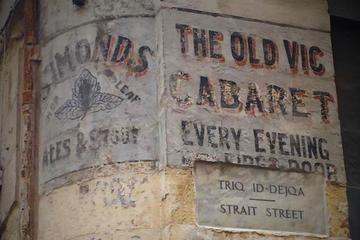


,_apple_orchard_with_grazing_cows.JPG)