Poland
by Wynne Crombie
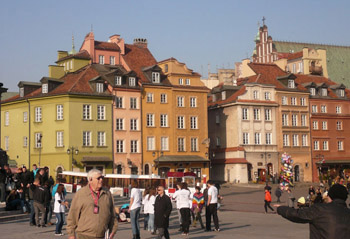
The cool November sun shone off the buildings. The burnished yellows and reds of the Renaissance, and Baroque structures had been carefully replicated. Seventy five years ago, the Square had been reduced to a pile of rubble by the German Luftwaffe. First, during the invasion of 1939 and then, after the 1944 Warsaw Uprising.
The Square was reconstructed mainly in the 1950’s from old photographs and 700-year-old drawings, (some of the narrow multi-storied buildings lean into the Square as they did centuries of ago.) Here, the town’s elite had lived.
 As my husband Kent and I strolled on the cobblestones ringing Warsaw’s Old Town Square Square, we bumped into a young man, briefcase slung over his shoulder, reading aloud in Polish. I was intrigued; he was either religious or political. Quite by surprise he was an American from Los Angeles and had come to evangelize the Poles. (Poland is 90% Catholic) Next to him an elderly lady, seemingly unaware of his readings, was selling homemade hats. A few feet away three nuns in full habits walked by without a glance.
It was almost noon. We had been told not to miss the showing of a twenty- minute movie on the destruction of Warsaw during World War II. Unfortunately, it is shown in English only at noon from Tuesday through Sunday. Look for the Historical Museum sign. It’s at 28-42 Rynek Starego. (south side of the Square) The theater is right inside the entryway and well worth the 6 zlotys admission. It is in black and white.
Back on the Square, we came across “Wario Wojciech” (the so-called keeper of the Square) in his red Tartar uniform brandishing a curved sword. He offered to smile for our camera. He took off his fur hat and plunked it on Kent’s head. click. Then the curved sword was placed on Kent’s throat. click. We gave him a few zlotys for his trouble. We also spotted a middle-aged Robin Hood look alike wearing a mesh helmet and carrying a quiver of bows and arrows. Another, click.


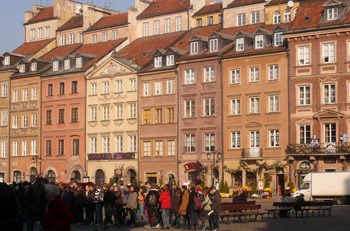 Part of the charm of the Rynek Starego Miasta is sitting on one of the many stone benches and watching what goes on. There is virtually no trash or graffiti. Mimes, violinists and accordionists are almost constantly performing.
The outdoor cafes are for beer and people watching. When it gets cold, heat lamps are turned on. Blankets appear when it gets very cold. Each restaurant usually has a young man in front handing out cards with the menu printed on them.
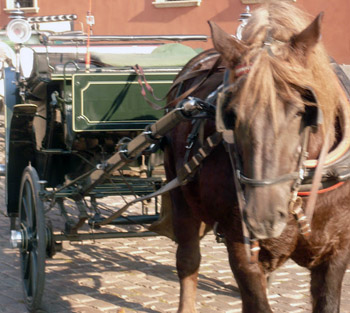
Beer and pretzels were just the snack to fuel our exploration of the venders and shops. An artist was sitting in a chair reading a newspaper waiting for customers. His “portraits” were really caricatures. Next to him a balloon seller was waiting for customers while across the cobblestones horses and buggies waited for fares. There is not much in the way of signs in English or any other language except Polish, but most people speak English.
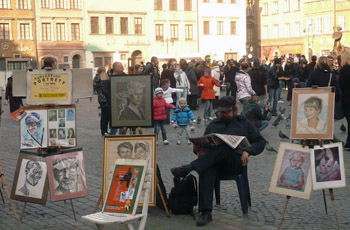 If you’re looking for souvenirs, there are many venders and shops on the Old Town Market Square. For example, PolArt is three rooms of Polish folk art, including folk costumes, paper art, textiles, dolls, and traditionally decorated eggs.
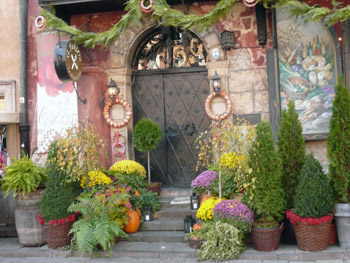
Potted flowers were everywhere…mostly mums and small potted firs. Flower venders had many bouquets for sale as it was near the Feasts of All Souls when everyone brings flowers to the gravesites.
The Mermaid Fountain statue (the syrenka) had been in the middle of the Square since 1855. Destroyed during World War II, it too was replaced. A WWII Polish paramedic served as a model. This mythical symbol of Warsaw is also on the city’s coat of arms. Supposedly she lives in the Vistula River and protects the townspeople.
 In the fountain’s shadows, an unsmiling accordionist sat playing on a bench. Across the square a violinist was doing the same. See if you can come across a, Chopin bench. Each button plays a different Chopin melody.
In the market for a sit-down meal? There is the Stacja Rynek just off the Square at #15. This eatery offers music and a good dinner menu. The Rybak, # 1 on the southeast corner, sports a nautical theme and menu. The Kamienne Schodki at #26 was average, nothing special. Note: most restaurants on the Square are more expensive than ones off the Square.
What’s on a Polish menu? Most restaurants we visited offered an appetizer, salad, soup, hot starter (such as mushrooms in cream sauce), followed by the entrée and dessert. Hearty indeed. The morning coffee is most like American; it gets progressively stronger as the day rolls on. Our personal favorites: pancakes with orange sauce, stuffed cabbage rolls and a shot of cherry vodka. Ah yes, and then there’s the marvelous variations of cabbage and sausage soup.
 After fortifying ourselves with a late lunch, we headed for the Square’s book store. Very few books are in English. Even current American best sellers like, “Steve Jobs’ are exclusively in Polish.
As we turned to stroll back to our hotel, we were met by a line of school children wearing fluorescent safety vests. We stepped in behind them and followed them out of the Square.
This year Warsaw will be part of the venue for the 2012 Soccer championships. The Old Town Square is ready.
If You Go:
TRANSPORTATION: You can fly into Warsaw from most European cities. We recommend taking the train from Berlin to Warsaw. It’s a great afternoon watching the countryside roll by.
LODGING: We stayed at the Westin. It’s a great location within walking distance of the 1944 Uprising Museum, the piece of the Ghetto Wall still standing and the Old Town Square.
Browse Warsaw hotels.
RESTAURANTS: Eating in the Square is more expensive, but well worth it. Even in cold weather the outdoor cafes provide heating lamps.
About the author:
Wynne Crombie has a master’s degree in adult education and teaches ESL at a community college outside Chicago. She met her husband of forty-four years in Berlin while both were working for the U.S. Air Force. They have been traveling ever since. They have four grown daughters and three granddaughters.
All photos are by Wynne Crombie:
1. Entering the Square
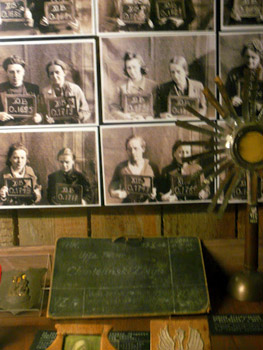
2. Photos in the Ghetto Museum just outside the Square
3. Reconstruction of Warsaw’s Old Town Square
4. Artist waiting for customers in Warsaw’s Old Town Square
5. Horse and buggy waiting for a customer
6. One of the many restaurants on the Square


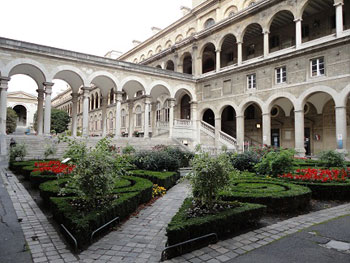
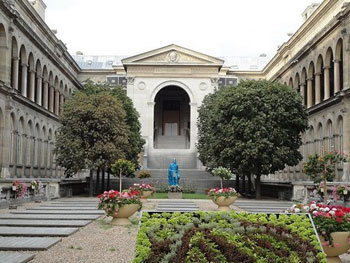
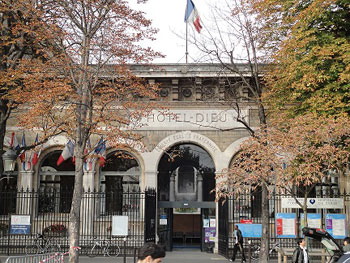 When we went to Notre Dame, I was delighted to find the Hotel Dieu next door. Why? This was one of the first hospitals built in Europe, in 622 AD. I assumed not many travelers knew it was a hospital and passed by thinking it was a hotel. (It says, “Hotel Dieu” at the entrance and is decorated with international flags.) The present building was not the one from 622 AD, as that original one was burned down in the 1700s. The one we see today was built in 1822. Why is it still called a hotel? In French, it translates to Hostel of God. The first European hospitals during the Middle Ages were managed by the clergy. Their purpose initially was not to treat the sick but to serve as lodging to travelers.
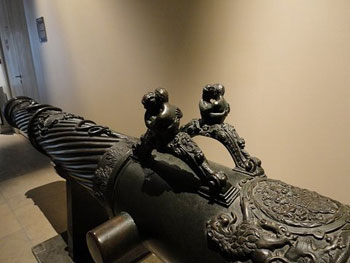
 This military museum houses historical artifacts of armour, artillery, and various weapons through French history. Napoleon’s Tomb is situated at one end where you have to leave the museum building to walk to the building’s tomb. We were certainly not military experts nor were we that interested in the museum (as we had planned on just going to Napoleon’s Tomb at the end of the tour), but a couple of amusing gems popped up here. We saw hundreds of knit armor and noticed some really small ones that would fit a child. Did children have to participate in the wars as well? Child labor laws did only appear recently in time! After passing by several cannons on our way to the tomb, we found a cannon with figures of two pairs of kissing couples [TOP PHOTO]. We could not find any history panels to explain its origin. Did the cannon makers have a sense of humor to make love and not war?
 The Rodin Museum houses the famed sculptor’s best works; he requested the government to establish a museum for his artwork. But what you might have known is that Rodin’s mistress, sculptor Camille Claudel, also has a collection here. Rodin and Claudel had a fiery on-and-off relationship; she once accused him of stealing her sculpting ideas. After Rodin left her to return to Rose Beuret, his longtime companion and mother of his son, Claudel spiraled into mental illness, living in a mental institution the last years of her life. Rodin, perhaps having a soft heart and appreciating her talents, requested Claudel’s works to be showcased in his museum.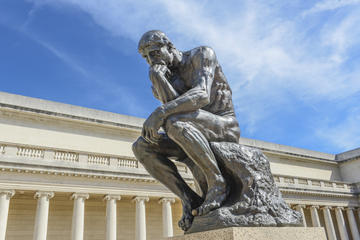
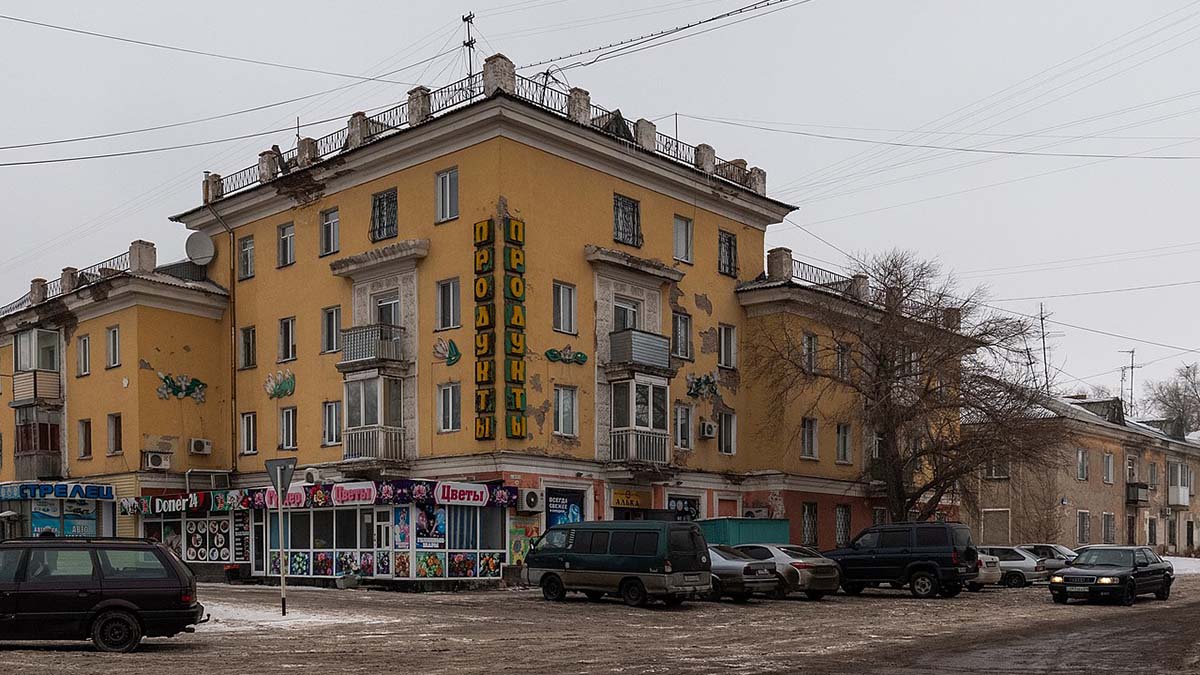
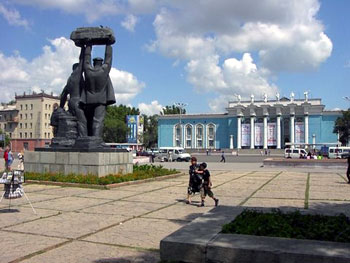 Before our adoption journey began, I knew next to nothing about Kazakhstan, in part, because until 1991, the country had been swallowed up in that vast entity known as the Soviet Union. So swallowed, it had lost its name, its freedom, much of its language and very nearly, everything about it which made it distinctly Kazakh. Even today, driving the streets of Karaganda, one notices the crouching, well-worn blocks of Soviet style apartment buildings with their Soviet graphics and wonders at the statue of Lenin still posing in the center of town. Still, there are no statues of Stalin, and that is a comfort. After all, it was Stalin who used Karaganda; along with hundreds of other locations in the vast Asian and Siberia steppes, as a full-service slave labor camp, a part of his infamous Gulag system. For years, people were deported to Kazakhstan from places as far away as Germany, Poland, Korea and Japan, put to work in the coal mines still prevalent in the area today and kept behind fences studded with barbed wire, guard towers and patrolled by guard dogs. Alexander Solzhenitsyn; the famous Russian author and Gulag inmate, was set to work not far from Karaganda in Ekibastuz, Kazakhstan. His famous novel, “ One Day in the Life of Ivan Denisovich”, was based on his experiences as a prisoner there.
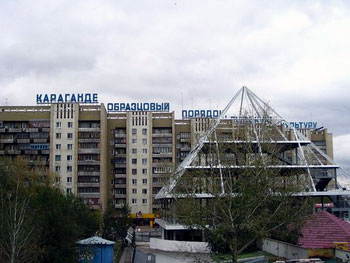 Though economic times are tough, there is a new openness to Karaganda. We met people, from translators to drivers, to those working in the orphanages we visited, who were willing to discuss the painful past of their city, its history of Soviet oppression and to ask us in turn, about our experiences in the west. No attempt was made to hide the shoddiness of much of their surroundings nor were they too proud to ask for help, especially as it pertained to my husband and I buying much needed supplies for our daughter’s orphanage. We found the younger adults and children particularly interested in our lives, our language and why were had come so far to their city. Indeed, it was the older generation of residents who kept their distance and watched us warily when we walked past or played outside with our new daughter. Perhaps a life spent under the thumb of a communist regime had taught them to be more cautious.
 Some of our best experiences however, focused on the spiritual rather than the temporal when we were invited to attend Sunday services in the beautiful Russian Orthodox cathedral. The religion, having been suppressed for so long under communism, seemed vibrant, the worshipers devout, the choir and ritual a balm to heart and soul. The nearby mosque was also impressive and stood as further testimony not only to Kazakhstan’s rich cultural and racial diversity, but to its new found religious freedoms as well. Trips to the surrounding countryside and out into the vast steppes were also a welcome change. Out under the endless Kazakh sky, one begins to understand this once nomadic race of people who still claim the land, air and sky as their own.
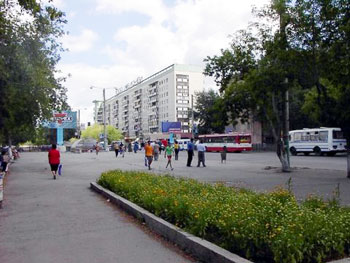 For those wishing to visit Karaganda, hotels, restaurants and apartments are available, in various price and quality ranges. While in Karaganda, my husband and I stayed in an apartment whose previous owners had emigrated to Israel, leaving the apartment, along with their clothes, family pictures and clothing, behind. Many permanent residents will move in with relatives and rent their apartments to foreigners willing to pay well and keep their apartments clean. The price for such an apartment is still reasonable and is a great way to get to know the people, places and culture of the city. Karaganda boasts a nice lake and central park in its downtown area which is a welcome change from the traffic of the streets and during the summer, a large circus plays in town which is an event the entire city looks forward to. Karaganda also supports a university and various academic institutions. There are gardens, a water park, a theater and a museum which contains many interesting displays on traditional Kazakh nomadic life which we found very well done. We also enjoyed the many monuments dotting the city, especially the massive memorial dedicated to the Kazakh effort during World War II.
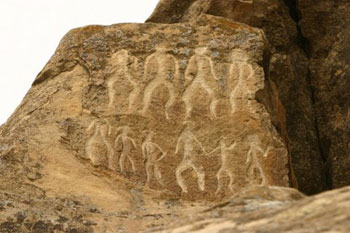
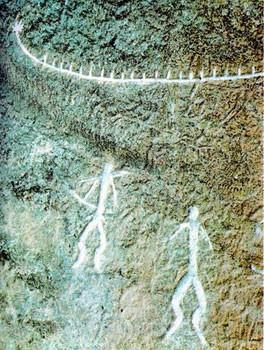 Declared a UNESCO World Heritage Site, Gobustan contains unique rock art engravings and images depicting the lifestyle, culture, economy, world outlook, magic and totemic conception, customs and traditions of the ancient inhabitants of the area. Long time ago the sea waves licked these mountains and then abandoned them leaving characteristic relief traces on the polished rocks.

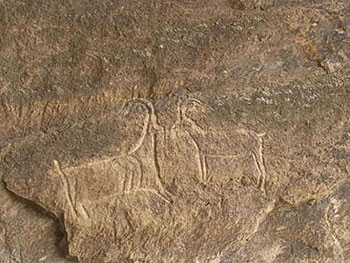
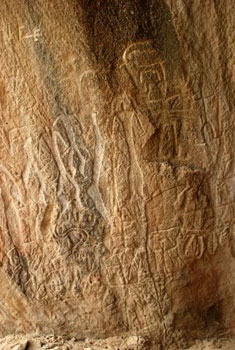 Gobustan rock carvings are marked with thematic diversity, plot originality, and certain artistic skill. Most of the petroglyphs depict people, domestic and wild animals, such as oxen, goats, gazelles, deer, horses, birds, fish, as well as battle scenes, ritual dances, bullfights, boats with men, hunting, fishing, solar symbols, etc.

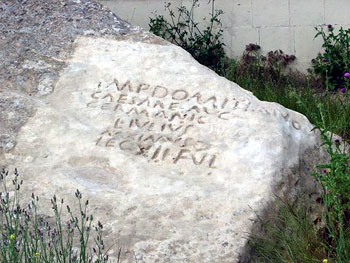 Personally, I am not sure about the presence of the Vikings in these areas. But the Romans were for sure. A rock found in Gobustan contains a Roman inscription which proves the presence of a centurion of the XII (12th) Roman legion, known as the Fulminat (Lightning) here on the shore of the Caspian Sea during the reign of Emperor Titus Flavius Domitianus in the second half the 1st century AD. Some assume, this may be the easternmost point any Roman patrol even ventured to. I can read the inscription though I am not good in Latin: “IMP DOMITIANO CAESARE AVG GERMANIC LIVIVS MAXIMVS LEG XII FVL” (“Emperor Domitian, the Blessed Caesar Germanicus. Livius Maximus, Legio XII Fulminata”).
 Near the end of our trip I ask my brother whether he would like to see the “Gobustan kitchen”. He first think I am joking. But I am not. I take him to the place I have read about many times and show him the bowl-shaped depressions carved out in the rock. They were probably used for collecting rainwater, the blood of sacrificed animals or for cooking. I remember from the old people that until quite recently mountain shepherds used these “bowls” for boiling milk by dropping heated stones into them. It may be an explanation about the usage of similar “bowls” by the prehistoric people.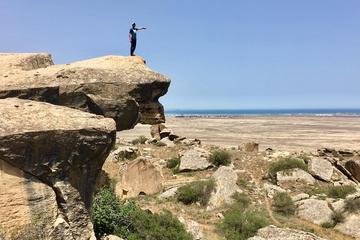
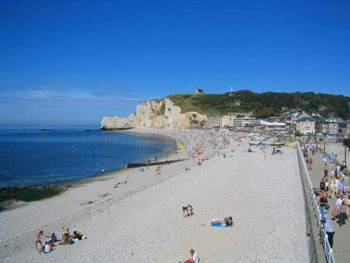
 The chalky north coast of Normandy captures the heart of every visitor at first sight. Years of seawater erosion and weathering have sculpted the coastline on both the west and east sides of the beach, leaving behind towering white cliffs and protruding headlands pierced by arches of various sizes. No wonder Monet visited Étretat every year between 1883 and 1886 and produced more than 60 paintings.

 “You are right to envy me. You cannot have any idea how beautiful the sea has been for two days, but what talent it will take to render it, it’s crazy. As for the cliffs, they are like nowhere else. Yesterday, I climbed down to a spot where I had never ventured to go before and saw wonderful things there so I very quickly went back to get my canvases. In the end, I am very happy.”
 Following the trail all the way to the top of Manneporte, I could see, on the east side, Porte d’Aval and Pointe d’Aiguille again next to each other as in L’Aiguille et la Porte d’Aval, Étretat. Monet painted the same motif from the beach below us as well. Bathed in the mellow evening light during low tide, the pillar and the arch in the painting hardly appear overwhelming although they still look gigantic compared with the tiny boats between them. While the view before me was imposing, the painting impressed me with its serenity.