by W. Ruth Kozak
If you visit my city, Vancouver, British Columbia, Canada, you are sure to spend some time in one of Vancouver’s unique tourist attractions, Stanley Park. The park covers 404.9 hectares (1,000 acres) of rainforest and is the largest city park in North America. It was named for Lord Stanley, 16th Earl of Derby who became Governor General of Canada. Stanley Park was first opened as a public recreation area in 1887. The park, which is located at the western entrance to Vancouver’s harbour, was originally settled by the Coast Salish people. It was their hunting and gathering ground and became the favorite haunt of an Indian princess/poet, Pauline Johnson, the first Native Indian to be published in Canada. Her book “The White Wampum” gained her high literary standing.
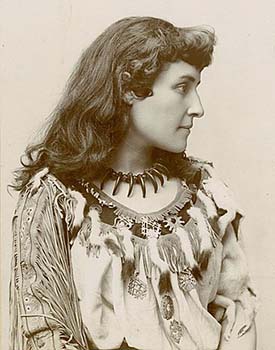 Born March 10, 1861 on her father’s estate “Chiefswood” on the Six Nations Indian Reserve near Brantford, Ontario, Pauline was the youngest child of G.H.M. Johnson, head Chief of the Six Nations and his English wife Emily S. Howells. Her Indian name was Tekahionwake. She was considered a “princess” because her father was the scion of 50 noble families which composed the historical confederation founded by Hiawatha, a noble chief made famous in a poem by Alfred, Lord Tennyson. It was known as the Brotherhood of the Five Nations.
Pauline’s education was meagre — a nursery governess for two years, attendance at a Native Canadian day school, and two finishing years at the Brantford Central School — but she was well educated in the School of Nature. With her voracious reading, retentive memory, and keen mind, Pauline acquired a wide knowledge of literature, especially poetry. Before she was twelve, she had read all the classics. Her fiest poems were published in New York and Toronto. By the time she was in her 20’s she became known for her public appearances and poetry readings, traveling from the Atlantic to the Pacific coasts of Canada. She also made several trips to England to perform and was presented to the Queen. She performed in dance halls across the country often clad in a buckskin outfit and a bear claw necklace to represent her Mohawk heritage and then later in the performance she’d change into a silk evening gown honoring her British ancestry.
Much of Johnson’s poetry focused on her cultural back-ground. In A Cry From an Indian Wife she wrote:
Go forth, nor bend to greed of white man’s hands.
By right, by birth, we Indians own these lands,
Though starved, crushed, plundered,
Lies our nation low;
Perhaps the white man’s God has willed it so.
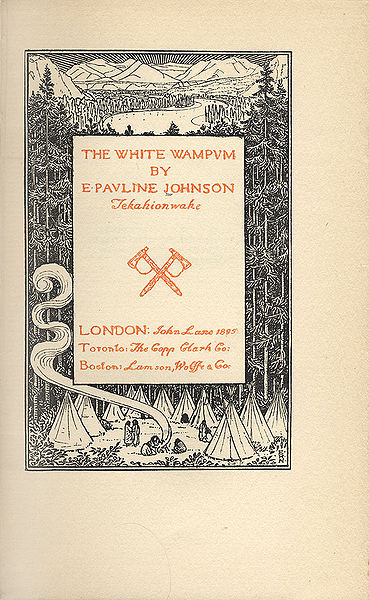 Pauline Johnson made many trips to the west coast, eventually settling in Vancouver. She spent much of her time in Stanley Park. She was an ardent canoeist and a great lover of nature and wrote many poems about the park.
As I enter the Park, I cross under the causeway and take the path to Lost Lagoon. Originally part of Coal Harbour, it was a tidal basin where Indians dug clams. In the early days, visitors to the park had to pick their way over a large log anchored in the mud flats until eventually wooden bridge was built. The causeway, constructed of earth, ashes and street-sweepings, was built in 1888. Pauline Johnson loved to paddle her canoe here. She named this tidal pool “Lost Lagoon” because of the way it emptied when the tide ebbed, and she wrote:
O! lure of the lost Lagoon/ I dream tonight my paddle blurs/ The purple shade when the seaweed stirs/ I hear the call of the singing firs/ In the hush of the golden moon.
The native name for Lost Lagoon is “Chul-Wah-Ulch” which means “a bog which is dry when the tide is out” Once there were Indian dwellings on the north side of the lagoon. Now, trumpeter swans, mute swans, duck families and grey herons make their home on the lagoon.
As I walk along the lagoon, I can feel Pauline’s presence and recall her poem about the Lagoon:
It is dusk on the Lost Lagoon,
And we two dreaming the dusk away,
Beneath the drift of a twilight grey-
Beneath the drowse of an ending day
And the curve of a golden moon.
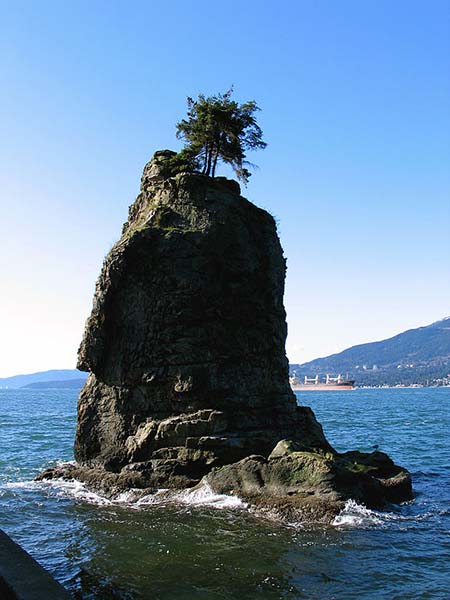 I follow the path to the end of the Lagoon to the seawall at Second Beach. As I walk along the seawall I come to another place that Pauline Johnson liked to visit in the park —Siwash Rock “where the twining roadway branches in two.” This monument of nature stands as a reminder to the Squamish people of one man who lived a good life. The tall pinnacle of rock that rises just off the shore represents Skalsh, a warrior who was turned into stone by Q’Uas the Transformer as a reward for his unselfishness. It is one of the best known legends about a young Indian who was about to become a father and decided to swim in the waters of English Bay to purify himself so his new-born son could start life free of his father’s sins. The gods made Sklash immortal by turning him into a pinnacle of rock. Two smaller rocks representing his wife and son stand in the woods overlooking Siwash Rock.
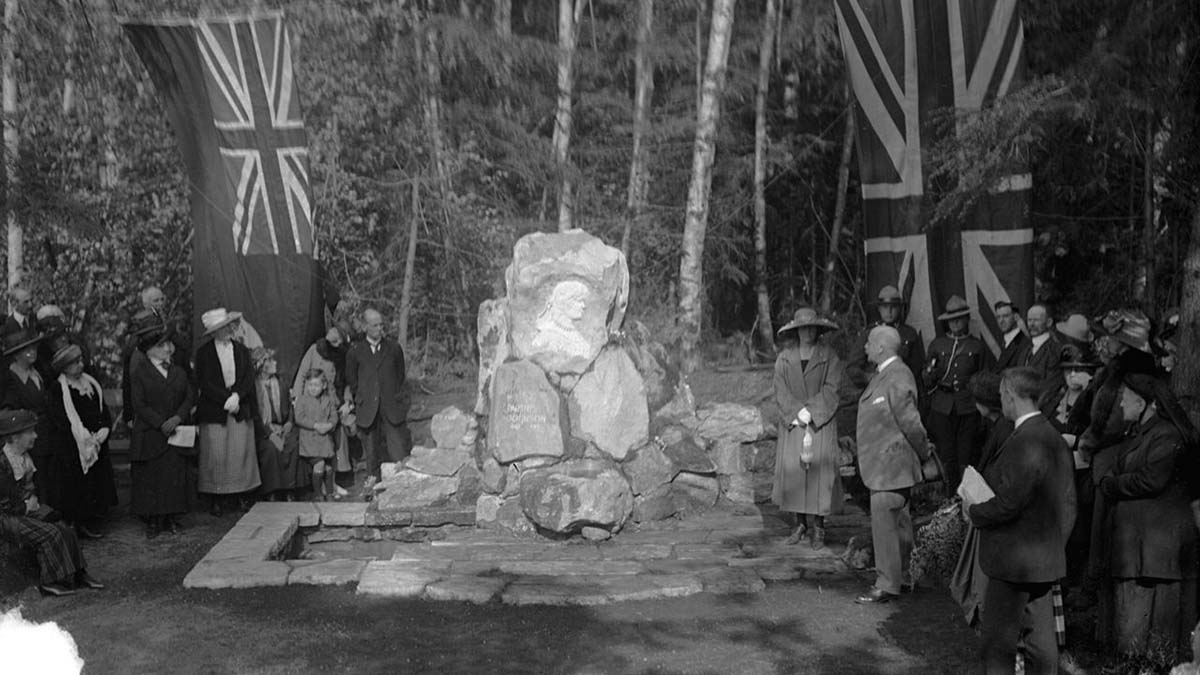
Pauline Johnson died in Vancouver at the age of 53, on March 7, 1913. The hardships of travel in those days had taken a toll on her health and in the latter years of her life this remarkable woman, known to her friends as ‘a beloved vagabond’ became an invalid. The last thing she wrote was her will, nine days before her death at 53, in which she requested no public mourning, no tombstone or monument. But a huge funeral was held with hundreds of people in the streets to honor her. Her will and ashes were lost for 43 years before they were found in the vault of a Vancouver law firm. Her ashes and two of her books Legends of Vancouver and Flint and Feather were eventually buried near Siwash Rock. In 1922 the Women’s Canadian Club of Vancouver erected a monument in her honour.
I visit the cairn in a cedar grove at Prospect Point near the Stanley Park Tearoom. It’s a simple relief carved out of a large piece of natural rock, where water flows from the rocks into a small hollow pool at its base. This day, someone has left a bouquet of flowers in her memory. I pause, engulfed in the silence of the tall cedars that surround the shrine, and pay homage to this remarkable woman whose beautiful poetry has given such a special meaning to Stanley Park.
If You Go:
If you visit Vancouver BC be sure to go to Stanley Park and you’ll see Lost Lagoon. Or take the road around the Park to 3rd Beach and up the steps by the roadside you’ll find the memorial stone to Pauline.
More Information:
PAULINE JOHNSON’S BIO
E. Pauline Johnson at Digital Library
BOOKS


Buckskin and Broadcloth: A Celebration of E. Pauline Johnson — Tekahionwake, 1861-1913


About the author:
W. Ruth Kozak is a historical fiction writer, travel journalist, poet and playwright who lives in Vancouver B.C. Canada. She is the former editor and publisher of TRAVEL THRU HISTORY. When she was young, Ruth lived in Brantford, Ontario and became interested in First Nations history and the story of Pauline Johnson. One of her favorite places in Vancouver is Stanley Park. www.ruthkozak.com and www.inalexandersfootsteps.com

Ceremony at Pauline Johnson’s grave by Thomson, Stuart / Public domain
Tekahionwake ca 1895 by Cochran / Public domain
Cover of 1895 edition of White Wampum by Pauline Johnson – Public domain
Siwash Rock, Vancouver by Andrew Raun under the Creative Commons Attribution-Share Alike 2.0 Generic license.

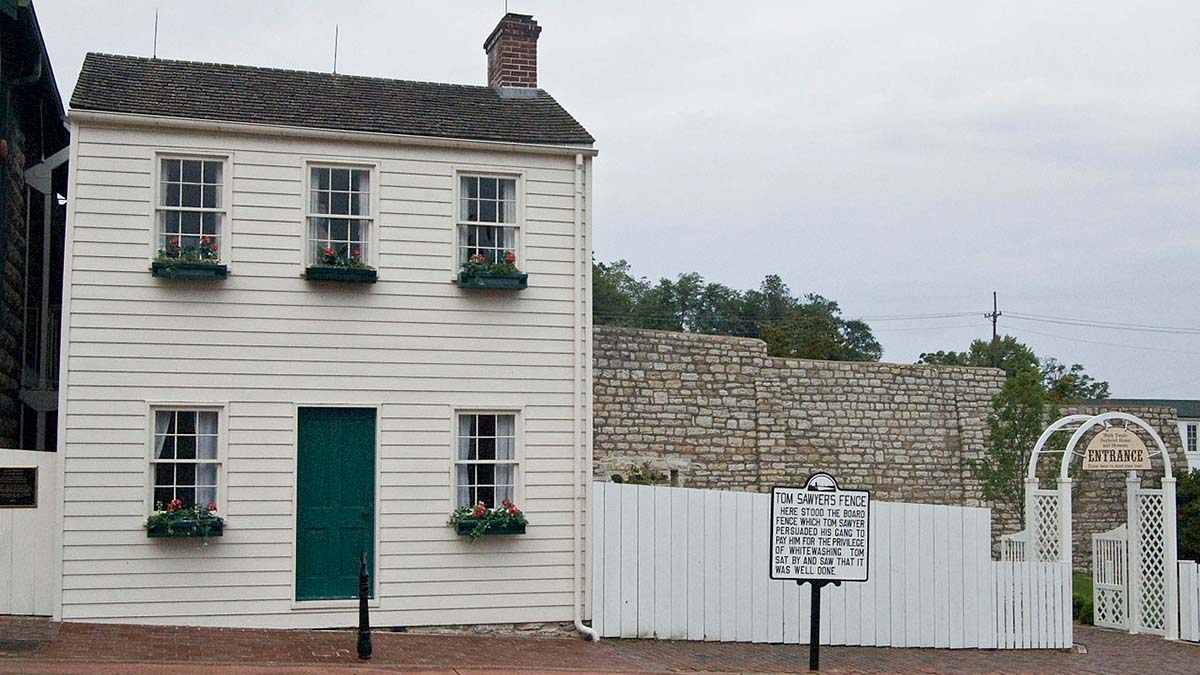
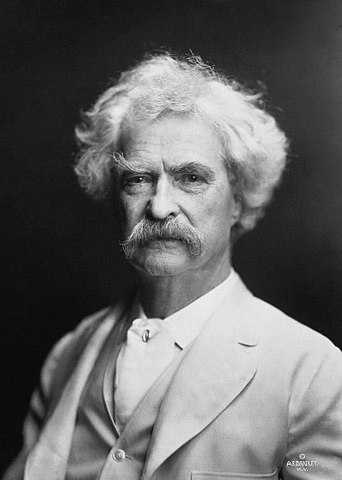
 One final stop on the Boyhood Home Complex is the bronze Tom and Huck Statue at the foot of Cardiff Hill. You can pose for a photo and be one of Tom and Huck’s “robber gang.” Look beyond the statue, and you’ll see 244 uphill steps that lead to the historic wooden Mark Twain Memorial Lighthouse, and be rewarded with a Birdseye view and sweeping panorama of the river and the town of Hannibal.
 Across from the Cave Complex is the Sawyers Creek Fun Park with bumper boats, waterworks, miniature golf for all you mini-golf duffers, a cafe and the towns only all year round Christmas store with an abundant selection of Christmas ornaments, trees, and holiday decorations to give your Christmas a Mississippi River flair. The Mark Twain Riverboat has daily excursions including a one hour sightseeing cruise or a two-hour romantic sunset dinner cruise where you can wine and dine with all the nostalgic ambiance of an earlier slower paced era of style and class.
 If the fireworks are spectacular try the Ghost Tour on for size and visit all the sites of Haunted Hannibal aboard a shuttle bus with tales of murder and mayhem and paranormal apparitions. You’ll visit the Baptist Cemetery for a ghostly tour of the grave sites of slaves, Confederate soldiers, murderers and their victims. There is also a haunted dinner and ghost walk available and to top it all off, you can stay at one of the haunted bed and breakfasts where ghostly apparitions may appear to share the room with you in a scene right out of House on Haunted Hill.

 San Francisco never ceases to entertain. The city is diverse, exciting and cosmopolitan. No matter how many times you visit, there is always something new to see. But the city hasn’t always been this refined. Between 1849 and 1917, the city enjoyed a raucous reputation known as “the Barbary Coast” period. The Barbary Coast, the original red light district, acquired its name around 1860 from the coast of North Africa where Arab pirates attacked Mediterranean ships.
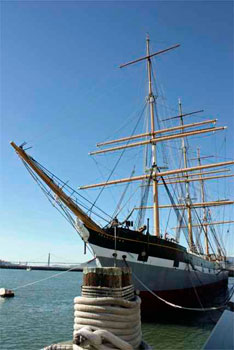
 Labor was scarce as passengers and crew jumped ship to seek their fortune. This problem was alleviated with the practice of shanghaiing – signing up sailors by coercion. Prospective sailors, no experience required, were slipped a “Mickey Finn” (opium) in their drink then dropped down a trap door in the saloon floor. This may be where the expression “down the hatch” originated. Upon awakening, they would find themselves unwilling crew members on an outbound ship destined for a two year tour.
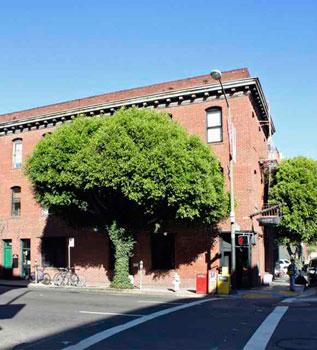 Those who were not shanghaied often frequented the local dance halls. Exit the Old Ship Saloon and walk approximately three blocks to the Hippodrome. Now an art supply store, the sidewalls of the entrance are still graced with the original white bas-reliefs of dancing nude nymphs. Superficially this establishment catered to lonely men but it also housed a secret tunnel used for smuggling goods and people. Descend the stairs into the basement and face the wall at the front of building. In the far right corner you find the entrance to a now walled-off tunnel approximately 15 feet long with 10 foot high arched ceiling.
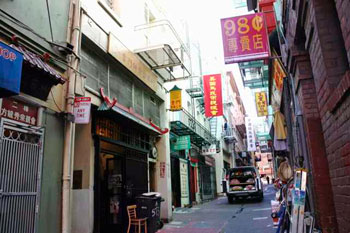
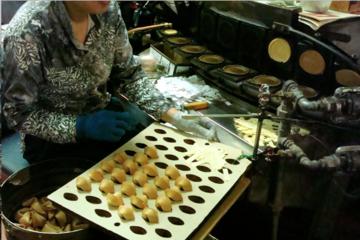
 A history of more vice follows in Chinatown’s Ross Alley (“the Street of the Gamblers”). Walking along, you find many of the doors in the alleyway covered by metal gates. Any one of these doorways potentially leads to a former gambling or opium den. While nothing from this time is clearly visible, it is not difficult to imagine men and women sprawled out in a drowsy or completely overcome condition. While you proceed through the alley, stop by the Golden Gate Fortune Cookies factory for a free sample and see how that product is made.

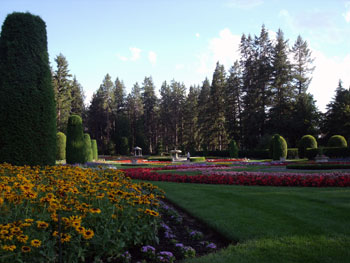
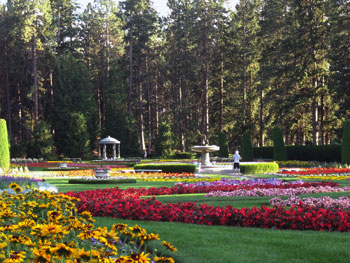 The park, designed by the famous Olmstead brothers of New York City’s Central Park fame, combines both the best of man’s landscaping ideas with Mother Nature’s unspoiled beauty. The area is prefaced by basalt rock formations jutting out everywhere. In the midst of the unspoiled habitat, my eyes were captivated by a stone bridge built in the 1930s. Even on a warm, sunny afternoon with the public out hiking, biking, or admiring one of the six gardens (including for lilacs and roses), I felt a real sense of calmness and peace in a place that once was a zoo, until the hard times of the Great Depression caused its closure. At the north central end of the park, one can still see remnants of the bear’s habitat, as just behind the Park Bench Café resides a basalt rock formation that has iron bars sticking out of it.
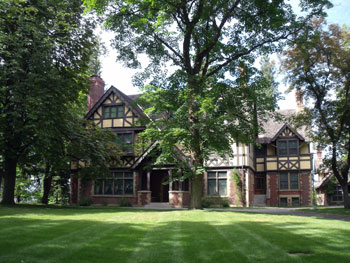 Tree-lined avenues to walk on are especially welcome during a balmy morning, which the Browne’s Addition provided for me. About a five-minute drive west of downtown, it was established in 1883, making it one of Washington State’s oldest neighborhoods whose homes include a mix of small and large dwellings and an array of 1970s and 1980s apartment complexes.
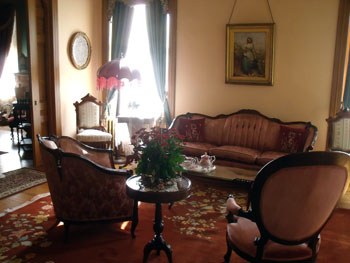 The spacious Campbell House, one of the inspired designs of architect Kirtland Cutter, offers tours. On the first and second floor, I got to view the family’s living quarters and Campbell’s personal office space. Guests get to see what life was life for the servants, who worked primarily in the basement. Here, 19th century lighting has been recreated (using old Thomas Edison reproduction light bulbs) to show how little light Campbell’s staff had while doing the laundry and other chores, which explains why there are windows in the basement for extra lighting. The property’s carriage house has plenty of exhibits that go over the history of the family and the late 19th and early 20th century times in Spokane. As big and dated as the house is, there’s been no reported haunting, even though it’s a bit creepy to explore. I took lots of pictures, and found no traces of orbs or ghosts.
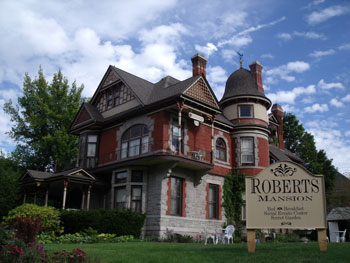 I took another tour of another famous Browne’s Addition house, The Roberts Mansion, also located on 1st Ave. It’s an 1889 Queen Anne Victorian home that serves as a bed and breakfast. The interior has been restored to reflect earlier times, but does offer guests the creature comforts of internet access and plasma TVs. I found the most notable aspect of the property in its backyard. It contains a “Secret Garden,” which is easily missed by guests because large shrubs obscure it, but once inside, it offered me a peaceful setting to rest in while surrounded by trees and other plant life. No wonder this place is used to host intimate gatherings.
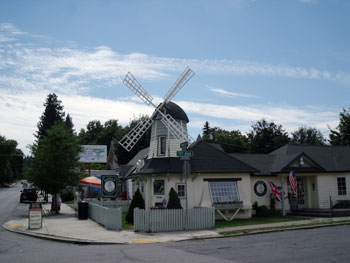 Dating back to the late 1800s, the South Perry District offered me a more rugged and vibrant city experience than the historic tranquility of the above two neighborhoods. It has blue collar roots, for its first businesses included a couple of lumberyards and a butcher shop. The most conspicuous landmark is located on the main drag of South Perry Street. It’s a Dutch windmill that originally housed a bakery, but has since had many businesses in it. Currently, there’s a health food and herbal store there, where I got some real black licorice made out of licorice root extract.

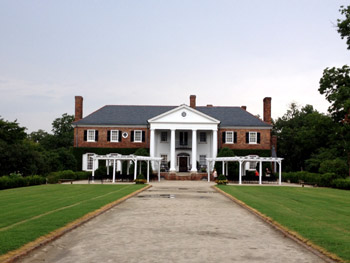
 I walked over the waterlogged ground to the nine slave cabins that were in the front yard. The cabins are made from brick, which is incredibly unusual for the time because most were made out of wood. Visitors would have seen these cabins first before the main house, and the reasoning was that if the slave cabins were made from brick, you knew you were entering a wealthy plantation. Each cabin would have housed between 6-12 people, mainly house slaves as the field slaves would have lived in wooden cabins in the fields. (There was a hierarchy among the enslaved, and you were considered ‘higher up’ on the scale if you worked in the house.)
 In each cabin, there was a small exhibition on the life of a slave and what happened to them after the Civil War. Quotes by Frederick Douglass, the fiery abolitionist William Lloyd Garrison and former slave Harriet Tubman adorned the walls. Tubman, my personal heroine, declared “there is either liberty or death, and if I can’t have one, I will have the other.” Standing in those slave cabins was the most surreal moment of my life so far. I had read about slavery for five years, imagined what life must have been like for a slave living in the heart of South Carolina, or in the humidity of Louisiana, but nothing came close to standing in that cabin, feeling the marks of fingerprints on the walls, and looking out of the window to stare at the alley of oak trees. Feeling the dust beneath my feet and staring at the broken pieces of glass, animal bone and metal. What would the enslaved have experienced within these walls? Loss and sacrifice. Heartbreak and death. Love and defiance. Survival. These slave cabins bridge the gap between two completely different worlds. We may never be able to recover the memories or the stories that scream to be heard, but the cabins stand as strong and silent testimony to those that lived and worked here. It was an incredibly moving experience, and one that I shall never forget.
 After the presentation I rushed to the ‘Big House’ for my tour, an elegant home that is still lived in. Unfortunately, you were not allowed to take photographs, and the tour was confined to the library, the study and the dining room. Little was mentioned about the role of the slaves within the house, but the tour was interesting nonetheless. It was beautiful, although not as grand as some of the plantations you will find in Louisiana. Perhaps that is a good thing, depending on your taste. And so concluded my powerful trip to Boone Hall. I made my way to the car park, which now resembled a small river, and carefully drove down the alley of oak trees, this time in the sunshine. The best destinations are those that stir the soul, pull at the heartstrings or blow us away with their beauty. For me, Boone Hall managed to do all three.