New York City
by Anna Marie D’Angelo
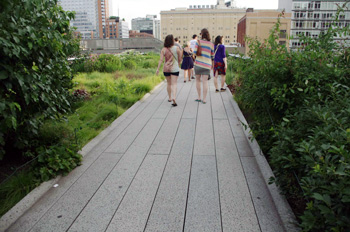
If you haven’t been to New York City in a few years, chances are you haven’t taken a delightful walk along the Chelsea High Line in Manhattan’s lower west side.
Opened in 2009, the linear elevated park, officially called The High Line, was built on the remains of a derelict freight train route near the Hudson River. For almost two decades, only weeds used the abandoned rail bed as trucks had long replaced trains hauling freight to the factories and warehouses. The last train unceremoniously moved three carloads of frozen turkeys in 1980, according to the non-profit conservancy that runs the park.
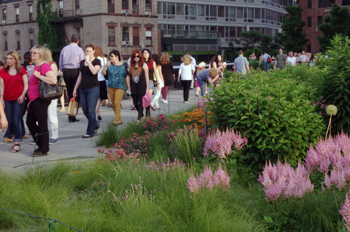 The High Line was set to be demolished around 1999 when a couple of New Yorkers started a movement to not only save the structure, but make it an extraordinary space for park goers to enjoy. The High Line is perfect for an early evening stroll when the Big Apple starts to cool down on a hot summer’s day. It’s free and although uncomfortably crowded in spots, you can’t beat enjoying the ever-changing streetscapes and unexpected scenery at your feet.
 My travelling companions and I started the High Line near its northern terminus on West 30th Street between 10th and 11th avenues. Signage was not great and we got on the High Line by climbing a metal staircase only to find that there was an elevator nearby.
The High Line is nine metres (30 feet) above ground with straightaways and gentle curves for about 20 blocks to Gansevoort Street, the heart of the Meatpacking District. The district is now trendy and commercial after years of being infamous and rundown or as the locals put it, the Meatpacking District went from raw to well done.
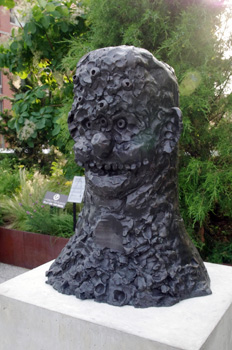
During our two-hour stroll, it was easy to be preoccupied with the different plants, sculptures and water features, and forget that you were on an elevated green space until you looked up and there was an amazing bird’s-eye view of this gritty part of Manhattan . Then you found yourself gawking at the old dirty buildings and the traffic, and listening to impatient honking with the odd motorist screaming at somebody from their car.
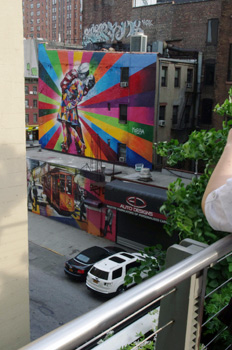 The walking path itself narrows to several people wide and expands to triple that in places with seating when it is most unexpected and appreciated. This includes a place called the 10th Avenue Square, complete with bleachers and huge picture windows for a broad view of the street life.
Where you place your feet on the High Line is also never dull. The long concrete planks are designed and laid out so rainwater runs off and waters the plants. No matter where you step, you will be reminded of railway tracks by the way the planks are always positioned.
When I went through the High Line in early summer, the plant life was thriving and, in many places, reminiscent of the greenery in Vancouver. Plants such as echinaceas, pink astilbes, ornamental grasses, shrubs and small trees adorn the route. It was a delight to see so many bees buzzing about the blooms, oblivious to the inhospitable concrete juggle nearby.
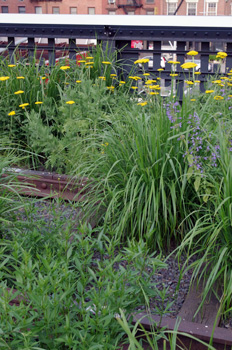 Sections of rusted track can be spotted throughout the High Line, but they are not always easy to find. This caused our group of park goers to each try to be the first to find a piece of old rail line at every change in garden space. The searches bordered on the obsessive by the end of our walk. Sometimes the old rails were far from the walking path and shaded by lush plants, growing among the rail ties like weeds did in the 1980s.
Near the south terminus of the High Line is a view of an automatic car park that managed to mesmerize a few of us park goers who watched in awe as a unmanned car was lifted by elevator and slid into a snug slot. Much more interesting were the talented street musicians that increased in number as we walked towards the southern end. This is also where a lot of information about the park’s history is posted. Near the south terminus are wooden chaise lounges that rested on old rails outfitted with new wooden ties. The lounge chairs, with a great view of the Hudson River, can easily be smashed together like rail cars to the merriment of children playing .


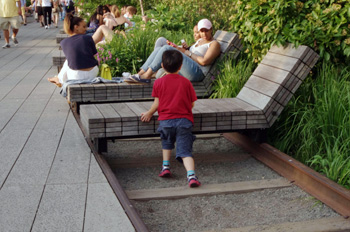 The High Line’s scale is more manageable than upper Manhattan’s huge Central Park. The two share a quirky characteristic in how the old concrete jungles appear to butt up against the green space of the parks for abrupt visual contrasts.
We got off the High Line on Gansevoort Street and stopped for a late dinner without reservations at a crowded Italian restaurant that turned out to be a chain. There are lots of eateries around but best to plan ahead and make reservations to avoid long waits.
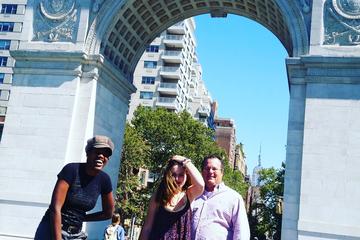
Private Greenwich Village, Chelsea, and High Line Walking Tour
If You Go:
♦ Access to the High Line is possible at Gansevoort Street, 14th Street (elevator access), West 16th Street (elevator access), West 18th Street, West 20th Street, 23rd Street (elevator access), West 26th Street, West 28th Street and West 30th Street (elevator access).
♦ The High Line’s summer schedule has the park open daily from 7 a.m. to 11 p.m. (with dramatic night lighting of the greenery).
♦ The High Line Information Line is 212-500-6035 or The High Line on the web for more information.
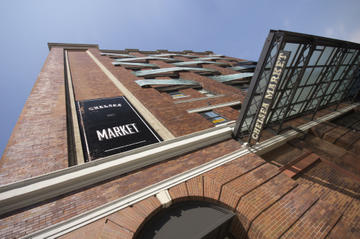
High Line and Chelsea Walking Tour
About the author:
Anna Marie D’Angelo has experience as a successful newspaper reporter and editor in the Vancouver area for 18 years. She now does Communications work and continues her writing passion through travel stories that have been published in major newspapers across Canada and online. Email: anna_dangelo@hotmail.com
All photos are by Anna Marie D’Angelo.
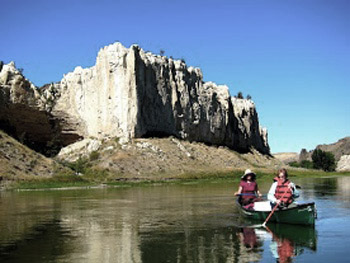 Rather than the tame goings-on of the last couple of centuries, it’s the little-known facts about Lewis and Clark and their expedition through un-mapped Missouri River wilderness which guide Mike Nottingham loves to discuss. This mountain man, trapper, fisherman, and river guide for the Missouri River Canoe Company even teaches you how to pronounce Sacagawea’s name correctly.
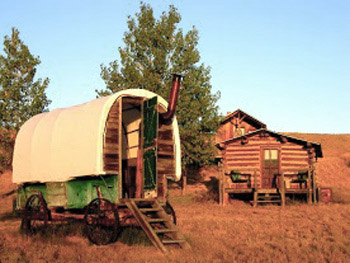 I went one step further. I chose the sheep wagon. How could I resist? It looked like one of the coolest places I would ever sleep. And it was. All night I heard coyotes howling in the distance as the light of the half moon glimmered through my canvas-topped covered wagon. I felt like Laura Ingalls.
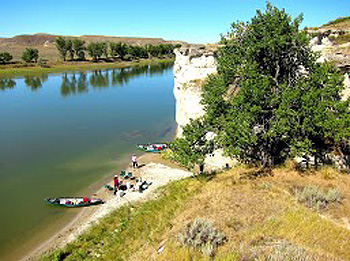 From our canoes, we didn’t see another soul on the river or bank, not a house, not even a broken-down homesteader’s shack. In fact, the Missouri Breaks landscape today, thanks to stewardship and land management, looks pretty much the way it would have looked to Lewis and Clark, even more so now than in the brief late-19th century steamboat days when trees were felled to fuel the boats. “The only difference now,” said Nottingham, “are the occasional Russian olive trees along the banks, which are invasive.” There’s also the odd cow which comes down from one of the ranches for a drink. Back then, of course, it would have been buffalo.
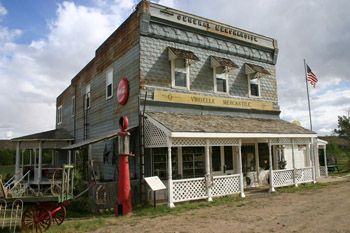
 In Virgelle, Montana, ghosts of the American west seem to be everywhere, their stories longing to be heard.
 , and Kite Strings of the Southern Cross: A Woman’s Travel Odyssey, shortlisted for the Thomas Cook Travel Book Award, and silver medal winner of ForeWord Magazine’s Travel Book of the Year. See: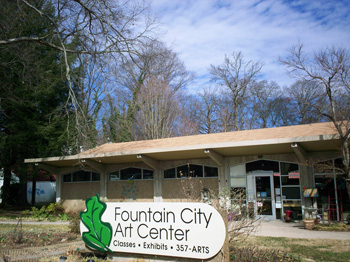
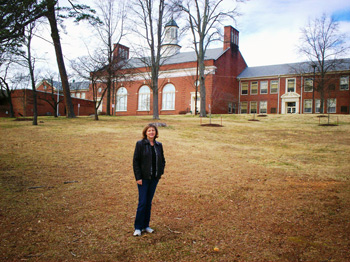 I did not attend Fountain City’s funeral, but a friend told me about it later and said it was quite an event that ended with the playing of “Taps.” Actually, as a teenager, I didn’t notice much difference after we were annexed, except that we got street lights on our street, which was a positive effect to me. I lived in Fountain City from the time I was nine until I got married and left, so I consider it my hometown. This trip was a sentimental journey for me.
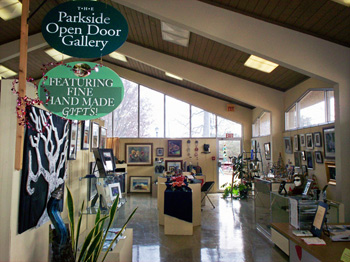 I remembered when I lived there that the building was home to the Fountain City Library. The Center was in-between main exhibits when we were there, but two new exhibits are now on display. The Knoxville Book Arts Guild and the Southern Appalachian Photography Society will be on view until April 8. Student exhibits from different area schools are also exhibited in the Center. There were some excellent works from middle school students on display when we were there.
 The eight-acre park now has lots of colorful playground equipment in addition to the swings and slides that were there when I was a youngster. Unlike some playgrounds, it seems to get a lot of use during good weather. The park is also now circled by a paved walking path, with freestanding “porch swings” scattered along the trail where you can sit and rest and watch the people and look at the old trees and the natural spring which flows through the park into First Creek. Fountain City Park is not owned by the City of Knoxville, but is owned, operated and maintained by the Fountain City Lion’s Club. The Lion’s Club Building is in the park and can be rented for meetings. My late father was a member of the club and we held his eightieth birthday party there.

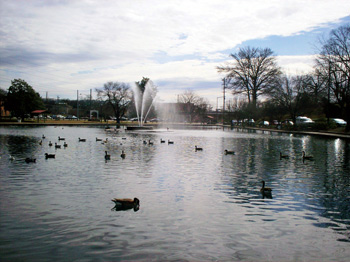 Before going to Litton’s, we walked around the block of Hotel Avenue and crossed the street to Fountain City Lake, also known as the duck pond. The lake was constructed around 1890. Designed by civil engineer F.G. Phillips, the heart-shaped body of water features a large fountain in the center gushing water skyward. We walked all around the lake, being careful to watch where we stepped. There were families there feeding the ducks, young couples and older couples strolling around, and even a couple of men fishing, and lots and lots of ducks.
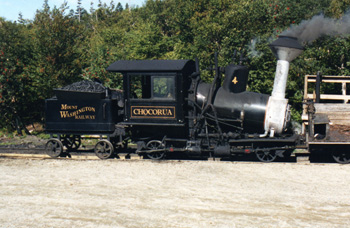
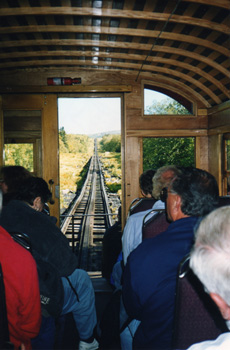 Crowding into our seats, old wooden benches polished and stained as if new, we wait for the jolt of the engine rejoining us. There are no CDs or TV screens to entertain us on the long haul but we have our tour group leader, brakeman and jack-of-all-trades, John, to keep us informed over the course of the 2.5 hour round trip.
 Up from the full forests of the valley through increasingly stunted and twisted growth and into the struggling bushes of the broad mountain slope we rise. The engine chugs behind us eating coal and spitting black smoke in a long trail; straining to reach the next water stop. That pause gives us a chance to regard an old shed clinging to the mountain at a severe angle or so it seems. In fact the shed is perfectly horizontal, it is us who are off kilter.
 The summit rises temptingly before us but again we pause, this time for another engine easing its coach back down to the distant valley. As seems so natural its passengers wave to us and us to them, a shared commonality in the experience. Trust in the engine is tested as we back off our siding to resume the climb. The comforting forward pitch sets us back on course.

 This summit is visited by a quarter million people a year and is seen by many in regular New England weather reports. Here winds have reached 231 miles an hour and the temperature dropped to -47 minus the wind factor. This September day was good with winds at 37 mph, gusting to 75. In winter it is a frost covered fairy land.

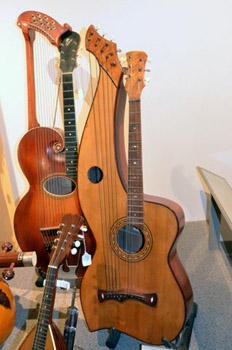 So, when I found out that the Museum of Making Music was about a stone’s throw from Legoland California Resort & Sea Life Aquarium in Carlsbad, I decided to make some time and check out the story on making music. A hidden jewel, it’s a treasure trove of a century of musical instruments and innovations that shaped American popular music.

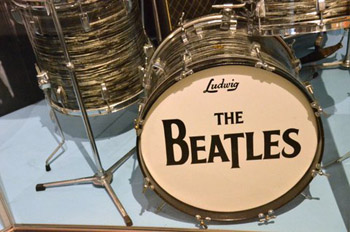 Along the way, I learned about someone I had never heard of as revolutionizing studio drumming. In the 1960’s, Hal Blaine developed a signature drum beat that made him quite popular with producers and songwriters. To keep up with the demand, he used a cartage company to transport his customized drums and hardware to meet the demands of live and studio performances. Songs like Elvis Presley’s “Return to Sender” and Frank Sinatra’s “Strangers in the Night” were recorded on the Hal Blaine Custom Drum Kit.