by Teresa Adamowski
Most people know Kaua’i as the Garden Isle. On a recent visit to the oldest Island in Hawaii’s archipelago, I was surprised to learn of Kauai’s other claim to fame.
 My first image of Kaua’i is from high above on the final approach to the Island. The vibrant red earth is a stark contrast to the intense cerulean ocean. The dirt is red due to the fact that the high iron content of the volcanic soils has had plenty of time to oxidize, especially with the wet conditions of the island. Incidentally, Kaua’i is the rainiest place on Earth.
As I step onto the sizzling tarmac, the air is still and stifling hot. The sun’s rays are tenacious and it is a relief to fling myself into the air conditioned van that will take me to my final destination approximately one hour North of Lihue Airport.
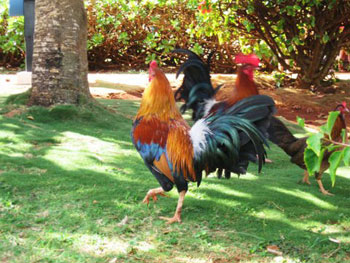
It’s not evident upon first glance, however as my taxi journeys over the bumpy and winding road Northward, I notice a copious cluster of chickens and roosters happily foraging the immaculate beachfront. It strikes me as odd to see so many chickens wandering freely, so I ask the cab driver for an explanation. He smiles and shares with me a fascinating story of Hawaii’s very recent history.
“When Hurricane Iniki hit the Island in 1992, the powerful storm destroyed many large chicken farms and the feathered inhabitants fled to all corners of the Island”.
He went on to explain that as Kaua’i encompasses dense vegetation, massive waterfalls, canyons and vast areas that are only accessible by air or water, the chickens were able to escape detection for many years. Since then, they have thrived in this tropical paradise and the lush Island has been overrun by a large and growing feral chicken population.


 “I don’t eat the chickens myself, but my wife’s family are always chasing them things,” The cab driver chuckles. “Her family’s a bit crazy,” he adds in a hushed tone.
The status of the Kaua’i chickens and roosters becomes more evident as I settle into my suite at the Princeville Westin Resorts on the North Shore.
I am awakened by loud crowing at the crack of dawn and the whole clan joins me by the infinity pool where they peck at the stray handouts willingly offered by curious tourists, who snap photos to commemorate the moment.
 The concierge at the Resort offers an alternate explanation to the recent chicken explosion. During the late 1800’s and early 1900’s, sugarcane plantation labourers imported and raised the chickens for eating and as a form of entertainment (“cockfighting”). Over the years, some of the chickens got loose and formed the wild clan. He concurs that the massive hurricanes certainly contributed to the over abundance of chickens.
Curious to test my theory that there must be a place on the Island without “free-range” chickens, I embark on a day trip to Tunnel’s Beach, which is a favourite haunt for snorkelers and swimmers due to the generous cove that is protected by a coral reef. I enjoy a scenic drive to the North West corner of the Island, along the rural twisting seaside roadway. Around each corner I strain to catch a glimpse of the most perfect uninhabited white sand beaches through the bushy over growth. I stop along the way to witness the enormous surf crash onto the shore with a thunderous clap.
 As if this display of ferocity is not enough to deter swimmers, there are many notices warning of dangerous tidal conditions. At the end of the road, I arrive at a secluded, romantic beach teeming with tourists, locals and yes, more chickens.
After a week of exploring the natural wonders of Kaua’i, I no longer think of wild chickens on the beach as strange. Somehow they have grown on me and add to the quirky but friendly ambience of the Island. I imagine the Kauaians are no doubt thankful for the boost to their local economy. A visit to any gift shop on the Island reveals numerous chicken themed souvenirs and surprisingly the quantity and selection surpasses the availability of local sea turtle merchandise. The Kaua’i chicken is here to stay as the unofficial and unusual mascot of the Garden Isle.
If You Go:
♦ Don’t be deterred by Kauai’s claim as the rainiest place on Earth. When it does rain it does not last long and dries very quickly due to year round tropical temperatures.
♦ Rent a car in Lihue airport or in the City as it can be very pricey to take a cab across the Island (e.g. $100 U.S.D. + tip from Lihue to Princeville).
♦ Bring with you a sense of adventure. There are many activities to enjoy while you visit Kaua’i, including helicopter tours, hiking in Waimea Canyon, surfing, snorkeling, kayaking and sailing to name a few.
♦ The locals are especially friendly and are a great source of information and advice.
About the author:
Teresa Adamowski is a writer who is very physically active and creative. In her spare time, she enjoys running, drawing, and hiking. Recently she suffered a setback in her half marathon training and has found solace in writing She loves to travel and explore new cities, however has found a special connection with the Islands of Hawaii and plans to return very soon. Publications: viewer.zmags.com/publication/4dba4be2#/4dba4be2/58
All photographs are by Teresa Adamowski.
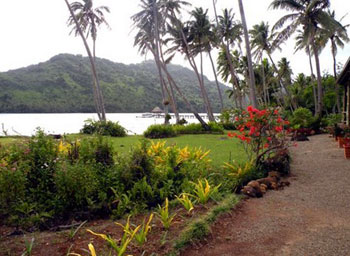
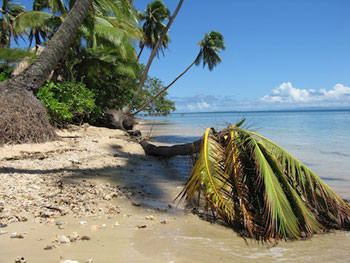 We arrived in mid-March 2010, one week after a category-four cyclone had torn through the Fijian islands and destroyed buildings, homes and roads. Driving from the tiny airport, we saw lots of damaged structures and broken tree limbs being chainsawed into manageable pieces. The once-verdant jungles, stripped of foliage and flowers, were tinged a mottled shade of brown. At the Cousteau resort we saw numerous downed trees, and a tour of the organic vegetable garden revealed a heartbreaking mess of broken seedlings. From the pier, we could see how the coral had taken on a variety of beige tones, and on the beach, piles of broken pieces had washed up, free for the guilt-free taking.
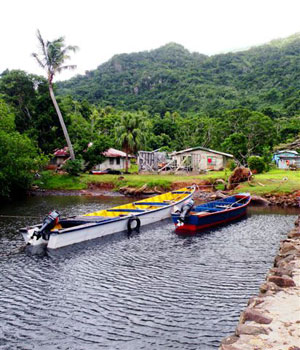 The size of our oceanview bure rivaled our Vancouver apartment, with enough closet space to keep our stuff hidden. Two walls were plantation blinds, the domed ceiling thatched, and the entire bathroom earthy-tone tile. After being briefed on everything from the best way to keep mosquitos out and the various organized activities, we were given a foot bath and massage on our porch. Talk about a fine howdy do, this was an effective way to make a visitor feel welcomed home. It made me want to curl up on the beach with a good book.
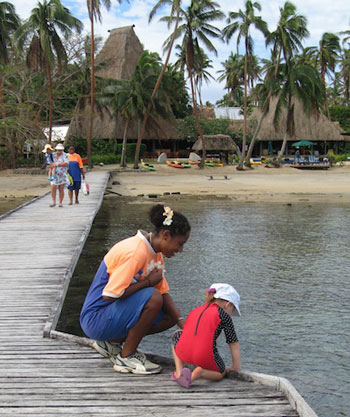 Before, during and after dinner we were entertained by the Cousteau’s house combo, the Bula Band, a group of young men who sang and played guitars. These guys were big on kava and encouraged us to sing and drink along. Joining them became a great way to relax after a long day of, well – relaxing.
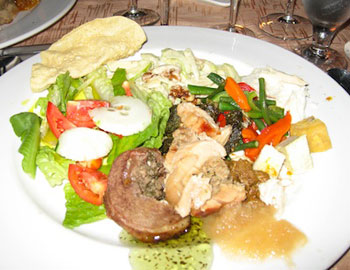 On our first night, we were treated to a traditional Fijian feast, cooked mostly in the lovo – a fire pit lined with heat-resistant stones. All afternoon, the smoky savoriness wafted over the resort, piquing our appetites. The buffet included lovo-cooked pork, chicken, beef as well as a whole walu – or Spanish mackerel – and were augmented with chunks of baked taro, sweet potato and plantain, smoked to perfection.
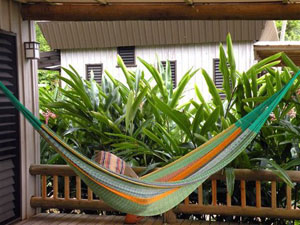 The good eats are not limited to the Serenity dining room, however. True romantics can have a table set up at the end of the pier for more privacy, an arrangement we saw working nicely until the wind and rain forced a quick evacuation. The kitchen will also load a gas grill, tables and chairs into a boat and set up a full lunch on Naviavia Island out in the bay, an event that impressed the large party of Californians who participated.

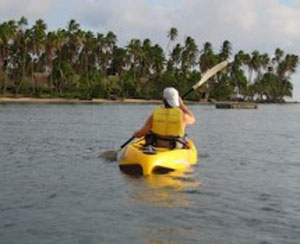 Our waiter told us he had worked on Fiji’s big island and it was expensive and a tough place to live, “but here, I can pull down a coconut or catch a fish to eat and it’s free.” Sounds pretty idyllic to me, although the village suffered some big-time crop loss in the storm. To support the village, the resort requests donations for a fund to benefit their Fijian employees and their families. Assistant Manager Bart Simpson – his real name – told us the Fijian’s hospitality comes naturally. “A lot of the nice things they do, we don’t ask them. They just do it.”
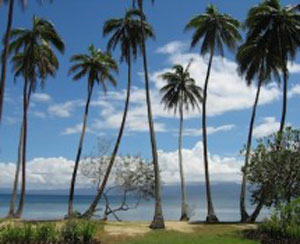 The resort’s nannies are available all day, so parents can have time alone if they want. Although kids are not allowed in the Serenity dining room, families can dine together in an equally beautiful space on the other side of the infinity pool. This separation of kids and adults is not only a welcome respite from the noise and frenetic energy of children, it also make you appreciate them more.
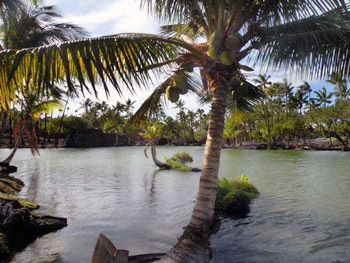 My wife Annie and I are immersing ourselves in the history and culture of Hawaii’s less crowded “outer” shores, far from the lights and traffic of Waikiki. It is like opening a Russian doll, so many hidden dimensions are revealed. We keep getting vivid glimpses of long-vanished ways of life. It is a rich, diverse and sometimes shocking tableau, full of extreme contrasts. On the one hand, there is the fondly imagined paradise of dramatic geography, a sultry climate and beautiful native people. On the other, a history of brutal warfare and the oppressive traditional social system, in which commoners might be killed for stepping on the king’s shadow. On the Big Island, however, people were safe if they reached sanctuary within the walls and temples of the City of Refuge, now painstakingly restored.

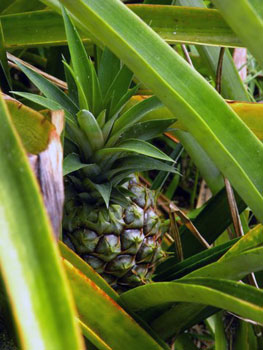
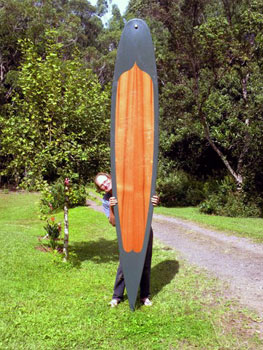 Also surprising is how rapidly Hawaii changed after Captain Cook arrived in 1778. By the 1820s, Lahaina was a bustling center for whalers and missionaries, with grog shops and churches, brothels and hotels. That was fully two decades before the Gold Rush led to the growth of San Francisco. In fact, Lahaina had America’s first high school west of the Mississippi. Since then, entire industries, such as pineapple cultivation, have come and gone, vanishing almost entirely. Great forests of koa and sandalwood were pillaged for export. Where fields of sugar cane flourished until quite recently, there are now virtual ghost towns and abandoned mills.
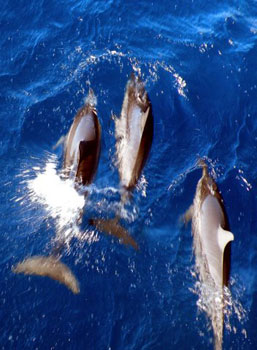 Then, we join a cruise that starts at the Big Island and ends on Maui. Carrying around 30 passengers, the
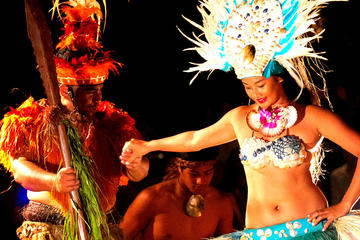
  Other evenings, special guests come on board. A hula troupe gives a performance that is nothing like what tourists experience at most resorts and commercial luaus. The lead dancers are men. They do aggressive, warlike steps, much like the Maori haka in New Zealand, rather than gentle, flowing ones. The moves are accompanied by chanting and drumming. There is not a ukelele or guitar in sight. We join them in drinking awa, a mildly narcotic ceremonial potion known elsewhere in the Pacific as kava. Another night, we meet Lawrence Aki, a hulk of a man who exudes quiet dignity, and his young disciple Kawika. Lawrence is a kumu (teacher) from a remote valley on Molokai. Kawika has lived with him for five years, helping at first in the taro patch and learning the old ways. This includes speaking the Hawaiian language and reciting genealogies. “It’s a lifetime commitment,” Lawrence says.
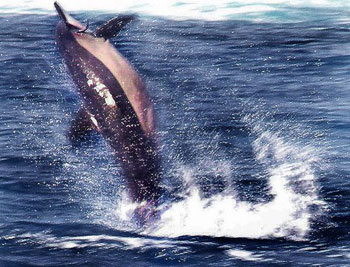 The final morning, a humpback leaps in the distance. It is a fitting sendoff. We have an entire afternoon to enjoy before a midnight flight home, and we have decided to visit a small museum about Pacific whaling. It features the old tools and equipment and the many products produced from an estimated 292,000 great cetaceans killed by the American fleet alone between 1825 and 1872. Fortunately, the humpbacks have made a remarkable recovery in recent years, from a low of around 1,000 in the 1960s to 20,000 or more today. On display outside is the impressive skeleton of a 40-foot sperm whale.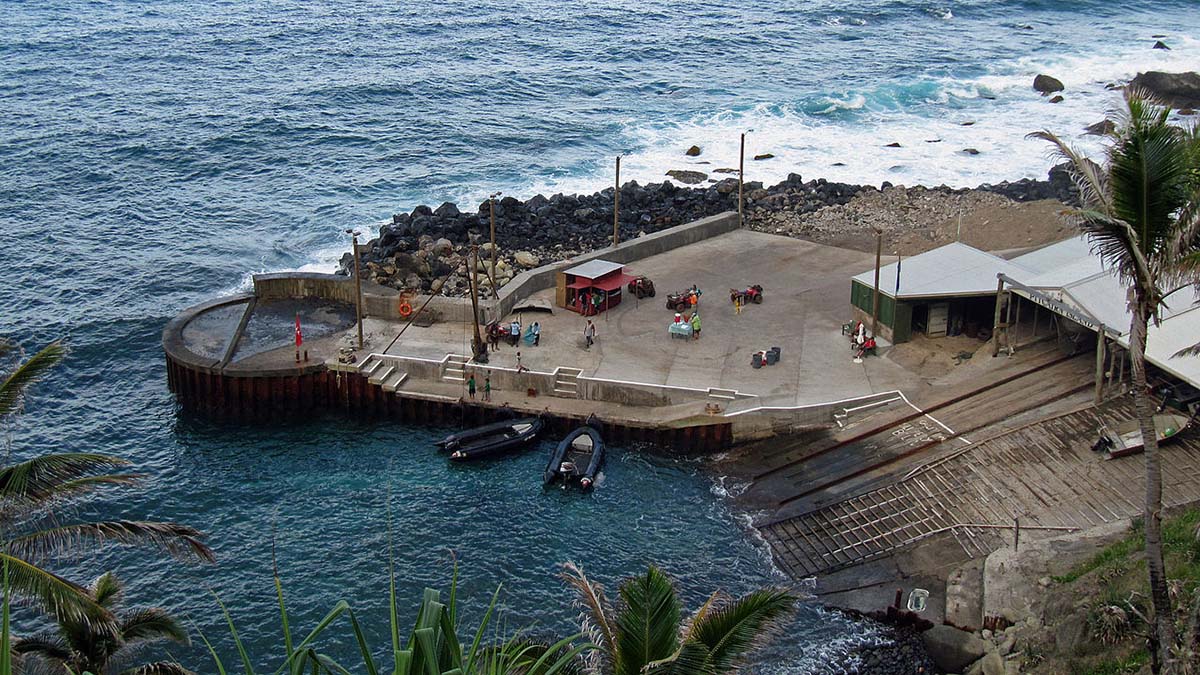
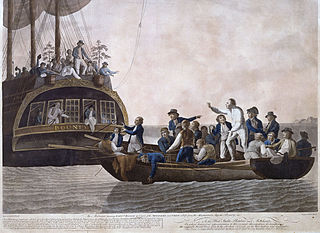 In 1790, near Tahiti Island in the South Pacific, English sailors staged a mutiny on the board the ship ‘HMS Bounty’. Nine English mutineers, their Polynesian ‘wives’ and a few Tahitian men and women took the Bounty on a desperate search for a safe hideout. They found it on Pitcairn Island. After being settled by mutineers, the island’s early history was bloody, with many feuds and violent deaths. Now Pitcairn Island is peaceful and its fifty families, many of them descendants of that infamous Bounty crew, welcome visitors to their idyllic tropical home.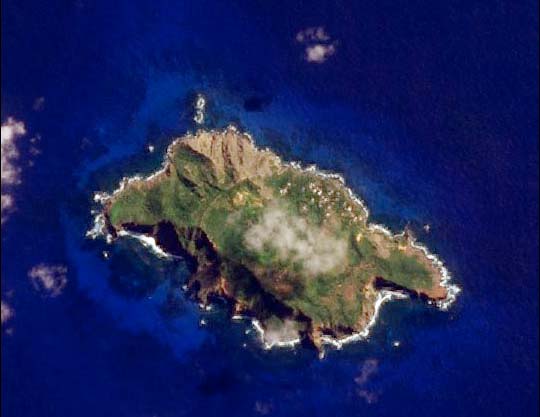

 A Saulsalito, California company Ocean Voyages Inc. called organizes yacht charters from French Polynesia to the Pitcairn Island. Every year between January and April the Rarotonga-based research vessel ‘Bounty Bay’, arranges cruises from Mangareva Island to Pitcairn and Henderson Islands, and paying guests are welcome.

 Many Kona coffee brands are sold in Hawaii. Most of these are blends however. Those wishing to enjoy 100% Kona coffee should read the labels carefully to eliminate the blends. Compare the taste of 100% Kona coffee to the blend just once and you’ll understand why there is simply no comparison between the two.
 After the tour, visitors are invited to sample light and dark roasted versions of both premium grades known as Extra Fancy and Peaberry. Peaberry beans are an anomaly in that they are plump, single oval beans. Regular coffee beans have two halves with matching flat sides. While this difference seems insignificant, the impact on taste is profound. Peaberry beans have a milder, fruitier taste combined with lower caffeine and higher oil content than regular coffee. I enjoyed the Peaberry so much that I purchased a one pound bag of the lightly roasted beans. The taste was fruity and full-bodied.
 The Ueshima Coffee Company offers a personalized hands-on roasting tour. Visitors can process their own half-pound bag of coffee beans and then apply a customized label to the product. Those not touring may sample the different Ueshima coffees in the company store.

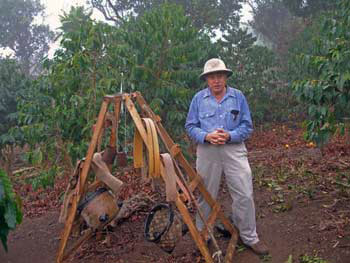
 The nearby Kona Historical Society’s Kona Coffee Living History Farm provides an unusual tour through an early 20th century coffee farm, owned and operated by a traditional Japanese family. A male guide outlines the early farming methods and equipment employed to cultivate and harvest coffee beans. Later, visitors are taken through the farm house by a kimono-clad female tour guide. Here they gain insight into how this family made use of its limited resources. Coffee farming was not a lucrative endeavor so the family was forced to make clothing from used coffee bean sacks. After touring the farm house, take some time to taste some different coffee types.
 Those wishing to explore the finer points of coffee tasting would benefit by reviewing the steps in detail at