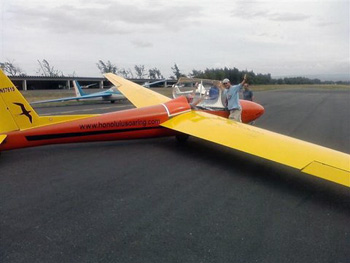
Glider Flying in Honolulu, Hawaii
by Larry Zaletel
I watch as the black Mercedes slowly begins to move down the blacktop runway. As the driver shifts through the gears the car quickly gains speed and the attached towrope begins to tighten. The glider slowly starts to lift off from. Catching the updrafts the pilot continues to take advantage of the air currents and rises out of the valley. The plane climbs higher and higher into the air where, nestled in the valley below lays the city of Erlangen, Germany. I can barely see the aircraft after a while as it is soon almost out of sight. For a long time I stand there in amazement my eyes transfixed on the sight.
I have watched gliders in movies before, but not up close. That was the first time that I had seen them. I happened to walk over to the flight line that Saturday after learning about the gliders from one of my Army buddies. I watched as they went about their work with a cool determination. There was more that one glider being readied. I remember that it was a partly cloudy day, the sun occasionally peaking out of the clouds.
Later I learned that this was a frequent occurrence. Every Saturday afternoon weather permitting, the German civilians came to the airfield located just outside of the American Army base to fly their gliders. I would stand there and observe them drive on to the airfield with their gliders and then watch as they would unload their equipment and prepare everything in order to launch. The air above the little valley provided the necessary current for them to spend the afternoon soaring in and out of the clouds. They sailed on the thermals through silence on gossamer like wings. Someday I vowed to do this.
 The thought stayed with me over the years. The idea of flying in a glider fascinated me but though opportunities came and went, I never took advantage of them. Finally when the opportunity became available I couldn’t miss the chance.
Honolulu Soaring is located at Dillingham Air Field in Mokuleia on the island of Oahu’s Hawaii North Shore. Close to Haleiwa town they have offered piloted gliding services since 1970. Dillingham Airfield was used extensively during World War II along with Haleiwa Field which was an unpaved emergency landing strip. I learned about Honolulu Soaring from an article I read in a guide book. The article intrigued me as it stated that they offer panoramic views of Oahu.
I didn’t know that a glider doesn’t need wind to fly. A glider just needs air flowing over its wings. It’s the pull of gravity that keeps the air flowing over the wings. When a glider flies through rising air, it climbs and vice versa.
The name of our orange and yellow glider is the Bird of Paradise. I briefly take a quick look inside of the glider. There are two seats one in front of the other, the control stick, and the pilot’s instruments. I climb into the plane’s cockpit followed by the pilot and we fasten our safety harnesses. My lanky legs straddle the underside of the pilot’s seat and the pilot instructs me not to touch the control rods of the ailerons, rudder and elevator mechanisms with my feet. Each has a specific mission.
The ailerons are the movable sections cut into the trailing edges of the wing or back of the wings. These are used as the primary directional control and they accomplish this by controlling the roll of the plane (tilting the wing tips up and down).


 The rudder or vertical stabilizer is the vertical wing-like structure on the tail and turns the airplane. It is used to control the yaw of the aircraft by allowing the pilot to point the nose of the plane left or right.
The elevator or horizontal stabilizer is the movable horizontal wing-like structure also located on the tail. It controls the pitch of the plane, allowing the pilot to point the nose of the plane up or down.
It is a cozy fit although surprisingly it is not as tight as I would have thought in the two man cockpit and I am able to fit my 6.1 foot frame in comfortably. The pilot checks his instruments (altimeter, compass, and airspeed indicator), closes the Plexiglas canopy and glances around the cockpit doing a quick security check.
The pilot in the tow plane performs a short circle in front of us to check that are no other objects (airplanes, skydivers etc) in the flight path. He then starts down the runway picking up speed. As the towrope tightens I feel a slight bump and movement in the plane. The air current begins to lift us after we travel only a few feet and the glider begins to rise into the air. Surprisingly my stomach remains calm. The tow plane revs its engine more and we edge higher and higher into the air, turning back and forth. The view of the lush green valley below becomes clear and larger and larger under us. “My goodness what I feeling!” I think.
I take a few deep breaths, relaxing my stomach muscles and view the panoramic seen around me. I glance around the valley below looking for interesting photo opportunities. I snap a few photographs hoping that the glint from the sunlight bouncing off the Plexiglas cockpit will not interfere with the clarity of my shots. Hopefully we will see.
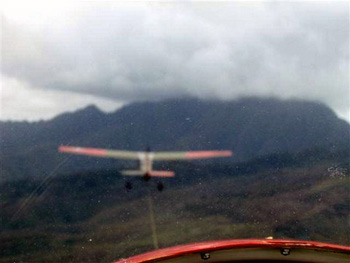 Soon I notice that the tow plane is loosing the tow rope and we are on our own. Suddenly it becomes so quiet, I can just about hear my heart beat. The rush of the incoming air into the compartment from the vent is the only noise I hear. It is like being up in the air with just you and God. I had always thought that it would be this way.
I have an incredible view of Oahu’s North Shore, the lush Waianae Mountains with their rugged cliffs laced with trails. I strain to look but I can’t see Pearl Harbor, the interior of Oahu, Diamond Head or Honolulu. Below me is the blue Pacific Ocean, with coral reefs and breaking waves. Someone once told me that the experience of soaring in a glider is about as close as you can get to flying like a bird, now I believe them. Spending time about 3000 feet over the lush landscape of Hawaii gives me a different perspective.
A glider can stay airborne indefinitely as long as it flies in updrafts. An updraft or thermals provide lift that can carry a glider higher and longer. Thermals are columns of rising air created by the uneven heating of the Earth’s surface from solar radiation. Thermals are also found in roadways and cities where the heat warms the ground and the air above it. Pilots also often tap into the winds deflected from mountain ridges or cliffs. By using these methods a glider pilot can remain airborne for hours. This is known as soaring. By finding and using lift sufficiently pilots can fly cross country and remain in the air all day.
We catch the thermals as we fly over the green valley toward the mountains. In the distance on the side of the mountain I see large white objects and as we fly closer I can make out a windmill farm of over 23 windmills. Turning 180 degrees we head toward the Pacific Ocean with its various shades of blue, the waves lapping at the shoreline. We pass over the airfield and I can see a sandy beach all along the coastline and below are pineapple farms and harvested fields plowed and ready for a new crop.
The pilot suddenly performs a sharp turn and we begin to descend to the airfield. We skim over the trees and come closer and closer to the earth. I can barely feel the ground as the singular wheel touches down gently on the runway and we roll a few feet and slow finally to a stop. It is finished. What an exciting way to spend thirty minutes flying in the clouds, something I’d wanted to do since the time when I had observed my first glider flight many years ago in Germany.
1-Hour Seaplane Adventure from Honolulu
If You Go:
♦ There are a variety of direct and indirect flights of airlines and prices to Honolulu, Hawaii.
♦ There are also a variety of Hotels and condos to choose from.
♦ My favorite restaurant in Honolulu is Jimmy Buffett’s Beachcomber, 2300 Kalakaua Avenue, Honolulu, HI 96815. [IT CLOSED IN 2016 – ED]
♦ Honolulu Soaring or 808-637-0207
Private 2-Hour Surfing Lesson in Honolulu
About the author:
Larry Zaletel is a freelance travel writer, an avid and dedicated traveler, and recurring visitor to Europe, the Caribbean, and the Far East. He writes about the various people that he has met and places that he has visited during his travels.
Photos by Larry Zaletel:
Thumbs-up landing
Touchdown just as we landed
Soaring over Dillingham Airfield and the Pacific Ocean
Our tow plane
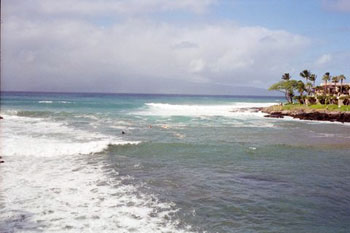
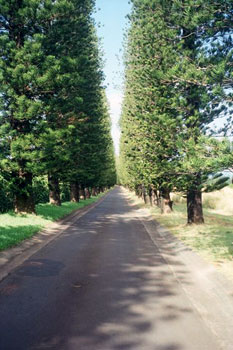 Is it worth it? Oh yes. We land, retrieve our luggage and walk out into the sunshine. The Trade winds are blowing; those wonderful, gentle breezes that caress the palm trees and carry the scent of plumeria, just one of the many flowers that grow in the Islands. I can feel my body letting go of all the stressors. We are back on Maui.
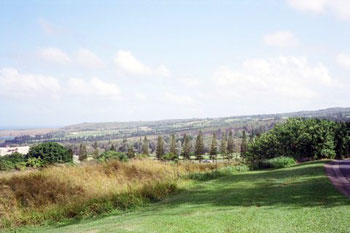 One of the highlights of our trip is driving to upcountry Maui on the slopes of the now dormant volcano, Haleakala. Every time we make the trip it feels like a new adventure. We are never bored by the scenery – the sugar cane and pineapple fields, the red earth, the rows of hibiscus and the sea below where earlier we had just squished the wet sand between our toes.

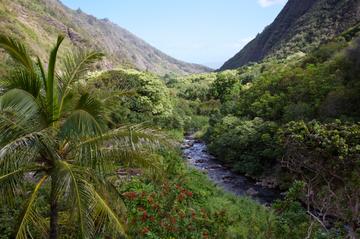
 My first image of Kaua’i is from high above on the final approach to the Island. The vibrant red earth is a stark contrast to the intense cerulean ocean. The dirt is red due to the fact that the high iron content of the volcanic soils has had plenty of time to oxidize, especially with the wet conditions of the island. Incidentally, Kaua’i is the rainiest place on Earth.

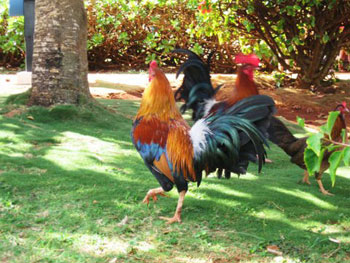
 “I don’t eat the chickens myself, but my wife’s family are always chasing them things,” The cab driver chuckles. “Her family’s a bit crazy,” he adds in a hushed tone.
 The concierge at the Resort offers an alternate explanation to the recent chicken explosion. During the late 1800’s and early 1900’s, sugarcane plantation labourers imported and raised the chickens for eating and as a form of entertainment (“cockfighting”). Over the years, some of the chickens got loose and formed the wild clan. He concurs that the massive hurricanes certainly contributed to the over abundance of chickens.
 As if this display of ferocity is not enough to deter swimmers, there are many notices warning of dangerous tidal conditions. At the end of the road, I arrive at a secluded, romantic beach teeming with tourists, locals and yes, more chickens.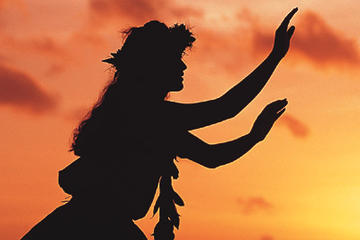
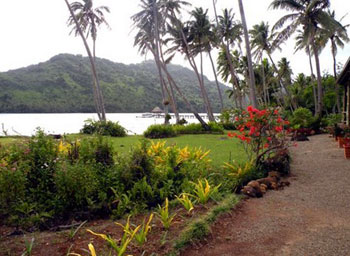
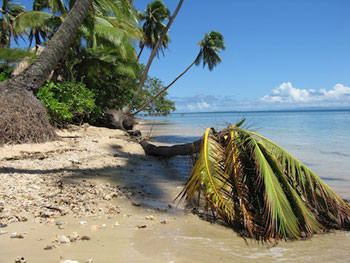 We arrived in mid-March 2010, one week after a category-four cyclone had torn through the Fijian islands and destroyed buildings, homes and roads. Driving from the tiny airport, we saw lots of damaged structures and broken tree limbs being chainsawed into manageable pieces. The once-verdant jungles, stripped of foliage and flowers, were tinged a mottled shade of brown. At the Cousteau resort we saw numerous downed trees, and a tour of the organic vegetable garden revealed a heartbreaking mess of broken seedlings. From the pier, we could see how the coral had taken on a variety of beige tones, and on the beach, piles of broken pieces had washed up, free for the guilt-free taking.
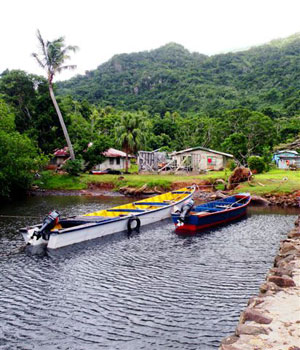 The size of our oceanview bure rivaled our Vancouver apartment, with enough closet space to keep our stuff hidden. Two walls were plantation blinds, the domed ceiling thatched, and the entire bathroom earthy-tone tile. After being briefed on everything from the best way to keep mosquitos out and the various organized activities, we were given a foot bath and massage on our porch. Talk about a fine howdy do, this was an effective way to make a visitor feel welcomed home. It made me want to curl up on the beach with a good book.
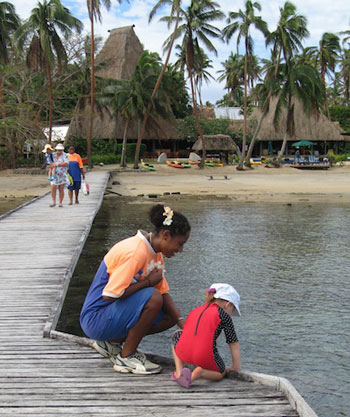 Before, during and after dinner we were entertained by the Cousteau’s house combo, the Bula Band, a group of young men who sang and played guitars. These guys were big on kava and encouraged us to sing and drink along. Joining them became a great way to relax after a long day of, well – relaxing.
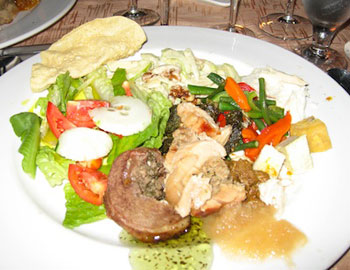 On our first night, we were treated to a traditional Fijian feast, cooked mostly in the lovo – a fire pit lined with heat-resistant stones. All afternoon, the smoky savoriness wafted over the resort, piquing our appetites. The buffet included lovo-cooked pork, chicken, beef as well as a whole walu – or Spanish mackerel – and were augmented with chunks of baked taro, sweet potato and plantain, smoked to perfection.
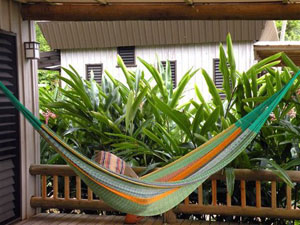 The good eats are not limited to the Serenity dining room, however. True romantics can have a table set up at the end of the pier for more privacy, an arrangement we saw working nicely until the wind and rain forced a quick evacuation. The kitchen will also load a gas grill, tables and chairs into a boat and set up a full lunch on Naviavia Island out in the bay, an event that impressed the large party of Californians who participated.

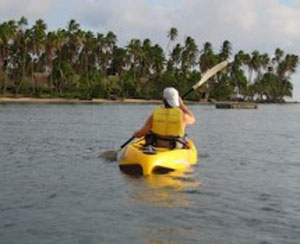 Our waiter told us he had worked on Fiji’s big island and it was expensive and a tough place to live, “but here, I can pull down a coconut or catch a fish to eat and it’s free.” Sounds pretty idyllic to me, although the village suffered some big-time crop loss in the storm. To support the village, the resort requests donations for a fund to benefit their Fijian employees and their families. Assistant Manager Bart Simpson – his real name – told us the Fijian’s hospitality comes naturally. “A lot of the nice things they do, we don’t ask them. They just do it.”
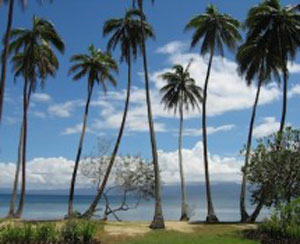 The resort’s nannies are available all day, so parents can have time alone if they want. Although kids are not allowed in the Serenity dining room, families can dine together in an equally beautiful space on the other side of the infinity pool. This separation of kids and adults is not only a welcome respite from the noise and frenetic energy of children, it also make you appreciate them more.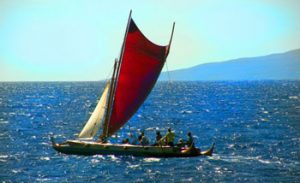
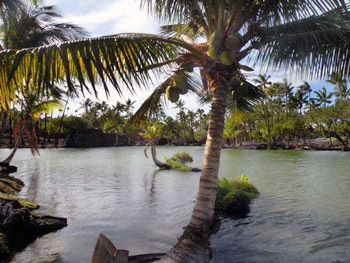 My wife Annie and I are immersing ourselves in the history and culture of Hawaii’s less crowded “outer” shores, far from the lights and traffic of Waikiki. It is like opening a Russian doll, so many hidden dimensions are revealed. We keep getting vivid glimpses of long-vanished ways of life. It is a rich, diverse and sometimes shocking tableau, full of extreme contrasts. On the one hand, there is the fondly imagined paradise of dramatic geography, a sultry climate and beautiful native people. On the other, a history of brutal warfare and the oppressive traditional social system, in which commoners might be killed for stepping on the king’s shadow. On the Big Island, however, people were safe if they reached sanctuary within the walls and temples of the City of Refuge, now painstakingly restored.

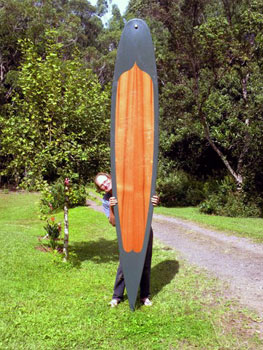 Also surprising is how rapidly Hawaii changed after Captain Cook arrived in 1778. By the 1820s, Lahaina was a bustling center for whalers and missionaries, with grog shops and churches, brothels and hotels. That was fully two decades before the Gold Rush led to the growth of San Francisco. In fact, Lahaina had America’s first high school west of the Mississippi. Since then, entire industries, such as pineapple cultivation, have come and gone, vanishing almost entirely. Great forests of koa and sandalwood were pillaged for export. Where fields of sugar cane flourished until quite recently, there are now virtual ghost towns and abandoned mills.
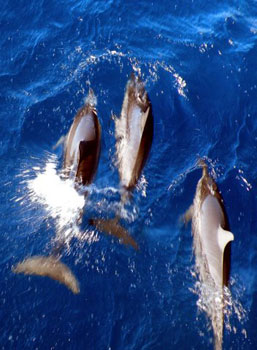 Then, we join a cruise that starts at the Big Island and ends on Maui. Carrying around 30 passengers, the
 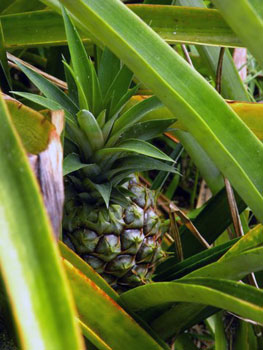 Other evenings, special guests come on board. A hula troupe gives a performance that is nothing like what tourists experience at most resorts and commercial luaus. The lead dancers are men. They do aggressive, warlike steps, much like the Maori haka in New Zealand, rather than gentle, flowing ones. The moves are accompanied by chanting and drumming. There is not a ukelele or guitar in sight. We join them in drinking awa, a mildly narcotic ceremonial potion known elsewhere in the Pacific as kava. Another night, we meet Lawrence Aki, a hulk of a man who exudes quiet dignity, and his young disciple Kawika. Lawrence is a kumu (teacher) from a remote valley on Molokai. Kawika has lived with him for five years, helping at first in the taro patch and learning the old ways. This includes speaking the Hawaiian language and reciting genealogies. “It’s a lifetime commitment,” Lawrence says.
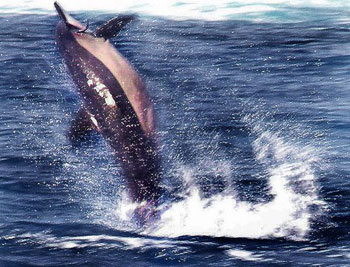 The final morning, a humpback leaps in the distance. It is a fitting sendoff. We have an entire afternoon to enjoy before a midnight flight home, and we have decided to visit a small museum about Pacific whaling. It features the old tools and equipment and the many products produced from an estimated 292,000 great cetaceans killed by the American fleet alone between 1825 and 1872. Fortunately, the humpbacks have made a remarkable recovery in recent years, from a low of around 1,000 in the 1960s to 20,000 or more today. On display outside is the impressive skeleton of a 40-foot sperm whale.