by Larry Zaletel
The sounds of the guns barking broke up the calm of the quiet Sunday morning; the Attack on Pearl Harbor had begun. It was to be the last day of peace for many years. The bullets were screaming and flying everywhere, amid the loud roar of the Japanese airplanes flying above. My body shuddered, my mind deep in thought. Then I realized I was walking down the runway. Now suddenly awake from my daydream I found that I was standing on Ford Island staring at the bullet holes in the hangar walls, the broken glass windows and the pockmarked concrete runway. History was all around me from the strafing Japanese airplanes.
It has been a long time over 70 years since that day December 7, 1941, a date which lives in infamy. However today it is a nice calm and warm summer day. All around the hangers the scars of war are present. It is amazing that there are still bullet holes left over from all those years ago on that fateful day. The next day December 8, 1941 President Franklin Roosevelt requests, and receives, a declaration of war against Japan. All around the island of Oahu are reminders of the attack.
 Fort Shafter is the oldest U.S. military installation on the island. Visit Quarters 5 residence of General Walter C. Short who was head of security on Oahu in 1941. Palm Circle which was strafed on December 7, 1941 houses the Pineapple Pentagon, Headquarters of the U.S. Army Pacific Command.
Schofield Army Barracks was the site of the movie, “From Here to Eternity,” which was filmed there. It is the largest Army Base outside of the Continental United States. The Japanese attack aircraft flew over the base strafing everything in sight as they headed to bomb Wheeler Field and Pearl Harbor.
Wheeler Army Airfield was the location of Oahu’s fighter command post in 1941 where brave Army Air Corps pilots fought against the Japanese in the skies of Oahu. The movies “Tora, Tora, Tora,” and Disney’s, “Pearl Harbor” were filmed there.


 Pearl Harbor Visitor Center/ Museum/ Battleship Row, the Arizona Memorial is probably the most visited site on Honolulu and begins at the visitor’s center with an outstanding film documenting the attack on Pearl Harbor, with actual footage of that day. There are informative displays to learn more about the events that took place that changed the course of American History. There are snack areas and food vendors where you can relax and grab a bite to eat. We met some of the survivors and were able to thank them for their service.
Board a US Navy launch for a short ride to the USS Arizona Memorial, which is part of the WWII Valor in the Pacific National Monument. The USS Arizona Memorial is built right above the sunken remains of the ship. You can read the names of all 1,177 sailors and marines who were killed on December 7, 1941.
Battleship Missouri Memorial located on Battleship Row located a mere ship’s length from the USS Arizona Memorial, completes a historical visitor experience that begins with the “day of infamy” that saw the sinking of USS Arizona in Pearl Harbor and ends with Imperial Japan’s unconditional surrender aboard USS Missouri in Tokyo Bay. Following an astounding career that spans five decades and three wars, from World War II to the Korean War to the Operation Desert Storm, the “Mighty Mo” was decommissioned and donated to the USS Missouri Memorial Association, Inc.
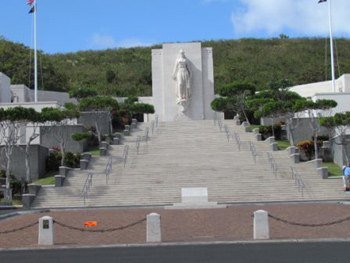
 The Punchbowl National Memorial Cemetery of the Pacific is known to the Hawaiians as Puowaina or “Hill of Sacrifice.” This is the final resting place of over 35,000 Americans who proudly served their country. Experience the serenity of the Cemetery and discover the cemetery’s meticulously landscaped acres. There are also the Courts of the Missing, the chapel and the finely detailed mosaic maps of the Pacific theaters of action in World War II.
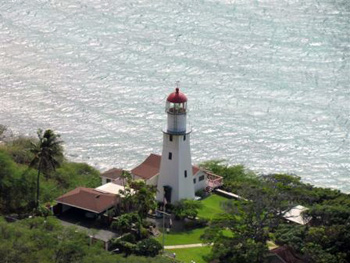
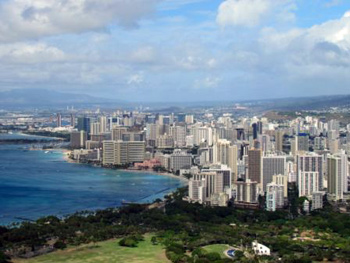
My wife and I visited the Diamond Head Crater which features a 360 degree view of Waikiki and the turquoise blue Pacific. After walking up the side of the crater, 271 plus steps, up staircases, through tunnels and bunkers we reached the top at about 760 feet above sea level. We stood over the Diamond Head Lighthouse beneath us, just offshore of the blue Pacific Ocean. It is now a United States Coast Guard facility that was listed on the National Register of Historic Places in 1980 and featured on a United States postage stamp in June 2007.
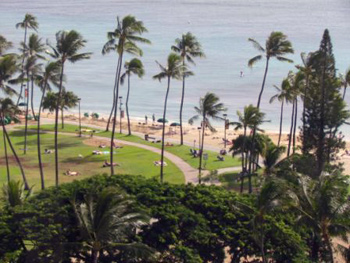 Waikiki Beach meaning (pouting fresh water) in Hawaiian in Downtown Honolulu is probably one of the most famous beaches in the world with it’s the white sand beach. The area of Waikiki is home to public places including Kapiolani Park, Fort De Russy Military Reservation, Kahanamoku Lagoon, Kuhio Beach Park, and Ala Wai Harbor.
Today, the area is filled with large resort hotels, such as the Hilton Hawaiian Village, the Halekulani hotel, the Hyatt Regency Waikiki, the Hyatt Place Waikiki, and the Sheraton Waikiki. However, earlier photographs show an almost deserted area. The Moana Surfrider Hotel and the Royal Hawaiian Hotel are some of the historic hotels dating back to the early 20th century. One of the most well known is the Royal Hawaiian or Pink Palace (recognized for its pink façade) opened in 1927. It has a rich history and connection to Hawaiian culture. Enjoy a Lava Flow at the open bar just off of beach and gaze at the majestic Diamond Head Crater.
The beach also hosts many events a year, including surf competitions, outdoor performances, hula dancing, and outrigger canoe races. The beach is the place for a lot of action as there is always something happening.
Iolani Palace is the only royal palace in the United States. It was the official residence of Hawaii’s monarchy and is a marvel of opulence, innovation and political intrigue. Meticulously restored to its former grandeur, this National Historic Landmark in downtown Honolulu tells of a time when their Majesties, King Kalakaua, who built the palace in 1882, and his sister and successor, Queen Liliuokalani, walked its celebrated halls.
Hawaii Five O Aliiolani Hale is a building located in downtown Honolulu and is currently the home of the Hawaii State Supreme Court and the statue of King Kamehameha the Great located in the front of the building. The headquarters of the television series Hawaii Five O is purportedly set inside of the building.
Walk through the downtown area and visit the multitude of stores available to fulfill the most finicky shopper’s desires. There are also many fine restaurants.
Hop a bus or drive out to the North Shore about an hour north of Waikiki and watch the surfers. The North Shore is considered to be the surfing Mecca of the world and Haleiwa town is the gateway. It is a laid back surf town with surf shops boutiques, restaurant and art galleries.


 Between the months of November and February are the best times to watch the more experienced surfer’s battle the big waves that can reach up to thirty feet. However from May to September the waves are smaller and more tranquil for beginning surfers and excellent for swimming and sunbathing. There are fifty one beaches on the North Shore some of the more famous include Waimea Bay, Sunset, and Ehukai (home of the Banzai Pipeline) and have thick white sands that stretch for more than eleven miles.
Complete the day by trying one of the local specialties. Haleiwa is also known for its shrimp trucks which are a group of individually owned and operated trucks that sell local, fresh shrimp. They each have there own unique style and flavor and individual specialties however basic garlic and butter and hot and spicy are the two most well known. Usually they are served with rice and macaroni salad. At Mackey’s we had the garlic and butter which included rice and a garden salad with pineapple.
The Home of the Brave Tour is a one of a kind World War II experience. They will visit Pearl Harbor, Arizona Memorial, Fort Shafter, the Punchbowl National Memorial, Schofield Army Barracks, Wheeler Army Airfield, Downtown Honolulu and the Home of the Brave Museum.
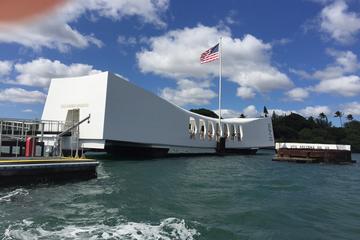
Private Pearl Harbor Deluxe Tour
If You Go:
♦ There are a variety of direct and indirect flights of airlines and prices to Honolulu, Hawaii.
♦ There are also a variety of hotels and condos to choose from.
♦ One of my favorite restaurants in Honolulu is Jimmy Buffet’s Beachcomber, 2300 Kalakaua Avenue, Honolulu, HI 96815.
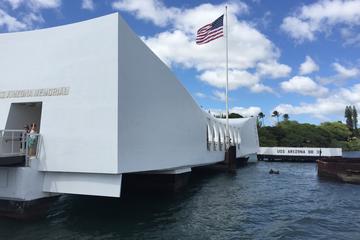
Private Pearl Harbor and USS Arizona Memorial Tour and Pacific Aviation Museum Tour from Waikiki
About the author:
Larry Zaletel is a freelance travel writer and a recurring visitor to Western and Eastern Europe, the Islands of the Caribbean, Mexico, South America, and Hawaii. He loves to travel and has also visited parts of Canada and many States of the United States. He writes about the places he has visited, the people he meets, and their customs. Larry is a regular contributor to Travel Thru History
All photos by Larry Zaletel:
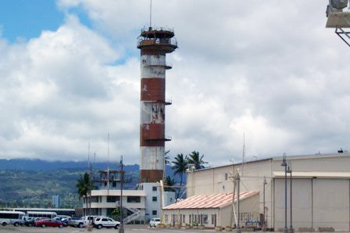
The tower on Ford Island, used in the movie ‘Pearl Harbor’
Lighthouse taken from the peak of Diamondhead Crater
The Punchbowl
Honolulu, also taken from Diamondhead Crater
Waikiki Beach
Mackey’s Shrimp Truck




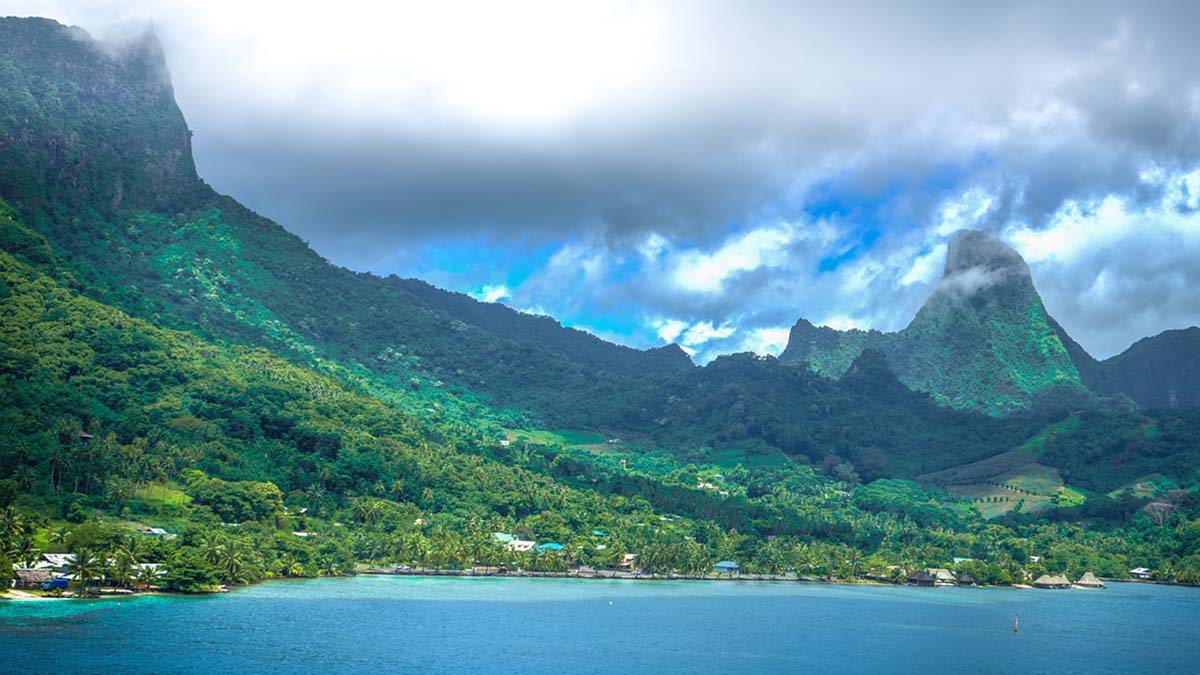
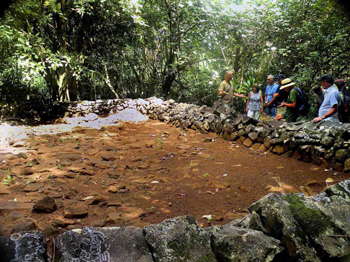 “This place has the feeling of power,” says archaeologist Mark Eddowes at a rectangular terrace enclosed by stone walls. We are on a wooded hillside overlooking the bay where Captain James Cook arrived at the island of Moorea in 1774. Eddowes has been excavating and restoring ancient sites like these, called marae, for many years. They were open-air temples that honoured gods and ancestors, where chiefs and priests once presided over rites to ensure a good harvest or a successful military campaign. These involved the sacrifice of valued animals and often humans as well.
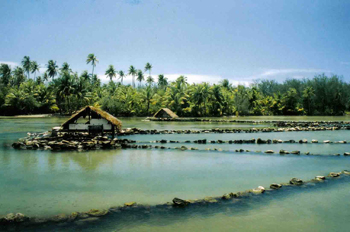 At Huahine, the tides surge through a narrow channel. Ancient islanders built stone walls in the shallows. These funnelled the lagoon fishes into small enclosures, where they were easily netted. The fish traps were restored in the 1970s. We watch local men reap a bountiful harvest. Our guide recognizes one man who recently lost his job. He may be catching fish to sell, but more likely it is for his family.
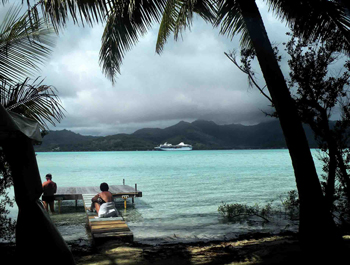 A week in the South Pacific is too short, so we follow the cruise with visits to two more islands. At Raiatea, we stay at the beautifully landscaped Raiatea Lodge. Our bed is sprinkled with hibiscus blossoms. The balcony looks out to sea. Renting a car gives us a closer look at island life than short outings from the cruise ship. The town of Uturoa bustles with shops, restaurants and traffic. Elsewhere, the pace is laid back, in tune with island time.

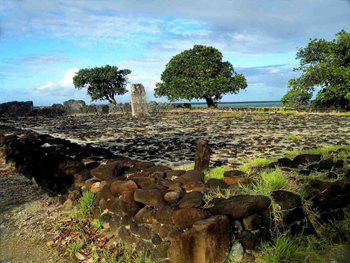 The warrior’s marae has a tall central stone. Only men who measured up were deemed suitable for combat. The larger main marae features a long wall of flat stones and carved totem-like wooden planks representing animal or human figures. Archaeologists have found human bones, likely from sacrifices to that fierce god. The story goes that Oro was frequently copulating with the goddess of the land and was weakened thereby, so he needed to be fed with male vibrancy. Warriors were sent out each year to snatch a number of unlucky young men. With the arrival of Christianity, the marae were abandoned.
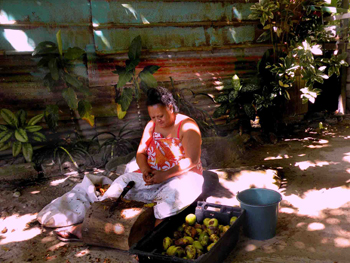 Hunched over a chopping block, a woman uses a machete to remove the green husks from chestnuts, while her son prepares to boil them. Smoke from an open fire, where breadfruits are roasting, fills the air. On a forested slope, huge pigs root around. Beyond a tin-roofed house sprawls an irrigated patch of taro. Coconuts, bananas and citrus fruits grow everywhere. After our stroll through several backyards, a man catches up to offer a plate of roasted breadfruit. Its smoky taste is delicious.
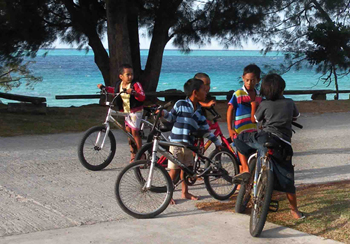 Island life centres on the seaside road. Bicycles are most of the traffic. For children, it’s their playground. Several cars or trucks come by every hour. It may be the baker, delivering the baguettes. Or Laboudet Edmond, a retired French officer and market gardener, who sells cabbages from a trailer behind his motor scooter. And then the dogs go back to sleep in the road. Nobody passes without a cheerful greeting.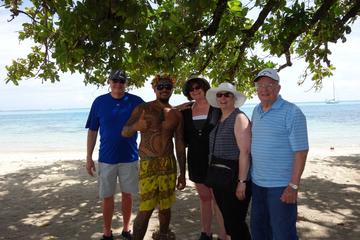
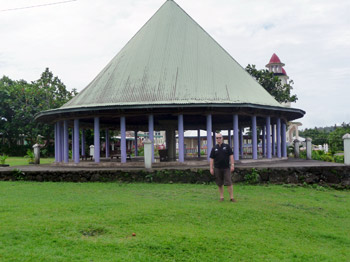


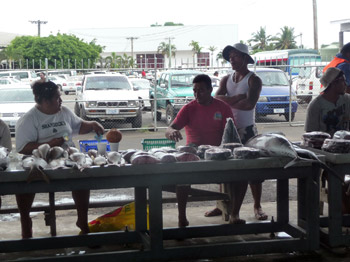 Samoa’s capital, Apia, on the island of Upolu, retains a pleasant, rather tired atmosphere that has been lost in the more popular Pacific tourist destinations of Hawaii and Tahiti. Life goes on at a leisurely pace and there are no crowds to negotiate or much traffic on the roads. Apia is small but charming and you can fill in a couple of hours meandering around.
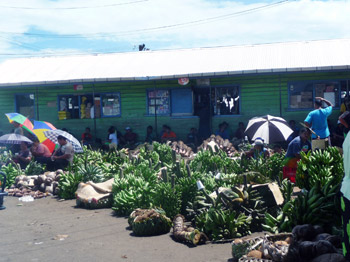 The fruit and vegetable market is in a low slung building in the centre of Apia. The pace on Samoa is slow and languid and neither buyers nor sellers are in a hurry. The efficient Germans brought in Chinese workers rather than rely on Samoans to work in the coconut, cacao and rubber plantations they established.
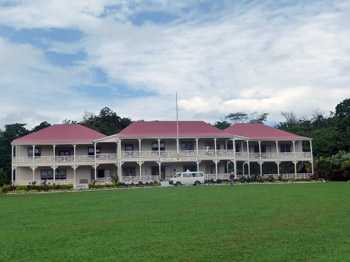 Vailima was the grandest house on the island with a magnificent staircase and a large room for entertaining which included a fireplace, the only one of its kind in Samoa. Stevenson’s mother, who lived with Stevenson, his wife and step-children in Samoa, brought all her furniture from Scotland, and all other furnishings were imported.
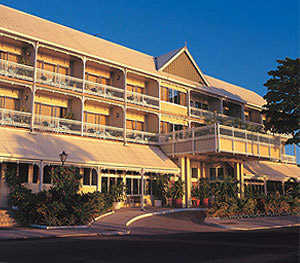 The wide and starry sky Stevenson lies under is far from the gaslights of Edinburgh’s New Town where he was born. You can walk up the Road of Loving Hearts to his grave and gaze out, as he does, across the green of his adopted home to the sparkling blue of the Pacific.
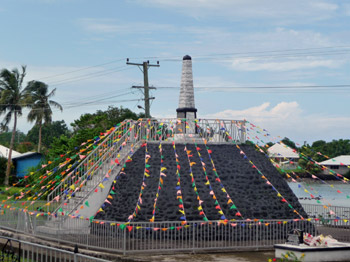 The island of Savai’i, the biggest island in the group and an hour and a half hour ferry ride from Upolu is well worth a visit. At Sapapali’i on Savai’i is a large monument to mark the spot where John Williams of the London Missionary Society landed in 1830 to spread God’s word among the Samoan people. He was obviously successful as religion plays an important part in Samoan life today. There are churches all over the islands and observation of the Sabbath is strict. On Sunday morning whole families go to church dressed in white; the men in lava lavas and the women in dresses and often hats. Apart from hotels there are no restaurants or shops open on Sundays.
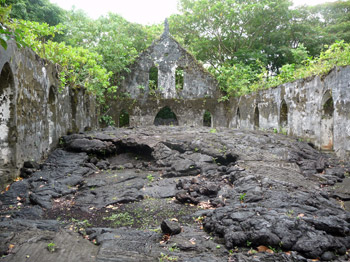 Between 1905 and 1911 the volcano of Mt Matavanu on Savai’i erupted and lava poured out destroying five villages. Today the lava fields of Saleaula are an eerie reminder of this disaster. The expanse of black hard molten lava with the odd plant growing has an unreal quality. Driving further on we were shown the ruins of a church buried in the lava by Lily, who lived nearby. Lily showed us the ‘virgin’s grave’ – the grave of a nun untouched by the flowing lava and where flowers have now been planted in the only soil at the site.

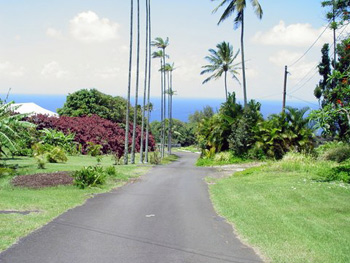
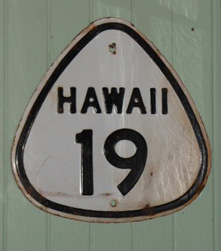 Today, the old general store and social hall far below are barely standing, my family’s house still sits proudly high atop a hill and the old mill remains were finally taken down this past year. Paauhau remains a peaceful residential enclave for those who have chosen this exquisitely beautiful, quieter lifestyle.
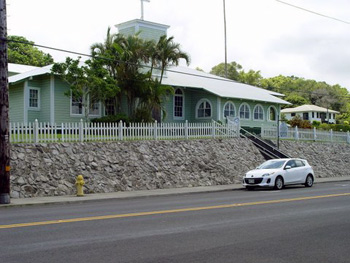 Having once played the role as a classic plantation region in the early 20th century, the Hamakua Coast has needed to diversify its economic base with the closure of many plantations. With much of the area still zoned for agriculture, additional crop offerings now include pineapples, coffee, papayas, macadamia nuts and tea.
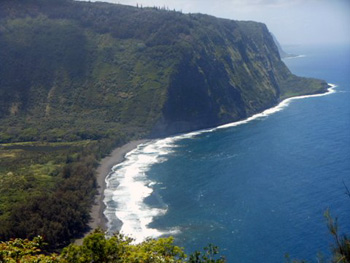 With a treasure trove of historic buildings still lining the downtown sector including the Honokaa People’s Theatre and Hotel Honokaa Club, Honokaa was once a popular hangout for thousands of WWII Marines and soldiers stationed nearby and a bustling commercial center for the sugar mill camps of Haina, Kukuihaele, Paauhau, Kapulena, and New Stable. It’s also where my grandmother once taught school and where my parents were married back in the 1950s.

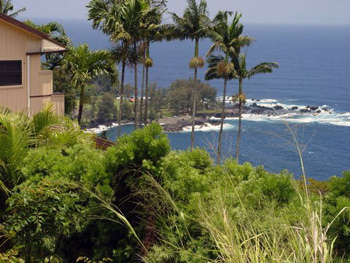 Continuing south, Hilo’s Sugar Plantation Museum is intriguing, authentic and informative. Recently relocated from downtown Hilo and up the Hamakua Coast a few miles, it’s now located in the old Papaikou Plantation Store and is now in the midst of reopening. With a family history so richly ensconced in the region’s sugar plantation legacy, we are granted our own personal viewing and tour the museum one afternoon. Still in the process of being refurbished, photos, home décor, carvings and vintage signs adorn the walls and display cases. This place is truly a step back in time to plantation life and a well-deserved restoration of an entire lifestyle once found throughout the region.
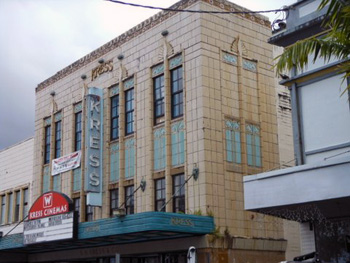 Heading into several antique stores is also synonymous with revisiting the area’s intriguing past. Authentic Hawaiian shirts, books, ukuleles and vintage record albums line the crowded aisles. There’s a dignified serenity throughout this town that honors a long, rich history. Art Deco buildings still bearing the names of original stores, including Kress and the Palace Theatre, rise high above the friendly, local streets below.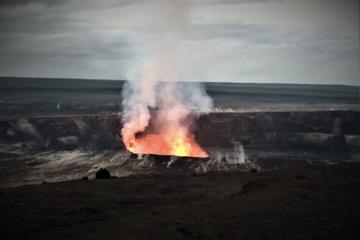




_-_Pu%27u_O%27o_Trail_-_Big_Island_-_HI_-_2015-11-06at15-07-451_(22419194588).jpg)
_Palilia_Discovery_Trail,_Mauna_Kea,_Big_Island,_HI.jpg)

_Hosmer_Grove,_Haleakala_Nat_Park,_Maui_co,_Hawaii.jpg)