Travel Thru History

Historical and cultural travel experiences

  • Home
  • Airfare Deals
  • Get Travel Insurance
  • Writers Guidelines

Discovering La Virgen de la Yemanja

Montevideo, Uruguay

by Paola Fornari

Virgen de la YemanjaToday, February 2nd, is the day of the feast of the Virgen de la Yemanja: the patron of fishermen. This evening, after dusk, people will flock to the Rio de la Plata, dressed in white, bringing gifts for her: sweets, clothes, and jewellery – gold chains, necklaces and watches. The gifts will be sent out to sea on paper and cardboard boats, to sink to the bottom, or be washed up on the shore.

The hurgadores in Uruguay are people whose livelihood depends on rubbish. They go about with a horse and cart, fishing through bins, particularly in “nice” areas, for bottles, old clothes, cardboard, anything that they might be able to sell.

Tonight the hurgadores will sleep at the beaches, waiting to see what the Rio brings in tomorrow. A feast day for the Virgen, and a feast day for the hurgadores.

At six-thirty I put the lead on the dog.

“So, Perdida, let’s go down and see what this Virgen de la Yemanja business is all about.”

Perdida wags her tail and whimpers with excitement, and we start our fifteen minute walk to the Rio. It’s a cool, sunny evening.

I’m not sure what to expect. Certainly I’m surprised that there are so few people. And even more surprised when we catch our first glimpse of the Rio. On the shore is a beautifully constructed cardboard boat, decorated with tinsel and flowers … and another a bit further along.

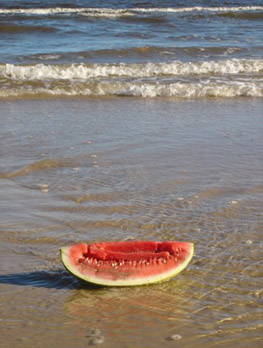
watermelon on beachWatermelons are strewn on the beach. We move closer. One boat appears empty. The other holds some carnations. A couple stroll up.

“Could you tell me more about this?” I ask.

“Well, they’re celebrating the Feast of La Virgen de la Yemanja”, the woman says.

“Who are?”

“Those people over there.” I look to where she’s pointing. About half a dozen people, dressed in long white robes, are coming down the steps onto the beach, carrying a big cardboard boat.

“Is it a sect?”

“Well, a religion, really. The Ubanda. Mostly fishermen. They’re thanking the Virgen for their blessings over the last year”. These white-gowned hippie-gypsy types hardly look like fishermen.

We wander westwards. In front of the Casino Hotel, a few people are building a sandcastle. As I get closer, I see that it’s a large altar.

A girl with blue hair is preparing a path from the altar to the water, neatly edging each side with alternating candles and flowers.

We move closer. “Señora,” I say, “could you explain? I’m a foreigner.”

“The altar is for the Virgen de la Yemanja. She should be here, but she hasn’t arrived “.

“The Virgen? She’s coming?”

“Yes, she was due at seven, but the bus must be delayed . Here, take this card.”

The Virgen’s business card? “La May Adelcia”, I read, under a 60s faded black and white photo of a dark buxom young woman. I turn it over. “Consultations: Mondays, Wednesdays, Fridays 10 a.m. – 6 p.m.”

It’s seven-fifteen. I approach another couple, and show them the card. “Ah, the May”, they say. “That’s not the Virgen. It’s a woman priest. A man priest is called a Bay. They are the Virgen’s representatives on earth.”

People are wandering down to the beach. Each group has at least one maté, the calabash which Uruguayans carry around, containing a strong type of tea, which they sip through a silver straw. The Rambla is filling up too. People on bikes, skates, walking, jogging.

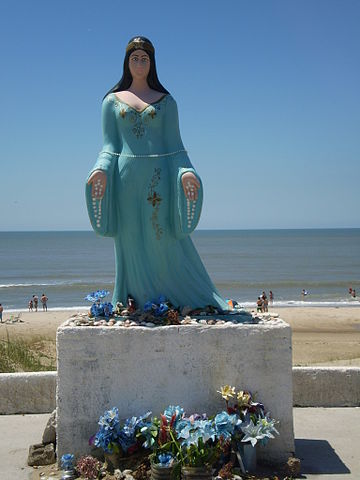
We look back at the sand altar. There is definitely some activity now – it’s almost eight – so we move closer. A group has formed, and in the centre is an elderly woman wearing a long pink satin dress and a rich brocade beige shawl. I recognize her as an aged May Adelcia from the photo on the card. Her white-clad acolytes look like doctors, apart from one young woman who, over her whites, has a bright red sarong tied over one shoulder like a Maasai. On the altar stands a statue of the Virgen, wearing a blue satin dress and a cape. She is decked with bead necklaces. Aha! So that’s the Virgen they were waiting for!

In front of the altar is a large plastic inflated dinghy. People are queuing up to lay gifts inside. I can’t work out whether the people crowding around are part of the ceremony or just onlookers.

The May gives a signal, and she and her assistants walk down the path to the river shore, chanting softly. Together, they raise their arms to the sky. Suddenly there is a loud hacking noise. I think that the May is having a fit but then I realize she’s laughing – a strange, guttural croak.

They walk back to the altar, except for one young man who prostrates himself in the water.

The crowd is thick now. Perdida and I scramble onto the Rambla to get a better view. My camera battery is flat. Perdida is shivering. So am I. It’s eerie. A fat couple beside me pass their warm maté to and fro.

The May and her followers are chanting and shuffling. The May is holding a bottle of Fanta Orange.

“Is the Virgen drinking?” asks the fat woman.

“Yes, says her husband, “Can’t you see?”

All I see is the May dancing around the Virgen pouring Fanta Orange onto her expensive-looking clothes.

“How long does this go on?” I ask.

“Oh, till morning,” says the fat lady.

“They will dance when the Virgen has gone out to sea”.

Perdida and I are really cold now. I decide to go home, recharge my camera battery, and come back to see the end of the action. But home is warm and cosy, so I settle down to a cup of herbal tea.

But next 2 February I shall wrap up warmly, and dance all night on the beach until at dawn, the treasure-filled cardboard boats carrying the Virgen and her treasures are sent out to their fate on the Rio de la Plata.

– First published in ‘The Oldie’ (UK) March 2007.

Notes:

Yemanja is a goddess originally of the Yoruba religion, who has become prominent in many African-American religions. Africans from what is now called Yorubaland brought Yemaya and a host of other deities/energy forces in nature with them when they were brought to the shores of the Americas as slaves. She is the ocean, the essence of motherhood, and a protector of children.

In Uruguay, her feast is of relatively minor importance, whereas in Brazil it takes on huge proportions. Every February 2 in Salvador, Bahia, there is a celebration which involves thousands of people lining up at dawn to leave their offerings at her shrine in Rio Vermelho. Presents for Yemanya usually include flowers, perfume, and objects of female vanity (jewellery, combs, mirrors). These are gathered in large baskets and taken out to the sea by local fishermen. Afterwards a massive street party ensues. In Rio de Janeiro, Yemanyá is celebrated on New Year’s Eve, when millions of people dressed in white gather on Copacabana beach to greet the New Year, watch fireworks, and throw flowers and other offerings into the sea for the goddess in the hopes that she will grant them their requests for the coming year. Paintings of Yemanja are for sale in Rio shops, next to painting of Jesus Christ. They portray her as a woman rising out of the sea. Small offerings of flowers and floating candles are left in the sea on many nights at Copacabana. In the Umbanda religion, Yemoja is a goddess of the ocean and patron deity of the survivors of shipwrecks.


Photo Credits:

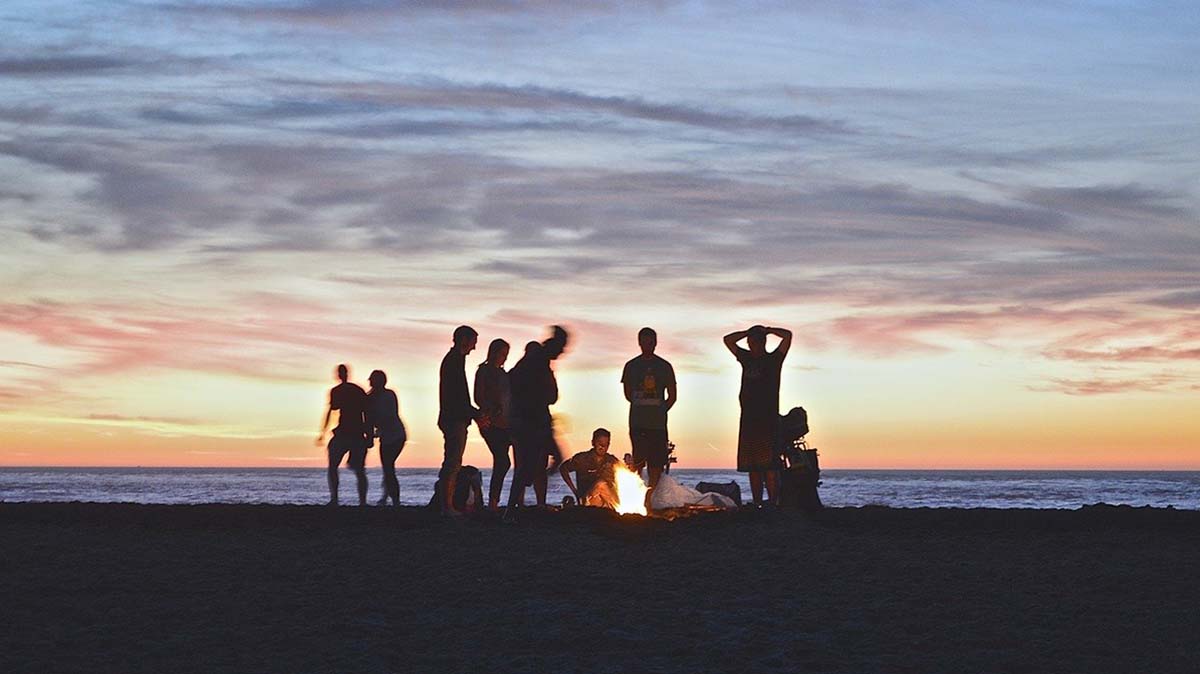
Beach group image by Free-Photos from Pixabay
Iemanja statue by FrancoBras / CC BY-SA
Watermelon on beach by Paola Fornari.


About the author:
Paola Fornari was born on an island in Lake Victoria, and was brought up in Tanzania. She has lived in almost a dozen countries over three continents, speaks five and a half languages, and describes herself as an “expatriate sin patria”. Her articles have featured in publications as diverse as “The Buenos Aires Herald”, “The Oldie”, and “Practical Fishkeeping.” Wherever she goes, she makes it her business to get involved in local activities, explore, and learn the language, thus making each new destination a real home. She has recently moved from Uruguay to Belgium. Read Paola’s blog on www.writelink.co.uk

Tagged With: Uruguay travel, Virgen de la Yemanja Filed Under: South America Travel

Inca Citadel in the Clouds

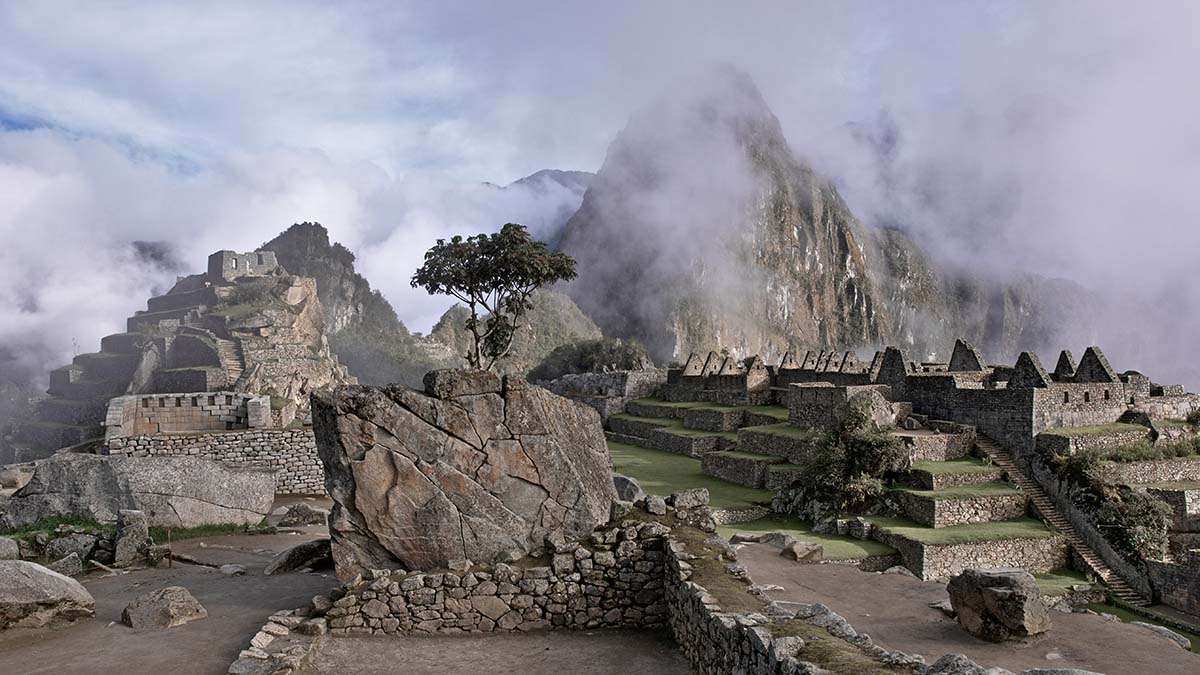
Machu Picchu in clouds

Machu Picchu, Peru

by Thomas Lera and Sandy Fitzgerald

At the end of the 15th century, the secluded Inca citadel Machu Picchu was a vibrant city still being carved into the Andean peaks flanking the Urubamba River canyon. Over 200 buildings already provided housing, temples and storage facilities for the city’s 1,200 residents. Vast tracts of land had been terraced for farming. Over the next 27 years, more than half of the entire Inca population became infected with smallpox and died. Machu Picchu fell into disuse, and, quickly enveloped by the robust undergrowth of the jungle, became motionless, frozen in time.

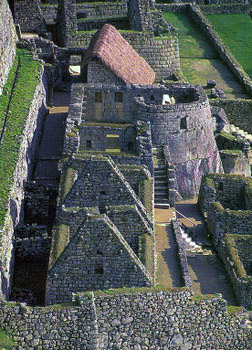
Inka buildings in Machu PicchuLuckily, this religious center was not discovered, sacked and pillaged by the Spaniards like so many other of their conquests. Its remote location at the end of an insignificant road cut through treacherous mountainous terrain, high above the Urubamba River canyon, helped guarantee the fact it would have no significant commercial, military, or administrative use. The site remained largely untouched for more than four centuries until Hiram Bingham, on an archaeological expedition funded by Yale, discovered it in 1911.

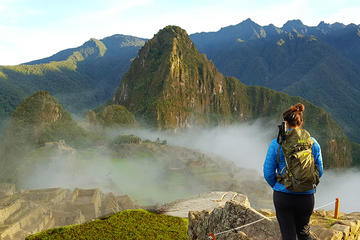
Machu Picchu drapes across the top, and spills down the sides of a vast mountain area strung between two distinct Andean peaks: the now famous Inca Trail begins high on the mountain’s south side at Intipunku, the Sun Gate; Huayna Picchu soars above the site on the farthest northern extremity like a silent guardian. If you can muster the strength, a hike to the top of either should not be missed as it provides an outstanding view of the ruins and surrounding valley.

Inca buildings at Machu PicchuMachu Picchu can be geographically broken down into agricultural and residential areas. From both the trail entrance and the main ticket gate you enter through the agricultural zone. The contours of these slopes are hugged tightly by many layers of stone walls several feet high, built to reduce erosion and increase the square footage available for agriculture. The Inca employed advanced terracing and irrigation methods to assure a high yield of the maize and potatoes they grew.

We were fortunate enough to visit with an excellent guide two hours before the general public was admitted, and strolled quietly along its main avenues and smaller streets. As we walked toward the center of the complex, the most important temples and structures revealed the incredible craftsmanship the Inca used in building them. Enormous granite blocks had been cut by hand with bronze or stone tools, then smoothed with sand. The mortarless blocks still rest so solidly together it is impossible to insert a knife blade or even a credit card between them – we tried.

Many of the structures also utilized existing stone formations in their construction. A few temples clutch the edge of steep precipices, displaying a oneness with nature. What has become known as the amazing astrological center was built upon the outcropping of an existing megalith, with windows through which the sun’s first rays shine as they peek slowly over the adjacent mountain on both the summer and winter solstice.
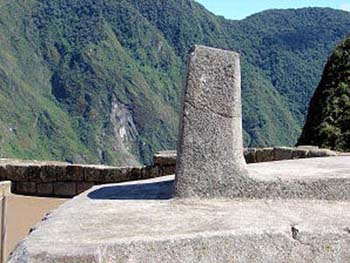
Intihuatana stone at Machu PicchuAnother of the many important structures at Machu Picchu is the Intihuatana. This stone column rises defiantly from a box-shaped slate platform. Intihuatana literally translates to “for tying the sun” but normally is translated as “hitching post of the sun.” History tells us as the winter solstice approached and the sun began to shine fewer hours each day, a priest would hold a ceremony to tether the sun to the stone to prevent it from vanishing entirely. Technically known as a gnomon, this genre of stone existed at many other Inca sites but was always destroyed by the Spanish. Thankfully this one remains, offering the meaning and significance surrounding it from its conception.

Surprises abound around every corner. Three dimensional sculptures carved into the rock in odd places appear as if by magic, and water still flows through ancient cisterns and stone channels. After hours of exploring we sat on a wall high along the edge of the city. Gazing down at this astounding group of residences and astrological temples, we were awestruck by Machu Picchu’s magic. Speech was superfluous. We could almost feel the deep pride, reverence and spiritual devotion of the ancient Inca, and this had nothing to do with altitude!

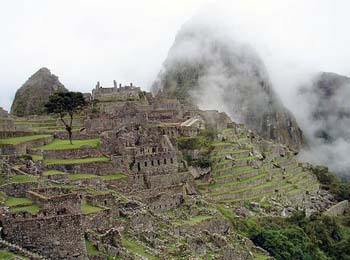
Machu Picchu with Huayna Picchu in fogEven the many tour groups which had trooped in and out during the day had done nothing to spoil the place for us. For a few precious moments, meandering down ancient trails, forgetting about the existence of buses, trains, cars and the world outside, we felt like Inca.

We boarded the bus back to our hotel in silence just before sunset. A young boy raced us to the tourist village of Agua Calientes, swiftly moving down ancient stone steps and unseen trails. He taunted us at various turns and switchbacks by waving, then ducking back into the bush, only to appear again at another turn. He won the “race” as the switchback road was much longer than the steep trail he had navigated.

The next morning rain drenched the village, washing away all evidence of our visit. The mountain top cradling the ruins was shrouded in impenetrable clouds, and Machu Picchu was once again hidden as if it never existed. Its impact on us, however, would never be lost.


Private Full-Day Classic Tour to Machu Picchu from Cusco

If You Go:

HOW TO GET THERE FROM CUSCO:
A 3 ½ hour journey on PeruRail is highlighted by wonderful mountain vistas and the beautiful Urubamba River which runs through the Sacred Valley of the Andes. On arrival in the town of Aguas Calientes, hop on a bus to traverse the last two kilometers up the mountain to the entrance. Trains leave at 6:00 AM and 3:30 PM for a round trip ticket is $73 per person.

Inkaterra Machu Picchu HotelWHERE TO STAY:
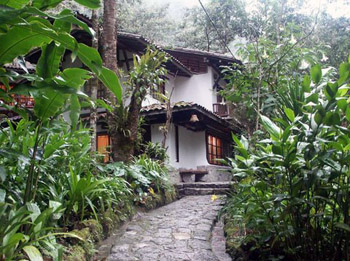
Aguas Calientes has a wide range of hotels from hostels to the exquisite. We stayed at the Machu Picchu Pueblo Hotel, which is now the Inkaterra Machu Picchu Hotel. Located in the cloud forest in the heart of the Machu Picchu Historical Sanctuary its 85-bungalow style cottage rooms are designed to give you the feeling of an Andean village woven throughout miles of trails. The “village” is complete with waterfalls and cloud forest gardens with over 375 different orchids, 175 species of birds and 125 varieties of butterflies. Our stay at this hotel was an eco-traveler’s paradise melding into the Machu Picchu spiritual experience. There are a variety of rooms available from the simple to the luxurious with corresponding costs. Our room was a welcome oasis with its large natural stone shower area and large working fireplace – both of which took the slight chill off the night an relaxed our tired muscle into a blissful nights’ sleep. Visit www.inkaterra.com for information.

About the author:
Thomas Lera is the pretentious literary persona of a real person, occupying the ever brief moments that lie between his many faces as adventurer, traveler, scholar, conservationist, and wage slave, while providing an excuse to refer to himself in the third person. He currently resides in Virginia and is collaborating with Dr, Hannibal Lecter on a cookbook. tikal22042@gmail.com

Photo credits:
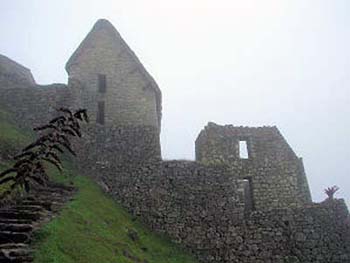
First Machu Picchu photo by Tomas Sobek on Unsplash
All other photos are by Thomas Lera.

Tagged With: Machu Picchu, Peru travel Filed Under: South America Travel

Lake Titicaca for Christmas

Uros reed boat on Lake Titicaca

Puno, Peru

by Irene Butler

Lake Titicaca is a name all school kids know and giggle at, although most have no idea where it is – straddling as it does the border of Peru and Bolivia. Coming over a rise, our first view of its sapphire waters is stunning – 170 km in length, it looks more like an ocean than a lake. Having traveled through Peru for three weeks in November and December, my husband Rick and I decide on spending the Christmas season here.

As our bus enters the lake shore city of Puno, the magical sounds of flutes, drums and bells float across the air. Craning our necks out of the window, we see elaborately costumed dancers twirling to the rhythm of the music. “Puno is the festival capital of Peru!” says our bus driver. “The whole town participates in more than 300 a year.” Hoisted above the heads of four carriers a gigantic wooden babe in a crib conveys the message of this joyous celebration.

After stowing our bags at our hotel we join the lively crowds along the street. We purchase alpaca toques with ear flaps for the folks back home, snack on ceviche (a Peruvian specialty of raw fish marinated in spiced lemon juice) and book a Lake Titicaca Island excursion.

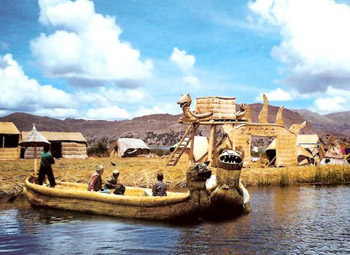
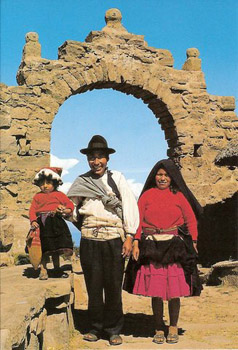
Uros family on TaquileLake Titicaca, the world’s highest navigable lake (at 3820 meters) competes with the sky for the deepest shade of blue under a brilliant sun. We skim over the glassy surface towards the Uros floating islands. “Step carefully and watch for soft spots,” our guide Juan says. I warily step onto the damp spongy surface of totora or reeds, then relax as I catch sight of children running effortlessly toward us and women going about their daily chores. Most of the men are out fishing or trapping waterfowl.

Everything is made of reeds – houses, furniture, and Viking-like dragon head boats. We test out a reed bench while the village leader demonstrates how the island’s base is built. Huge blocks of buoyant roots are harvested from the lake bottom. Once secured together and anchored, they are piled with criss-crossed layers of cut reeds until the surface is out of the water and sturdy enough to support community life.

Juan explains the “why” of this water-world: “The Uros people took refuge here to escape Inca domination, and later to avoid Spanish slave labour in silver mines.”
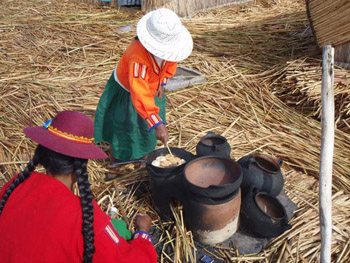
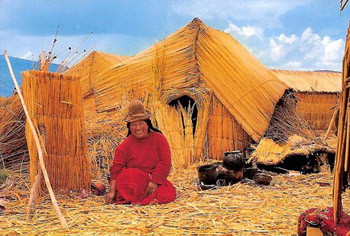
Uros woman frying breadThe aroma of frying bread wafts from an iron pan set over a small fire – we are captivated when the women sing a carol while offering us the warm brown rounds “as a Christmas gift” Juan says smiling.

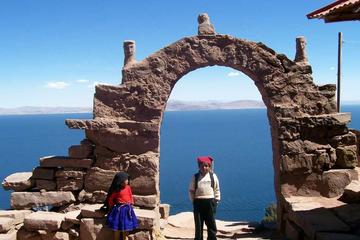
Another two hours brings us to Taquile Island. The inhabitants speak Quechua, the ancient Inca language, and hold strongly to traditional ways of life. Listen up fellows – the men do the knitting here, and are renowned knitters at that, learning the trade from early boyhood.

Half the island is rock; the fertile remainder is terraced for growing crops. Goats and chickens provide cheese, milk and eggs, and although the occupants are mainly vegetarian, they enjoy fresh catches of fish. We are served a divine quinoa soup and omelette in a private home before heading back in a sudden afternoon squall that whips the lake into frothy grey foam.

After wishing our family back home in Canada “Feliz Navidad” by phone, we walk to a small colonial church for Christmas Eve mass. We didn’t need to understand the language to be uplifted by the choir and the brightly decorated altar.

Uros woman sitting among reedsRoco, our hotel manager, and his wife Maria invite us to share their Christmas Day supper. Knowing the fare might well be guinea pig, eaten widely in Peru, we don our “try anything once” attitude.

A feast awaits as we join a dozen or so guests. And yes, one of the many courses is Cavia Porcellus, which tastes rather like chicken, although there was no mistaking its form. Alpaca, roasted Inca style, is served to table on flat hot rocks just lifted from an open wood fire. The fireplace is then stoked for an evening of camaraderie while we sip fine wine.

It was an enlightening experience being so far removed from our country of plenty, and in the midst of a simpler, less affluent world. The differences of customs and traditions dissolved in the universal message of love, peace and good will as shown us by our Peruvian hosts. Truly an unforgettable Yuletide celebration.

For Further Information:

Peru Information
Puno Hotels
Puno Travel Agency – Edgar Adventures
Plaza Mayor Hotel, Puno


Full Day Tour: Uros and Taquile Islands on the Titicaca Lake from Puno

About the author:
Irene Butler and her husband Rick are a travel journalist/photographer team from Richmond, B.C. They lead a gypsy existence travelling around the world for six months of each year – their tally is 53 countries visited to date.
www.globaltrekkers.ca

Photo Credits:
Reed House and Frying Bread by Mick Linthorne. Woman Sitting, Boat and Taquile Island by Rick Butler

Tagged With: Peru travel, Puno attractions Filed Under: South America Travel

Ancient Iglesia de San Francisco in Quito, Ecuador

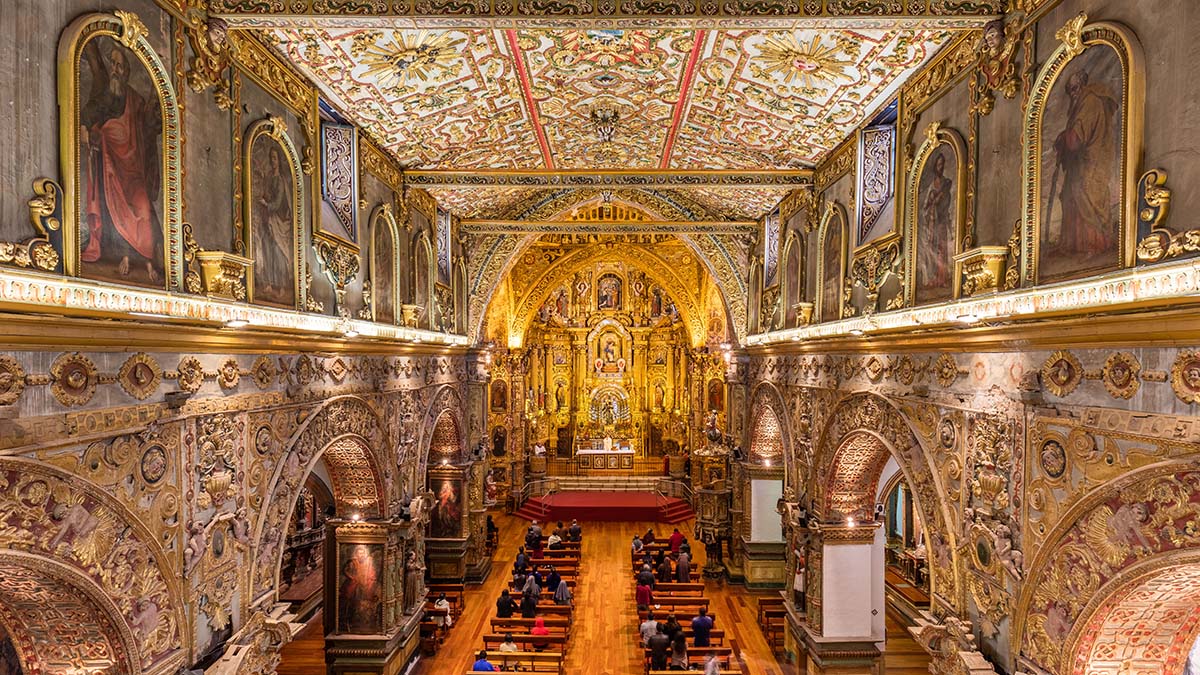
Interior of Iglesia de San Francisco, Quito

If These Walls Could Talk

by Amy E. Robertson

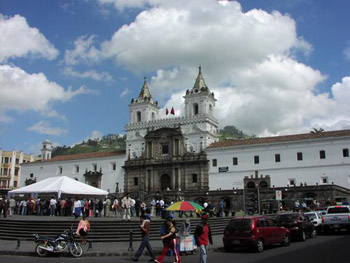
The Iglesia de San Francisco, or Church of Saint Francis, in the historic center of Quito, Ecuador, is one of the oldest churches in South America.

Exterior view of Iglesia de San FranciscoFounded in 1535, this massive stone and whitewash construction has witnessed nearly 500 years of history. What might it tell us of all that it has seen? Perhaps we would hear of the Inca marketplace on whose land the first stones of the church were laid. Indigenous peoples from far and wide traded goods from the mountain highlands, cloud forest, jungle and beaches of Ecuador.

Flemish Franciscan, Jodoko Ricke, forced the market out, envisioning a church to convert the New World. Covering eight and a half acres, in its heyday the complex included a church, two chapels, a convent, six wells, two orchards, a school, a cemetery, and four cloisters with their cells, infirmary, bakery and kitchen. San Francisco virtually was the city.

courtyard of Iglesia de San FranciscoWould San Francisco tell us the stories of those buried in its cemetery? Destitute Quiteños could not afford interment within the walls of the church. Or would the walls reveal the truth behind the legend of Cantuña? The indigenous architect was threatened with prison if the church was not completed on time. It is said that he promised his soul to the devil in exchange for help. A missing stone, leaving the church as yet unfinished, saved Cantuña from eternal damnation.

Perhaps we would hear stories of the women who drew water from the fountain in its sweeping stone plaza, or the men trained by the Franciscans in painting, blacksmith, and stone and wood working. Or maybe San Francisco would tell instead of the merchants and market-goers that lined adjacent streets for centuries, eliminated only recently by city regulations.

The Iglesia de San Francisco’s relevance has not diminished with time, and the worn wooden floorboard creaks with the shifting of hundreds of feet during Sunday mass. The simplicity of the floor is in stark contrast with the baroque gold-leafed walls – the mudejar coffer ceiling of interlocking geometrical pieces, the elaborately carved pulpit sustained on the back of a saint, the statues of saints in silver-threaded vestments lining the walls.

fountain in Quito squareWould San Francisco be satisfied by the devotion of Quiteños? Year in and year out fervent Catholicism is on display at jubilant Palm Sunday celebrations where thousands brandish palm crosses, and at solemn Good Friday processions, hundreds of robed and hooded penitents trudge barefoot through the Old City while tens of thousands bear witness. But Quiteños don’t limit their spirituality to special occasions; pious worshipers fill an impressive number of pews every Sunday.

San Francisco lends its plaza to frequent civic and political gatherings as well. It was here that tens of thousands peacefully gathered and instigated the fall of two presidents in recent years (1997 and 2000). On quieter days the plaza hosts shoeshine boys and tourists, tents offering everything ranging from blood pressure tests to free water, flocks of pigeons that swoop through the sky and return to the ground.


When you walk through the Iglesia de San Francisco, be sure to listen to the whispering of the walls.

If You Go:

Iglesia de San Francisco is located at the intersection of Benalcazar, Bolivar, Sucre and Cuenca streets. The adjacent museum, Museo Fray Pedro Gocial, displays religious art primarily from the 16th to 18th centuries and offers a view into the cloisters. It is through the museum that the coffer ceiling in the choir loft can be accessed. The museum is open Monday through Saturday 9:00 a.m. to 1:00 p.m., 2:00 p.m. to 6:00 p.m., and Sunday from 9:00 a.m. to 1:00 p.m. Admission is $2.00. Guided tours are available in English as well as Spanish.

Private Sightseeing Tour Historic Centre Quito and 2 traditional markets

Private Quito City Tour

Cultural Historical Culinary and Food Market Tour in Quito

Where To Stay:
Hotel Patio Andaluz
The first boutique hotel in the historic center, this 16th century home was recently renovated and now offers 31 slightly austere but tastefully appointed rooms. Doubles: $200.00, suites, $250.00, plus 22% taxes (breakfast not included).
Garcia Moreno N6-52
La Posada Colonial
An alternative for a smaller budget is a few doors away. It is also in a renovated colonial building. Rooms are comfortable and doubles go for $30.00, tax and breakfast included.
Garcia Moreno 1160 Tel: 593-2-228-0282; email: posadacolonial@yahoo.com.

Where To Eat:
El Cucurucho de Santa Clara
A block south of San Francisco at Benalcazar and Rocafuerte. This elegant restaurant opened last year in what was a city market in the 1800s. It offers cuisine from throughout Ecuador, the house specialty is ceviche Cucurucho, served with popcorn and corn nuts, as per local tradition. Open Tuesday through Saturday, 12:00 p.m. to 11:30 p.m., Sunday 12:00 p.m. to 4:00 p.m.
Hasta La Vuelta Señor
Built in 1625, the Archbishop’s Palace (Palacio Arzobispal) on the Plaza de Independencia houses several restaurants, including this simple café offering traditional Quiteño cuisine. The seco de chivo, lamb stew and empanada de viento, an airy plate-sized turnover filled with cheese, are especially good, as are the fresh juices. Open Monday through Saturday, 12:00 p.m. to 11:00 p.m., Sunday, 12:00 p.m. to 4:00 p.m.

About the author:
Amy E. Robertson is a multitasker who writes about travel, food and news, as well as writes fundraising copy and grant proposals. Her work has appeared in Travel + Leisure, the Christian Science Monitor and Ms. Magazine, among others. An avid explorer, Amy has lived in five countries (including three years in Ecuador ) and globetrotted in 60. Amy currently resides in Tegucigalpa , Honduras, with her husband and two children.
www.mediabistro.com/AmyERobertson

Photo credits:
Iglesia de San Francisco interior by Diego Delso / CC BY-SA
All other photographs are by Amy E. Robertson.

Tagged With: Ecuador travel, Quito attractions Filed Under: South America Travel

Peru: Off the Gringo Trail in Sipán

walled compounds of Chan Chan

by Irene Butler

Lord of SipánWith the uncovering of over 1000 ceramic pots containing food for the afterlife, archaeologist Walter Alva knew his 1987 discovery near the village of Sipán, Peru was of major importance. I can only imagine his euphoria when under the pots he unearthed a sarcophagus of a king in royal splendour, and deeper digs revealed other kings and priests – the Lords of Sipán.

There are two ways to get to Sipán; the easy way is to fly from Lima to Chiclayo (which is 30km from Sipán). Or for the more adventurous, such as my husband Rick and myself, hop a bus heading north. A bonus of overland travel is being able to take in the treasure trove of sites along the 760 kilometer route.

Northern Peru is considered “off the gringo trail” since nine out of ten travelers to the country head south, the draw being Machu Picchu and other Inca ruins. Our first bivouac north of Lima is to the town of Trujillo (tra-HEE-yo) – the absence of souvenir shops and touristy restaurants speaks for itself – we are going against the grain.

Display in Royal Tombs Of Sipan MuseumThe most prominent ruin in the Trujillo area is Huaca de la Luna, a 10-storey adobe pyramid of the pre-Inca Moche Empire. From the outside this temple, built in stages between 100-700AD, appears to be a gigantic mound of clay. Upon entering our eyes widen at the sight of mud walls curiously cut away, revealing levels painted with geometric figures and mythological beings. As we gaze at the elaborate mosaics in shades of magenta, gold, green and black, our guide Juan explains that each new century the Moche sealed the bodies of their deceased rulers into the pyramid by completely covering the tombs with a new stepped platform. Thus with archaeologists slicing through the eight-level pyramid, we are awarded this amazing glimpse of condensed history.

As gold was buried with the royals, these tombs were the target of relentless plundering since colonial times. Juan, now in his 30s says, “When I was a young boy my parents warned me to stay far away from this pyramid because of grave robbers.”

Fortuitously, in 1997 an area with gold disks and textiles was found that had been missed by thieves (the items now housed in a Chiclayo museum). A year earlier excavations behind the pyramid revealed the skeletons of 40 men, aged 15-35, believed to have been sacrificed to stop the El Niño rains which partially destroyed the temple circa 750AD.

Chan Chan siteStill in the Trujillo area, our route followed the chronology of the ancients. After the decline of the Moche, the Chimú civilization emerged in 900AD. By 1300 AD their adobe domain Chan Chan covered 20 square kilometers (4940 acres), becoming one of the largest pre-Inca empires. It was abandoned in the 1470s when Chimús were overrun by an Inca army.

In its heyday this complex is believed to have sustained a population of 60,000. Dwellings are interspersed by storage bins for food, huge walk in wells, workshops, and temples. In the centre of the complex are 10 royal compounds built by the succession of rulers. In 1983 and then again in 1998 El Niño unfurled its watery destruction, badly eroding the adobe, but also uncovering bodies with gold masks.

Paruvian hairless dogWhile walking about the site, I find myself cringing at what I think are diseased dogs, until Juan points out they are fine specimens of the Peruvian Hairless (declared in 1986 as a distinct breed by Kennel Club International). From paintings on the ceramics and dog skeletons found in tombs, it is believed this type of “naked” dog has been around for nigh on 4000 years, thus deserving mention with the relics of old. The locals tell of their legendary healing properties. Contact with their skin is said to cure asthma in children, and with their unusually high body temperature they are hauled off to bed like hot-water-bottles by arthritics.

Our next northbound bus is to the bustling city of Chiclayo. From here we taxi to the much anticipated Moche ruin of Huaco Rajada (Cracked Pyramid) near the village of Sipán where the Lords were discovered in a most bizarre way.

Huaco Rajada ChiclayoA call from police at midnight alerted archaeologist Walter Alva to hasten to the site where they had interrupted grave robbers hauling out rice sacks stuffed with gold antiquities. It became apparent this was not the first visit from robbers, but fortunately the looting had been confined to this one chamber.

Excavation was soon underway. Directly below the ceramics Alva came across the skeleton of a sentry with feet cut off, believed to have symbolized eternal vigil – plus a standard bearer, three young women, a child, two llamas and a dog buried with this ruler. This funerary chamber (carbon dated 300AD), was followed by a series of discoveries; the latest in 2007 being chamber #14.

bones and royal treasures in Royal Tombs of Sipán MuseumThe Museo Tumbas Reales de Sipán (Royal Tombs of Sipán Museum), where these treasures now rest, is like being time-warped back to the grandeur and sophistication of this ancient civilization.

Moving from display to display, I was awestruck by the exquisitely crafted masks, jewellery, and sceptres of gold and silver embedded with turquoise. I had to agree with Rick’s proclamation, “King Tut had nothing over the Lords of Sipán.”

gold and turquoise jewelryA mausoleum to these ancient leaders, their bones arranged in wooden coffins, is the final riveting exhibition.

Ready to leave Chiclayo, a glance at a map had us rationalizing, “Why not continue another seven hours north when we have already come so far – especially when the added distance means a week at Mancora Beach.”

Miles of fine sand backed by a riot of palms and caramel coloured hills greeted us. Surfers bragged about always catching a good wave. There isn’t a high-rise hotel in sight; and most of the moderately sized accommodations are Peruvian owned.

We readily slip into a hedonistic existence of lying under a halogen sun, with occasional dips in the ocean, and walks up the beach to a small fishing village dotted with homey seafood restaurants. A perfect setting to ponder the wonders of the venerable empires we had seen on our journey north before busing to the nearby coastal city of Tumbes, and taking the easy way back to Lima by air.


Chiclayo Private Archeological Tour:
Huaca Rajada, Tucume and Sipan Royal Tombs

If You Go:

BUS
Panamerican Hwy from Lima to Trujillo
– 554 km (approx 9 hours)
Panamerican Hwy from Trujillo to Chiclayo
– 206 km (approx 3 hours)
Chiclayo to Mancora Beach – (approx 7 hours)

AIR
AeroCondor Flights leave regularly from …
– Lima to Chiclayo (approx 1 hour)
– Tumbes to Lima (approx 1 ½ hours)

More Information:
Inka Natura Travel – Northern Peru
Chan Chan Archaeological Zone was declared a UNESCO World Heritage Site in 1986
Museo Tumbas Reales de Sipán – in Lambayeque – ll km N of Chiclayo
The Lords of Sipán excavation site – near Sipán village – 30 km E of Chiclayo.


About the author:
Irene Butler and her husband Rick are a travel journalist/photographer team from Kelowna, B.C. They lead a gypsy existence traveling around the world for six months of each year. Their tally is 53 countries visited to date. Web Site: www.globaltrekkers.ca

Photo Credits:
First Chan Chan Archaeological Zone by Jim Williams / CC BY-SA 3.0-IGO
All other photos are by Rick Butler.

Tagged With: Peru travel, Sipan Filed Under: South America Travel

  • « Previous Page
  • 1
  • …
  • 7
  • 8
  • 9
  • 10
  • Next Page »

MORE TRAVEL STORIES:

Girl Leaves Books, Sees World

Exploring Bodrum and Fethiye, Turkey

Mexico: The Siren of Barra de Navidad

Trekking the Historic Neighborhoods of Spokane, Washington

Belize: The Cave of the Crystal Maiden

Exploring the Great Castles of North Wales

Discover New Adventures with Unique Travel Solutions

Consulting the Apollo Oracle


SEARCH

DESTINATIONS

  • Africa Travel
  • Antarctica travel
  • Asia Travel
  • Australia travel
  • Caribbean Travel
  • Central America Travel
  • Europe Travel
  • Middle East Travel
  • North America Travel
  • Oceania Travel
  • South America Travel
  • Travel History
  • Travel News
  • UK Travel
  • Uncategorized
  • World Travel
facebook
Best Travel Blogs - OnToplist.com

Copyright © 2026 Cedar Cottage Marketing | About Us | Contact | Privacy Policy | Terms & Conditions | Copyright Notice | Log in