by Paris Franz
My trip to Brighton was both a response to the end of an excruciatingly long winter and an exercise in nostalgia. Brighton had been the destination of choice for many a day at the seaside during my childhood, and would be forever associated in my mind with windswept, pebbled beaches and ideas of escape. It’s been said you should never go back to places where you were happy, lest the reality not measure up to the memory, but how could I not? It’s less than an hour from London by train, and the sun was shining.
I set out from London Bridge Station and the chaos of its extensive refurbishment, prompted by the arrival of the gleaming and unlikely Shard next door, the tallest building in the European Union at 1,016 feet. It was, briefly, the tallest building in the whole of Europe, until the Mercury City Tower in Moscow overtook it.
My train left from platform five, departing smoothly with cool and quiet glory, so different from the noisy and stuffy trains of yore. The landscape was one of increasing greenery, complete with allotments and ponds, sheep and cows and horses. It struck me again, as it does every time I travel across England when the sun is shining, just how many shades of green there are, and how pretty the country is.
Taking the waters in Brighton
 Brighton’s train station is still magnificently Victorian, with its soaring iron roof. The formerly sleepy fishing village of Brighthelmstone began to be transformed towards the end of the eighteenth century when the aristocracy arrived ‘to take the waters’, but it wasn’t until the arrival of the railway in the 1840s, that Brighton really put itself on the map and became the destination of choice for toffs and day-trippers alike.
I can’t remember my first visit to Brighton. It’s all a jumble of memories – sunshine, wind, ice-cream on the pier, an unsuccessful experiment with candy-floss (I was a fastidious child). I remember stumbling across the pebbles and paddling in the sea with my grandmother, and swimming farther out when I was older and bolder and getting caught by a wave just as the seabed beneath my feet gave way. My grandparents met in Brighton, and my mother was born there, and it’s always felt a little like home.
Brighton has been called London-by-the-Sea, and it’s easy to understand why. For all its relatively small size, it has that busy, big-city, cosmopolitan vibe, with many a language to be heard. Queen’s Road, which leads directly from the station to the sea, was lined with cafes and supermarkets and a gratifyingly large Waterstone’s bookshop, and was as crowded as any London thoroughfare.
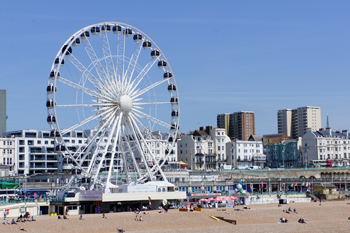
I stopped for a coffee and a sandwich at the Beach Hut overlooking the sea, where I was able to sit and look out over the expanse of beach and sky. There were stacks of evenly placed deck chairs ready for hire, a sandy volley-ball court, and a plentiful array of restaurants and cafes, stretching all the way to the pier and beyond. I didn’t recall it being quite this organised, or tidy.
It seems to me that Brighton doesn’t quite know what it wants to be, so it’s a bit of everything. It is certainly family friendly, and has also acquired a reputation as an arty, bohemian kind of place. The architecture is mostly Georgian, with an abundance of pale stone and wrought-iron balconies. There’s a hint of art deco about the casino and a timeless innocence about the pier, while the Royal Pavilion, with its domes and its silks, is an Orientalist fantasy come to life.
The Fishing Museum
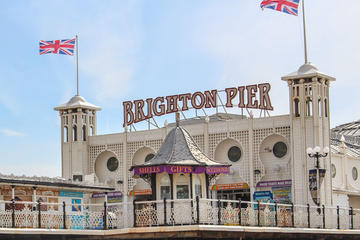
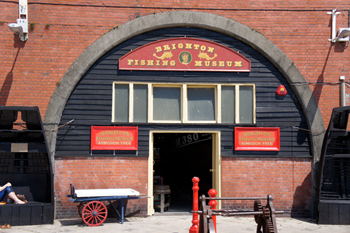 I took a walk along the sea-front, breathing deeply of the sea air, and made a nostalgic detour to the pier, complete with funfair and fish and chips. I visited the small but perfectly-formed Fishing Museum. The fishermen of Brighthelmstone were not best pleased at the arrival of all these new visitors, but they made the best of it.
The museum houses a full-sized fishing boat, along with plaques and photos and anchors, and delights in telling visitors of the broad-beam hog boats, or hoggies, known locally as ‘knock-arse boats’. Sleek they are not, but they remained stable in rough seas. There’s also a section honouring the boats that went to the rescue at Dunkirk – I can remember my grandmother telling me you could barely see the sea that fateful summer in 1940 for all the boats.
The Royal Pavilion
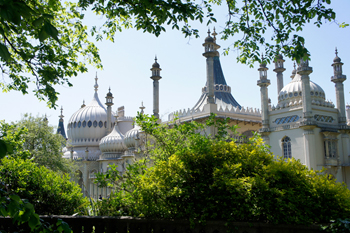 When it came to mistresses and houses, the Prince Regent was a lover of excess. ‘The more, the merrier’ would appear to be his motto. His mistresses were plump and matronly, and his houses extravagant.
George moved to Brighton in 1786, escaping both his creditors and the stultifying dullness of the court of St James. He soon rented a farmhouse on the river Steine and, once his financial troubles were sorted out (he had to sell his horse-racing stud) he instructed the architect Henry Holland to convert the house into a dwelling more suitable for the Prince of Wales, as he then was. The result was a beautiful example of neo-classicism.
The Pavilion soon became an alternative court, where a colourful aristocratic circle surrounded the Prince. They were, according to contemporary biographer Robert Huish, “a set of titled cardsharpers.”
But it was not enough. By the 1820s, the house had been transformed into a grand Orientalist fantasy by the architect John Nash, who also designed Buckingham Palace and Marble Arch. The flamboyant mix of Indian and Chinese influences really shouldn’t work, yet somehow it does.
The interior is a riot of chinoiserie, at its most flamboyant in the magnificent Banqueting and Music Rooms, rooms dedicated to two of the Prince Regent’s passions. In the Banqueting Room, the walls are decorated with murals and the table is set for the dessert course. The lamp stands, blue jars of Spode porcelain, are original, as is one of the sideboards, veneered in satinwood and with carved and gilded dragons.
The room is dominated by the dazzling chandelier, a ton in weight, grasped in the claws of a silvery dragon suspended from the ceiling. I’d read that, hidden among all the chinoiserie, are a number of Masonic symbols, and I set about looking for them, the sun and the moon and the All-Seeing Eye. The Prince Regent was the Grand Master of the Prince of Wales Lodge, mostly made up of his friends.
The Music Room is likewise a sumptuous space, lit by nine lotus-shaped chandeliers. The Italian composer Rossini performed here in 1823, by which time the Prince Regent had become King George IV. The room has been fitted with a hand-knotted carpet, a reproduction of the original, made using evidence from surviving fragments and contemporary illustrations, and visitors wearing high-heeled shoes are requested to take them off before entering.
Other rooms are rather more restrained, in an elegantly sumptuous kind of way. I was reminded of a Jane Austen novel, and it occurred to me that I could really do with a chaise longue.
Upstairs are the guest suites and private rooms, complete with heavy silks and four-poster beds. There’s also an art display, including a set of irreverent cartoons satirising the Prince Regent – he was a cartoonist’s dream – and the delightfully cheeky painting HRH The Prince Regent Awakening the Spirit of Brighton, painted by Rex Whistler while he was billeted in Brighton in 1944. I think the Prince Regent would have approved.
Sailing Sunset Cruise from Brighton
If You Go:
♦ Brighton is easily accessible from London by fast train, departing from either London Bridge or Victoria Station. Rail passes and tickets can be booked at Britrail online.
♦ Apart from trains, some travellers prefer private transfers from London for a smoother ride, especially on day trips. Services like London Wheels Limo offer direct, door-to-door travel.
♦ Information on accommodation, restaurants and Brighton’s plentiful events calendar can be found on the comprehensive Visit Brighton website.
Brighton Pier Tour with Lunch at English Pub
About the author:
Paris Franz is a London-based freelance journalist. She has had work published in a variety of web and print publications, including The Independent, Wanderlust and Europe Up Close. See more of her work at www.parisfranz.com
All photos are by Paris Franz:
Ferris wheel
Fishing Museum
The Royal Pavilion
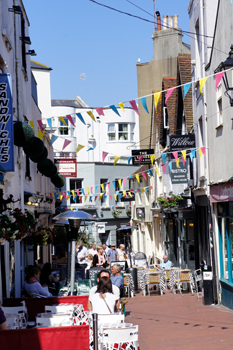
The Lanes shopping area
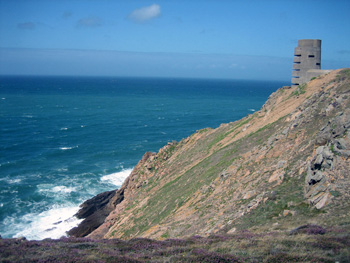
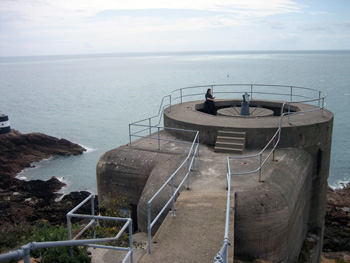
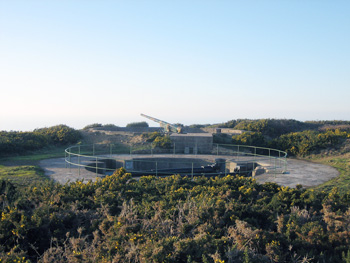 On top of the cliff, the concrete observation tower built during the German occupation of the Channel Islands stands at attention and fixes its martial gaze into the distance. Below, at the bottom of the cliff, covered by the high tide, is the graveyard of the guns. These are heavy artillery weapons captured by the Germans during World War II and thrown over the cliff by British forces after the liberation of the islands. This is within living memory. There are still people who remember those terrible times.

 Manpower was needed in order to build trenches, anti-tank walls, bunkers, gun emplacements, observation towers and tunnels. The Organisation Todt was in charge of providing workers. Its primary source were prisoners of war in mainland Europe, political prisoners and even men rounded up on the Continent. These poor men were treated worse than slaves. The Russians bore the brunt of Nazi cruelty as they were considered sub-humans. Many tried to escape the labour camps in search of food and some locals, running enormous risks, gave them food and shelter.
 Visitors can see the original operating theatre, the boiler room and telephone exchange. There also other exhibits, like the clandestine crystal radios people used to listen to news from the outside world at the risk of imprisonment or even death. There’s even an Enigma machine on display, which reminded me of World War II movies and made me smile.
 It occurred to me that my own grandfather could have been among those labourers in Jersey had he not been rescued by the Argentinean government just in the nick of time. He was in the concentration camp at Argelès-Sur-Mer, close to the Spanish border. He is an Argentinean national but he was living in Spain when the war broke out and since his parents were Spanish, he was considered a Spaniard and recruited by the Republican side without further ado.

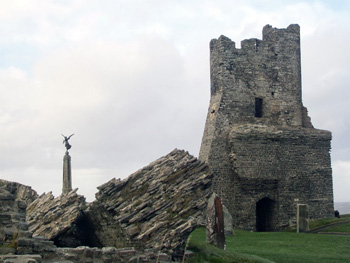
 Hinterland was the first network television series (a combined Fiction Factory production for Welsh language channel S4C and the BBC) filmed in Ceredigion; probably because its lack of motorways makes it difficult to reach for film crews. Its stark location was part of the appeal though, according to series producer Ed Talfan on the BBC Hinterland blog page:
 I wrote an article about the Cambrian line railway journey still available on what was Suite 101 years ago, and this year wrote a poem about a possible railway journey from Scarborough on Britain’s east coast to Aberystwyth on the west.
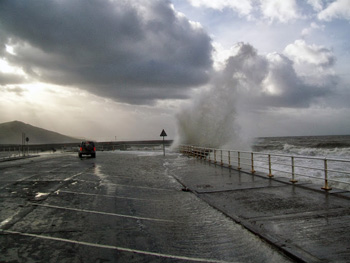
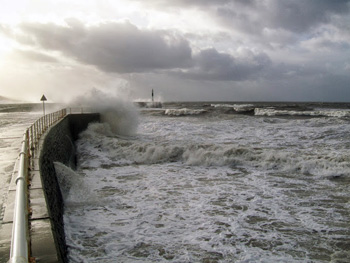 Circling the headland again, I saw the waves looked even higher as they crashed onto the south beach and defensive walls between the sea and harbour. So I walked down as far as I could, and was rewarded with excellent views and photos of the sun setting over the highest southern peak; between swirling grey clouds and above seawater flying high into the air after battering the promenade.
 A Welsh uprising against the rule of Henry IV under Owain Glyndwr captured the castle in 1404. He crowned himself Prince of Wales, and held a parliament at Machynlleth. Mach is a few stops on the trainline east of Aber, where the train can divide into two: one continuing east-west, and the other riding the south-north coast line to Pwllheli. The rebellion lost the castle in 1408, and order was restored under Henry V by 1415.
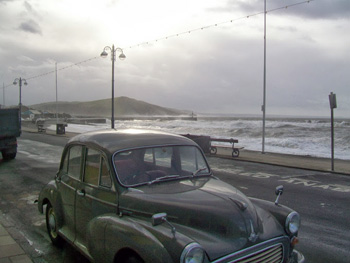 Aber town centre is quite small and easy to navigate. Walking out from the station the north beach is straight ahead past a pub sarcastically named after Lord Beechings. Lord Beeching’s report closed down the fifty-miles long Aberystwyth to Carmarthen train line linking mid and south Wales in 1965.
 Under the bridges, the Mynach falls 300 feet in five steps to the Rheidol. The Devil’s Bridge name was inspired by a local legend that thought the original bridge was too difficult to build, so the Devil must have built it in exchange for the first soul that crossed. An old woman tricked the Devil by sending her dog onto the bridge. It’s a nice story, but a shame for her dog!

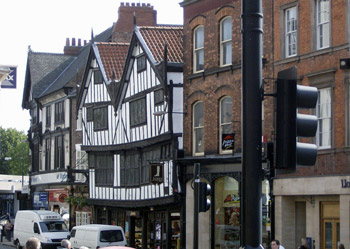 From London to York
 Rising the next morning to very un-English like weather ( read “sunny” ) the three of us headed for Petersfield, south of London. During our stay this would be our home away from home. Founded in the 12th century by William Fitz Robert the second Earl of Gloucester as a market town, Petersfield grew in importance because of its location on a direct route north to London and south to the coast. Like those travelers before us we took advantage of the locale returning most days to a late meal and a pint at the pub. Albeit we had the benefit of modern travel and Brit Rail passes purchased before leaving Canada which offered us sizeable fare savings.
 A short visit can’t do justice to all that York offers but the highlights of our visit include Jorvik on the site of a Viking village complete with its workshops to latrines. The Shambles, a medieval street were butchers dressed and displayed their wares. Thomas Herbert House on the site of a Lord Mayor of London Christopher Herbert’s house of 1620. Could I be related? Of course the Ghost Walk, an entertaining stroll through after hours York and a great way to learn the town’s darker history followed by a glass of the local bitters and Cornish pasties at the Golden Fleece Pub. Do you sense a bedtime ritual? To quickly our stay in York is over and we board the return train to Petersfield. Our next excursion, Windsor.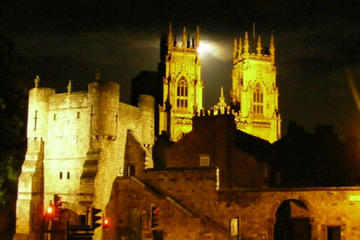
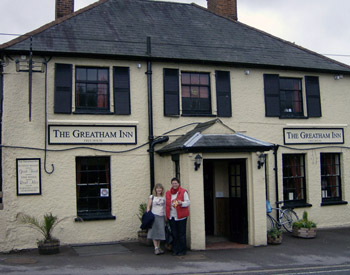 During my walk-about I meandered down narrow roads, past Market Cross House which is said to have a secret passage way used by King Charles II for private trysts. Continuing through public and some private gardens. After a lengthy stroll along the Thames I found myself at Eton College where since 1440 A.D. Olde Blighty’s future leaders have been educated. A quick check of my watch and I realize that I have barely enough time for a fly-by sandwich and an Ale at the Bel and The Dragon before I am to meet up with the women.

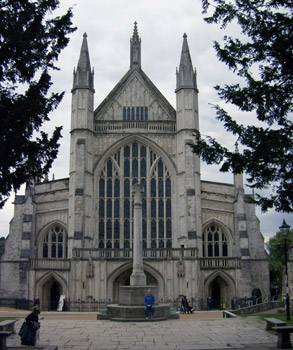 Over that ale we decided that London should be next on our agenda even if we could not agree on what to do once there. Fortunately by the time we had arrived at Waterloo Station a compromise had been reached. We spent the day doing the tourist things. Crossing the Thames by the Waterloo Bridge we continued along Victoria Embankment, through the gardens of the same name finding our way to Covent Gardens. There we stopped at Pips Dish before moving on to Trafalgar Square where we took the Tube to Harrods for a little shopping. I vowed that my next time in London would be spent in exploration.
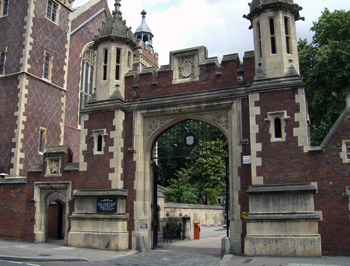
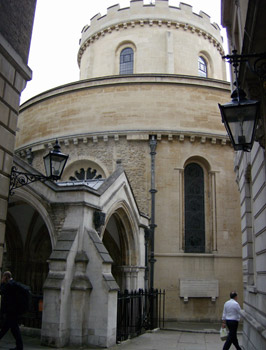 Being a fan of Dan Brown‘s The DaVinci Code, locating the Knights of the Templar Church was a must do. As my time in England was rapidly passing I needed to get to it. Some say that the Temple Church is so named for Knights Templar, 12th century pious noblemen who set out to protect pilgrims travelling to the holy land. Others insist the Temple Church was a medieval bribe designed to silence the Knights Templar as they knew a little to much of the Catholic Church’s looting and pillaging of which they played a major role. Likely there is some truth in either version. After following a circuitous route in an effort to find the Temple Church and about to give up I spotted it nestled between much larger buildings in a back alley between London’s Fleet St. and Pump Ct. around the corner from Ye Olde Cock Tavern, fittingly in the centre of a district rife with solicitor’s chambers. Unfortunately, this day the church was closed.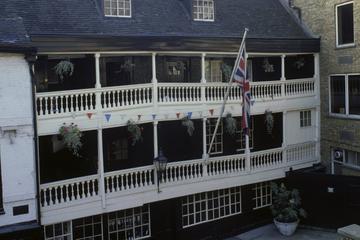
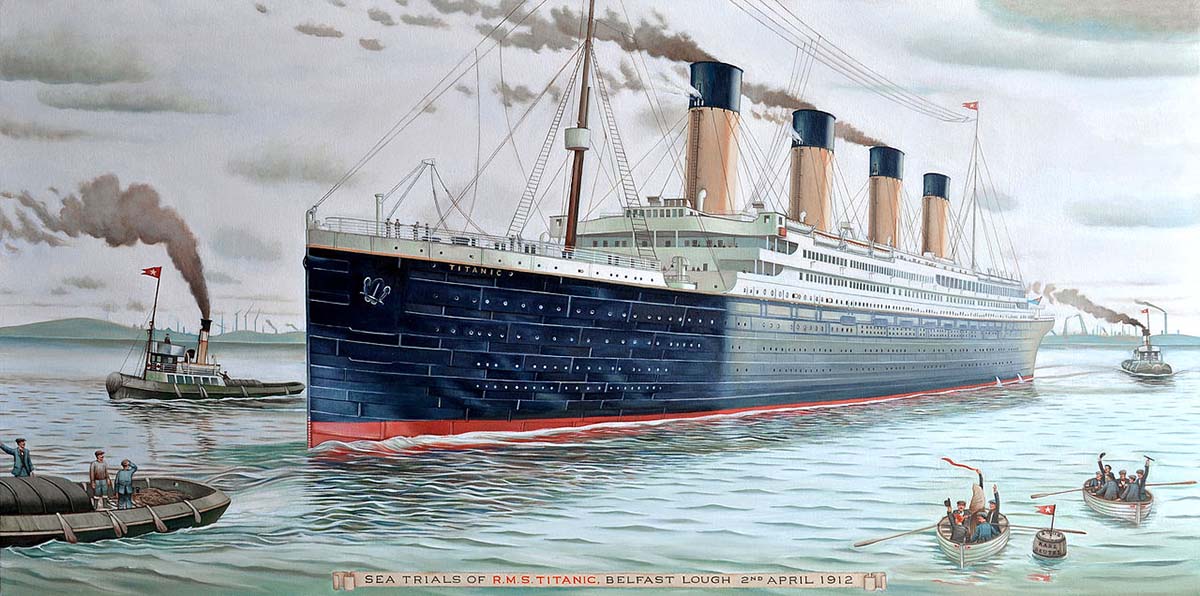
 For the anniversary a new state-of-the-art SeaCity Museum was opened at Havelock Road, within the Cultural Quarter of Southampton. This museum has now replaced the former, and smaller, Maritime Museum which was closer to the seafront. As the SeaCity Museum is located within a former court building it does not win any prizes for innovative architecture!
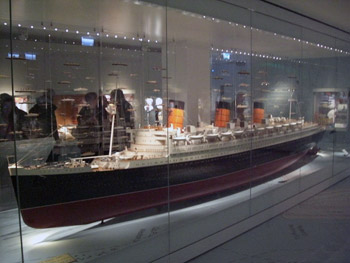
 Southampton’s Titanic Story is the exhibition that covers the brief history of the Titanic. A large diagram of the Titanic is drawn out on one wall which displays the ship’s layout and various compartments such as kitchens, boiler rooms, cafés, the Grand Staircase, cabins, lifts etc. Behind this there are glass cases which display Titanic documents and artefacts such as the captain’s sword. Various bits and pieces from other similar ships are also included in the exhibition like the Olympic’s Honour and Glory Panel, which was very similar to the panel included at the Grand Staircase of the Titanic.
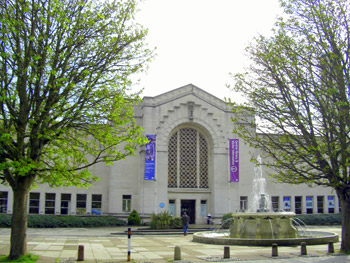 Beyond the SeaCity Museum, the Cultural Quarter also includes the City Art Gallery which displays a variety of paintings. Although not exactly the Louvre, it is still renowned for its collections. For the Titanic anniversary this gallery is dominated by hundreds of Titanic paintings. These probably won’t always be included in the City Art Gallery, but there are always a variety of paintings displayed at the gallery.
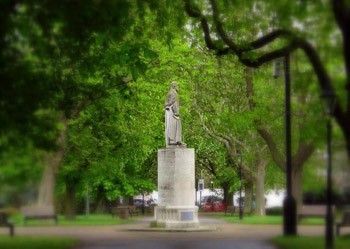 However, Southampton is not just famous for ships. Famous aircraft have also ‘taken off’ at this site in the UK. Among them, the first Spitfire was constructed at Southampton’s assembly lines during the 1930s. Unlike the Titanic, this plane did not go down so easily as it was an influential RAF aircraft during World War Two.
 So, when in Southampton visit the SeaCity Museum, Mayflower Theater, Solent Sky Museum, City Art Gallery or the Bargate Monument Gallery. You can reach Southampton via the air, rail or the sea. However you travel, the trip should be a smoother one than the Titanic’s maiden voyage!