Travel Thru History

Historical and cultural travel experiences

  • Home
  • Airfare Deals
  • Get Travel Insurance
  • Writers Guidelines

England: A Holiday In Torbay

Paington Pier

by Matthew Adams

During one summer, I took a holiday in the seaside town of Paignton. Paignton is one of three towns in Torbay alongside Brixham and Torquay. It is part of a supposed English Riviera that has miles of sandy beaches along its coastline, and some great coastal landscapes.

When visiting in late August I expected sunshine, but it rained for much of the week. It was not great weather for a trip to the seaside. Paignton has a number of beaches along its coastline such as Goodrington Sands, Broadsands Beach and Hollicombe Beach. Paignton Sands is the stretch of beach that includes Paignton Pier which I visited during a wet day in August. The pier includes an arcade, bingo hall, café, seafood and ice cream takeaways.

Dartmouth Steam Railway

Dartmouth steam railwayThe Dartmouth Steam Railway is a preserved steam railway line that runs from Paignton through to Dartmouth. This is one of the few remaining U.K. steam railway lines which has a variety of rolling stock locomotives. Locomotives such as the 4277 Hercules, 7827 Lydham Manor and 75014 Braveheart run the 6.7 mile railway from Paignton to Kingswear.

This was something I couldn’t miss in Paignton. From Paignton station I boarded one of the steam locomotives which passed Goodrington Sands Halt and Churston en route to Kingswear. The train passed the Saltern Cove and Armchair Rock, and then crossed over the Broadsands Viaduct. After crossing the Greenway Viaduct, the River Dart came into view on the just before the train stopped at Kingswear Station.

When I arrived, the station was packed out. This largely due to the annual Dartmouth Regatta. Consequently, I did not cross the River Dart into Dartmouth. One of the highlights of the Dartmouth Regatta is the Red Arrow displays. During one such display the Red Arrows flew over Paignton, and I spotted some fairly low flying aircraft from my hotel.

Oldway Mansion

Oldway mansionAmong the more notable buildings in a Paignton is Oldway Mansion. This is a large 19th century building built in the same style of the Palace of Versailles. I visited the intriguing building in Paignton, which is something of an architectural landmark.

At the building’s entrance is the grand staircase. Ornate paintings, partly based on the original design of the Versailles Palace, decorate the ceiling above the marble and bronze grand staircase. Also above the staircase hangs a reproduction of the Crowning of Josephine by Napoleon painting. The original is, as you probably guessed, on display in Versailles.

There are 17 acres of landscaped gardens around Oldway. The gardens strike upon an Italian theme, and contain various subtropical plants and shrubs. In addition, the grotto gardens include a waterfall that passes over a rocky cave into a pool below.

Torquay and Brixham

Torquay harbourOn the final couple days of my holiday the weather was a little better, and I went into two of the neighbouring towns. The first I visited was Torquay. Torquay is a town that includes exotic gardens along its seafront, Living Coasts, Kents Cavern, Babbacombe Model Village and Cockington Court which is about a mile away.

The historic building of Torre Abbey is also in Torquay. This restored building now includes painting and sculpture art exhibitions. Instead of going inside, I went into the Torre Abbey gardens. Outside Torre Abbey there is also Abbey Park. This is a picturesque seaside location that includes tennis courts and pitch & putt golf course.

Finally, I made the trip to Brixham aboard one of the regular boat crossings that run from Paignton to other towns in Torbay. Brixham is primarily a fishing port in Torbay with a rich maritime history. There you can board a replica of Drake’s Golden Hind, and the Brixham Museum displays a variety of boat models within its galleries.

In Brixham I headed for the Royal Estate, otherwise Berry Head, which is a coastal headland nature reserve. Guillemots, Razorbills and Black-legged Kittiwakes seabirds flock to the coastal cliffs of Berry Head. At Berry Head there is also a promontory Napoleonic fortress which guarded the Torbay naval anchorage. The former artillery house now includes a display which provides further details on the fort.

After visiting Brixham, my holiday had finished. A week in Torbay certainly made for an interesting vacation. Aside from soaking up the sun on Paignton’s beaches, soak up the history at Torbay’s museums, steam railway, Oldway Mansion and Berry Head.


English Wine Tasting Tour to Sussex from London

If You Go:

♦ Dartmouth Steam Railway
♦ Berry Head
♦ Paignton Pier
♦ Paignton
♦ Brixham

Photo credits:
Paignton Beach and pier by Herbythyme / CC BY-SA
The Dartmouth Steam Railway by Geof Sheppard / CC BY-SA
Oldway Mansion by Ianmacm at English Wikipedia / Public domain
Torquay Harbour by averoxus / CC BY

About the author:
Matthew Adams is a freelancer that has produced a variety of articles for various publications and websites such as Swing Golf Magazine,TripAdvisor, Captured Snapshot, Coed Magazine the Washington Post and Vagabundo Travel. Matthew also has his own golf blog at: amateurgolfer.blogspot.co.uk

Tagged With: England travel, Torbay attractions Filed Under: UK Travel

Belfast, Northern Ireland: Back to the Future

Republican mural
by Helen Moat

I was back on the train to Belfast after decades, the new stock state-of-the-art shiny, clean, comfortable, smooth and fast. Rolling neon lights flashed up the destinations along the line. A soothing English voice told us our next stop. Automatic doors slid open effortlessly. The female voice recited the remaining destinations. Surely I was in the English Home Counties, not in my homeland?

Back in the 1980s the train to Belfast shuddered and creaked its way to the city. The seats were blighted with cigarette holes and knife slits, the floors covered in litter, the walls plastered with graffiti. Disaffected youths smoked in the no smoking compartments and no one dared challenge them. This was Northern Ireland at the height of the troubles: troubled, angry, defiant.

I breathed out slowly, and soaked in the past and the present. Across the way, a couple were speaking in the tongue of my childhood. A language half forgotten. Every sentence was punctuated with a verbal full stop.

“I’ve just got back from Australia – so I have.”
“I didn’t know that – I didn’t.”
“Loved it out there – aye.”
“You’re still in Finaghy – are you?”
“I am – aye.”

I smiled to myself. When did my birthplace become a foreign country?

I reached the city, the views of Belfast, strangely familiar: The Belfast Hills on one side, clouds scudding across the hillsides, the sky overhead a mixture of threatening black and baby blue; then the city in front of me with the bright yellow Harland and Wolff cranes towering over it.

Off the train, I met a friend at the City Hall. We dodged the ‘tour-of-the-troubles’ operators, touting for business and headed to Donegal Square, the main shopping area. Back in the 80s, you entered it through a gated terrapin, to be given a thorough body search – repeated in every store you entered. Shopping in the city wasn’t for the faint hearted. People in Derry refused to go to Belfast because they felt it was too dangerous. Belfast citizens wouldn’t go to Derry for the very same reason. But now, there was such an air of freedom and optimism, I felt dizzy. We continued on to Victoria Square and the new shopping mall, with its glass dome offering 360 degree views: of the city, the river Lagan, the Lough, the sea beyond, and the Black Mountain on the skyline.

Ring of ThanksgivingWe walked on to the waterside. I had no idea it was so close to the city centre. During the troubles it was a forgotten wasteland. By the Lagan, we gazed up at the Ring of Thanksgiving, a monument to peace and reconciliation. The locals prefer to call it ‘The Thing with the Ring,’ ‘Nuala with the Hula’ or ‘The Doll on the Ball’. They have a way with words here. Just a stone’s throw away is the handsome Customs House and the Albert Tower, Belfast’s very own Leaning Tower of Pisa. Once again, that infamous Belfast humour kicks in, with the locals describing it as having the time and the inclination.

A few months later, I took one of the open-top buses with my son, feeling odd for playing the tourist in my own home city. But I wanted to show him Belfast – and to see the Republican Falls Road that had been a no-go area for me as a young Protestant girl.

Titanic museumThe bus took us along familiar streets: Donegal Square with its handsome Baroque-styled City Hall and Donegal place, the main shopping drag, now lined with 16 metre high sculptural masts, homage to 8 ambitious ships (including the Titanic) built by Harland and Wolff in its heyday. We skirted the Lagan again and the newly regenerated waterside and along city streets that were so familiar and yet so different. Gone were the grey police jeeps, the wary soldiers, the turnpikes and terrapins, and the beefy security guards on each and every shop door. Gone was the smell of subdued fear. And in its place there was art and sculpture and new innovative architecture. There was vitality and a joie de vivre in Belfast.

We drove down Bedford Street and onto Great Victoria Street past Queen’s University: streets I knew well. We passed the canary yellow City Hospital. Our guide laughed and told us Prince Charles taken one look at it on a visit to the city and claimed it was one of the ugliest buildings in Europe. Now we call the hospital ‘Camilla!’ he said. Then we were driving over the West link and onto the Falls Road, a stone’s throw from the modern, cosmopolitan city centre and yet another world. I looked at the so-called peace lines, in places 25 foot high walls, reinforced with iron, brick and steel. We passed gates, closed each evening and at weekends. It was a sobering reminder of a society that is still damaged and wounded.

The bus hovered outside the Bobby Sands Memorial Garden, a hunger striker who had starved himself to death in his attempt to gain political prisoner status. On his death, Republican supporters heralded him a hero.

The commentator on the bus spoke in hushed, reverential tones. It wasn’t difficult to guess his politics.

We reached the political murals. ‘Oppression breeds resistance, resistance brings freedom’. The mural commemorated the Falls curfew of 1970. There was a painting of Che Guevara and murals supporting Cuba and the Basque Separatists. There were condemnations of Israel and the US. Most of the murals focused on the wider politics of the world and Marxist communism. There was also a mural of Bobby Sands.

Protestant muralWe continued on past the remaining infamous Divis Flat, once an IRA stronghold. During the Troubles, the army had occupied the top two floors and could only access the building from the air. The flat occupants were subjected to searches night and day, their homes torn apart. Most, if not all of them, were involved in terrorist activity- or at least supported it. The residents hated the army occupation. The animosity was mutual. A nine year old child was killed by the RUC (the police) who claimed they had been under sniper attack at the time.

In Protestant Shankill and East Belfast, the loyalists had their own murals: ‘You are now entering Sandy Row Heartland and ‘No surrender’. There were memorials and shrines to Rangers, the Protestant Scottish football club, to the soldiers who had died in two World Wars and the UDA (the Unionist terrorist equivalent to the Republican IRA.) There were paintings of men in balaclavas with guns cocked that sent a chill down my spine.

It occurred to me that the two communities had more in common with each other than they would ever acknowledge, with their shrines and monuments, their murals and mafia-type communities. And yes, there was warmth and generosity and community and support.

The people of Belfast are full of contradictions: they are passionate, fierce, loyal, resourceful, sharp, intelligent, vengeful, quick to anger and slow to forgive and forget (some of them are still remembering 1690 and beyond!). At the same time, they are among the kindest and friendliest people on the planet. When you’re in Belfast, it’s easy to forget that you are in Northern Ireland’s capital city and not in a village. Then there’s that wonderful, Belfast wicked sense of humour.

Samson and Goliath cranesThe bus continued on to the Titanic Quarter past the Samson and Goliath cranes that are monuments to a once wealthy and successful Belfast. The old ship-building and linen industries had faded away and unemployment and poverty had taken its place – and with it the seeds of discontent started to sprout.

From the bus, the Titanic museum, an iconic aluminium-clad building, rose out of the dock wastelands like an ice-clad ship from the sea. Here in Belfast, the Titanic has been, in a sense, resurrected a century later: with the building of the Titanic Visitor Centre. Back in 1912, the city launched the mighty Titanic, designed and built in Belfast’s docks. At this time, the city was buzzing with success. Then the Titanic sank and the shipyards closed down. It was the prologue to ‘The Troubles’. By the 70s, Belfast had become a dark, strife-torn city. Fast-forward 40 years and Belfast is reclaiming its place in the world. No longer ashamed of its past (and happy to take ownership of its infamous ship again), Titanic Belfast is the largest Titanic attraction in the world and hugely popular.

Apart from Titanic Belfast, it’s worth visiting the Drawing Offices, the Pump House and the Dry Dock. Climb down the 44 feet to the bottom of the dry dock and you’ll begin to get a sense of the sheer scale of the Titanic. Inside Titanic Belfast, you can walk through the history of Belfast. As your silhouette mingles with the Victorian figures that hurry across huge projected images of Victorian Belfast, you’d be forgiven for thinking you’ve stepped back through history and are walking with ghosts.

This new, state-of-the-art museum is a symbol of hope and optimism, just like the Ring of Thanksgiving. Belfast is lifting its head, no longer ashamed of its past and looking to the future. Maybe this optimism, pride and positive energy will spread to the Falls and the Shankill and to the other working class areas of West Belfast, and the wounds will heal. I hope so.


Belfast History Walking Tour The Ultimate Belfast experience

If You Go:

WALK THE CITY
♦ Grab a free map from the information centre and create your own route. You don’t really need a guide as there are information boards across the city
♦ Belfast i-tours: Download a guide to your mobile, available from Belfast Welcome Centre
♦ Follow the Titanic Trail along the River Lagan. It’s well sign-posted with explanation boards along the way.
♦ Follow the sign-posted Merchant Trail. Belfast was a thriving, successful shipping and merchant city at the height of its powers when the Titanic was built.
♦ Join a guided walking tour. Choose your interest. There are Ghost Walks, Political Tours, Titanic Tours and walks uncovering ‘Hidden Belfast’.


Belfast Famous Black Taxi Political Mural Peace Wall Tour

BY BIKE
♦ Hire a bike or join a guided bike tour from the University or the Titanic Quarter

BY SEGWAY
♦ A guided tour of the Titanic Quarter by a more unusual method of transport

BY BOAT
♦ Tour Belfast Harbour and the Titanic area

BY BUS
♦ Buy a metro ticket or take one of the guided open-top buses

BY TAXI
♦ Take a taxi tour of the Troubles


Full-Day Trip from Belfast: The Ultimate Game of Thrones Experience including Winterfell, Direwolves and Replica Throne

GETTING THERE
♦ There are scheduled flights into Belfast International and Dublin airport from all over Europe and world-wide destinations. Dublin is only two hours away from Belfast by train.
♦ There are a number of no-frill flights fly to Belfast City Airport from other parts of Ireland and the UK. There are sailings from Liverpool to Belfas,t and from Scotland (with a connecting train service).

WHERE TO EAT AND SLEEP
♦ McHugh’s bar and restaurant is Belfast’s oldest surviving building (1711). Situated in Queen’s Square, the historical commercial centre of the city, McHugh’s serves traditional Irish food with a modern twist. Try the massive Flintstone-esque “on the rock” steaks (served on slabs of slate) – or if meat is your poison, there are tasty vegetarian options such as champ (Creamed potatoes with scallions).
♦ There’s a wide selection of eateries in the Victoria Shopping Centre off Donegall Square.
♦ You mustn’t miss the Crown Liquor Saloon, one of the most beautiful historical pubs in Europe.

WHERE TO SLEEP
♦ There’s a range of hotels, Bed and Breakfast accommodation, and self-catering options in the city to suit all budgets.

All photos by Helen Moat:
Republican mural on the Peace Line
Ring of Thanksgiving
Titanic Museum from the marina
Protestant Shankill and East Belfast loyalist mural
Samson and Goliath cranes

About the author:
After decades, Helen Moat returns to her home city, Belfast, to find it had changed beyond all recognition. Helen Moat spent her childhood squished between siblings in her Dad’s Morris Minor, travelling the length and breadth of Ireland. She’s still wandering. Helen was runner-up in 2011 British Guild of Travel Writers Competition and was highly commended in the BBC Wildlife Travel Writing Competition this year. Her writing has been published in The Guardian, Telegraph and Wanderlust magazine as well as online. She blogs at: moathouse-moathouseblogspotcom.blogspot.co.uk

Tagged With: Belfast attractions, Northern Ireland travel Filed Under: UK Travel

Hadrian’s Wall: A Walk Through History

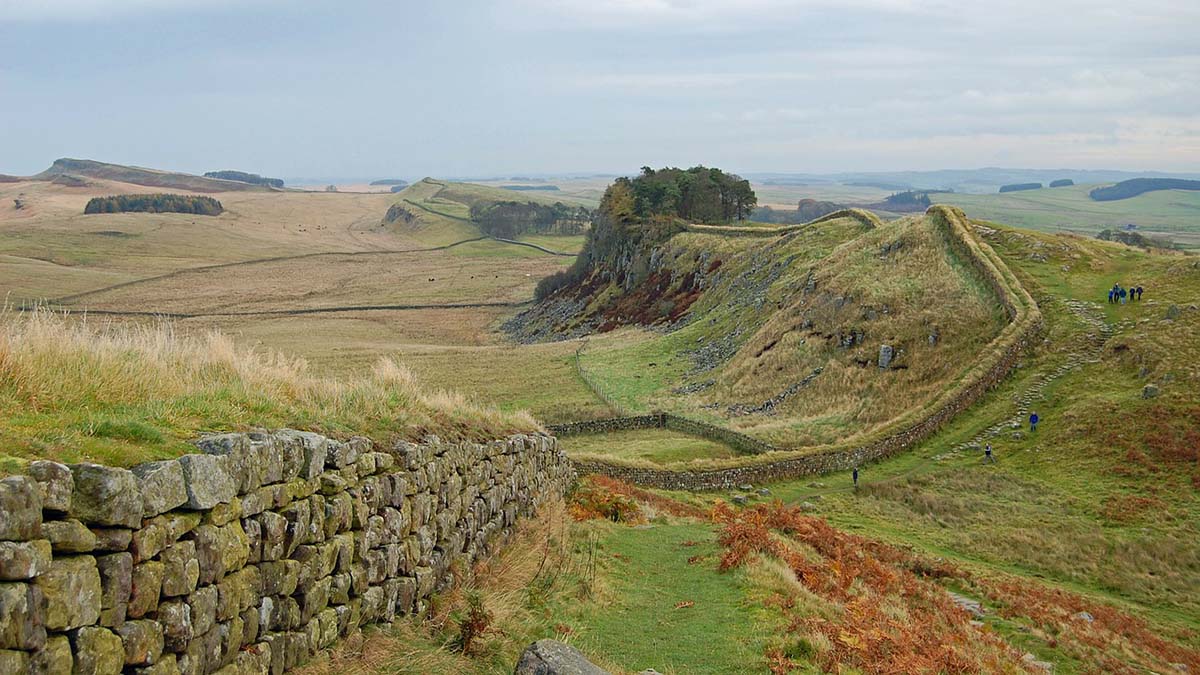
Hadrian's Wall

by Melissa Gardiner

It was a bright spring morning as my walking partner and I took our first footsteps along the path of Hadrian’s Wall. It’s an 84-mile trail across the north of England from Wallsend near Newcastle on the east coast to Bowness-on-Solway on the west coast. Or that’s the most popular route, we were travelling west to east as it fitted in better with our travel plans. The Hadrian’s Wall Path is a World Heritage site, passing through historic towns and villages, and sticking very closely to the path of the Roman wall built in AD 142, primarily to protect Roman England from troublesome Scots north of the border. It also passes through some of England’s most notable archaeological sites, dotted across rolling hills and at times, wild, rugged countryside.

Carlisle

Housesteads Roman fortWe managed to complete the trail in seven days, walking between 12-15 miles each day and stopping in decent bed and breakfast accommodations or cozy country pubs along the way. There were a number of historical highlights, with the Roman city of Carlisle first along the way. Carlisle is a bustling border town on the banks of the River Eden. Its impressive medieval castle sits high on a hill overlooking the city and is open for tours and visits to its dungeons. We arrived in Carlisle late in the afternoon and after a shower and a bite to eat, enjoyed a few drinks in some of the historic pubs dotted around the center. The King’s Head was the pick of the bunch.

After Carlisle, it was a few days hard walking and taking in the sights of the countryside that runs between the border city in the west and the vibrant city of Newcastle in the east. We spent a night in the quaint market town of Brampton and then headed towards the Housestead Crags, some of the toughest walking on the trail. The trail is well sign-posted for walkers even in the remote areas and we regularly saw plaques marking points where the original wall stood. There are still a few small stretches of the original wall that can be seen, as well as mounds and trenches which now evidence where the wall once ran.

Newcastle

The second half of the trip saw us heading down from the hills towards the north-east coast. Our final day walking took us from the quiet village of Wylam along the banks of the Tyne, right into the heart of Newcastle. It’s an impressive city as you walk along the Quayside area and underneath the magnificent Tyne Bridge. Newcastle has been a major port for centuries and whilst the docks are no longer as busy as in the past, the city has partly re-invented itself as a tourist destination and a starting point for cruises to Northern Europe and the Arctic. Passenger ferries to Holland and Belgium also run out of Newcastle as well. The Hadrian’s Wall trail ends a couple of miles past the city center at Segedunum Roman Fort in the suburb of Wallsend. This has an impressive visitor center with a viewing tower looking over the wide area of excavated fort on show. We saw barracks blocks, command posts and an 80 metre stretch of the original wall as we wandered around the site, tired but delighted that we had completed the trail.

Roman Forts

The historical highlights of the trip however were the old Roman forts that we came across along the way. Hadrian’s Wall is a route for lovers of history and architecture and the forts and the visitor centers that accompany them will not disappoint enthusiasts. Housesteads Roman Fort is found on an escarpment above the trail route. There are substantial remains of the 2000-year old fort and the views out over the rugged crags were spectacular on the clear day that we visited. The site has a museum and exhibition and we wandered through the remains of barracks that once housed over 800 soldiers. In Cumbria we passed Lancercost Priory, an Augustinian Priory which dates back to 1169 and still functions as an Anglican church, as well as paying a brief visit to the remains of Birdoswald Roman Fort – not as impressive as Housesteads but with impressive interactive displays and a full height model of the wall it’s worth the detour from the trail route.

We also stopped for a night in Chollerford, a picturesque Northumberland village and visited the nearby Chesters Roman Fort on the banks of the River Tyne. This was a cavalry fort and there are also remains of Roman baths and steam rooms nearby. As with the other forts along the route, there was an informative visitor center with knowledgeable staff to chat to.

We ended our walk with a look around Segedunum, weary but delighted to have finished the trail. We’d seen history and magnificent rural scenery along the way, but on the final leg of the trip it was time for a metro back into Newcastle city center and an evening enjoying its famous nightlife.


One For the Road – Newcastle Pub Walk

If You Go:

Along with the other places in this article, you may also want to visit:
♦ Durham Cathedral, known for being one of the finest and best examples of Norman architecture in the world
♦ Lindsifarne, home of the monastery of St Cuthbert. Visiting this small, tidal island off the North East coast is a rare and sacred pleasure and will need careful planning, but will be worth every moment.
♦ Monkwearmouth-Jarrow – Visit the remains of the Monastic dwelling of the Venerable Bede, responsible for the creation of the epic tome “Ecclesiastical History of the English People”
♦ Lanercost Priory
♦ Housesteads Roman fort
♦ www.nationaltrail.co.uk/hadrians-wall-path
♦ www.english-heritage.org.uk
♦ Art Cruises: www.iglucruise.com/art-cruises

Photo credits:
Hadrian’s Wall Image by David Mark from Pixabay
Housesteads Roman Fort by Eleonora Pavlovska from Pixabay

About the author:
Melissa Gardiner is now a freelance writer, but prior to this she worked within the travel industry as a tour guide, specializing in sites of historical interest throughout the UK. She has a keen interest in ancient history and loves seeking out places of interest to write about that she feels will interest others as much as herself.

Tagged With: Carlisle attractions, England travel Filed Under: UK Travel

England: A Stroll Along The Coast Of Portsmouth

Portsmouth harbour

by Matthew Adams

The city of Portsmouth, on the south coast of England, is one that has a great coastline and harbor. As such, Portsmouth has plenty of boats! A variety of boats of various shapes and sizes, both modern and more historic, can be found at its harbor. As the city includes a Royal Navy naval base, which is one of the largest in Europe, it has a fascinating naval heritage.

I arrived in the city at the Portsmouth and Southsea train station for a stroll along the coast. Located at the waterfront is Portsmouth and Southsea station which is one of two train stations in Portsmouth. The other, further north, is Fratton Station which is an alternative departure point. The closest airport to Portsmouth is a relatively short train trip away at Southampton.

After exiting the train station, the first thing that cannot escape your attention is the HMS Warrior which dominates the harbor. The HMS Warrior is a 19th century battleship that was added to the Royal Navy’s fleets in 1860. This was Britain’s first iron-hulled, armored warship that was the largest and most advanced battleship of its time. Today it’s both a museum and monument of the city of Portsmouth.

To the right of the Portsmouth and Southsea station exit is the Hard Interchange. This is essentially a bus station and coach drop-off point. However, many of Portsmouth’s highlights are along the waterfront and well within walking distance.

A tourist information office is located just beyond the Hard Interchange, besides the Historic Dockyard’s entrance. It is here that the Millennium Promenade, or trail, begins. The Millennium Promenade is a three kilometer promenade which links Portsmouth’s historic waterfront. It stretches from the entrance of the Historic Dockyard to the Spur Redoubt at Clarence Pier. This is an ideal point to begin a stroll along the coast which is highlighted with a chain motif which runs along the path of the promenade.

The Historic Dockyard

HMS WarriorHowever, first I just had to drop in at the Historic Dockyard. It is here that a variety of naval museums are located such as the Royal Naval Museum and Mary Rose Museum. As mentioned the Historic Dockyard includes the HMS Warrior, which can also be considered a museum. Whilst you’ll need tickets for the ships, you can still enter the dockyard without tickets.

Its other famous ship is better hidden at the back of the Historic Dockyard. The HMS Victory is the other ship displayed at the Historic Dockyard which, at the time of writing, is undergoing renovations. This is an older warship than the HMS Warrior that was the flagship of Admiral Lord Nelson during the Napoleonic Wars. It was aboard this warship that Lord Nelson and his officers planned the Royal Navy’s victory at the Battle of Trafalgar.

Upon reaching the HMS Victory, you may notice more modern warships at the Royal Navy base. A 20th century camouflaged warship is also displayed next to the HMS Victory. This ship includes dazzled camouflage, and was introduced during World War One to disguise Royal Navy ships.

Gunwharf and the Spinnaker Tower

Gunwharf and Spinnaker TowerAfter exiting the Historic Dockyard, the Millennium Promenade will take you to Gunwharf Quay right next to the train station. The Gunwharf shopping precinct is a more recent addition to Portsmouth that opened in 2001. It includes a bowlplex, cinema, Grosvenor Casino and a Holiday Inn Express hotel at the Gunwharf Quays Plaza which is ideal for any longer stay in Portsmouth.

Undoubtedly, the highlight of Gunwharf is the Spinnaker Tower which dominates the skyline of the Millennium Promenade. This has become a landmark tower of Portsmouth, and rises over 500 feet. The tower includes three platforms, the highest is the crow’s nest which has a wire-mesh roof. The Spinnaker Tower also includes the Café in the Clouds located on the second platform.

Beside the tower there is a small marina along the waterfront of Gunwharf. This includes a waterbus terminal from which you can take boat tours of Portsmouth’s harbor. The other waterbus terminal is located at the Historic Dockyard. These provide tours of the harbor with full commentary, and require no advance booking.

Portsmouth Old Town

The Spinnaker TowerModern Portsmouth soon gives way to Old Portsmouth along the Millennium Promenade which links Gunwharf with Portsmouth Old Town. This is where the trail gets interesting! After leaving Gunwharf, I reached the Renaissance Trail section of the Millennium Promenade. The Renaissance Trail passes through Portsmouth Old Town and ends at Clarence Pier.

At Portsmouth Old Town there is the Camber which is a small harbor that dates back centuries. It was here that spices used to arrive in Portsmouth, as well as coal which remained a notable import up into the 20th century. Today smaller fishing vessels dominate the Camber.

There are also some great pubs scattered around the Camber. Portsmouth Old Town has up to nine pubs, which are ideal for a pint. Among them include The Bridge Tavern on the Camber, The Wellington and the Still and West.

The Round Tower is one of the old coastal fortifications that remain in Portsmouth Old Town. The roof of the tower is open to the public, and provides great views of the harbor. At the seaward end of the High Street in Portsmouth Old Town there is also the Square Tower, and between the two towers lies a stretch of seawall and cobbled shingle beach.

Portsmouth Old Town ends at the Spur Redoubt. Here there is Nelson’s Passage which links the Renaissance Trail with Southsea Common. Alternatively, you can continue along the trail which links to Clarence Esplanade.

Southsea Seafront

naval memorial at Southsea CommonSouthsea Seafront begins at Clarence Esplanade, and the Victorian seafront continues for about four miles. At the esplanade I reached Clarence Pier and its fair that includes the small Skyward roller coaster, dodgems as well as miniature golf. However, the fair remains closed until March. Although the adjacent arcades are open, and they also include the Coffee Cup café and Wimpy Bar. The Premier Inn and Holiday Inn are two nearby hotels next to Clarence Pier which could be suitable accommodation for visitors.

On the right side of the Clarence Esplanade a stretch of open pebbled beach emerges from Clarence Pier up to Blue Reef Aquarium. To the left the esplanade is dominated by the grassy Southsea Common. Located halfway up the common is a large world war naval memorial with the dates of both world wars included on it. A smaller Crimean War monument also lies at the Blue Reef Aquarium’s entrance.

An ideal restaurant in Southsea is the Mozzarella Joes beach bar and grill. Located between the aquarium and Clarence Pier, this is the only restaurant on Southsea Beach. Mozzarella Joes cooks some famous grills such as sirloin steaks, rump steaks and BBQ ribs. Alternatively, gourmet burgers, stonebaked pizzas and seaside classics are also on the menu at this beachside restaurant.

U.S. Sherman tankOne of the highlights of the Southsea Seafront is perhaps the D-Day Museum at Castle Field. This is a museum that documents the 1944 D-Day landings in France. It includes the Operation Overlord embroidery which is an 83 meters long D-Day textile. Outside the museum an American Sherman tank and a British Churchill tank are also displayed.

Behind the D–Day Museum you will also find Southsea Castle. This old coastal castle was constructed to guard the entrance to the Solent. It’s also open to visitors, with various old military armaments and artifacts displayed around the castle’s grounds.

Beyond Southsea Castle the common ends, but Southsea’s seafront does not. South Parade Pier is located on the largest stretch of Southsea Beach. Opposite the beach of Southsea Esplanade there is the Canoe Lake and Southsea Model Village.

A stroll along the coast of Portsmouth can cover a few miles. The Historic Waterfront and Southsea seafront dominate the southern coast of Portsmouth. With boats galore, award winning gardens, a beach and other highlights such as the Historic Dockyards and D–Day Museum Portsmouth is great city to visit.


HMS Victory, Mary Rose & Portsmouth Historic Dockyard – Private Tour From London

If You Go:

12 Top-Rated Tourist Attractions in Portsmouth
Travel Guide: Portsmouth


Portsmouth Historic Dockyard: The Eleven Attraction Ticket

About the author:
Matthew Adams is a freelancer that has produced a variety of articles for various publications and websites such as Swing Golf Magazine,TripAdvisor, Captured Snapshot, Coed Magazine the Washington Post and Vagabundo Travel. Matthew also has his own golf blog at: amateurgolfer.blogspot.co.uk.

All photos by Matthew Adams:
The HMS Warrior
Gunwharf and Spinnaker Tower
The Spinnaker Tower
The naval memorial at Southsea Common
The U.S. Sherman tank at Castle Field

Tagged With: England travel, Portsmouth attractions Filed Under: UK Travel

England: Lost Villages of East Anglia

Old Customs House Padstow
by Helen Moat

There was a time when I lived on the edge of East Anglia. Just to the east of Peterborough, the town where I’d settled, there are flat wetlands – great empty spaces that stretch out to the horizon under big skies. It is a landscape that has a kind of bleak poetry to it. It’s a barren, harsh place – the sort of place you imagine could be inhabited by the ghosts of highwaymen, farmhands, beggars and thieves. It’s a place where houses sit marooned in the fens like becalmed ships at sea; a place where the inhabitants look out at outsiders with deep suspicion and keep their doors firmly bolted. It’s a hostile landscape, the kind of place where you have to be tough and insular to survive.

East Anglia is England’s little Holland. The land is flat and expansive like a weedy, reedy ocean. Sometimes it’s an ocean of cabbages and turnips too. You know you’ve reached the farmlands of East Anglia when the pungent stench of root vegetables hit your nostrils. There are pockets of softer, rolling countryside as well, but mainly East Anglia is flat, very flat.

East Anglia lighthouseUp until the Middle Ages large tracts of East Anglia lay under water. Only the higher land was free from flooding. I could never understand why the cathedral town of Ely is referred to as an ‘isle.’ A hilly place surrounded by land and no water in sight, it certainly isn’t an island. But once you know the historical geography of East Anglia, it becomes clear. Slowly, slowly the wetlands, the lakes and water systems were drained and reclaimed from the sea. Since then, man and nature have been at war. In the main, man has won. Clever, he’s built dykes, installed pumps and constructed defences. But nature is a force to be reckoned with. Man has fought the sea, and the sea has, on occasion, won.

Over a decade ago, I moved away from East Anglia to the Peak District. Some people, particularly artists, love the light, the big skies and the big landscapes of East Anglia (such as John Constable), but for me it was a relief to get back to the hills. It felt cosy and comforting after the emptiness and bleakness of the Fens.

row of houses, East AnglisRecently, I returned to East Anglia for an autumn break with my family. All the time I had lived there, I’d never visited the Norfolk Broads. The Broads are made up of rivers and lakes and wetlands. The area, rich in wildlife, is popular with visitors for boating, kayaking and canoeing as well as cycling. Between the wetlands, there are pretty villages wrapped in the folds of gently undulating countryside: thatched cottages, dwellings of flint or warm brick, traditional pubs and duck ponds.

I also wanted to explore the Norfolk and Suffolk coastline, most of it still unfamiliar to me – old-fashioned seaside towns and villages like Southwold and Aldeburgh that echoed the fenland bleakness, particularly in winter.

windmill, East AngliaAnd so it was when we visited Aldeburgh on a cold, bright day in November. Fishing boats had been shored up on the pebbled beach; guest houses were winding down and closing up for winter; the beach was a place for a brisk walk, head down against the icy wind, coats pulled close around the neck. Dogs were allowed on the stony beach again.

As we waded through the pebbles, tall Victorian terraces seemingly rising straight out of the shingle, we came to a long spit. Part way along, we could see a Martello tower, one of the squat circular brick buildings that had been erected along the British coast to defend the country against Napoleon. We headed out onto the narrow spit towards the tower. Other than the lookout, there was just a boatyard and boathouse. Yet once there’d been a thriving commercial centre here. A map from 1588 showed a busy quay and a long row of tiny store huts. Boats were built and repaired here and merchant boats off-loaded their cargo at this point.

Slaughden, the village on the spit, had always been vulnerable to storms. The last house in the village was aptly called ‘The Hazard’. Once it had been a thriving farm, but it lost its 30 acres to the sea – a farmhouse without its land. A non-farming family took it over in 1922. In a space of a few years, they had been flooded out four times. Then in 1926, there was a storm so severe, the inhabitants woke up to find the shingle had reached the second floor. The sea had finally defeated them and they moved along the spit to the village of Aldeburgh. In the great storm of 1953 the rest of the village succumbed to the sea and the broad slice of land was reduced to a narrow spit.

Our week on the Broads had come to an end. It was time to return to our home in the hills of the Midlands. We decided to wind our way back along the Norfolk coast. We headed along the A47 through the Broads, a route as straight as any Roman Road. The feeling of being at sea was enhanced by the roll of the road – our car travelling over a wet, shifting landscape. Nothing interrupted the ocean of scruffy wetlands but for the odd isolated windmill, sails spread out under big skies.

eroded shorelineWe stopped off at Sea Palling, another seaside resort devastated by the storm of 1953. The sea had breached and ripped through a section of the protecting sand dunes and carried away the Longshore Café. Several other homes, a bakery and a general store were smashed up too. Villagers clung to the roofs of their homes as the ocean engulfed them, waiting to be rescued. Seven people died and thousands of acres of land were destroyed. We sat in the café-cum-amusement arcade, drinking bitter coffee and reading the faded newspaper cuttings adorning the wall. It made for sobering reading among the duke-box pop and random slot machine sounds.

We climbed the road that rose like a wall over the dunes to the beach, a flood barrier in place to keep the sea at bay in the event of a storm. Long off-shore islands of Norwegian rock form another defence and concrete groynes provide additional protection. They are ugly manmade structures in a pretty, natural setting. Despite all efforts to control the sea, some argue that it is useless to protect the coast here: the sea will prevail, sooner or later.

We drove further along the coast and came to Happisburgh. A lighthouse towered behind the village. We found our way to it and walked across to the coast. Signs warned of the danger of erosion. We could see how nature had taken great ‘bites’ out the land. The neighbouring medieval village of Whimpwell has long since surrendered to the sea. Only the name survives enshrined in the names of lanes and buildings.

And slowly the sea has been ravaging the coastal land around Happisburgh, continuing to threaten this modern day village. On one day in 1845, a field was drilled with wheat; by the next morning it had disappeared. In 1855 a farm and its out-dwellings had yielded to the ocean too. The North Sea has continued to eat away at the coastline over the decades at a steady pace. In 1953, a bungalow, 15 feet from the sea one day, was dangling over the edge of the cliff the next.

It’s a tough place, East Anglia. The sea giveth (up) and taketh away. This bleak and lonely landscape has a fragile and sometimes terrible and terrifying beauty.

Postscript: Three days after completing this article, the sea in East Anglia had ‘taken away’ again. Just this week (December 2013) a severe storm combined with a spring tide caused devastation on the East Anglian coast. It is believed that this storm was every bit as severe as the storm of 1953. However, unlike 1953, there was no loss of life – thanks to advances in meteorology. A large evacuation operation took place, moving those at risk to shelters away from the coast. Despite improved coastal defences, on the 5th December, another slice of coast was sacrificed to the sea: three properties fell into the sea, and another four were seriously undermined.


Oxford and Cambridge Tour from London

If You Go:

♦ Visit Cambridge, the ancient university town in Cambridgeshire.
♦ Pop in on Her Majesty at Sandringham Estate, one of the Queen’s residences near King’s Lynn.
♦ Holkham: a wide expanse of beach fringed with pine trees. Walk through the wooded dunes.
♦ Wells-next-the-sea: Not very next the sea, a long estuary winds its way through the marshes to this this charming coastal resort. Have a go at crabbing or take the little train down to the bay lined with colourful beach huts.
♦ Blakeney: A pretty flint villages. Take a boat trip to Blakeney Point to watch the seals.
♦ Lavenham: One of the finest medieval villages in England, ancient half timbered, crooked houses lean over narrow streets.
♦ The Norfolk Broads: Best explored by water. Hire a motor boat, canoe or kayak to visit this area rich in wildlife.
♦ Southwold: Visit the pretty pier, the lighthouse and handsome town.
♦ Windmills and village pubs: Hire a bike to cycle the flatlands or gently rolling countryside of Norfolk and Suffolk. Stop off at villages for a pint of the local brew. Visit one of the windmills that dot the waterways.


‘Downton Abbey’ TV Locations, Cotswolds and Blenheim Palace Tour from Oxford

About the author:
Helen Moat spent her childhood squished between siblings in her Dad’s Morris Minor, travelling the length and breadth of Ireland. She’s still wandering. Helen was runner-up in 2011 British Guild of Travel Writers Competition and was highly commended in the BBC Wildlife Travel Writing Competition this year. Her writing has been published in The Guardian, Telegraph and Wanderlust magazine as well as online. She blogs at: moathouse-moathouseblogspotcom.blogspot.co.uk

All photos are by Helen Moat.

Tagged With: East Anglia attractions, England travel Filed Under: UK Travel

  • « Previous Page
  • 1
  • …
  • 9
  • 10
  • 11
  • 12
  • 13
  • …
  • 20
  • Next Page »

MORE TRAVEL STORIES:

Inside a Bufo Ceremony: When Ego Dissolves and Pure Awareness Remains

Experience the Beauty of Switzerland Through Hiking

Following Washington Irving Through the Catskills

On Track: U.S. National Parks and Amtrak

Visiting Amsterdam’s Historical Museums and Monuments

Drinking Mate is a Tradition in Uruguay

Wondrous Sea Caves on the Isle of Skye

France: Ghosts of the Trianon


SEARCH

DESTINATIONS

  • Africa Travel
  • Antarctica travel
  • Asia Travel
  • Australia travel
  • Caribbean Travel
  • Central America Travel
  • Europe Travel
  • Middle East Travel
  • North America Travel
  • Oceania Travel
  • South America Travel
  • Travel History
  • Travel News
  • UK Travel
  • Uncategorized
  • World Travel
facebook
Best Travel Blogs - OnToplist.com

Copyright © 2026 Cedar Cottage Marketing | About Us | Contact | Privacy Policy | Terms & Conditions | Copyright Notice | Log in