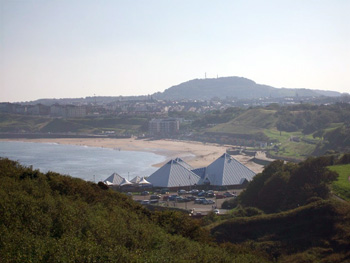
by Marc Latham
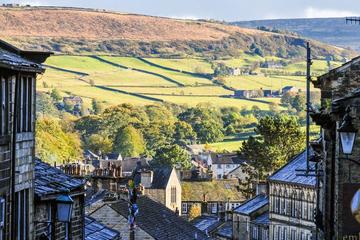
The terracotta roofs and gleaming walls of Robin Hood’s Bay buildings have always been a welcome sight, whichever way I’ve arrived. So I could relate to the four middle-aged male-hiker characters in the film, Downhill, who were finishing their 190-mile west to east Coast to Coast ramble from Saint Bees in Cumbria by walking down to the sea on vertiginous cobbled roads running parallel to streams flowing under flowering gardens, wooden bridges and atmospheric alleys.
I have walked down the hill from the north and inland, but the closest I have so far felt to emulating the Downhill hikers is by walking part of another trek; the Cleveland Way; from Scarborough in the south. It is a thirteen miles section of a 109 miles trek that mostly runs parallel with the North Sea. The walk is mostly flat, walking along countryside coastal paths, but occasionally it dips down to the beach. At Boggin Hole the cove is lined with trees, making it particularly picturesque.
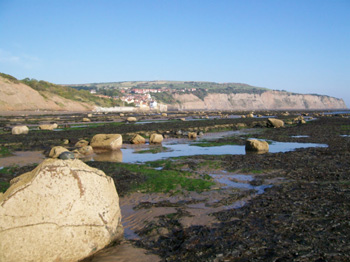
 Arriving from the south, Robin Hood’s Bay is visible miles away; from a jutting limestone headland just past Ravenscar, one of a few villages on the walk. The approach to Robin Hood’s Bay at low tide is on a long stretch of sandy beach, with some rocks and pools along the way. The sea covers most of the beach at high tide; reuniting with the high cliffs in the evening like a blanket being tucked between bed and wall.
It is called Yorkshire’s Jurassic Coast, due to the high amount of fossils found in the area. Ammonites that lived 200 million years ago are commonly found, and occasionally the bones of marine reptiles from that era. Human artefacts have been found in the area from about 9,000 years ago. Star Carr, five miles south of Scarborough, is the best Mesolithic site in Britain, due to its boggy ground preserving artefacts usually lost elsewhere. Only stone tools usually survive from that time, but at Star Carr they have found twenty-one deer-head headwear and 200 antler spears. Romans, Angles and Vikings all landed and built settlements in the region, before it became part of newly created Yorkshire after the mid-11th century Norman Conquest.
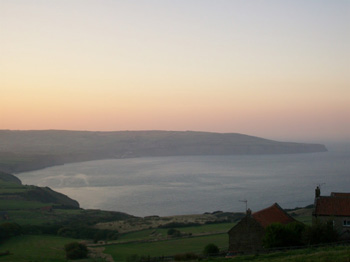 The age of Robin Hood’s Bay is unknown, as it was a thriving village of fifty cottages when first recorded in 1540 by Leland, King Henry VIII’s topographer. In the following century it was recorded on Dutch sea charts, which omitted Whitby; RHB’s now much larger northern neighbour. The origins of RHB’s name are also unclear, with no recorded reference to the famous outlaw of Sherwood Forest. That legend did become popular in the 15th century though, with the first recorded ballad dated to 1450, around the same time that the Yorkshire village was thought to be growing. If Robin Hood was the John Lennon of his time, then it seems likely that people would want to name things after him. However, the local history society believe it is more likely that the name derived from ancient woodland spirits, such as Robin Goodfellow, who preceded the now more famous Medieval rebel, and may have played a part in creating the green Sherwood Forest legend, rather than Hood influencing other contemporary things.


 The area does seem to have thrived on independence from outside control and taxes, as the legendary Robin Hood did, with the local history society writing there is no doubt that Robin Hood’s Bay was the busiest smuggling village on the Yorkshire coast by the 18th century. That coastal culture was made famous in the Poldark books
 Smuggling was not the only activity dividing village and rulers, as on the other side there was something that looks even more evil in history: Press Gangs were sent into villages such as Robin Hood’s Bay to find and kidnap men for the Royal Navy. Those pressed into service were unlikely to return. It is easy to imagine the drama of the 18th century in the compact steep closely-knit village that still structurally exists, with contraband passed through windows from harbour to hilltop without touching the ground; or the women banging drums when Press Gangs were spotted, and the men running to hide.
While the Downhill end scene showed the harbour and Bay Hotel beer garden it missed the rest of the village, where bookshops and haberdasheries share the seafront approach with ancient pubs such as Ye Dolphin and The Laurel Inn. At the top of the village, The Victoria Hotel provides excellent views of the bay.
 When I finished my walk from Scarborough I had to find the campsite a couple of miles farther north of the village. After stopping to take too many photos it was totally dark by then, but I was compensated by a clear night providing an amazing countryside view of the sky, after becoming used to inner city light pollution skies. Looking upwards at regular intervals for long periods of time delayed me further, but as Downhill showed, it’s not all about keeping to time, but what you see and learn along the way.
Last year, alerted by the Coast documentary series, I thought Staithes looked similar to Robin Hood’s Bay, so travelled up there on the last sunny warm day of the year. I took a bus from Leeds to Whitby, and a local bus from there. I was not disappointed, and felt a sense of deja vu walking down the hill to the harbour. Unfortunately, I didn’t have time to lunch at the Cod and Lobster after crossing over the Roxby Beck bridge to the harbour.
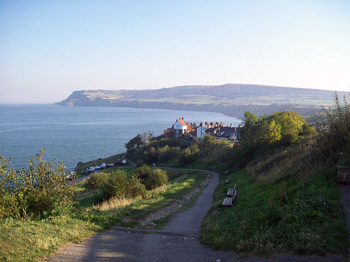 Instead, I walked back to Whitby, completing another section of the Cleveland Way. Staithes is ten miles above the town famous for Dracula’s fictional landing in England, while Robin Hood’s Bay is five miles below. As with my walk from Scarborough, I took too many photos and made slower progress than planned. Thankfully, I reached Whitby fifteen minutes before the last bus back to Leeds.


If You Go:
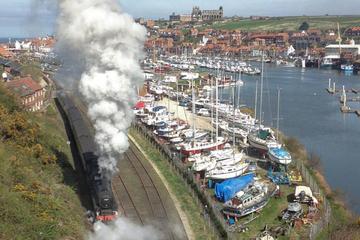
Robin Hood Bay, Whitby and the North York Moors
About the author:
Marc Latham traveled to all the populated continents during his twenties. He studied during his thirties, including a BA in History, and spent his forties creative writing. He lives in Leeds, writing from the www.greenygrey3.com website. He has had a Magnificent Seven books published, most recently completing a trilogy of comedy fantasy travel by web maps and information. The blogged book’s theme might have inspired the return of the X Files. The Truth is Out There and all that, and the books are available on Amazon and other bookstores.
All photos are by Marc Latham:
Leaving Scarborough to the north on Cleveland Way
Cleveland Way sign
Robin Hood’s Bay first sighted from the south
Robin Hood’s Bay arriving from the south
Streams and narrow houses
Interesting seaside
Robin Hood’s Bay from the north
 Ilkley is a picturesque town in the Wharfe Valley, with the Wharfe river on its eastern side, and a rock plateau rising above the western. The latter is known as Ilkley Moor, and is the subject of Yorkshire’s unofficial anthem, On Ilkla Moor Baht ‘at. The song is about a man courting a woman while questioning her decision to walk on the moor without a hat – bar hat. The first published version of the song dates from 1916, so it is a century old this year; although it is thought to have been sung as a folk song for a couple of generations before being written down. The Cow and Calf rocks on the southern edge of the moor are popular landmarks, as well as providing small sheer cliff-faces to climb.
 That era was brought to an end about 2000 years ago, when a large local force known as the Brigantes fought with the Romans in the area. The Brigantes are thought to have been a conglomeration of smaller tribes, and the unified organisation of the Romans meant they subdued the local warriors, although there were constant rebellions against the occupiers. There is evidence of a Roman fort in Ilkley dated to about AD 80, although the town has been built around it. Ilkley became a popular spa town in the nineteenth century, and Victorian architecture still provides a window into that world.
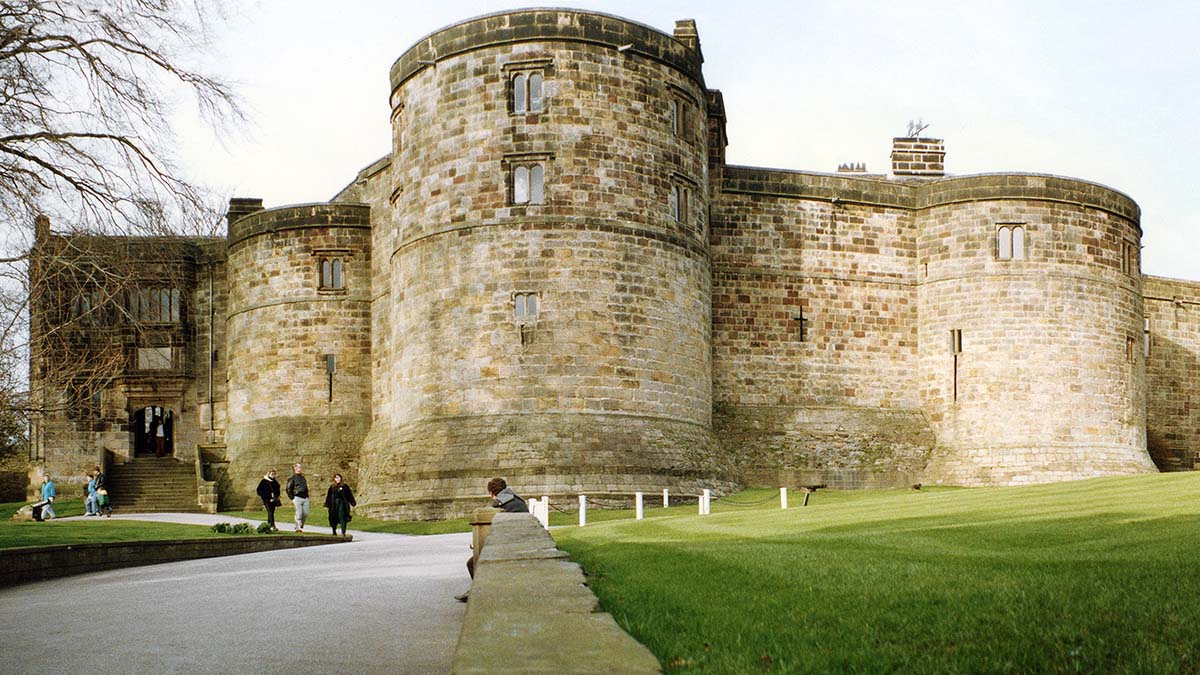
 Skipton Castle was built in 1090 by Normans who had recently defeated Anglo-Saxon King Harold at the Battle of Hastings in 1066. Hastings is in the south of England, and one of the reasons for Harold’s defeat is that many in his army had only just returned from defeating a Viking invasion led by Harald Hardrada and Tostig in the east Yorkshire Battle of Stamford Bridge.
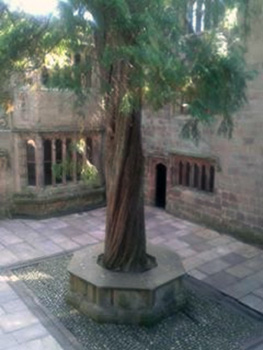 The last Clifford, Lady Anne, planted the yew tree that still stands in the Tudor-era Conduit courtyard. It is a fine sight on a sunny summer day, with its greenery rising high enough atop a twisting trunk to feel the warmth of sky above the castle walls.

 Skipton is the local gateway to the Yorkshire Dales National Park, with buses weaving out from the town along country lanes to picturesque stone-built villages. A few miles from Skipton is Malham. The small village is famous for its 260-feet high limestone cove and paving, which was the setting for a scene in Harry Potter and The Deathly Hallows Part 1.
 There is evidence of 4000-year-old buildings on Ingleborough, and the second part of its name derives from burh, an Old English word for a fortified place. It has been assumed for years that it was a hillfort village, but an information board on one of its paths advises that a newer theory argues it could have been a special location for spiritual occasions, like Stonehenge in the south.
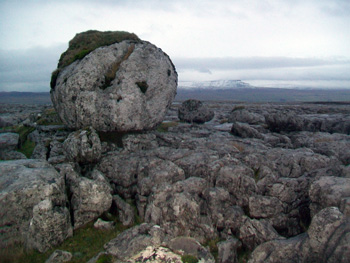
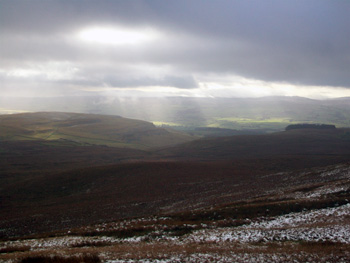
 Renowned hiker and writer Alfred Wainwright considered the hike around Ingleborough from Clapham to Horton-in-Ribblesdale his favourite in the Yorkshire Dales. The last time I looked in that direction, crepuscular rays fell from thick clouds over the valley in the distance, while snow brightened the foreground fields. Limestone pavements decorate large areas of greenery, with lonely hawthorn and rowan trees, or big boulders, sometimes ornamenting them.

 Photo credits:
 by John Thomson
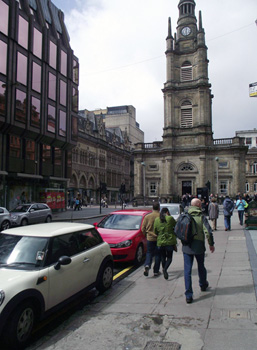 I’m in Glasgow visiting relatives, recalled to the city by blood ties and circumstance. Glasgow is Scotland’s largest city, a little shabby in parts I must admit, its once busy dockyards replaced by a shopping mall, an amusement centre and a transportation museum. Thankfully, many of Glasgow’s magnificent sandstone buildings remain intact, a reminder of its better days when the city was flush with pride and Scottish architect Charles Rennie Mackintosh was at the top of his game. The Mackintosh story, like the city itself, is a bittersweet tale of success, decline and ultimate redemption. Not familiar with the name? You’ll recognize his furniture. His straight, high-backed chairs are cultural icons often associated with the British Arts and Crafts movement and although I’m not a fan of his chairs – too rigid for me – I have to acknowledge their importance.
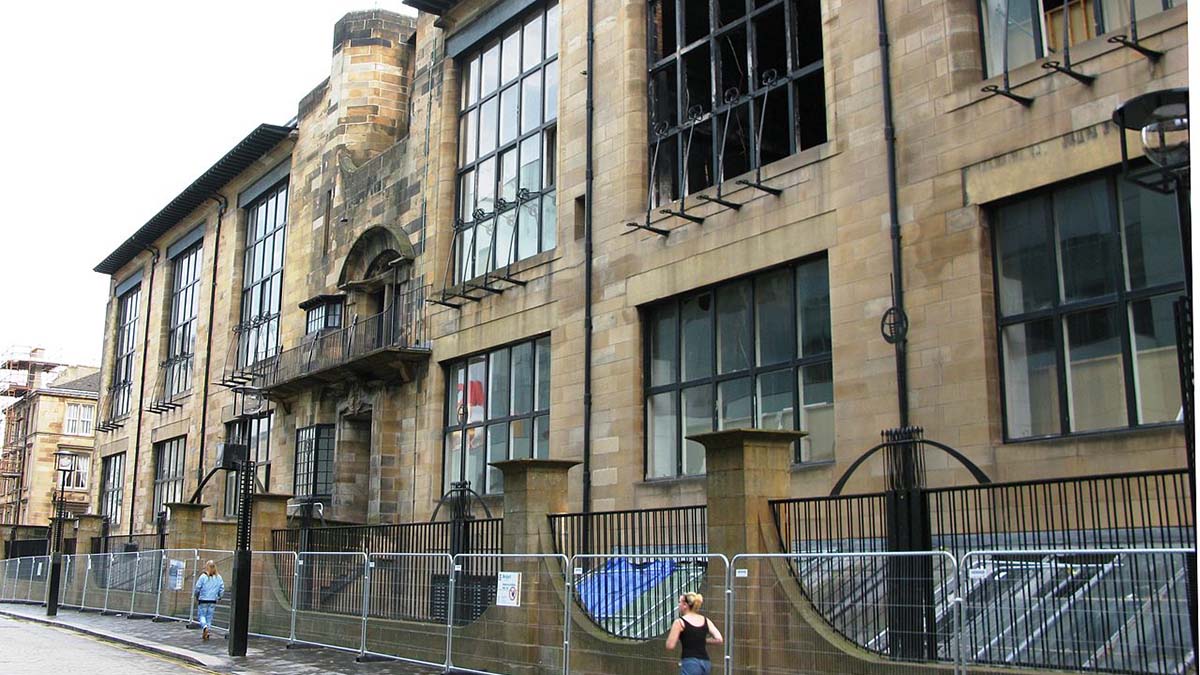
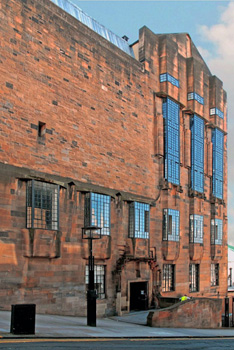
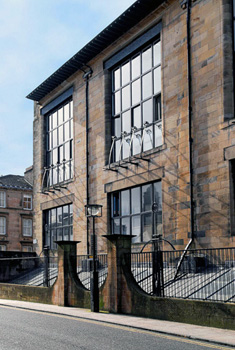
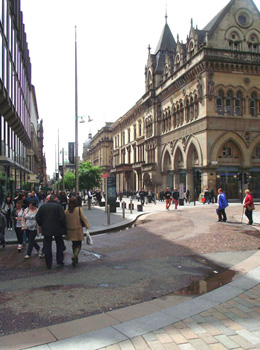 I start my Glasgow tour on Sauchiehall (pronounced Sock-ee-hall) Street and work my way west. Glasgow converted its two main downtown thoroughfares, Buchanan and Sauchiehall Streets into pedestrian malls years ago and getting around the central core is a pedestrian’s dream. A gentle rain sprinkles the pavement but as soon as it starts, it stops. I’m barely wet. I climb Scott Street to the Glasgow School of Art considered the pinnacle of Mackintosh’s architectural career. Completed in 1909, it’s an imposing structure with a domineering command of its surroundings. It reminds me of a fortress. The western wall is tight and dense with narrow loopholes from which I imagine the inhabitants, if they were medieval archers, could shoot arrows if the city were under siege. The northern wall on the other hand has lots of large windows giving it an airy feel and letting in lots of light too. After all, this is an art school. Form follows function.

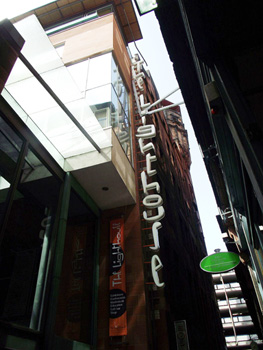
 Mackintosh was not only an architect but a designer too and the original Willow Tea Room on Sauchiehall is a prime example of his handiwork. Recruited by local businesswoman and teetotaller Catherine Cranston in 1896 to dress up her establishments, Mack designed everything – tables, chairs, room dividers, wall decorations, napkins and cutlery. The Tea Room, one of two in the city, has been preserved as a Mackintosh museum with the original stained glass door and replica furniture and yes, they still serve tea. Angularity is the prevailing theme – there are those high backed chairs again – and everything conforms to Mackintosh’s singular, unifying concept.
 I get off at the Kelvinhall stop and walk to the Hunterian Art Gallery on the grounds of the University of Glasgow. Mack’s 1906 residence or at least parts of it – the hall, dining room, living room and the main bedroom – have been moved from their original location and reassembled here for public display. It’s breathtaking in its simplicity. Mackintosh and Margaret have designed everything themselves right down to the fireplace decorations. They even knocked down interior walls to create more space, a radical innovation at the turn of the nineteenth century. Sunlight bounces off the stark white walls accentuating the open plan. The angular motif that I first saw at the Willow Tea Room, lots of right angles and variations on the square, is repeated in the floor, the furniture and the wall decorations. Everything is co-ordinated. A bit too co-ordinated. I feel like I’m in a museum piece, which of course I am, and long for the remains of a half-eaten breakfast on the dining room table or a pile of dirty clothes at the foot of those oh-so-perfect matching beds. I wonder if Mack and his wife ever felt the same way. Probably not. I have to admit the duo were ahead of their time though. Their turn-of-the-century digs look like they belonged in the 1930’s.
 I learn that young Mackintosh was quite the celebrity when he completed the Glasgow School of Art in 1909 but when he left his employers, Honeyman and Keppie, to strike out on his own, tastes changed and his business faltered. He and his wife Margaret retreated to London to concentrate on textile design. And when that didn’t pan out the couple eventually retired to southern France where Mackintosh renounced architecture entirely and spent the rest of his life painting watercolours.
 Today he’s Glasgow’s favorite son and the city isn’t shy about promoting him. He’s been immortalized, idolized and commercialized. It’s impossible to leave Glasgow without hearing his name, his handiwork or for that matter, a Mackintosh souvenir. One can’t have too many coffee mugs.
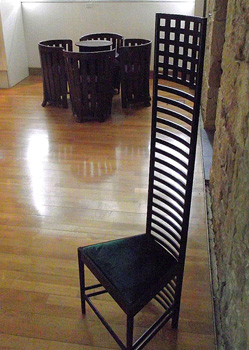 As I board the plane to return home, I ponder the Mackintosh phenomenon. Yes, his buildings are stunning. Built to withstand the Scottish climate, they’re solid, substantial structures in contrast to those flouncy neo-classical buildings in vogue at the time. Scholars have called the style Scottish Baronial, tying Mackintosh and his ideas to the Scottish Renaissance of the early twentieth century when there was a creative surge in Scottish arts and letters. Perhaps he deserves his fame because he stripped away superfluous decoration in favour of detail that complemented the building’s integrity, paving the way for Modernism. Perhaps it’s because he involved himself in total design – integrating architecture with wall treatments, light fixtures and furniture. Mack pre-dated future “starchitects” like Frank Gehry by decades. Perhaps it’s all of these things, a combination of accomplishments both historic and aesthetic.

 About the author:
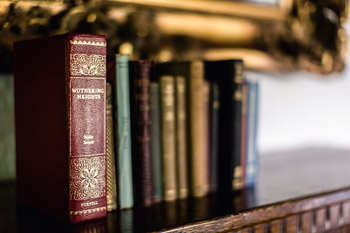 If you love Wuthering Heights devoutly, the words “bed and breakfast” can inspire fear. Would the broad beamed ceilings and mossy walls be protected, or would they be swallowed up into an upscale conversion? Bronte’s “Thrushcross Grange”, or as it is known in reality, Ponden Hall, is exactly as its hero and heroine would have it.
 “Don’t worry, I’ll take your bags,” he said as he stepped out the front door. I ushered my daughter into the long, narrow hallway lined with wellies and jackets. It is still a family home. We entered the sitting room to the right and met the home’s other half- Julie Akhurst, a warm and inviting hostess bearing tea and cookies.
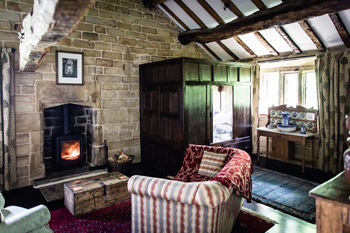 We were upgraded you to the Heaton Room, the first of many kindnesses Our room was as if a home of its own. Two twin beds were at opposite ends of the room while a large four-poster graced the interior wall. Stephen had built a warm fire in the hearth in front of the chairs and sofa, and the ceiling reached up to a height that made the room grander than a suite. It was quiet enough to hear the cows chewing the grass outside our window, and when we went to bed, a slight wind rattled the windows occasionally, but seemed to promise calm.
 Despite the protective comfort of our warm duvets, we eagerly came down for traditional British breakfast. The Akhurst-Brown family invited us to join them at dinner because it would be late for us to take a taxi to the local pub the previous night and Julie proved she is an excellent cook with a delicious squash soup. Julie came in and out of the kitchen juices, fresh eggs, and warm homemade bread. Stephen pulled two large pillows in front of the stone fireplace so my daughter could sprawl out on the stone floors and watch cartoons. Listening to the family move behind us in the daily lives added more warmth to the room, aside from their heated stone floors and their giant Aga stove, than I ever could have imagined. Indeed it felt as if the haunted souls of Wuthering Heights had been set free.

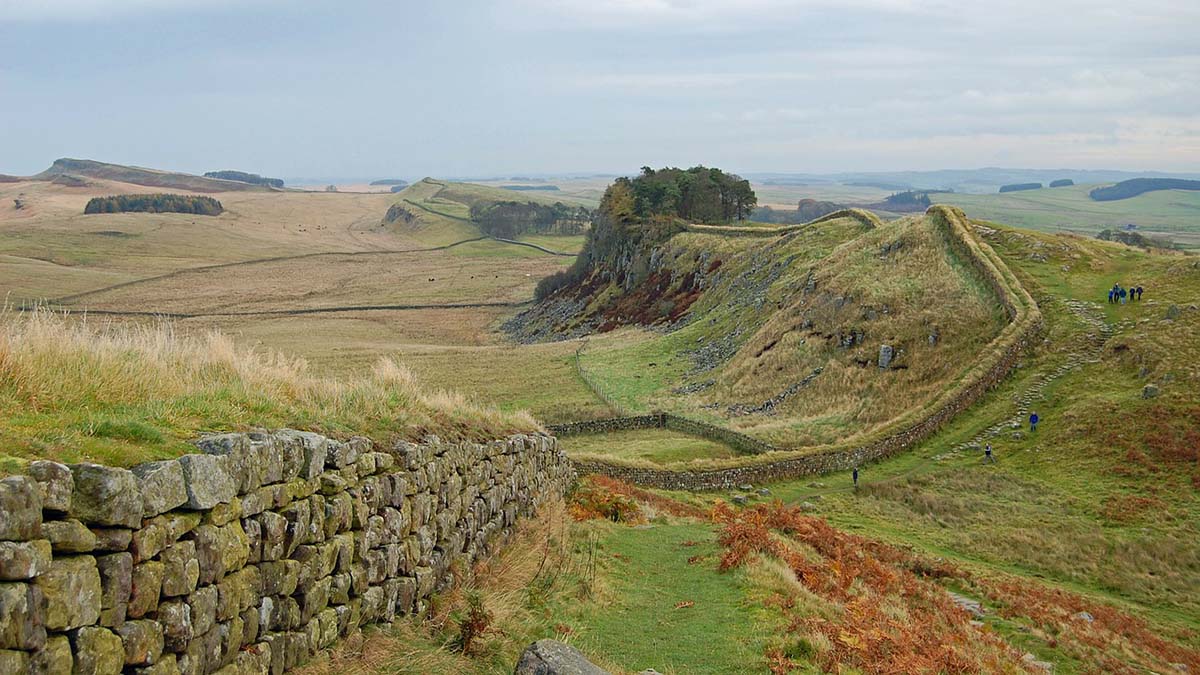


 Stretching eighty miles from the natural beauty of Solway Firth on the west coast to Newcastle in the east, it was built around 124 AD on the orders of Emperor Hadrian. He decided his Empire needed securing and he gave the order to build a wall across the northern frontier. The Wall took six years to complete and it’s thought to have begun as a rampart of earthwork and turf and then later replaced by local stone.
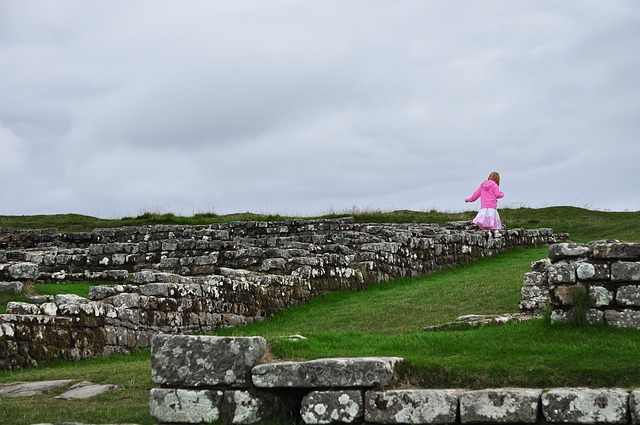 A splendid view of the Wall is seen at Housesteads in Northumberland at a section between Walltown Crags where it undulates for several miles over Whin Still ridge. I loved to ramble on top of the Wall itself where it is eight to ten feet wide and over ten feet high. I would stand alone on one of the Wall’s highest vantage points and look down on some of the most spectacular scenery in England, and immerse myself with thoughts of Roman legions patrolling where my own feet were firmly planted. I could envision them toiling to pull earth, cut turf, and lay stones, hewed, hacked and sawed and placed one by one to strengthen and form this massive barrier their Emperor had ordered.
 When I walked I could envision the Roman soldiers marching to protect this well fortified defence. Forts were built every five miles and small settlements for housing sprang up, well equipped to provide shelter and storage. In this wild outpost of the Roman Empire, amidst the clamour of every tongue and the practice of every cult, the legions gathered together for training, sometimes to meet British tribes on the other side in friendly chatter or more often in deadly strife.
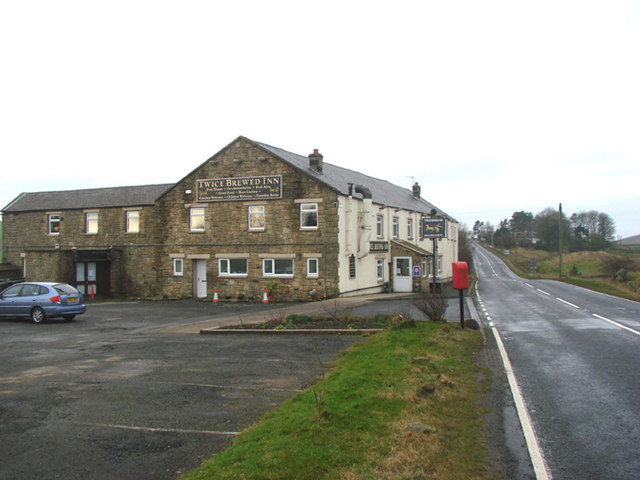 Few facilities existed then and I continued my trudge over undulating hills, past a tiny wood and down a small valley, dotted with grass chewing sheep with the occasional osprey swooping down to grab an unsuspecting field mouse, to the hamlet of Once Brewed where The Twice Brewed Inn served good hearty northern fare. Feet sore, body aching, a hot home cooked meal washed down with a local light ale, and I was in my heaven on earth and I have never found anywhere better. Forgotten was children’s writer Beatrix Potter’s Cumbrian house, Hill Top, where she created her characters Peter Rabbit and Jemima Puddle Duck. It would be seen another day. William Wordsworth, inspired by the same lakes and mountains, could also be remembered another time, and Dove Cottage on Lake Grasmere, where he lived for over fifty years, could be re-visited. But, during my allotted time with Hadrian and his Wall, I had deliberately stayed remote with my thoughts midst Nature’s grandeur and Rome’s remnants from empire building, aware that, just around a corner in a lane in Once Brewed, I had left a car which would transport me down the road back into Yorkshire and family happenings, where tranquility, dreams and contemplation would be put on hold.


_(9452735031).jpg)
