by Elizabeth von Pier
London is noisy and teeming with tourists and horn-honking traffic. Crowds queue up in line or push and shove to see the sights. I spent three weeks there this past summer and, along with everyone else, I visited the usual attractions, queuing up in lines and pushing and shoving. But I also found that not far from the mayhem are lovely little places where you can quietly sit on a shady bench and rest and renew yourself. Here are some of the gems that I discovered.
Japanese and Dutch Gardens in Holland Park
Location: Abbotsbury Road and Holland Walk
Closest Underground: Holland Park, High Street Kensington
Website: www.rbkc.gov.uk/leisure-and-culture/parks/holland-park
Holland Park is a lovely 54-acre park in an elite section of London, a few blocks west of Kensington Palace and Gardens. Stunning Victorian houses and terraces line the streets in this area, and shops, cafes and restaurants cater to an affluent clientele. The park opened in 1952 on what remained of the grounds of Holland House, a large Jacobean mansion dating from the 17th century which had been largely demolished. The northern half of the park is mainly woodland abundant with wildlife (including peacocks), and the southern part is used for sports and recreation.
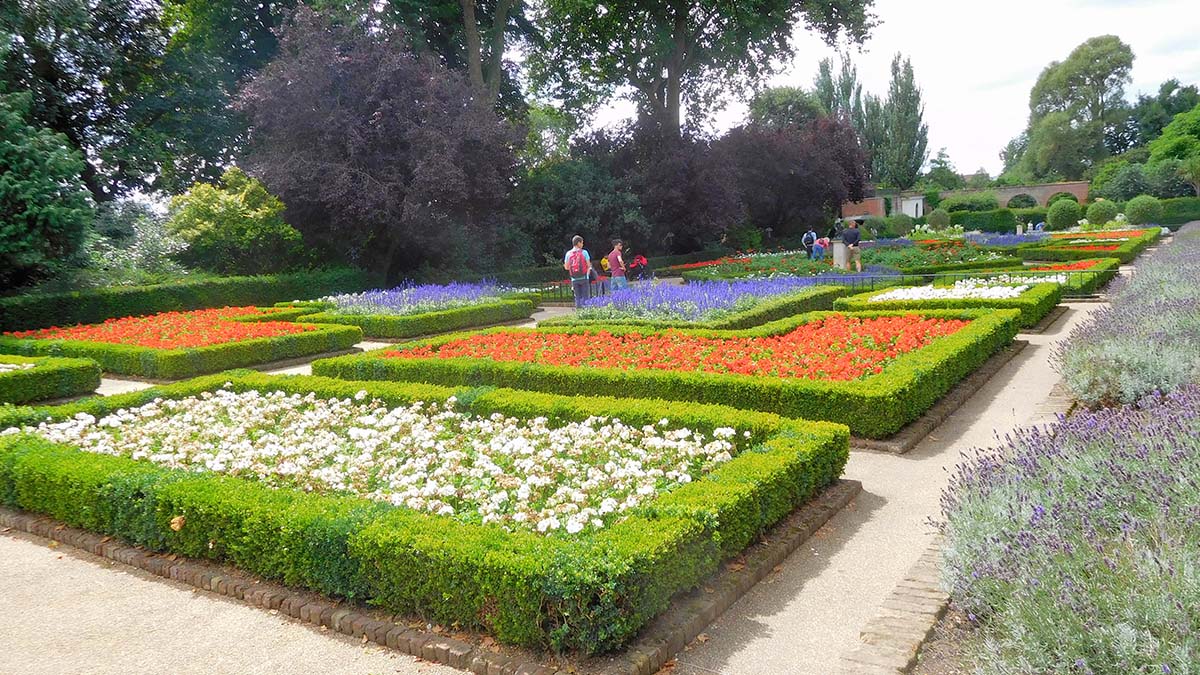
The Japanese and Dutch Gardens are in the central section, surrounding the ruins of Holland House. This is a more formal area and, besides the gardens, includes an orangery now used as an exhibition space and a restaurant where the old ice house and ballroom were located. The Dutch garden was laid out in the 19th century when Holland House was in its heyday as a gathering place for socialites, artists, writers and politicians. It contains formal beds of perennial and annual plantings along with some modern sculpture and grassy areas where people lounge. The Kyoto Garden was donated by the Kyoto Chamber of Commerce for the 1991 London Festival of Japan. It is a magnificent space containing all the elements of a Japanese garden—water, rocks, a bridge, stone lanterns, trees, flowers and fish. Children holding their parents’ hands walk along the stone walkway over the pond, listening to the waterfall up above and fascinated by the koi down below.
 Garden of St. Michael’s Cornhill
Location: Cornhill Street and St. Michael’s Alley in the City borough
Closest Underground: Bank, Monument
Website: st-michaels.org.uk/
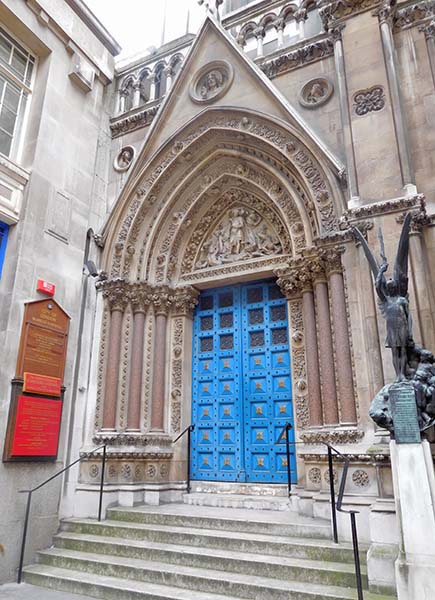
As you walk up Cornhill Street toward Leadenhall Market and Lloyd’s of London, a blue door on an extremely narrow church next to an even narrower alleyway will catch your eye. This is the Parish Church of St. Michael Cornhill and it stands on one of the oldest Christian sites in Britain, dating back to the Roman occupation. The church was destroyed in the Great Fire of 1666 and was rebuilt by Sir Christopher Wren in 1672.
To get to the churchyard, walk down St. Michael’s Alley to the corner, take a left at The Jamaica Wine House and go to the farthest gate. The churchyard is laid out as a garden with lawns, flower beds, shrubs and trees and is an enjoyable place to spend some time on one of the benches or stretched out on the lawn. It is very quiet here, except for the sound of low voices coming from the wine house.


Location: 99 Kensington High Street, entrance on Derry Street
Closest Underground: High Street Kensington
Website: www.virginlimitededition.com/en/the-roof-gardens/the-gardens
Phone 020 7937 7994
 This is an amazing place. It is an event venue so you have to plan your visit according to their schedule. Check their website, which they update weekly, and call before you go. The small effort is well worth it.
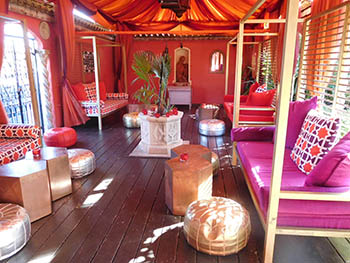
The roof garden was created in the 1930’s on the 6th floor rooftop over Derry & Tom’s department store, now home to many smaller stores. It consists of three lovely themed gardens on one and a half acres. The Spanish garden is small and formal and brings to mind Spain’s Alhambra. It has lovely tiles, arches, wicker sofas and chairs, throw pillows, palm trees, a Moorish sun pavilion and panoramic views over London’s skyline. The brick-walled Tudor garden is made up of three courtyards and vine-covered Tudor-style archways and is often used for weddings. And the English woodland garden has a big variety of trees, a running brook, a giant chess set and a pond stocked with fish. There are over 70 full-size trees up here, families of ducks in the brook, and four resident pink flamingos. Kensington Roof Gardens is a spectacular and extraordinary landmark that has won many awards over the years and you should not miss it.
Millenium Courtyard of Southwark Cathedral
Location: Montague Close
Closest Underground: London Bridge
Website: cathedral.southwark.anglican.org
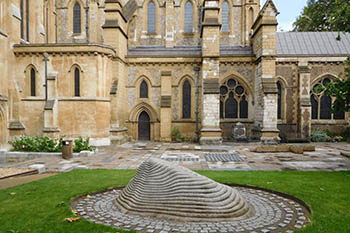 Sitting in the cloister-style courtyard, you are surrounded by lovely grassy areas, benches, trees and shrubs, and a giant chess set. Birds chirp and people talk in low voices. Looking up, you see the spire of a gigantic new building, the Shard, in stark contrast to the architecture of the 15th century church.
The Cathedral is on the south bank of the Thames, close to London Bridge and Borough Market. For over 1,000 years, Christians have worshiped here—it was a convent in 606, a priory in 1106, a parish church in 1540, and a cathedral in 1905. It is the oldest Gothic church building in London and has some exquisite stained glass windows, a 13th century wooden effigy of a knight and a chapel dedicated to John Harvard, founder of Harvard University who was baptized here in 1607. William Shakespeare, Geoffrey Chaucer and Charles Dickens worshiped here, and it is believed that Shakespeare was present when John Harvard was baptized.
Lunchtime Concerts at St. Martin-in-the-Fields
Location: Church of St. Martin-in-the-Fields, Trafalgar Square
Closest Underground: Charing Cross, Leicester Square
Website: www.stmartin-in-the-fields.org/
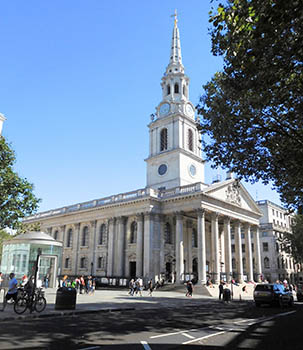 This church is home to The Academy of St. Martin-in-the-Fields, a world renowned chamber orchestra, and three high-quality choral groups. You may be lucky to catch one of their free lunchtime concerts or a rehearsal for an evening concert. Leaving the mayhem of nearby Trafalgar Square, I was there mid-afternoon on a Saturday and delighted in the music coming from a group of talented artists practicing for the Vivaldi concert that night.
There has been a church in this spot since medieval times. The current church was designed by James Gibbs and completed in 1726 in a simple neoclassical style that has been copied throughout North America. The window behind the altar is of a stylized cross and is very unique and controversial. The pipe organ was acquired in 1990 and is considered one of the finest in London, and the acoustics in the church are superb. Handel and Mozart performed here. Downstairs in the crypt is a gift shop and bookstore, a cafe and restaurant, and a brass rubbing center where families can enjoy the Victorian craft. St. Martin’s ministry is committed to social justice, humanitarianism and international issues, and it uses the medium of music to increase appreciation and understanding of other cultures. This church has it all, providing fuel for the mind, the body and the soul.


Location: North of Paddington Station and Regent’s Park
Closest Underground: Warwick Avenue (Little Venice End) and Camden Town
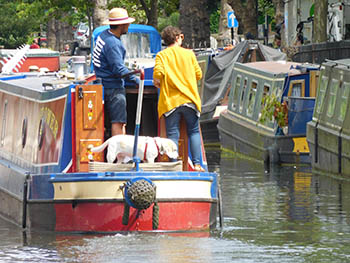 Little Venice is a charming area around Browning’s Pool, a picturesque basin of water where the Grand Union and Regent’s Canals meet. It is an affluent area surrounded by multi-million pound homes. It also is a tranquil and serene place where you can relax at one of the waterside cafes or pubs or just sit on a bench and lazily watch the world go by. Charming houseboats painted in purples, oranges, reds and blues are moored here and a floating cafe is docked at the side of the lagoon.
After taking in picturesque Little Venice, you can stroll Regent’s Canal along a paved walk that follows the canal all the way to Camden Lock and beyond. It is peaceful here, traveled only by the occasional walker and narrow barges that take passengers to destinations north and west of Little Venice.

Private Tour: London Walking Tour
About the author:
Elizabeth von Pier is a retired banker who travels extensively throughout the world. In her retirement, she has written and published articles in travelmag.co.uk, WAVE Journey, Travel Thru History, hackwriters.com, and GoNomad. Ms. von Pier lives in Hingham, Massachusetts.
Photos by Elizabeth von Pier



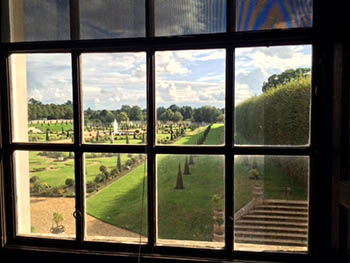
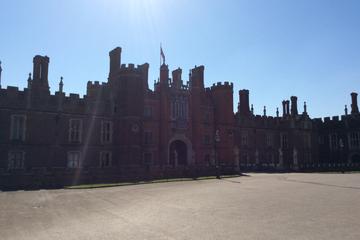


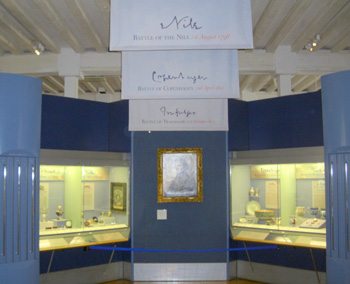
 Nelson was a Royal Navy officer who won a number of naval battles during the Napoleonic Wars. In the Nelson gallery visitors will find artifacts from naval battles such as the Battle of Trafalgar, Battle of the Nile, the Battle of Cape St Vincent and the Battle of Copenhagen. There are a variety of artifacts such as pottery mugs, jugs, vases, pocket watches, porcelain cups and medals from those battles displayed in display cabinets at front of the exhibition.
 Then visitors enter the Sailing Navy exhibition. There, there is a collection of wooden boat models. Among them are models of the HMS Nile, which was a 92 gun sailing battleship that saw active service in the Baltic during the Crimean War, HMS Endeavour and the HMS Kent. An interesting relic displayed in this exhibition is the HMS Conway’s Wheel. That was one of the relics saved from the ship when it went aground in the Menai Straits. Also displayed in this exhibition are Royal Navy swords and guns from the era, and a computer database shows visitors some of the key medals in the museum’s collection.
 After passing through the tunnel, visitors enter the HMS Hear My Story galleries. The galleries include narratives which you can listen to with headphones. Those stories bring you closer than ever before to the real Royal Navy.
 There are a number of display cases within the galleries showing artifacts from numerous battles and wars. Among them are a Battle of Jutland, Battle of Atlantic and Falklands War display cases. The Jutland case displays a silver model of the HMS Iron Duke, a telescope used during the battle and the remains of a German armor-piercing shell fired at the HMS Tiger among other artifacts
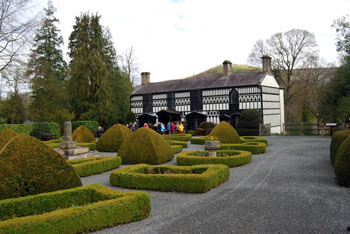
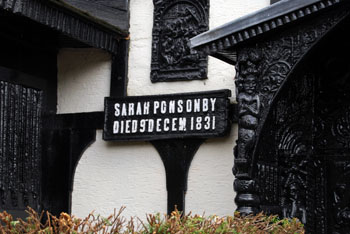 I’d heard the expression ‘Ladies of Llangollen’ before, but wasn’t sure in what context. A girls’ school, maybe? No, they were a pair of women who, back in the 19th Century, were famed far and wide … ‘celebrities’ of the day, if you like. Now, if the ‘Ladies of Llangollen’ lived in this day and age, they would probably be described as ‘offbeat’, eccentric or quirky. That is, if they were noticed at all, for nowadays, it’s accepted that women may take an interest in poetry, literature and politics, and two women living together would hardly raise an eyebrow.

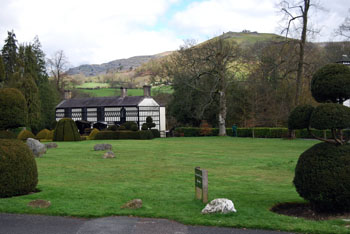
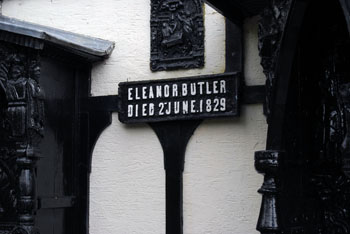 While they wished to lead a life of ‘ … sweet and delicious retirement’, their story attracted a great many visitors, who often stopped by on their way to Snowdonia or Ireland, and their fame rapidly spread. Their visitors included Robert Southey, Sir Walter Scott, Josiah Wedgewood Sir Humphrey Davy and the Duke of Wellington. William Wordsworth also came, and wrote a poem describing Plas Newydd as ‘ … a low roofed cot’ …’ which, reportedly, didn’t find much favour with the ladies, who declared they could write better poetry themselves.

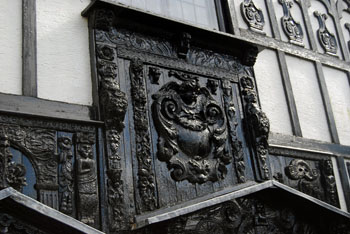 The house is laid out pretty well as the ladies would have known it, with many memorabilia of their famed visitors. But, what most visitors notice above all is the intricate wood carvings, which the ladies collected, and embellished both the interior and the exterior of the house. ‘Low roofed cot’ it may have been originally, but their constant additions made it well worth the visiting. But, it’s not all down to the Ladies. After their deaths, subsequent owners added their own embellishments. The gardens, although started by the Ladies, owe their present form to a Mr G.H. Robertson, who lived there in the 1890s.

 In search of peace and quiet, I traveled there at Easter, but of course any time of year is good. I stayed with my family in a little stone cottage outside the town of Dolgellau. The cottage was the first source of delight. It was converted from an old 16th century farm building, and although it has been fitted up with modern conveniences – there is no way I would stay anywhere without electricity! – it has kept much of the original character of the place.
 The cottage was in a beautiful setting, with simply marvelous views – who can beat the majestic sight of a mountain rising in the distance?
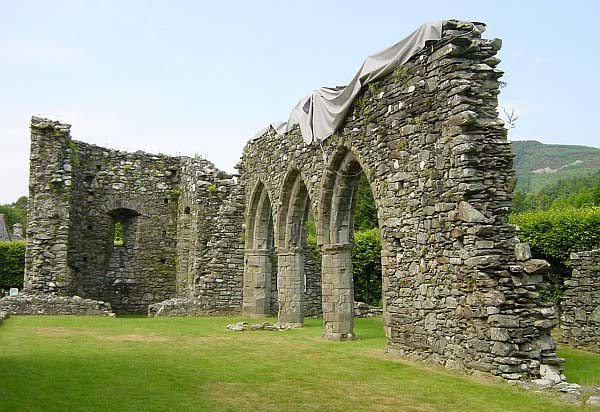
 We were determined to experience something of the long history of the town, starting with a visit to the great ruined arches of Cymer Abbey, [TOP PHOTO] founded there in 1198. It was a bit of a walk from the town, around two miles, but we had set off early and had plenty of time, so since it was a lovely day, off we went. It was very interesting to see the sight. The abbey remains are quite substantial, and it is easy to picture in the mind’s eye how it might once have been.
 Back at Dolgellau, we were in the mood for a traditional tea, and we found just the place. A lovely little tea shop that used to be an ironmongery, with many of the old fixtures and fittings retained. A perfect setting for our traditional cream tea with home baked scones, local blackberry jam and a hot pot of tea. Who could ask for more?
 After a couple of days spent in Dolgellau, we decided to change direction. Off we went to Blaenau and the unexpected treat of its steam railway. This was a matter of half an hour’s drive from where we were staying, and we were glad that we had hired a car for a few days, as it was well worth it. Blaenau is another historical town, but of another sort. This was the site of the famous slate mines that sent slate all around the world. Today it is a pretty little town, also with its share of tea shops. Don’t be surprised if the language you hear spoken around you there is not English, for this is still a stronghold of the Welsh language, the beautiful Celtic tongue spoken in the British isles long before the Germanic tribes first landed, bringing with them the languages that would later evolve into English. Welsh is a very different sort of tongue, soft on the ears and a musical pleasure to listen to.

 Back to our walking the next day, we decided to drive for a couple of miles and start our walk from another spot, to see something different. We were to be well rewarded with the beautiful view of Cregennen Lake. Looking out over the water, it was easy to see how the great myths and legends of our forebears arose. I could well picture a hand rising up through the mist shrouded waters of just such a lake, or imagine water spirits and goddesses of the land.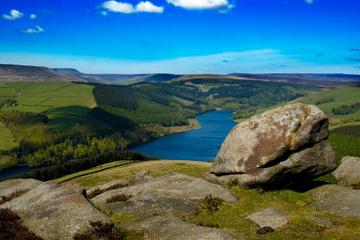

 Photo credits: