Travel Thru History

Historical and cultural travel experiences

  • Home
  • Airfare Deals
  • Get Travel Insurance
  • Writers Guidelines

A Travel Guide to The city of London, Told Through Its History and Its Tables

London is a city that eats its history. If you peel back the layers of glass and steel in the Square Mile, you won’t just find Roman ruins and medieval crypts; you’ll find the remnants of a thousand years of appetites. This isn’t just a place where people trade stocks and dodge red buses. It’s a living, breathing pantry where every cobblestone has a story and every cellar once held something delicious-or dangerous. To truly understand the City of London, you have to follow your nose. From the salty tang of Roman oysters to the caffeinated buzz of the 17th-century coffee houses, the City’s timeline is written on its menus.

If you want to feel the weight of this history without actually becoming a museum exhibit yourself, you start at the heart of it all: the Bank of England. This area is the financial pulse of the world, but it’s also where some of the city’s most grand dining rooms reside. Take 1 Lombard Street, for example. Sitting right across from the Mansion House, this place is a former banking hall that screams “Old City” while whispering “New London.” Beneath its magnificent glass cupola, you can almost hear the ghosts of 19th-century clerks scratching their quills. It captures that essential City vibe-high ceilings, high stakes, and a sense that very important things are happening over very good eggs Benedict. It’s a fixture of the Square Mile’s landscape, a place where the grandeur of the past meets the frantic energy of the present.

Londinium: The Original Street Food Scene

Long before the bankers arrived, the Romans were the ones setting the table. When they founded Londinium around 47 AD, they brought more than just straight roads and bathhouses; they brought a taste for the finer things. Archaeological digs across the City-notably around Leadenhall Market-constantly turn up mountains of oyster shells. For the Romans, oysters weren’t a luxury served with a side of pretense; they were the original street food.

The Roman historian Tacitus described London as a “busy emporium for trade,” and food was the primary currency. You could walk through the forum and smell fermented fish sauce (garum), imported wine from Gaul, and spices that had traveled thousands of miles. The City was built on this trade. Even today, if you look at the street names around the Square Mile-Bread Street, Milk Street, Poultry-you’re looking at a medieval map of the City’s stomach. Each guild had its territory, and each territory had its flavor.

The Great Fire and the Rise of the Caffeine Cult

In 1666, the City effectively reset itself. The Great Fire tore through the timber-framed houses, leaving a charred skeleton in its wake. But like a sourdough starter that’s been fed and left to rise, the City came back stronger. Sir Christopher Wren didn’t just rebuild St. Paul’s Cathedral; he helped define the aesthetics of a new, stone-clad London.

Interestingly, the post-fire era wasn’t fueled by ale alone. This was the age of the coffee house. Places like Lloyd’s and Jonathan’s became the breeding grounds for the modern world. You didn’t just go for a brew; you went to hear the news, trade maritime insurance, or argue about politics. Samuel Pepys, the ultimate Londoner, famously recorded his first taste of “tee (a China drink)” in 1660. By the 1700s, there were more coffee houses in London than in any other city in the world besides Constantinople. They were “penny universities” where anyone with a coin could get an education in the latest gossip.

As the City grew wealthier, the food grew more ambitious. The “London Particular”-a thick pea and ham soup named after the yellow “pea-souper” fogs of the Victorian era-became a staple. It was heavy, comforting, and perfectly suited to a city that was increasingly industrial and soot-stained.

Narrative Dining: When Food Tells a Story

As we move into the middle of this century, London’s culinary identity has shifted again. We’ve moved past the era of bulk-feeding the masses and into an era of “narrative” dining. Today’s chefs aren’t just making dinner; they’re curators of memory.

You can see this shift in how restaurants across the capital-not just in the Square Mile-are obsessed with provenance and personal history. Even if you wander slightly west toward the refined streets of Belgravia, the influence of London’s storytelling tradition is everywhere. A key takeaway is that dining has become an autobiography. At Muse by Tom Aikens, for instance, the menu is literally built on the chef’s childhood memories. Every dish tells a story of a specific moment, a specific person, or a specific ingredient from his past. It’s a far cry from the anonymous “hot pies” cried out in the medieval streets. This trend of storytelling through plates has bled back into the City, where diners now expect to know the name of the farmer who grew their carrots and the exact coordinates where their scallops were dived.

Why do we care so much about the story? Perhaps it’s because, in a city that changes as fast as London, we crave connection. We want to feel that we aren’t just consuming calories, but participating in a legacy. Whether it’s a dish inspired by a Norfolk garden or a cocktail named after a long-lost London alleyway, the narrative is the seasoning.

Markets, Monasteries, and the Meat Trade

If you want to find the raw, visceral heart of the City’s food history, you have to head to Smithfield. This area has been a market for over 800 years. It was a place of “smooth fields” where livestock was traded, but it was also a place of public executions. The juxtaposition of the bloody meat trade and the somber shadow of the gallows is peak London.

The nearby Church of St. Bartholomew the Great, founded in 1123, is the oldest surviving church in London. Walking through its cloisters feels like stepping out of time. The monks here would have brewed their own beer and grown their own herbs, creating a quiet pocket of self-sufficiency amidst the chaos of the livestock market outside.

Today, Smithfield is the last of the great wholesale markets still operating in its historic home. It’s a place of early-morning white coats and the smell of fresh carcasses. But it’s also the site of a modern gastronomic renaissance. Tucked away right next to that ancient church is Restaurant St. Barts. It’s a Michelin-starred temple to British produce that feels utterly at home in this ancient corner of town. The dining room looks out over the cloisters, offering a view that hasn’t changed much in nine centuries. It’s a place where you can eat 15 courses of meticulously sourced British food while contemplating the “ongoing, epic churn of time,” as one critic famously put it. It captures the essence of Smithfield: ancient, unapologetic, and world-class.

The Future of the Square Mile

As we look toward the future of the City of London, it’s clear that the appetite for history isn’t fading. If anything, we’re becoming more obsessed with it. The new skyscrapers-the Cheesegrater, the Walkie-Talkie, the Scalpel-might look futuristic, but at their feet, people are still drinking in pubs that were rebuilt after the fire.

The City is currently undergoing a massive transformation into a “seven-day-a-week” destination. The bankers are still there, sure, but so are the tourists, the foodies, and the history buffs. We are seeing a return to the City as a social hub, much like the coffee houses of the 1700s. The streets are being reclaimed from cars and given back to people who want to walk, talk, and, most importantly, eat.

Notably, the rise of “Green Stars” and sustainable practices shows that London is finally learning to respect its resources as much as its traditions. We are moving toward a circular economy of food, where waste is minimized and localism is king. It’s a modern twist on the medieval guild system, where quality and provenance were the law of the land.

Conclusion

A travel guide to the City of London can never truly be finished because the City itself is never finished. It is a work in progress, a palimpsest where new menus are written over old ones. To visit the City is to join a long line of hungry people. Whether you’re standing in the shadow of the Roman Wall with a snack in hand or sitting in a high-backed chair under a Victorian dome, you are part of the feast.

The beauty of the Square Mile lies in its contrasts. It’s the sound of a high-tech kitchen humming next to a medieval graveyard. It’s the smell of roasted coffee beans in the same alleyway where merchants once traded silk. It’s the ability to find a world-class meal at Restaurant St. Barts just steps away from where ancient monks once sang their vespers.

So, don’t just look up at the skyscrapers. Look down at the pavement. Look through the windows of the basement bistros. Ask where the gin came from and why the soup is called what it’s called. London is a city that rewards the curious and the hungry. It’s a city that has survived fire, plague, and war, and through it all, it never forgot to set the table.


Tagged With: London attractions Filed Under: UK Travel

London: Tracing The Indian Link At Two Venerable Museums

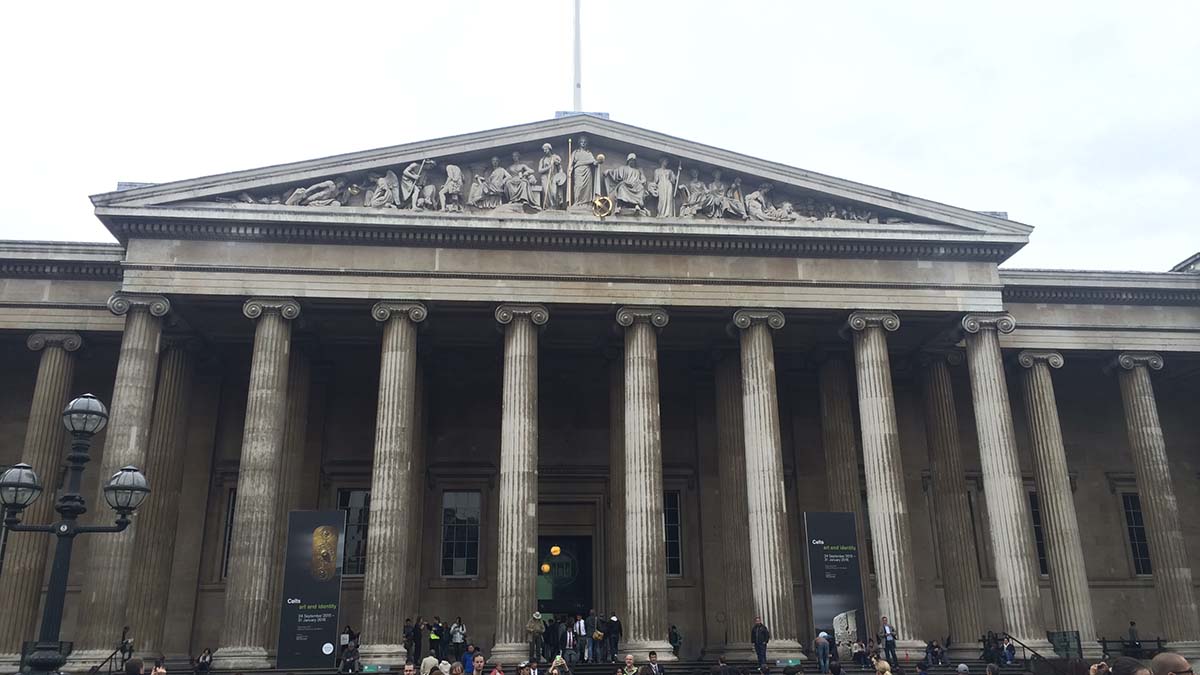
British Museum Exterior

by Susmita Sengupta

London can be called the city of museums, or more correctly, a city well known for offering free admissions to its museums that are home to arguably the world’s greatest collections. As a frequent visitor to this multicultural city, my family and I make it a point to visit and revisit two of the most famous museums of London, namely the British Museum and the Victoria and Albert Museum. These museums hold a treasure trove of South Asian relics and antiquities as a direct consequence of British rule over the Indian subcontinent.

In a recent visit, starting at the British Museum, we decided to bypass the heavy crowds at the Rosetta Stone, the inscribed rock discovered by Napoleon’s soldiers in Egypt, and we walked past the Elgin Marbles from the Acropolis in Greece. I decided to not get tempted by the magnificently detailed carved stone panels from Nineveh or the Assyrian stone sculptures and reliefs from 7th and 8th century BC. On most other visits, these rooms are what would attract me the most, thereby depriving me of the chance to devote time to the galleries related to objects from the Indian sub-continent.

The South Asian collection at the British Museum began with Sir Hans Sloane in the 18th century and continued on with Sir Augustus Franks who used his connections to add to the collection, most notably from Sir Alexander Cunningham, the first Director General of the Archaeological Survey of India appointed in 1871. The ASI was preceded by the Asiatic Society founded by William Jones in 1784 in Kolkata, who started a periodical journal which focused on the antiquarian wealth of India. Thus the 18th and 19th centuries proved to be a ripe period for the British to accumulate South Asian antiquities.

Mathura Lion CapitalThe crowd was sparse in the gallery when we entered compared to the other halls where the world famous artifacts are present. The South Asian objects are in Room 33 and the first thing I saw after walking in was the Mathura Lion Capital from the first century CE. Discovered in 1869 in Mathura, in central India, about 112 miles from New Delhi, the capital belongs to the Indo Scythian period (200BC – 400CE). It is covered with inscriptions in Prakrit, the predecessor of the ancient classical language Sanskrit, using Kharosthi script. The capital also shows the triratana symbol, meaning the Three Jewels, emblematic of the Buddha, his Dharma and the Sangha. This was the first of the many objects present from the rich Buddhist period of ancient Indian history. The museum has an extensive collection of Buddhist figures and reliquaries on display ranging from the ancient to the relatively modern era of 13th century India. A section of the gallery is also devoted to Buddhist objects from Thailand, Sri Lanka, Burma, Japan and China.

However, the prized possession here is certainly the remnants of the Amaravati Stupa, from the 2nd century BC. The region around Amaravati located in South India, was a major Buddhist hub during the Ashokan period. Ashoka the Great, the third Mauryan Emperor (304BC – 232BC), is well known to historians as the king who devoted himself to Buddhism after the human deaths he saw in war. His rule extended from the borders of present day Afghanistan and Iran in the west to the borders of current Bangladesh and Burma to the east. Only the southern tip of India and the country of Sri Lanka was outside his reach along with the state of Kalinga (presently the state of Orissa), located to the south of his capital Pataliputra (now called Patna). Ashoka wanted to conquer Kalinga, and where his illustrious ancestors had failed, he was hugely successful. The Kalinga War of 265BC caused a huge impact on the Emperor. Buddhist texts talk about the morning after the war when he went to review the battleground. He was struck by the carnage he encountered and became a convert to peace. The years after the Kalinga War saw a proliferation in the building of stupas, monasteries, edicts and pillars by Ashoka and he aided in the spread of Buddhism beyond India.

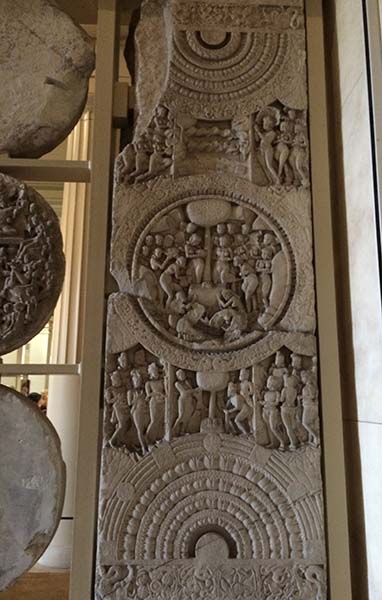
Similar to the Elgin Marbles of the Acropolis, the remnants of the Amaravati Stupa are sometimes known as the Elliot Marbles. I walked into the Amaravati gallery and felt myself being transported to a different, serene world. All around me were intricately sculpted discs, crossbars, slabs and railings stacked and displayed high up almost to the ceiling. I could see beautifully carved limestone discs in shapes of lotus flowers and railings and crossbars carved intricately with worshippers around an empty throne, a symbol of Buddha. There were drum slabs with gorgeous carvings of events in the life of Buddha.

Amaravati StupaThe Amaravati Stupa, also known as a Maha Chaitya or Great Stupa is considered to be the largest stupa in India, even larger than its most famous counterpart, the Sanchi Stupa. While the Sanchi Stupa is a major tourist attraction in India, the Amaravati Stupa suffered a different fate. Evidence has shown that the stupa built during the reign of the Mauryan Emperor Ashoka, remained a major religious site well into the 14th century when Hinduism had become the primary religion in India. Till about 1344 AD, various successive dynasties, helped in building and extending the stupa and its surrounding areas.
After that it fell into disrepair and remained hidden till 1797 when Colonel Colin Mackenzie, a Scottish army officer in the British East India Company made its discovery. He carried out some excavations in 1816 after being appointed the first Surveyor General of India and also made detailed drawings, a folio of which survives at the British Library. Then in 1845, another Scottish officer, Sir Walter Elliot excavated more sculptures from the site and a whole collection of these were sent to the erstwhile India Museum in London. Subsequently, the sculptures were acquired by British museum after the closure of the India Museum in 1879.

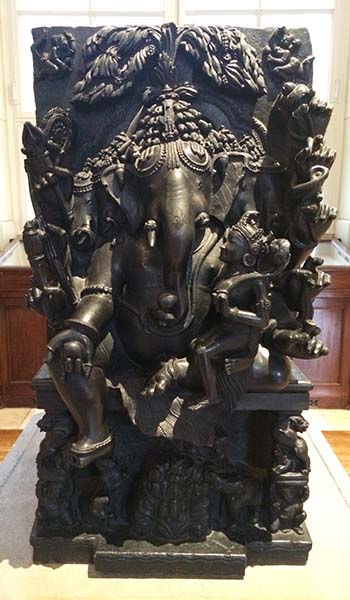
bronze Ganesh statueThe gallery also boasts of a sprawling collection of Hindu bronzes, statues and sculptures known almost misleadingly as the Bridge Collection. I admired the dark, seated stone figure of the Hindu sun god, Surya from 13th century Orissa, part of a group of eye catching sculptures which show the nine planets or the “navagrahas”. My eyes rested on a marvelously carved, seated stone figure of Ganesh, the remover of obstacles, also from the same era, depicted unusually with five heads and ten hands. The entire collection was amassed by Charles “Hindoo” Stuart, an Irish officer in the East India Company, known for his affinity to Hinduism and Indian culture. He collected antiquities mostly from the states of Bengal, Orissa, Bihar and Central India and displayed them at his home in Kolkata. After his death and burial in Kolkata in 1828, his impressive collection was transferred to England where it was sold in auction to John Bridge in 1829-30. Thus the collection was given to the museum in 1872 by the Bridge family heirs.
The next day at the Victoria and Albert Museum, we entered the South Asian galleries, and found ourselves in the era of 16th-19th century India. That is not to say, the V & A does not have ancient Indian artifacts. Here too we saw the statues and relics of Buddhist periods and early Indian dynasties. But the hallmark collection here belongs to the Mughal period (1526-1748), Rajput kingdoms and the Indian rulers defeated thereafter. The spectacular collection also includes textiles, paintings, photographs and myriad objects of decorative arts from all regions of South and Southeast Asia.

The immense collection at this museum has its beginnings in the East India Company’s India Museum, founded in 1798. The V & A, which was known as the South Kensington Museum in the 1800s, received this collection in 1879 but the India Museum was formally integrated and the name abolished only in the 1950s.

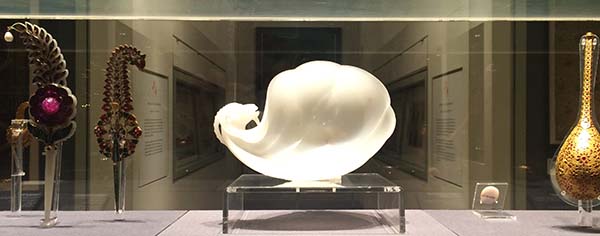
white nephrite jade wine cup of Emperor Shah JahanFrom the era of the Mughal Empire, the white nephrite jade wine cup of Emperor Shah Jahan (1592-1666), builder of the Taj Mahal, caught our attention because of its exquisite craftsmanship. Made in 1657, the cup is a unique example of artistic unity from China, India, Iran and Europe. We moved on to the Akbarnama, the chronicle of Akbar’s reign (1556-1605) by his court historian and biographer Abul Fazal. It is a collection of manuscripts painted in watercolor by royal artists with Persian inscriptions at its bottom. We looked at rooms full of outfits, furniture and everyday living objects belonging to British men and women who lived in India during the Raj. We spent our time reading everything, trying to take it all in.

But we hadn’t yet seen the two most significant holdings of the museum. The first one is the solid gold throne of Maharaja Ranjit Singh, the founder of the Sikh empire who ruled over undivided Punjab that stretched to the borders of Afghanistan from 1799-1839. The throne kept in the Sikh treasury came in to the possession of the British after Punjab was annexed in 1849.

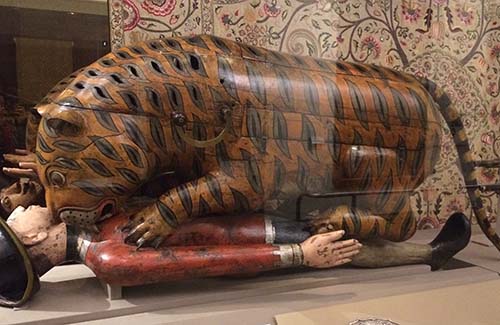
tipu's tigerFollowing this, we walked over to see Tipu’s Tiger. Considered by the museum to be one of its most precious and popular objects, this intriguing musical tiger mauling a red coated European soldier was made for Tipu Sultan, the king of Mysore, sometimes known as the “Tiger of Mysore” in South India. Tipu ruled from 1782 to 1799 and fought three wars against the British East India Company before being finally defeated and killed in his capital, Seringapatam in 1799. His treasury was immediately divided among the Company soldiers and the tiger was first displayed at the India museum in 1808. After the dissolution of the East India Company, this semi-automaton musical instrument was moved to the South Kensington museum, now the V & A and has been on display ever since. I realized that a visit to these two museums can be an enlightening as well as a poignant experience for most Indians.
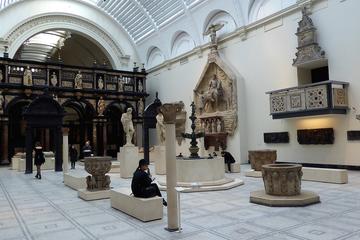

Private Guided Tour of the British Museum in London

from: Viator

If You Go:

British Museum: As per the website, Room 33 is undergoing major renovation and will reopen in Nov. 2017.

Victoria and Albert Museum: Room 41 – The Nehru Gallery


Private Tour: Victoria and Albert Museum

from: Viator

About the author:
Susmita Sengupta is a freelance writer who loves to travel. She and her family have traveled to various parts of the USA, Canada, Europe, the Caribbean, Middle East, Southeast Asia and India. She resides in New York City with her family.

All photos by Susmita Sengupta:
Outside the British Museum
The Mathura Lion Capital
Carved Railing Detail from Amaravati Stupa
An Intricately Carved Sculpture of the Deity Ganesh
Emperor Shah Jahan’s Jade Wine Cup
The Gold Throne of Maharaja Ranjit Singh
The Lacquered and Carved Musical Instrument, Tipu’s Tiger

Tagged With: England travel, London attractions Filed Under: UK Travel

The Best Places To Find Peace And Quiet In London

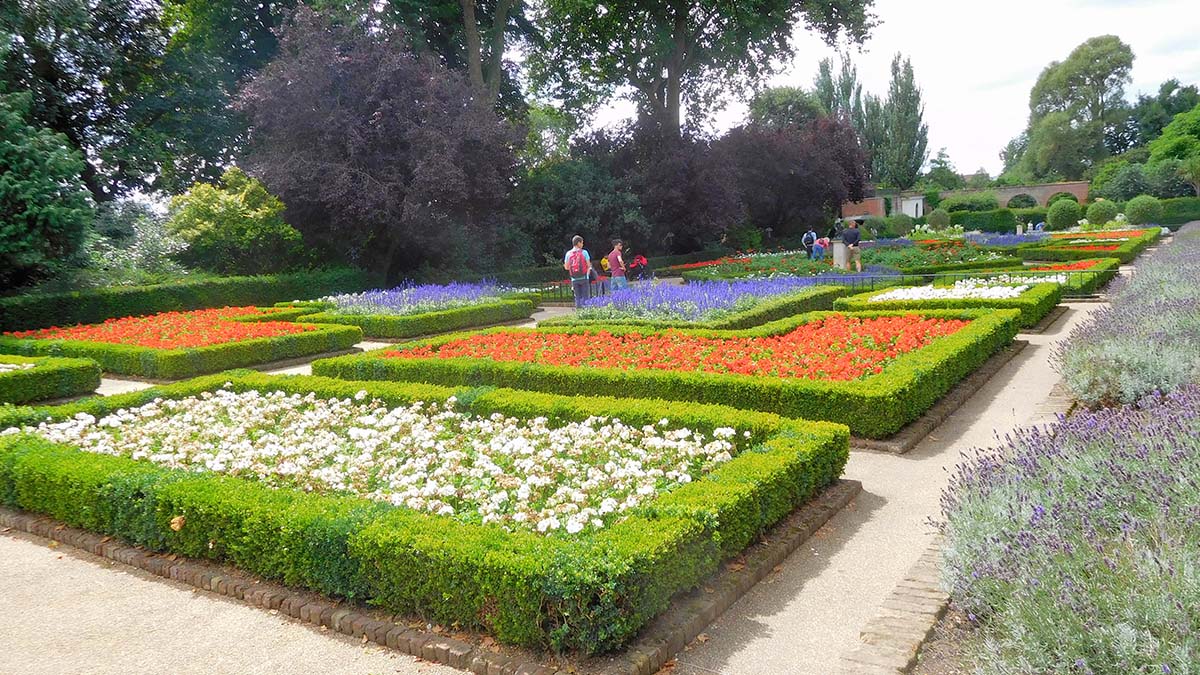
Holland Park Garden, London
by Elizabeth von Pier

London is noisy and teeming with tourists and horn-honking traffic. Crowds queue up in line or push and shove to see the sights. I spent three weeks there this past summer and, along with everyone else, I visited the usual attractions, queuing up in lines and pushing and shoving. But I also found that not far from the mayhem are lovely little places where you can quietly sit on a shady bench and rest and renew yourself. Here are some of the gems that I discovered.

Japanese and Dutch Gardens in Holland Park

Location: Abbotsbury Road and Holland Walk
Closest Underground: Holland Park, High Street Kensington
Website: www.rbkc.gov.uk/leisure-and-culture/parks/holland-park

Holland Park is a lovely 54-acre park in an elite section of London, a few blocks west of Kensington Palace and Gardens. Stunning Victorian houses and terraces line the streets in this area, and shops, cafes and restaurants cater to an affluent clientele. The park opened in 1952 on what remained of the grounds of Holland House, a large Jacobean mansion dating from the 17th century which had been largely demolished. The northern half of the park is mainly woodland abundant with wildlife (including peacocks), and the southern part is used for sports and recreation.

The Japanese and Dutch Gardens are in the central section, surrounding the ruins of Holland House. This is a more formal area and, besides the gardens, includes an orangery now used as an exhibition space and a restaurant where the old ice house and ballroom were located. The Dutch garden was laid out in the 19th century when Holland House was in its heyday as a gathering place for socialites, artists, writers and politicians. It contains formal beds of perennial and annual plantings along with some modern sculpture and grassy areas where people lounge. The Kyoto Garden was donated by the Kyoto Chamber of Commerce for the 1991 London Festival of Japan. It is a magnificent space containing all the elements of a Japanese garden—water, rocks, a bridge, stone lanterns, trees, flowers and fish. Children holding their parents’ hands walk along the stone walkway over the pond, listening to the waterfall up above and fascinated by the koi down below.

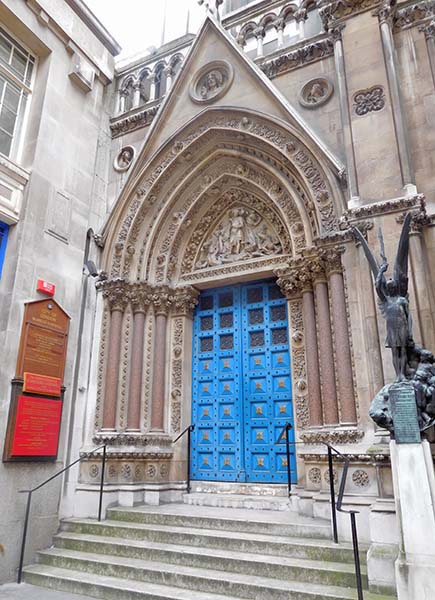
St. Michael’s CornihillGarden of St. Michael’s Cornhill

Location: Cornhill Street and St. Michael’s Alley in the City borough
Closest Underground: Bank, Monument
Website: st-michaels.org.uk/

As you walk up Cornhill Street toward Leadenhall Market and Lloyd’s of London, a blue door on an extremely narrow church next to an even narrower alleyway will catch your eye. This is the Parish Church of St. Michael Cornhill and it stands on one of the oldest Christian sites in Britain, dating back to the Roman occupation. The church was destroyed in the Great Fire of 1666 and was rebuilt by Sir Christopher Wren in 1672.

To get to the churchyard, walk down St. Michael’s Alley to the corner, take a left at The Jamaica Wine House and go to the farthest gate. The churchyard is laid out as a garden with lawns, flower beds, shrubs and trees and is an enjoyable place to spend some time on one of the benches or stretched out on the lawn. It is very quiet here, except for the sound of low voices coming from the wine house.

Kensington Roof Gardens
Location: 99 Kensington High Street, entrance on Derry Street
Closest Underground: High Street Kensington
Website: www.virginlimitededition.com/en/the-roof-gardens/the-gardens
Phone 020 7937 7994

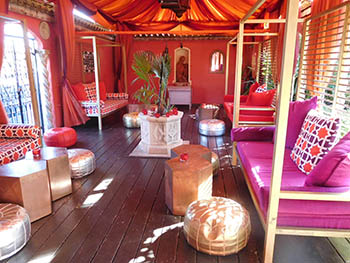
Kensington Roof GardensThis is an amazing place. It is an event venue so you have to plan your visit according to their schedule. Check their website, which they update weekly, and call before you go. The small effort is well worth it.

The roof garden was created in the 1930’s on the 6th floor rooftop over Derry & Tom’s department store, now home to many smaller stores. It consists of three lovely themed gardens on one and a half acres. The Spanish garden is small and formal and brings to mind Spain’s Alhambra. It has lovely tiles, arches, wicker sofas and chairs, throw pillows, palm trees, a Moorish sun pavilion and panoramic views over London’s skyline. The brick-walled Tudor garden is made up of three courtyards and vine-covered Tudor-style archways and is often used for weddings. And the English woodland garden has a big variety of trees, a running brook, a giant chess set and a pond stocked with fish. There are over 70 full-size trees up here, families of ducks in the brook, and four resident pink flamingos. Kensington Roof Gardens is a spectacular and extraordinary landmark that has won many awards over the years and you should not miss it.
Millenium Courtyard of Southwark Cathedral

Location: Montague Close
Closest Underground: London Bridge
Website: cathedral.southwark.anglican.org

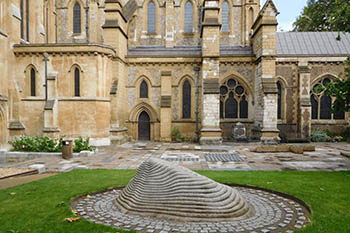
Millenium Courtyard of Southwark CathedralSitting in the cloister-style courtyard, you are surrounded by lovely grassy areas, benches, trees and shrubs, and a giant chess set. Birds chirp and people talk in low voices. Looking up, you see the spire of a gigantic new building, the Shard, in stark contrast to the architecture of the 15th century church.

The Cathedral is on the south bank of the Thames, close to London Bridge and Borough Market. For over 1,000 years, Christians have worshiped here—it was a convent in 606, a priory in 1106, a parish church in 1540, and a cathedral in 1905. It is the oldest Gothic church building in London and has some exquisite stained glass windows, a 13th century wooden effigy of a knight and a chapel dedicated to John Harvard, founder of Harvard University who was baptized here in 1607. William Shakespeare, Geoffrey Chaucer and Charles Dickens worshiped here, and it is believed that Shakespeare was present when John Harvard was baptized.

Lunchtime Concerts at St. Martin-in-the-Fields

Location: Church of St. Martin-in-the-Fields, Trafalgar Square
Closest Underground: Charing Cross, Leicester Square
Website: www.stmartin-in-the-fields.org/

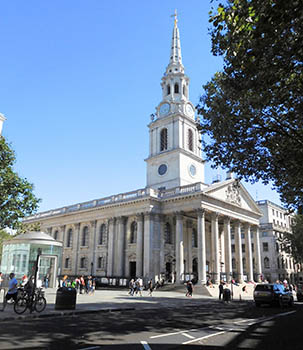
St. Martin-in-the-FieldsThis church is home to The Academy of St. Martin-in-the-Fields, a world renowned chamber orchestra, and three high-quality choral groups. You may be lucky to catch one of their free lunchtime concerts or a rehearsal for an evening concert. Leaving the mayhem of nearby Trafalgar Square, I was there mid-afternoon on a Saturday and delighted in the music coming from a group of talented artists practicing for the Vivaldi concert that night.

There has been a church in this spot since medieval times. The current church was designed by James Gibbs and completed in 1726 in a simple neoclassical style that has been copied throughout North America. The window behind the altar is of a stylized cross and is very unique and controversial. The pipe organ was acquired in 1990 and is considered one of the finest in London, and the acoustics in the church are superb. Handel and Mozart performed here. Downstairs in the crypt is a gift shop and bookstore, a cafe and restaurant, and a brass rubbing center where families can enjoy the Victorian craft. St. Martin’s ministry is committed to social justice, humanitarianism and international issues, and it uses the medium of music to increase appreciation and understanding of other cultures. This church has it all, providing fuel for the mind, the body and the soul.

Little Venice and Regent’s Canal

Location: North of Paddington Station and Regent’s Park
Closest Underground: Warwick Avenue (Little Venice End) and Camden Town

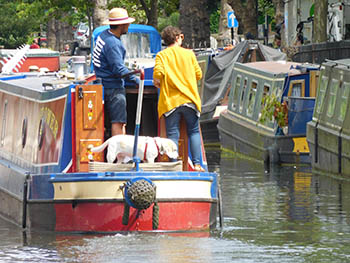
Regent’s Canal Little Venice is a charming area around Browning’s Pool, a picturesque basin of water where the Grand Union and Regent’s Canals meet. It is an affluent area surrounded by multi-million pound homes. It also is a tranquil and serene place where you can relax at one of the waterside cafes or pubs or just sit on a bench and lazily watch the world go by. Charming houseboats painted in purples, oranges, reds and blues are moored here and a floating cafe is docked at the side of the lagoon.

After taking in picturesque Little Venice, you can stroll Regent’s Canal along a paved walk that follows the canal all the way to Camden Lock and beyond. It is peaceful here, traveled only by the occasional walker and narrow barges that take passengers to destinations north and west of Little Venice.


Private Tour: London Walking Tour

About the author:
Elizabeth von Pier is a retired banker who travels extensively throughout the world. In her retirement, she has written and published articles in travelmag.co.uk, WAVE Journey, Travel Thru History, hackwriters.com, and GoNomad. Ms. von Pier lives in Hingham, Massachusetts.

Photos by Elizabeth von Pier

Tagged With: London attractions Filed Under: UK Travel

England: Hampton Court Palace

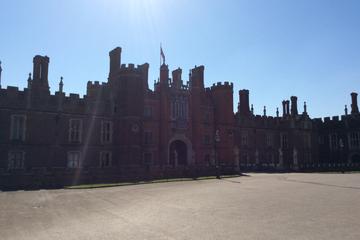
Hampton Court exterior

A Royal Residence Through The Ages

by Susmita Sengupta

Henry the VIII, who has not heard of him? The English monarch who ruled England from 1509 – 1547, is famously known to everyone as the king who had six wives, and forged the path for English Reformation in his quest for marriage to Anne Boleyn. Also known as Henry Tudor, he was born to Henry VII and Elizabeth York, at Greenwich Palace, in Greenwich, London in 1491.

Hampton Court Palace, located in East Molesey, Surrey, is one of the many palaces of King Henry the VIII but only one of the surviving few. This is the place from where the King and his advisers first sent out letters to Rome threatening to break up with the Catholic Church. This is where he married Kateryn Parr, the final Queen Consort. Henry’s son Edward VI was also born here.

But first here are some details about King Henry the VIII and his political and matrimonial saga. After the death of his brother Arthur, at age ten he became Henry VIII, king of England. At the age of seventeen, he married his brother’s widow, Katherine of Aragon, in the year 1509. Katherine and Henry had one surviving child, Mary but Katherine was unable to provide him with a male successor. Henry’s eyes were now on Anne Boleyn, his queen’s lady-in-waiting. In order to marry Anne, Henry in 1527 began seeking annulment of his marriage to Katherine. It was a long struggle as is well documented in history which culminated in Henry marrying Anne in 1533. For this marriage, Henry broke away with the Catholic Church and the Church of England was formed with the king as its head.

Anne became the mother of Elizabeth I who would go on to become one of the greatest monarchs of English history. In 1536, Anne was executed on charges of adultery and conspiracy against the king. Henry then married Jane Seymour who provided the longed for male heir. Edward VI ascended the throne at barely ten years of age and ruled for about six years before he died of illness. Jane Seymour, Edward’s mother died within two weeks of childbirth and Henry after two years, in 1540, married Anne of Cleves. The marriage, a diplomatic effort, did not work out and it was dissolved within six months. She was awarded the title of “The king’s sister”. Henry’s next wife was Catherine Howard, first cousin to Anne Boleyn and lady-in-waiting to Anne of Cleves. This was once again a love match and Henry and Catherine were married that same year soon after the annulment with Anne of Cleves. The King at forty nine was in love with the teenaged Catherine and lavished gifts of jewels and land to her. Catherine Howard suffered the same fate as her cousin Anne Boleyn as she too was executed in 1542 on charges of adultery. The sixth and last wife of Henry VIII, Kateryn Parr, married him in 1543 and outlived the King who died in 1547. Kateryn Parr passed away in 1548.

On a sunny September morning, my family and I boarded a train from London’s Waterloo station to Hampton Court Palace. By the time we reached Hampton Court, the train had emptied out, thereby showing me that not too many tourists traveled to see this palace. It was a short walk from the station to the large, gilded gates of the palace and we arrived at a virtually empty ticket entrance. This was certainly in stark contrast to the crowds at Tower of London and we were happy to be away from the pressure of the heavy tourist areas of the city.

Rose garden at Hampton CourtWe started our visit at the rose garden, also next to which is the kitchen garden. These are but two of the various gardens that cover about sixty acres of landscaped gardens along with about 750 acres of royal parkland. One would need an inordinate amount of time or multiple visits to see all the different garden areas such as The Maze, the Great Vine, the Orangery, the Fountain court gardens to name just a few, all of which would make for a delightful outing for garden enthusiasts. But we were pressed for time and so we decided to focus on the palace instead.

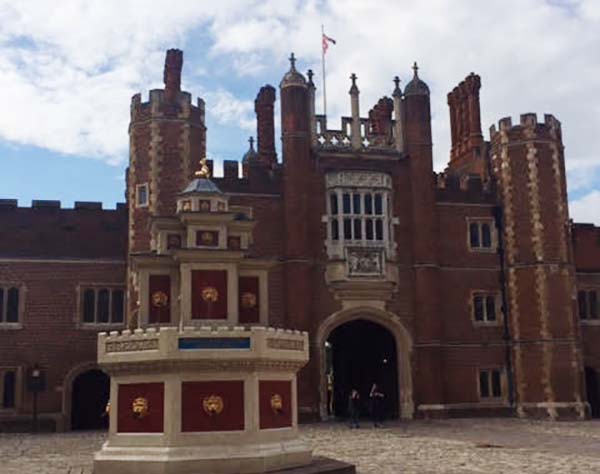
Entrance to Hampton CourtThe Hampton Court Palace which started out as a manor in 1494 was rebuilt in a grand manner by Cardinal Thomas Wolsey, the Lord Chancellor for Henry VIII. The king took over the palace in 1528 after Wolsey fell out of favor with him because of his failure in procuring an annulment of his marriage to Katherine of Aragon. The palace would now become a Tudor royal residence, an impressive edifice with all the hallmarks of Tudor architecture.

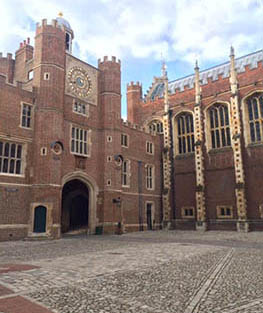
There was the fabulous gatehouse with the still functioning astronomical clock with its Renaissance bas reliefs. I realized that the palace is clearly divided into parts, each highlighting the eras of the different monarchs who occupied it. Therefore, the palace also has a distinct Baroque side as it functioned as home for later Stuart and Georgian rulers.

Great Hall Hampton CourtWe made our way through the Tudor side, stopping to admire the grandeur of Great Hall, impressive with its ornately carved hammer beam roof and walls covered in elaborate, medieval tapestries, a hallmark of English Gothic architecture. This was followed by the Chapel Royal, a truly, magnificent prayer room with its sumptuously gilded blue pendant vaulted ceiling. The chapel, a splendid specimen of the Tudor style also had renovations done 150 years later in the Baroque form by the famed architect Sir Christopher Wren, builder of the magnificent St. Paul’s Cathedral in London. While reading the leaflet about the chapel, I discovered that the altar cross that we were seeing was made by Sir Edwin Lutyens, the architect famous for planning the city of New Delhi in India and also a lot of its buildings.

The kitchens of Henry VIII are the largest such from Tudor England, built by the king to feed his six hundred or so courtiers. There were various rooms filled with mock meat, fish, pies, various kitchen implements and pottery giving us a true picture of the hustle and bustle of everyday kitchen life in medieval England. We finished our tour of the Tudor kitchens after visiting the wine cellar; now better understanding the voracious food habits of Henry VIII and his companions that most of us are familiar with through movies and television shows.

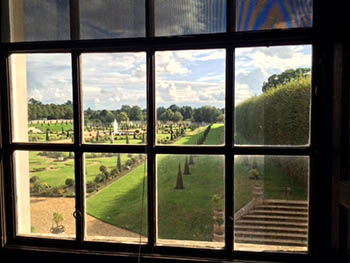
View through window of Privy GardenAfter a bit of a rest, we decided to tackle the Stuart and Georgian portions of the palace. The Stuart sections are associated with the rulers James I (1566 – 1625), Charles I (1600 – 1649) and William III (1650 – 1702) and Mary II (1662 – 1694) the joint monarchs. These are the Baroque sides and the stark difference in the interiors and architecture from the Tudor Perpendicular Gothic style is immediately apparent. I was intrigued to see the difference in the scale between the State Apartments and the Private Apartments of William III. What caught my eye was the spectacularly eye catching display of arms and armors on the walls of the Guard Room. We saw the stunning Privy Gardens from the windows of the Privy Chamber of William III’s State apartments. The Privy Garden is the most accurate restoration of a Baroque garden with its raised terraces, pyramidal topiaries and intricately carved grass turf where the cut out spaces are filled with gravel.

The highlight in the Georgian apartments is the dining room of George I (1660 – 1727) where I first encountered the art of starched linen napkin folding. Folded cloth was turned into folded art depicting animals, trees, architectural shapes and such displayed on dining tables in European courts. Thus this predominantly German art followed the Hanoverian George to England.

Hampton Court Palace turned out to be quite a serene, wonderful trip to discover the lifestyle of Tudor and later England if one wants to spend a few hours away from busy London.


Private Hampton Court Palace Tour from London

If You Go:

Hampton Court Palace is 35 minutes by train from London’s Waterloo station. The palace gates are a short walk away from the station.

Lots more information is available on the palace’s website.

A new addition is the Magic Garden for families which opened in May 2016.

About the author:
Susmita Sengupta is a freelance writer who loves to travel. She and her family have traveled to various parts of the USA, Canada, Europe, the Caribbean, Middle East, Southeast Asia and India. She resides in New York City with her family.

All photos are by Susmita Sengupta:
Cobblestoned palace exterior courtyard
A view of the garden with its beautifully manicured yew trees
The Anne Boleyn Gate with its pre-Copernicus astronomical clock
The Great Hall of Henry VIII
The magnificent Privy Gardens

Tagged With: London attractions Filed Under: UK Travel

Literary London: Virginia Woolf’s Bloomsbury

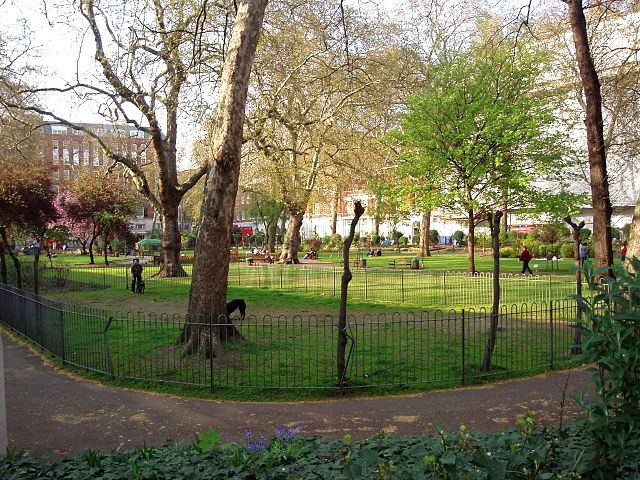
Gordon Square, London

by Lynn Smith

For those people who have a passion for literature, history and London, a London guided walking tour will combine all these interests. There are several such tours available, led by knowledgeable guides, most of whom have been trained by the London Tourist Board. The tours are also reasonably priced.

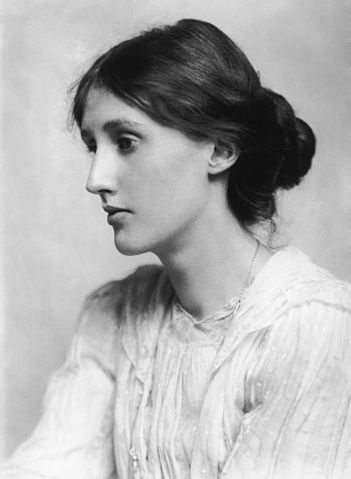
Virginia WoolfSeveral months ago, on a visit to London, I opted to take such a tour and chose the Bloomsbury walking tour as I have always been fascinated by Virginia Woolf and the Bloomsbury group.

I met the tour guide outside Russell Square Underground and we began the two hour walk from there. It was a beautiful summer’s day which allowed us to see the green and pleasant squares at their best.

Bloomsbury is in the Borough of Camden and is bounded on the north by Euston Rd, Gray’s Inn Rd on the east, Tottenham Court Rd on the west and High Holborn on the south side.

The area has a fascinating history. The name Bloomsbury is a corruption of “Blemonde” which was the name of Baron Blemonde, William the Conqueror’s vassal who received the land from William in the 11th century.

In the 18th century, Bloomsbury was open country and was considered to be very healthy. In 1660 the Earl of Southampton built his house there and laid down an attractive square in front of the house. The borough took shape as more aristocrats discovered the area; the Duke of Montague built a stylish house on the site of what is now the British Museum and the great landowning family of the Russells, the Dukes of Bedford, Gordon and Brunswick all built their mansions in the area.

In the 19th century, Bloomsbury lost some of its glamour – trade and industry moved in and the area was no longer considered to be fashionable. The British Museum was erected on its present site in 1823 and London University began in 1827.

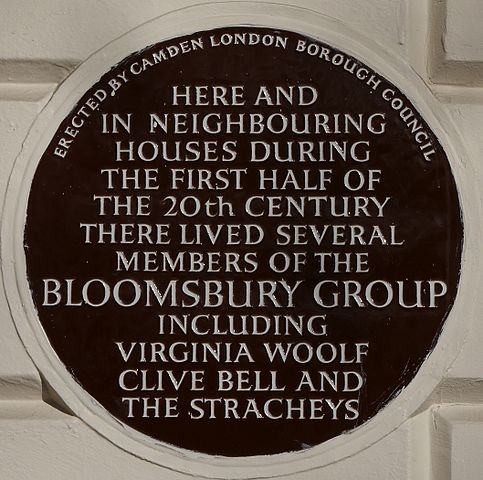
The arrival of the Bloomsbury Group in the early 20th century gave the area its reputation as an intellectual, artistic and somewhat Bohemian area – a reputation which is still considered relevant today.

Virginia Woolf (born Stephen, 1882 – 1941) was the third child of Sir Leslie Stephen and his wife Julia. Virginia’s siblings were Vanessa, Thoby and Adrian. The family lived at 22 Hyde Park Gate, a large house always filled with children, friends and family.

The Stephen children grew up in a literary household – Sir Leslie was a journalist and had a well-stocked library, to which Virginia had unrestricted access.

When she was thirteen, Virginia’s beloved mother died and this traumatic event caused her first mental breakdown; this was followed by another breakdown when her father died in 1904. After Sir Leslie’s death the Stephen children decided to leave Hyde Park Gate (with its unhappy memories) and move to Gordon Square, in the heart of Bloomsbury, just north of the University of London.

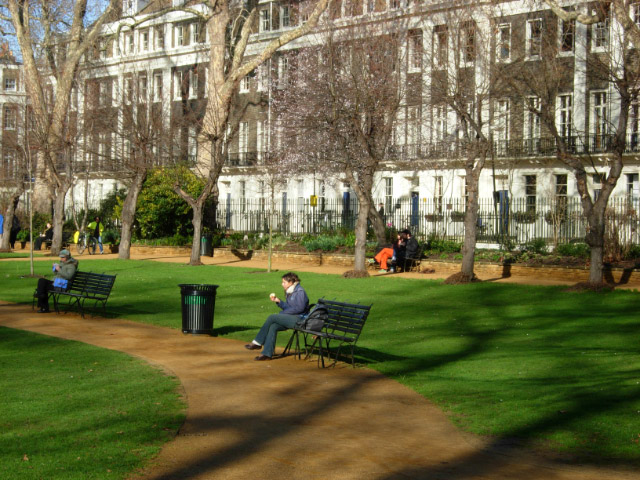
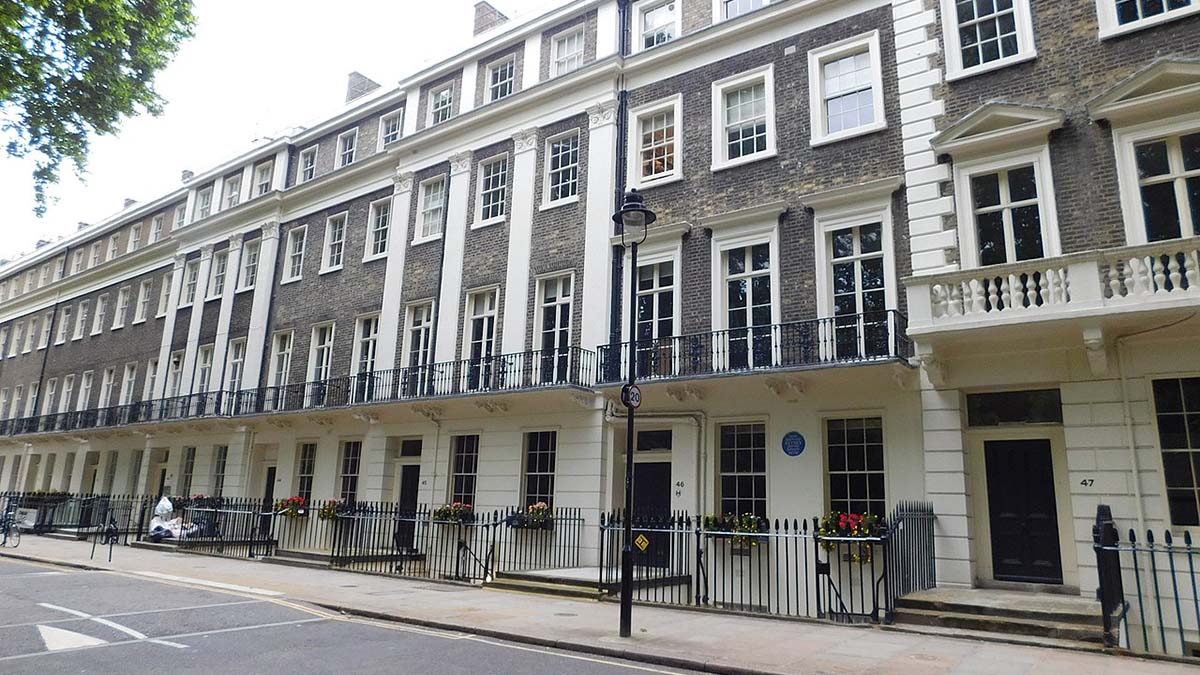
Gordon square parkGordon Square is on the corner of Gordon Rd and Tavistock Place. No. 46, the house the Stephen children moved into, in 1904, was a large, elegant building, fronted by the pretty garden square. The Stephens’uncles and aunts, however, frowned on the move as Gordon Square was not considered a desirable address.

Gordon Square soon became a meeting place for Thoby Stephen’s Cambridge friends. Other visitors were Lytton Strachey, Clive Bell, Duncan Grant and later, Leonard Woolf. Virginia and Vanessa both took part in the lively discussions at these meetings, which could be described as the beginnings of the Bloomsbury Group.

After Thoby’s death from typhoid in 1906 and Vanessa’s marriage to Clive Bell shortly after, Virginia and Adrian left Gordon Square and rented a house at 29 Fitzroy Square.

Fitzroy Square

Although still in the Borough of Camden, Fitzroy Square is not strictly Bloomsbury but Fitzrovia, just further south of Tottenham Court Rd. The area was originally developed to provide houses for the aristocracy and many elegant mansions were erected, designed by Robert Adam. Building began in 1792 and was eventually finished in 1835.

In 1907, when the Stephens moved into 29 Fitzroy Square, the area consisted mainly of offices, workshops and lodging-houses. These unpretentious surroundings suited the brother and sister; they carried on with the Gordon Square intellectual get-togethers and the circle soon grew. An important addition to their gatherings was Lady Ottoline Morrell (1873-1938) – that eccentric and Bohemian patron of the arts, who lived in nearby Bedford Square.

The years at Fitzroy Square were eventful ones for Virginia – her two nephews (Vanessa’s sons) were born in 1908 and 1910 and in 1909 she accepted Lytton Strachey’s proposal of marriage but, by mutual consent, the engagement was cancelled almost immediately.

When the lease of 29 Fitzroy Square came to an end in 1911, Virginia and Adrian leased a four-storey house, No 38 Brunswick Square, which they shared with Maynard Keynes and Duncan Grant. While living in Brunswick Square, Virginia became engaged to Leonard Woolf and they were married on 10 Aug. 1912. The Woolfs went to live in Sussex where Virginia had taken a five-year lease on Asheham House. It was to be another twelve years before Virginia moved back to Bloomsbury.

The intervening years 1912 -1924

During the years that Virginia was living elsewhere, she published four books and had, unfortunately, another serious mental breakdown from which she was slow to recover. The Woolfs moved to Hogarth House in Richmond and in 1917 they bought a hand-press – and so began Hogarth Press; soon they were printing pamphlets, books and slim volumes of poetry, mainly the works of the Bloomsbury Group.

Tavistock SquareIn January 1924 Virginia bought the lease of 52 Tavistock Square and the Woolfs, together with the Hogarth Press, moved into their new premises in March, where the Press was established in the basement. Tavistock Square was part of the Russell family, the Dukes of Bedford’s estate and No 52 was a typical terraced house.

The years spent at Tavistock Square were Virginia’s most productive and she became much sought after as a guest speaker at various prestigious universities.

Today, Tavistock Square is surrounded by a number of famous buildings, all of which are worth investigating. The Square was also the scene of the suicide bombings in 2005, in which 13 people were killed.

Mecklenburgh Square was Virginia Woolf’s final Bloomsbury residence. Like Brunswick Square, Mecklenburgh Square was part of the grounds of the Foundling Hospital and was named after King George III’s wife, Queen Charlotte of Mecklenburg.

The 2 acres of gardens are beautifully laid out, with lawns, trees and pathways. The gardens are only open to the public on two days a year. The rest of the year, the gardens are only open to resident key-holders.

No. 37 which the Woolfs leased, was once again, a large terrace house facing the square. They operated the Hogarth Press from No 37. The house was badly damaged during the bombing of London in 1940.

In 1941, Virginia, fearing another onslaught of her mental condition, committed suicide by drowning herself in the River Ouse.

A walk through Bloomsbury is certainly an experience not to be forgotten. There is so much of interest – graceful, elegant architecture, quiet, peaceful gardens and the all-pervading atmosphere of intelligentsia.

It is no wonder that the Bloomsbury Group put down roots here and kept returning to the area throughout their lives.

After my walking tour was over, I certainly felt that I’d come to know Virginia Woolf and her group on a much more personal level.

References: 1975. Lehmann, John. Virginia Woolf and her World. London: Thames and Hudson.

If You Go:

♦ Contact www.walklondon-uk.com or www.walks.com for information about the tours, what is on offer, where to meet, etc.
♦ Wear comfortable shoes, take an umbrella and something to drink if it is hot.
♦ Don’t forget your camera and be prepared to walk for a good couple of hours, although the pace is not fast.
♦ The guides are knowledgeable and enjoy answering questions. Now is your opportunity to get answers to those questions you’ve always wanted to ask.
♦ Make the most of the tour and enjoy it.

Photo credits:
Gordon Square, London by Paul the Archivist / CC BY-SA
Virginia Woolf by George Charles Beresford / Public domain
Bloomsbury group blue plaque by Edwardx / CC BY-SA
Gordon Square park by Stephen McKay / Gordon Square, Bloomsbury
Tavistock Square by Ewan Munro from London, UK / CC BY-SA

Browse London Historic Walking Tours Now Available

About the author:
Lynn is a retired librarian who lives in Durban, South Africa. She lived in London for some time many years ago and has returned to visit several times in the past few years. Her last visits overseas were to Eastern Europe where she fell in love with Prague and Budapest. When not travelling, Lynn enjoys writing articles for the internet and does freelance editing and proof-reading. She is a keen gardener and shares her home with her six beloved cats.

Tagged With: London attractions Filed Under: UK Travel

  • 1
  • 2
  • 3
  • Next Page »

MORE TRAVEL STORIES:

Viñales, Cuba: A Step Back In Time

England: A Literary Stay in London

India: The Durga Puja Festival

Seeking Jane at the Austen Fest in Mount Dora, Florida

Learn About the Viking Heritage in Reykjavik, Iceland

A Day at a Spanish Medieval Market

Paris Welcomes Croatia: Glagolitic script

India: New Delhi, a Shopper’s Paradise


SEARCH

DESTINATIONS

  • Africa Travel
  • Antarctica travel
  • Asia Travel
  • Australia travel
  • Caribbean Travel
  • Central America Travel
  • Europe Travel
  • Middle East Travel
  • North America Travel
  • Oceania Travel
  • South America Travel
  • Travel History
  • Travel News
  • UK Travel
  • Uncategorized
  • World Travel
facebook
Best Travel Blogs - OnToplist.com

Copyright © 2026 Cedar Cottage Marketing | About Us | Contact | Privacy Policy | Terms & Conditions | Copyright Notice | Log in