Spain: Galicia’s Most Famous Poetess
by Inka Piegsa-Guischotte
 Before I set off on my three week trip to Galicia, Spain’s green, wet and wild northern province, I had a vague idea who Rosalia de Castro was, but none whatsoever about a place called Padron.
By the time I hit Santiago de Compostella, I was very familiar with Rosalia and her work. Everywhere in Galicia you find statues or other reminders of the province’s most famous poetess of the late 19th century.
I had also learned that she had lived in Padron. Thanks to the literary minded owner of a small café where I used to have my breakfast, I found out, that Padron was just an hour’s train ride away in the direction of Pontevedra. What’s more, she told me that the house is a beautiful little museum with exquisite gardens and that Padron is also the birthplace of Spanish Nobel laureate Camilo Jose Cela and home to his foundation. There must be something in the air in this place to produce not one but two literary geniuses.
 Still, my main interest was Rosalia de Castro. Even before I went to Galicia, I was familiar with the idiosyncratic concept of moriña. It’s best translated as a deeply felt longing of every Galego for his home and roots. An example: a Galego who has to move to – say – Madrid, considers himself an ex-pat. Another word for moriña is saludade and that’s also the Leitmotiv of Rosalia’s work.
Her merits not only lie in the quality of her poems and novels, but also in the fact that she was the first to write literature in Galego, at the time much despised as a primitive dialect by the rest of Spain.
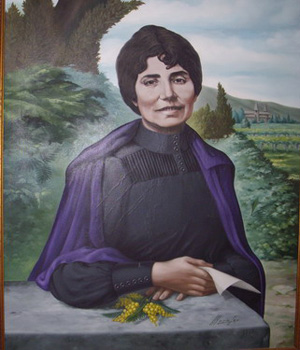 Moreover, although basically a romantic, she strongly opposed abuse of authority and was a strong defender of women’s rights. And she made her voice heard. Married to Manuel Murgia, a historian, academic and journalist, she had seven children despite a very fragile health. She died at age 48 in 1885 in her home in Padron.


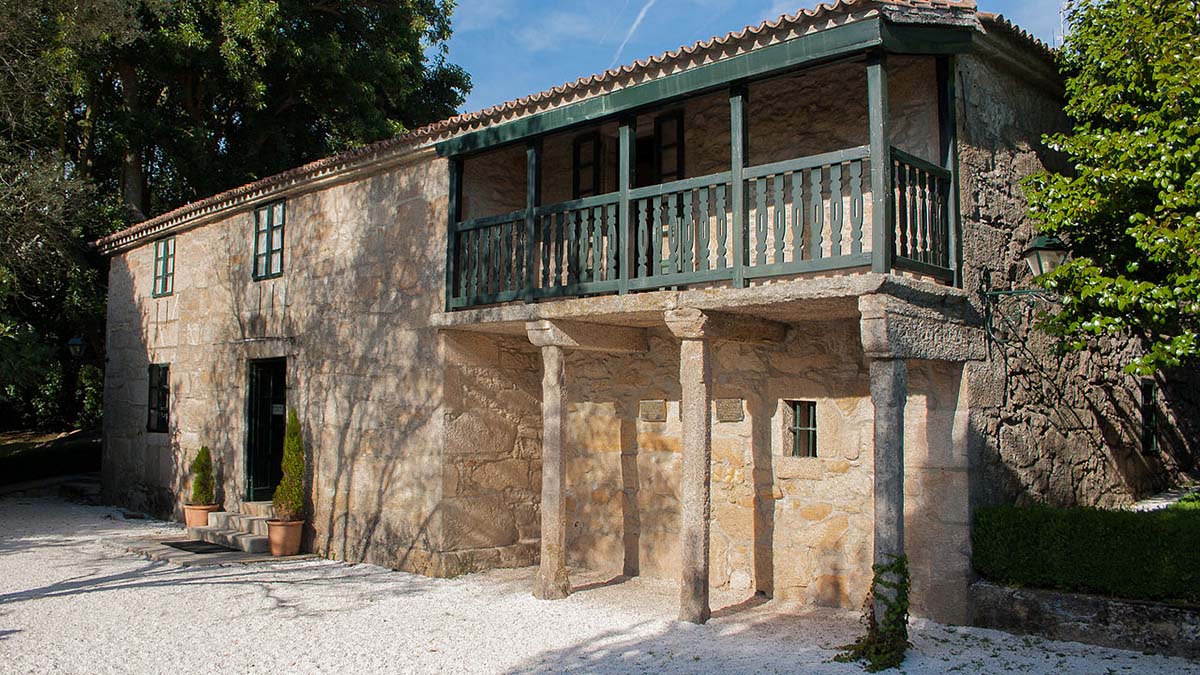
 The stone cottage is visible, but only just, above the garden full of trees and flowers which Rosalia tended herself. She used to sit among blooming camellia bushes on a carved stone bench and dream up new poems. The whole scene is so romantic that one feels like writing a love poem there and then.
Rosalia and her husband weren’t rich, but they weren’t poor either and the house reflects that. An internationally acclaimed and recognized writer and poetess, even during her much too short lifetime, she raised her children and did her housework herself.
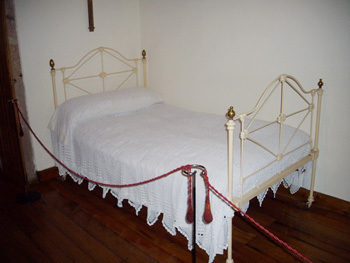
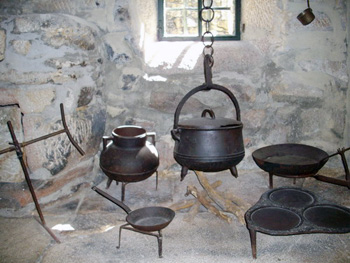 The kitchen with its woodstove and iron kettles looks no different to any other farmhouse kitchen at the time. Her bedroom is spartan, still with her clothes hanging in the closet. Next door is her study with the desk and writing utensils. I wished I could just have sat down, hoping to be infused by her creative spirit.
The ground floor is dedicated to the Rosalia de Castro Foundation, full of documents, photographs , awards and certificates of recognition from countries as different as Japan and South America.
There is just one lady attending to visitors and she is a huge Rosalia fan. At the time I visited, I was the only one there and she talked to me at length and even recited parts of Rosalia’s most famous poem: Cantos Galegos. Thankfully she did so in Spanish and not Galego.


If You Go:
♦ Padron is easily reached from either La Coruña or Santiago de Compostela by car or, better, train. Bear in mind the closing during siesta, but you can beautifully fill the hours in Padron.
♦ The center of town is reached crossing and old stone bridge and just beyond lies a tropical garden and park. Opposite is a restaurant which serves Galego specialties at very reasonable prices.
♦ Admission to the Rosalia de Castro House Museum is free and the opening times are:
– July to September: 10am to 2pm and 4pm to 8pm
– Rest of the year: 10am to 1:30pm and 4pm to 7pm
– Mondays closed, Sundays and bank holidays open 10am to 1:30pm
♦ A donation is appreciated if you want to or else you can buy pretty editions of her books.
♦ And then you can walk a little further and pay homage to the other literary great of Padron: the library, museum and foundation of Camilo J. Cela.
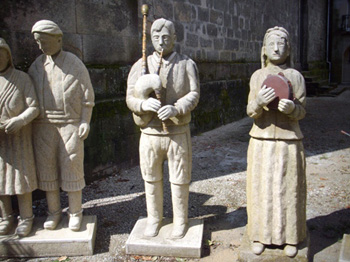
♦ Padron features some interesting modern sculptures of Galego musicians around the market square.
♦ When traveling in Galicia be prepared to find notes and explanation in Galego. Sometimes there isn’t even a Spanish version, leave alone an English one. But someone speaking English is never far away and they will be pleased to help you.
Galicia & North of Portugal, 6 days from Madrid
About the author:
Inka Piegsa-quischotte is an ex-attorney turned travel writer and novelist. She writes for online travel magazines and has two novels and a travel guide to Galicia/Spain published. She lives in Spain.
Photo credits:
Facade of Rosalía de Castro Museum in Iria Flavia, Padrón, Galicia, Spain by Iago Pillado / CC BY-SA
All other photos are by Inka Piegsa-quischotte.

 I entered the castle’s grounds, which now stage temporary exhibitions after the military museum closed. Among them is the Sala Montjuic festival with outdoor cinema and live music during the summer. The castle provides some great views of Barcelona’s harbor. It still includes static artillery displays such as coastal defense guns.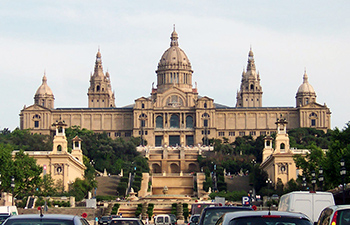

 Photo credits:




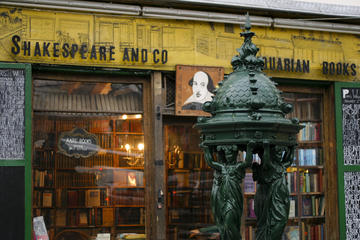
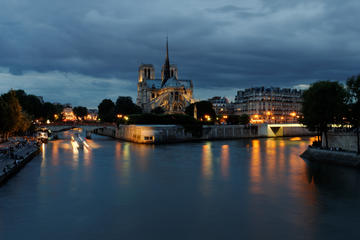


 History, as it’s studied in school, can be a tough concept to wrap your head around. Centuries can be covered in days; weeks can be spent on one event. For many, the time when prehistoric man was living and roaming the caverns and fields and mountains of the Earth gets scrambled with the era of the dinosaurs. I had a hard time figuring out a real timeline when I was in high school history class. In fact, it’s only been in living history, in exploring the places where these things actually took place, pressing my hand against the wall of a building that once witnessed a revolution, a king’s court dance, a meeting of the French Resistance, that I’ve been able to understand, even a little bit, the events, the moments, the people that came before me.
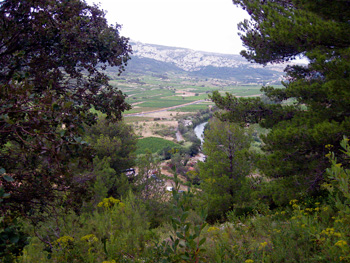
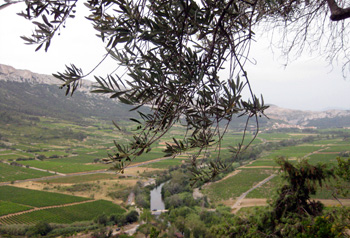 But somehow, prehistory is harder to get a grasp on. How can you look at a place and imagine nothing, none of the buildings or houses or even roads, none of the modernity that seems to exist wherever you go today? It’s difficult, near impossible, and yet I found it much easier to wrap my head around the prehistory as I journeyed through Southern France.
 Tautavel Man is a 450,000-year-old fossil, a proposed subspecies of Homo erectus, one of our true ancestors. I find it incredibly hard to fathom the time between when he was born and when I was, and yet that’s the point of the museum in the town of Tautavel, which explores the discoveries uncovered in the cave and offers a unique view of life in this region at Tautavel Man’s time.

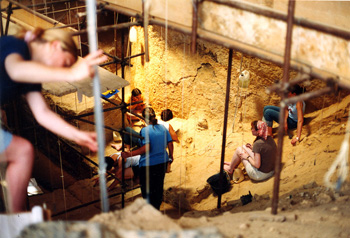 The museum is split into two portions: the first is in the village and offers an exploration of the tools and shelters created by Tautavel man and his contemporaries. Visiting this portion of the museum first allows you to experience some of the wonder that the first archaeologists excavating in the cave above did.
 The museum is ideal for visits with kids, complete with activities in the summer including teaching participants how to throw a spear or make fire out of stones and moss. But even for adults, these activities are essential to gaining a true glimpse of life in the time of Tautavel Man.
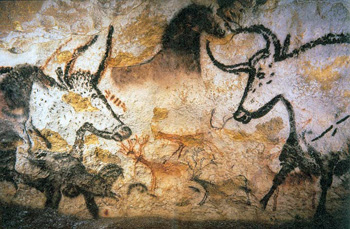 It is in Lascaux that, in 1940, three local teenagers accidentally stumbled upon prehistoric cave paintings, changing the way that we perceive of these “cave” men forever. Soon after their discovery, experts identified the paintings as Paleolithic art, some of the earliest to have ever been discovered. The paintings are far more recent than Tautavel man, at 17,300 years old, and they have long been a draw to this region, not far from Limoges, where art still remains an important element of local life due to the tradition of Limoges porcelain.

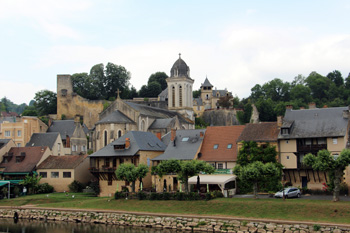 I went to Lascaux to visit the caves, but like all visitors since the 1960s, I actually visited Lascaux II, a replica of the original cave, which was closed when experts realized that lichen had become prevalent due to the frequency of visits and risked destroying the paintings. But visiting Lascaux II is not discouraging; after buying our tickets in the village of Montignac below and driving up to the caves, we are taken on a journey through time.
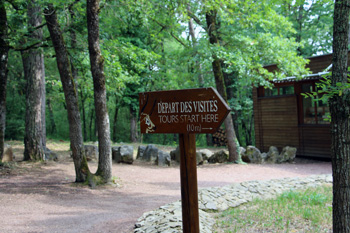 The guide goes into details that never would have occurred to me over the next 45 minutes: how the paints were made by the artist, who shows considerable skill in representing the animals that existed around him including horses, cattle and stags. As we wander through the caves, I almost forget that this is a facsimile, until the guide explains the feat of reproducing the caves using a concrete base and the recreation of the same sorts of paints that would have been used for the originals. Lascaux II is accurate up to a couple of millimeters to the original.
 While all of these questions bring us closer to the answer, none answers it. Today, some researchers claim that the paintings are prehistoric star charts, guides to the summer night sky and what we would later call the zodiac. Others say that the work is religious or spiritual, conceived from visions experienced during trance dancing.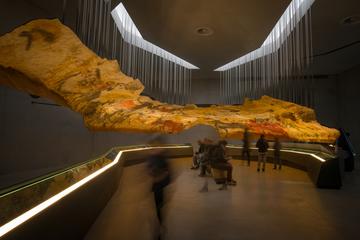

 Photo credits:
 As for the stage fright, it never goes away… it’s agony every single time but I stay focused and I know that once I’m on stage it’ll be fine; I’ll be in my happy little bubble.’
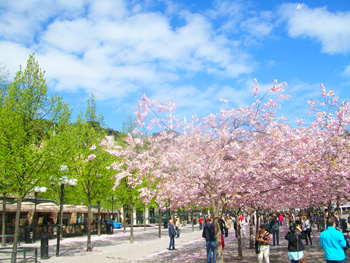 Stockholm grew out of Stadsholmen, and the 13th century island was originally called Stockholm. As the city grew, it kept the Stockholm name, and the island became known as Staden Mellan Broarna: The Town Between the Bridges. It only became known as Gamla stan in the 20th century.
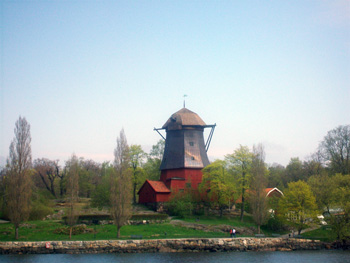 Stockholm means ‘log island’. The legend of Stockholm’s origins is that a log filled with gold was sent downstream from the old Swedish capital of Sigtuna, after they had trouble from armed gangs, and wherever that log landed would become their new capital.
 Norway became independent of the Swedish kingdom in 1905. The Bernadotte dynasty still rules Sweden. Napoleon’s rule was ended at the Battle of Waterloo in 1815. Abba found fame singing Waterloo to win the 1974 Eurovision Song Contest for Sweden.
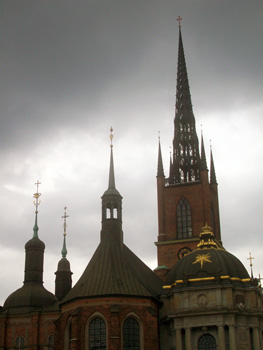 The bed wasn’t available until 2pm, so I walked around small Skeppsholmen island to Kungliga Djurgarden (The Royal Game Park) island, stopping along the way for a siesta under the sun in a small park.
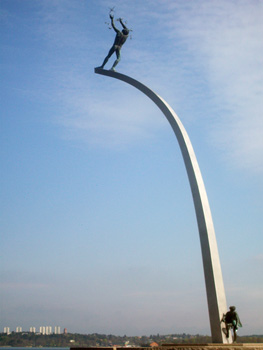
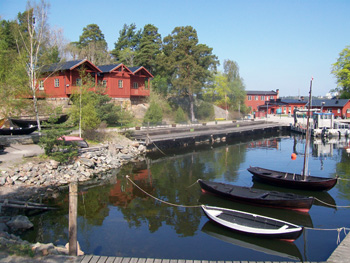
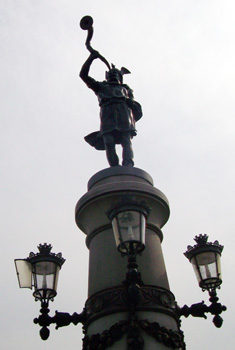 I had taken a ferry from Slussen, at the southern end of Skeppsbron, to the main island of four known as Fjaderholmarna. Opposite Djurgarden’s south-east tip we stopped under an impressive Carl Milles statue at Nacker. Fjaderholmarna was nice to walk around, with some pleasant coves, restaurants and craft shops. There were also lots of birds, primarily Canada geese and seagulls.

 All photos by Marc Latham:


