Segovia, Spain
by Keith Kellett
Segovia, Spain is a UNESCO World Heritage site, noted mainly for its Roman aqueduct. Although my schedule only permitted me just under a couple of hours there, that was longer than a lot of the ‘follow the flag’ tour groups seemed to take who get a ten-minute lecture in each place, five minutes to take photos, and then back on the bus.
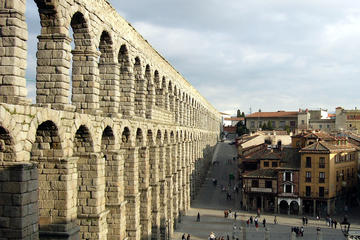
The famous Roman aqueduct was first on my list of sight-seeing stops. When the Romans arrived in Spain, Segovia was already an important point on the trade routes, lying at the foot of a mountain range called the Sierra de Guadamara, on the banks of the Rio Clamores. The Romans were interested in other purposes than trading, though. With an eye to defence, they needed to be higher up, to better survey the land. So, they built their camp where the Alcazar castle stands today, and the city expanded around it.
 But, how to get water supplies up there? The water from the Rio Clamores was insufficient for their needs, anyway. So, in the middle of the 1st Century AD, during the reign of the Emperor Domitian, an ambitious project was begun. A canal was dug, to bring water from the Rio Frio, 18 kilometres (12 miles) away. The valley of the Rio Clamores would be spanned by a massive aqueduct 800 metres (about 2500 feet) long and, at its highest point, reaching nearly 30 metres (100 feet) high.


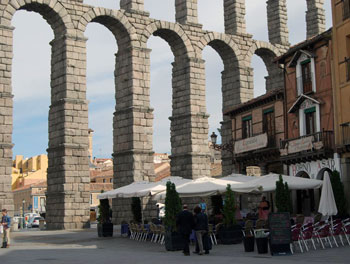 The aqueduct was built from 25,000 stone blocks and, notwithstanding its size, no mortar at all was used in its construction. It took over fifty years to built, was completed in the early 2nd Century, by which time the Emperor Trajan had ‘taken the purple’. However, a much later folk-tale told that it had been built overnight, by the Devil himself … hence its alternative name of Puente de Diablo, or ‘Devil’s Bridge’. It’s said that the Evil One was after the soul of a local woman, to achieve which, he had to complete the bridge in a single night … in which task, he failed, because he was unable to find the last block before the sun rose.
After the Romans left, Spain was occupied for several centuries by Muslims, popularly called the Moors. They partly destroyed part of the aqueduct, but as the Christians gained gradually control over the Iberian peninsula, it was restored in 1484 by King Ferdinand and Queen Isabella.
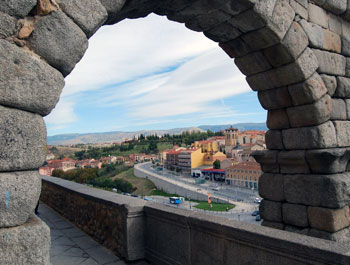
The aqueduct remained in use until the late 19th Century … according to some sources; others say it’s still in use today. Whichever, it’s such a gigantic size that it can be seen all over the city; indeed, it was almost the first thing we saw on the way in. And, it’s still in surprisingly good condition … and certainly not a “Roman ruin.”
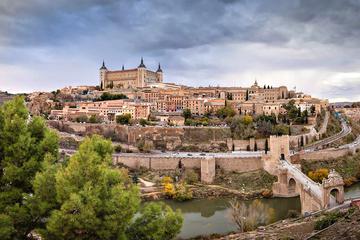
Private full day tour of Toledo and Segovia from Madrid
If You Go:
Aqueduct of Segovia (Wikipedia)
Old Town of Segovia and its Aqueduct (UNESCO)
How to Get There:
♦ The airport nearest to Segovia is Madrid/Barajas (MAD). Segovia is about 55 kilometers north-west of Madrid by road; approximately one hour’s drive.
♦ By Rail: Frequent trains run from Madrid/Atocha. Times vary from about 30 minutes (AVE High Speed Train) to 90 minutes (regular stopping train) www.renfe.es
♦ By Bus: Buses leave regularly from the coach station near the Principe Pio Metro station. Journey time about 75 minutes, fare about €8. www.lasepulvedana.es
♦ We stayed at ‘El Rancho de Aldeguela’ in Torrecaballeros, about seven miles away; from there, from which Segovia was easily accessible by taxi.
Day Trip to the Ancient City of Segovia and gourmet experience
About the author:
Having written for fun while serving in the Royal Air Force, Keith Kellett developed his hobby into a business when he retired. He found, to his surprise, that his writing work was good enough to finance his other hobbies; traveling, photography and computers. He lives near Salisbury, in the south of England.
Photo credits:
All photos are by Keith Kellett
 by Mara Baudais
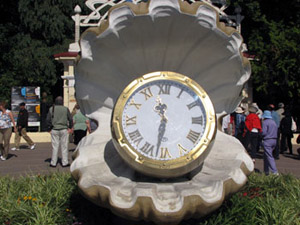
 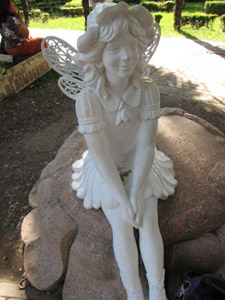 Suddenly it appeared … the fairy wishing well which held the Russian currency we had been looking for! My companion had greatly wanted Russian coins for his grandson’s collection back in Canada. We had been thwarted at every turn. The banks and exchange kiosks were all closed on Sunday. But just as suddenly as the coins had now appeared, a policeman now also appeared, watching as my companion quickly reached forward to exchange American currency for Russian currency from the wishing well. I held my breath, imagining my companion being dragged off to the police station. However, in his hand were the coins he had wanted for his grandson’s collection and, if anything, had given much more than he took.
 Besides this experience with the fairy wishing well, a few other memorable times are remembered. The pool and fountain housed a single gorgeous pink water lily. A simple foot bridge with a gentle brook below it was graciously set against the afternoon sun and the waters of the Black Sea. We had a great time admiring a portrait artist’s work in the park and befriending a father and his child with our smiles and nods of acknowledgement.
 It is favourable climate — April to November — with summer — July and August — being around l8 degrees in temperature. The warmest sea temperature for swimming is in July and August at 26 degrees. Many subtropical plants flourish—magnolia, eucalyptuses, palm trees, oleanders, rhododendrons, azaleas and yuccas. Citrus such as tangerine and lemon also grow here.
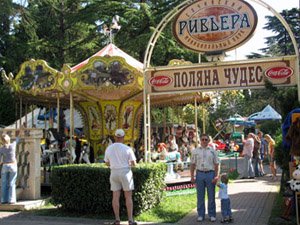
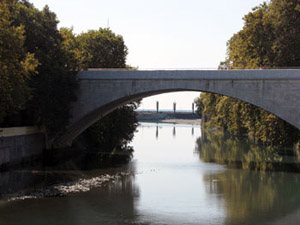
 Vendor side stalls, artist’s displays, games, amusement park rides, art galleries, sports facilities, a cinema, numerous cafes, statues, a pool with a fountain and the Green Theatre, a venue for outdoor music performances fill the park. A pedestrian bridge connects the harbour to the park.
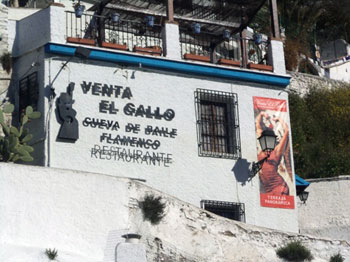
 “Tourist traps,” `he sniffed,” and anyway the performances are only at night”. Little did he know what I found.

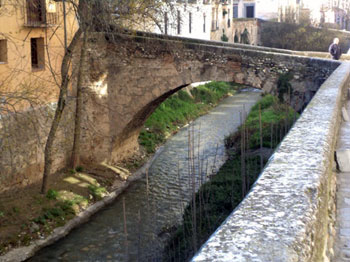
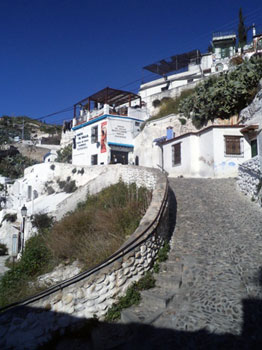
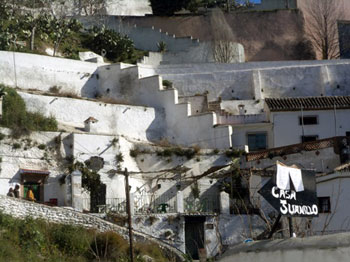 Many of these caves, warm in winter, cool in the summer, are still inhabited today, well appointed and furnished. Climbing white washed stairs from one level to the next, I came past many tablaos, the venues where nightly performances of Flamenco take place and which earned Sacromonte the byword of tourist trap. Up to a point this is justified, but if you know what to do and where to look you get to experience the real thing.
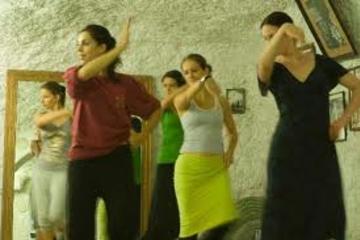
 They waved me inside and I was the recipient of a performance just for me and definitely a spell bound spectator to the real thing.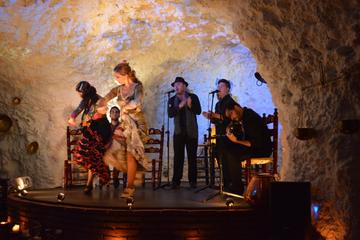
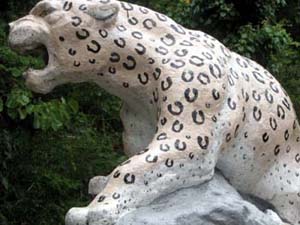
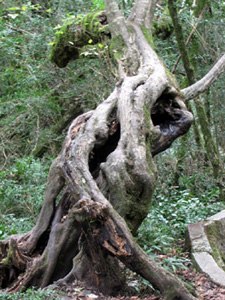 Thunder, then lightning flashed above the forest. Light rain fell, then more. My group, all passengers from my ship that had docked at Sochi, had quickly scampered ahead at the first crack of thunder. Somehow, suddenly it had happened…I was on my own, on increasingly slippery granite, limestone steps, roots and uneven chunks of clay.
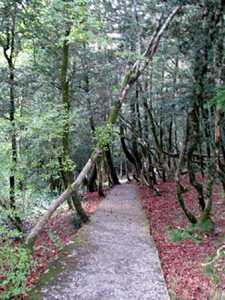 It had become impossible for me to keep up with this very mobile group. At first I found it quite amusing to see the guide on the steps with her wobbly spiked red heels. After the third trip to see if I was still alive, she never returned to me again. That was not quite so funny! I was alone somewhere in this Reserve with a storm brewing and the dusk increasing.
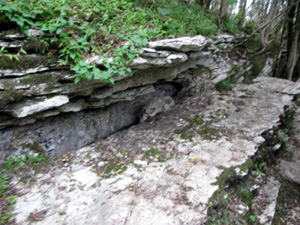
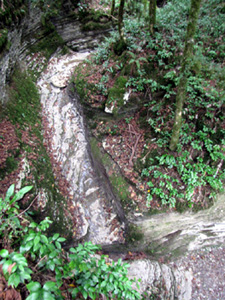 I gently touched the fossils, lingering as long as I could with thunder, lightning and gentle rain as my companions. I fingered the ancient layers, marvelling that at one point in prehistory these same crustaceans below my fingers were once part of a sea. I tried to capture the eternity they held. I now knew being alone was a gift with which to experience this ancient place and I was so grateful for this solitary time.
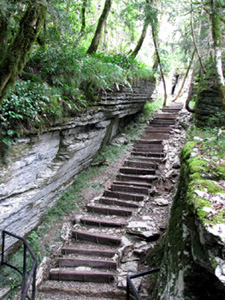 I carried on, into darkness now. Surely it couldn’t be much further. Where was the rest of the group? I passed a lone statute of a leopard as if leaping. My steps quickened. Why was this statue here? I later learnt that this area is home to the Persian Snow Leopard, an endangered species.
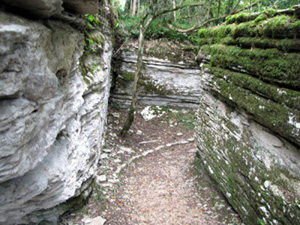 Human habitation goes back 500,000 years and there are undisturbed remnants of 150 prehistoric villages. The area was a prince’s hunting reserve called ‘Kuban Chase’ in the l880s. In 1906 the area was returned to settlers. In 1924 the area was referred to as the Kavkazskiy Reserve. In 1999 it became a UNESCO Natural World Heritage Site, 120 km east to west and 50 km north to south.
 nhabiting this area are 384 species of vertebrates. There are 60 mammal species including wolf, bear, lynx, wild boar, deer, chamois and reintroduced European bison which are globally endangered. There are 246 species of birds, some endangered as well as l5 species of reptiles, 7 of amphibians, 12 kinds of fishes and 2500 recorded insect species from a projected total of 5000.

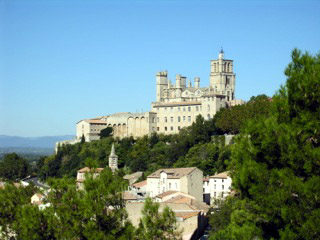
 Beziers is ancient. It has been settled since neolithic times, predating the arrival even of the wide ranging Celts. The Phoenicians are credited as being the first settlers and the city itself takes its inception as 575 BC, only 25 years younger than ancient Marseille. The Romans re founded the city in 36 or 35 BC as a settlement for retired veterans renaming it Colonia Julia Baeterrae Septimanorum. Even the Islamic Moors had a short reign as rulers here from 720 to 752.
 With difficulty, amid the winding streets of the old city where we actually came upon a sign pointing in two separate directions to the cathedral, we eventually found ourselves in a shaded square staring high up at the steeple of Saint Nazaire. To say it is awe inspiring is saying the least. It oozed poignancy; I half expected the stone to speak or ghosts to stare down from its heights.
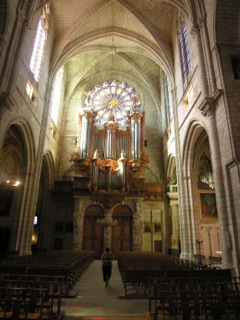 The Albigensian Crusade was initiated by Pope Innocent III, a most ironic title at best, in 1208, against a growing religious splinter group known as the Cathars ( from the Greek Katharos meaning pure). The crusade was to persist until the last of the Cathar “parfaits” was burned at the stake in 1321. What the crusade missed the Inquisition finished. The Cathars, who have been referred to as the Buddhists of Christianity, held there were two gods at play in the world and the world of man was created by the evil god, the satanic god, and the only way to escape was to live a pure life and after several incarnations one would exit the vicious cycle. As part of the purity were such requirements as vegetarianism and celibacy. Of highest esteem were the “parfaits”, those who were most achieved in their quest for heaven.
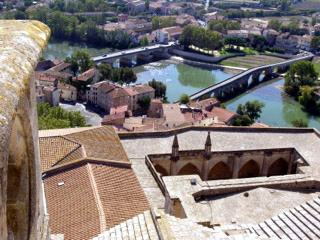 On July 21, 1209 the crusaders appeared at the doorstep of the city and sent word the Catholics could leave and be spared the fate of the resident Cathars. In a remarkable display of loyalty the Catholics chose to stay with their friends and neighbours. The forces of the Crusaders quickly overran the defences and fell upon the inhabitants like wolves. None, neither man woman nor child, Catholic or Cathar, were spared.
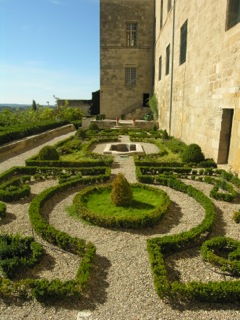 Clambering down we emerged at the square below the heavenly directed spire. An emblazoned plaque sits as a silent reminder of the dark deeds of so many years ago. To be remembered. That is good.

 The cheery pedestrian ways, squares and cafe’s brought us back to the present and the witnessing of the fact life goes on. And under the Sun of southern France colour and liveliness are even more rampant. Beziers is like its urban kin throughout southern France. It is beautiful and a treat to explore.