Transylvania, Romania
by Iolanda Scripca
In the twenty-four years of my life I spent in Romania, I never had the occasion to visit a unique place in Transylvania called the Merry Cemetery.
So, about two months ago, I called my childhood friend in Romania and asked if she wanted to join me on an adventure that would take us from Bucuresti – the capital of Romania and our native city – to Maramures, a region way up north, in Transylvania. It is said that if you do not visit Maramures you do not know the real Romania.
My friend jumped with joy at the idea, and soon I was making airplane reservations.
I landed in Bucuresti at 3:00 a.m., a long flight that took me over the U.S., Canada, Iceland, Germany and, finally, Romania. Gabriela was waiting for me at Bucuresti’s International Airport Otopeni. We hugged for a long time, as excited as two little girls who’d just seen the ice-cream truck approaching.
The next day we took the train from Bucuresti to Sighetu Marmatiei – a city along the Tisa River on the Ukrainian border. The long ride allowed us to reminisce over our carefree childhood, places, the other kids and the “whatever happened to David?” kind of things.
Maramures’s beautiful landscape takes you back to a time when life was simpler. Village houses are still built the traditional way, and the residents still wear traditional, handmade clothes decorated with colorful patterns and from cloth that originated from local fields. The villagers are particularly helpful and friendly.


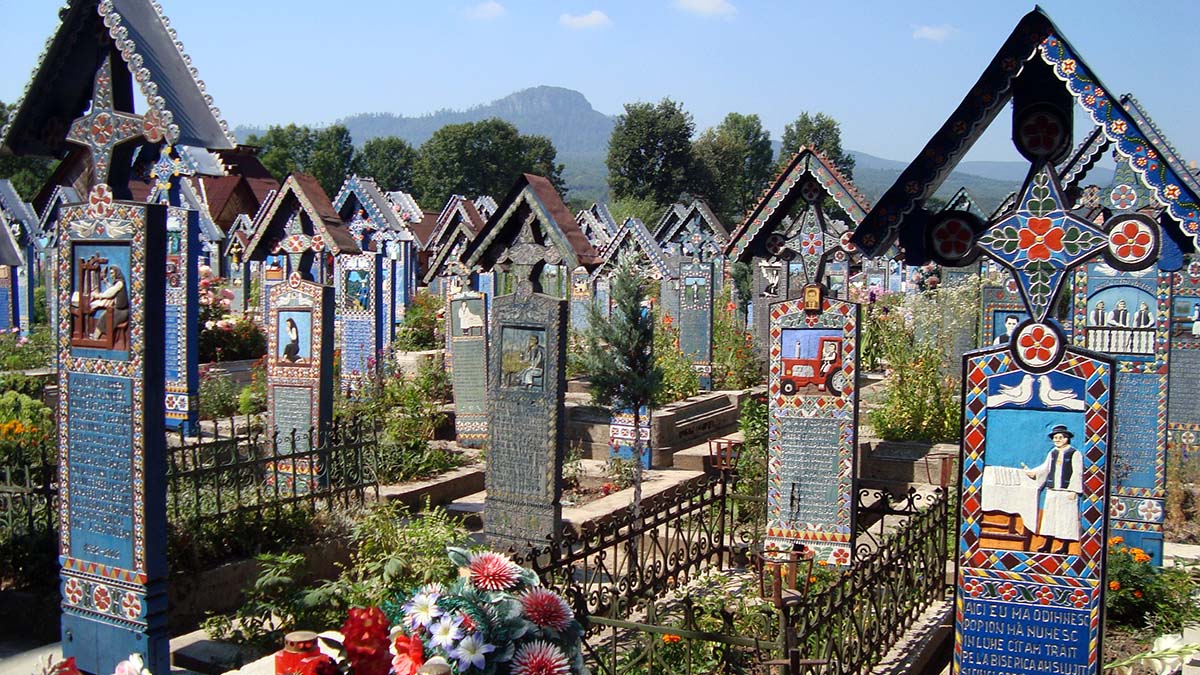
Once in Sighetu Marmatiei, we stayed in a picturesque bed and breakfast. From there we joined a touring bus and headed to Sapânta (sah-PUNTS-ah), where the famous Merry Cemetery is located. It is not a simple cemetery any longer, but a place where visitors pay a few pennies to look around– an outdoor museum, if you will.
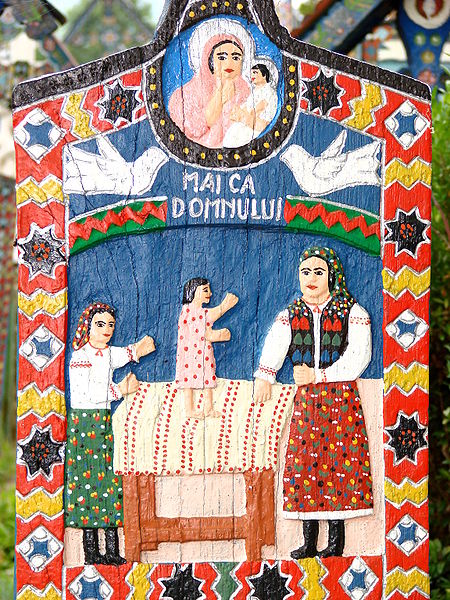 The over 600 multicolored crosses carved in oak stand about five feet tall; each is protected by two wooden beams in a shape of a roof. Each cross is personalized with the deceased figure at the center and a scene of his life, carved in a folk Naïve style, followed by a witty epitaph that informs the living how and why that person died. From the lumberjack to the barber to the shepherd, these crosses depict a nostalgic village life (and even death), a visual historical chronicle of that particular place and time. The colors used by the founder of this cemetery, Stan Ioan Patras, are all symbolic to the life of each deceased: red for passion, yellow for fertility, green for life, and black for untimely death.
All of this makes for over 600 stories visitors can read about: the shepherd who was unaware of the murderous robber behind him, the young man old enough to marry who was struck by lightning in the fields, the little six-year-old girl who died prematurely, even an epitaph about the village drunk.
Here I lie to take my rest
They call me Stan Gei Crautu
Since I was a child I loved my sheep much
But a bad rabbit horse splattered me all over
Took away my life
Mother and father will wail for me as long as they live
Death, you have an ugly name
as you carried me away young
and took my life at age 14.
After the cemetery founder passed away, his followers continued his artistry, and one notices the progress in the passing of time. A more recent epitaph explains the cause of one boy’s death – an accident in the subway in Paris while he was fooling around on his roller blades. Many of the present-day stories tend to involve trucks, cars, trains.
Here I lie to take my rest.
Pop Mihai Sustac is my name.
Nobody should have bad luck
As I had when learned about the tractor
Far away from my village.
Death there found me
And young it took me away.
As we left this unique place, we looked at the tourists’ faces. They were intrigued, and maybe, in my opinion, a little more “at ease” with the idea of the dead and dying. This interesting, fulfilling trip that reunited me with my childhood friend couldn’t help but make me more aware of what life is all about – remembering your family and friends and how important they should be!
Taste of Transylvania Private Tour – from Dracula and Peles Castles to medieval Brasov

If You Go:
About the author:
Iolanda Scripca is a published photographer, poetess, journalist, and translator. She lived in Eastern Europe for the first twenty four years of her life, in a loving family. Her mom was a teacher, a high school principal, and a cultural promoter. Her dad was a published novelist, poet and TV producer. An unforgettable moment was her collaboration with her Dad in the translation and adaptation of a children’s book by the Bulgarian author Leda Mileva. She is a graduate of Foreign Languages and Literatures from the University of Bucuresti/Romania. Nowadays she enjoys Southern California and possesses a CA Teaching Credential from Chapman University. Ms. Scripca publishes in several Romanian-American Newspapers both in Romanian and English. “Lava Of My Soul” is her recently released collection of poems and essays. scripca@aol.com.
Photo credits:
Merry Cemetery, Sapanta, Maramures, Romania by Avramescu Marius / CC BY-SA
Merry Cemetery – Sapanta – Romania by Avramescu Marius / CC BY-SA
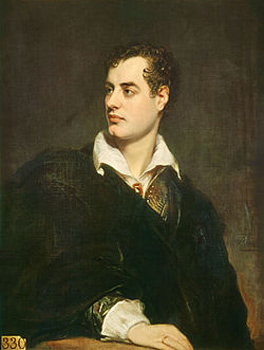 At the corner of Lysikrattis and Vironos Streets in Athens Plaka, stands a choreographic monument awarded to a choir at a Festival for Dionysos in ancient Athens’ Dionysos Theatre. Once, next to this monument, the last of its kind in Athens, was a French Capuchin convent. The poet, George, Lord Byron, stayed here when he was in Athens. At that time, the panels between the columns of the monument had been removed, so Byron used it as his study and wrote part of Childe Harold here in 1810-11. This was once the theatre district of ancient Athens, so it seemed appropriate that the flamboyant poet should choose to spend his time there. In Greek, “Vironos” means “Byron” and this is Byron’s street. I used to live there and spent much of my leisure time at the little milk shop, now a posh coffee shop, at that corner. The convent was destroyed in a fire, but there’s an inscribed monument on the spot where it once stood honouring Byron. His presence always seemed near.
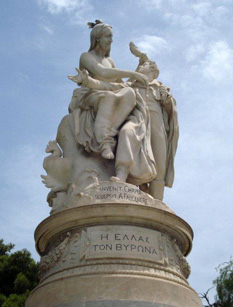 The street adjacent, is Shelley Street, named for his poet colleague Percy Bysshe Shelly who tragically drowned in Italy. Both poets are honoured in Greece, especially Byron, who became a national hero when he joined the Greek resistance movement during the War of Independence.
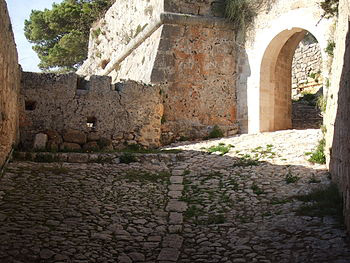 He lived for awhile on the island of Kefalonia (Cephalonia) in the tiny village of Metaxata, near Argostoli, where he enjoyed exploring the ruins of a Venetian castle at Ayios Yeoryios, once the Venetian capital of the island.
 During his travels around Greece, Byron not only grew to love the country but was also impressed with the moral tolerance of the people. He became involved in the rebellion against the Turks, joining forces with Alexandros Mavrokordatos, the leader of the forces in western Greece to take part in the War of Independence. In spite of Byron’s lack of military training, together they planned to attack the Turkish-held fortress of Lepanto at the mouth of the Gulf of Corinth. The Greek struggle against the ruthless Turks was supported by many intellectuals and poets like Lord Byron who volunteered to fight and become leaders of the revolution. They were known as the Philhellenes (friends of the Greeks). Although many became disillusioned by the pettiness and greed of the Greek klefth leaders others, like Bryon, took up the cause, arriving in Messolonghi , a squalid little port on the Gulf of Corinth, the western outpost of the resistance movement against the Ottomans. He was greeted with a 21 gun salute. In spite of despairing “in this realm of mud and discord” he donated 4000 pounds of his own money to prepare the Greek fleet for sea service and employed a fire master to prepare artillery as well as paying the Souliot soldiers who were reputedly the bravest of the Greek resistance fighters.
 There is no better place to begin your exploration of this, too seemingly real, walled city. Here beneath the gaze of a serene statue of Saint Louis, actually King Louis IX of France, the city’s ascribed founder, you can sit under the shade of Plantain trees at one of the many outdoor cafes and ponder over the self-guided walking tour pamphlets available at the bordering tourist information centre.

 In 1270 Louis once again led his crusader forces from Aigues Mortes reputedly taking service at the still standing Notre Dame de Sablon (Our Lady of the Sands), alongside Place Saint Louis, ere departing. It was his last foray as he died within months from typhus on the shores of North Africa. His new city however fared much better.
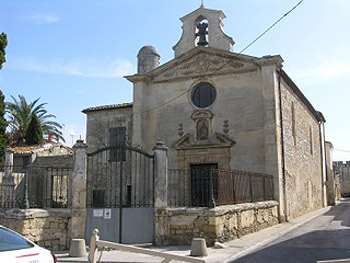
 Visit La Chapelle des Penitents Gris (Grey) [TOP PHOTO] and La Chapelle des Penitents Blanc (White); ancient orders rooted in Christianity’s dim past. Their simplistic exteriors belie the more ornamental interiors.
 Crossing the only bridge spanning the moat surrounding La Tour de Constance brings you to the awe inspiring edifice which harkens back to the very beginnings of the Aigue Mortes fortress town. With the revocation of the Treaty of Nantes (a tolerance act allowing for French Protestants) in 1685 the tower began its long years as a prison. Exploring its bright rooms and walkways it takes some effort to recreate in mind the jailhouse conditions of so many years before. The tower rises above the rampart walls and is topped by an rooftop adorned with a beacon which once served the mariners as a lighthouse. From here you can see the encircled city in its entirety. Here, above the world, its long gone sentries could breath the light Mediterranean air likely much appreciated during odour rich Medieval era.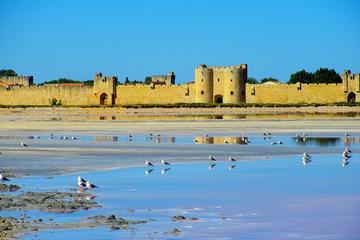
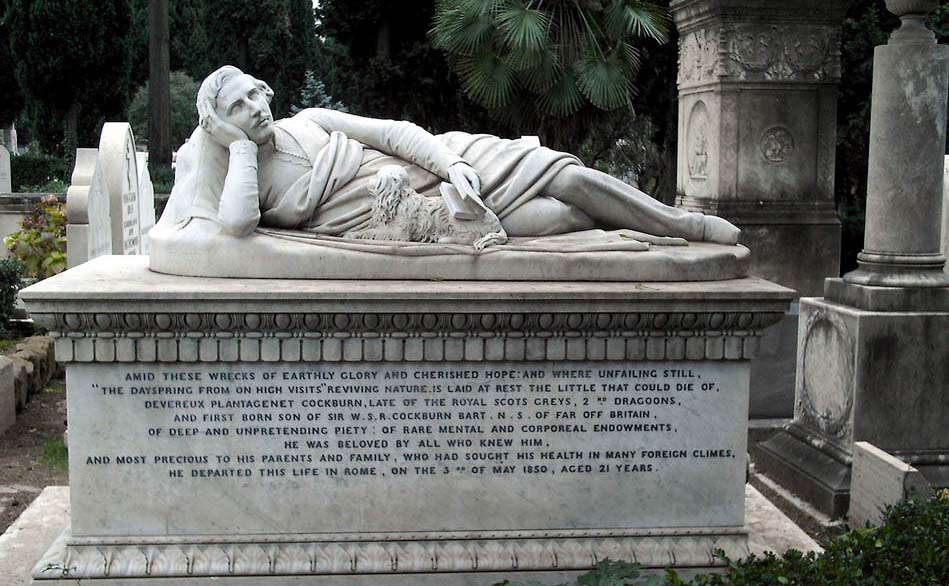
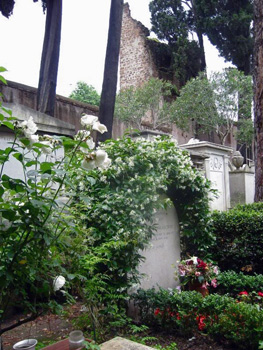 Perhaps Italians might disagree with me when I use this term, since this, the Cimitero Acattolico, is the last resting place for those who could not, or would not be buried in the traditional Catholic cemeteries here in the heart of Roman Catholicism. But hallowed it is, nonetheless, since this patch of land, overgrown with weeds and flowers, contains the remains of the some of the most important figures of the last few centuries: local dissidents and those from other lands, ex-pats, writers, revolutionaries, atheists and Jews who, famous or not, all came to rest together here in this painfully beautiful monument to non-conformity. Antonio Gramsci, Gregory Corso, and a cat named Romeo are some among this motley crew, though none of them hold higher places in the echelons of artistic memory than the two greats of English Romanticism buried here: John Keats and Percy Bysshe Shelley. How could it not be raining, then? It was as if the luminous Roman sky had been replaced for a moment by a melancholy English one, pausing to weep a bit for two lost sons, entombed amidst the ruins, far far away.
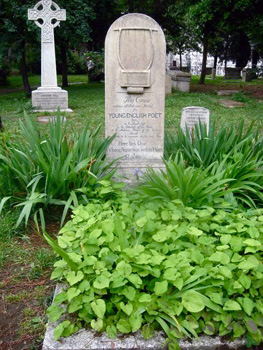 Though their names are often intertwined, John Keats and Percy Shelley came to Italy for very different reasons. Shelley, the rebellious Etonian from an Aristocratic family, was leading a wild life, one easier experienced abroad. He was best friends with Lord Byron and romantically entangled with Mary Wollstonecraft Godwin (turned Shelley), the author of Frankenstein. His lifestyle, radical views, and writing had brought him not only fame, but also infamy. Like many writers and artists of his day, he was attracted to the warmth of the European south, to its classical pagan origins, and to that fact that he could live freely there, away from the scandals that plagued him in England. Keats, on the other hand, came to Italy to die.

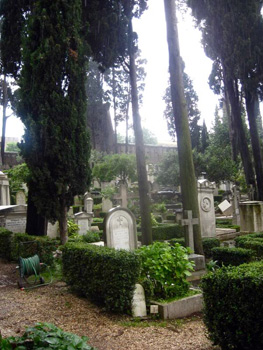 Besides the cruelty inherent in this statement, the irony was palpable too. Keats’ medical training, no matter how practical it may have been, could do nothing to stop what was then an almost incurable disease, tuberculosis. Not long after his brother died, it became clear that John Keats had contracted the illness too. Knowing that he would not survive the English winter, his friends gathered whatever money they could in order to send him to a gentler climate, a last ditch attempt to save his life.
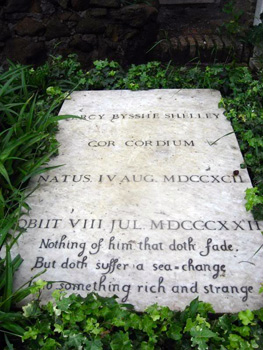 Shelley was buried in the same cemetery a mere year later, the victim of a violent Mediterranean storm that drowned him while sailing off the coast of northern Italy. A book of John Keats’ poetry was found in his pocket. Shelley’s cremated remains (all but his heart, which was kept by Mary Shelley and eventually buried in England) can be found under a small flat tombstone a short walk from Keats’, bearing the Latin “Cor Cordium” (heart of hearts), and a quote from Shakespeare’s The Tempest: “Nothing of him that doth fade, But doth suffer a sea-change is to something rich and strange.”
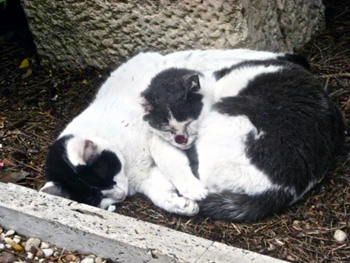 On my own visit, while I sat there overcome with tears, I heard a rustling from the wall above me. From out of one of the vines came a black and white cat, who jumped down onto the bench, and then snuggled up onto my lap. Through my own teary-eyed haze and quixotic imagination, it was easy to believe that in that moment I was being visited by the spirit of the poet himself. Of course, as I got up to walk to Shelley’s grave, straight ahead and to the right, I realised that the cat was just one among many strays who live in the cemetery, and to whose livelihood you can also donate money. However, the impression stayed with me, there on that wet rainy day, as I wandered alone through the grounds of the Cimitero Acattolico. And I emphasize the word “alone”, because visitors here are many fewer than in other famous cemeteries such as Père Lachaise or in Roman tourist spots like Saint Peter’s. When Oscar Wilde visited in 1877, he called it “the holiest place in Rome”. There, breaking bread with the dead, it’s not hard to see why.

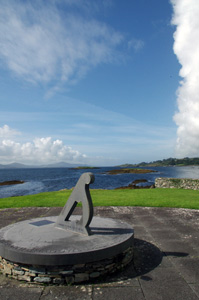 Visiting the Air India memorial is not easy, and the usual response from people in Ireland was “never heard of it” and occasionally, “I remember something about that. When did it happen?” The memorial is not on any tour route nor do tour buses get close so I organized my visit through the hotel in Killarney where I was staying. Killarney is the largest town in the area and a major southern Ireland tourist spot. A local cabbie, who does customized tours, offered a flat rate for the day. The other option, and cheaper choice, would have been to rent a car.

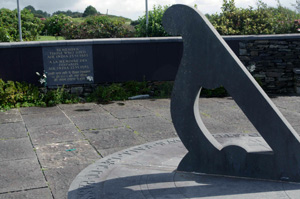 The memorial includes a well kept with a sundial that commemorates the day and hour of jumbo jet’s explosion in the air. There is a low, stone, semi-circle wall with the names of the victims that appears to cup the sundial. (Picture 4)A tidy garden maintained by the village borders the path to the memorial, which is oriented towards the breezy, wide-open ocean.
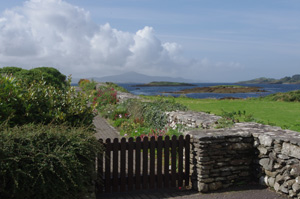 At one point, we had to stop for a flock of sheep across the road which gave the weathered sheepherder time to walk up to the van. He quickly fired off about a dozen personal questions in a sing-songy Irish accent including asking where were we from, where were we going and was I married. Driver Walsh had predicted we were going to be there a long time when the sheepherder headed towards us. Walsh was greatly relieved when another car came around the bend and the sheepherder had new people to question.


.jpg)