by Troy Herrick
“Never again!” I said after my day trip to Naples in 2008. And true to my word I returned in 2009 and did it all over again. But this time my visit was a real pleasure. Like me, your first impression of Naples is colored by the imposing maze of streets adjoining the train station. The success of your visit to old Napoli largely depends upon how quickly you can escape from this area of the city without becoming lost. And the secret to a successful escape is to ride the bus from the Piazza Garibaldi in front of the train station to your first tourist destination.
Begin your day trip by riding bus R2 to the Palazzo Reale. Upon arrival, you are sized-up by statues of eight past Neapolitan Kings set into the external façade including Roger the Norman, Charles V and Victor Emmanuel II.
Once inside, climb the stately white marble Grand Staircase to the baroque style royal apartments. Winged nymphs guard the main entrance. Beyond are rooms filled with 17th to 19th century paintings, frescoed ceilings and furnishings. Stroll down the elegant hallway reminiscent of the Hall of Mirrors at Versailles. Visit the throne room which features a well-used royal throne. The red velvet seat and back are badly torn. The Palatine Chapel houses an intricate 210 figure nativity scene on the left side of the room and a scale model of the Palazzo Reale on the right.
The San Carlo Theater, originally built for private performances, is on the ground level. This opera house is second only to La Scala in Milan. An operatic exhibition of props and costumes is spread over 30 rooms.
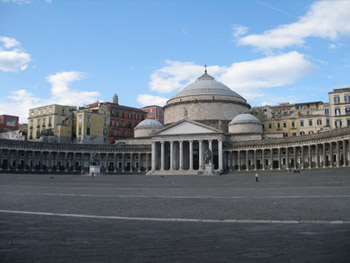 Leave the theatre and cross the Piazza del Plebicito to the Church of San Francesco di Paola. Its design is based on that of the Pantheon in Rome. At 53 meters in height, the dome is 10 meters higher than its Roman counterpart. While the San Francesco oculus is covered, the Pantheon’s is not. The white marble church interior features thirty two Corinthian columns circling the perimeter and an altar inlaid with lapis lazuli and precious stones.
Fifteen minutes from the Piazza del Plebicito, you find the Castel Dell’Ovo strategically situated atop a jetty. In its time, this 12th century Norman castle served as a Benedictine Monastery, a ducal residence, a state prison and now a showcase for art exhibits. Visitors to the terrace should note that the art works are protected by 6 cannons aimed at the city. This same terrace features a panoramic view of the harbor and Mount Vesuvius in the distance. In the dungeons, you find columns that were part of an old Roman villa on this site. This villa once served as a prison for the last Western Roman emperor, Romulus Augustulus, after he was deposed by Odoacer in 476 AD.
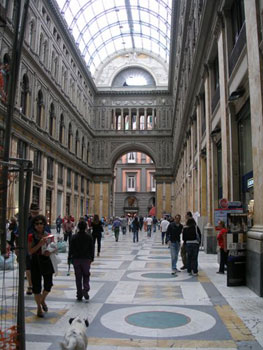 Returning to the Piazza del Plebicito, cross the Via San Carlo to the 19th century Galleria Umberto I. The refined galleria is an octagonal structure, enclosed under a glass and iron dome. Stylish shops and businesses fill this indoor mall.
Exit the Galleria Umberto and board the Funiculare Centrale for a ride to the top of hill. Upon your arrival, follow the signs to the Villa Floridiana to escape the hectic pace of the city. While the neoclassical villa houses the National Museum of Ceramics, the real attraction is the serene garden and the sea-and-sky view of the Bay of Naples. You may wish to enjoy the cool breeze and a picnic lunch from a shaded bench overlooking the city. A number of turtles in a nearby fountain are your dining companions.
 After lunch, ride the Funicalare Centrale back down to the bottom and follow Via Toledo through the heart of old Napoli – the Spaccanapoli district. Naples earns its reputation from these chaotic, unkept streets. Common sights include laundry hanging from balconies above the colorful shops and street vendors hawking goods with their operatic voices and theatrical gestures. Enjoy some window shopping as you walk between tightly parked cars and dodge oncoming vespas on your way to the National Museum of Archeology.
One of the finest museums in the country, the National Museum of Archeology features Greek and Roman antiquities. Larger-than-life statues of Hercules, Atlas, Bacchus and Diana meet equestrian statues and busts of long dead Roman emperors. Highlights include lost treasures from Pompeii like the famous mosaic of Alexander the Great meeting Persian King Darius in battle and the statue of a faun from which the House of the Faun derives its name. Several galleries feature frescoes and erotic items acquired from both Pompeii and Herculaneum.


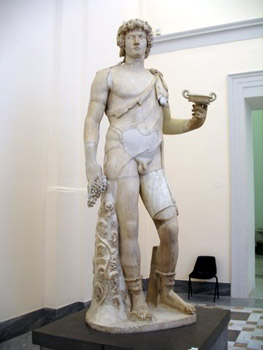 After passing your afternoon at the museum, continue your tour at the 14th century Gothic Duomo. Displayed within the Chapel of San Gennaro, a silver reliquary bust of the saint holds his skull and two vials of his congealed blood. Tradition holds that if this blood fails to liquefy on each of three festival days during the year (the first Saturday in May, September 19 and December 16), disaster will strike the city. Remember that Mount Vesuvius is a short distance from Naples.
On the opposite side of the Duomo, the 4th century Basilica Santa Restituta was the earliest Christian basilica in Naples. It stood alone until 1315 when it was incorporated into the Duomo. The columns inside were recycled from the Temple of Apollo which originally stood on this site.
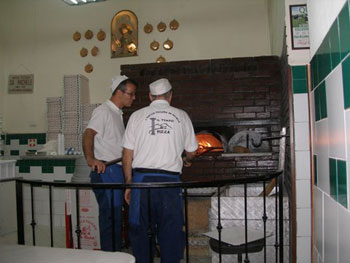 Dinner time is likely upon you as you walk back to the train station. And this is your opportunity to enjoy original Neapolitan pizza. At the train station, board the R2 bus and experience a genuine Neapolitan traffic jam as you ride to the first stop on the route. Exit the bus and walk through the maze to L’Antica Pizzeria da Michele.
L’Antica Pizzeria da Michele, in business since 1870, is renown throughout Naples for its traditional wood oven-baked Margherita and Marinara pizzas. Add these two items to beer and Coca Cola and you have the entire restaurant menu. Amazingly, wine is not available for some strange reason. A rustic two room interior adds to the ambiance. Savor your meal as people line up outside for a table.
At this point, if you are like me, a good meal and a memorable day trip have dispelled any stress and reservations that you might have had about Naples. The real Napoli is charming, vibrant and colorful. And the secret behind this revelation is a bus ride from the train station.
Naples, Pompeii and Sorrento full day tour from Naples
If You Go:
♦ Find the tourist information booth at the train station and ask for a map of the area.
♦ Purchase a day pass for the bus. This also allows you to use the Metro and the funicular.
♦ Ride the R2 bus from the central train station to the Palazzo Reale.
♦ Admission to the Palazzo Reale was 8 Euros at the time of my visit.
♦ Photography is not permitted inside the Church of San Francesco di Paola.
♦ Admission to the Castel Dell’Ovo is free.
♦ The Funiculare Centrale (funicular) leaves from Via Toledo near the Galleria Umberto.
♦ Entry into the park at the Villa Floridiana is free.
♦ Hold on tightly to your belongings as you walk through the Spaccanapoli neighbourhood as motorcycle riders have been known to suddenly grab items and speed away.
♦ The National Museum of Archeology is located on the Piazza Cavour on Via Pessina. Admission was 10 Euros at the time of my visit.
♦ The Cathedral of San Gennaro is found on Via Duomo. The cathedral is usually open in the late afternoon after 4:30 p.m. Admission is free.
♦ L’Antica Pizzeria da Michele is located at Via Cesare Sesate, 1-3-5-7. Ask staff at the tourist information office in the train station how to find this pizzeria.
About the author:
Troy Herrick, a freelance travel writer, has traveled extensively in North America, the Caribbean, Europe and parts of South America. His articles have appeared in Live Life Travel, International Living, Offbeat Travel and Travel Thru History Magazines. He also penned the travel planning e-book entitled ”Turn Your Dream Vacation into Reality: A Game Plan for Seeing the World the Way You Want to See It” – www.thebudgettravelstore.com/page/76972202 based on his own travel experiences over the years. Plan your vacation at his website www.plan-a-dream-trip.com
Photo credits:
All photos are by Diane Gagnon. A freelance photographer, Diane has traveled extensively in North America, the Caribbean, Europe and parts of South America. Her photographs have accompanied Troy Herrick’s articles in Live Life Travel, Offbeat Travel and Travels Thru History Magazines.
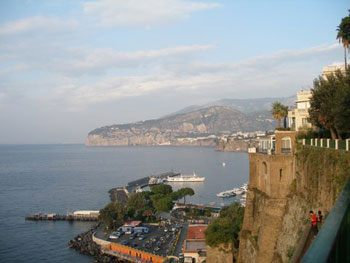
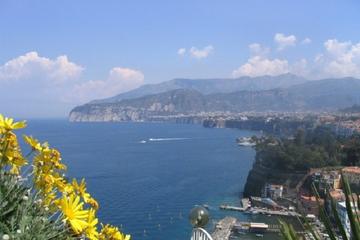
1. The Bay of Naples
2. Church of San Fransisco di Paola
3. Galleria Umberto I
4. Spaccanapoli District
5. Statue of Bacchus in National Museum of Archeology
6. L’Antica Pizzeria da Michele
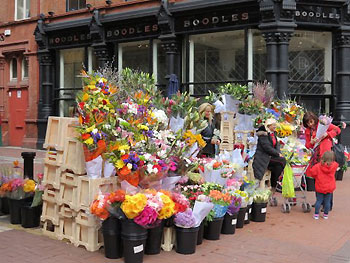 We started in Dublin, where Grafton Street has become a pedestrian mall. On any afternoon or evening, here we encountered a carnival atmosphere: people going both ways in streams or else standing in circles, entranced by one of the jugglers, musicians, comedians, or acrobats. At the foot of Grafton, we had no trouble finding the risque statue of that fictional fishmonger Molly Malone. The locals call it “the tart with the cart.” Turns out every statue and even the new Spire has a nickname, though most are unprintable.
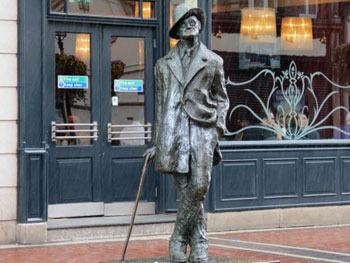 Dublin is a writers’ city. Ireland has a population of just over six million, combined north-south, yet four Irish authors have won the Nobel Prize: William Butler Yeats, George Bernard Shaw, Samuel Beckett, and Seamus Heaney. We started at the Dublin Writers Museum to get a feel for the tradition, and then walked down the hill to the James Joyce Centre, and went on one of the numerous Dubliners walk.
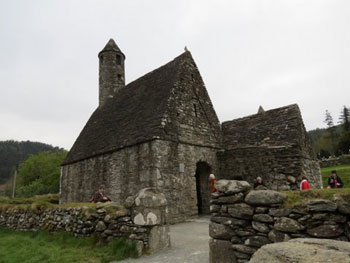
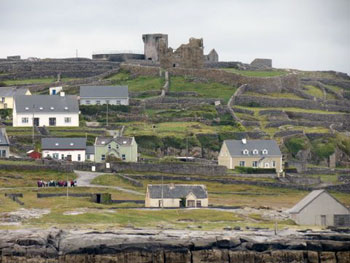 The stone buildings here date from 500 A.D., when a monk called Saint Kevin settled into a cave and spent seven years wearing animal skins and communing with birds and small mammals. Walking along the lake to the ruins is half the fun, as one of the glories of Glendalough is its situation between two picturesque lakes in a forested valley. You can see why Saint Kevin chose this spot to go hermit, and also why throngs of fellow monks turned up and put an end to his solitude.
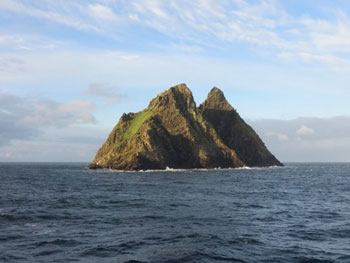 Directly ahead, one hour and twenty minutes away, you find one of the world’s great drives: the Ring of Kerry. From Killarney, the road takes you past abbeys, castles, and picturesque cottages, and offers fantastic views of cliffs and ocean. You can’t miss the dramatic
 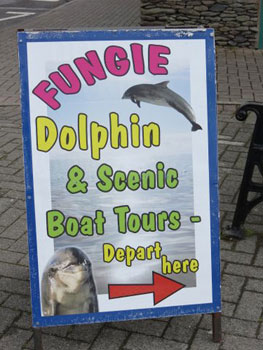 The town of Dingle, just over an hour from Killarney, is colourful, bustling, and sophisticated enough to have charmed such visitors as Paul Simon, Dolly Parton and Julia Roberts. We strolled the winding, hilly streets lined with craft shops, restaurants, and pubs. Deidre’s Cafe on Orchard Lane serves a superb seafood chowder with brown bread, and the jam-covered scones aren’t bad either. Dingle harbour is home to Fungie the Dolphin, and if you get onto the water for a short cruise, he will probably turn up to cavort alongside your boat. Really.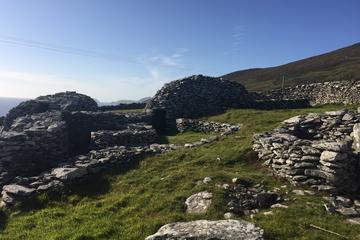
 . Follow his blog at:
  by Jane Parlane
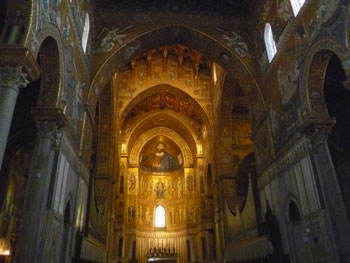
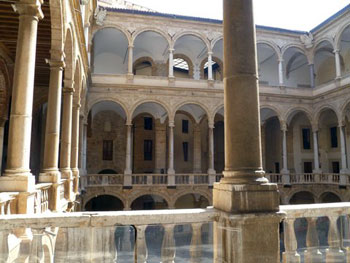 The bus back dropped us at the Piazza Indipendenza, the site of one of Europe’s most beautiful castles. The Royal Palace of Palermo, dating from the ninth century for many centuries housed Sicily’s rulers and even today it’s the seat of regional government. Local politicians are lucky enough to govern from such an architectural gem with its beautiful mosaics, painted roof and marble walls.
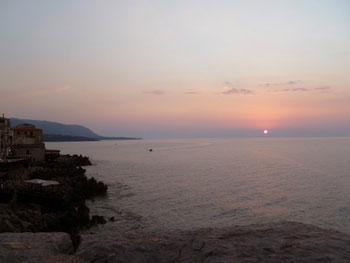 In our rental car it was an easy one-hour drive east to Cefalu, originally a fishing port. Now it’s an attractive cobblestoned tourist town with a sandy beach – not completely lined with recliners. Our accommodation was in an old stone house just a minute from the cathedral and main square. It was easy to find a restaurant table overlooking the sea and over a chilled Sicilian wine watch the bright pink sunset explode while families paraded past.
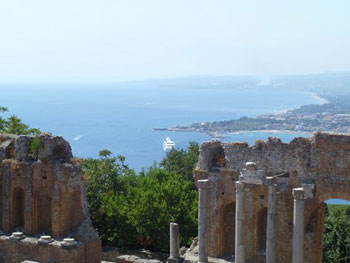 Taormina has many bars where you can sip a Marsala or Campari martini and just people watch. Most evenings you’ll see Sicilians decked out in their finery strutting the streets. Alternatively book an opera or concert at the Ancient Theatre dating from Greek and Roman times – sadly the opera was cancelled during our stay. But the swordfish at a trattoria washed down by a local wine and tiramisu to follow eased the pain.
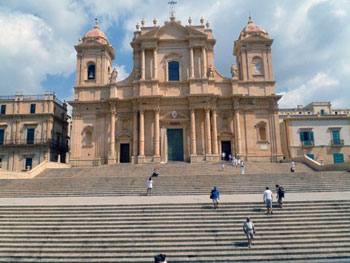 It was an easy day trip the next day to the ancient limestone towns of Modica, Ragusa and Noto, the latter famously rebuilt in 18th century in the baroque style after an earthquake destroyed the town in 1693.
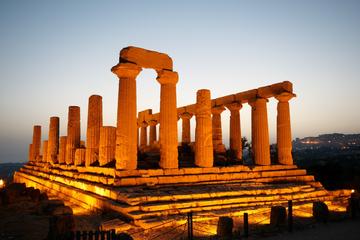
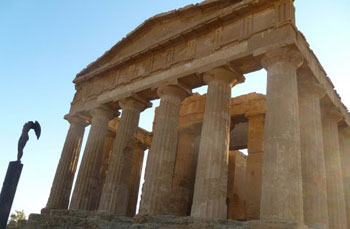 Our final destination for the day was Agrigento, famous for its Valley of the Temples. It was exhilarating to look out of our hotel window and see Greek temples standing there. This once ancient city, Akragus, was dominated by seven great Doric Greek temples built in the sixth and seventh centuries BC. Today several are still wonderfully preserved making the area one of the world’s most important archeological sites. It’s easy to spend two hours with a guide wandering the site, especially in late afternoon when the sun lights up the temples. A bonus for us was the spectacular exhibition by world-renowned Polish sculptor Igor Mitoraj cleverly placed among the ancient structures.
 It was an easy drive on the autoroute to catch our flight from Palermo airport the next morning – just over an hour.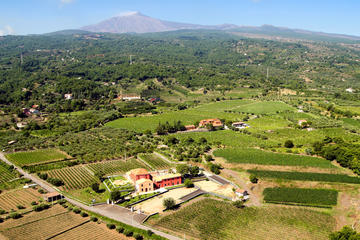
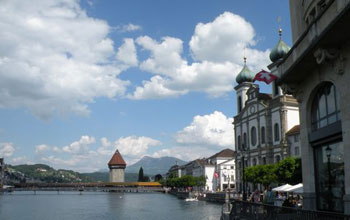
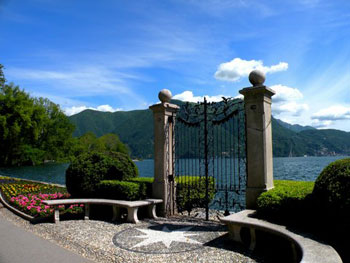 My wife Annie and I are enjoying an eye-opening Alpine sojourn as guests of dear old friends, Margit and Andres, health care professionals who live in Graubuenden but have stayed with us in Canada several times. When not having to work, they drive us around, and we make side trips on our own by train. We had expected beautiful mountain scenery, postcard-perfect towns and a prosperous land of clean efficiency, where the predominant German and French-speaking populations get along. But we had never imagined the full diversity of the rich Swiss cultural tapestry, the quirky and endearing coexistence of the traditional and modern, and the way history is cherished and kept alive.
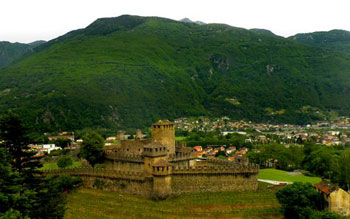
 She takes us to three impressive 13th to 15th century castles that dominate Bellinzona, built by the dukes of Milan to command a strategic river valley and to tax trade along the passes leading northward. Montebello castle, high on a slope, hosts an annual medieval festival, with jousting, period costumes, and roast pig eaten without cutlery from wooden bowls.
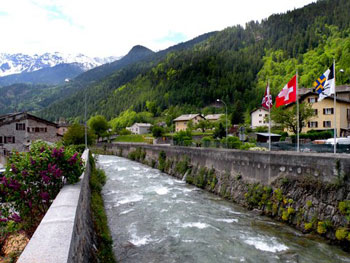 Our destination is Poschiavo, an enchanting village in another isolated Italian-speaking region that is part of Graubuenden itself. We stay at the historic Albrici hotel, built in the 17th century and run for 150 years by the same family. The 10 bedrooms feature antique furniture but no phones, TV or other electronics. We dine outside on the cobblestone piazza, which is bracketed by two ancient churches. The owner recommends some regional main dishes. I enjoy flavourful buckwheat noodles in a creamy sauce, garnished with a skewer of endive and slices of salami. Annie savours the tasty spinach dumplings (gnocchi) with melted cheese, similarly garnished.
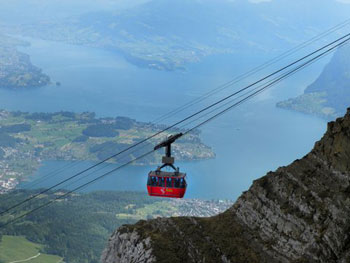 Even the larger central Swiss cities offer an intriguing mix of old and new. In Zurich, our hotel abuts the beautifully maintained old town. Its narrow streets are lined with medieval towers and intersect at ornate fountains featuring sculptures. We indulge in sweets at an elegant 19th century pastry shop but also take the funicular up to see the renowned technical institute just above, where Albert Einstein got his doctorate. In Lucerne, we walk the massive old city walls and cross the landmark 14th century covered bridge. But we also ride a spectacular cog railway (the world’s steepest) up 2,132 metre Mt. Pilatus, where an ultra-modern hotel adjoins a much older one, and watch a paraglider lift off and drift away on the thermals.
 Even within the Swiss-German majority population, we discover, there are minority subcultures. Our friend Andres turns out to be a Walser, the proud member of an alpine tribe that numbers about 20,000 in Switzerland and has sizable communities in neighbouring Italy, Liechtenstein and Austria as well. They trace their history back to the south-central canton of Wallis and an outward migration that began in the 13th century. Historians debate whether the cause was overpopulation, or feudal politics, or possibly the plague. Those who moved northeastward into Graubuenden and beyond were attracted by empty high-elevation lands to settle and privileges offered to them by feudal lords in exchange for doing military service, notably patrolling and controlling the crucial mountain passes.

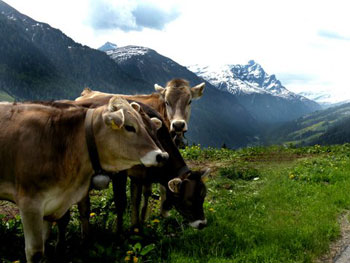
 Andres regales us with stories of his upbringing in the 1960s and 1970s on a subsistence farm high in the Praettigau Valley, just east of Graubuenden’s charming capital city of Chur, where he now works. Like his neighbours, his family had only a few cows, which he helped to feed and milk in winter; in summer they were moved up to higher grazing pastures. A few men from the hamlet tended everyone’s cows, milking them collectively and making cheese every day. The cheese was brought down in autumn and divided up, a festive event that remains an annual celebration. Each family also had a vegetable garden and perhaps a pig, chickens and rabbits. Yet they eked out a livelihood. Andres hiked, or sledded in winter, down to school in the larger village below. He and Margit drive us up switchback roads to a scenic Walser village, Tenna, with a population of around 100 overlooking the Safien valley. There is a two-room school, a cheese-making shop, and a church dating to 1524. The gravestones record only a handful of family names, generation after generation. Houses have huge stacks of firewood and tiny outbuildings that are actually ovens for baking bread. Cows and sheep graze nearby; in May, they have not yet been moved to higher slopes. The weather is sunny and warm, perfect for lunch on an outdoor hotel terrace. We try the barley soup, grilled mushrooms on bread, and local hard cider. Andres greets an elderly couple, who immediately recognize his dialect. You must be from Praettigau, they say, and they are too. They even knew his late parents, but have retired to this distant, yet also Walser, village.
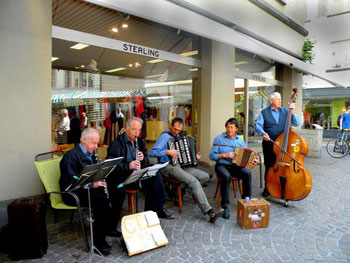
 Another evening, Margit and Andres take us to a concert at a pub high in the Praettigau valley, where Andres grew up, in a village with stunning Alpine architecture where one of his sisters now lives. He is the only one of five siblings who has left the valley, although he has not moved very far. Between songs, the band tells jokes in Walser German. Andres laughs along, but Margit, who was raised in Germany and is totally familiar with mainstream Swiss German, can hardly make out a word. But if we were expecting Tirolean um-pa-pa tunes, we were mistaken. The popular local trio—they have performed 1000 times over 20 years—treats us to to an eclectic display of world music: klezmer, gypsy, tango, blues, Celtic, on a bevy of instruments. Andres’ sister tells us that she is leaving in the morning for a cycling trip in Ireland. Everyone is from the valley, but they all seem well educated and most speak remarkably good English. This is 21st century Switzerland. They may be locals, but they are by no means yokels.
 . Koppel provides a personal tour of that vast ocean and presents the latest findings in archaeology, genetics and carbon dating. Mystery Islands is now available at www.uspbookcentre.com and soon on Amazon.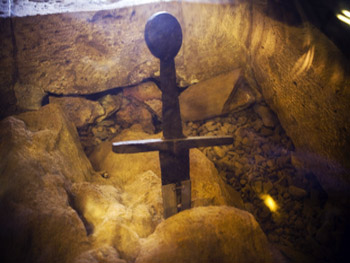
 Cistercian monks built the round chapel of Montesiepi around the “cross” in the stone. The domed roof is built of concentric circles of alternating white stone and terracotta and frescos by Sienese painter Ambrogio Lorenzetti decorate the walls. It has been claimed that the chapel itself is a “book in stone” hiding the location of The Holy Grail.

 Italian scholars claim that Galgano’s Sword in The Stone precedes Arthurian legends and the original story may well be Italian. The first stories of King Arthur appear decades after Galgano’s canonization, in a poem by Burgundian poet Robert de Bron. It has been suggested tales of The Round Table may have been inspired by the round chapel and the name Galgano was altered to become Gawain. Claims that the Italian sword was a fake, made to echo Celtic legends of King Arthur, have been recently disproved. The skeletal arms in the chapel have been carbon-dated to the 12th Century, and metal dating research in 2001, by the University of Siena, indicates the Italian sword has medieval origins. Could it be that the stories of King Arthur are really based on Italian history?
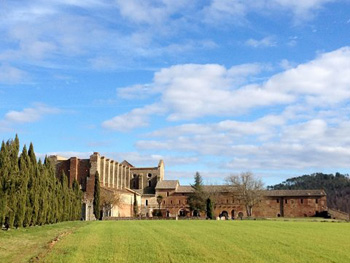
 Every summer the company Opera Festival Firenze holds classical music concerts and operas in this splendid setting. Performed annually, a spine-tingling rendition of “Carmina Burana “ under the Tuscan stars, is unforgettable. Other favourites include Vivaldi’s ”Four Seasons, “Swan Lake” and “La Traviata.”