by W. Ruth Kozak
 At the corner of Lysikrattis and Vironos Streets in Athens Plaka, stands a choreographic monument awarded to a choir at a Festival for Dionysos in ancient Athens’ Dionysos Theatre. Once, next to this monument, the last of its kind in Athens, was a French Capuchin convent. The poet, George, Lord Byron, stayed here when he was in Athens. At that time, the panels between the columns of the monument had been removed, so Byron used it as his study and wrote part of Childe Harold here in 1810-11. This was once the theatre district of ancient Athens, so it seemed appropriate that the flamboyant poet should choose to spend his time there. In Greek, “Vironos” means “Byron” and this is Byron’s street. I used to live there and spent much of my leisure time at the little milk shop, now a posh coffee shop, at that corner. The convent was destroyed in a fire, but there’s an inscribed monument on the spot where it once stood honouring Byron. His presence always seemed near.
 The street adjacent, is Shelley Street, named for his poet colleague Percy Bysshe Shelly who tragically drowned in Italy. Both poets are honoured in Greece, especially Byron, who became a national hero when he joined the Greek resistance movement during the War of Independence.
While in Athens he often lodged with a widow, whose daughter, Theresa Marcri is celebrated in his poem The Maid of Athens. The house where he lived in the district of Psiri at Odhos Pyias Theklas, is marked with a plaque. There are traces of him in various locations. If you visit the Temple of Poseidon at Sounion you will see his name carved in the marble steps. Sunium’s marbled steep, where nothing save the waves and I may hear our mutual murmurs sweep.
I have visited many of the places where Byron lived and can understand how the beauty and serenity of the Greek landscape inspired him. Byron wrote many poems about Greece including the famous “Isles of Greece”
The isle of Greece! The isles of Greece!
Where burning Sappho loved and sung,
Where grew the arts of war and peace, —
Where Delos rose and Phoebus spring!”
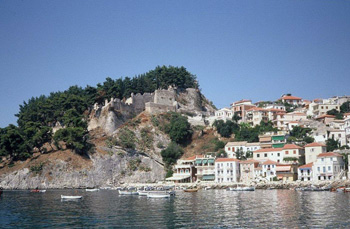
Byron first visited Greece in 1809, landing in the town of Parga. From there he went north to Ioannina where the infamous Ali Pasha held sway. While there he visited the Pasha who had an even shadier reputation with women than the poet. Ali Pasha, like Bryon, also appreciated beautiful young men. He was enchanted by Byron, noting his delicate small ears “the mark of good breeding”. It was during his stay in Ioannina that Byron began his autobiographical narrative poem, Childe Harold’s Pilgrimage, which commemorated his meeting with Ali Pasha who had lavished hospitality on him. Byron knew though that behind Ali’s deceptively friendly countenance were “deeds that lurk” and “stain him with disgrace”. Athens. While at Ioannina he loved to swim out to a small island in the lake. In spite of being born with a club foot, Byron was a skilled swimmer and once swam across the Hellespont from Troy. To this day they hold swimming meets there to remember him.
Yet are thy skies as blue, thy crags as wild;
Sweet are thy groves, and verdant are thy fields,
Thine olive ripe as when Minerva smiled,
And still his honey’d wealth Hymettus yields;
There the blithe bee his fragrant fortress builds,
The freeborn wanderer of thy mountain-air;
Apollo still thy long, long summer gilds,
Still in his beam Medeli’s marbles glare:
Art, Glory, Freedom fail, but Nature still is fair.”
– Childe Harold’s Pilgrimage
Byron traveled the country extensively often visiting the islands. On Lefkada (Levkas) Childe Harold saw the hovering star above Leucadia’s far projecting rock of woe”. This was at the site of ancient Leukadas, a precipitous cliff 200 feet high where there was once a Temple to Apollo. It was here, known today as “Sappho’s Leap” that the lyric poet Sappho tragically committed suicide by jumping off the cliff.
In 1823, apparently bored with his extravagant life in Italy, Byron sailed to Spain and Malta before finally returning to Greece. This voyage is detailed in his poem Sailing with Byron from Genoa to Cephalonia. From Preveza he went north to Parga
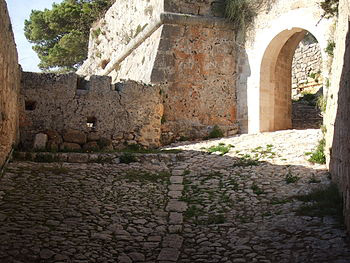 He lived for awhile on the island of Kefalonia (Cephalonia) in the tiny village of Metaxata, near Argostoli, where he enjoyed exploring the ruins of a Venetian castle at Ayios Yeoryios, once the Venetian capital of the island.


On Suli’s rock, and Parga’s shore,
Exists the remnant of a line
Such as the Doric mothers bore:
And there, perhaps, some seed is sown,
The Heracleidan blood might own.
Trust not for freedom to the Franks —
They have a king who buys and sells;
In native sword and native ranks,
The only hope of courage dwells:
But Turkish force and Latin fraud
Would break your shield, however broad.”
During the spring of 1824, Byron fell ill but continued to carry out his duties. During his recovery he was unfortunately caught in a rainstorm and came down with a violent cold. Unfortunately this was aggravated by the bleeding insisted on by the doctors which may have caused sepsis. He slipped into a coma and died on April 1824 at the age of 37.
The Greeks considered him a hero and buried his heart at Messolonghi where there is now a small museum containing Byron artifacts. He remains were sent to England but refused burial in Westminster Abbey and were instead placed in the vault of his ancestors new Newstead. It wasn’t until 145 years after his death, that a memorial to Byron was placed on the floor of the Abbey.
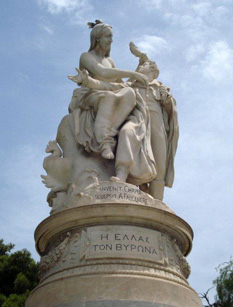
In Greece, he was still revered, and a beautiful monument to him held in the arms of an angel who stands at the edge of the National Garden in Athens. Each time I’m in Athens I visit it and think of the life and poetic words of this exceptional and intriguing man of literature.
If You Go:
THE MESSOLONGHI BYRON SOCIETY
MESSALONGHI: The house where Byron lived was destroyed in WW II and there is a small memorial garden at the site. There is a small museum devoted to the revolution on central Platia Botsari (Mon-Fir 9 am – 1.20 pm and 4-7 pm. Sat & Sun 9am – 1 pm & 4 -7 pm. There is a small collection of Byronia on the ground floor. In the Kipos Iroon (Garden of Heroes) there is a statue of Byron beside the tomb of Souliot commander Markos Botsaris, erected in 1881.
WEB SITES ABOUT BYRON IN GREECE:
The Greek Revolution of 1821
Lord Byron; The Life of George Noel Gordon – Facts & Information
Greece hails Lord Byron a hero and dedicates a day of celebration in his name
About the author:
Ruth lived on Lord Byron’s street (Odos Vironos) for several years and has traveled to many of the poet’s sites in Greece. She is a travel and historical fiction writer. Her novel SHADOW OF THE LION, about the fall of Alexander the Great’s dynasty, will be published in UK in 2014. www.ruthkozak.com
Photo credits:
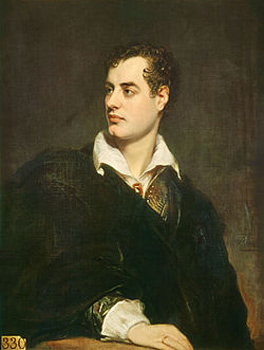
Portrait of Lord Byron by Thomas Phillips / Public domain
All other photos by W. Ruth Kozak
 There is no better place to begin your exploration of this, too seemingly real, walled city. Here beneath the gaze of a serene statue of Saint Louis, actually King Louis IX of France, the city’s ascribed founder, you can sit under the shade of Plantain trees at one of the many outdoor cafes and ponder over the self-guided walking tour pamphlets available at the bordering tourist information centre.

 In 1270 Louis once again led his crusader forces from Aigues Mortes reputedly taking service at the still standing Notre Dame de Sablon (Our Lady of the Sands), alongside Place Saint Louis, ere departing. It was his last foray as he died within months from typhus on the shores of North Africa. His new city however fared much better.
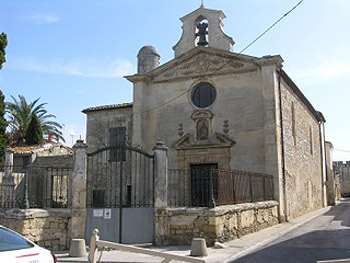
 Visit La Chapelle des Penitents Gris (Grey) [TOP PHOTO] and La Chapelle des Penitents Blanc (White); ancient orders rooted in Christianity’s dim past. Their simplistic exteriors belie the more ornamental interiors.
 Crossing the only bridge spanning the moat surrounding La Tour de Constance brings you to the awe inspiring edifice which harkens back to the very beginnings of the Aigue Mortes fortress town. With the revocation of the Treaty of Nantes (a tolerance act allowing for French Protestants) in 1685 the tower began its long years as a prison. Exploring its bright rooms and walkways it takes some effort to recreate in mind the jailhouse conditions of so many years before. The tower rises above the rampart walls and is topped by an rooftop adorned with a beacon which once served the mariners as a lighthouse. From here you can see the encircled city in its entirety. Here, above the world, its long gone sentries could breath the light Mediterranean air likely much appreciated during odour rich Medieval era.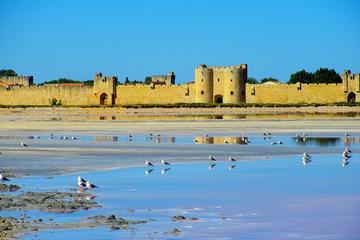
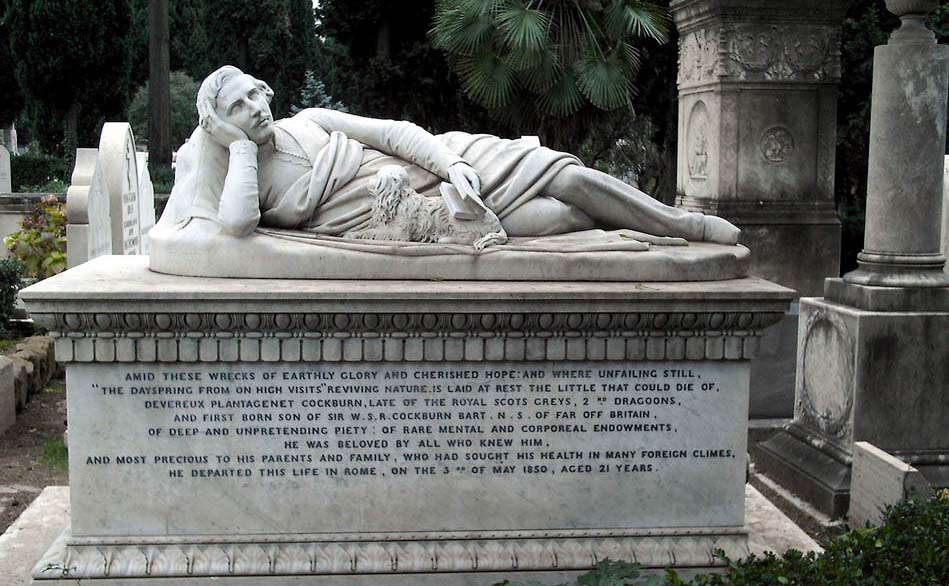
 Perhaps Italians might disagree with me when I use this term, since this, the Cimitero Acattolico, is the last resting place for those who could not, or would not be buried in the traditional Catholic cemeteries here in the heart of Roman Catholicism. But hallowed it is, nonetheless, since this patch of land, overgrown with weeds and flowers, contains the remains of the some of the most important figures of the last few centuries: local dissidents and those from other lands, ex-pats, writers, revolutionaries, atheists and Jews who, famous or not, all came to rest together here in this painfully beautiful monument to non-conformity. Antonio Gramsci, Gregory Corso, and a cat named Romeo are some among this motley crew, though none of them hold higher places in the echelons of artistic memory than the two greats of English Romanticism buried here: John Keats and Percy Bysshe Shelley. How could it not be raining, then? It was as if the luminous Roman sky had been replaced for a moment by a melancholy English one, pausing to weep a bit for two lost sons, entombed amidst the ruins, far far away.
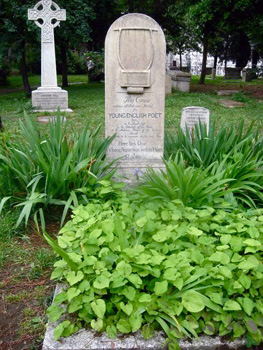 Though their names are often intertwined, John Keats and Percy Shelley came to Italy for very different reasons. Shelley, the rebellious Etonian from an Aristocratic family, was leading a wild life, one easier experienced abroad. He was best friends with Lord Byron and romantically entangled with Mary Wollstonecraft Godwin (turned Shelley), the author of Frankenstein. His lifestyle, radical views, and writing had brought him not only fame, but also infamy. Like many writers and artists of his day, he was attracted to the warmth of the European south, to its classical pagan origins, and to that fact that he could live freely there, away from the scandals that plagued him in England. Keats, on the other hand, came to Italy to die.

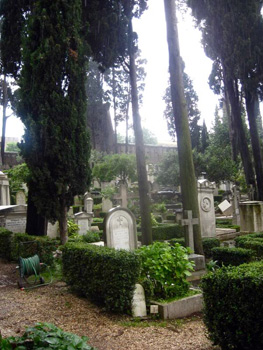 Besides the cruelty inherent in this statement, the irony was palpable too. Keats’ medical training, no matter how practical it may have been, could do nothing to stop what was then an almost incurable disease, tuberculosis. Not long after his brother died, it became clear that John Keats had contracted the illness too. Knowing that he would not survive the English winter, his friends gathered whatever money they could in order to send him to a gentler climate, a last ditch attempt to save his life.
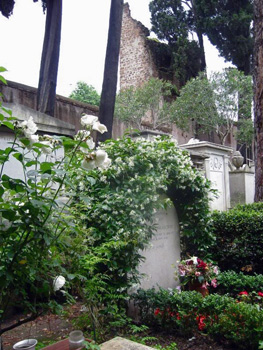
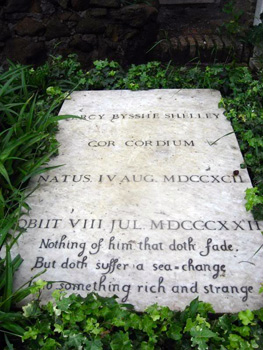 Shelley was buried in the same cemetery a mere year later, the victim of a violent Mediterranean storm that drowned him while sailing off the coast of northern Italy. A book of John Keats’ poetry was found in his pocket. Shelley’s cremated remains (all but his heart, which was kept by Mary Shelley and eventually buried in England) can be found under a small flat tombstone a short walk from Keats’, bearing the Latin “Cor Cordium” (heart of hearts), and a quote from Shakespeare’s The Tempest: “Nothing of him that doth fade, But doth suffer a sea-change is to something rich and strange.”
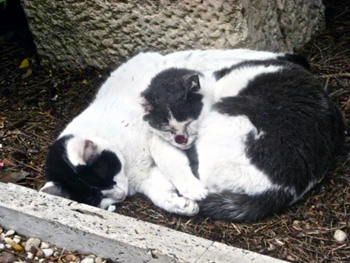 On my own visit, while I sat there overcome with tears, I heard a rustling from the wall above me. From out of one of the vines came a black and white cat, who jumped down onto the bench, and then snuggled up onto my lap. Through my own teary-eyed haze and quixotic imagination, it was easy to believe that in that moment I was being visited by the spirit of the poet himself. Of course, as I got up to walk to Shelley’s grave, straight ahead and to the right, I realised that the cat was just one among many strays who live in the cemetery, and to whose livelihood you can also donate money. However, the impression stayed with me, there on that wet rainy day, as I wandered alone through the grounds of the Cimitero Acattolico. And I emphasize the word “alone”, because visitors here are many fewer than in other famous cemeteries such as Père Lachaise or in Roman tourist spots like Saint Peter’s. When Oscar Wilde visited in 1877, he called it “the holiest place in Rome”. There, breaking bread with the dead, it’s not hard to see why.
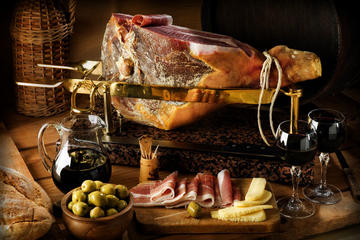

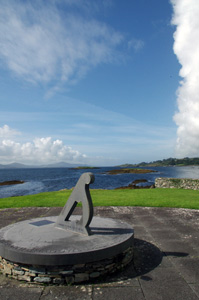 Visiting the Air India memorial is not easy, and the usual response from people in Ireland was “never heard of it” and occasionally, “I remember something about that. When did it happen?” The memorial is not on any tour route nor do tour buses get close so I organized my visit through the hotel in Killarney where I was staying. Killarney is the largest town in the area and a major southern Ireland tourist spot. A local cabbie, who does customized tours, offered a flat rate for the day. The other option, and cheaper choice, would have been to rent a car.

 The memorial includes a well kept with a sundial that commemorates the day and hour of jumbo jet’s explosion in the air. There is a low, stone, semi-circle wall with the names of the victims that appears to cup the sundial. (Picture 4)A tidy garden maintained by the village borders the path to the memorial, which is oriented towards the breezy, wide-open ocean.
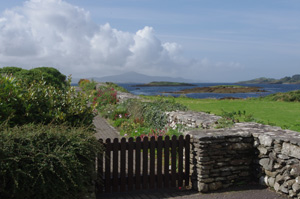 At one point, we had to stop for a flock of sheep across the road which gave the weathered sheepherder time to walk up to the van. He quickly fired off about a dozen personal questions in a sing-songy Irish accent including asking where were we from, where were we going and was I married. Driver Walsh had predicted we were going to be there a long time when the sheepherder headed towards us. Walsh was greatly relieved when another car came around the bend and the sheepherder had new people to question.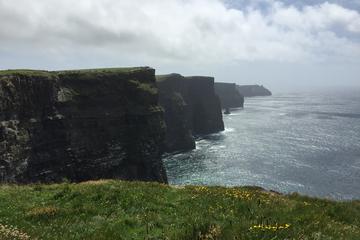
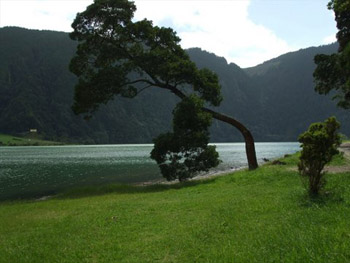
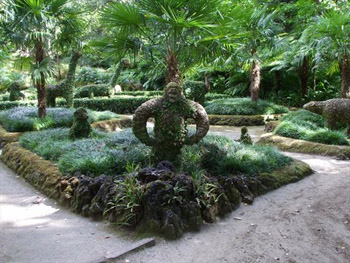 The old spa village of Furnas is our tranquil retreat for a few days before we head to the capital, Ponta Delgada. Here in Furnas is the delightful Terra Nostra Park, a botanical garden created in the 18th century by the American Consul Thomas Hickling. Walking the avenues and winding paths of these gardens we pass monuments, grottos, koi carp ponds, and a whimsical area of animals carved in stone – my favourite is a laughing gorilla stood with hands on hips. Also in the grounds an ochre coloured geothermal lake overlooked by Hickling’s house is popular with many visitors for a restorative swim. Perhaps less popular is the yellowing of swimming gear from the water. I opt not to ruin my swim shorts and instead enjoy an hour lazily swimming in the hotel’s otherwise empty indoor pool.
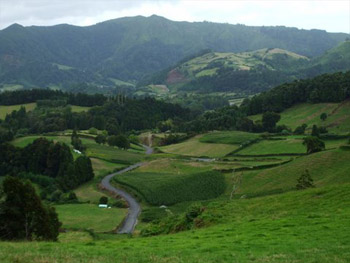 The track could be a tricky ascent when wet and muddy, and is best tackled in dry weather. A few minutes hard walk is amply rewarded by a view across the verdant valley in one direction, and to the other Furnas lake with Jose do Canto’s chapel visible at the far side. A reminder of the volcanic nature of this land is the eggy aroma of sulphur wafting up from the fumaroles below. A young bull chained up nearby is less than enthralled by our presence. His distressed calls eventually signal an end to our viewing. We start the trek back to the village in search of somewhere to get a cold drink.
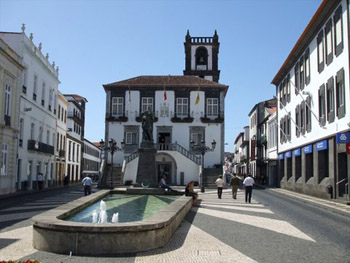 After a mellow few days in Furnas we head to the other side of the island where Ponta Delgada lies in the south-west corner. Here trappings of modern life mix happily with traditional Portuguese architecture – monochrome stone buildings of whitewash edged with black basalt. Squares and narrow cobbled streets in the old part of town can become crowded. So it’s with some relief that we find the drivers to be mostly tolerant of pedestrians.
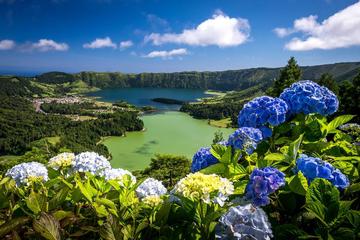
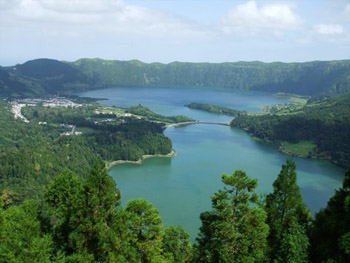 We arrive at the best vantage point, Vista do Rei, where all the brochure pictures of the caldera are taken from. It’s located just off the main road opposite an abandoned concrete hotel, just before the road heads down to the village. Our reward is a superb panorama of the caldera: its twin lakes Azul and Verde, and the village of Sete Cidades nestled on the flat land to the western side. Giant blobs of cloud shadows move across the murky green and blue lakes like giant Rorschach tests. From this spot the adventurous can embark on a long walk around the ridge of the caldera on a narrow path edged by vertiginous drops through trees and other foliage.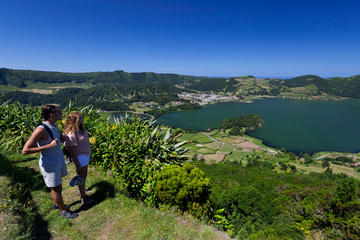




.jpg)