Travel Thru History

Historical and cultural travel experiences

  • Home
  • Airfare Deals
  • Get Travel Insurance
  • Writers Guidelines

The Serpent Shadows of Chichén Itzá

spectators view equinox shadow at Chichen Itza

Maya Mystery in Mexico’s Yucatan

by George Fery

What we see is not always what we expect whether from nature or man-made. This is often true with archaeological remains of ancient cities or human settlements, when new discoveries shed unexpected light on old finds, leaving question marks in their wake. So, let us have a look at Chichén Itzá, the Maya pre-Columbian city in Mexico’s Yucatán Peninsula, that is a place we thought had been thoroughly explored and visited, at last count by over five thousand people per day, but yet…

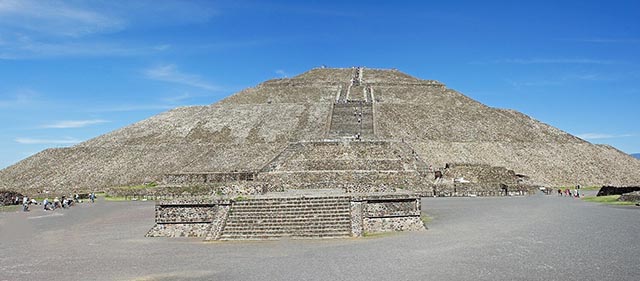
The biggest visitor’s draw take place on the spring and autumn equinoxes, when the sun plays with the angles of the northeast stairway of the Kukulcán pyramid, called El Castillo in Spanish. At that time, the course of the sun at sunset projects the shadows of the corners of the pyramid onto the vertical northeast face of the stairway balustrade, giving the visual impression of an undulating serpent slowly crawling down toward its stone head at the bottom of the stairs. Thousands of tourists gather on the Grand Plaza to witness the event. They come to simply share in a common spirit that transcends time and culture. In our age of extraordinary advance in sciences and technologies, unimaginable only twenty years ago, peoples seem to search for “something” beyond their daily lives in a swiftly changing world.

To find out how this remarkable city came to make history in the Yucatán, requires a brief look at why Chichén Itzá became such an important theocratic metropolis. Its history spans from the mid-Classic (600-900AD) to the early part of the Postclassic period (900-1200AD). The ancient city historical record, however, is clouded in uncertainty with often inconsistent description and dates. Help may be found with early Spanish chroniclers and the nine Chilam Balam books written by the Mayas in the sixteenth and eighteenth centuries, such as those of the towns of Chumayel, Ixil and Tizimin, among others. The Chilam Balams are collections of myths, prophesies, mythological and ritual texts among other topics. Chilam means together prophet and priest, while Balam stands for jaguar. At its height, Chichén Itzá was a major theocratic center in the lowlands, drawing pilgrims from afar with its sacred well.

Kukulcan and the Temple of VenusFrom early times, the Mayas traded with cities in central Mexico, exchanging beliefs and inherent in such contacts. Toltec groups migrated sporadically to the Yucatán throughout the sixth centuries and possibly earlier. Their migration to both the west and east coasts of the lowlands intensified in the early tenth century when their objectives shifted from trade to military and political control of the peninsula. Together with the Maya-Chontal, historians call Putún, they came from Ppolè on the Yucatán’s east coast. They then united their forces at Cobá with those of the Toltecs, sixty-two miles away on the connecting sacbeh (white road), to Yaxuná, and thirteen miles from Chichén. From Yaxuná, they conquered Chichén Itzá in 987AD; this event is recorded as “the great descent.” The building of the Kukulcán’s we see today started shortly after their taking possession of the ancient city.


The Shadow and the Equinox

For the ancient Maya, the pyramid was representative of the four-sided temple-mountain, or fourfold partitioning of the world. The name of the Maya deity before the Toltecs’ Tlaloc, was Cha’ac in Yucatec. Kukulcán, that is Quetzalcoatl in the nahuatl language means “Quetzal Feathered Serpent” is a deity that came with the Toltec capital of Tula, in Mexico’s highlands. The Toltecs brought their own god Tlaloc with similar religious attributes as those of the local Maya god Cha’ak, “the longest continuously worshipped god of ancient Mesoamerica” (Miller & Taube, 1993:59). Tlaloc, like its Maya equivalent, is believed to represent the Creation Mountain. For it is the top of mountains that receive rain first in tropical highlands and holds waters in its caves helped by guardian deities. Furthermore, the pyramid is the cultural apex found in most ancient mythologies, believed to have its inverted counterpart bellow the upward structure or counter-image, in the “otherworld.”

The interface between the bases of both pyramids, is where humans and all life-forms live. This inverse perception of a world below is grounded in the belief that the vegetal world sprouts from beneath the ground. After all, are not the roots pointing down into the earth undeniable proof of nature’s perpetuation of life through its never-ending cycles of birth and rebirth? The symbolism of life’s perpetual renewal is underscored again with the serpent’s iconography that appears on numerous stone stelas, temple columns and painted on ceramics. What is seen is not the animal but its perceived power over life. The shedding of its skin was believed to be the renewal of time and life through nature’s repeated cycles. The allegorical significance of the serpent figure in agrarian cultures’ mythologies, assigns the animal shedding of its skin as its past, to live again another life.

Chichen Itza and its reflectionKukulcán is not cardinally oriented, although mythologically it is believed to sit at the center of time and space. Its corners are aligned on a northeast-southwest axis toward the rising sun at the summer equinox, and its setting point at the winter equinox, making it a monumental sun dial for the solar year. Each of the temple-pyramid’s fifty-two panels seen in the nine terraced steps, equal the number of years of the solar calendar. The pyramid’s nine levels are reminders of the nine steps to Xibalba, the underworld. Above all, Kukulcán is an instrument dedicated to the deities of nature and their role in its alternances such as night-day and life-death. The western and eastern sides of the temple are angled to the zenith sunset and nadir sunrise. The main doorway of the temple at the top of the pyramid opens to the north. The four stairways, one on each side ascending the pyramid, have 91 steps each, equal to 364 steps that, with the temple at the top, total the 365 days of the solar year, the haab’, in Maya. The north stairway is the main sacred path, that of the sun at dawn, and it is on its northeast balustrade that triangular shadows appear at sunset on spring and autumn equinoxes.

The Great Plaza, Kukulcán and the Primordial Sea

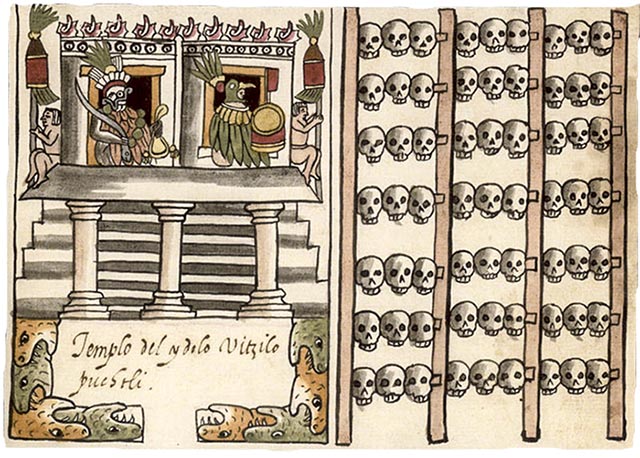
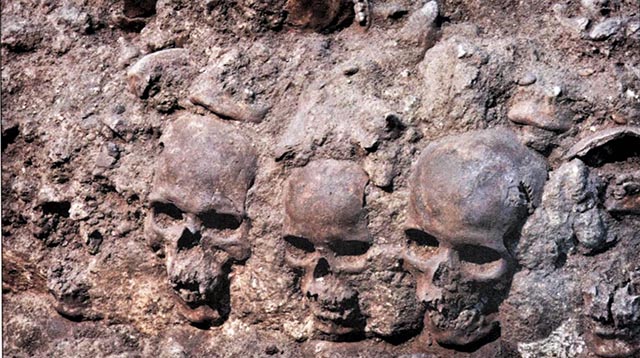
Chichen Itza in Great PlazaThe Great Plaza that surrounds El Castillo on four sides, was completed during the New Chichén phase (900-1500AD). Symbolically, it represents the “primordial sea of creation” from which, according to Maya tradition, all life sprung at the beginning of time. The plaza’s north side, on which Kukulcán is built, was also the area where major ceremonies took place. It is bordered by the Venus Platform, close to that of the Jaguars and Eagle Warriors, behind which is the massive skull rack, or tzompantli in nahuatl. It is 164 feet long by 40 feet wide and may follow in size the biggest in Mexico-Technochtitlán. On  the skull rack was a scaffold-like built of wood poles over the stone structure, on which hundreds of skulls of war captives and sacrificial victims were displayed.

On the east side of the Great Plaza is the massive Temple of the Warriors, and the no less important Ball Court to the west, the largest in the Americas – 552 feet long by 300 feet wide, with 20 feet high walls. The theocratic city inner sanctum was the Great Plaza, that was surrounded by a seven feet high wall with a number of guarded entrances, among which is the 980 feet long and 25 feet wide sacbeh.1 or “white road” that leads to the Sacred Well. There are over 34 sacbehobs (sacbeh plural), in Chichén connecting major structures and residential complexes. Most buildings are oriented 17 degrees off true north; Kukulcán is 23 degrees off.

Chichén Itza Spiritual Gateways

There are two spiritual gateways, that are linked to the temple-pyramid, one natural, the other man-made. The first is the huge sacred cenote, or sink hole, called the “Great Well of the Itza.” The name Chichén Itzá in Maya-Chontal, is made up of the words “chi” that means mouth and “chen” for well; while “itz” means sorcerer and “ha” or “á” is for water, that translate as “the mouth of the well of the water sorcerer” (Piña Chan, 1998:32). The Chilam Balam de Chumayel record an earlier name, before the Itza’s arrival, as Uuc Yabnal (“Seven Great Houses”), that is found engraved on door jambs in “Old Chichén.”

well of sacrificesThe First Spiritual Gateway is the Sacred Well, a large sink hole that was not used for domestic purposes, but for rituals. It is reached by the large elevated sacbeh.1 heading 980 feet northward from the Great Plaza. This sink hole was believed to be the place of contact with the deities of Xibalba, the “place of awe” or underworld, abode of the tantamount Maya god Cha’ak, the powerful Maya god of rain, lightning and thunder. The Sacred Well is oval shaped (164 feet by 200 feet). From its lip to the drop is 79 feet to the water and its depth 65 feet; there is a bed of mud about 20 feet thick at the bottom.

In one of the rooms of the shrine built on the south side lip of the well, was the temazcal or steam bath in the nahuatl language, to purify sacrificial victims to Cha’ak or Tlaloc. Gifts to the god were precious jade and gold, fine ceramics, jade and lives, as human remains found at its bottom testify. Of forty-two human remains, more than half were younger than twenty and fourteen were younger than twelve years old (Tozzer, 1957:212-213). Offerings in the cenote to the gods Tlaloc or Cha’ak are noteworthy for their origins, particularly gold and mix gold-copper metals (tumbaga), that were not used by the Maya, but imported from lower Central America. Atonement gifts were in reverence to the needs of the time and the demands of the deities. The archaeological record shows that human sacrifices were of both gender and of any age. In time of dire needs, however, such as persistent droughts, a community would sacrifice its best, not the sickly or the maimed. Sacrificial victims had to be able, in their prime and, the younger the better for the gods would not accept anything less.

The socio-economic organization of ancient Maya communities, as that of other ethnic groups at the time, revolved around agriculture. At the Yucatán’s latitude there are only two seasons, which meant two harvests. Hence the Maya religious organization that adhered to a close partnership with nature. The gods and deities from above and below humankind plane were those believed to drive the fundamentals of sun, rain and the vegetal world. Those fundamentals are enshrined in the Maya-K’iche’ sacred book, the Popol Vuh or Book of Counsel, which describes the creation of the universe by the gods who, after failing four times, succeeded in creating humankind out of maize dough.

The “Feathered Serpent” is a mythological deity of the Toltecs found in Late Classic architecture (600-900AD). In Guatemala the deity was called Guqumatz by the Maya-K’iche’, while the Maya-Lacandón refer to it as an evil monstrous snake, the pet of the sun god. Before the Toltecs, the Maya god of agriculture, wind, and storms was Cha’ak, “the longest continuously worshipped god associated with abundance and fertility in ancient Mesoamerica” (Miller & Taube, 1993:59). Kukulcán appears in the mid-Classic Maya period (800-1500AD), as the Vision Serpent.

close up of serpent shadow on Chichen ItzaThe serpent sculpted on monuments at Chichén Itzá and other Mesoamerican sites is a metaphor, for it was perceived as it slithers, as the swirls of smoke following self-sacrifice by a member of the nobility or the priesthood. After a self-inflicted wound, a person’s blood would drip on thin sheets of dry bark paper that was then burned. The swirling smoke of the burning bloodstained bark paper was believed to carry the prayers of the supplicant to ancestors and deities, seeking their guidance for living another day in a dangerous world. For ceremonies, copal nodules called pom in Maya-K’iche’, are used instead of human blood. Copal is a tree resin obtained from the sap of the copal tree (protium copal), emblematic of the vegetal world’s “blood.” In the Yucatán today, for Chac Xib Cha’ak ceremonies or “Red Man Cha’ak”, fowls and small mammals may also be sacrificed to plead for rain and a good corn harvest.

Chichen Itza ballcourtThe Second Gateway is the Toltec style I-shaped Great Ball Court is the second spiritual gateway. It is man-made but no less a powerful portal, located on the west side of the Great Plaza. Four temples are associated with the ball court, the Upper and Lower Temples of the Jaguars as well as the North and South Temples. For the ancient Mayas and Toltecs, ritual games played in ball courts were believed to open a portal to the “otherworld” This “gateway” however, could only take place during a ritual fateful game destined to end in sacrifice. The Book of Counsel (Popol Vuh) stresses that the deities of Xibalba in the underworld, did not play unless a ritual contest took place simultaneously above ground. It is only when ritual games were concurrent in this world and the “other” that the interplay between the participants in the two worlds were believed to materialize, that is, open the door to the underworld. Through history, secular and ritual games underline the same need to keep peace and balance within and between communities as well as with gods and deities. Secular games did not involve sacrifice and took place more frequently, with the same intensity as our games today, along with heated betting on teams and players. Essential to ritual games, however, and to a certain extent secular games as well, was the need to keep in check latent antagonism between factions of the same polity, as well as between polities.

The Pyramid Within and Balamku’s Cave Below

illustration of pyramid within KukulcanBuilding larger structures over smaller ones was a common practice in Maya and other ancient Mesoamerican cultures. The reason was that any man-made structure was the product of culture and therefore was believed to be saturated with the ancestral power of those who ordered its construction, together with that of their stone carvers, and could not willingly be destroyed. The pyramid within Kukulcán, discovered by archaeologists in 1958, has a single stairway that faces northeast; it has sixty-one steps and a temple on top with two parallel galleries. There is a triple molding on its façade and a frieze showing a parade of jaguars, shields and two intertwined serpents over its main door. In the antechamber of the inner temple was found a red jaguar that may have served as a throne for the High Priest. On the seat was an offering of a turquoise mosaic disk. The jaguar is painted red on polished limestone; the teeth are made of flint, and there are incrustations of fine jade disks for its eyes and on its body for the animal spots. Architectural similarities between the two pyramids indicate that the one within may also be of Toltec origin, possibly built 650-750AD. Was the “serpent” shadow also seen on the buried structure at spring and autumn equinoxes? Unlikely.

illustr4ation of cenote beneath KukulcanIn 1958 a cenote or sink hole was found sixty-five feet beneath Kukulcán, its waters running from north to south. The pyramid seats on a 16-20 feet thick limestone layer above the sink hole’s dome. The discovery, together with a man-made corridor below the cenote, was sealed off from the outside world, probably for lack of resources to further its exploration at the time. The cenote and the cave system were “re-discovered” during the ongoing research project GAM-Gran Acuifero Maya (2016), that expands below the archaeological complex and beyond, including the cenotes Xtoloc, Kanjuyún and Holtún. The cenote below the pyramid is at the center of the Toltec mythical world, its axis mundi. Sink holes, above and below ground, were regarded as gateways to another side of reality, for water was perceived to be the single most important medium for the survival of all life forms. Below Kukulcán’s sink hole, a cave that was also found in 1958, was partially explored in 2018 by the National Geographic’s arqueologists Guillermo de Anda, Ana Celis and their team of investigators from the Great Maya Aquifer Project (GAM). During their investigations was found below the cenote, a 1,500 feet long corridor difficult of access.

The archaeologists called the cave Balamkú, that is Maya for “Jaguar God ” for its ancient name is unknown. The black jaguar is a central figure in Mesoamerican and other pan-American mythologies, because of the belief in the animal’s ability to enter and leave the underworld at will, while the spotted jaguar is symbolic of the deities and powers of light. Maya cave ceremonies, especially those that took place in their deepest recess, were bound to rituals performed within the underworld. Those rituals were enacted to symbolically “re-enter the womb” in addition to a sense of rebirth and renewal upon exiting the cave, inherent to initiation. Exploration of the cave system was funded in part by a grant from the National Geographic Society, in cooperation with the University of California at Los Angeles. So far, over 170 ceramic bi-conical censers and other pots were found in seven small rooms carved out of the limestone walls and were identified as those of the Toltec god Tlaloc. The ceramics are dated from the Late Classic (700-800AD) to the Terminal Classic (800-1000AD), contemporaneous with those in the nearby cave at Balamkanché. This important discovery will no doubt help rewrite Chichén Itzá’s history.

In the archaeologist Guillermo de Anda’s opinion, Balamkú seems to be what he called the “mother” of Balamkanchè located 2.5 mile away, since as he puts it “I don’t want to say that quantity is more important than information, but when you see that there are many, many offerings in a cave that is also exceedingly difficult of access, this tells us something” (2017:15). Archaeologists now have the opportunity to answer some of the most perplexing questions that continue to stir controversy among professionals, such as the level of contacts and influence exchanged between Maya highland and lowland cultures, as well as with central Mexico, and perhaps clarify what was going on in the Maya world prior to the building of the first pyramid at Chichén Itzá.

Chichén Yet to be Discovered

archaeological excavation in Great PlazaThere still is a lot to be discovered at Chichén Itzá, since much more is hidden, as work on Balamkú reminds us. Furthermore, excavation programs in the Great Plaza, started in 2009, revealed buried structures that pre-date Kukulcán. By then we already knew about the pyramid within. Puzzling discoveries and wonders are certain to continue. We will visit Chichén Itzá again of course, since this story is only a glimpse of the ancient city’s complex history, while so much more wait to be brought to light. Understanding the “whos” “whys”, “whens” and “hows” of the city’s great past will take a few more “stories” and interpretations in the light of ongoing discoveries.

Whether or not sharing the serpent’s shadow during the equinoxes help visitors in their quest for balance in their lives, they will leave the ancient city and return home with fascination and wonder. What else does Chichén Itzá, and its great pyramid hold? And what happened to Kukulcán? After the defeat of Chichén Itzá by the Cocom ruler Unac Ceel of Mayapán in the thirteenth century, Kukukcán moved with the conqueror to the new Maya political epicenter, sixty-five miles to the west…but that is another story.

Credits for Photos & Illustrations

  1. Equinox Shadow by Fernando Pineyro in postcardemexico.com
  2. Kukulcan and Temple of Venus georgefery.com
  3. A World Below georgefery.com
  4. Chichen Itza Great Plaza georgefery.com
  5. Sacred Well of Sacrifices georgefery.com
  6. The Serpent and the Equinox georgefery.com
  7. The Great Ballcourt georgefery.com
  8. Two Kukulcans Alberto Ruz Lhuillier, 1998:21
  9. Gateways to Another Life INAH-GAM in geofisica.com.mx
  10. Great Plaza Discoveries georgefery.com

Bibliography – References:

Román Piña Chan, 1998 – Chichén Itzá, La Ciudad de los Brujos del Agua
Ralph, L. Roys, 1967 – The Book of Chilam Balam of Chumayel
Scarborough & D. R. Wilcox, 1991 – The Mesoamerican Ballgame
Linda Schele & Peter Mathews, 1998 – The Code of Kings
Ralph L. Roys, 1965 – Ritual of the Bacabs, A Book of Maya Incantations
Eric S. Thompson, 1970 – Maya History and Religion
Fray Diego de Landa, 1966 – Relación de las Cosas de Yucatan
Clemency Chase Coggins, 1984 – Cenote of Sacrifice
Mary Miller & Karl Taube, 1993 – The Gods and Sybols of Ancient Mexico and the Maya
Linda Schele & David Freidel, 1990 – The Untold Story of the Ancient Maya
Nigel Davies, 1980 – The Toltec Heritage
Robert J. Sharer & Loa P. Traxler, 2006 – The Ancient Maya

Chichen Itza Tours Now Available:

Private tour to Chichen Itza, Valladolid and Ek Balam
VIP Chichen Itza & Coba Private Tour
From Cancun & Riviera Maya: Early-Bird Chichen Itza, Cenote & Valladolid Tour
Chichen-Itza Evening Light Show & Ik Kil Blue Cenote Tours~Also Accessible Tour

About the author:

Freelance writer, researcher, and photographer, Georges Fery (georgefery.com) addresses topics, from history, culture, and beliefs to daily living of ancient and today’s indigenous communities of the Americas. His articles are published online in the U.S. at travelthruhistory.com, popular-archaeology.com, and ancient-origins.net, as well as in the quarterly magazine Ancient American (ancientamerican.com). In the U.K. his articles are found in mexicolore.co.uk.

The author is a fellow of the Institute of Maya Studies instituteofmayastudies.org  Miami, FL, and The Royal Geographical Society, London, U.K. rgs.org. As well as a member in good standing of the   Maya Exploration Center, Austin, TX mayaexploration.org, the Archaeological Institute of America, Boston, MA archaeological.org, NFAA-Non Fiction Authors Association nonfictionauthrosassociation.com, and the National Museum of the American Indian, Washington, DC. americanindian.si.edu.

Tagged With: chichen itza, Maya pyramid, yucatan travel Filed Under: North America Travel

How To Spend A Romantic Getaway In Historic Charleston, South Carolina

horse and carriage

by Loretta Berry

When I travel I love to learn about the history of a place and about its people. What made ordinary people seek new lands? What daring adventures did they have and what struggles did they experience to get there? What was life like in this place hundreds of years ago?

As a girl I read a lot of historical novels including those set in Charleston. I dreamed I was there – Women wearing beautiful lace, hoop-skirt dresses and dashing men in coattails and top hats strolling arm in arm down cobblestone avenues or sipping tea in the parlor of a grand mansion by the waterfront. It was all so romantic.

Charleston is full of history. The oldest city in South Carolina, founded in 1670, it is the epitome of southern charm and hospitality. History and romance ooze on every street in the historic district, like something out of one of the novels I used to read.

Charleston is also one of the most remarkably well-preserved cities in America. The restoration efforts by local groups to preserve this great American city is noticeable and is what keeps Charleston’s grand old buildings and homes, and their rich history, intact, restored, and preserved for many more generations to enjoy.

Here is my list of how to enjoy the history and find romance in Charleston:

Take a Walking Tour

French Huguenot Church, CharlestonWe found that the best way to see Charleston is by walking around. We grabbed our tour book and headed out. You can stop by the Visitor’s Center for a free map or pick one up in your hotel lobby. If you prefer a guided tour, there are many Walking Tours available.

Must see points of interest: St. Phillip’s Episcopal Church and Graveyard, the Dock Street Theatre built in 1736, and the Gothic Revival style French Huguenot Church all on Church Street.

Nearby is Chalmer’s Street – Walk on the original cobblestone street paved in 1760. There you will find the famous Pink House, the Old Slave Mart (now a museum), and the German Fire Steam Engine Co. (a fire house used from 1851-’88).

At the end of Broad Street, on East Bay Street, stands the Old Exchange and Provost Dungeon (now a museum). East Bay street is also where you’ll find the iconic Rainbow Row houses.

Be sure to visit the Pineapple Fountain in Waterfront Park and White Point Park at the end of Battery Street to see its 160-year-old oak trees, civil war cannons, and monuments.

Enjoy a Horse-drawn Carriage Ride or Tour

What could be more romantic than riding in a carriage down centuries old cobblestone streets? Whether its just the two of you or you’re enjoying a family vacation, one of the best ways to experience Charleston is relaxing in an open carriage ride – feel the sunshine on your skin, smell the sweet fragrances of the many gardens throughout the city, hear the clippity-clop of the horses hooves all while listening to the driver’s tales of a by-gone era as he points out various historical landmarks.

There are several companies that offer horse-drawn carriage tours including Charleston Carriage Works, Classic Carriage Works, Old South Carriage Co, and Palmetto Carriage Tours.

Admire Historical Antebellum Mansions

Pink House, CharlestonNothing speaks romance louder in Charleston than its historic, grandiose, antebellum mansions. You can’t miss them as you walk or drive around.

Get a glimpse into the lives of past Charleston elite and most prominent residents. Take a tour of these mansions and their magnificent English gardens. If only the walls could talk.

A few notable homes that offer tours are the Heyward-Washington House, built in 1772 by Thomas Heyward, one of the signers of the Declaration of Independence, and where President George Washington once stayed. The three-story Federal-style Edmondston-Alston House built by a notable shipping merchant in 1825.

Williams Mansion, a fine, Gilded Age, 24,000 square foot home of business tycoon George W. Williams. One of my favorites, with its three-story “flying” staircase, is the Nathaniel Russell House. And there’s the iconic Aiken-Rhett House and Museum.

Mansion tour times, information and tickets are available online. Prices vary for each house with discounts available for multiple tours.

Visit Historic Magnolia Plantation and Gardens

Magnolia Plantation GardensAll the fun and romance doesn’t just happen in the historic district of Charleston. Just 12 miles away on SC-61 you’ll find the Magnolia Plantation and Gardens. This impressive 500-acre estate was acquired by the Drayton family in 1676. Listed on the National Register of Historic Places, it is one of the oldest plantations in the South. Once a rice plantation, Magnolia is now known for it’s 60-acres of romantic gardens. Visit anytime of year and you will find hundreds of fragrant, colorful blooms.

The estate also includes a reconstructed and restored pre-Revolutionary mansion, horticultural maze, nature trails, petting zoo, biblical herb garden, nature boat, nature train, and a swamp garden.

Hours of operation vary throughout the year. Allow 2 hours for a tour, although you might want to stay all day. Prices vary depending on tour. For information and to buy tickets, click here.

Take a Harbor Tour and Visit Fort Sumter

Cruise out to Charleston’s most popular attraction, Fort Sumter. Spend an hour exploring the small island and fortress, now a National Historic Park, where the first shots of the Civil War rang out. While cruising you’ll see the city wall, Battery Park, the skyline with its many church steeples, and the stately Rainbow Row and Battery homes along the waterfront.

Boat Tours depart from two locations: Liberty Square and Patriots Point. Tour times vary throughout the year. Ticket prices also vary with discounts for kids, seniors, and active military.

Other Harbor Tours include a 90-minute, narrated Charleston Harbor Cruise with a certified tour guide and for even a bit more romance, enjoy a multi-course dinner and drinks aboard a SpiritLine Dinner Cruise.

Be Awed by Historic Churches

Charleston SkylineNicknamed “Holy City” for its many churches, no visit would be complete without checking out these historic places of worship. Admiring the architecture alone is worth the stop. Many still hold services. Some provide tours.

Stop and listen to the bells ringing from the bell tower of St. Phillip’s Episcopal Church (c.1836) at noon.

Admire the Cathedral of St. John the Baptist Roman Catholic Church (c.1907 the original 1854 church was lost in a fire).

Visit St. Michael’s Church (c.1761). Sit in the very same pew as President George Washington and Gen. Robert E. Lee when they worshiped here.

Shop ‘Til You Drop

Silk Scarves in Charleston MarketBelieve it or not, not everyone who visits Charleston is a history buff or romantic. The good news is that there is so much more to see and do here – something for everyone. For instance, Charleston is a shoppers paradise.

The Shops of Historic Charleston on Meeting Street is where you’ll find bookstores, boutiques, reproduction furnishings, jewelry, and artwork.

Upper-crust retailers like Gucci and Louis Vuitton alongside mid-range shops can be found at The Shops at Belmond Charleston Place, also on Meeting Street.

As you stroll through the French Quarter, look for the many eclectic shops and galleries in Cabbage Row/Catfish Row (89-91 Church Street).

Upper King Street is home to the “designer district” with a bohemian atmosphere. Innovative furniture shops, home décor, and designer jewelry along with trendy restaurants and lively nightspots. While Lower King is home to Antique Row, “hip” boutiques, and art galleries.

Over 200 years old, the City Market is a “must-see” and the best place to find souvenirs. The four-block long open-air market hosts dozens of vendors with everything from spices, South Carolina treats, and hand-crafted trinkets, hats, and artwork. A must-have souvenir is a traditional African sweetgrass basket hand made by local Galluh women.

Museums And Other Interests

Rainbow Row CharlestonCharleston has its fair share of history museums, but there are others. The Gibbes Museum of Art, Children’s Museum of the Lowcountry, Postal Museum, Karpeles Manuscript Library Museum, and the Mace Brown Museum of Natural History.

South Carolina Aquarium is home to more than 5000 animals, from the ocean and coastal region to the forest and mountains.

For military buffs is Patriots Point Naval and Maritime Museum Just north of the historic district across the Cooper River. Home to the USS Yorktown, destroyer USS Laffey, submarine USS Clamagore, and 28 historic aircraft.

Nearby historic Fort Moultrie was prominent in the Revolutionary War. A palmetto-log fort, it was first attacked by nine British ships in 1776.

There is so much to see and do in Charleston. One thing is for sure, one trip is not enough – You will want to go back time and again.

How To Get There

Getting there is easy. To drive is less than five hours from Atlanta and three from Charlotte. Most major airlines fly into Charleston International Airport (CHS), 12 miles west on I-526.

Where To Eat

After a day of sightseeing or shopping you’ll want to grab some lowcountry cuisine at the many dozens of restaurants in Charleston’s historic district. Most of them serve fresh seafood as well as lowcountry favorites – shrimp and grits, lowcountry boil (sausage, shrimp, potatoes, and corn-on-the-cob), she-crab soup, crab cakes and oysters.

Some favorites are SNOBS – Slightly North of Broad Street, housed in a renovated 18th century warehouse. You’ll find upscale and refined southern cooking at Magnolias. One of my favorites, housed in an old church (of course), 5th Church Charleston. And Amen Street Fish and Raw Bar. Best she-crab soup ever. The staff is great and even the manager came out to tell us the fantastic history of the building.

Restaurants in the historic district tend to be somewhat expensive, although many have moderately priced items on their menus as well as dishes to share.

Where to Stay

There are several amazing hotels in the historic district, although somewhat pricey. More moderately priced and budget friendly hotels can be found north of the historic district as well as just across the Ashley River to the south and the Cooper River to the north.

The moderately priced Charleston Harbor and Marina Hotel to the north, next to Patriot’s Point, is what I’d consider a grand hotel. It has spacious room with balconies, a swimming pool, jacuzzi, gift shop, and Fish House Restaurant all on site. The Marina here is where you take the cruise to Ft Sumter or a fishing charter. This hotel also has a convenient, 365 days a year, hourly shuttle bus to and from the heart of the historic downtown district.

For younger travelers or anyone dealing with age restrictions, there are resources that highlight hotels open to 18+ guests, making booking simpler.

About the author:

Loretta Berry is a freelance travel writer and photographer. She loves discovering new places and experiencing the local history, food, and drink. She has traveled extensively throughout the United States. She loves traveling with her kids and grandkids, sharing with them her passion for fun and adventure. She is a member of ITWPA and TraveMedia. You can find her on both Facebook and Instagram to follow her travels.

Photo credits:

First horse and carriage photo by Palmetto Carriage Works
All other photos are by Loretta Berry


Tagged With: Charleston attractions, South Carolina travel Filed Under: North America Travel

Colonial History in New York’s Mohawk Valley

Nellis Tavern exterior

by Lisa Evans

“There is nothing new in the world except the history you do not know.”
– Harry S. Truman

St. Johnsville, New York is ripe with Colonial history. It is a charming, quaint village located just a bit over an hour west of Albany and situated along the Mohawk River. Growing up here, I was surrounded by history and places that my youthful mind never appreciated nor found necessary to explore outside classes in high school. Within 15 minutes of my childhood home stands places so steeped in history that all are listed on the National Register of Historical Places.

Fort Klock is likely the most well-known of these places. This homestead, still intact and standing, was built in 1750 by Johannes Klock. Fort Klock played a prominent role in the Revolutionary war, with its owners taking part in the Battle of Oriskany and the bloody encounter known as the Battle of Klock’s Field. While Fort Klock is an amazing place to visit, today I would like to focus on lesser known gems in the Mohawk Valley.

Together, lets sojourn back to these places a few hundred years ago, back to Colonial America, back to Europe in the 18th century, and learn of the people who emigrated to the American colonies in search of freedom and a better life. Let’s learn of the ones who were already here, and the places they built which miraculously are still standing today – over 250 years later.

Indian Castle Church

Indian Castle ChurchThis quaint, beautiful church is located not far from either Little Falls, in Herkimer County or St. Johnsville in Montgomery County. It is quite simply a lovely country church built in 1769 by Sir William Johnson.

Sir William was an honorary member of the Society for the Propagation of the Gospel and the British Superintendent of Indian Affairs in the Colonies. It was built as a mission church to teach Christianity to the Mohawk Nation, one of the Five Nations of the Iroquois League. The land the church is built on was donated by Molly and Joseph Brant, two prominent siblings of the Mohawks of the time. Molly was also Sir William’s companion for many years, having been mother to several of his children. Her brother Joseph became a Mohawk leader and war chief.

Today, it is the only Indian mission church still surviving in New York State and is owned by the Indian Castle Church Preservation Society. The church itself is very simple and lovely. In historical records, it is listed only that as “a wooden church, 50-foot-long by 32 wide.” Its dedication service was in June of 1770. Unfortunately, it never truly acquired a permanent catechist to live among the Mohawks, but there were frequent services performed by neighboring missionaries.

headstones in Indian Castle church cemeteryAfter the British were defeated in the Revolutionary War, the building stood vacant for quite some time. By 1855, the church was in desperate need of renovation and a separate group of churches formed an accord to rebuild Indian Castle Church. Originally, it had been built facing East-West. During the renovation, it was moved on a 90-degree angle, so the entrance now faced North-South. There were many changes made to the structure but today it still holds the original super-structure and a small window in the south attic wall. The roof still possesses its 18th century steep pitch.

Behind the church lies a cemetery and burial grounds which has original headstones and remains of both Mohawks and Europeans. It is an eerily beautiful spot, looking down on the Church from the hill above. A peaceful resting place for its residents, some dating back centuries.

Old Palatine Church

Old Palatine ChurchThis enchantingly humble church is located on State Route 5, between Nelliston and St. Johnsville.

In the early 1700s, many Palatine Germans left their home along the Rhine Valley in southwest Germany in search of economic, religious and social freedom. They first ventured to England. The Crown saw them as a means to settle Colonial America, in the Colony of New York, on the frontier to help England hold the land from the Indians and the French. Many settled in the Schoharie Valley, and many moved to the Mohawk Valley. These pioneers played a significant role in making America. They fought and died at the battles of Oriskany and Saratoga.

One such prominent family was the Nellis family. There were several branches – some were loyalists to the Crown while others were colonial settlers, intent on making a better life. The Nellis family was one of four who provided the necessary funding to build the Old Palatine Church in 1770, making it one of the oldest churches in the Mohawk Valley. It has massive stone walls, made from the limestone taken from a nearby creek. It still has the gilded bronze rooster on top of the spire, donated by the Nellis family.

During the American Revolution, there were devastating raids across the Schoharie and Mohawk Valley. The British were burning all the farms, trying to force the colonists to retreat and leave the fertile farmland along the Mohawk River to the British. It was to be resettled once they won the war. One such raid took place in 1780 not far from the church. While all the other farms on the road were ravaged, Old Palatine Church was not harmed. It is said the British officer stopped there because he had made a promise to his friend Henry Nellis not to harm the church his family had built.

In 1938, the Palatine Society of the Evangelical Lutheran Church Inc. took possession of the deed with the purpose of maintaining the integrity of the history of the Church and ensuring it would always be used as a place of worship.

Palatine Church Pipe OrganThrough the years, the building fell into disrepair and with the generosity of local families, restoration of the Church was made possible. Inside your will find books and other items of historical significance, housed in glass cases to preserve them. The open rafters in the ceiling, the pulpit and sparkling windows allow one to feel the magic of the building. Possibly the clearest statement of this house of worship – besides the history that has seeped into its walls – is the pipe organ.

This magnificent pipe organ was built in 1978 by Robert S. Rowland, in the fashion of organs built by David Tannenberg of the Moravian church. Mr. Tannenberg was the first notable organ builder in the 1700s. The organ was designed to match the interior of the church. It was the last organ done by Mr. Rowland in his long career, being built in Ossining, NY and transported and assembled inside Old Palatine Church.

The church was placed on the National Register of Historical places in 1973, and today still holds limited worship services and special events.

1747 Nellis Tavern

Located just east of the village of St. Johnsville, on State Route 5, you will find Nellis Tavern (photo at top). Another branch from the large Nellis family was Christian Nellis Sr., who moved into the Mohawk Valley in 1722. In 1725, he obtained land and built a homestead along with Fort Nellis near the Mohawk River. By 1747, the Nellis Tavern was born – during the 18th century, travelers were not turned away. With that in mind, and with the tavern’s proximity to the Mohawk River, many travelers docked along the river and sought food and drink at the tavern. As my guide stated, it was rather like a “Bed and Breakfast with Booze.”

By 1767, Christian Sr. had deeded the property to Christian Jr., and the tavern tradition carried on. Not too many years beyond that, the Revolutionary War came to the area and with it came a situation much like that of the Civil War almost a century later. While perhaps not considered at the time, the war pitted family members against family members – splitting them apart. Some fought for the Crown and some fought for the Colonies. The Nellis family was not immune to this trend. Much of the Mohawk Valley was burned, but some buildings remained standing. Perhaps, as in the case of the Old Palatine Church, the Nellis family Loyalist connections saved the 1747 Nellis Tavern.

The building remained a tavern through the mid-1800s. Prior to the Civil War it reverted to being strictly a farmhouse and homestead. It was lived in by members of the Nellis family until the 1950s and then fell into grave disrepair. In the 1980s, the Palatine Settlement Society purchased the land and building, and renovations began and continue to this day.

The allure of the 1747 Nellis Tavern is not only in its history, but also in its architectural and artistic components. Once inside, you can follow the history of the building through all its phases – it is truly fascinating. There are so many nuances, it takes a true visit to appreciate it all, but a few that stood out are listed below.

The wattle and daub construction of the walls. This technique is used in timber framed houses – in between the scored upright stakes, the area is filled with wood, limbs, whatever is available mixed with mud, dirt or animal dung. Then plaster is placed over this. This type of construction affords great insulation for the home. Despite the renovations that have been done, when inside the home, you can see where the original buildings and walls were, where the second story was added, the different size doors in the center room, and the original staircase up to the second floor.

Nellis Tavern stove roomThe artistic stenciling on the walls of the home is something that is truly incredible. During restoration, some wallpaper was removed to reveal underneath 19th century early American stencils. There are seventeen different patterns, including the thistle and tulip. Through a technical assistance grant, the Palatine Settlement Society was able to identically replicate the original stencils from the plaster walls on the newly installed sheetrock. When you see the intricate and beautiful stenciling, you are in awe of the work that goes into this type of art. In the first-floor parlor, there are still three separate stencil patterns, furthering evidence this was once three separate rooms.

The house was ‘reoriented’, meaning originally the door to the home was facing the Mohawk River. In the early 19th century, the Mohawk Turnpike was established. As this now served as the means of travel for most, the back door was made the front and vice versa to ensure the travelers had full access to the tavern. This is also about the time the second story was built to accommodate more guests.

Nellis Tavern Family BibleI would be remiss if I did not mention the late 19th century clasp Bible that is present. This was a Nellis family bible, from the William Nellis branch who had settled near Stone Arabia. It was captivating to see something so sacred to the family on display.

Lovers of times past already know the area in and around St. Johnsville, in the center of the Mohawk Valley, is filled with historical significance for those who choose to look and appreciate.

The next time you take a trip and want to explore some charming off-the-beaten-path places with monumental history at your fingertips, venture to the Mohawk Valley. From Albany, head west on the NYS Thruway (I-90) or Route 5. From Utica or Syracuse, head east. You will not be disappointed.

For More Information:

Indian Castle Church is located at 141 Dillenbeck Rd, Little Falls, NY 13365

Old Palatine Church is in Fort Plain, NY 13339

Nellis Tavern is located at 7355 St. Rte. 5, just east of St. Johnsville, NY 13452

About the author:
Lisa Evans is a freelance travel writer and photographer, currently based in Coastal Mississippi after having relocated from Central New York several years ago.  Her love of travel and historical places with stories to tell, in addition to her admiration of beautiful, poignant photographs has ignited her desire to write stories and take photos that will instill a desire in her readers to explore the world and discover new places. With a background in tourism, sales and events, she has a unique perspective of the interests of many people. Lisa is a member of TravMedia and Travel Writer’s Cafe and has written for various publications. She maintains a website at WriterLisa.com as well as a social media presence on Instagram.

Photo credits:
All photographs are by Lisa Evans:
1. Nellis tavern
2. Indian Castle Church
3. Aged headstones in cemetery of Indian Castle church
4. Old Palatine Church
5. Palatine Church Pipe Organ
6. Nellis Tavern stove room
7. Nellis Tavern family Bible

Tagged With: Mohawk Valley, New York travel Filed Under: North America Travel

Historic Homes of Lexington

parlor in Mary Todd Lincoln home

Three Early 19th Century Houses Visited in a Day Trip to Lexington, Kentucky

by Wynne Crombie

The Mary Todd Lincoln House

Upon entering the Mary Todd House, it’s the original banister that catches your eye. Abe Lincoln on his visits could have placed his hands on the very same wood. This is the first house museum in America to honor a First Lady.

exterior of Mary Todd Lincoln home, LexingtonMary’s grandfather was one of Lexington’s original settlers. Before Mary’s father, a prominent Lexington businessman, bought the house in 1831, the building had been a stagecoach stop. She lived here from the ages of thirteen to twenty-one. The style is late Georgian (early 19th century).

Today, the fourteen-room house (ten fireplaces) contains period furniture, family portraits and furnishings from the Todds as well as the Lincolns. The original property also contained separate slave quarters, (the Todds had five slaves) an outdoor kitchen, wash house, smoke house, and stables with a carriage house.

On the day we visited, the crimson drapes had been drawn (photo at top), commemorating the 150th anniversary of Abraham Lincoln’s assassination.

A nearby creek supplied the Todds with water. A slave auction site was located only a couple of blocks away.

mourning dress of Mary Todd Lincoln is on bedRestored in the 1970s, the historic home now appears as it did when the Todds inhabited it. The furnishings are designed to chronicle life as it had been in the early 19th century. There were two parlors, one for the family and one for guests. Mary’s bedroom is especially interesting. The original desk displays her Bible and inkwell.

The house features period furnishings and many of the family’s personal possessions. The shawl on the back of a chair belonged to Mary as well as the original Meissen collectables. The candelabra the Lincolns used in the White House sits on the dining room table. The photographs next to an 1817 Bible belonged to Mary’s stepmother. Mary’s mourning wardrobe is laid out on her bed.

The Hunt-Morgan House

desk in Hunt Morgan houseThe chest of drawers was actually a desk, called a butler’s desk. The top drawer opens to reveal a desk a little over waist high. That way the speaker could stand and conduct business. Then, there was the piano with less than eighty-eight keys and four pedals instead of three.

exterior of Hunt Morgan homeWe were back in the early 19th century at the Lexington home of John Wesley Hunt, confederate grandfather, who moved to Lexington in 1795. He became a merchant, horse breeder, hemp manufacturer, banker and first millionaire west of the Alleghenies. In 1814, he built a two-story brick mansion known as the Hunt-Morgan House. His grandson was John Hunt Morgan, a general in the Confederate Army.

The period furnishings give visitors a glimpse into the social interaction of the day. Rooms were dressed seasonally, with slipcovers, straw mats and rugs for summer, dark colors in the winter. There were nine bedrooms; the nursery being the smallest.

Fire screens had a special function. In 1814, women wore heavy makeup to cover smallpox scars. Their makeup would melt if they were seated too near the fireplace. Hence, the screen. They would bathe, but not often and only on special occasions. An embroidered screen is on display in the Hunt’s bedroom along with an original dining table and wooden mantel.

dining room of Hunt Morgan houseAir conditioning consisted of moving beds near windows in the summer. The ceilings were fourteen feet high, thus providing increased air movement. Oil lamps or candles were used for lighting. In addition, mirrors provided light reflection. The summer kitchen was outside, keeping additional heat out of the house.

Mr. Hunt conducted business from a room with special door to the outside. His original travel trunk is on display next to the chest of drawers. The visitor can also view his 1810 Bible and glasses. It’s hard to imagine dining ever being a casual affair with tables set with china and silver candelabras at either end. Check out the 1805 serving spoon.

John Hunt's book and glassesSince photography had yet to come into being, portraiture was a frequent thing. The one of John Wesley Morgan, with an amused look on his face, sits in the main parlor. Card playing was a frequent source of enjoyment.

The artifacts reveal how people lived. Glasses had no sides and were perched on one’s nose. Hunt’s worn eyeglass case sits next to his glasses. The travel chest he used on his travels is on display in his office. (The trip from the east coast to Lexington took three weeks.)

A display of Civil War Museum artifacts is located on the second floor. Especially notable are the items associated with General John Hunt Morgan and his “Morgan’s Raiders.”

The Pope Villa

Pope villa exteriorRight in the midst of a Lexington residential neighborhood is the 1811 house designed by Benjamin Henry Latrobe, known as, the “nation’s architect.” A friend of Thomas Jefferson, Latrobe oversaw the construction of the U.S. Capitol, and designed parts of the White House.

The design was unique: a perfect square, with a domed, circular rotunda in the center of the second story. Latrobe drew his inspiration from 16th Century Italian architect, Andrea Palladio.

Reservations to tour the house are a must. Jason, of the Blue Grass Trust, met us at the door. We could not help but notice that the interior was stripped of any wallpaper, or furnishings. It was down to the very basics.

As we walked on the wooden planks, Jason pointed out what had been the sitting rooms, the dining and bedrooms, etc.  He also described what life was like in the early 19th century.

interior of Pope VillaThe absence of wallpaper allowed us to examine the horsehair makeup of the plasterboard. Behind, lay brick in a design known as Flemish Bond Brickwork. This gave the structure strength plus design.

On the second floor, we could look up and see the circular configuration where the dome had been. The dome was destroyed by fire in 1986. This enables the restorers to see remodeling over the decades down to basic Latrobe. After the fire, the property was purchased by the Blue Grass Trust. They have carefully restored the exterior to its 1812 appearance; the interior is an ongoing project.

Besides fundraising, the biggest question facing the committee was to which period it should restore the villa. It was decided that the restored home would represent the 1812 period and Latrobe’s original intentions as much as possible.

All three of these historic properties can be easily viewed in a day. It’s a wonderful informative step back in time on a day trip to Lexington.


Half-Day Lexington Kentucky Horse Farm Tour

If you go:

The Mary Todd Lincoln House is located at 578 West Main Street, Lexington, KY, 40507.
Phone: 859-233-9999

Hopemont, the Hunt–Morgan House is at 201 N Mill St, Lexington, KY 40507
859-233-3290

La Trobe’s Pope Villa is at 326 Grosvenor Ave, Lexington, KY 40508
859-253-0362

More Lexington, Kentucky Tours Now Available:

Ashland Henry Clay Estate Ticket with Guided Tour
Horse Farm Tour & Keeneland Race Track Visit
Bourbon Trail Day Trip with Buffalo Trace

About the author:
Wynne Crombie has a master’s degree in adult education. Her work has appeared in: Travel and Leisure, Grit, Dallas Morning News, Cat Fancy, Quilt Magazine, Italy Magazine, Irish-American Post, Catholic Digest, Get Lost (Au) Yours (UK) Air Force Times, Stars and Stripes, and GoNomad.com.

Photo credits:
All of the photos are by Wynne Crombie.

  1. Mary Todd Lincoln House parlor
  2. Mary Todd Lincoln House exterior
  3. Mourning dress of Mary Todd Lincoln on bed
  4. Desk at Hunt Morgan house
  5. Hunt Morgan home exterior
  6. Dining room of Hunt Morgan home with original china
  7. John Hunt’s book and glasses
  8. Pope Villa exterior
  9. Interior of Pope Villa

Tagged With: Kentucky travel, Lexington day trip Filed Under: North America Travel

Hidden Gem on Texas Hwy77

Pink VW beetle in grass

Every Day Is Veteran’s Day at this Rosebud Cafe

by George Fery

On TX77 in east Texas, the late spring’s low green hills are beautiful and at times, full of surprises. Take the pink 1960s crowned VW in a field of weeds, in the middle of nowhere. How did it land here of all places? It is carefully set off the ground, doors and windows tightly closed, as if to keep the twenty-first century at bay. Was it left perhaps at the end of a night-long “weed-trip” to say goodbye? Bet it’s a heck of a story, especially the way things were back then. We waved goodbye to the 1960s relic and kept heading north, looking for another unusual eye-opener.

Hwy77 CafeOn the outskirts of Rosebud, we stumbled on a great café. You can’t miss it; it’s at left on the northbound side of TX77 (not US77), 36 miles south of Waco. The Hwy77 Cafe stands on the shoulder of the road, surrounded by a vast hay field. We thought it would address our past-noon grumblings so, in we went and found ourselves in a fine family restaurant that blends, Texas home cooking and American military history with great charm. What a place! Very nicely done, clean and folksy, with tables covered with checkered red- and-white tablecloth and comfortable country chairs and bar stools.

What catches the eye right away are the 566 mostly black-and-white photos on the Veteran Wall of Honor, that commands the four walls of the room. There are photos of service men and women, from all five branches of the military, going all the way back to the Civil War, WWI, WWII, Korea and Vietnam, to today’s conflicts in the Middle East and Afghanistan. The list grows as anyone may add their name, always framed together with a photo in the uniform of their service.

Wall of Veterans at Hwy77 CafeOn the wall are a number of military figures, including Audie Murphy (#199) from Kingston, TX, Army WWII, Medal of Honor, the most decorated soldier in WWII; Walter Light (#448), WWII POW, Purple Heart, Operation Market Garden, invasion of Holland; Justin Brown (#258) USN, USS Hopper, grandson of Barbara Hungerford (#92) WAC, and her husband Norman (#94), USN Vietnam, USS Enterprise; William T. Warford III (#266) Operation Iraqi Freedom, KIA; Tony Herrera (#242) USN, and son Maximo Herrera (#243), Vietnam. Others are no less dear to our flag, such as H.F Westerman, Jr. (#46), Korea, Vietnam (4 tours), USS Hornet – uncle of the café’s founder. All present stand for the fifty states and U.S. territories.

Martha Westerman, who café in 2001, started the Veteran Wall of Honor with pictures of relatives and patrons. The wall grew rapidly with the new owners, Bill and Sue Sturrock, thanks to visiting service members adding their own photos as well as those of their loved ones and friends. Sue and Bill are a hardworking couple, attentive to their clients, who often span generations, with grandparents and grandchildren enjoying food and time together.

Beside military history, the café offers excellent food, which was our main reason for stopping over in the first place. A quick look at the menu will make you forget about your diet in a heartbeat. Just look at the café’s hallmark, the Bar-B-Q, served Thursday to Saturday. You had Bar-B- Q before? I don’t think so! Not until you’ve tried this one, smoked with locally grown honey mesquite wood. The sauce and rub recipes are Uncle Harold’s you can see him, he’s # 204 on the Veteran Wall of Honor. The German slaw recipe is Momma’s, and the potato salad recipe comes from Sue’s cousin Billie. All are made from scratch right in the café’s kitchen, with Sue and Bill keeping a sharp eye on everything.

platte of barbecue ribs and beansThe locally made Westphalia Sausage ($10.95) or Baby-Back Rib Plate ($11.95) are exceptional too. But why be shy? Go for the Combo Sausage and Rib Plate, with local coleslaw and German potato salad, excellent, and at $13.95 you can’t afford to pass the experience. You don’t have to take my word for it, the dish is featured in “The Prophets of Smoked Meat: A Journey Through Texas Barbecue” by Daniel Vaughn (an Anthony Bourdain Book at Harper Collins Publishers,  pages 247 through 249).

Other days are superbly attended too with such offerings as the Texas Patty Melt, burgers ($5.75 to 6.49) that range from double meat (with or without cheese) to, listen to this, the Texas Sausage Burger (a must!) They are all served with potato chips, sauce, pickles and onions. The liver and onions is worth the detour all the way from Chicago, as are the chicken fried steaks ($8.25) and the Queso Chopped Steak ($7.75). You ask for sides? Great thought since, among delectable others, try the Shoestring or the Steak Fries and, if fries are not your style, you’ve got to go for Skin-on Mashed Potatoes. You’ve got to, period.

banana bread puddingAnd dessert, you ask? Now that’s a hard one, because it’s difficult to choose between the Chocolate Lover’s Cake, the Peach Cobbler, the German Chocolate Pie and other finger-licking treasures. You can’t leave without trying one or more! And you cannot miss Aunt Evelyn’s Banana Bread Pudding with Vanilla Sauce. Good you ask? So good that when I got back to Dallas that evening, I was ready to turn right back south for seconds. It is that good!

All of the above will happily pairs with great drinks such as the Shiner Bocks, the Buds, the Coors, and the Millers, the Lone Stars and the Coronas. If beer is not your pick, there are good wines to suit your taste: Merlot, Moscato, and others from Texas and beyond. And, for great or not so great celebrations: Champagne. Good coffee? Of course!

This remarkable place features great service and warm ambiance. Bill or Sue will be happy to tell you about the café’s history and talk about the men and women on the Veteran Wall of Honor. “Where Every Day is Veteran’s Day.”

For More Information:

Hwy 77 Cafe
1101 U.S. Hwy 77 South
Rosebud, TX 76570
(254) 583 4444
Check out their Facebook page


Brazos River Historical Cruise in Waco

About the author:

Freelance writer, researcher, and photographer, Georges Fery (georgefery.com) addresses topics, from history, culture, and beliefs to daily living of ancient and today’s indigenous communities of the Americas. His articles are published online in the U.S. at travelthruhistory.com, popular-archaeology.com, and ancient-origins.net, as well as in the quarterly magazine Ancient American (ancientamerican.com). In the U.K. his articles are found in mexicolore.co.uk.

The author is a fellow of the Institute of Maya Studies instituteofmayastudies.org  Miami, FL, and The Royal Geographical Society, London, U.K. rgs.org. As well as a member in good standing of the   Maya Exploration Center, Austin, TX mayaexploration.org, the Archaeological Institute of America, Boston, MA archaeological.org, NFAA-Non Fiction Authors Association nonfictionauthrosassociation.com, and the National Museum of the American Indian, Washington, DC. americanindian.si.edu.

Photo credits:
All photos are by George Fery.

Tagged With: Rosebud, Texas travel Filed Under: North America Travel

  • « Previous Page
  • 1
  • …
  • 31
  • 32
  • 33
  • 34
  • 35
  • …
  • 72
  • Next Page »

MORE TRAVEL STORIES:

Tuscany, Italy: Enchanting Lucca

Of Water And Rock: A Road Trip Through The Canadian Rockies

The Best Things To Get Up To On Your Holiday In Oahu

Discovering Split, Croatia’s Coastal Gem

Best Things to Do in Milan When Visiting for the First Time

Climbing Sri Pada, the Sacred Mountain

Messina, Sicily: Our Lady of the Letter

Paris Welcomes Croatia: Glagolitic script


SEARCH

DESTINATIONS

  • Africa Travel
  • Antarctica travel
  • Asia Travel
  • Australia travel
  • Caribbean Travel
  • Central America Travel
  • Europe Travel
  • Middle East Travel
  • North America Travel
  • Oceania Travel
  • South America Travel
  • Travel History
  • Travel News
  • UK Travel
  • Uncategorized
  • World Travel
facebook
Best Travel Blogs - OnToplist.com

Copyright © 2026 Cedar Cottage Marketing | About Us | Contact | Privacy Policy | Terms & Conditions | Copyright Notice | Log in