London, England
by Helen Moat
Early evening in London and its dark and cold, just a few weeks off Christmas. Whilst people are thronging the pavements of Oxford and Regent Street, I’m making my way down Grace’s Alley, a quiet paved lane somewhere between Tower Bridge and St Katherine’s Dock in Wapping.
As the London traffic hums faintly in the distance, I stop outside an old crumbling building, the walls oozing patchy brick-red and mustard-yellow; a cracked wooden double door bearing the last remnants of faded paint. Surrounding the door frame, the stonework is exquisitely sculpted. It feels as if I have stumbled into a Dickensian scene.
 Wilton’s, the world’s oldest surviving music hall, was opened in 1858. If its disintegrating walls could talk, they would have a few tales to tell. It began its life as a sailor’s club (and possibly a brothel); then became a music hall. The burlesque lyricist and performer, George Leybourne, aka Champagne Charlie stepped onto the stage here, as did the dancers of the risqué can-can (only to be promptly banned). Sadly, Wilton’s only initially survived a short 20 years as a music hall. In 1877, the hall had to be rebuilt after a disastrous fire. Soon after, this place of twilight glamour was closed down and it took on a series of very different functions from Methodist mission hall, soup kitchen, refugee centre, safe house (from the fascists) to a sorting house for rags.
It was the only building in the area to survive the Blitz. But for years, Wilton’s lay empty, neglected and forgotten but for the ghosts of the past. In 1997, Deborah Warner and Fiona Shaw (of Harry Potter fame) reopened it with an impressive stage production of T.S Eliot’s Wasteland. It is presently managed by Wilton’s Music Hall Trust, a dedicated team of people, who are determined to breathe life back into this magical, living piece of Victoriana.
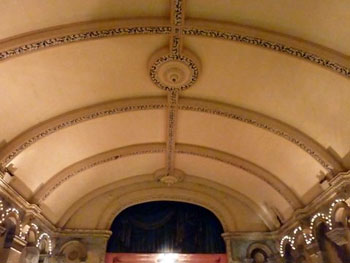 It’s an almost impossible task, and the building (in its unsafe state) has come very close to closure. When I was there, I could see daylight appearing through the rafters in places. There were unsafe electrics, leaking plumbing, and floorboards in the bar so rotten that the number of people permitted at any one time restricted. The whole of the second floor was boarded up, unfit for public use. Even the stone walls were eroding in places. Yet, it’s this forgotten, neglected state that’s given Wilton’s its indescribable atmosphere. It has the feel of Miss Havisham’s mansion in Great Expectations – as if someone had stopped the clock on time and left the building in a state of decaying beauty.
Money has started to trickle in to save this extraordinary building. The custodians of Wilton’s are determined to stop further deterioration and make it safe, but they also want to ensure that the haunting atmosphere contained in its faded glory is kept intact.
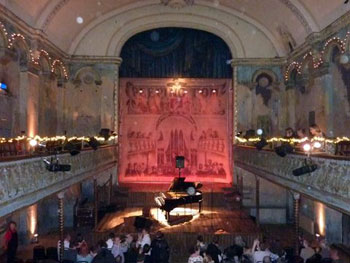
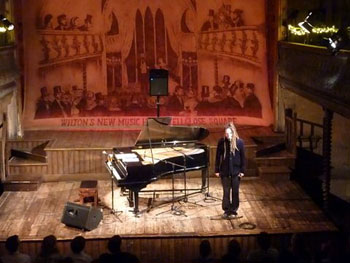
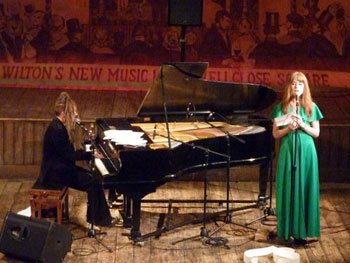 I head upstairs and into the Great Hall. I’ve walked into a Victorian fable. From the gallery a hundred fairy-lights cascade outwards from the centre of the ceiling. Yet more fairy-lights line the gallery’s railings. Pastel frescos fill the peeling walls between great arches. The gilt banister is decorated with delicate, intricate detail. A red silk curtain drapes the stage. Musician and artiste Duke Special enters the stage, eyes black with kohl, long dreadlocks, draping shirt cuffs and velvet jacket. To his left sits a string quartet: Behind him a projector screen. For two hours, he sings and plays the piano – songs he has written to accompany the black and white photos of the renowned early twentieth century American photographers, Stieglitz, Steichen and Strand. The music (commissioned by the Met Museum in New York) is heart-wrenchingly moving, the images haunting. The beauty and timelessness of the music and the photographic images fit perfectly in this magical, ethereal building. A great deal of thought is put into the theatre pieces and concerts that are produced at Wilton’s. The art, like the building, is sumptuous. So the next time you are in London, take the tube out to Wapping and to Wilton’s Music Hall and step back in time. Book a tour, or better still, one of their exceptional shows. You won’t regret it.


If You Go:
More info on Wilton’s Music Hall, Duke Special and Stieglitz, Steichen and Strand at:
www.wiltons.org.uk
www.dukespecial.com
www.youtube.com/watch?v=F_VdxPtlnso
www.sphericalimages.com/wiltonsmusichall/index.html (Virtual Tour)
Private London Music & Art Tour
About the author:
Helen Moat is a British teacher and travel writer. She has won several travel writing competitions, including runner-up with the British Guild of Travel Writers, and has been published in The Daily Telegraph. Her greatest passions in life are music, travel and writing (not surprisingly). Find other travel pieces by her at:
moathouse-moathouseblogspotcom.blogspot.com
All photographs by Gail and Michael Watts.
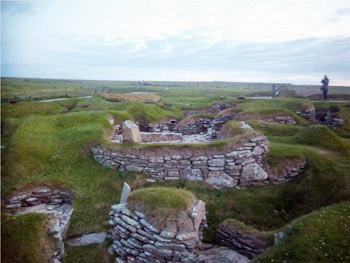
 Skara Brae, a prehistoric village that was built before the Egyptian pyramids, has been listed as one of the “Heart of Neolithic Orkney” World Heritage Sites, and it illustrates a perfect example as to why the Orkney Islands have often been referred to as “The Egypt of the North.”
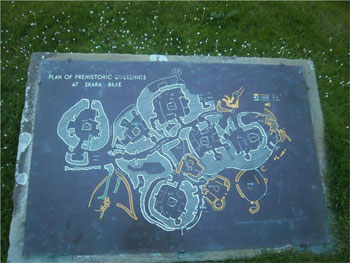 Skara Brae is approximately 5,000 years old and is located about eight miles away from the small town of Stromness on the southern shore of the Bay O’ Skaill. Although it was originally thought that the site was a Pictish village, researchers now believe that the settlement was actually an Orcadian village that was inhabited between the years of 3200 and 2200 BC.

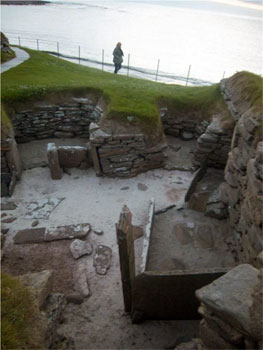 It is believed that Skara Brae was big enough to hold about 50 to 100 villagers at any given time, and that it was inhabited for approximately 600 years.
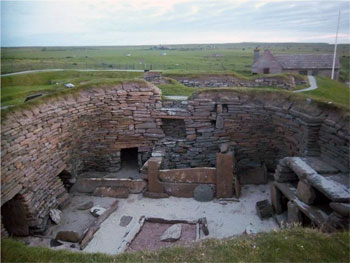 The villagers also used volcanic pumice that could have been washed up on the shore from Iceland to help shape the bone tools and stone balls, and over 2,400 inscribed beads and hundreds of bone necklaces were found in one of the stone cupboards as well. It is believed that many of these objects resembled one’s symbol of status or may even have been used for ritualistic purposes. It is also thought that the dressers which were sitting directly across from the doorway were used to “show off” any prized possessions and/or hunting trophies whenever a visitor entered the home.
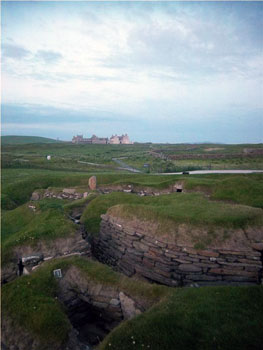 Because many belongings and artifacts were left behind in the village and stored carefully away in the cupboards, some believe that Skara Brae was abandoned because of an “apocalyptic” event and/or disaster which forced the villagers to flee their home.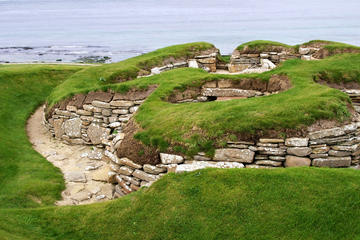
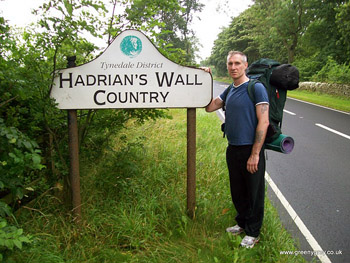


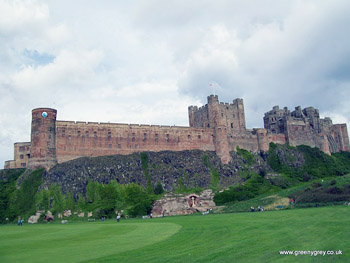 The information board also had a map showing the route of St. Oswald’s Way (97 miles, 156 kilometers), which stretches from the church to the north-east coast locations associated with St. Oswald. We had largely covered that route over the previous few days with our hosts, Paul and Laura: taking in the medieval castle of Warkworth near Amble, and the picturesque coastal villages of Alnwick and Seahouses. Further up the coast we marveled at Bamburgh, which has a history every bit as intriguing as the castle is majestic. It was chosen as the home of the Anglo-Saxon royalty ruling Northumbria in the seventh century.
 The Holy Island of Lindisfarne is still well worth a visit. A priory resident on the island since the 7th century and a 16th century castle provide stimulating landmarks as well as great views of the Farne Islands farther out at sea and the mainland to the south. On a clear day the volcanic rock that supports the castle provides an ideal promontory for relaxing and dozing under the sun to absorb the harmonious mixture of rich island history and fresh sea air. The mystique of the island is maintained by its natural seclusion: the causeway that links the island to the mainland is submerged by sea twice a day when the tide is in. It is wise to check safe times to travel on the causeway with the tourist board before making the journey.
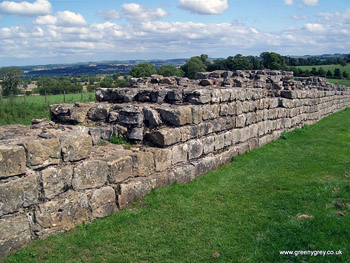 “Having completely transformed the soldiers, in royal fashion, he made for Britain, where he set right many things and – the first to do so – drew a wall along a length of eighty miles to separate barbarians and Romans.” (The Augustan History, Hadrian 11.1)
 Continuing west the next highlight was Chesters; near the village of Chollerford. It is the best preserved Roman cavalry fort in Britain. There are extensive foundations on view here, as well as the structure of a commandant’s house and the multi-roomed military bath-house. A museum houses Roman artifacts found in archaeological digs on the site.
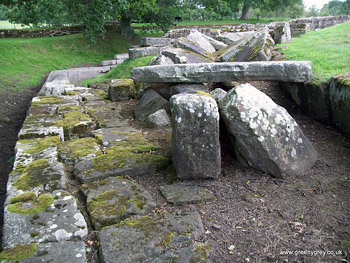 It was now mid-afternoon, so we decided to make the Procolitia fort the final destination on our westward Hadrian’s Wall hike, as we also had to walk back to the campsite near Acomb; across the valley from Hexham. Three miles later we arrived at Procolitia to find that it is now a car park! However, the extra miles were not in vain, as behind the car park there is the mithraeum: a temple to Mithras, the Persian sun god that the Romans imported into Britain.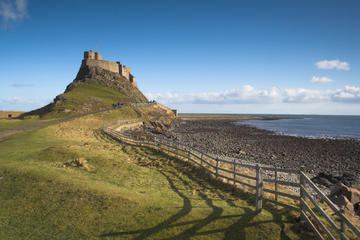
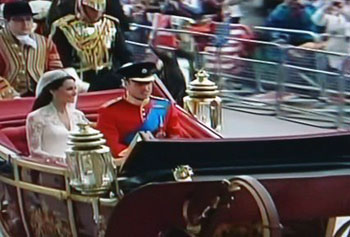
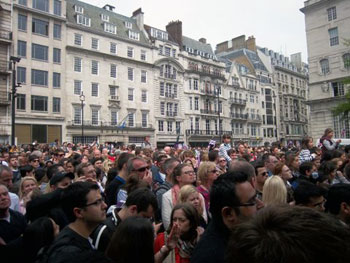 One third of the world’s population tuned in to watch the Royal Wedding coverage on TV, and nearly one million people took to the streets of London on Friday, April 29th just to be at the epicenter of all the festivities. Luckily for me, I was one of those people.
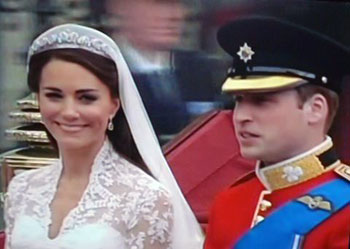 Believe it or not, when Kate was growing up in Bucklebury, England she used to have posters of Prince William and Prince Harry hanging up in her bedroom. Little did she know that a few years down the road she would end up meeting her beloved Prince William while studying at St. Andrews University in Scotland and end up becoming his wife nearly ten years later.

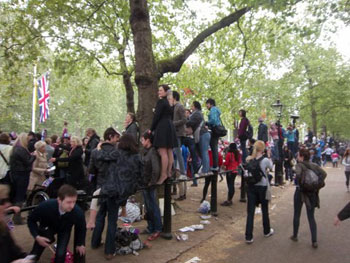 I woke up at the crack of dawn (6 a.m. to be exact) just so I could grab a good spot along the royal carriage route near Buckingham Palace. (Not being a particularly upbeat morning person I was committed to waking up early because I spent close to $100 USD so I could stay at a centrally-located hostel).
 I talked to one Londoner who said he was in London celebrating Charles and Diana’s wedding in 1981 and felt that it was only right to attend William and Kate’s wedding 30 years later…only this time he was celebrating with his daughter.
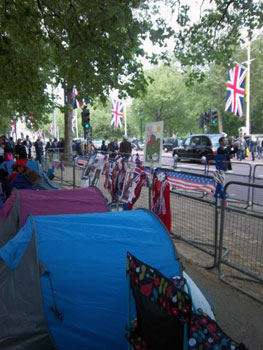 As the start of the ceremony edged closer and closer we started to see cars driving wedding guests and buses of foreign royals being escorted to Westminster Abbey. The ones who were smart enough to bring radios with them were listening through their headphones and shouting out reports about who was in the vehicle. Word started to spread that we would soon see members of the royal family being escorted to the service.
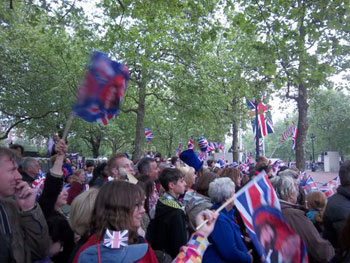 People were shoving each other and getting their cameras ready, and some children in the crowd broke out into tears because the atmosphere was so intense.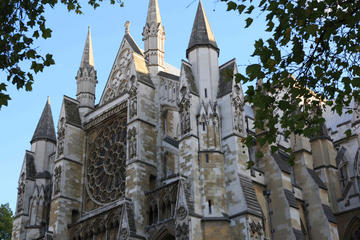
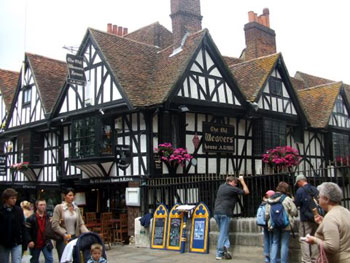
 The great cathedral, towering over the city, beckoned to me. As I walked closer, my heart stirred as I anticipated walking among a place that holds such a strong significance in England’s amazing history. There are two events connected to the cathedral, events that tell a story that’s both rich and bittersweet. Though this story, and Christianity in England, begins in the late sixth century, Britain’s history goes back even further.
 In 595AD Pope Gregory began contemplating missionary activity in Britain. According to the Venerable Bede (Ecclesiastical History of the English People), Gregory saw some attractive fair-skinned boys for sale in a slave market in Rome, and inquired as to who they were. He was told they were Angli (Angles) from Britain, and pagans; Gregory replied that they were not Angli, but Angeli (not Angles, but Angels) and deserved to be fellow heirs with the angels of heaven – they and their people ought to be converted to Christianity. A year later the pope commissioned Augustine, the prior in charge of his papal monastery in Rome, to cross the channel to the distant island with 40 other monks and work among the Anglo-Saxon peoples.
 Augustine and the monks arrived in Canterbury, the seat of Ethelberht, the Anglo-Saxon king of Kent, around Easter 597AD. The missionaries were given a polite but cautious welcome. King Ethelberht, despite his suspicion, was impressed by the monks’ sincerity and allowed them to preach. The king and his people would eventually be won over to the Christian faith, and over the next couple of years Ethelberht would see the conversion of his people. Christianity would continue to grow in the area and Augustine would become the first Archbishop of Canterbury; there have been 104 ever since. And he would also establish the Abbey of St. Peter and Paul outside the city walls, the ruins of which are still visible today (www.english-heritage.org.uk).
 The second problem involved the king’s eldest son, also named Henry. In 1170 AD the king wished his son, also named Henry, formally crowned as king so the boy would succeed him as the next king of England when the elder Henry died. Normally the Archbishop of Canterbury presided over the ceremony, but as Becket was in France the next most powerful cleric in England, the Archbishop of York, presided in his stead. Becket of course was opposed to this and came back to England to excommunicate all the bishops that had taken part in the coronation. Becket also threatened to put England under interdict – a censure that forbids participation in most sacraments. King Henry, exasperated, had had enough.