Travel Thru History

Historical and cultural travel experiences

  • Home
  • Airfare Deals
  • Get Travel Insurance
  • Writers Guidelines

The England of Charles Dickens

Charles Dickens at his writing desk

A Real “Father Christmas”

by Cindy-Lou Dale

His name is synonymous with Christmas and for many may conjure up visions of plum pudding and a warm fireside.

Ghost and Scrooge in A Christmas CarolIn fact, Charles Dickens probably has more influence on the way we celebrate Christmas today than any single individual (except one). At the start of the Victorian era, celebrations of Christmas began to decline but its romantic revival began when Prince Albert introduced the German custom of decorating trees and singing carols and soon thereafter Christmas cards appeared. But it was Charles Dickens’ Christmas stories ( “A Christmas Carol” is one of five) that rekindled the joy of Christmas across Britain and America. “A Christmas Carol” was written during a time of decline in the old Christmas traditions. Dickens wrote it as a serial for the newspaper at a time when he was financially strapped. As a result of this Christmas “ghost story,” first published on December 19, 1843, with illustrations by John Leech, Charles Dickens probably had more influence on the way we celebrate Christmas today than any single individual.

However, life back then wasn’t all sugar and spice. Dickens also wrote of abused orphans and street children, a murderer, and a measly schoolmaster — drawing from his own wretched experiences on London’s streets as a child. Perhaps it was because of those experiences that a talent emerged which would later lead to Dickens becoming the greatest writer of his time.

Charles John Huffman Dickens was born in Portsmouth, England in 1812; the first son to Elizabeth Barrow and John Dickens, a naval pay clerk.

Dickens' birthplace house Portsmouth UKThe house he was born in (now 393 Old Commercial Road) has miraculously survived and is preserved as a museum furnished in the style of 1809 which is when John and Elizabeth Dickens set up their first home together. Charles only lived in Portsmouth for the first three years of his life but returned on three occasions – once was to do background research for his novel “Nicholas Nickleby”.

The pieces displayed in the museum — furniture, ceramics, glass, household objects and decoration, have been recreated in the Regency style which his parents would have chosen. There are three furnished rooms: the parlor, the dining room and the bedroom where Dickens was born. Also displayed is a small collection of memorabilia: the couch on which he died, his snuff box, an inkwell and a paper knife.

When Charles turned five his family moved to No. 2 Ordnance Terrace, Chatham, Kent, where they lived for several years. Their house is still stands and is only a few yards from the railway station.

The Dickens’s were considered moderately well off and Charles attended a private school. But all that changed when his father was incarcerated in the Marshalsea Prison for debt. The then twelve year old Charles was deemed old enough to work and labored in a shoe factory to pay for his lodgings in North London and help support his family. He believed these events to have been the most horrendous of his life and haunted him to the grave; which he thinly disguised in the dark experiences of childhood poverty and feelings of abandonment in “David Copperfield”.

The Marshalsea prison was eventually closed in the late 19th century and demolished sometime afterwards. All that remains of it now is a fragment of wall containing the entrance arch, which stands in a forgotten corner of a church yard, which itself has been converted into a small park. The absence of information is remarkable, in view of the historic importance of this prison. Nevertheless, a vivid portrait of conditions in this gaol can be found in Dickens’ work.

Dickens began work as a law clerk soon after his father’s release from prison. He quickly tired of this and became a journalist, reporting parliamentary debates which shaped his first collected works – “Sketches by Boz’” (his pen name).

Dickens' London House on Doughty St.He married Catherine Hogarth, the daughter of a prominent editor, in 1836. They moved to the house at 48 Doughty Street (left) in the spring of 1837 with their new baby Charles, as well as Dickens’ brother Fred who worked in the counting house of Dickens’ first publisher. Catherine’s younger sister Mary Hogarth was also a frequent visitor.

At this time, Dickens was on the threshold of fame with his successful “Pickwick Papers”. Soon after the family moved in, Mary Hogarth died of heart failure at the age of 17. Dickens was so shocked he couldn’t write and his publications of the “Pickwick Papers” and “Oliver Twist”, which ran as a newspaper serial, were halted. Eventually he resumed writing and in his later fiction novels such as “The Old Curiosity Shop”, the character of Little Nell was based on Mary.

In the study of Doughty St. house you can see the desk that Dickens used until the end of his life. The room is depicted in an engraving “The Empty Chair” by Sir Luke Fildes. Dickens always worked with fresh flowers on his writing table.

The Dickens family lived in London for some time and over the ensuing years, Catherine bore him ten children. But Dickens longed to return to his Kent roots and often spoke of Gad Hill Place – a home he had much admired as a child. In 1885, after he had become a world-famous author, his dream home came on to the market. After some haggling he acquired Gad Hill Place, which was the only home he would ever own.

While living at Gad’s Hill he wrote “A Tale of Two Cities”, “Great Expectations” and “Our Mutual Friend”.

Poets' Corner, Westminster AbbeyAfter twenty-two years of marriage, Charles and Catherine separated – a time when divorce was almost unthinkable. The year before their separation, Dickens had met Ellen Ternan, an attractive 18-year-old actress who eventually became his mistress.

Charles Dickens died at his home in 1870 while writing chapter 23 of “The Mystery of Edwin Drood”. He was buried in the Poet’s Corner of Westminster. The inscription on his tomb reads: “He was a sympathizer to the poor, the suffering, and the oppressed; and by his death, one of England’s greatest writers is lost to the world.”

The great writer may have passed but his stories, their characters and the places he wrote of will live forever.


Charles Dickens Walking Tour

If You Go:

PORTSMOUTH:

The historic Portsmouth dockyard is truly impressive with the HMS Victory, the flagship of Vice Admiral Lord Nelson, moored there. The Victory is the only remaining eighteenth century warship anywhere in the world and is the oldest serving Royal Navy ship in commission.

You will no doubt be beckoned by the tranquil Victorian seafront; head off to the notorious Still & West Country House pub and listen to the landlord’s yarns of the pub’s history. He claims the area in which the pub stands was once the centre for Caribbean spice imports and was once the haunt of smugglers and press gangs. The view over Portsmouth Harbor is spectacular as the Isle of Wight and the Marina can be seen from the windows. A little further some of the Royal Navy’s most modern warships are moored.

To walk through Old Portsmouth today, with its cobbled streets, charming pubs and restaurants is to walk through history. The narrow side streets recall a medieval community huddled together within town walls. It was in these streets that press gangs sought new recruits for the Navy.

Highly recommended accommodation in Portsmouth is the award winning Fortitude Cottage – a quaint family run guesthouse, overlooking the quayside in the heart of Old Portsmouth. The original Fortitude Cottage, dating back to the 16th century, was destroyed in WW2. Its replacement, built on the same site as the original, with pastel bedrooms and beamed ceilings is immaculately maintained.

Hop onto the water bus (operates from Easter to November) on the quay opposite Fortitude Cottage and take a five minute ride into the naval dockyard and appreciate some of Britain’s proud naval history.


Portsmouth Historic Dockyard: All Attraction Ticket

LONDON:

The Charles Dickens Museum, located at 48 Doughty Street, London, WC1N 2LX is open six days a week, from 10 till 5.

Great accommodation nearby is the Georgian House Hotel – just 10 minutes bus ride from London’s West End. They offer a variety of rooms and a great English breakfast.
London Transport Museum – Hidden London


Haunted London Walking Tour: Ghosts and Criminal History

KENT:

In the first week of June, the nearby town of Rochester comes alive with Charles Dickens celebrations. The towns’ folk dress up in Victorian costume and parade the streets of Rochester. Numerous other commemorative festivals are held in the Rochester throughout the year – the ‘Sweeps Festivals’ in May and the ‘Summer Concerts’ held in the grounds of Rochester Castle in July. The ‘Dickensian Christmas’ is a must with the aromas of roasting chestnuts filling the air, skating on the ice rink in the Castle gardens and candlelight Christmas carolers proceeding through the streets heading towards the Cathedral. Throughout December there are guided walks in the area the Dickens family lived.

Photo credits:
Charles Dickens at his Writing Desk: CC0 Public Domain
Ghost and Scrooge in “A Christmas Carol” by John Leech / Public domain
Dickens’ birthplace and museum in Portsmouth: Austriantraveler / CC BY
Dickens’ London house at 48 Doughty St. by Spudgun67 / CC BY-SA
Poets’ Corner, Westminster Abbey by See page for author / Public domain

About the author:
Cindy-Lou Dale is an award winning writer and photojournalist who has been featured in numerous publications across the globe. She heralds from a small farming community in Southern Africa and has since lived in 18 countries. Currently her roots are in a village on the Kent coast in England.

Tagged With: Charles Dickens, England travel Filed Under: UK Travel

Edinburgh, Scotland’s City of Festivals

Edinburgh Castle

by Andy Hayes

The fun starts in the beginning – or the end – of the year with Edinburgh’s Hogmanay, a multi-faceted festival brightening up the long dark nights of winter and welcoming in the New Year. Many modern day traditions for the New Year come from Scotland, including the iconic Auld Lang Syne song, written by Scottish poet Robert Burns. The song is written in Scots, which explains why many find the lyrics to be near-undecipherable.

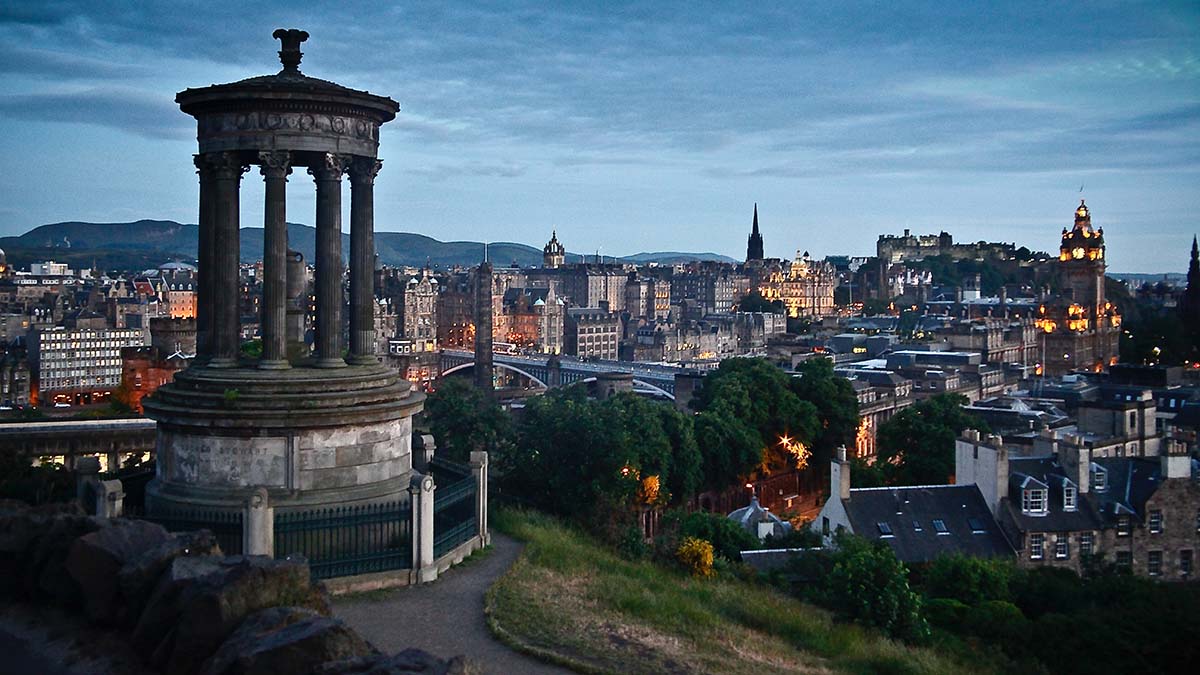
Edinburgh at nightThe city events leading up to the huge street party held on December 31 include an authentic German Christmas market set in Princes Street Gardens; this venue offer the opportunity to ice skate or simply sip a hot mulled wine while surveying the beautiful Christmas lights adorning the already magnificent city skyline. Stalls offer freshly made food, ornaments, and other great gifts. The market is surrounded by masses of amusement park rides, filling the cold air with sounds of screams and laughter. A giant Ferris wheel, sitting next to the charming Scott Monument, completes the picture-postcard setting.

June brings us the Edinburgh International Film Festival. One of the higher profile film festivals in Europe, Edinburgh’s score tends to focus more on independent and sometimes eccentric European content. From dark Danish themes to English happy-go-lucky tales, each year’s lineup includes something for every theater fan. Movies are shown in the city’s wonderful films venues, including the Cameo and the Filmhouse. The Cameo welcomes visitors with its bright, old-fashioned signage, and more of these traditional touches can be found inside. Nearby, the Filmhouse is a slightly more modern space but upstairs in the main theatre is a classic screening room fronted by a massive, thick red curtain that is as beautiful as it is functional. Each theatre has a cafe worth visiting on its own, with a full array of drinks and ambience that can be enjoyed either before or after a show. The Filmhouse also has a lengthy menu of fresh, healthy entrees suitable for either lunch or dinner.

statue of David Hume with St. Giles' cathedral behindEdinburgh turns into the UK’s busiest city in August, when not only does the Edinburgh Fringe Festival roll into town, but also the Jazz and Blues Festival, Art Festival, Military Tattoo, International Festival, Book Festival, and Mela Festival. The streets are filled beyond capacity with tourists watching buskers show off their latest routines. Every room in the city is transformed into a performance venue – from vaults in cellars to school classrooms to caravans parked out on the street. Pubs are open until the wee hours of dawn, restaurants are packed and reservations are impossible to be had. City squares are turned into tent-filled carnivals. This is August in Edinburgh, home to the world’s largest arts festival, the Edinburgh Fringe.

The Fringe is obviously the biggest component of the August-madness; established in 1947, the event has grown to include 31,320 performances of 2,088 different shows in 247 different venues in 2008. That is over 130 performances every single hour of every day for the entire month of August – just for the Fringe! Many of Fringe performances are stand-up comedy; indeed, 2008 was the first year to see this category become the majority. Mini-musicals are also popular, featuring song and dance as well choreographed as you would find in a Broadway production. Celebrities often feature in the headlines, including names like Joan Rivers. Dark topics like murder or sex are not taboo; in fact, the most unusual or risqué-orientated events can be sellouts. Navigating this never-ending stream of content is done by perusing the fringe guide, available for free in major fringe venues as well as the fringe box office on the Royal Mile. You can also search the Fringe website (edfringe.com) for shows and book online. It is best to take one of two approaches: either plan ahead and book for the shows you really want, or just wing it and get word-of-mouth suggestions on the best things to see as you go.

row of Georgian townhomes in Edinburgh's Charlotte SquareThe Scottish capital was the first city to be titled as a UNESCO City of Literature so it is only appropriate that August also make space for a book festival. Writing still features highly in Edinburgh, with resident J.K. Rowling often making the headlines with her world-famous Harry Potter series. The book festival features a number of interesting authors across all genres, but even a non-book lover could enjoy this event due to the setting: the entire festival is set within the grassy knoll at the center of charming Charlotte Square, surrounded on all sides by Georgian townhomes and black iron fences. The center of the square is normally closed to pedestrian access, so this view of the surrounding streets is only available once a year.

The crowning centerpiece of the August events tends to be the Edinburgh Military Tattoo, a mélange of bagpipes, military drums and dancing performers. It is easy to see why this particular experience is so special as the setting is straight from a fairy tale, taking place directly underneath Edinburgh Castle on the Esplanade; highlights of show include fireworks, over-the-top military processions and kilts as far as the eye can see. Tickets sell out for this event almost as soon as they go on sale, so if you have not booked a year in advance then you might be hard pressed for a seat.

The key to Edinburgh’s charm is in its balance of big city offerings in a compact city size. It is a rural paradise but also a cosmopolitan capital. There is nothing else like it. And with a revolving calendar of amazing festivals, you’ll never be shy of a reason to come for a visit.

For More Information:

Wikipedia explains Hogmany
Hogmany celebrations across Scotland
Official guide to Edinburgh
City Guide to Edinburgh, Scotland

While Edinburgh is full of sights, there is plenty of excitement outside the city center. One great choice is an afternoon in Rosslyn Chapel in the nearby village of Roslin. Accessible by a short 25-minute bus ride, the chapel is open every day of the week and costs only £10 to explore the inside and outside of this medieval relic. It is an unusual survivor, as almost all nearby churches were destroyed in earlier times. Free talks are hosted throughout the day – these explain some of the historical facts of the church, as well as some of the various speculation that has developed with the rise in Roslin’s fame due to Dan Brown’s novel, The DaVinci Code. Make your own conclusion as to what is buried in the sealed basement underneath your feet.

Edinburgh Tours Now Available:

3-Hour Private Edinburgh Castle Tour
Rosslyn Chapel and Hadrian’s Wall Small Group Day Tour from Edinburgh
Guided Edinburgh Private Walking Tour
Rosslyn Chapel, the Scottish Borders and Glenkinchie Distillery Tour from Edinburgh
Whisky-Tasting Day Trip from Edinburgh

About the author:
Andy Hayes is a freelance travel writer and photographer based in Edinburgh, Scotland. When not out having travel adventures (or dreaming of new ones), he is hitting the walking trails near home. To get in touch or see Andy’s other travelogues, visit his website at www.andyhayes.com.

All are photos © Andrew Hayes.

Tagged With: Edinburth attractions, Scotland travel Filed Under: UK Travel

Secrets of Cave Hill Revealed

Belfast Castle exterior

Historic Belfast, Northern Ireland

by John Rooney

When the first rays of sunlight break through the cold early morning mist, to reveal the uppermost peaks of Belfast’s Cave Hill, it’s easy for me to see why it’s said to have inspired Jonathan Swift to write his most well known novel, Gulliver’s Travels.

Cave Hill, BelfastSilhouetted against the palest blue sky, the craggy basalt summit forms the outline of a man staring upwards and into heavens. Known locally as ‘Napoleon’s Nose’ it not only bears an uncanny resemblance to the famous emperor, but is also reminiscent of the sleeping giant in the classic tale.

Rising to over 1200 feet above sea level, the Cave Hill is Belfast’s most prominent feature and despite being only a few miles from the city centre it is perhaps one of Northern Ireland’s best kept secrets. Originally known in Gaelic as Beann Mheadagáin (the Hill of Madigan), named after an ancient king, the hill now takes its name from a number of caves which are thought to be early iron mines, dug into its steep rock face.

As well as providing the perfect hunting ground for peregrines, kestrels and ravens, the hill is home to Belfast Castle, Zoological gardens and some of the finest woodland trails to be found anywhere. The summit provides panoramic views of Belfast Lough and is also the site of several primordial raths (forts), dating back to between 400 – 1200 AD.

In Victorian times Limestone was mined on the hill’s southern flanks, then transported to Belfast Docks by a horse-drawn railway system and two hamlets, ‘Mammystown and Daddystown,’ were built on either side of the track to accommodate quarry workers. The railway was abandoned in the 1890s and the two villages are nothing more than references on survey maps of the time. But many streets and avenues close to the hill bear the name ‘Waterloo,’ in reference to their geological origins.

During the Second World War Belfast’s shipbuilding industry was heavily bombed by the German Luftwaffe and on one such raid a bomb was dropped on the Cave Hill, causing a huge crater close to Belfast Castle. And sadly on 1st June 1944, while flying through thick fog, an American B-17 bomber crashed into the Cave Hill, killing all ten crew members instantly. The site of the unfortunate incident is marked with a plaque in the grounds of the Zoological Gardens.

Being a native of Belfast I’ve walked these hills many times and usually approach via the Hightown Road entrance. There’s a small car-park marked with two stone pillars. On my left is thick woodland which occasionally gives way to reveal the underlying basalt, while on my right the hillside descends into a vista of vibrant green valleys and dense vegetation.

The hardcore path makes my ascent relatively straightforward (if somewhat breathless due to the sometimes steep incline), and it isn’t long before I’m making my way through a patchwork of yellowish-brown heathers and bog cotton. Meadow Pipits and Skylarks provide a pleasant chorus over the open moor-land and there’s a strong westerly breeze that swirls around my legs, threatening to throw me of the rugged cliffs should I venture too close to the edge.

looking down toward Belfast LoughBelow me, Belfast Lough reflects the bluish-grey tones of the sky, as it makes its way past Carrickfergus and into the Irish Sea, where I can just make out the ashen outline of the Isle of Man.

Straight ahead and some five miles across the lough, the small costal towns of Bangor, Hollywood and Newcastle, nestle beneath the safety of the cornflower-blue Mourne Mountains. On my right Harland and Wolfe’s two colossal yellow cranes, mark not only the birth place of the Titanic, but are reminder that during the late 19th century Belfast was the industrial capital of Europe.

McArts FortFurther along the track and McArts Fort comes into view. The huge grass covered mound measuring 150 feet by 180 feet, is the remains of an ancient circular fort and balances somewhat precariously on an almost vertical slab of rock. It’s hardly surprising that the United Irishmen, Wolfe Tone and Henry Joy McCracken, chose this exact spot to plot the Irish rebellion of 1798. With its inaccessible cliffs and views of the surrounding area, it’s the perfect place to conspire treason.

On passing the fort I begin my descent along the narrow track past the Devil’s Punchbowl (an area of boulders, where it’s believed ancient Celtic farmers corralled their cattle), to enter the castle estate. The air is heavy with the pungent aroma of wild Garlic and the overhead trees grant me respite from the mid-day sun. The trees provide the perfect habitat for a variety of woodland birds and if I’m lucky I might catch a fleeting glimpse of a grey squirrel, or towards dusk a hedgehog or badger.

tree-lined path leads to Belfast CastleAfter crossing a narrow stream, no wider than an average persons step, I make my way along the tree lined avenue that leads to Belfast Castle. The castle is a large sandstone building, built in the Scottish Baronial style and was designed by John Lanyon in 1867, as home to the 3rd Marquis of Donegall. Construction was completed in 1870 and following the Marquis’ death in 1884, it became home to Shaftesbury’s.

The Shaftesbury’s were well known for supporting local charities and held fetes within the castle grounds, and in 1907 the 9th Earl of Shaftesbury was appointed Lord Mayor of Belfast. The castle bears witness to both families; the Donegall coat of arms can be seen above the front door and on the building’s north wall, whilst a section of the Shaftesbury crest appears on the exterior Italian style, serpentine staircase.

Belfast City Council took control in 1934, when the family presented the castle and surrounding estate to the city. Then following a major refurbishment program instigated by the council in 1978 and costing £2 million, the castle is now a popular venue for wedding receptions and conferences.

cat statue in Belfast Castle gardenAdjacent to the castle is the ‘cat garden.’ Legend has it that the castle has always had a resident white cat and that those visiting the castle will have good luck, provided the tradition is maintained. It’s thought that the custom began when a sociable feline befriended the castle’s gardeners and as I make my way down the stone steps leading to the garden, I feel certain that some good fortune will come my way.

The garden’s centre piece is a small decorative fountain where a bronze feline slumbers in the summer sun. On either side of the water feature set in red brick paving, two mosaic felines welcome me to their home, whilst below me a feline carefully sculpted from the semi-evergreen ‘Privet’ soaks up the tranquil atmosphere. There are nine cats for nine lives depicted in the garden’s furniture and paving. My favorite is a statuesque mouser who sits elegantly in a bed of Roseglow (above).

The castle has a bar, restaurant and an antique shop. But before I enter for some much needed refreshment, I’ll take a seat on one of the wooden benches and just like those who first inhabited the hill over 1200 years ago, I’ll watch the sun setting over Belfast Lough.

If You Go:

The Cave Hill is susceptible to extreme weather conditions, whilst some of its cliffs are hazardous and are not suitable for amateurs. Sturdy footwear and waterproof clothing is advisable. For full details on how to get there and to download a PDF map of the advised route please visit:
www.belfastcity.gov.uk To learn about Jonathan Swift and Gulliver’s Travels: www.incompetech.com

Belfast Tours Now Available:

Belfast History Walking Tour The Ultimate Belfast experience

Belfast Mural Political Black Cab Tour

Titanic Walking Tour in Belfast

Guided Tour of Crumlin Road Gaol in Belfast

Full-Day Trip from Belfast: The Ultimate Game of Thrones Experience including Winterfell, Direwolves and Replica Throne

About the author:
John Rooney is a freelance writer and photographer working and living in County Antrim, Northern Ireland. His work has appeared in a variety of magazines and features regularly in ‘Ireland’s Own’. John’s website is www.freewebs.com/johnrooney1 His blog is at http://jon1words.blogspot.com Email: wordwelder58@yahoo.com

All photos are by John Rooney.

Tagged With: Belfast, Northern Ireland travel Filed Under: UK Travel

The Tall Ships Races

Italian tall ship

Liverpool, England

by Maggie B. Dickinson

Around a million visitors were expected to descend on Liverpool’s World Heritage waterfront between the 18th and 21st July to watch the ceremonies and departure of The Tall Ships’ Races 2008. But as everyone gathered for the final highlight – the “Parade of Sail” – it appeared to me as though the entire population of England was lining the banks of the famous River Mersey.

tall ship at dock in LiverpoolSomething I’ve always wanted to do is cross the Mersey on a ferry whilst singing Gerry and The Pacemakers’ hit from 1964 “Ferry ‘Cross the Mersey”. So for a better view I’d decided to go on one of the special cruises. Not surprisingly they were all fully booked.

The fleet of tall ships, that is both spectacular and unique, was the largest ever to grace British waters, being made up of around 70 vessels, including representatives from countries as far apart as Bulgaria, Oman, Brazil and Mexico. On board were a mind-boggling 8,000 trainees and crew. In its year as European Capital of Culture the hosting of the Tall Ships’ Races is one of the highlights in Liverpool’s fascinating and imaginative calendar of events. This is the third time, in over 50 years’ existence, that the Tall Ships have been hosted by Liverpool – a city that is well qualified to organise events featuring the ocean because if its 800 years of maritime history.

The significance of the occasion was emphasised by the presence of HRH Princess Anne, Princess Royal, herself no stranger to this important city, who officially opened proceedings on the 18th July as well as inspecting a couple of the vessels. This was followed by a weekend during which the general public were able to view and go aboard the ships. Indeed, an informal visit was made by HRH Prince Andrew, Duke of York. He served 22 years in the Royal Navy, which supports the Tall Ships’ Races, and saw action in the Falklands War.

Brazilian tall shipThe smaller ships – Classes B, C and D were berthed at Canning and Albert Docks, with the Class A big boys at Wellington and Sandon Half-Tide Docks. Included at Wellington was a ship that caters for people with disabilities – the Lord Nelson. The Royal Navy’s supply ship RFA Lyme Bay was hosted at the new Cruise Liner Terminal landing stage on Princes Parade, with the Royal Marines’ Band not only on board but giving band concerts at various places around the town too.

Clearly all the stops had been pulled out to organise the wide range of vital services that needed putting in place in readiness for the numbers who were expected to descend on the city because, as island people, the Brits love anything nautical. It is said that Merseyside Police had been planning the event for a whole year and it is pleasing to note that it all went smoothly and without any major incidents.

Liverpool knows how to do fun: it has had a lot of practise and music runs through this city’s veins like nowhere else. For one thing it’s the original home of the sea shanty and the non profit-making enterprise “Shanties 08” ensured this traditional genre was covered at venues throughout the city.

All weekend the streets leading away from the train and bus stations were thronged wall-to-wall with happy folk, stopping now and again on their way to the docks to listen to and join in with the various music combos. Dotted en route were a wide range of feet-tapping attractions – Latino groups playing panpipes, Native American Indians with flutes and drums, West Indians with their bongos, Bob Dylan sound-alikes strumming guitars, whilst through the open windows and doors of Liverpool’s ancient and modern inns came the sound of karaoke singers belting out the latest hits.

deck and rigging of a French tall shipThe British are well versed at patiently forming queues but Liverpool had reckoned on the mounting anticipation of a vast crowd who would be standing six deep along the harbour for hours, waiting for the ships to take part in the “Parade of Sail”. To keep us happy the organizers had provided a death-defying air spectacular by The Yakovlevs Formation and Aerobatic Display Team that had the crowd gasping and clapping and cheering, especially when one of the nerveless pilots pretended to take his plane into a suicidal dive but pulled back from the sea at the very last moment.

The “Parade of Sail” is the traditional run-up to departure and it gave everyone a final chance to see each vessel in full splendour before the fleet left for a point off Northern Ireland where the first race would take place on the 23rd July. It was led by HMS Argyll, followed by the Stavros S Niarchos.

For hours we were entertained to one glorious vessel after another, with a few minutes’ gap between each so that we could really savour each and every one and give them our undivided attention as they glided majestically through the water, with or without sail. Shades of the long ago, reminders of our great explorers, envious of those who were aboard and able to take part in this great event.

Greek tall shipThe main objective of the races, which cover a period of five weeks, focuses on the sail training of youth, 48 of whom are being funded by Liverpool City Council. Another 48, sponsored by Tall Ships Youth Trust (Merseyside), helped sail the ships from London. Their involvement, as well as that of the officers and crews, is intended to foster good international relationships, friendships and understanding and to promote teamwork and leadership.

The initial race is of 11 days’ duration across the North Sea to Måly in Norway. After the buzz of Liverpool, picturesque Måly, with a backdrop of islands and mountains, will appear a tiny place with its 4,000 inhabitants living around one of the smallest ports ever to have hosted the Tall Ships’ Races.

The ships take a break there from 9th to 12th August, followed by a cruise-in-company to Bergen in Norway along a route that will cover the coast, and fjords which can stretch 100 miles in length. Highlights of this journey will be glaciers, mountains and huge waterfalls too. Several ports are accommodating the ships and visitors, along with providing free berthing and lots of activities for the crews.

tall ship sailing in Liverpool harborIt will be the third time Bergen has played host to the Tall Ships’ Races. It is a city of museums and wooden houses that fan out over steep hillsides, from what is considered one of the world’s most beautiful natural harbours. A full programme of events is planned to occupy the time before the start of the second race which takes eight days for the fleet to arrive at Den Helder in the Netherlands where the final celebrations occur between the 20th and 23rd of the month.

Den Helder is 80 km north of Amsterdam to which it is linked by the North Holland Canal. Until the beginning of the 19th century it was a tiny village dependent on fishing which, along with textiles, is still the town’s main economy. It is also the prime seaport for offshore sailing. There are several monuments of a maritime nature and the naval fortifications go back to Napoleonic times. Of note is its lighthouse which is made of cast-iron and carries the distinction of being the tallest in Europe.

It seems a likely and befitting place for the final prize-giving ceremonies, which include the presentation of the much-coveted award of the Friendship Trophy which, for me, is symbolic of what the Tall Ships’ Races are all about.

For More Information:

Visit Liverpool
Tall Ships Tracking Map
Culture Liverpool: Three Festivals Tall Ships Regatta 2018 & Liverpool Bordeaux Wine Festival
Sail Training International
Tall Ship Races in Bergen, Norway
Mersey Ferries

Liverpool Tours Now Available:

Mersey River Explorer Cruise from Liverpool
Private Beatles Tour of Liverpool by Taxi
Private Half-Day Peaky Blinders Tour of Liverpool
Liverpool FC Football Match at Anfield Stadium
Liverpool Ghost Walking Tour

About the author:
Maggie Dickinson lives in England’s North West. She has written on travel, local history and outdoor pursuits. Two of her articles on caring for her late husband, who had Alzheimer’s Disease, were published in US anthologies. Her special interest is photographing and writing about lesser-known areas and backwaters of the UK.

Photographs:
All photos are by Margaret B (Maggie) Dickinson.

Tagged With: England travel, Liverpool Filed Under: UK Travel

Notting Hill Carnival: UK’s Biggest Street Party

women dancing in Notting Hill Carnival

London, England

by Cindy-Lou Dale

When the Trinidadians first arrived in England they longed for their elaborate carnivals back home. Dressed in elaborate costumes, pounding on steel drums they began a small procession through the streets.

parade of costum wearing peopleNow, some 42 years later, the Notting Hill Carnival has become a full-blown Caribbean celebration, second only to that held in Rio. It attracts multi-cultural participation and draws millions of spectators from all over the world.

The Notting Hill Carnival began through the energies of West Indian immigrants from the Caribbean, in particular, Trinidad, where the carnival tradition is very strong. Together with other local folk, they conjured up a dream of creating a festival to bring together the Caribbean people of Notting Hill, most of who were facing racism, unemployment and poor living conditions, prevalent in the 50s era of racial tension.

Back then dances were organised in halls in North London, where West Indian and African immigrants could come together freely. At the same time Trinidadian steel band music was being played each Sunday at a local pub in Earls Court. From this evolved the idea of inviting the steel bands to partake in a street festival in Notting Hill, thus encouraging people, especially children, to come onto the streets and express themselves socially as well as artistically. Once the West Indians of Notting Hill heard the first tunes of the steel bands, they immediately took the opportunity to dance and perform in London’s streets.

In Trinidad, slaves were historically forbidden to wear costumes or play musical instruments. Tamboo, bamboo and hand drums were outlawed. The West Indians were also banned from going out after dark, unless they were accompanied by their masters. When the laws were repealed and freedom from slavery was announced in 1833, the slaves took to the streets in song and dance. Deprived of traditional rhythmic instruments, they took any object they could find, including garbage can lids, old car parts and empty oil barrels and used their artistic skills to mimic their masters and pour scorn of the system that had enslaved them for so long. The newly freed slaves would dress like their masters, powder their faces to look pale or make masks to resemble their former oppressors, distorting images and features if they regarded them as particularly evil.

These celebrations of freedom provided the only opportunity for the former slaves to express their feelings towards the inhumanity they experiences. They quickly developed the art of costume making, creating fantastic ensembles which satirised their situation as Africans, transported to the Caribbean to become slaves.

woman wearing calypso wardrobeIn London today, their tradition continues, as local immigrants from around the world take part and associate themselves with the Notting Hill Carnival. The skills of costume making, steel drumming and the traditional Caribbean calypso folk music has made these celebrations what they are today – an explosion of fun, food, culture, colour, art, music and a Mardi Gras atmosphere which turns the vibrant borough of Notting Hill into Europe’s biggest street party.

The carnival is always held on the last bank holiday weekend in August and operates an all inclusive policy encouraging artists to celebrate their cultural traditions through art, dance and music; a celebration of life which Trinidadians everywhere are justifiably proud of.

The carnival warms up on the Saturday with spectacular floats and handsome costumed masqueraders emerging at around 12 noon. They dance and cajole the spectators along the parade route, and may even evoke a smile from one of the many policemen overseeing the festivities, which covers approximately three miles. By Sunday, with the Children’s Day Parade, the carnival is in full swing, with the main event happening on Monday. The carnival officially finishes each day at 7 pm, but the parties continue into the small hours in London’s clubs and bars.

couple dancing in Notting Hill CarnivalIn addition to pan bands, there are scores of massive mobile and static sound systems spread throughout the area pumping out a range of music, including hip-hop, house, basement, acid jazz, jungle, R&B and reggae, at mind-numbing volume. Expect live instruments, Latin vibes, chunky Carnival beats and more than a few surprises such as Ms Dynamite, Sean Paul, Mos Def and Dizzee Rascal. A carnival map shows you where to find the large rigs and tell you what type of music they specialise in.

There are hundreds of licensed stalls lining the streets. The wafts of thyme, coconut, ginger, nutmeg and cinnamon will guide you to the exotic foods being served from around the world, including traditional Caribbean dishes such as curried goat, fried dumplings, ackee and salt fish, plantain, jerk chicken, steamed cabbage, and rice and peas.

Through the West Indian community’s historic efforts in bringing together the locals, the Notting Hill Carnival has grown to include members of the Afghan community, Kurdistan, Bangladesh, the Philippines, Bulgaria, Russia, Brazil – compelling them to draw on all aspects of their own cultural heritage.

Notting Hill Carnival is the biggest festival in Europe and in carnival terms is second only to Rio. It’s fantastic, it’s vibrant, energetic, it’s for everyone – and it’s free. At the Notting Hill Carnival every spectator is a participant.

If You Go:

When: Last ‘long weekend’ in August – starting at around 12 noon until 7pm.
Where: London, England: Notting Hill, Holland Park and neighbouring areas.
Getting there: Some Tube stations are closed and roads blocked off. Check the Transport for London website for details.


Notting Hill Tour

About the author:
Cindy is an award winning writer and photojournalist whose been featured in numerous publications across the globe. She heralds from a small farming community in Southern Africa and has since lived in 18 countries. Currently her roots are in a village on the Kent coast in England.

Photo Credits:
First Notting Hill Carnival women photo by David Sedlecký / CC BY-SA
All other photos are by Cindy Lou Dale.

Tagged With: London travel, Notting hill Filed Under: UK Travel

  • « Previous Page
  • 1
  • …
  • 16
  • 17
  • 18
  • 19
  • 20
  • Next Page »

MORE TRAVEL STORIES:

From Ancient Spotted Horses to the American Appaloosa

A Travel Guide to The city of London, Told Through Its History and Its Tables

Italy: The Secret World of Narni

Roman Pompeii: Suspended in Time

Breaking Codes at Bletchley Park

Cliff Side Temple Tombs of Fethiye, Turkey

6 Offbeat Things to Do in Goa

Casper, Heart of Wyoming


SEARCH

DESTINATIONS

  • Africa Travel
  • Antarctica travel
  • Asia Travel
  • Australia travel
  • Caribbean Travel
  • Central America Travel
  • Europe Travel
  • Middle East Travel
  • North America Travel
  • Oceania Travel
  • South America Travel
  • Travel History
  • Travel News
  • UK Travel
  • Uncategorized
  • World Travel
facebook
Best Travel Blogs - OnToplist.com

Copyright © 2026 Cedar Cottage Marketing | About Us | Contact | Privacy Policy | Terms & Conditions | Copyright Notice | Log in